

9 Sales Funnel Examples With Real Numbers You Can Benchmark Against
Every "sales funnel examples" article draws the same AIDA triangle, labels four stages, and calls it a day. No conversion rates. No math you can actually use. No explanation of why your funnel leaks 70% of its pipeline between MQL and closed-won.
96% of visitors aren't ready to purchase on their first visit. Your funnel isn't a nice-to-have framework - it's the system that determines whether those visitors ever come back. Here are nine real funnels with stage-by-stage numbers, plus the benchmarks and failure modes that actually matter.
B2B SaaS? Start with the free trial funnel (Example 2). Running outbound? Jump to the cold email funnel (Example 5). Just want benchmarks? Skip to the industry conversion table.
Quick Funnel Primer
The classic funnel follows AIDA: Awareness (prospect learns you exist), Interest (they engage with content or a demo), Decision (they evaluate your solution against alternatives), and Action (they buy). Most modern teams add a fifth stage - Retention - because acquiring a customer who churns in 90 days isn't a win.
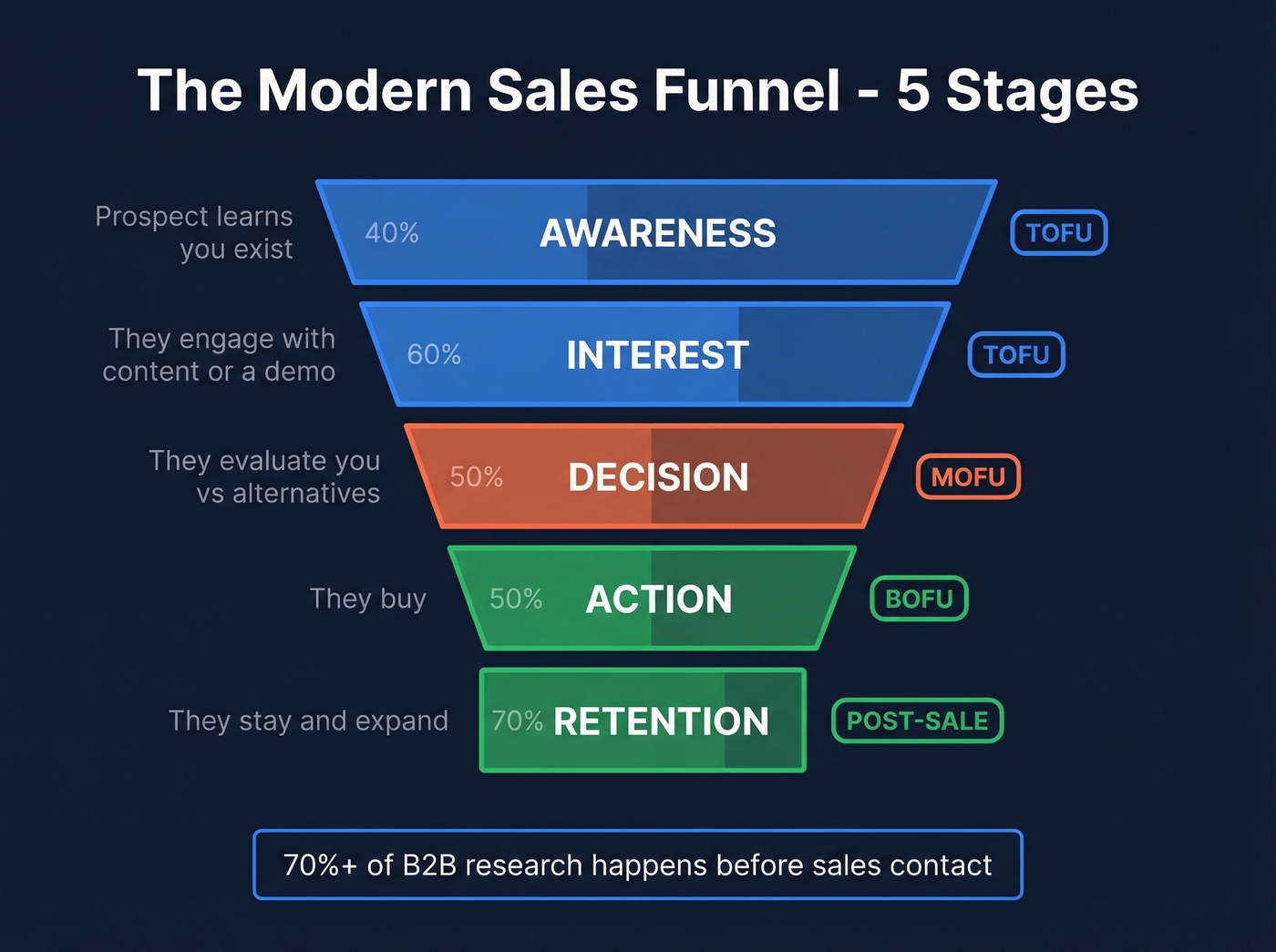
These stages map to the shorthand you'll hear in every RevOps meeting: TOFU (top of funnel), MOFU (middle), and BOFU (bottom). TOFU is about volume - getting enough of the right people in. MOFU is about qualification - separating tire-kickers from real buyers. BOFU is about conversion - closing deals and not losing them to indecision.
Here's the thing: B2B buyers complete 70%+ of their research before talking to sales. Your funnel stages don't match the buyer's actual journey - they're your internal model for measuring where things break. Optimizing a funnel isn't about pushing people through stages faster. It's about being present and useful during the research they're already doing without you. If you've ever studied a funnel that actually converts, you'll notice it's built around the buyer's timeline, not the seller's.
Types of Sales Funnels
You don't need twelve funnel types. Master two or three that match your business model and ignore the rest.
| Funnel Type | What It Does | Best Fit |
|---|---|---|
| Squeeze Page | Captures emails via a single offer | List building, info products |
| Tripwire | Low-cost offer ($30 max) to convert leads into buyers | Ecommerce, digital products |
| Webinar | Educates, then pitches on a live call | B2B, high-ticket services |
| Free Trial | 7-14 day product access | SaaS, software |
| Sales Letter | Long-form persuasion page | Direct response, courses |
| Product Launch | Timed sequence building anticipation | New products, seasonal offers |
| Consultation | Application, discovery call, proposal | Agencies, professional services |
| Content/SEO | Organic traffic, gated content, nurture | B2B, content-heavy brands |
Most B2B teams run some combination of content/SEO, free trial, and outbound. Ecommerce teams live in tripwire and product launch territory. Pick the two or three that match how your buyers actually buy, and build those well before experimenting with the rest.
9 Real Funnels With Metrics
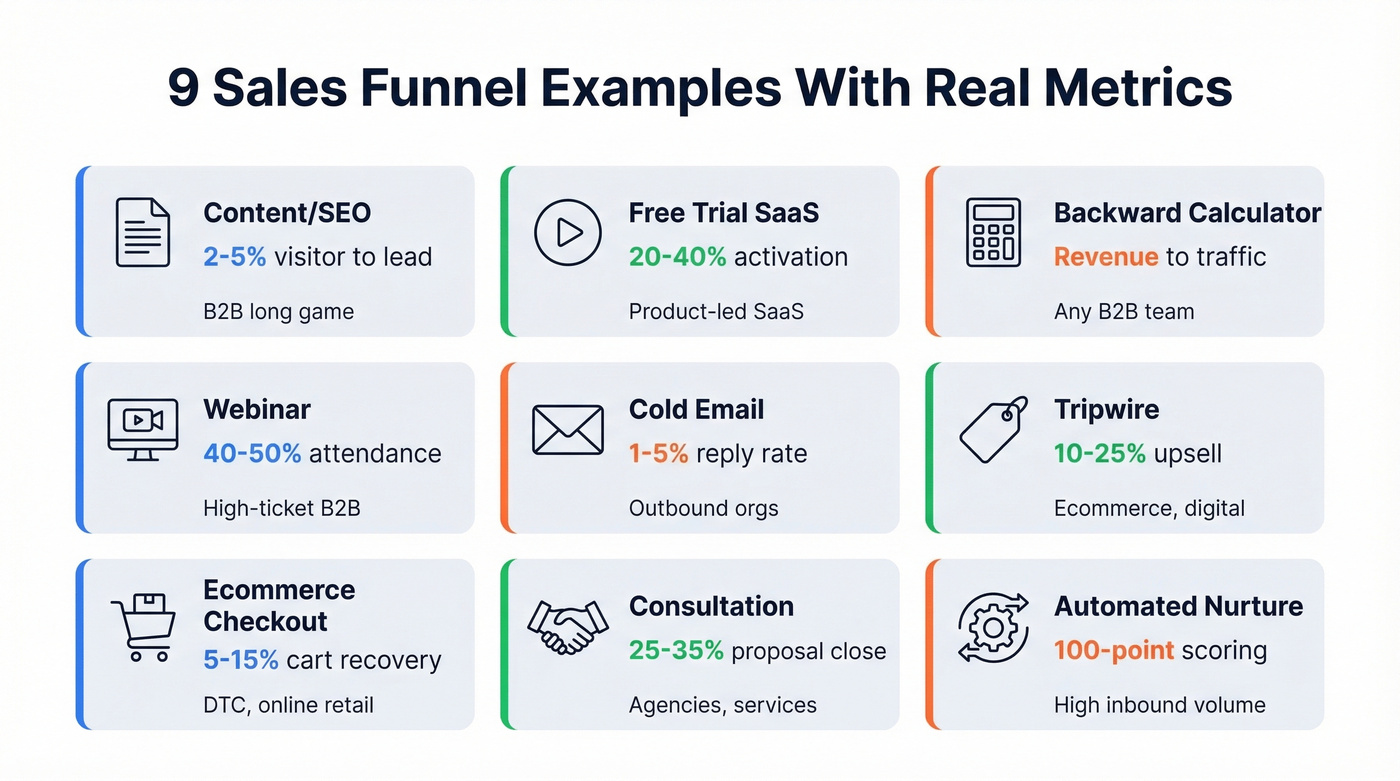
Here's a snapshot of all nine so you can jump to the one that fits your model:
| Funnel | Key Metric | Best For |
|---|---|---|
| Content/SEO | 2-5% visitor-to-lead | B2B brands playing the long game |
| Free Trial SaaS | 20-40% activation rate | Product-led SaaS |
| B2B SaaS (Reverse Math) | Revenue to traffic target | Any B2B team with a quota |
| Webinar | 40-50% attendance rate | High-ticket B2B, services |
| Outbound Cold Email | 1-5% reply rate | Outbound-first sales orgs |
| Tripwire | 10-25% post-purchase upsell | Ecommerce, digital products |
| Ecommerce Checkout | 5-15% cart recovery | DTC, online retail |
| Consultation/Services | 25-35% proposal close rate | Agencies, professional services |
| Automated Nurture | 100-point scoring threshold | Teams with high inbound volume |
Content/SEO Funnel
This is the long game. You publish content that ranks, capture emails through gated assets like templates, reports, and calculators, and nurture leads until they're ready to talk to sales.
The numbers are humbling at the top: visitor-to-lead conversion runs 2-5% for most B2B sites. Lead-to-MQL is typically 25-35%. That means for every 10,000 organic visitors, you're generating 200-500 leads and qualifying 50-175 of them. The economics only work at scale.
95% of your target audience isn't in the market right now. Content funnels are designed for exactly that reality - you're building trust with the 95% so that when they do enter the market, you're already on their shortlist. The key MOFU tactic is a nurture sequence that delivers genuine value - case studies, benchmarks, templates - rather than "just checking in" emails that everyone ignores (see sales follow-up templates for better options).
Action step: Audit your gated assets. If your visitor-to-lead rate is below 2%, the problem is usually the offer, not the traffic.
Free Trial SaaS Funnel
The standard SaaS trial runs 7-14 days. Shorter trials create urgency. Longer trials let enterprise buyers loop in stakeholders. And the cultural resentment around auto-charge at trial end is real - if cancellation requires calling a phone number or navigating five settings pages, you'll generate more chargebacks than conversions.
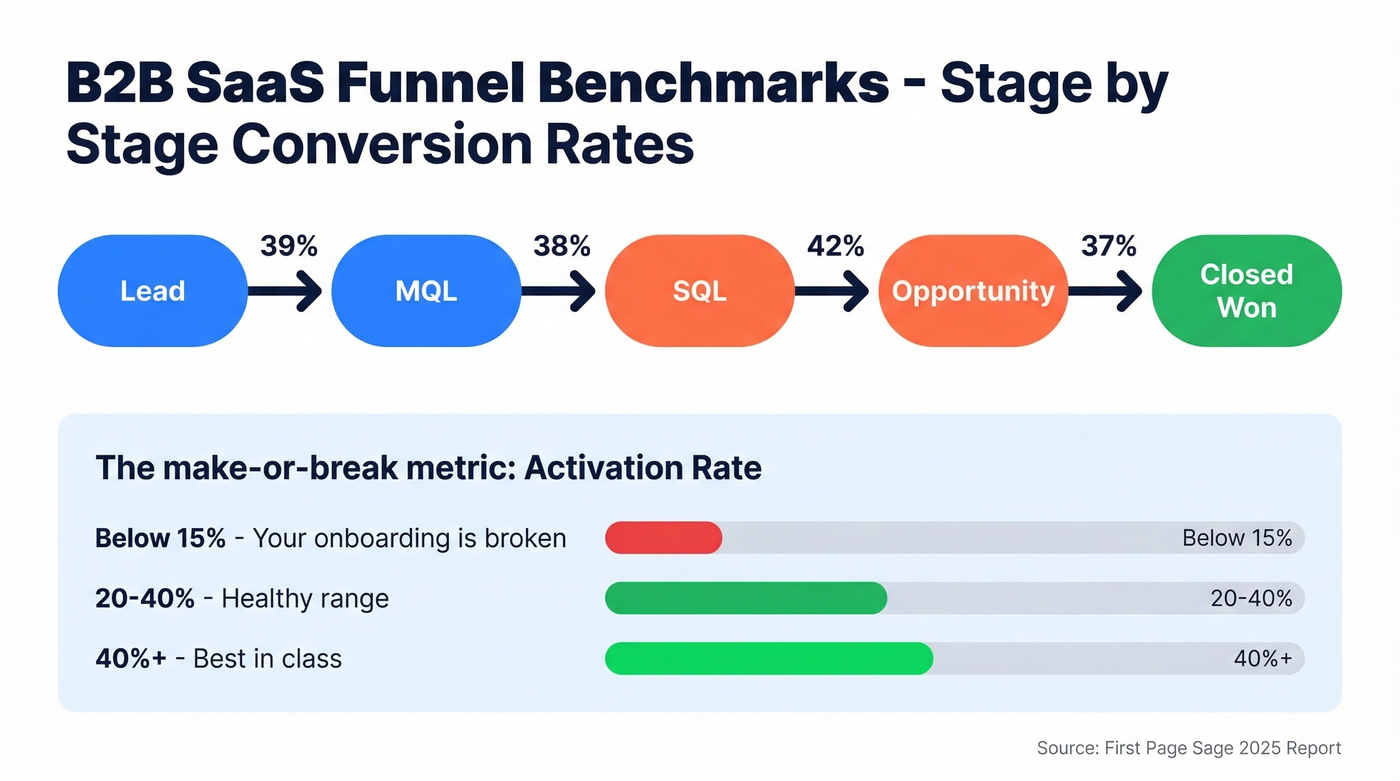
The stage-by-stage benchmarks for B2B SaaS are stronger than most people expect. First Page Sage data shows Lead-to-MQL at 39%, MQL-to-SQL at 38%, SQL-to-Opportunity at 42%, and SQL-to-Closed at 37%. Those are healthy numbers - but they assume your trial-to-paid conversion is actually feeding qualified leads into the funnel, not just inflating MQL counts with people who signed up and never logged in.
The make-or-break metric is activation rate: what percentage of trial users complete the core action that correlates with conversion? For most SaaS products, that's 20-40%. If yours is below 15%, your funnel problem isn't at the bottom. It's in onboarding.
Action step: Identify your product's "aha moment" and measure what percentage of trial users reach it within the first 48 hours.
The Backward Funnel Calculator
This is the funnel template you can actually replicate with your own numbers. Let's walk through a worked model from the InfiniGrow framework.
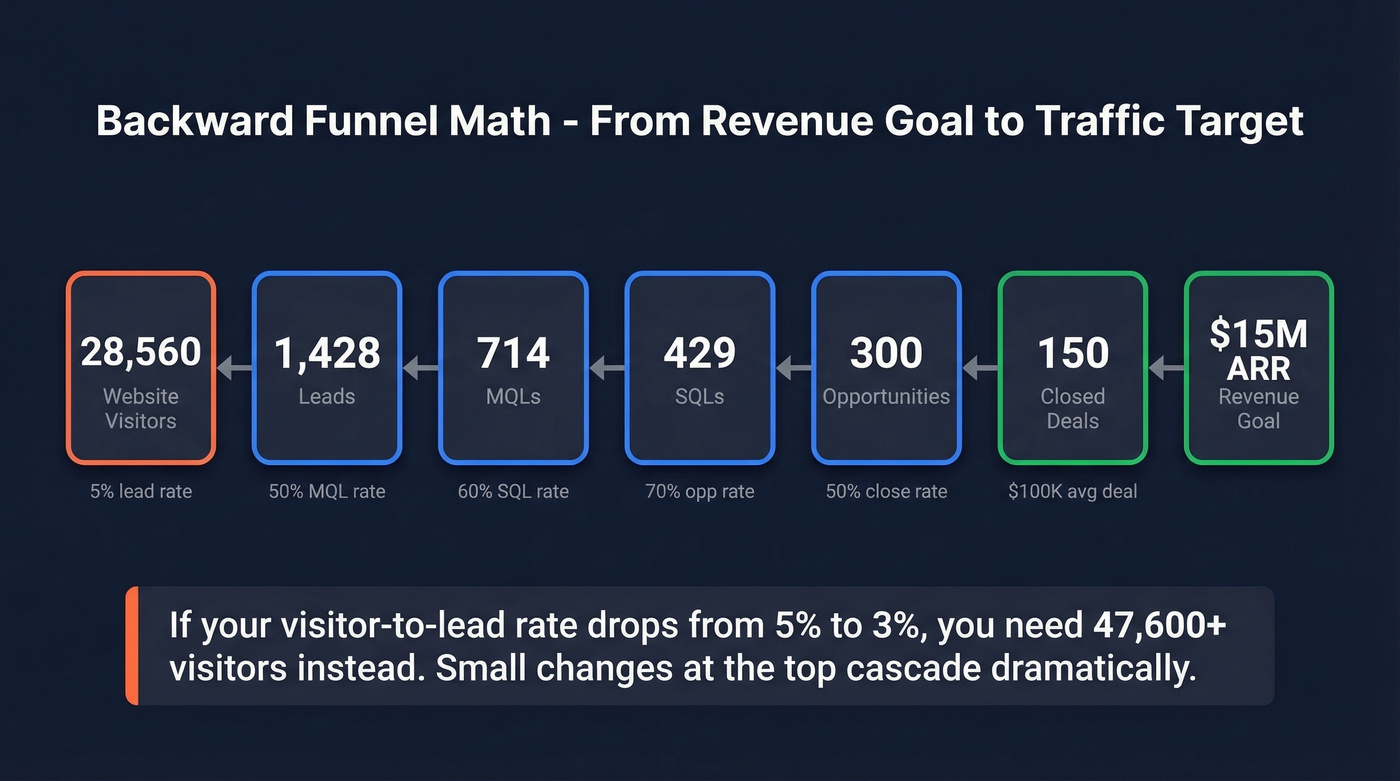
Say your company targets $15M in new ARR. Average deal size is $100K. Now work backward using example conversion rates from that model (visitor-to-lead 5%, lead-to-MQL 50%, MQL-to-SQL 60%, SQL-to-opp 70%, opp-to-closed 50%):
- You need 150 closed deals
- That requires 300 opportunities
- Which requires 429 SQLs
- Which requires 714 MQLs
- Which requires 1,428 leads
- Which requires 28,560 website visitors
That's the power of funnel math: it turns a revenue goal into a traffic target. If your visitor-to-lead rate is 3% instead of 5%, you suddenly need 47,600+ visitors. Small changes at the top cascade dramatically. We run this exercise quarterly with our own conversion rates, and it tells us exactly where to invest next (more on what to track in funnel metrics).
Action step: Plug your own numbers into this framework today. If you don't know your stage-by-stage rates, that's your first problem to solve.
Webinar Funnel
The webinar funnel follows a tight sequence: promote, register, attend, follow up, demo request, close. The critical drop-off happens between registration and attendance - typical attendance rates run 40-50% of registrants, which means half your marketing spend on driving registrations evaporates if you don't have a no-show strategy.
A solid rule of thumb: 20-40% of webinar attendees turn into qualified leads, and around 5% purchase at the end or convert into the next paid step. A webinar with 200 registrants produces roughly 80-100 attendees, 16-40 qualified leads, and about 4-5 purchases.
The winning tactic is dead simple. Send a replay email the same day the webinar ends, and follow up within 48 hours with a specific next step. Not "let us know if you have questions" but "here's a 15-minute slot to see how this applies to your team."
Action step: Track your registration-to-attendance ratio. If it's below 40%, your reminder sequence is the problem, not your topic.
Outbound Cold Email Funnel
This is where most funnels die before they start. The stages look simple: build list, send sequence, get replies, book meetings, run demos, close. The numbers are brutal and honest.
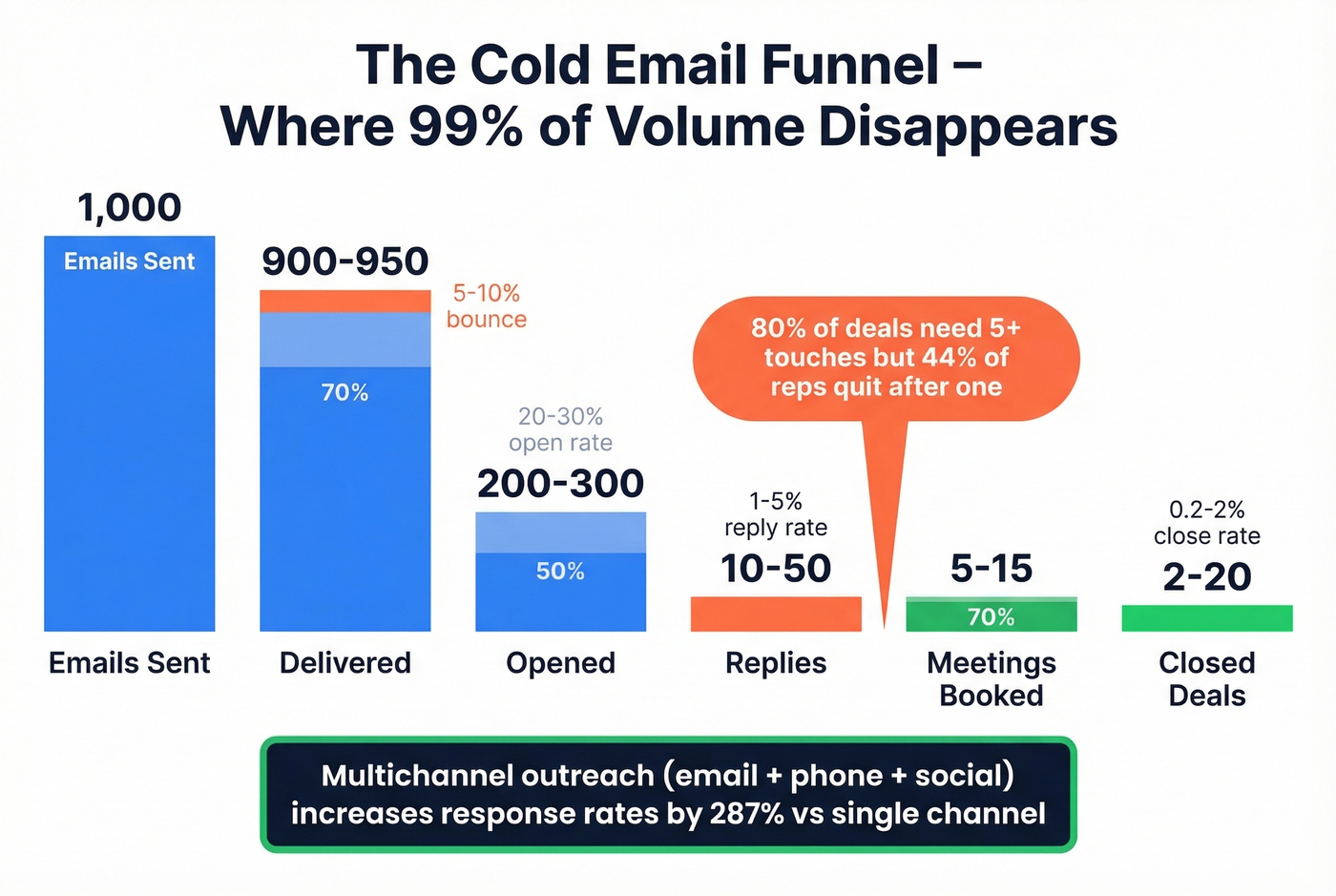
Cold email reply rates run 1-5%. Conversion from cold outreach to closed deal sits at 0.2-2%. For every 1,000 cold emails, you're looking at 10-50 replies and 2-20 eventual deals. The economics only pencil out if your average deal value justifies the volume - and if your data is clean enough to actually reach inboxes (see email deliverability for the non-negotiables).
What most teams get wrong: 80% of deals require 5+ touches, yet 44% of reps give up after one. And multichannel outreach increases response rates by 287% versus single-channel. The reps sending one email and moving on are leaving almost all the value on the table. The consensus on r/sales is blunt - enterprise B2B cold calling alone is dead, but multichannel sequences combining email, phone, and social still work.
None of that matters if your list is garbage, though. Your outbound funnel dies at step one when 10%+ of your emails bounce. In our experience, the fastest fix is verifying every address before it enters a sequence. Prospeo does this in real time with 98% accuracy and refreshes data every 7 days, so your SDRs reach actual inboxes instead of spam traps (if you want bounce benchmarks and fixes, start with email bounce rate). One customer, Meritt, saw bounce rates drop from 35% to under 4% after switching, with pipeline tripling from $100K to $300K per week.

Hot take: If your average deal is under $15K, you probably can't afford the volume required for cold outbound to work. Focus on inbound and product-led growth instead, and save outbound for when your deal sizes justify the math.
Action step: Check your bounce rate on the last 1,000 emails sent. If it's above 5%, your data is the bottleneck - not your copy.
Tripwire Funnel
Skip this if you sell B2B SaaS. The tripwire model is built for low-ticket digital products and ecommerce, not typical subscription software.
The tripwire converts a lead into a buyer at minimal risk. The offer maxes out around $30 - low enough that the purchase decision is almost impulsive. The real revenue comes from the immediate upsell page that appears after checkout.
This funnel works because of a psychological shift: someone who's spent $7 on your mini-course is much more likely to buy your $200 product than someone who only downloaded a free PDF. The tripwire isn't about the $7. It's about changing the relationship from "subscriber" to "customer." Conversion rates on post-purchase upsells - order bumps and one-click offers on the thank-you page - typically run 10-25% because the buyer's credit card is already out (related: upsell vs cross-sell).
Action step: Test a $7-$19 tripwire offer against your best-performing lead magnet. Measure 30-day LTV of tripwire buyers vs. free-only leads.
Ecommerce Checkout Funnel
When you sell online, you're fighting two battles at once: turning visitors into buyers through checkout behavior, and turning leads into repeat customers through email and SMS.
On the lead side, First Page Sage benchmarks show ecommerce averages of Lead-to-MQL at 23%, MQL-to-SQL at 58%, SQL-to-Opportunity at 66%, and SQL-to-Closed at 60%. On the checkout side, the bottleneck is cart abandonment.
Abandoned cart recovery rates typically run 5-15% depending on your category and how aggressive your recovery sequence is. The standard playbook is a 3-email sequence: reminder at 1 hour with just the cart contents, social proof at 24 hours featuring reviews and a "still available" nudge, and a discount at 48-72 hours offering 5-10% off or free shipping. Here's a friction pattern worth noting: a buyer wishlists a product and anchors on $20-25, but the actual price is $30. The purchase stalls - not because $30 is unreasonable, but because it breaks the anchor they built over time. That's exactly the kind of friction a well-timed incentive can solve.
Action step: Segment your cart abandonment emails by cart value. High-value carts get a personal outreach; low-value carts get the automated discount.
Consultation/Services Funnel
For agencies, consultancies, and professional services, the funnel is longer and more relationship-driven: awareness, application or intake form, discovery call, proposal, close. Sales cycles stretch 30-90 days for mid-market deals and 6+ months for enterprise.
Mid-market services firms generally close 25-35% of proposals they send. The real point of leverage is earlier: getting the right prospects into discovery calls. If your proposal close rate is below 20%, you're qualifying too loosely - writing proposals for people who were never going to buy (tighten qualification with a structured framework like MEDDIC sales qualification).
The key MOFU asset isn't a whitepaper. It's a case study that mirrors the prospect's situation closely enough that they think "these people understand my problem." The discovery call isn't a pitch; it's a diagnostic. The proposal isn't a price list; it's a roadmap. Every stage is about demonstrating competence, not describing it.
Action step: Track your proposal-to-close rate. If it's below 25%, tighten your discovery call qualification criteria before writing another proposal.
Automated Nurture Funnel
This is the funnel that runs while your team sleeps. It takes inbound leads and scores them based on engagement until they hit a threshold that triggers a sales handoff.
Here's a concrete scoring model: email open gets +5 points, link click gets +10, pricing page visit gets +20, content download gets +30, and unsubscribe gets -50. When a lead hits 100 points, they're flagged as SQL - triggering a Slack notification, a CRM task, and a status change from MQL to SQL. The drip sequence that feeds this scoring runs 5 emails over 15 days: case study, video tutorial, webinar invite, benefits-focused CTA, and a "last chance" demo offer. Each email is designed to generate a scoreable action, not just deliver information (if you need a deeper model, use a dedicated lead scoring framework).
The beauty of this approach is that it self-selects. Leads who engage heavily are genuinely interested. Leads who don't are left to nurture longer rather than wasting a rep's time.
Action step: If you don't have lead scoring, start with just two signals: pricing page visits (+20) and content downloads (+30). Those two alone will surface your hottest leads.

Your backward funnel math breaks the moment bad data inflates your MQL count. With 98% email accuracy and a 7-day refresh cycle, Prospeo ensures every lead entering your funnel is real, reachable, and current - so your conversion rates reflect actual pipeline, not phantom contacts.
Stop leaking pipeline to bounced emails and stale data.
Conversion Benchmarks by Industry
Stop obsessing over individual stages and start obsessing over stage-to-stage conversion rates. Here's how different industries compare, based on First Page Sage's benchmark data:
| Industry | Lead-to-MQL | MQL-to-SQL | SQL-to-Opp | SQL-to-Closed |
|---|---|---|---|---|
| B2B SaaS | 39% | 38% | 42% | 37% |
| Cybersecurity | 24% | 40% | 43% | 46% |
| Ecommerce | 23% | 58% | 66% | 60% |
| IT & Managed Services | 19% | 38% | 41% | 46% |
A few things jump out. Ecommerce has the weakest top-of-funnel conversion but the strongest bottom - once someone's qualified, they're very likely to buy. Cybersecurity and IT convert fewer leads into MQLs but close at higher rates, reflecting longer evaluation cycles with more committed buyers.
VWO puts the overall visitor-to-customer range at 3-10% across industries. If you're below 3%, your funnel has a structural problem. Above 5%, you're doing better than most. The real diagnostic value comes from comparing your stage-to-stage rates against these benchmarks - that's how you find the specific leak, not just the symptom.
5 Funnel Leaks and How to Fix Them
Every funnel leaks. The question is where, and whether you can fix it. Here are the five failure modes we see most often - plus a sixth that almost nobody talks about.
Bad data at the top. Most B2B databases refresh every 6 weeks. If your outbound sequences are bouncing at double digits, your funnel problem isn't messaging. It's data. Teams using Prospeo's 7-day refresh cycle have cut bounce rates from the 35-40% range to under 5%.
Reps quitting too early. 44% of sales reps give up after one touch. Meanwhile, 80% of deals require five or more. This is the single most fixable leak in any outbound funnel - it's not a strategy problem, it's a discipline problem. Build sequences with 7-10 touches across email, phone, and social, and enforce them (use these sales activities to standardize the motion).
No nurture in the middle. 60% of consumers take 6+ actions before buying from a new brand. If your funnel goes straight from "downloaded whitepaper" to "call from SDR," you're skipping the entire consideration phase. Build a nurture sequence that earns the right to ask for a meeting.
Undefined ICP. If your sales team can't describe your ideal customer in two sentences, your funnel is targeting the wrong people. Targeted outreach to a tight ICP will always outperform spammy blasts to a broad list - even if the list is smaller (start with an ideal customer profile template).
Data fragmentation across tools. When your marketing data lives in one platform, your sales data in another, and your customer success data in a third, nobody has a complete picture of where the funnel actually breaks. Teams optimizing in silos make local improvements that don't move the overall number. Centralize your funnel metrics in one dashboard before you start "optimizing."
No referral system post-close. Most teams treat the funnel as ending at closed-won. It doesn't. Customers who had a great experience are your cheapest acquisition channel - but only if you build a system to capture referrals. I've talked to founders who had zero MQLs all year after marketing budget cuts, with BDR activity unable to compensate. A referral engine would have provided a buffer. Look, if your company cut the marketing budget and expects outbound to fill the gap alone, the funnel math simply doesn't work.
Cold email funnels live or die on deliverability. Teams using Prospeo see bounce rates under 4% and book 35% more meetings than Apollo users - because 143M+ verified emails and proprietary 5-step verification mean your outbound actually reaches real inboxes.
Fill your TOFU with verified contacts at $0.01 per email.
Funnel vs. Flywheel
The funnel model is great for acquisition clarity and forecasting. You can see exactly where deals stall, allocate resources to the weakest stage, and predict revenue with reasonable accuracy. Its limitation is that it treats the customer journey as linear and finite - once someone buys, they fall out the bottom.
The flywheel model fixes this by making customers the engine of growth. Happy customers refer, expand, and advocate - creating a self-reinforcing loop. Returning customers spend 67% more than new ones, which means your retention motion can outperform your acquisition motion over time. And remember that 70%+ of B2B research happens before a buyer talks to sales - the flywheel acknowledges this by making the customer experience itself a marketing channel. Your best customers are doing the TOFU work for you.
Use the funnel for acquisition visibility and the flywheel post-sale. Map your stages, measure your conversion rates, and forecast pipeline using funnel math. Then invest in customer success, onboarding, and advocacy programs that turn closed deals into referral engines. The two models aren't competing - they cover different halves of the revenue lifecycle.
FAQ
What are the 5 stages of a sales funnel?
Awareness, Interest, Decision, Action, and Retention - mapping to TOFU (Awareness/Interest), MOFU (Decision), and BOFU (Action). B2B SaaS converts at 39% from Lead to MQL, while ecommerce runs closer to 23% at the same stage. Retention is the often-skipped fifth stage that separates one-time revenue from compounding growth.
What's a good conversion rate?
Overall visitor-to-customer conversion runs 3-10% depending on industry. Ecommerce sees 60% SQL-to-Closed while cybersecurity sees 46%. Always compare against your specific vertical benchmarks rather than generic averages - a 5% close rate can be excellent in one industry and a red flag in another.
How do I build a funnel for my business?
Start with your revenue goal, divide by average deal size to get required closed deals, then work backward through each stage using your conversion rates. A $15M ARR target at $100K per deal maps to roughly 28,560 visitors needed when using the reverse-math framework in Example 3 above. Plug in your own numbers - the gaps will tell you exactly where to invest.
How do I fix a leaking funnel?
Identify which stage has the biggest drop-off by comparing your rates to industry benchmarks. Common culprits: bad contact data at the top (bounce rates above 5% signal stale data - tools like Prospeo verify emails in real time to solve this), reps quitting after one touch when 80% of deals need five or more, and no nurture sequence bridging first touch to sales conversation.
What's the difference between a funnel and a pipeline?
A funnel tracks the buyer's journey from awareness to purchase - it's the demand perspective. A pipeline tracks the seller's deals from first contact to close - it's the revenue perspective. Funnel stages describe buyer behavior; pipeline stages describe sales activities. Most teams need both views to forecast accurately.