

Pipeline Prioritization: Benchmarks and Framework That Actually Work
84% of sales reps are missing quota. Pipeline prioritization is a big reason most of them won't recover.
A manager running a 150-person team described the problem on r/sales: opportunities with wrong values, outdated close dates, and a pipeline "realistically inflated by about 60%." Meanwhile, a 4-person SaaS team on r/smallbusiness admitted they were tracking deals across Sheets, Slack, and gut instinct - no scoring, no stages, no system. That's not a pipeline. It's a fantasy spreadsheet that happens to live in Salesforce.
The fix isn't more activity. It's ruthless prioritization backed by data. Three things before you read another word:
- Your pipeline is probably 40-60% noise. Clean it before optimizing. A 2.9% median B2B conversion rate means most of your pipeline won't close.
- Velocity beats deal size. Deals closed within 50 days win at 47%. Past that threshold, win rates drop to 20%. Prioritize speed.
- Use a fit + intent scoring model (template below). Gut feeling and first-come-first-served aren't strategies - they're coin flips with extra steps.
Why B2B Sales Prioritization Matters
Companies with a defined pipeline process grow revenue up to 18% faster than those winging it. Gartner data shows structured pipeline management improves forecast accuracy by up to 20%. The math is blunt.
With a 2.9% median conversion rate, a 500-lead pipeline contains roughly 15 future customers. The other 485 consume your reps' time, pollute your forecast, and make your coverage ratio look healthier than it is. And here's the kicker - 61% of B2B buyers now [prefer a rep-free buying experience](https://www.gartner.com/en/newsroom/press-releases/2025-06-25-gartner-sales-survey-finds-61-percent-of-b2b-buyers-prefer-a-rep-free-buying-experience). Your reps shouldn't be chasing all 500. They should be laser-focused on the subset that actually wants human interaction and fits your ICP.
If your average deal is under $15k and you're running a 5x coverage ratio, you don't have a pipeline. You have a to-do list that's lying to you. A tight 2x with verified, scored contacts will outperform it every time.
Metrics That Predict Closes
Pipeline Velocity Formula
Pipeline velocity measures how much revenue moves through your pipeline per day:
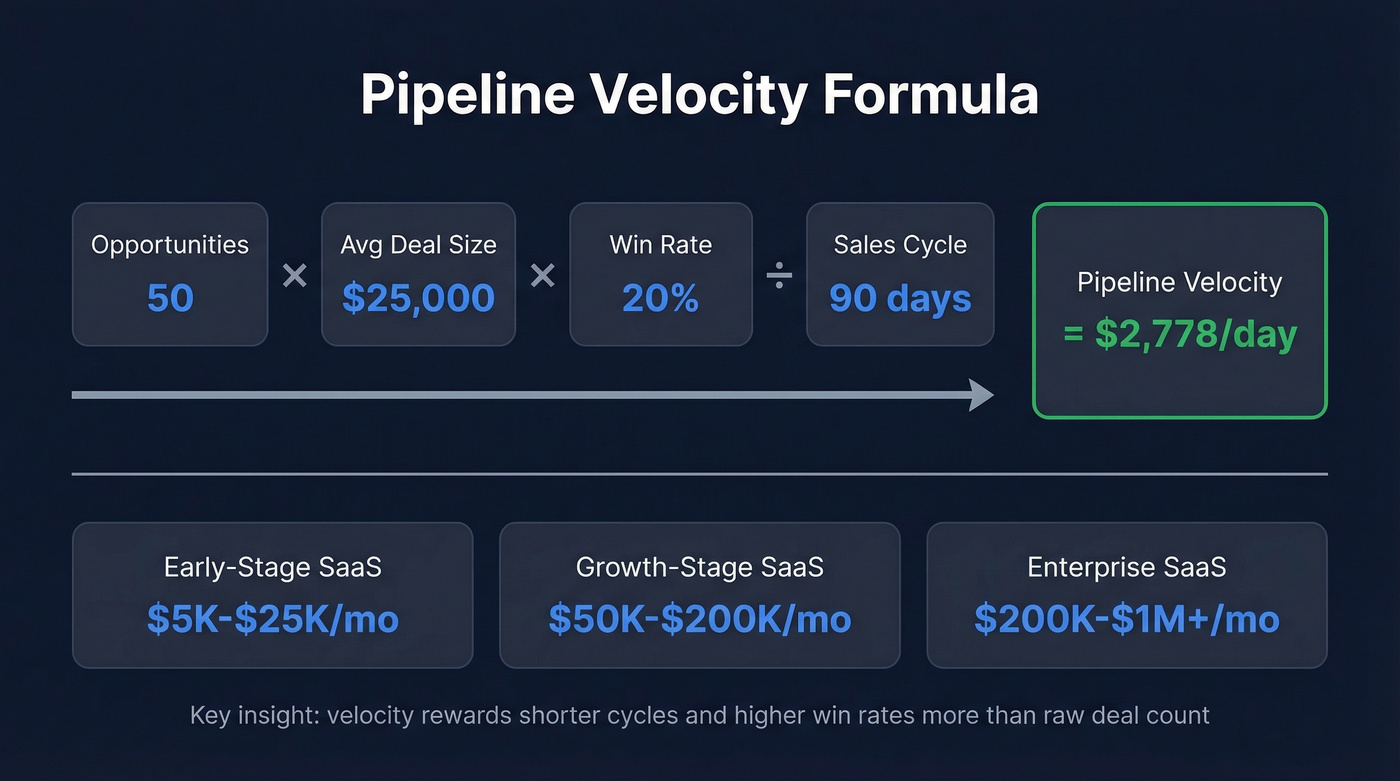
Pipeline Velocity = (Opportunities x Avg Deal Size x Win Rate) / Sales Cycle Length
With 50 opportunities, $25,000 average deal size, a 20% win rate, and a 90-day cycle: (50 x $25,000 x 0.20) / 90 = $2,778/day.
| Company Stage | Velocity Benchmark |
|---|---|
| Early-stage B2B SaaS | $5K-$25K/mo |
| Growth-stage B2B SaaS | $50K-$200K/mo |
| Enterprise SaaS | $200K-$1M+/mo |
The prioritization insight here: velocity rewards shorter cycles and higher win rates more than raw deal count. Adding 20 low-quality opportunities hurts velocity if they drag out your average cycle length.
Stage Conversion Benchmarks
Not all funnels convert equally. SMB and enterprise pipelines differ dramatically:
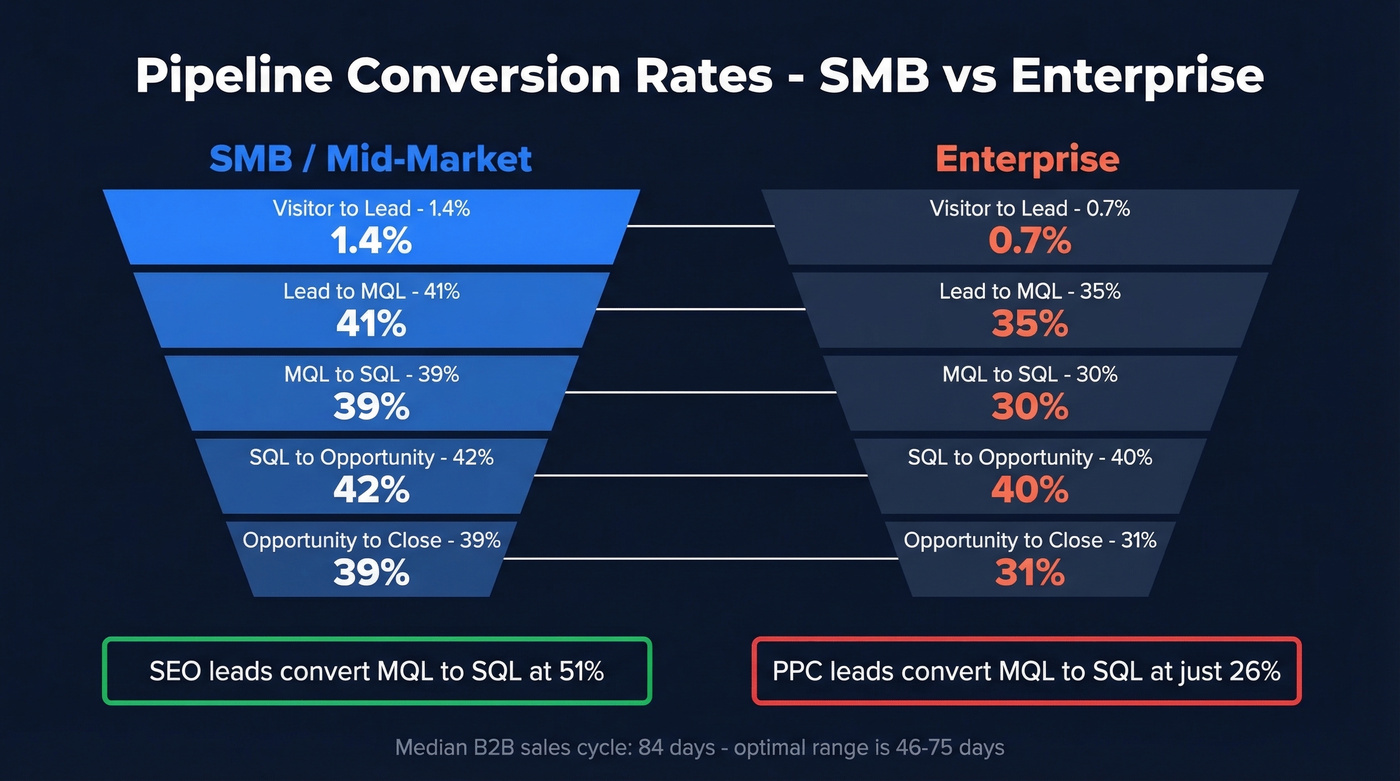
| Stage | SMB/Mid-Market | Enterprise |
|---|---|---|
| Visitor to Lead | 1.4% | 0.7% |
| Lead to MQL | 41% | 35% |
| MQL to SQL | 39% | 30% |
| SQL to Opportunity | 42% | 40% |
| Opportunity to Close | 39% | 31% |
One detail that gets overlooked constantly: lead source matters enormously. SEO leads convert MQL to SQL at 51%, while PPC leads convert at just 26%. If you're not weighting lead source in your scoring model, you're treating a warm organic visitor the same as a cold paid click. Don't.
The median B2B sales cycle sits at 84 days, with an optimal range of 46-75 days. Deals consistently running past 84 days are a signal that something upstream is broken.
The 4-Signal Stack: A Scoring Model for Deal Prioritization
Most scoring models you'll find online list the same generic criteria. We've tested variations across dozens of teams and landed on four signals that consistently separate real deals from pipeline filler.
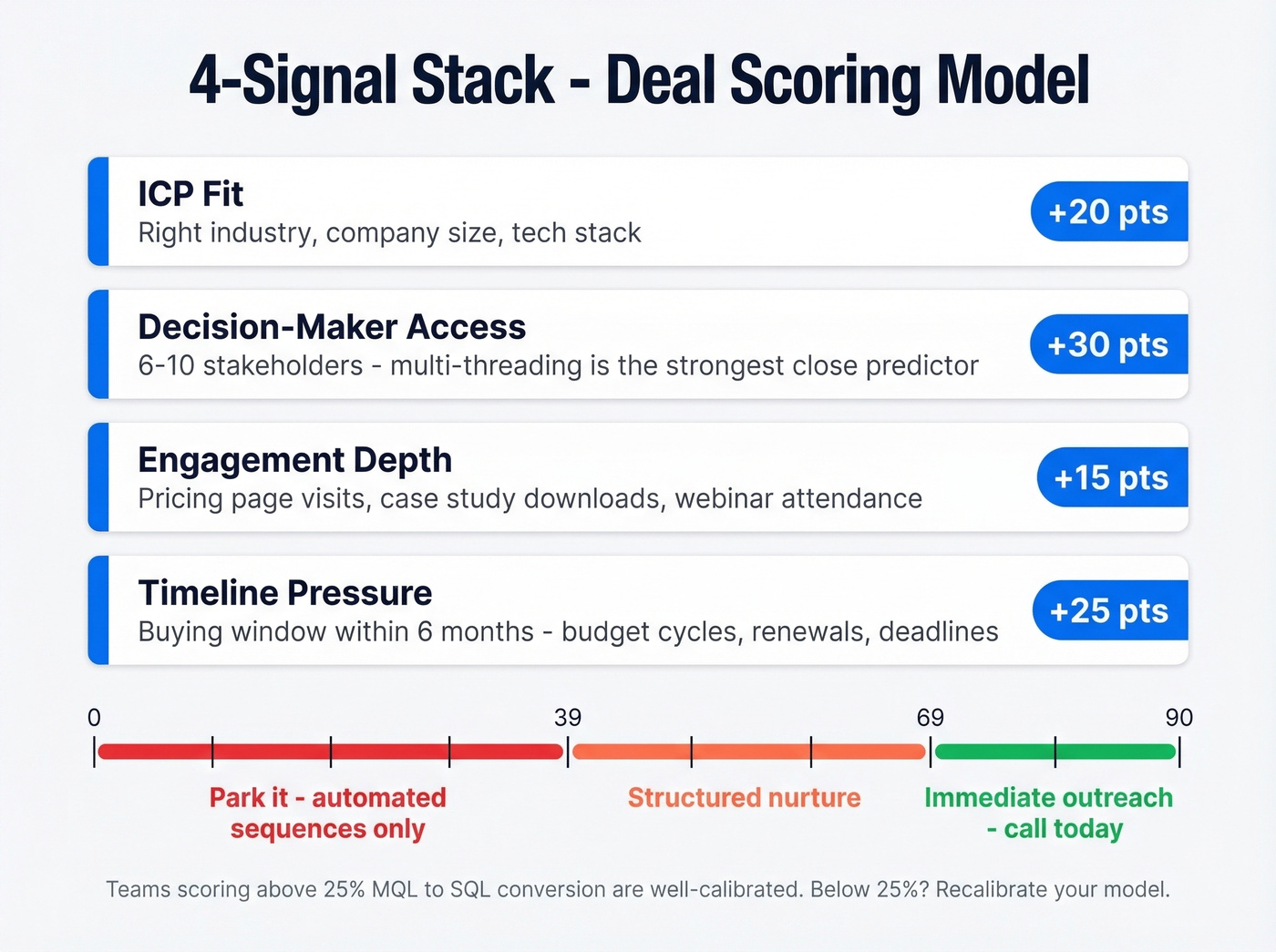
ICP Fit - +20 points. Right industry, company size, tech stack. Consider adapting the RICE framework from product management: score reach, impact, confidence, and effort for each account.
Decision-Maker Access - +30 points. B2B deals involve 6-10 decision-makers on average. Team selling into an account is the single strongest close predictor we've seen. This is where most teams fall apart - they've got one champion and zero backup contacts, so when that champion goes on PTO or changes roles, the deal evaporates.
Engagement Depth - +15 points. Pricing page visits, case study downloads, webinar attendance. Surface-level content views don't count.
Timeline Pressure - +25 points. Stated or inferred buying window within 6 months. Budget cycles, contract renewals, and regulatory deadlines all qualify.
Leads scoring 70+ get immediate outreach. 40-69 go into structured nurture. Below 40, they sit. Typical teams convert MQL to SQL at 25-35%. High-alignment RevOps orgs hit 40-50%. Below 25%? Your model needs recalibration.

Decision-maker access is the #1 close predictor in your scoring model - but it's worthless if your contact data is stale. Prospeo refreshes 300M+ profiles every 7 days, so when you multi-thread into a high-priority account, every email and direct dial actually connects.
Stop routing reps to dead numbers on your highest-scored deals.
AI-Driven Signals for Smarter Ranking
The AI sales tools market surpassed $3B in 2025 and continues growing at roughly 13% annually. Sellers who effectively partner with AI are 3.7x more likely to meet quota, and 45% of teams already run hybrid AI-SDR models where AI handles initial qualification and routing.
Modern AI tools monitor job changes, funding events, tech stack shifts, pricing page visits, and executive involvement in deal conversations. Modern Health generates 60% of its pipeline from AI-qualified leads. Airbase saw a 300% increase in sourced opportunities after implementing AI-driven outreach.
But AI-powered ranking is only as useful as the signals feeding it. Intent data - tracking which accounts actively research topics relevant to your product - is the highest-leverage input. Layering buyer intent signals directly into your 4-Signal Stack alongside firmographic fit turns prioritization from educated guessing into genuine prediction. Tools like Prospeo integrate Bombora intent data across 15,000 topics, which means you can filter for accounts actively researching your category before a rep ever picks up the phone.
Mid-Cycle Management and the Data Quality Problem
Here's the thing: no scoring model compensates for wrong phone numbers, outdated job titles, and contacts who left six months ago.
We've seen teams build elegant frameworks that route reps to "high-priority" accounts - only for half those calls to hit dead numbers. Mid-cycle pipeline management is where most deals quietly die, not because the buyer lost interest, but because reps lack the clean data needed to re-engage the right stakeholders at the right time.
One team cut 70% of their low-value leads and watched their close rate jump from 2% to 7% in three months. That wasn't a scoring improvement. It was a data hygiene improvement.
The speed-to-lead data makes this urgent: responding within 5 minutes makes you 21x more likely to qualify a lead versus waiting 30 minutes. Speed means nothing if the contact info is wrong. Snyk's team of 50 AEs saw bounce rates drop from 35-40% to under 5% after switching to a platform with a 7-day data refresh cycle - compared to the 6-week industry average - and their AE-sourced pipeline jumped 180%.
Intent data turns pipeline prioritization from educated guessing into prediction. Prospeo layers Bombora buyer intent across 15,000 topics with 30+ firmographic filters - so you can score accounts on real in-market signals, not gut instinct.
Find which accounts are actively researching your category right now.
Mistakes That Kill Your Ranking System
Inconsistent prospecting. Reps over-focus on late-stage deals, stop filling the funnel, then panic-prospect during dry spells. This feast-or-famine cycle is the most common pipeline killer we see, and it's entirely preventable with time-blocked top-of-funnel work.
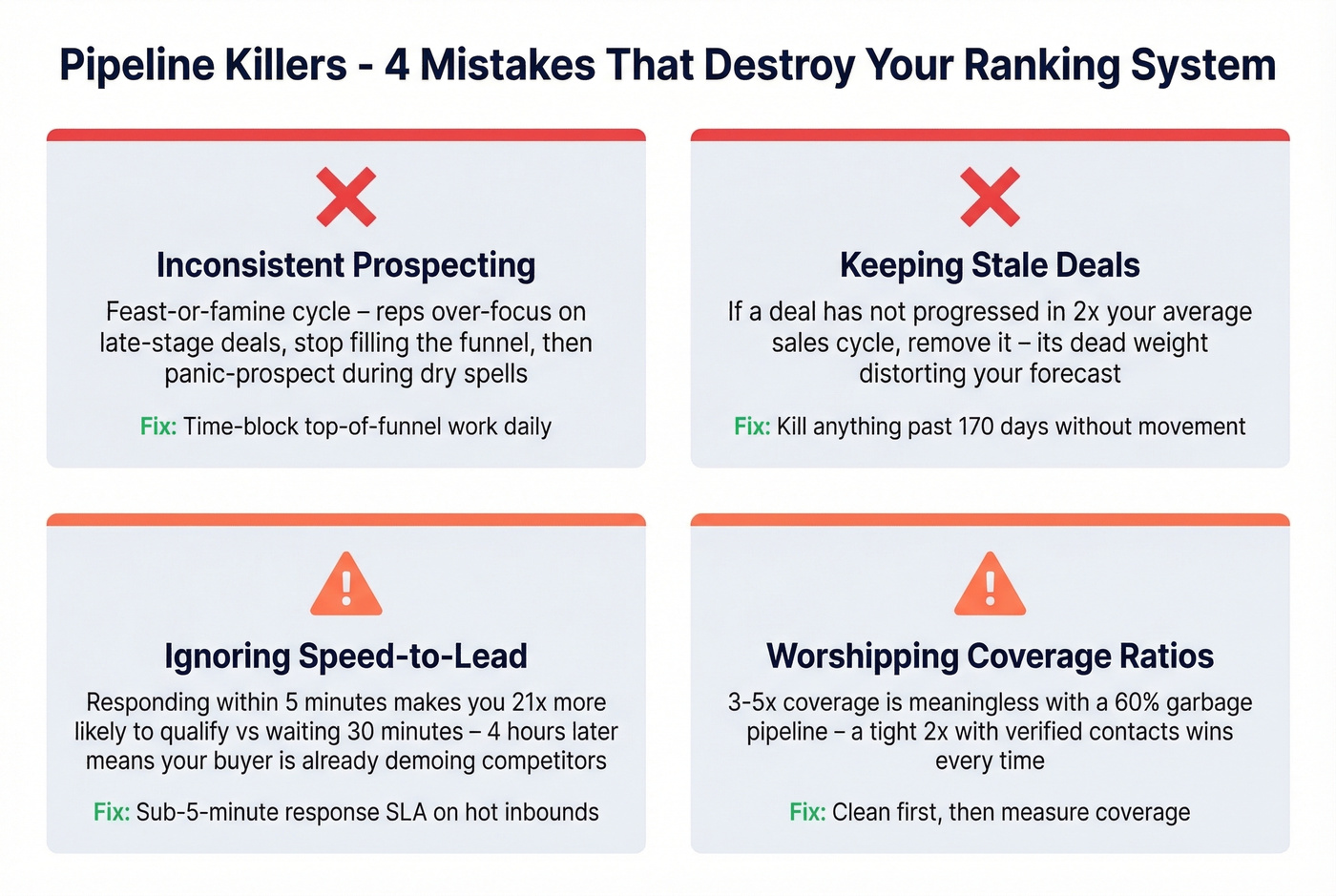
Keeping stale deals. If a deal hasn't progressed in 2x your average sales cycle, remove it. It's dead weight distorting your forecast. Build an in-quarter opportunities saved view in your CRM so reps can instantly see which deals still have a realistic shot of closing this period versus which ones need to be pushed or killed.
Ignoring speed-to-lead. Your model routes a hot inbound lead to the right rep, who follows up 4 hours later. The buyer's already demoing with your competitor.
Worshipping coverage ratios. Skip this metric entirely if your pipeline isn't clean. 3-5x coverage is meaningless with a 60% garbage pipeline. A tight 2x with verified, recently-engaged contacts wins every time.
How to Prioritize Sales Calls Daily
The scoring model tells you which deals matter. But reps still need a daily system for deciding call order when they sit down each morning.
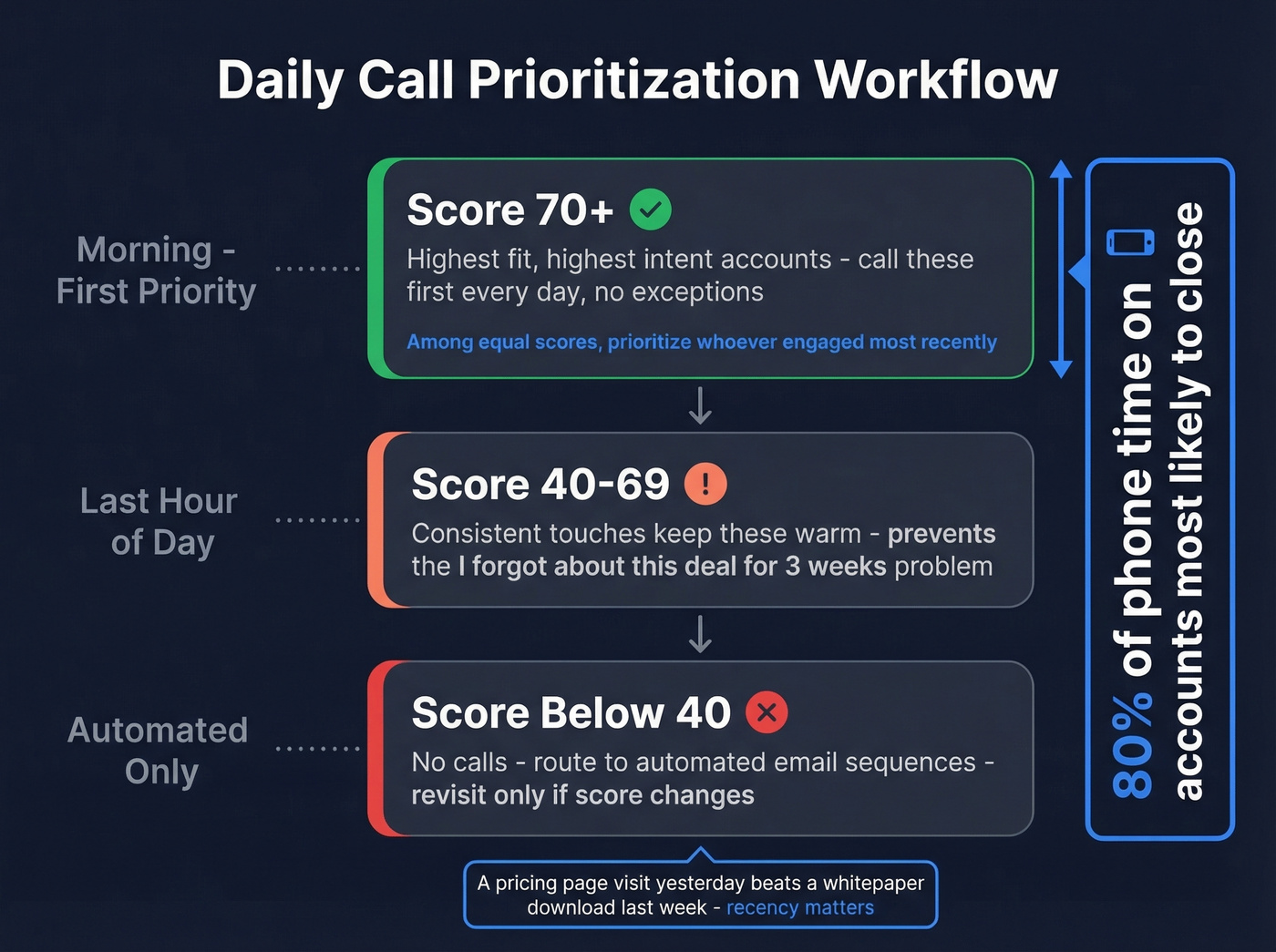
Start with 70+ scores. These are your highest-fit, highest-intent accounts - call them first, every day, no exceptions. Among equally scored leads, prioritize whoever engaged most recently. A pricing page visit yesterday beats a whitepaper download last week.
Reserve the last hour of your day for 40-69 scored leads. These aren't urgent, but consistent touches keep them warm and prevent the "I forgot about this deal for three weeks" problem that plagues every team we've worked with.
Anything below 40 doesn't get a call. Period. Route those leads to automated email sequences and revisit only if their score changes. This approach ensures reps spend 80% of their phone time on accounts most likely to close, rather than working the list top-to-bottom like it's 2012.
FAQ
What's a good pipeline coverage ratio?
3x for enterprise deals, 4-5x for SMB/mid-market - but only with clean, verified data. A bloated 5x ratio built on stale contacts is worse than a tight 2x with recently confirmed decision-makers.
How often should you review your pipeline?
Weekly minimum. Top-performing teams review daily. Remove any deal stalled beyond 2x your average cycle length - at an 84-day median, that means killing anything past 170 days without movement.
Can a tool help prioritize deals automatically?
Yes. CRMs like HubSpot and Salesforce support native lead scoring rules. For the data quality foundation underneath, you need a provider with high email accuracy and frequent refresh cycles so your scoring inputs stay reliable and current.
What's the fastest way to improve pipeline quality?
Cut the bottom 40% of your pipeline immediately - leads with no engagement, no ICP fit, or stale contact data. Teams that do this routinely see win rates double within a quarter because reps stop wasting cycles on dead opportunities.
That 150-person team's pipeline didn't need more leads. It needed fewer, better ones - and a system to tell the difference. Build the 4-Signal Stack, clean your data, and stop letting a bloated CRM dictate your forecast. Pipeline prioritization isn't a one-time project. It's a weekly discipline that separates quota-crushers from the 84% still falling short.