

What Is an MDR in Sales? Definition, Benchmarks & When You Actually Need One
Marketing hits their MQL targets. Pipeline is flat. Sales blames lead quality, marketing blames follow-up speed, and the CFO wants to know why conversion sits at 2-5%. Meanwhile, 70% of B2B reps missed quota in 2024, and 65% of B2B sales organizations are expected to adopt data-driven strategies by 2026.
There's a role designed to close exactly this gap - the MDR in sales. Most companies don't need one. But the ones that do are leaving pipeline on the table without one.
What Does MDR Mean in Sales?
MDR stands for Marketing Development Representative. Some companies say Market Development Representative - same role, different label. The MDR's job is straightforward: take inbound marketing leads (MQLs) and qualify them into sales-qualified opportunities for Account Executives to close. They sit at the seam between marketing and sales, owning the handoff that most orgs fumble.
Think of the MDR as the translator. Marketing speaks in campaigns and content downloads. Sales speaks in pipeline and revenue. The MDR converts one language into the other by qualifying intent, assessing fit, and booking meetings that AEs actually want to take.
MDR Job Description
The MDR role is more structured than most people expect. A typical marketing development representative job description includes:
- Respond to inbound leads via phone, chatbot, and contact forms - speed matters more than anything else
- Qualify leads using frameworks like BANT or CHAMP to separate tire-kickers from real buyers
- Book demos and sales appointments for AEs, with enough context that the AE doesn't start from scratch
- Maintain pipeline hygiene through data quality audits and GDPR compliance
- Collaborate with marketing on email campaigns, providing frontline feedback on what messaging actually resonates
MDR is often a first sales role with a clear career ladder: MDR to SDR to AE. Those hundreds of qualification conversations build exactly the product knowledge an Account Executive needs.
MDR vs. SDR vs. BDR
If you've spent any time on r/sales, you've seen the perennial debate: are these truly different roles or just different titles for the same job? Many companies use them interchangeably. But the functional distinctions matter for compensation, career path, and team structure - even when the titles don't.
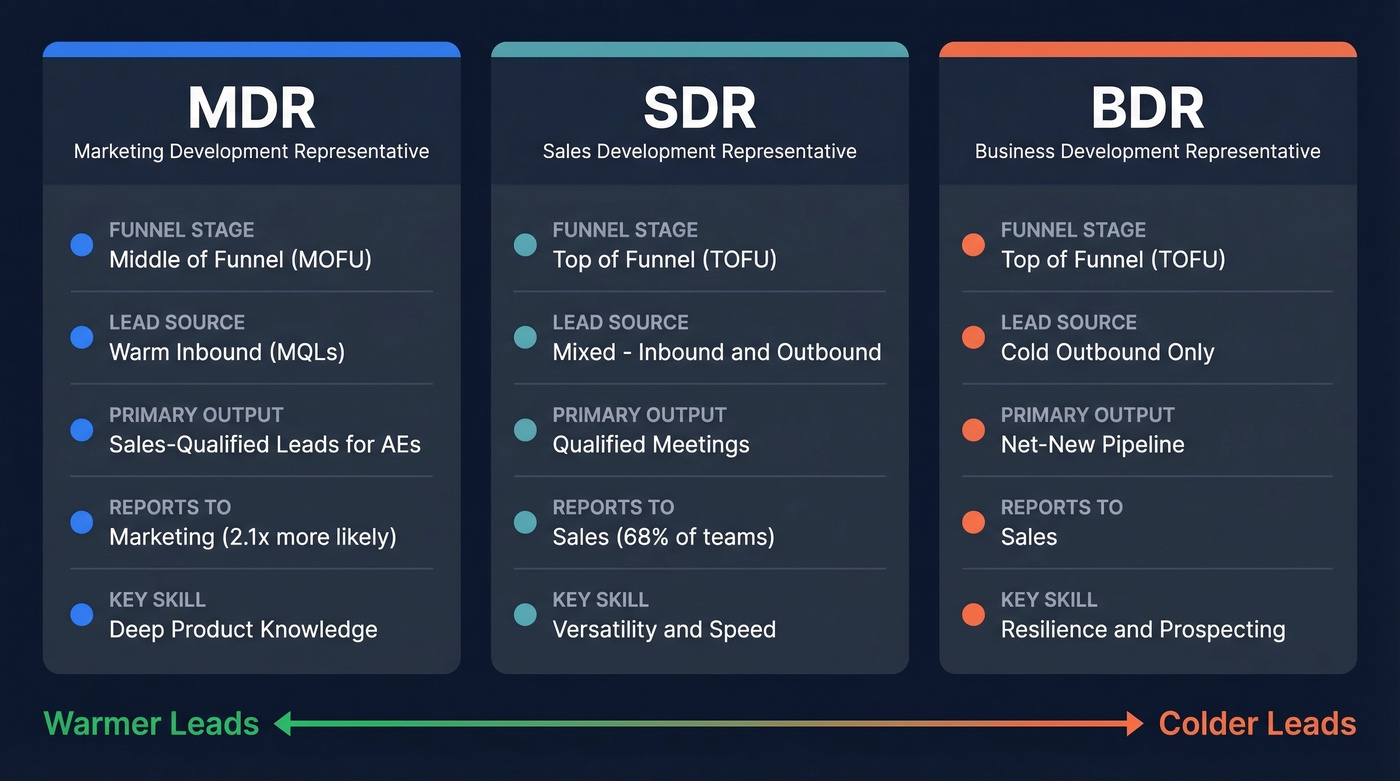
| Role | Funnel Stage | Lead Source | Primary Output | Typical Reporting |
|---|---|---|---|---|
| MDR | MOFU | Inbound (MQLs) | SQLs for AEs | Marketing (2.1x more likely than SDR teams) |
| SDR | TOFU | Mixed (varies by org) | Qualified meetings | Sales (68%) |
| BDR | TOFU | Cold outbound | Net-new pipeline | Sales |
The key distinction: MDRs work warm leads that marketing already generated. SDRs handle a mix of inbound and outbound depending on the org. BDRs are cold prospectors building pipeline from scratch. About 68% of SDR/BDR teams report to sales, and the typical ratio runs about 1 sales development rep per 2.6 AEs.
MDRs need deeper product knowledge than SDRs because they're qualifying leads who've already engaged with content and have real questions. That makes the marketing development representative role a stronger AE training ground than pure cold outbound work.

Speed-to-lead is the MDR's most critical metric. Prospeo's CRM enrichment returns 50+ data points per contact at a 92% match rate - so your MDRs respond to MQLs in minutes with full context, not hours with a bare name and email.
Cut your MDR's speed-to-lead from hours to minutes.
Salary & Compensation
Glassdoor's US median total pay for "Market Development Representative" is $106K/year (970 salaries), with a most likely range of $86K-$133K. Salary.com's US average base salary is $77,170/year as of March 2026.
| Experience Level | Base Pay (US) | Total Pay (US) |
|---|---|---|
| Entry (<1 yr) | ~$76K avg | ~$86K-$95K |
| Mid (2-4 yrs) | ~$108K avg | ~$106K-$120K |
| Senior (5-8 yrs) | ~$129K avg | ~$129K-$133K |
The gap between those sources tells you everything about MDR comp structure: variable compensation - commissions and bonuses - often makes up 30-50% of total pay. San Jose MDRs average $97,334 base; New York runs $89,432. Top performers at the 90th percentile hit $161K+ total comp.
Here's the thing: most companies underpay MDRs relative to the pipeline they influence. An MDR converting 20% of MQLs to SQLs is directly responsible for millions in pipeline, yet they're often compensated like junior reps. If your MDR is good, pay them like the revenue driver they are.
KPIs & Benchmarks
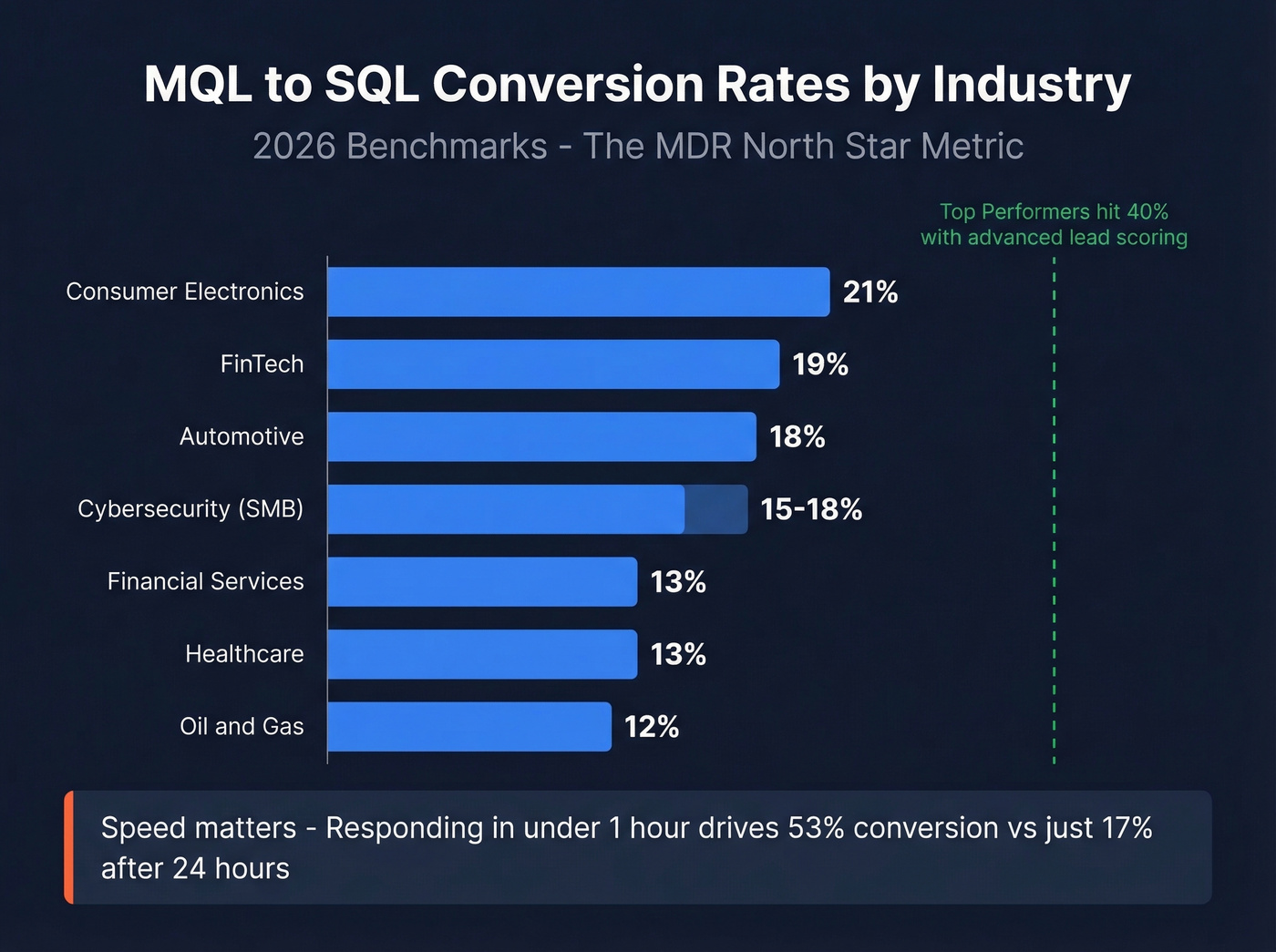
MQL-to-SQL conversion is the MDR's north star metric, and benchmarks vary significantly by industry:
| Industry | MQL to SQL Rate |
|---|---|
| Consumer Electronics | 21% |
| FinTech | 19% |
| Automotive | 18% |
| Cybersecurity (SMB) | 15-18% |
| Financial Services | 13% |
| Healthcare | 13% |
| Oil & Gas | 12% |
Top performers push conversion as high as 40% with advanced lead scoring and fast follow-up. And "fast" isn't a suggestion - responding within the first hour drives 53% conversion versus just 17% after 24 hours. Speed-to-lead is the single most important MDR metric, and it's the one most teams get wrong.
Activity benchmarks often run around 50 calls/day and 20-40 emails/day, with MDR conversations skewing longer and more consultative than pure outbound dials. We've seen teams cut their speed-to-lead from hours to minutes just by adding a contact enrichment layer on top of their CRM. Implementing formal SLAs between marketing and sales can reduce lead handoff time by 48%.
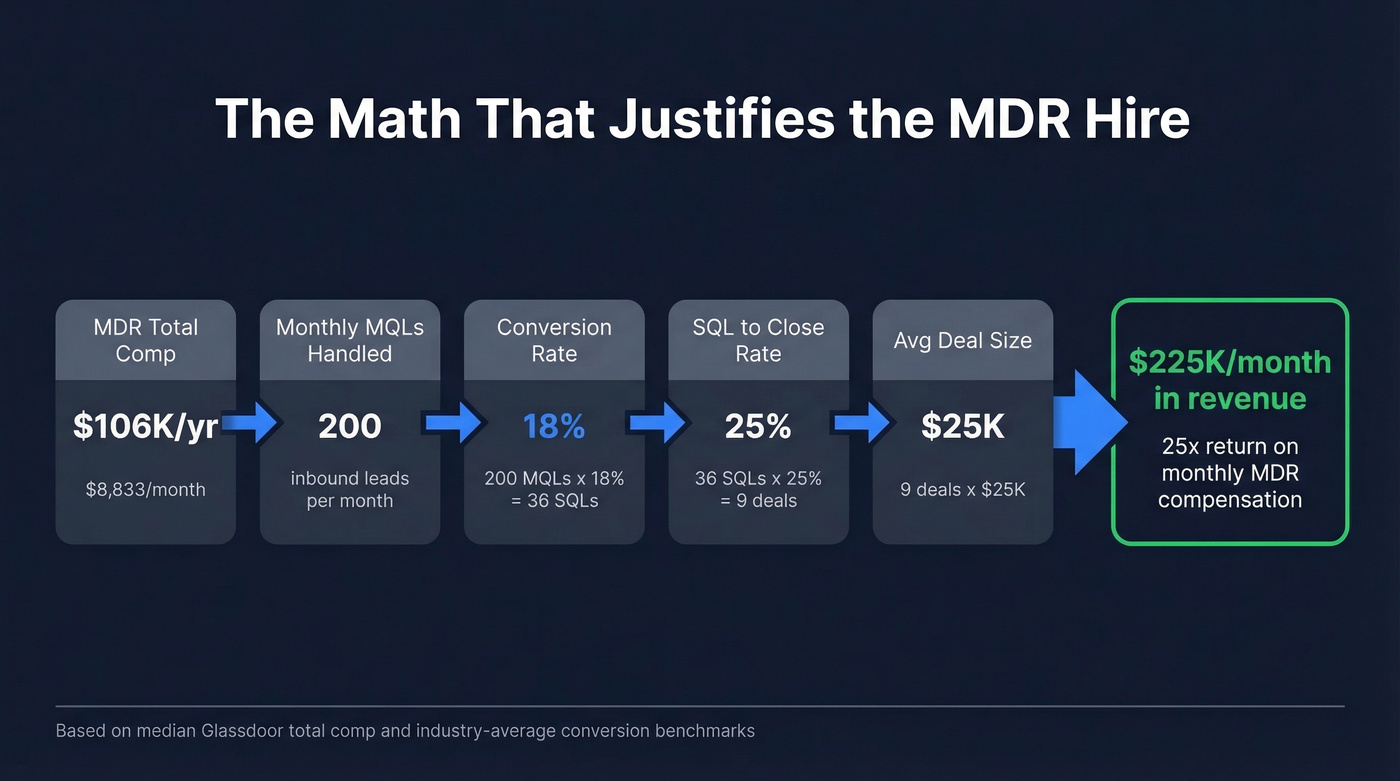
The Math That Justifies the Hire
Let's run the numbers. If your MDR earns $106K in total compensation and converts 200 MQLs per month at 18%, that's 36 SQLs per month. If your average deal size is $25K and your SQL-to-close rate is 25%, that MDR generates $225K in monthly revenue - roughly a 25x return on their monthly comp. That's why the role exists.
When to Hire an MDR
Hire one when:
- You're generating 200+ MQLs per month and SDRs can't context-switch between cold outbound and warm inbound
- Your product requires discovery before demo - complex sales where qualification matters
- You need a dedicated handoff role to prevent MQLs from dying in a shared inbox
- Plan for 1 MDR per 2-4 AEs, depending on inbound volume
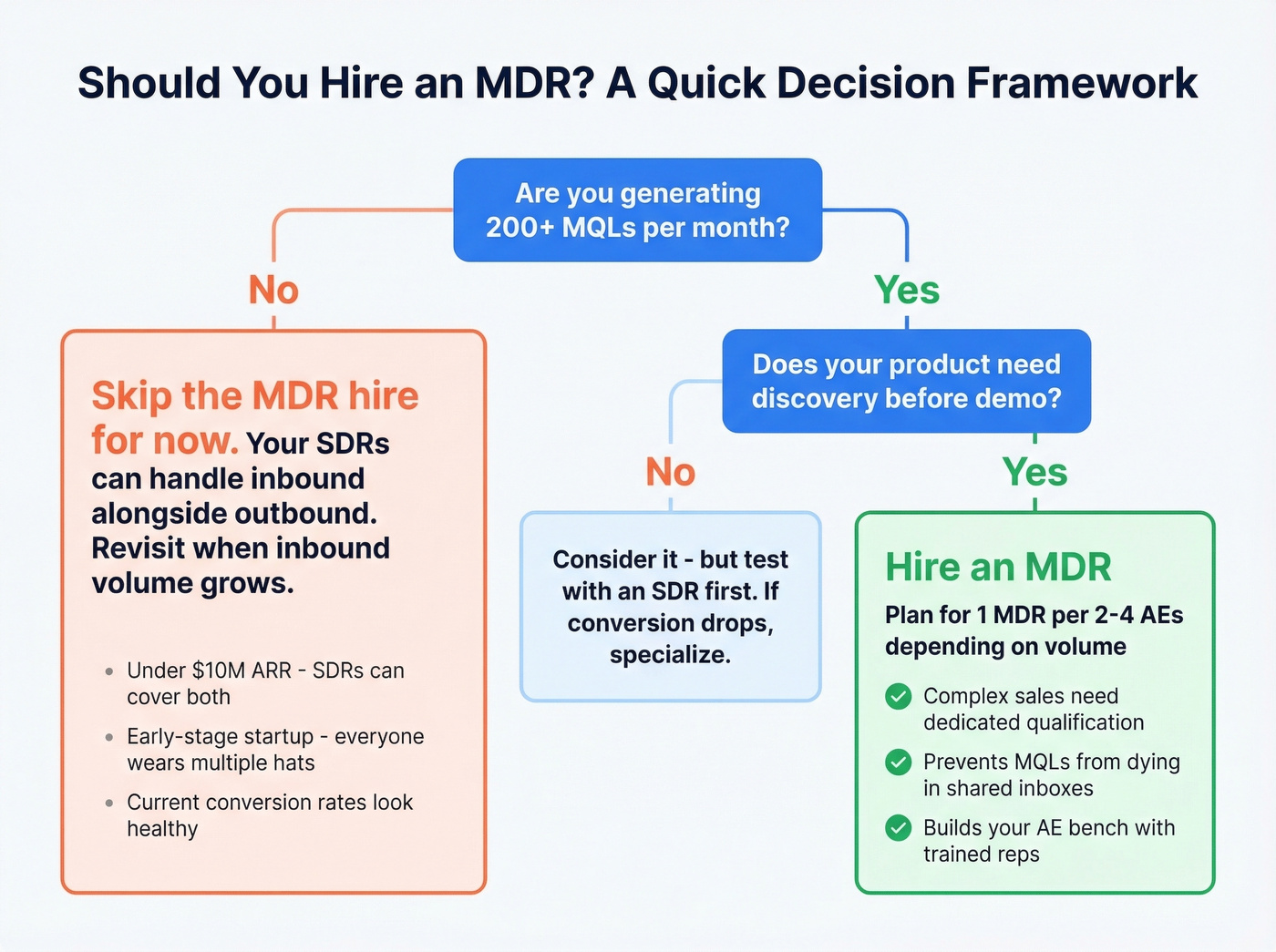
Skip the hire when you're under 200 MQLs per month - your SDRs can handle inbound alongside outbound. Same goes for early-stage startups where everyone wears multiple hats, or teams where SDRs are already handling inbound effectively and conversion rates look healthy.
In our experience, most companies under $10M ARR get better results having SDRs handle inbound. The dedicated marketing development representative role makes sense when inbound volume is high enough that specialization pays for itself.
MDR Tech Stack
Three categories matter for an MDR's daily workflow.
CRM is table stakes - HubSpot (free tier for small teams) or Salesforce ($25-$330/user/month depending on edition) for pipeline tracking and lead routing. Pair that with lead scoring and routing so your MDR calls the hottest leads first instead of working a queue in chronological order.
The third category is the one most teams underinvest in: contact enrichment. Following up in under an hour is impossible if your MDR is manually hunting for phone numbers. Prospeo enriches inbound leads with verified emails and direct dials - 98% accuracy, 7-day data refresh - so your team calls within minutes of a form fill, not hours. With an 83% enrichment match rate and 50+ data points returned per contact, it plugs directly into HubSpot or Salesforce via native integrations.
If you're evaluating vendors, start with a shortlist of data enrichment services and compare them against your CRM workflow.
Your MDRs are only as effective as the data behind them. Prospeo delivers 98% email accuracy and 125M+ verified mobile numbers on a 7-day refresh cycle - so every MQL gets qualified with current, direct contact info instead of stale records.
Stop losing pipeline to bad data. Start qualifying with confidence.
FAQ
Is an MDR the same as an SDR?
No. MDRs qualify warm inbound leads generated by marketing (MQLs), while SDRs typically handle cold outbound prospecting or a mix of inbound and outbound. Some companies use the titles interchangeably, but the workflows, skill sets, and funnel positions differ - MDRs report to marketing 2.1x more often than SDR teams do.
What does MDR stand for in sales?
MDR stands for Marketing Development Representative (or Market Development Representative). The role focuses on converting marketing-generated leads into sales-qualified opportunities that Account Executives can close, typically handling 200+ MQLs per month at mature organizations.
How much does an MDR make?
Median total compensation is ~$106K/year in the US based on 970 Glassdoor salaries. Base pay runs $57K-$79K, with commissions and bonuses adding $29K-$54K. Senior MDRs with 5-8 years of experience average ~$129K base.
What tools help MDRs respond to leads faster?
A CRM with automated lead routing (HubSpot, Salesforce) plus a contact enrichment platform are the essentials. Pair that with lead scoring to prioritize high-intent MQLs first, and you'll cut speed-to-lead from hours to minutes.
What's the difference between an MDR and a BDR?
MDRs work inbound - they qualify leads that marketing already generated. BDRs work outbound - they build pipeline from scratch through cold calls, emails, and account research. MDRs need deeper product knowledge; BDRs need higher resilience to rejection. Both feed AEs, but from opposite ends of the funnel.