

What Is Meeting Cadence? Definition, Benchmarks & How to Get Yours Right
It's Monday morning. You open your calendar and count 23 meetings this week. Half are recurring syncs you can't remember creating, and the other half are "quick aligns" that'll eat 45 minutes each. Your actual work gets squeezed into the cracks between calls.
That's not a meeting cadence. That's chaos - and understanding what meeting cadence actually means is the difference between a productive week and a calendar you dread opening.
What Meeting Cadence Means
Meeting cadence is the recurring rhythm of your team's meetings - the combination of frequency, schedule, and duration that determines how often people gather, for how long, and who attends. The definition is straightforward. Designing a cadence that actually works is where most teams fall apart. A well-designed cadence creates predictability; a bad one creates the calendar you just winced at.
One clarification that trips people up: "biweekly" means every two weeks, not twice a week. If you mean twice weekly, say "twice weekly." The ambiguity has derailed plenty of scheduling threads on Reddit.
| Frequency | Format | Duration | Who Attends |
|---|---|---|---|
| Daily | Standup / huddle | 15 min | Core team |
| Weekly | Team sync / 1:1 | 30-60 min | Team or manager + report |
| Biweekly | Sprint review / deep-dive | 45-90 min | Cross-functional group |
| Monthly | All-hands / strategy | 60-90 min | Department or company |
| Quarterly | OKR review / planning | 90-120 min | Leadership + stakeholders |
| Annual | Kickoff / offsite | Half-day+ | Company-wide |
Why Cadence Matters for Productivity
The average knowledge worker receives 117 emails and 153 Teams messages per day. They're interrupted every two minutes. And 57% of meetings are ad hoc calls without a calendar invite - more than half the time people spend in meetings wasn't even planned.
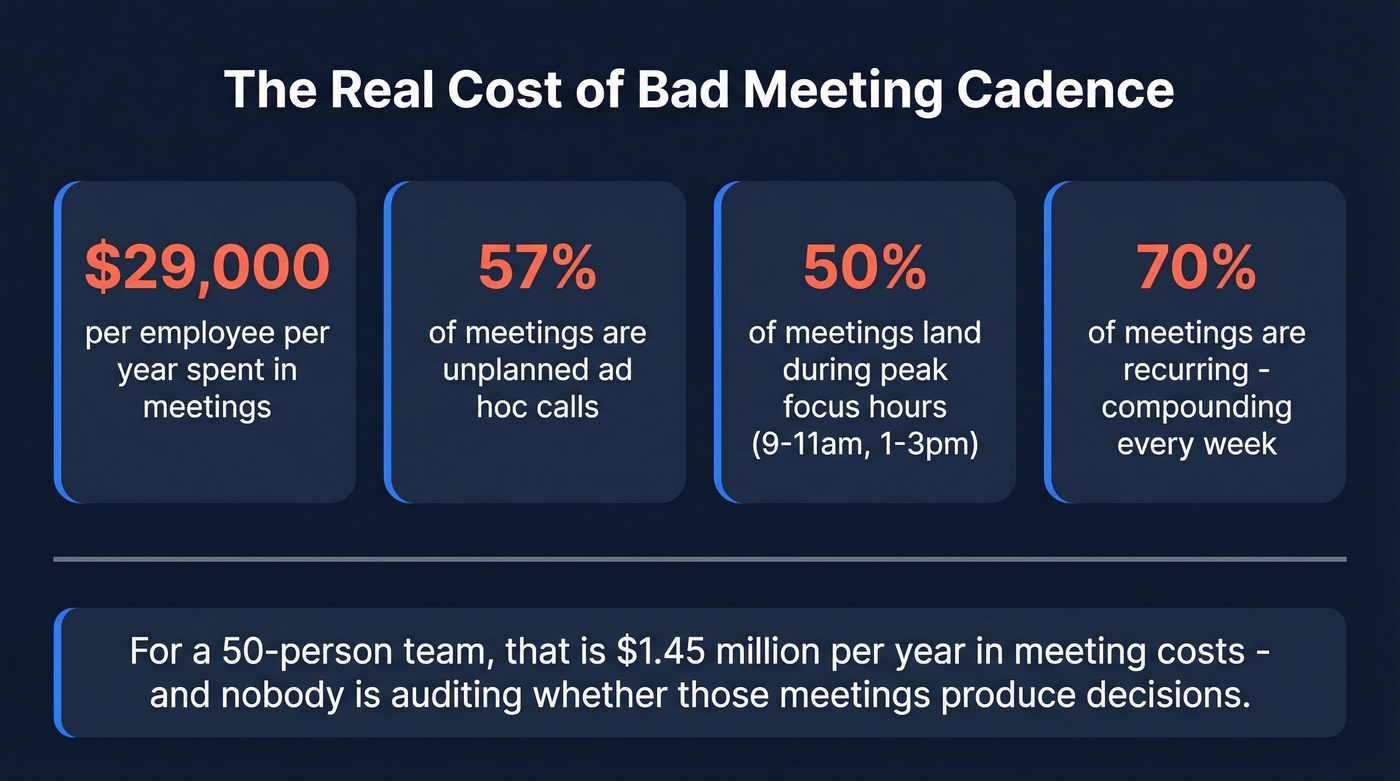
Microsoft's 2026 Work Trend Index paints a brutal picture: 48% of employees say work feels "chaotic and fragmented," and 50% of all meetings land during prime focus windows between 9-11am and 1-3pm. You're not just losing meeting time. You're losing the best hours of the day.
Meeting time costs organizations roughly $29,000 per employee per year when you factor in salary and lost productivity. For a 50-person team, that's $1.45 million annually spent in meetings - and nobody's auditing whether those meetings produce decisions.
The typical employee attends about 25 meetings per month, and 70% of those are recurring. The cadence you set today will compound for months. Get it right, and your team has breathing room. Get it wrong, and you've built a machine that manufactures calendar debt every single week.
Benchmarks by Role
Not everyone should spend the same amount of time in meetings. The data from Hubstaff's 2026 benchmarks breaks this down clearly:
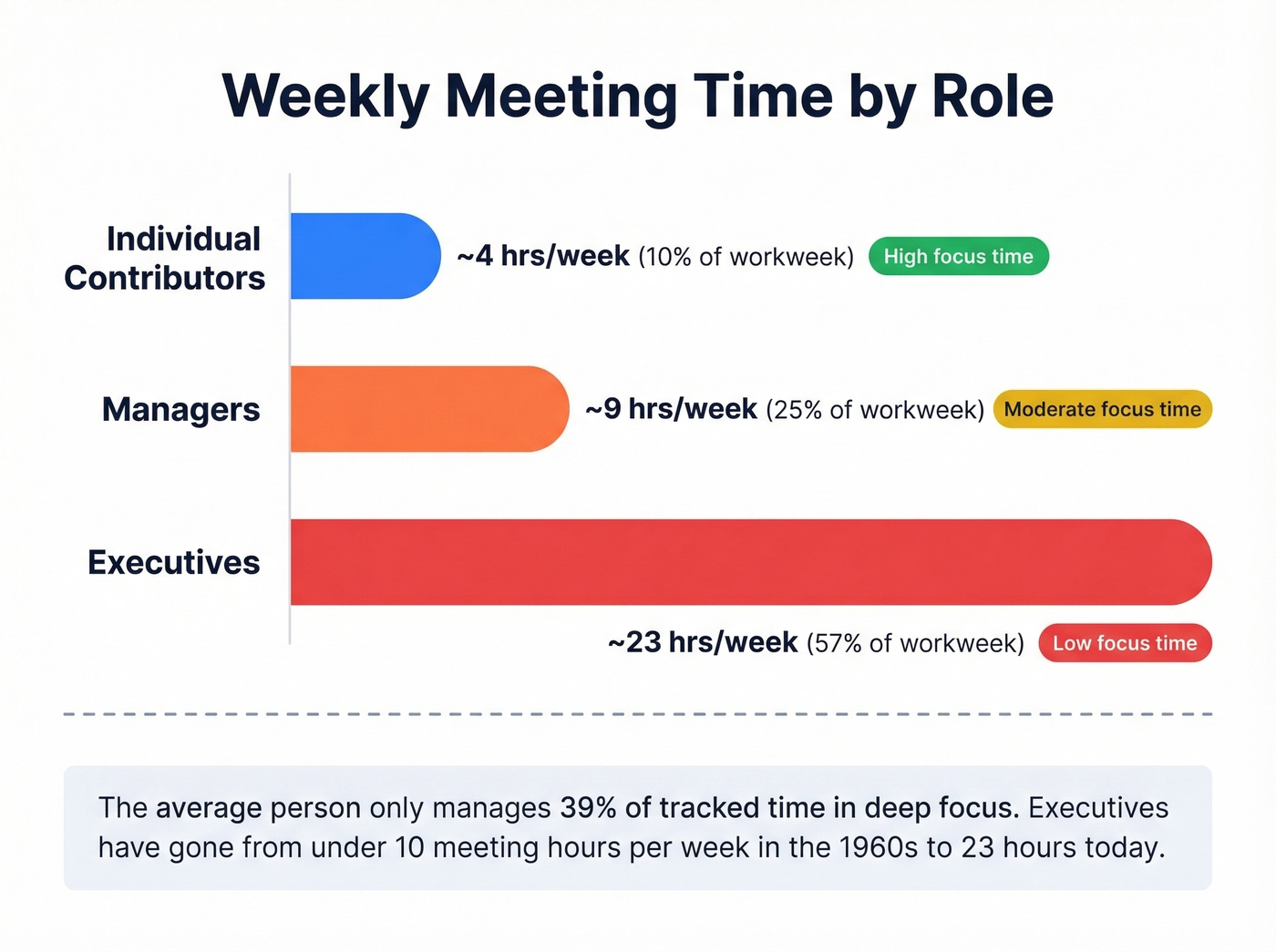
| Role | Hours/Week | % of Workweek | Deep Focus Time |
|---|---|---|---|
| ICs | ~4 hrs | ~10% | Higher |
| Managers | ~9 hrs | ~25% | Moderate |
Slack's research adds an executive reality check: nearly 23 hours per week in meetings, up from fewer than 10 in the 1960s. That's not a cadence. That's an occupation.
If you're a manager spending 9 hours a week in meetings, you're losing more than a full workday. The average person only manages about 39% of their tracked time in deep focus - the rest is fragmented across syncs, check-ins, and "quick questions" that are never quick.
Cadence Examples by Function
The right cadence depends heavily on what your team actually does. How you define cadence in a business context will vary by department, team size, and whether your work is project-based or ongoing.
Engineering
Engineering teams have the most formalized cadence, thanks to Agile and Scrum frameworks. Zenhub's recommended structure is a solid baseline:
| Meeting Type | Duration | Frequency |
|---|---|---|
| Daily standup | 15 min | Daily |
| Sprint planning | 60-90 min | Per sprint |
| Sprint review | 30-60 min | Per sprint |
| Retrospective | 45-60 min | Per sprint |
| Backlog refinement | 30-60 min | Weekly/biweekly |
| Weekly team sync | 30-45 min | Weekly |
| Quarterly all-hands | 60-90 min | Quarterly |
Zenhub's internal analysis found up to 20% faster issue resolution with daily standups. Daily matters - skip-a-day standups lose the thread. But keep them at 15 minutes. The moment a standup hits 30, it's no longer a standup.
Sales
Here's the thing: daily standups are overrated for non-engineering teams. For sales, we'd rather see a few short async check-ins each week than a daily sync that pulls reps off the phone during prime calling hours. In our experience, the weekly forecast review is the non-negotiable meeting - it's where pipeline accuracy lives or dies, and it's where bad contact data wastes the most collective time.
If you're tightening up your pipeline rhythm, it helps to standardize your sales activities alongside the meeting schedule.
| Meeting Type | Duration | Frequency |
|---|---|---|
| Pipeline huddle | 15 min | 3x/week or daily |
| Forecast review | 30-45 min | Weekly |
| Deal review | 60 min | Monthly |
| Quarterly kickoff | 90 min | Quarterly |

Marketing & Leadership
One CEO's approach to 1:1 cadence, shared on r/ExecutiveAssistants, illustrates how layered cadence works at scale: 7 direct reports get weekly 30-minute 1:1s, 5 skip-level reports meet every 6 weeks, and 10 skip-skip reports get quarterly check-ins. Structured, scalable, and keeps leadership connected without consuming the entire calendar.
If your leadership team runs QBRs, align this cadence with your QBR questions so the meeting produces decisions.
| Meeting Type | Duration | Frequency |
|---|---|---|
| Marketing standup | 30 min | Weekly |
| Campaign review | 45 min | Biweekly |
| Strategy session | 60 min | Monthly |
| All-hands | 90 min | Monthly |
| OKR review | 2 hrs | Quarterly |

Your weekly forecast review is only as good as the data behind it. When reps waste meeting time troubleshooting bounced emails and dead phone numbers, that $29K per employee in meeting costs delivers nothing. Prospeo gives your team 98% verified emails and 125M+ direct dials so every pipeline huddle focuses on closing - not cleaning data.
Turn your sales meetings into revenue conversations, not data cleanup sessions.
How to Choose the Right Cadence
Before you schedule anything, run through these diagnostic questions:
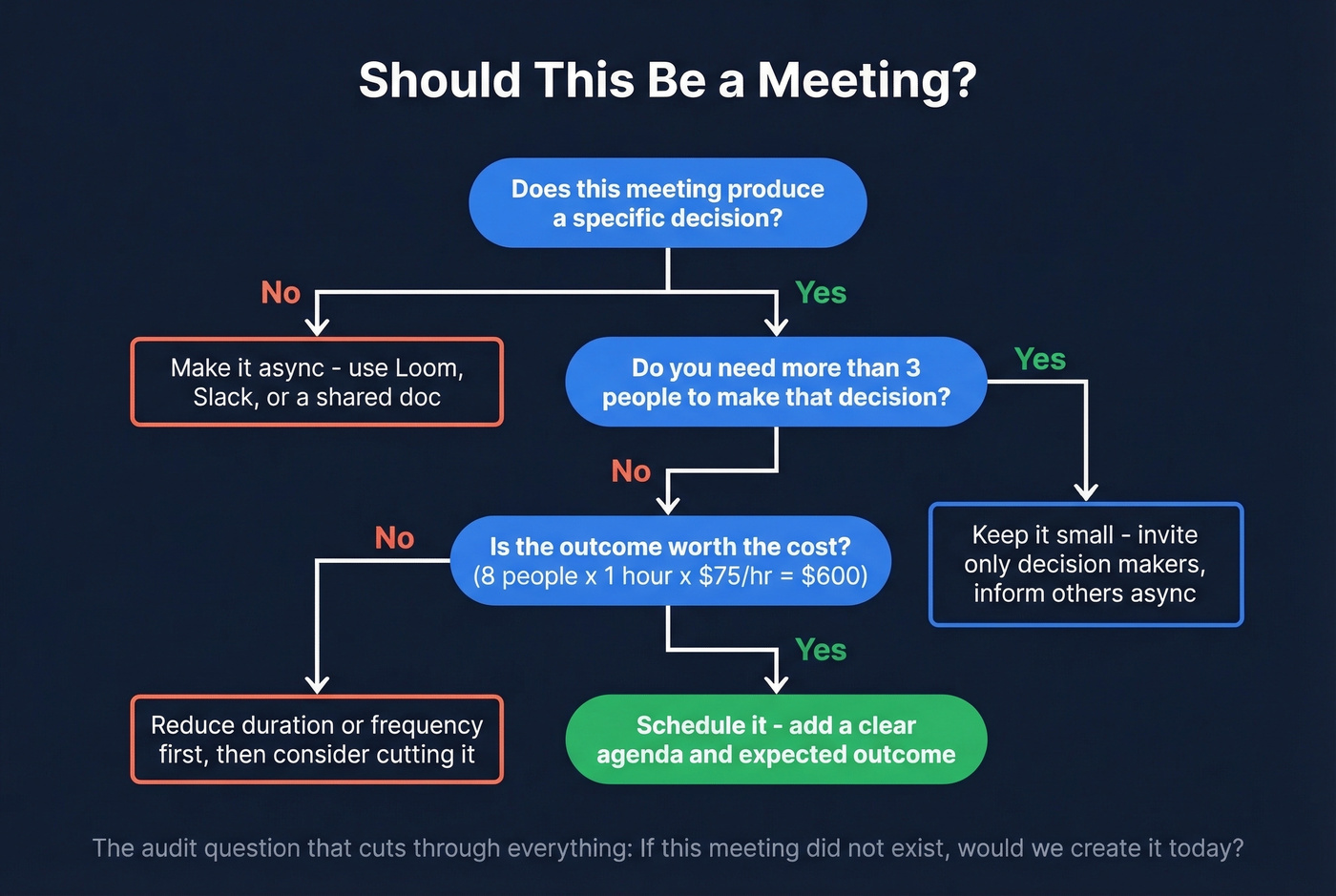
- What decision will this meeting produce? If you can't name one, it's a status update. Make it async.
- Can this be a Loom, a Slack thread, or a shared doc? Most "alignment" meetings can.
- How many people need to be in the room? Smaller groups decide faster.
- What's the cost? A 60-minute meeting with 8 people earning $75/hour costs $600. Is the outcome worth $600?
Good cadence serves two purposes: work outcomes like decisions, alignment, and accountability, and human outcomes like trust, belonging, and shared context. If a meeting only delivers status updates and doesn't build either, it's a candidate for async.
The audit question that cuts through everything: If this meeting didn't exist, would we create it today?
Signs Your Cadence Is Broken
A product manager whose calendar runs 8am to 3pm with back-to-back meetings barely has bandwidth for follow-up notes, let alone the deep thinking their role demands. Other PMs tell them to "get used to it." That's not advice - that's learned helplessness.
If you're in a PM/RevOps seat, it can help to treat cadence as part of your go-to-market strategy, not just calendar hygiene.
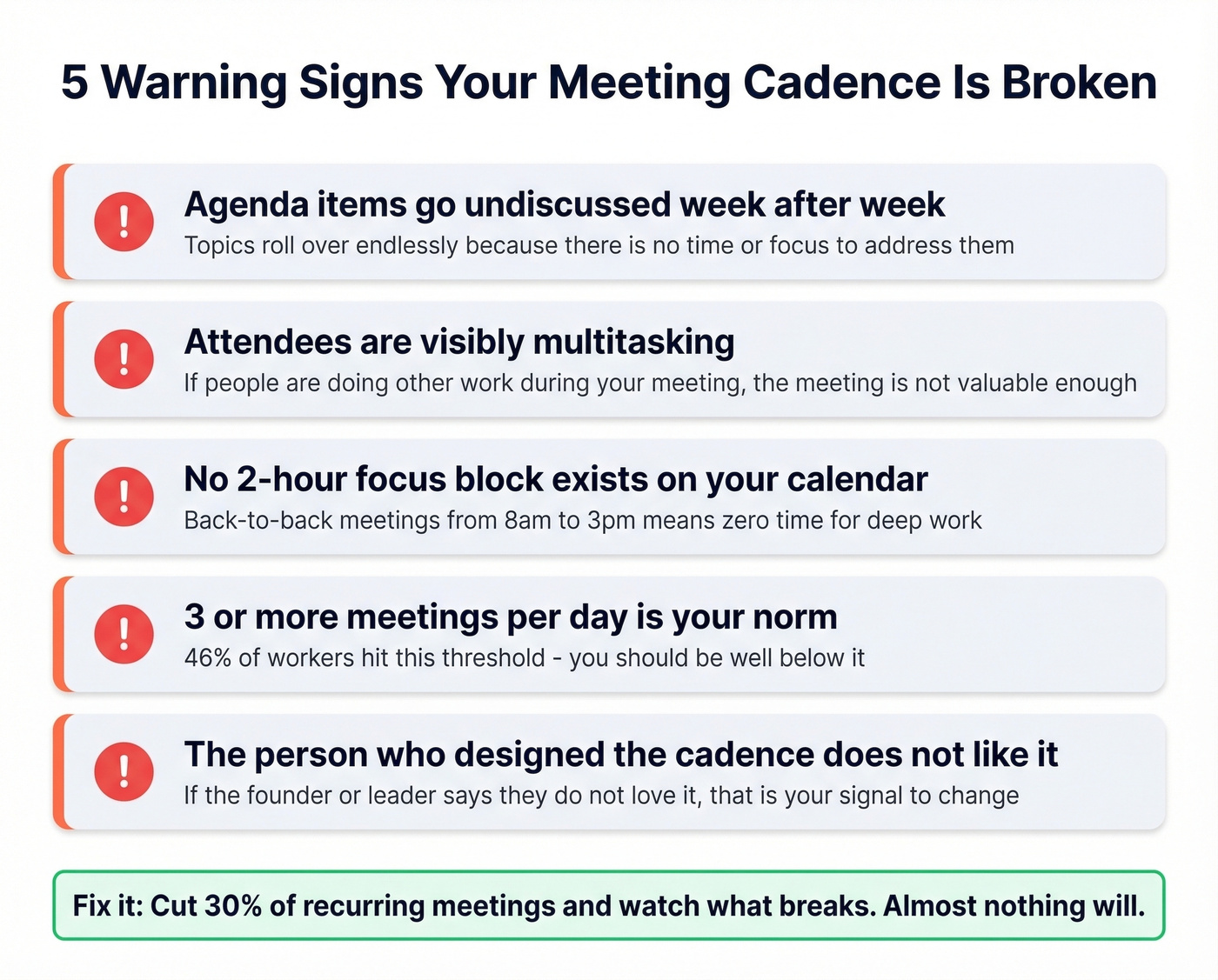
A startup founder running a 22-person company with daily exec standups, a Monday exec meeting, and a Wednesday all-hands gave their own assessment: "Candidly, I don't love it." When the person who designed the cadence doesn't like it, that's your signal.
Your cadence is broken if agenda items go undiscussed week after week, attendees are visibly multitasking, or you can't find a single 2-hour focus block on your calendar. 46% of workers attend 3+ meetings per day - you should be well below that.
Remote & Hybrid Considerations
The cadence you designed for a single-office team breaks down the moment someone joins from a different time zone. Nearly a third of meetings now span multiple time zones, meetings after 8pm are up 16% year over year, and 85-90% of meetings include at least one remote participant.
If your team is customer-facing, these constraints also change how you run calls; see our remote sales meeting tips for practical adjustments.
Two models are gaining traction, per CoworkingCafe's 2026 guide:
Anchor days are recurring, purpose-driven in-person sessions - typically one day per week with a structured 4-hour block covering planning, collaborative work, and lunch. Together weeks are concentrated strategic resets held monthly or quarterly for OKRs, offsites, and kickoffs.
The cost isn't trivial. A 10-person team using a coworking meeting room for a 4-hour weekly anchor session runs about $720/month. Factor this into your cadence design.
For global teams, define a 2-4 hour daily overlap window where synchronous meetings happen. Everything outside that window defaults to async. This single rule eliminates most after-hours meeting creep.
How to Audit Your Cadence
Let's be honest: stop optimizing your meeting cadence. Start deleting meetings. We've done this with our own team - cut 30% of recurring meetings and watched what broke. Almost nothing. The work still got done, often faster, because people had time to actually do it.
If you're auditing sales meetings, pair this with a quick pipeline health check so you don't cut the wrong rituals.
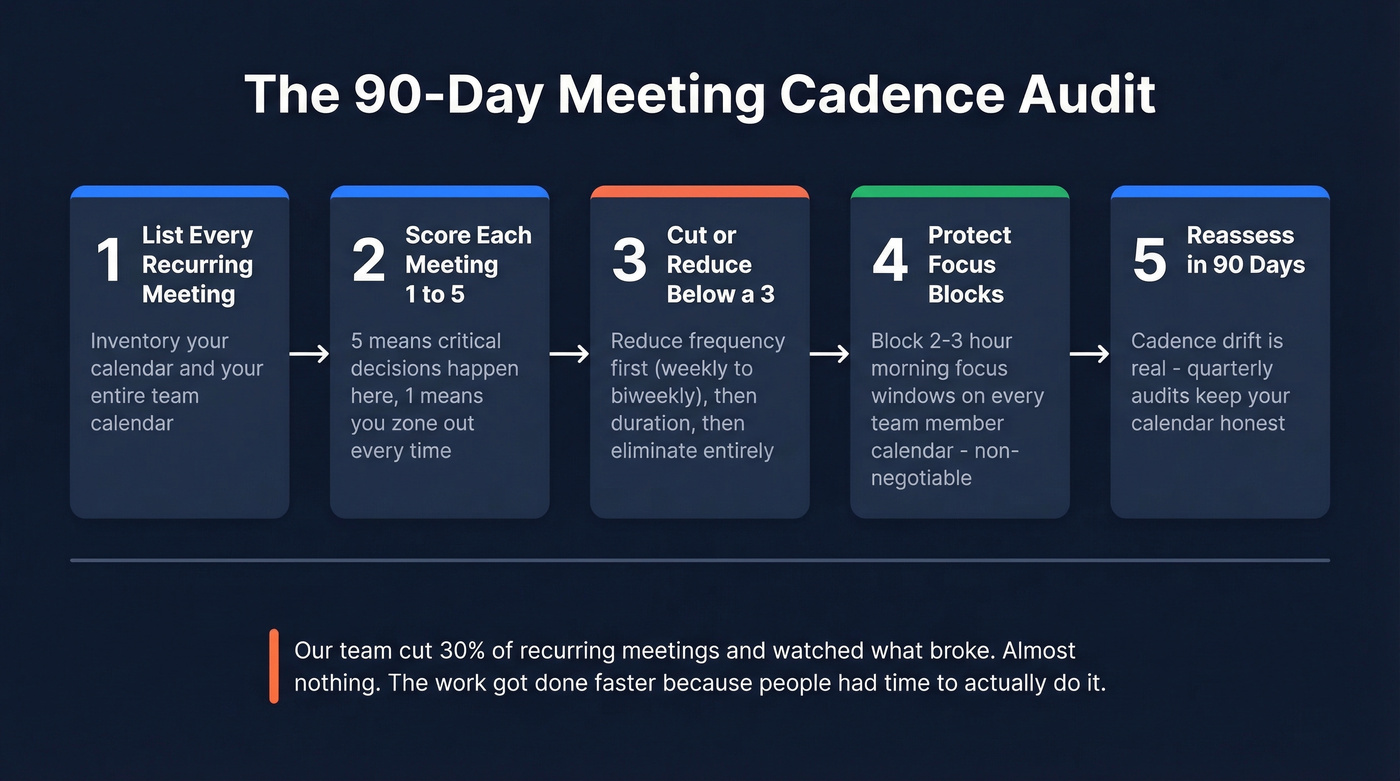
If you want a more measured approach:
- List every recurring meeting on your calendar and your team's.
- Score each meeting 1-5 on necessity - 5 means "critical decisions happen here," 1 means "I zone out every time."
- Cut or reduce anything below a 3. Reduce frequency first (weekly to biweekly), then duration, then eliminate.
- Protect 2-3 hour morning focus blocks on every team member's calendar. Non-negotiable.
- Reassess in 90 days. Quarterly audits are the right rhythm - cadence drift is real.
One specific thing that's saved our sales team hours of meeting time: running prospect lists through Prospeo before the weekly forecast review. When contact data is already verified at 98% accuracy, the meeting focuses on strategy and deal progression instead of debating whether someone's email is even valid.
If you're rebuilding your outbound motion, start with sales prospecting techniques that reduce "pipeline cleanup" meetings in the first place.
You just calculated what bad meetings cost your team. Now calculate what bad contact data costs. Teams using Prospeo book 35% more meetings than Apollo users because 98% email accuracy means reps spend zero time in "quick aligns" about bounced sequences. At $0.01 per email, accurate data costs less than a single wasted meeting.
Spend less time in meetings about bad data and more time closing deals.
Cadence in Agile & Scrum
If you've heard "cadence" in an Agile context, it refers to something more specific: the fixed-length timeboxes (sprints) that govern a team's development rhythm. Sprints typically run 1-4 weeks, and the key principle is consistency - same length, back-to-back, no gaps.
This consistency makes velocity measurement possible. If your sprints vary from 1 week to 3 weeks, your throughput data is meaningless. Unfinished work doesn't extend the sprint; it returns to the backlog for reprioritization. Agile cadence is a subset of your broader meeting rhythm - get the sprint cycle right, and the meeting schedule follows naturally.
FAQ
What's a good meeting cadence?
A good meeting cadence is the minimum viable set of recurring meetings that keeps your team aligned without consuming productive time. Start with one weekly team sync, one weekly 1:1 per direct report, one monthly all-hands, and one quarterly strategy review. Add meetings only when you can justify the cost - every additional recurring meeting compounds across weeks and months.
How often should a team meet?
Individual contributors need roughly 4 hours per week in meetings; managers around 9. Engineering teams meet daily for standups plus per-sprint ceremonies. Sales teams need a weekly forecast review at minimum. The right answer is always "as little as possible while still making decisions and maintaining team trust."
What does biweekly cadence mean?
Biweekly means every two weeks, not twice a week. The term is genuinely ambiguous in everyday English, which is why Atlassian and others recommend always clarifying "every other week" or "twice weekly" instead. Using "biweekly" without clarification will guarantee at least one person shows up on the wrong week.
How do you reduce meeting overload?
Audit quarterly. Score each recurring meeting 1-5 on necessity and cut anything below 3. Protect morning focus blocks and default to async for status updates. Skip meetings that exist solely to clean up bad data - if your team verifies contact info upfront with a tool like Prospeo, you don't need pipeline-cleanup syncs at all. Fewer, sharper meetings that produce decisions is the goal.