

Meeting Subject Line Examples: Formulas, Data, and 60+ Templates
You sent 15 meeting requests last week and got two replies. The other 13? Opened and ignored - or never opened at all. The problem usually isn't your ask. It's the five words someone sees before deciding you're worth a click.
We've spent years watching outbound teams obsess over email body copy while ignoring the one line that determines whether anyone reads it. Here are meeting subject line examples backed by data from millions of emails, plus the formulas behind them so you can stop guessing.
What the Data Says
A Belkins study analyzing 5.5M B2B emails found three patterns worth building every subject line around:
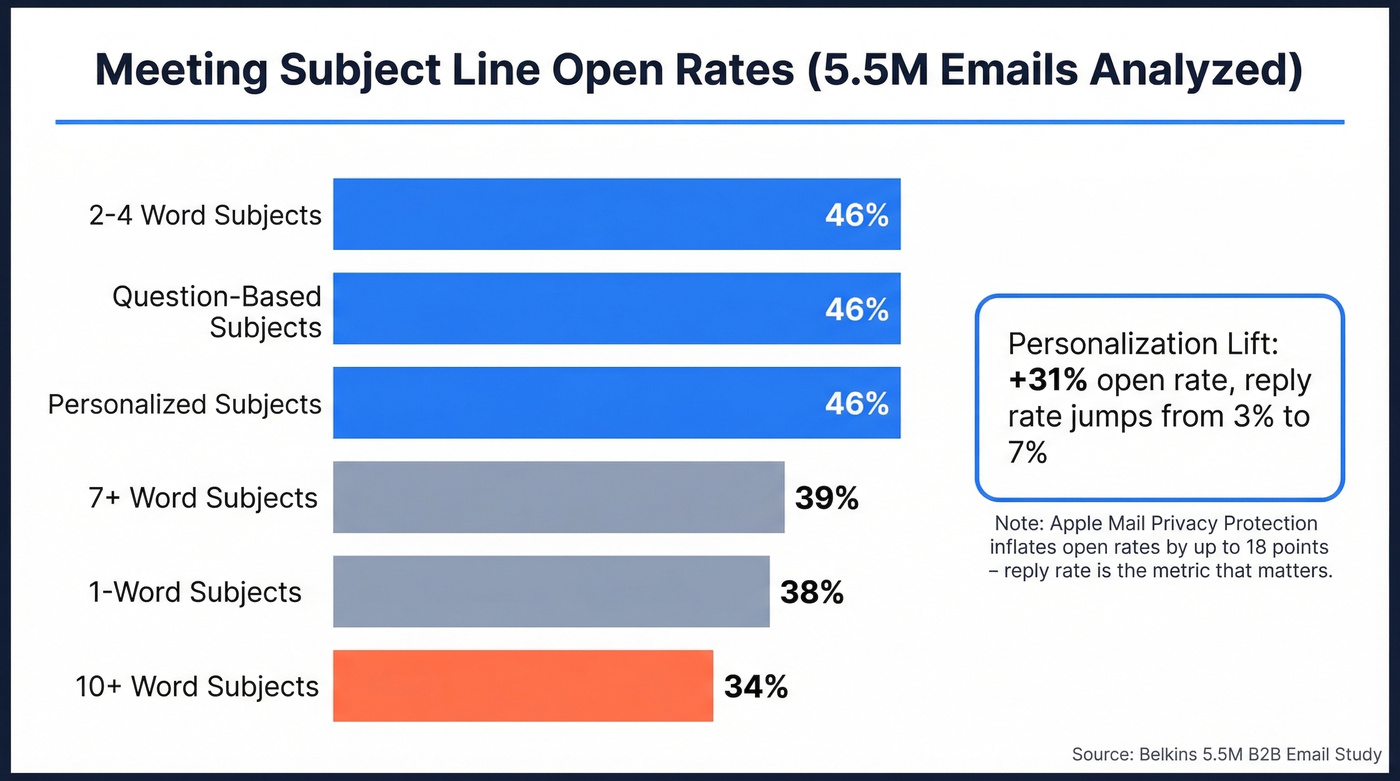
| Factor | Open Rate |
|---|---|
| 2-4 word subjects | 46% |
| Question-based subjects | 46% |
| Personalized subjects | 46% (vs 35% without) |
| 1-word subjects | 38% |
| 7+ word subjects | 39% |
| 10+ word subjects | 34% |
That personalization lift - 31% higher open rates, reply rates jumping from 3% to 7% - comes from the same dataset. For context, the 2026 average marketing email open rate sits around 39.26% across ActiveCampaign's customer base, while other sources put the cross-industry average at 43.46%.
One catch: Apple Mail Privacy Protection, which holds roughly 46% of email client market share, inflates open rates by up to 18 percentage points. Reply rate is the metric that actually matters for meeting requests.
Ideal Subject Line Length
Put your key message in the first 33 characters. That's not arbitrary - it's the tested truncation limit on the most restrictive major email client.
| Client / Device | Visible Characters |
|---|---|
| Gmail (Android) | 33 |
| Gmail (iPhone) | 37 |
| Apple Mail (iPhone) | 48 |
| Outlook (desktop) | ~51 |
| Gmail (desktop) | ~88 |
Your preheader text picks up where the subject line gets cut off, so treat it as a continuation - not a repeat. Front-load the specifics (topic, date, name) and let the preheader carry supporting context.
Three Formulas That Work
These map to the three highest-performing formats: short, question-based, and personalized.
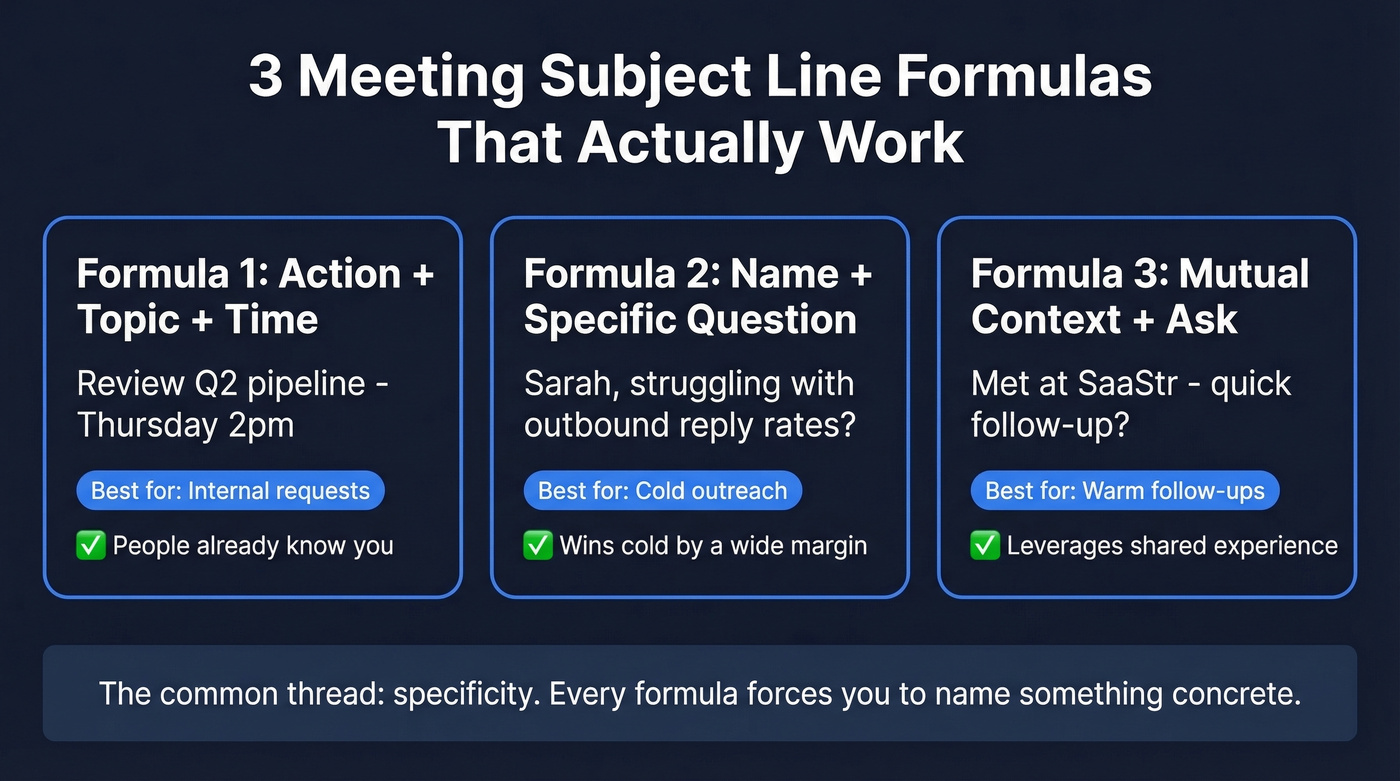
Formula 1: Action + Topic + Time
Review Q2 pipeline - Thursday 2pm
Formula 2: Name + Specific Question
Sarah, struggling with outbound reply rates?
Formula 3: Mutual Context + Ask
Met at SaaStr - quick follow-up?
We've tested all three across cold and warm sequences. Formula 1 dominates for internal requests where people already know you. Formula 2 wins cold outreach by a wide margin. The common thread is specificity - every formula forces you to name something concrete instead of hiding behind "Quick chat."

Personalized subject lines boost open rates by 31%. But personalization requires real data - first names, company names, job titles, recent initiatives. Prospeo gives you 50+ data points per contact across 300M+ profiles, so every {{FirstName}} and {{Company}} token in your subject lines resolves to accurate, verified information.
Stop sending meeting requests to dead emails. Start with 98% accurate data.
60+ Templates by Scenario
Cold Meeting Request Subject Lines
Cold subjects live or die on relevance. The best ones reference something the recipient actually cares about - a recent hire, a public initiative, a shared connection. Expected open rates: 20-30%.
- Quick question about {{Company}}'s outbound
- {{FirstName}}, thoughts on [specific challenge]?
- {{Mutual Connection}} suggested we connect
- Idea for {{Company}}'s Q3 pipeline
- {{FirstName}}, saw your post on [topic]
- 15 min on [pain point] - worth it?
- {{Company}} + [Your Company]: quick intro
- Noticed {{Company}} is hiring [role] - relevant?
- {{FirstName}}, one question about [initiative]
- Can I send you a 2-min overview?
Warm and Internal Meeting Requests
- Agenda for Thursday's sprint review - best for recurring meetings
- {{FirstName}} / {{YourName}}: Q2 planning - best for cross-functional syncs
- Need 15 min on the migration timeline
- Budget review - your input needed by Friday
- Prep for Monday's board deck
- Sync on the new comp plan?
- Quick align before the customer call
- {{FirstName}}, can we talk about [project]?
- Design review - 30 min this week?
- Stakeholder update: [project name]
Follow-Up and Reminder Lines
Follow-up subjects need to reference the original conversation without sounding passive-aggressive. "Per my last email" energy kills reply rates.
Outcome-specific follow-ups outperform generic "following up" subjects because they remind the reader what decision you're trying to make - not just that you exist and are waiting.
- Tomorrow at 2pm - Q1 planning
- Following up: [previous topic]
- Still open to connecting this week?
- Circling back on [specific ask]
- {{FirstName}}, any thoughts on my last note?
- Reminder: pipeline review Thursday 3pm
- Didn't want this to slip - [topic]
- Quick bump: [one-line context]
- Our call is in 1 hour - agenda attached
- Last week's proposal - next steps?
Reschedules and Cancellations
- Need to move Thursday's call - new times
- Cancelling tomorrow's sync (here's why)
- Can we push to next week?
- Rescheduling: [meeting name] -> [new date]
- Conflict came up - three new slots
- Moving our 1:1 to Wednesday - same time
- Sorry - double-booked. Two alternatives inside
- New time for [meeting name]?
One-on-One and Team Meetings
- 1:1 check-in - anything to add?
- All-hands Friday: product roadmap update
- Weekly standup agenda (June 12)
- {{FirstName}}, topics for our 1:1?
- Team retro - what went well, what didn't
- Monthly review: [team name] metrics
- Skip-level: open floor, no agenda required
- Quarterly planning kickoff - prep doc inside
Meeting Recaps and Minutes
- Notes from today's pipeline review
- Action items - Q2 kickoff
- Summary: what we decided on pricing
- Recap: [meeting name] key takeaways
- Meeting notes + next steps (June 10)
- Decisions from the hiring sync
- Follow-up doc: [client name] strategy call
- Recording + action items from [meeting name]
Before-and-After Rewrites
Most bad subject lines aren't creative failures. They're just vague.
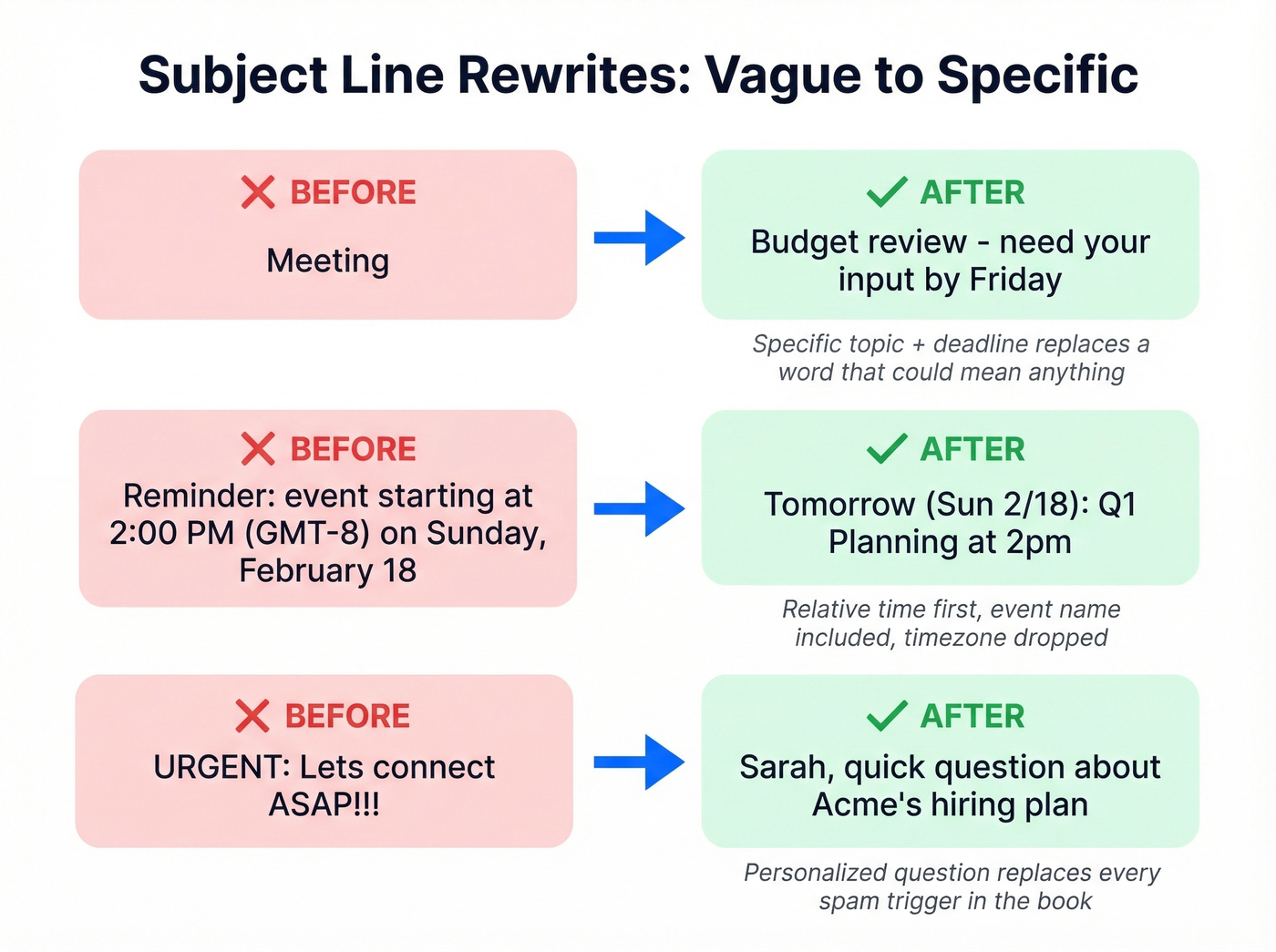
Before: "Meeting"
After: "Budget review - need your input by Friday"
Specific topic plus a deadline replaces a word that could mean anything. That single change is often the difference between a reply and the archive folder.
Before: "Reminder: event starting at 2:00 PM (GMT-8) on Sunday, February 18"
After: "Tomorrow (Sun 2/18): Q1 Planning at 2pm"
Relative time first, event name included, timezone dropped. This anti-pattern from a ProtonMail thread triggers false urgency when the timestamp appears before context.
Before: "URGENT: Let's connect ASAP!!!"
After: "{{FirstName}}, quick question about {{Company}}'s hiring plan"
Personalized question replaces every spam trigger in the book. The consensus on r/sales is pretty clear: all-caps urgency in a cold email is an instant delete.
What to Avoid
Authentication failures override everything else. Since May 2025, Microsoft requires SPF, DKIM, and DMARC for domains sending more than 5,000 emails/day to Outlook.com, Hotmail.com, and Live.com. No subject line optimization matters if your emails get rejected with a 550 5.7.515 error. Check your DNS records before you touch a single subject line.
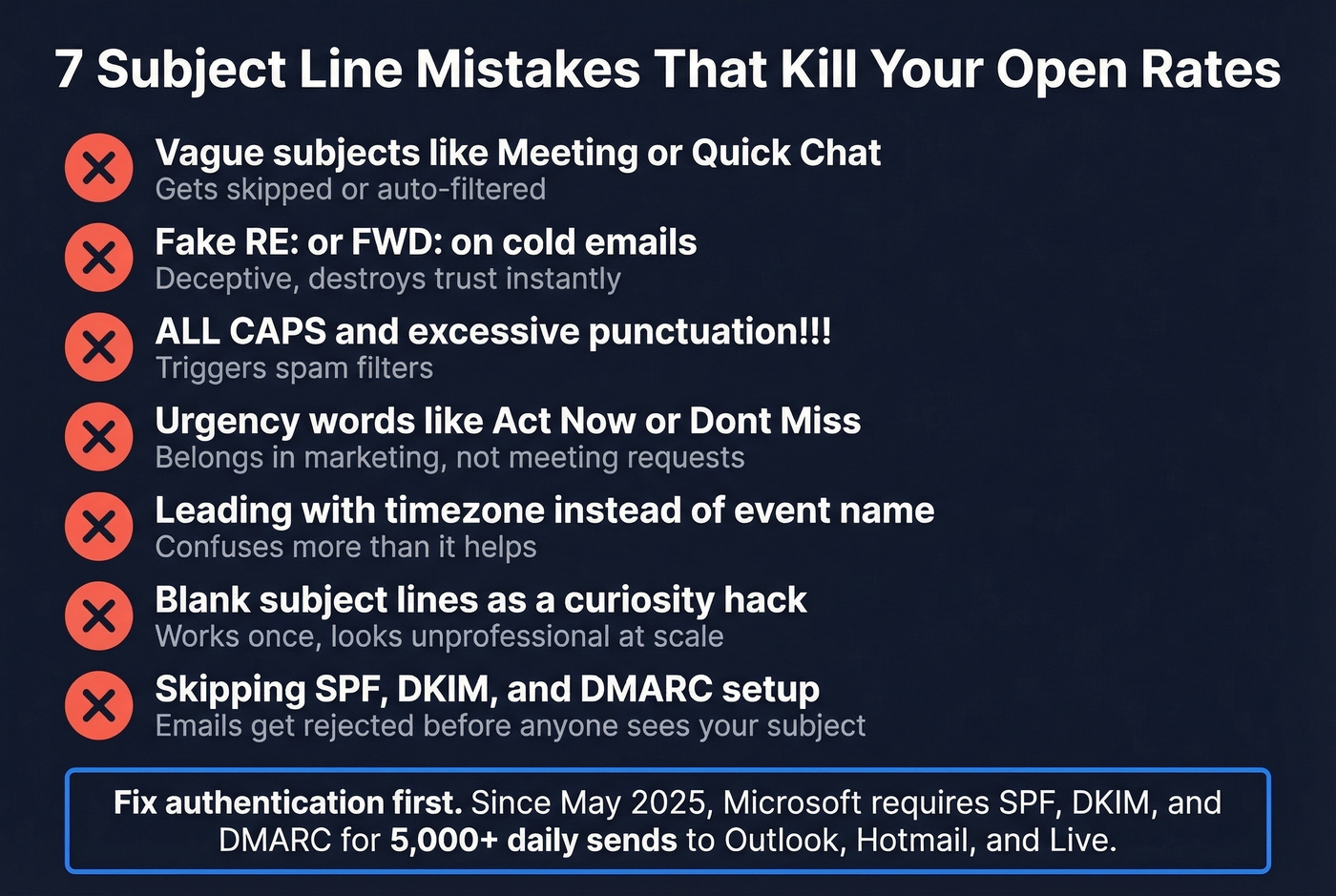
Beyond authentication, here's what tanks your open rates:
Vague subjects like "Meeting," "Quick Chat," or "Hello" get skipped or filtered. Fake threads - adding "RE:" or "FWD:" to cold emails - are deceptive and destroy trust fast. ALL CAPS and excessive punctuation trigger spam filters. Words like "Act now" or "Don't miss" belong in marketing, not meeting requests. And calendar reminders that lead with a timezone instead of the event name confuse more than they help.
Some reps swear by blank subject lines as a curiosity hack. Skip this approach. It can work once, but it's not repeatable and looks unprofessional at scale.
Fix Your Data Before Your Subject Lines
Let's be honest: if your bounce rate is above 10%, no subject line formula will save your reply rates. I've watched teams A/B test subject lines for weeks while sending to lists full of dead addresses. It's like optimizing a billboard on a road nobody drives.
Prospeo runs every email through a 5-step verification process with 98% accuracy - catch-all handling, spam-trap removal, honeypot filtering included. Teams at Snyk cut bounce rates from 35-40% to under 5% after switching, and their AE-sourced pipeline jumped 180%.
If you're seeing deliverability issues, start with email bounce rate benchmarks, then work through a full email deliverability audit. After that, tighten your sender reputation and run a quick spam check before scaling.
You just built the perfect subject line. Now you need the right person to send it to. Prospeo's 30+ search filters - buyer intent, job changes, technographics, headcount growth - let you target prospects who are actually in-market. At $0.01 per email, a 15-email meeting request batch costs less than a cup of coffee.
Great copy deserves a great list. Build yours in minutes.
FAQ
How many words should a meeting subject line be?
Two to four words hit 46% open rates in the Belkins 5.5M email study. Beyond 10 words, rates drop to 34%. Stay under seven words - short enough to avoid truncation on mobile, long enough to be specific.
Should I personalize every meeting request subject line?
Yes for external and cold requests - personalization drives a 31% open rate lift. For recurring internal meetings, consistency matters more. Use the same format weekly so people recognize the thread instantly.
Do meeting requests get higher open rates than marketing emails?
Warm meeting requests typically land 40-55%, while the 2026 marketing average hovers around 39-43%. Cold requests can dip below 30%. Reply rate matters more - a 46% open rate means nothing if nobody responds.
What's the best way to verify emails before sending meeting requests?
Run your list through a verification tool before any campaign. Bouncing off dead addresses tanks your domain reputation and makes future subject lines irrelevant. Most verification tools offer free tiers so you can test before committing.