

Middle of the Funnel: Benchmarks, Frameworks, and Tactics That Convert
Here's a stat that should make you uncomfortable: 36% of leads never become MQLs, and half of MQLs get no follow-up. That's not a top-of-funnel problem or a bottom-of-funnel problem - it's the middle of the funnel quietly bleeding out while everyone argues about ad spend and close rates.
The consideration stage is where pipeline goes to die. Marketing reports on traffic and form fills. Sales reports on close rates and revenue. The stage between those two? It lives in a no-man's-land where neither team has full visibility, the data sits in three systems that don't talk to each other, and 60% of buyers take six or more actions before committing to a new brand. That messy, nonlinear middle is where you're losing deals.
Let's be honest about the math: if your average contract value is above $5K, improving your MOFU conversion by just 10% at each stage compounds to roughly a 32% revenue lift. That's not a rounding error. It's the highest-leverage fix most B2B teams aren't making.
The Three Numbers That Matter
Before we go deep, here's the short version. Three metrics define middle of the funnel performance: your MQL-to-SQL conversion rate (40% is average, 60% is good, 80% is great for B2B teams with >$5K ACV), your nurture sequence open rate (aim for 20-30%), and your time-to-follow-up on intent signals (within 5 minutes yields 21x higher qualification likelihood).
The one framework you need is a 4-week nurture cadence that's 80% educational and 20% ask. The biggest mistake to avoid is pushing product before you've built the consideration bridge - a pattern so common there are entire Reddit threads dedicated to diagnosing it. Everything below is the detail behind those numbers.
What Is MOFU, Exactly?
The middle of the funnel covers the consideration stage. Your prospect knows they have a problem (TOFU established that) and hasn't decided on a vendor yet (that's BOFU territory). They're evaluating solutions, comparing approaches, and building internal consensus.
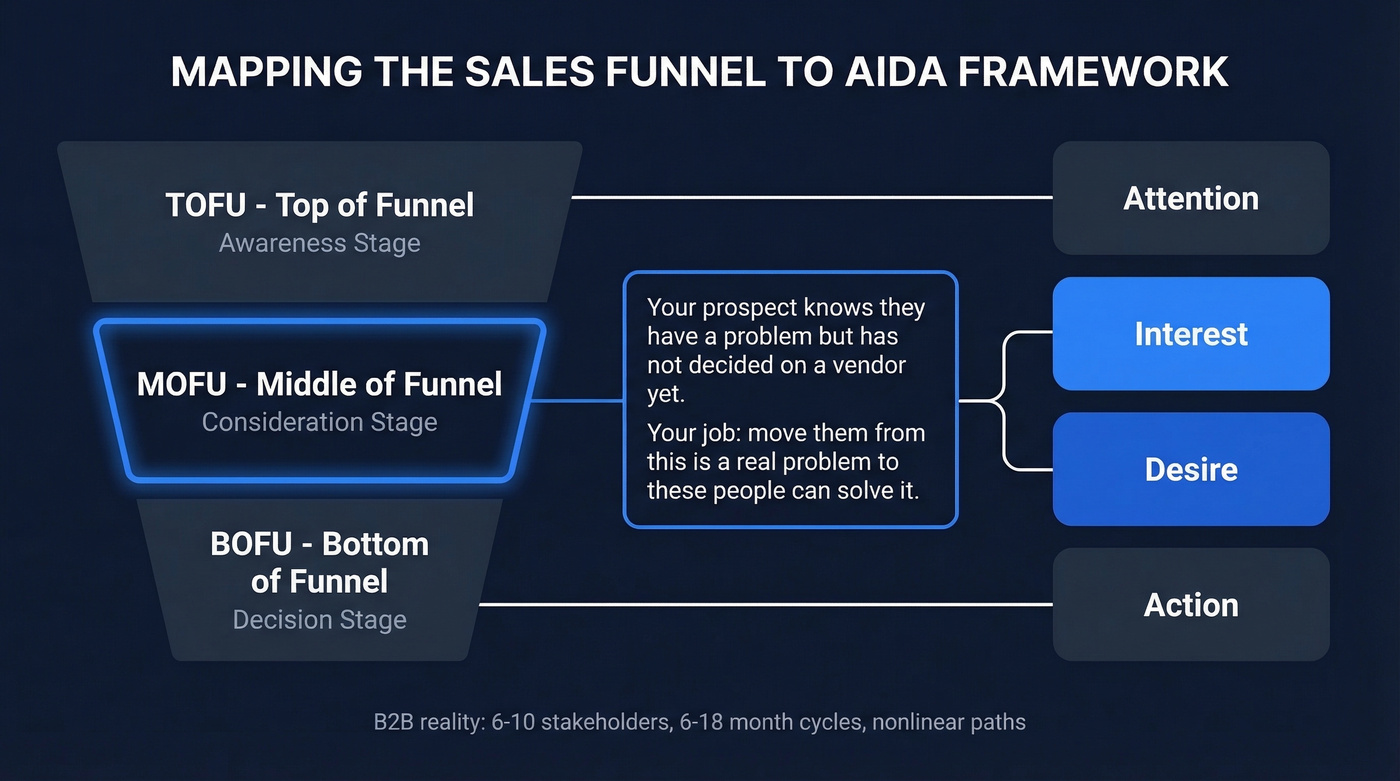
Map it to the AIDA framework) and MOFU covers Interest and Desire. The prospect is interested enough to engage with deeper content but hasn't yet developed the desire to buy from you specifically. Your job is to move them from "this is a real problem" to "these people can solve it."
In B2B, this stage is brutal because purchases involve 6-10 stakeholders and sales cycles run 6-18 months. The mid-funnel isn't one person reading one case study - it's a buying committee consuming different content at different speeds, often without coordinating with each other. The linear funnel diagram on your whiteboard is a useful simplification, but the reality looks more like a pinball machine.
Why MOFU Gets Neglected
The root cause is data fragmentation. Marketing owns TOFU metrics. Sales owns BOFU metrics. The middle sits where neither team has full visibility, and Funnel.io's research confirms what we all suspect: teams optimize in silos because their data is siloed.
We see this constantly: a team runs thought-leadership ads on social, gets decent engagement, then immediately retargets those viewers with product videos and free trial CTAs. Results are underwhelming. A practitioner on r/LinkedinAds described exactly this pattern - TOFU engagement followed by mid-funnel retargeting that pushed product too early. The question they asked: "Is it too soon to talk about our product and push them towards our free trial?" Almost always, yes.
Forrester's data gets cited as a useful rule of thumb: only about 3% of your market is actively buying at any given time, but 40% is poised to buy. That 40% is your MOFU audience. They're not ready for a demo, but they're not cold either. Ignore them and they'll buy from whoever stayed top of mind. Some practitioners are ditching the TOFU/MOFU/BOFU labels entirely in favor of an "in-market vs. out-market" framework - a cleaner lens for modern B2B, even if the underlying principle is the same.
MOFU Benchmarks
Let's put numbers on this. The table below shows stage conversion benchmarks by industry, based on data collected from 2017-2025:
| Industry | Lead-to-MQL | MQL-to-SQL | SQL-to-Opp | SQL-to-Closed |
|---|---|---|---|---|
| B2B SaaS | 39% | 38% | 42% | 37% |
| Cybersecurity | 24% | 40% | 43% | 46% |
| Financial Services | 29% | 38% | 49% | 53% |
The MQL-to-SQL column is your core MOFU metric. Notice how it clusters around 38-40% across industries - that's the gravity well most teams orbit. Breaking out of it requires deliberate mid-funnel effort.
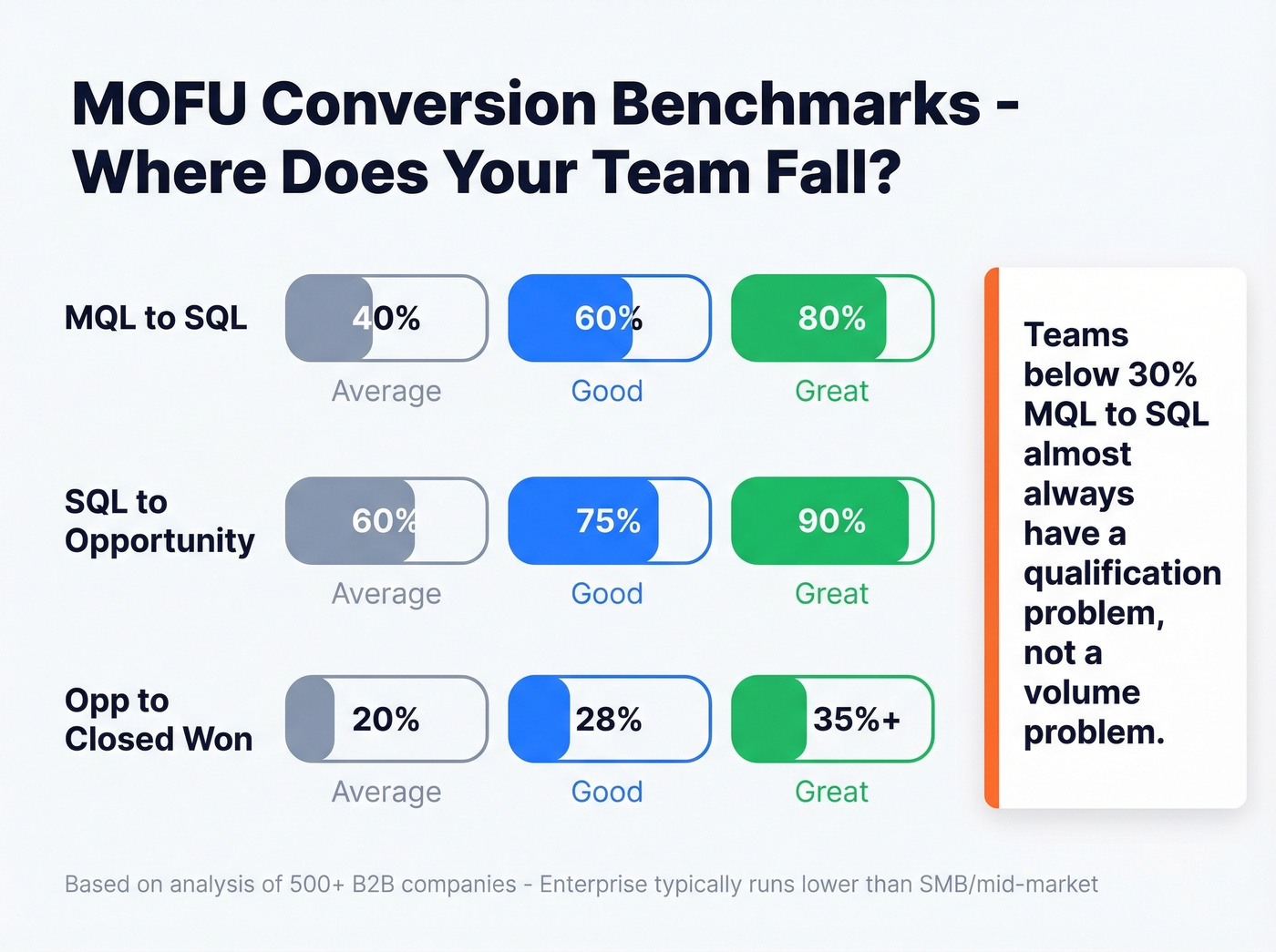
For a simpler goalpost framework, Convertify's analysis of 500+ B2B companies breaks it down by quality tier:
| Stage | Average | Good | Great | |---|---|---| | MQL-to-SQL | 40% | 60% | 80% | | SQL-to-Opportunity | 60% | 75% | 90% | | Opp-to-Closed Won | 20% | 28% | 35%+ |
Enterprise teams typically run lower than SMB/mid-market across the board. Digital Bloom's pipeline audit shows enterprise MQL-to-SQL at 31% versus 39% for SMB/mid-market SaaS - a gap that reflects longer sales cycles, more stakeholders, and stricter qualification criteria.
In our experience, teams below 30% MQL-to-SQL almost always have a qualification criteria problem, not a volume problem. They're either scoring leads too loosely at the top or failing to nurture the consideration stage entirely.
Which Channels Drive MOFU Conversions
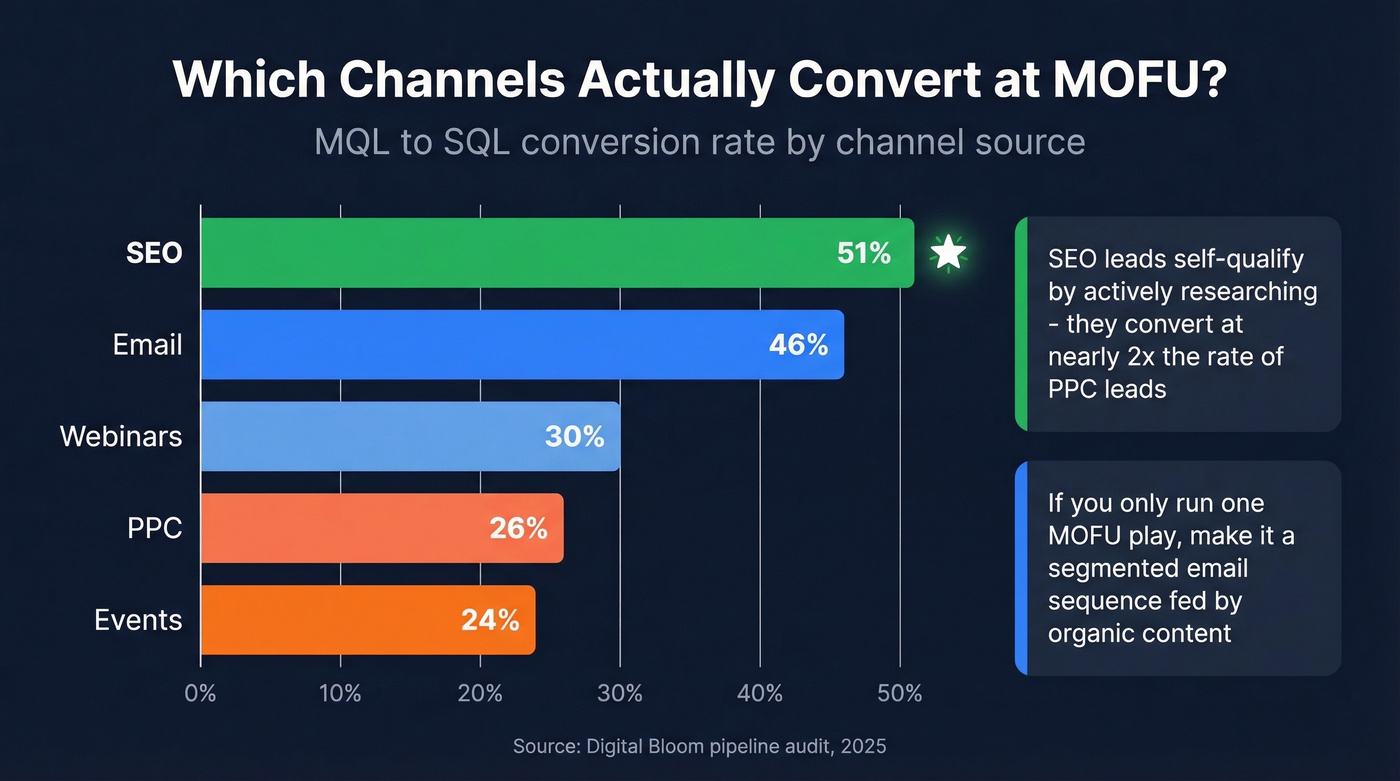
Not all channels perform equally once a lead enters the consideration stage. The MQL-to-SQL conversion rates by channel tell a clear story:
| Channel | MQL-to-SQL | Opp-to-Close |
|---|---|---|
| SEO | 51% | 38% |
| 46% | 32% | |
| Webinars | 30% | 33% |
| PPC | 26% | 35% |
| Events | 24% | 40% |
SEO-sourced leads convert to SQL at nearly twice the rate of PPC leads. That's a massive delta.
Here's the thing: PPC leads clicked an ad, filled out a form, and moved on. SEO leads found your comparison guide or technical deep-dive while actively researching - they've already self-qualified by the time they convert. Email sits between the two because it's your nurture channel, the one you control entirely. If you're only running one MOFU play, make it a segmented email sequence fed by organic content. Everything else is a bonus.

Half of MQLs get no follow-up because reps don't trust the data. Prospeo's 98% email accuracy and 30% mobile pickup rate mean your nurture sequences reach real people - not dead inboxes. With intent data across 15,000 topics, you can identify which MOFU leads are actually in-market right now.
Stop losing pipeline in the middle. Start reaching buyers who are ready to engage.
MOFU Content That Converts
Generic advice says "create case studies and whitepapers." That's not wrong, but it's not specific enough to act on.
Porter Metrics added interactive product demos across their landing pages, guides, and support docs and saw a 25% lift in website engagement plus faster feature adoption. Interactive demos work at this stage because they let prospects self-educate without committing to a sales call - and 52% of B2B buyers prefer a self-service approach to gathering information.
The pattern is consistent: educational content paired with intelligent routing beats brute-force nurturing every time.
Apply the 80/20 rule. Eighty percent of your MOFU content should be educational - comparison frameworks, industry data, methodology breakdowns, technical deep-dives. Twenty percent can be direct asks: demo invitations, trial offers, consultation CTAs. Flip that ratio and you'll watch engagement crater. Prospects evaluating solutions are building a mental shortlist. They want to learn, not be sold to.
The 4-Week Nurture Sequence
Companies strong at lead nurturing generate 50% more sales-ready leads at 33% lower cost, and nurtured leads make 47% larger purchases. Here's a framework you can steal, based on a standard 4-week cadence:
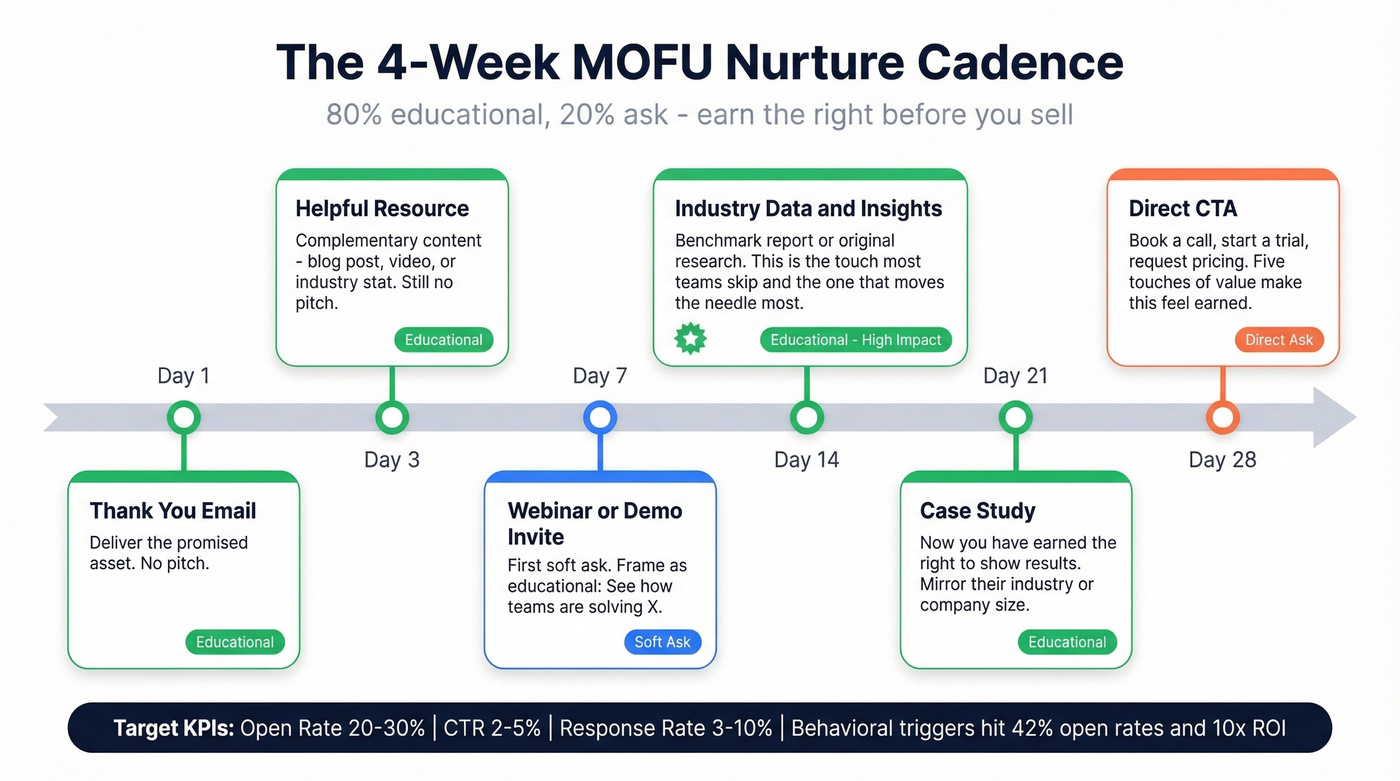
- Day 1: Thank-you email. Acknowledge the action they took, deliver the promised asset. No pitch.
- Day 3: Helpful resource. Send something related but different - a complementary blog post, a short video, a relevant industry stat. Still no pitch.
- Day 7: Webinar or demo invite. Your first soft ask. Frame it as educational: "See how teams are solving X" beats "book a demo."
- Day 14: Industry data or insights. Share a benchmark report, a trend analysis, or original research. Position your company as the expert, not the vendor.
- Day 21: Case study. Now you've earned the right to show results. Pick one that mirrors the prospect's industry or company size.
- Day 28: Direct CTA. Book a call, start a trial, request pricing. Five touches of genuine value make this ask feel earned.
Well-executed nurture sequences hit 36.7-42.35% open rates with roughly 8% CTR - dramatically higher than standard marketing emails. Behavioral trigger emails hit about 42% open rates and deliver 10x higher ROI than broadcast sends.
We've tested this cadence across dozens of accounts, and the Day 14 industry data touch is the one most teams skip - and the one that moves the needle most. Progressive profiling makes each touch smarter too. Instead of asking for everything on the first form, collect one or two new data points per interaction. 78% of marketers using progressive profiling report better lead quality.
Your KPI targets for this sequence: open rate 20-30%, CTR 2-5%, response rate 3-10%. Below the floor? The problem is usually list quality or relevance, not send timing.
How to Score MOFU Leads
Traditional lead scoring measures activity - ebook downloads, email opens, webinar registrations. The problem is that activity doesn't equal buying intent. Someone who downloads every piece of content you publish might be a student writing a thesis, not a VP evaluating vendors.
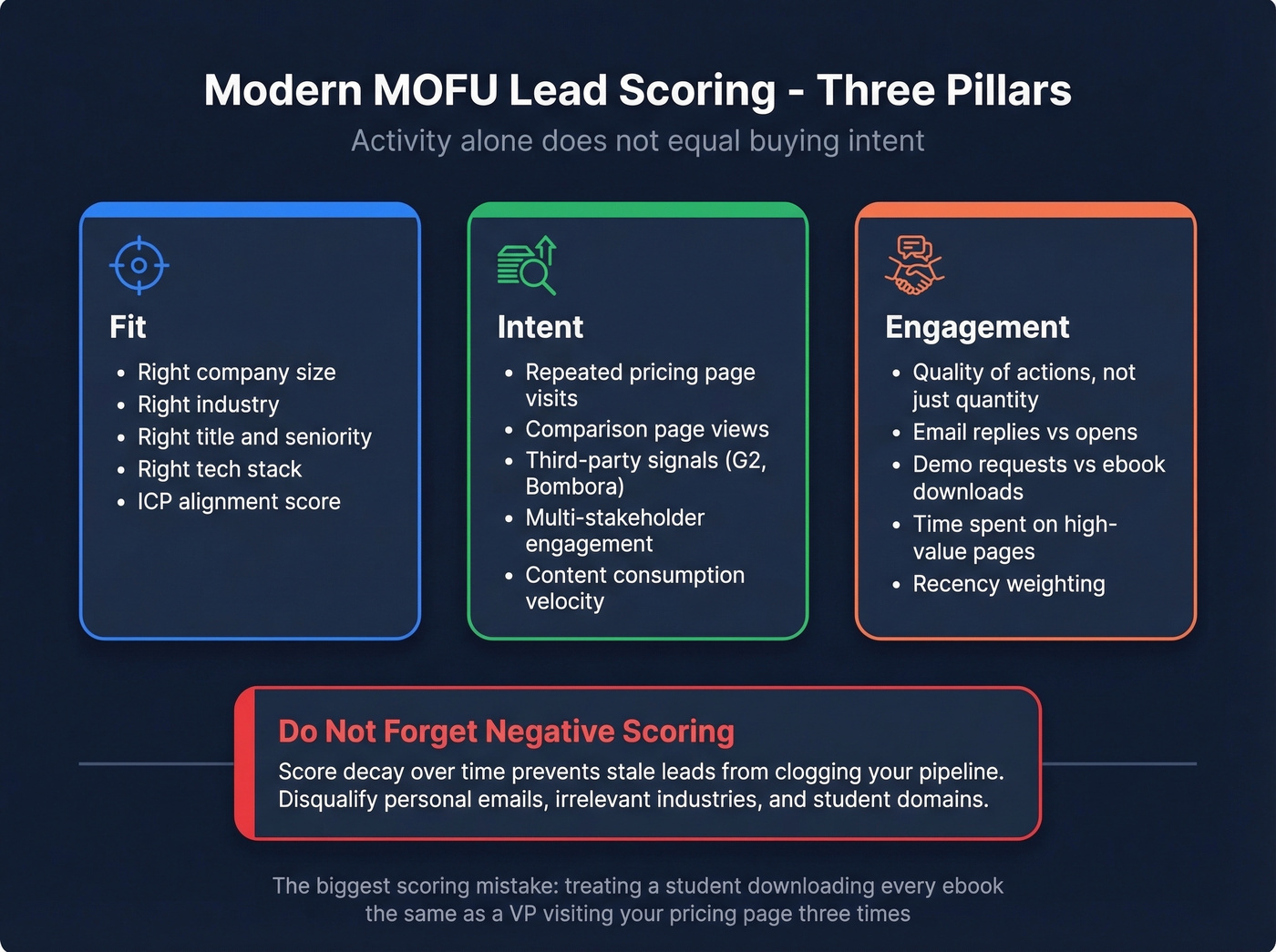
Modern scoring uses three pillars:
Fit measures ICP alignment - right company size, industry, title, and tech stack. Intent tracks buying behavior patterns like repeated visits to pricing or comparison pages, third-party signals from G2 or Bombora, and multi-stakeholder engagement from the same account. Engagement weights the quality of actions, not just the quantity.
Negative scoring matters just as much. Score decay over time prevents stale leads from clogging your pipeline. Disqualifying signals - personal email addresses, irrelevant industries, student domains - should actively subtract points. A pricing page visit is worth more than ten ebook downloads, and your scoring model should reflect that gap explicitly.
One governance point most teams miss: lead scoring is a revenue function, not a marketing function. If sales doesn't trust the scores, they'll ignore them. Build the model collaboratively with sales and RevOps, review it quarterly, and adjust thresholds based on actual conversion data. Skip this alignment step and you'll have a beautiful scoring model that nobody uses.
MOFU Tools and Tech Stack
You need three things at minimum: a CRM with lead scoring, email automation, and verified contact data. Everything else is optional until those three are working.
For CRM, HubSpot's free tier is enough for small teams that need basic scoring workflows. Salesforce is the enterprise standard.
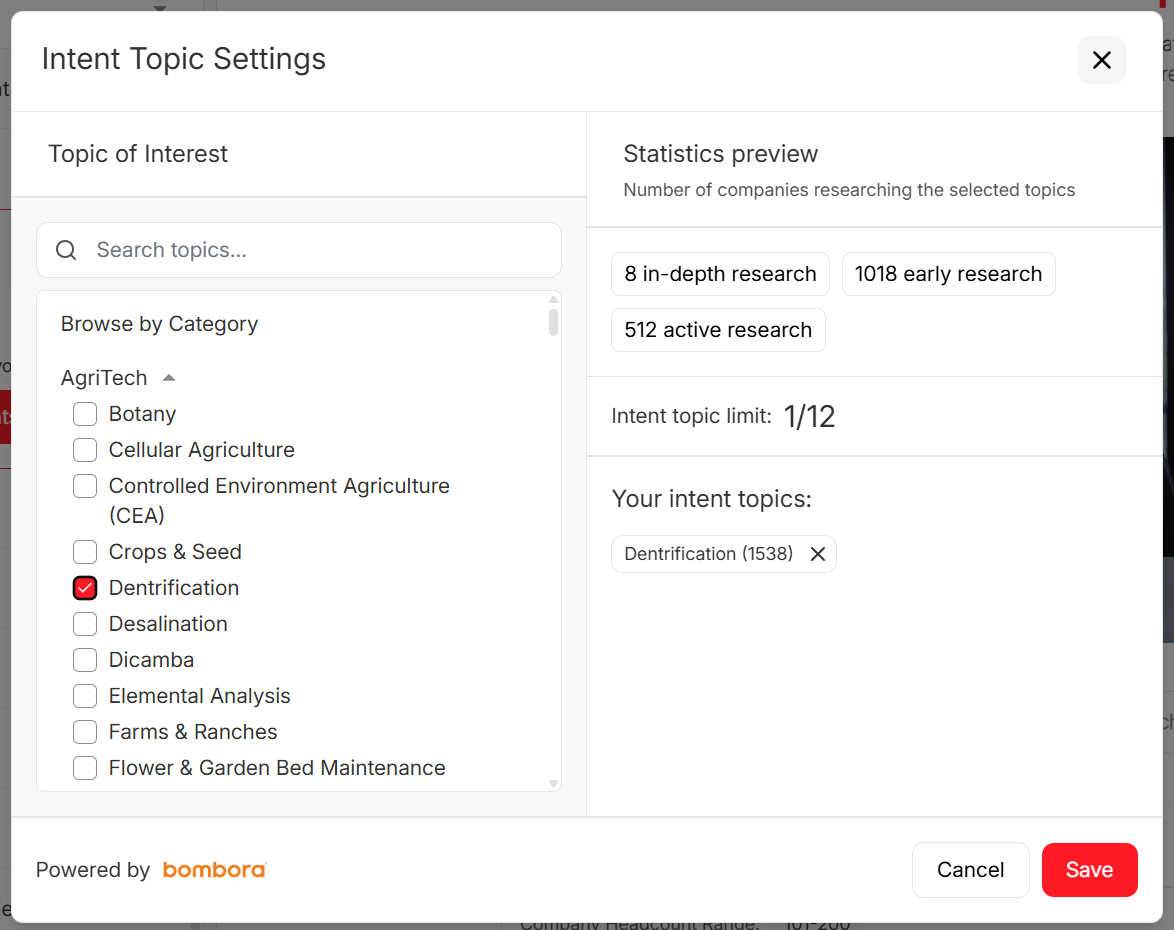
For the data layer, Prospeo covers 300M+ professional profiles with 98% email accuracy and a 7-day refresh cycle - compared to the 6-week industry average. Bombora-powered intent data tracks 15,000 topics, so you can identify which accounts are actively researching your category before they ever fill out a form. The free tier gives you 75 verified emails plus 100 Chrome extension credits per month, enough to test your first nurture cadence. Paid plans run about $0.01 per email with no contracts.
For email automation, Instantly (~$30-97/month), Lemlist (~$39-99/month), or Smartlead (~$39-79/month) handle sequencing and send optimization. All three integrate natively with Prospeo, so verified contacts flow directly into your sequences without manual CSV exports.
If you're evaluating vendors, start with a shortlist of data enrichment options and a dedicated SDR tool for sequencing.
Your MQL-to-SQL rate lives or dies on data quality. When 36% of leads never advance, enriching contacts with 50+ data points and 7-day-fresh records turns your mid-funnel from a leak into a pipeline engine. At $0.01 per email, fixing MOFU costs less than one lost deal.
Enrich your MOFU leads with verified data before your competitors do.
Pipeline Velocity Formula
Everything above feeds into one number your leadership team actually cares about: pipeline velocity.
Pipeline Velocity = (Opportunities x Avg Deal Value x Win Rate) / Sales Cycle Length
Say you have 50 qualified opportunities, a $25,000 average deal value, a 30% win rate, and a 90-day sales cycle. Your daily revenue velocity is (50 x $25,000 x 0.30) / 90 = $4,167/day.
Now improve your MQL-to-SQL conversion by 10% - that feeds more qualified opportunities into the formula. Shorten your sales cycle by even a week through better MOFU nurturing, and velocity jumps again. SaaS companies average around $1,847/day in pipeline velocity. The point isn't the absolute number - it's that optimizing the middle of the funnel directly increases the numerator (more opportunities, higher win rates) and decreases the denominator (shorter cycles). It's the highest-leverage stage to fix.
If you want to pressure-test your numbers, compare them against broader funnel metrics and your overall sales conversion rate.
FAQ
What's the difference between MOFU and the consideration stage?
They're the same concept viewed through different frameworks. MOFU is funnel terminology; "consideration stage" comes from the buyer journey model. Both describe the phase where prospects evaluate solutions after recognizing a problem. Use whichever language your team prefers - the tactics are identical.
What's a good MQL-to-SQL conversion rate?
For B2B companies with deal sizes above $5K, 40% is average, 60% is good, and 80%+ is great. Most B2B SaaS teams cluster around 38-40%. Below 30% typically signals a qualification criteria or nurture process issue, not a volume problem.
How long should a MOFU nurture sequence last?
Four weeks is the standard starting point for mid-market deals. Enterprise cycles of 6+ months may need 8-12 week sequences, while SMB motions with shorter cycles can compress to 2-3 weeks. Test cadence length against your MQL-to-SQL rate rather than guessing.
How do I know when a lead is ready for BOFU?
Intent signals matter more than activity volume. Pricing page visits, demo requests, multi-stakeholder engagement from the same account, and third-party intent data (G2 research, Bombora topic surges) are stronger indicators than ebook downloads. Look for clusters of high-value actions within a short window rather than a slow drip of low-signal engagement.
What tools do I need for MOFU?
At minimum: a CRM with lead scoring (HubSpot or Salesforce), email automation (Lemlist, Instantly, or similar), and a verified data platform for contact accuracy and intent signals. Get those three working before adding anything else to the stack.