

Miller Heiman Blue Sheet Example: A Field-by-Field Walkthrough
Ask in any sales community and you'll hear the same complaint: everyone explains what a Blue Sheet is, nobody shows you one filled out. That's like teaching someone to cook by describing a kitchen.
This Miller Heiman Blue Sheet example walks through a realistic enterprise deal - every field completed, every rating justified. The Blue Sheet remains the best deal-planning tool for complex sales, but most teams use it as a compliance exercise, and their win rates reflect it. Korn Ferry's 2024 Sales Maturity Survey found that organizations selling with Perspective outperform peers by 22% in win rates, even as overall win rates have dropped 5% over the past three years.
What follows is a fully worked walkthrough for a fictional enterprise deal, field by field, with every cell filled in.
What Is a Blue Sheet?
The Blue Sheet is a strategic opportunity planning tool from Miller Heiman's Strategic Selling methodology. It's a structured one-page plan that forces you to map every stakeholder, competitive threat, and action item for a complex deal. Use it when a deal has real complexity: more than $50K in value, four or more stakeholders, and a sales cycle stretching past 90 days. That describes most enterprise B2B - Gartner research puts the typical complex buying group at 6-10 stakeholders.
Expect to spend 3-5 hours on the initial completion. It's not quick. But it forces the kind of thinking that separates deal strategy from deal hope.
The framework dates back to 1978, when a Reno, Nevada printer ran out of white paper and used blue stock instead - the name stuck, and so did the methodology. One distinction worth making early: MEDDIC qualifies whether a deal is real. The Blue Sheet plans how to win it. They're complementary, not competing.
Full Walkthrough: Worked Example
Let's walk through a fictional but realistic deal: selling a cloud security platform (SecureStack) to Apex Manufacturing, a mid-market industrial company with 1,200 employees. The deal is worth $180K annually.
Opportunity Details
| Field | Entry |
|---|---|
| Today's Date | Jan 14, 2026 |
| Account | Apex Manufacturing |
| Deal Size | $180,000 ARR |
| Sales Objective | Apex replaces legacy on-prem firewall with SecureStack cloud security platform by Q2 2026 |
| Target Close | Mar 31, 2026 |
The Sales Objective is your Single Sales Objective - one sentence describing what the customer buys, not what you sell. Notice it's written from Apex's perspective. That framing matters because it forces you to think about the outcome they're buying, not the features you're pitching.
Competitive Position
| Field | Entry |
|---|---|
| Competitor 1 | PaloGuard (Incumbent) |
| Competitor 2 | CloudShield (Front Runner) |
| PaloGuard Positives | Known vendor, existing integrations |
| PaloGuard Negatives | On-prem only, 3-year contract expiring in 60 days |
| CloudShield Positives | Strong brand, aggressive pricing |
| CloudShield Negatives | No OT/IoT coverage (critical for manufacturing) |
| My Position | Front Runner |
| Funnel Placement | In the Funnel |
Be honest with yourself here. "Front Runner" doesn't mean you've won - it means you're ahead right now. The classic methodology uses an Euphoria-to-Panic continuum for self-assessment. If you can't justify your position with evidence, you're a step behind where you think you are.
Buying Influences
| Name | Role | Influence | Mode | Rating |
|---|---|---|---|---|
| Dana Reeves (CFO) | EB | H | EK | +1 |
| Marcus Chen (VP Ops) | UB | H | G | +4 |
| Priya Nair (IT Dir.) | TB | M | T | +3 |
| James Okoro (Procurement) | TB | L | EK | 0 |
| Lisa Tran (Plant Mgr.) | C | M | G | +4 |
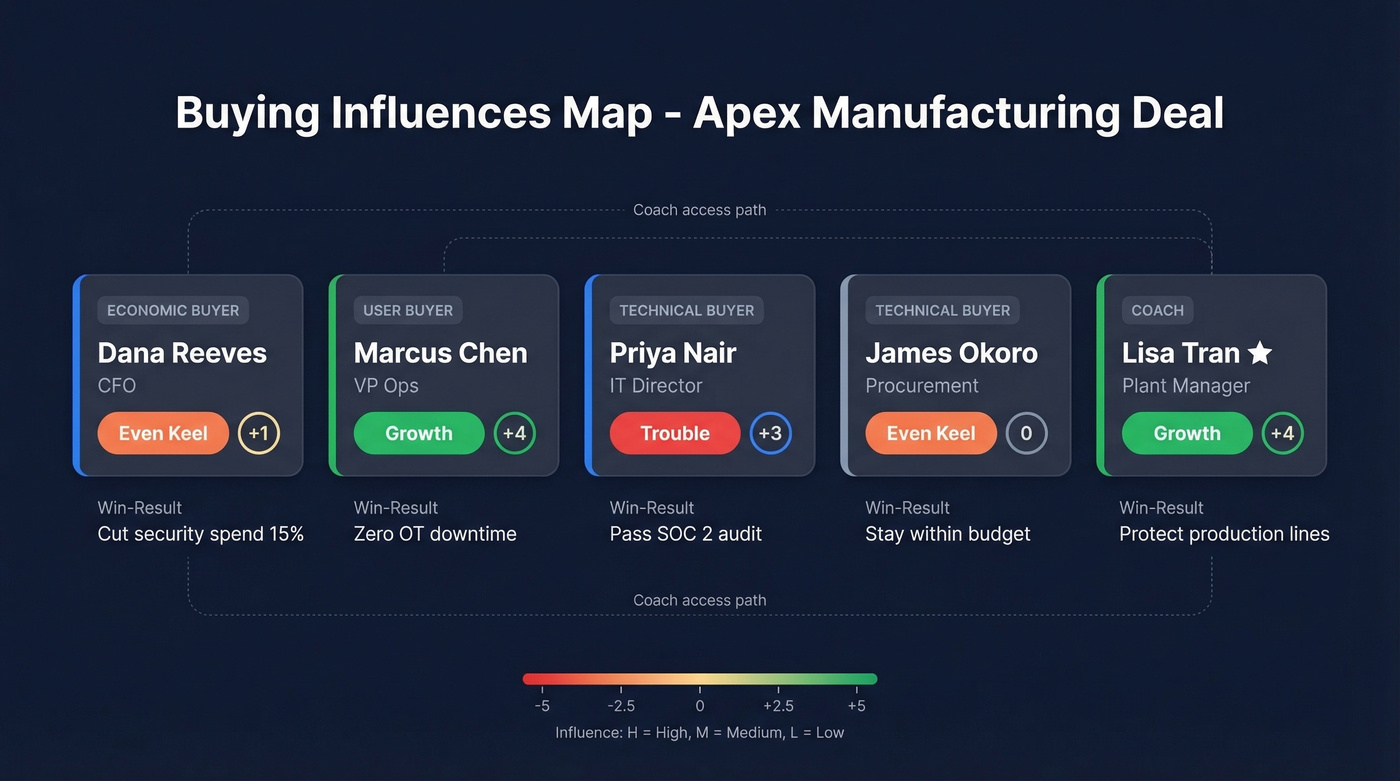
Win-Results by stakeholder:
- Dana Reeves - Business: Cut security spend 15%. Personal: Board confidence in risk posture.
- Marcus Chen - Business: Zero OT downtime from breaches. Personal: Team stops firefighting.
- Priya Nair - Business: Pass SOC 2 audit. Personal: Prove new-hire competence.
- James Okoro - Business: Stay within budget. Personal: Smooth vendor transition.
- Lisa Tran - Business: Protect production lines. Personal: Visibility with exec team.
Lisa Tran is your Coach. The evidence: she's actively sharing internal pain points about last quarter's ransomware scare, she has credibility with Marcus (her direct report feeds into his org), and she's explicitly told you she wants SecureStack to win because the incumbent failed her team.
Here's the thing - most reps we've worked with treat the Coach field as "whoever's nicest to me on calls." That's not a Coach; that's a friendly contact. A real Coach meets three criteria: credibility inside the org, genuine desire for you to win, and access to other stakeholders. Lisa checks all three.
Modes matter in context. Dana (CFO) is in Even Keel - she doesn't see a burning problem, which means your pitch needs to create urgency around the contract expiration. Priya (IT Director) is in Trouble mode - she was hired to fix security gaps and her reputation depends on it. Lean into that.
Red Flags and Strengths
| Type | Detail |
|---|---|
| Red Flag | No direct access to CFO (Economic Buyer) |
| Red Flag | New CTO hired 3 weeks ago - unknown stance |
| Strength | Coach actively championing SecureStack |
| Strength | PaloGuard contract expires in 60 days |
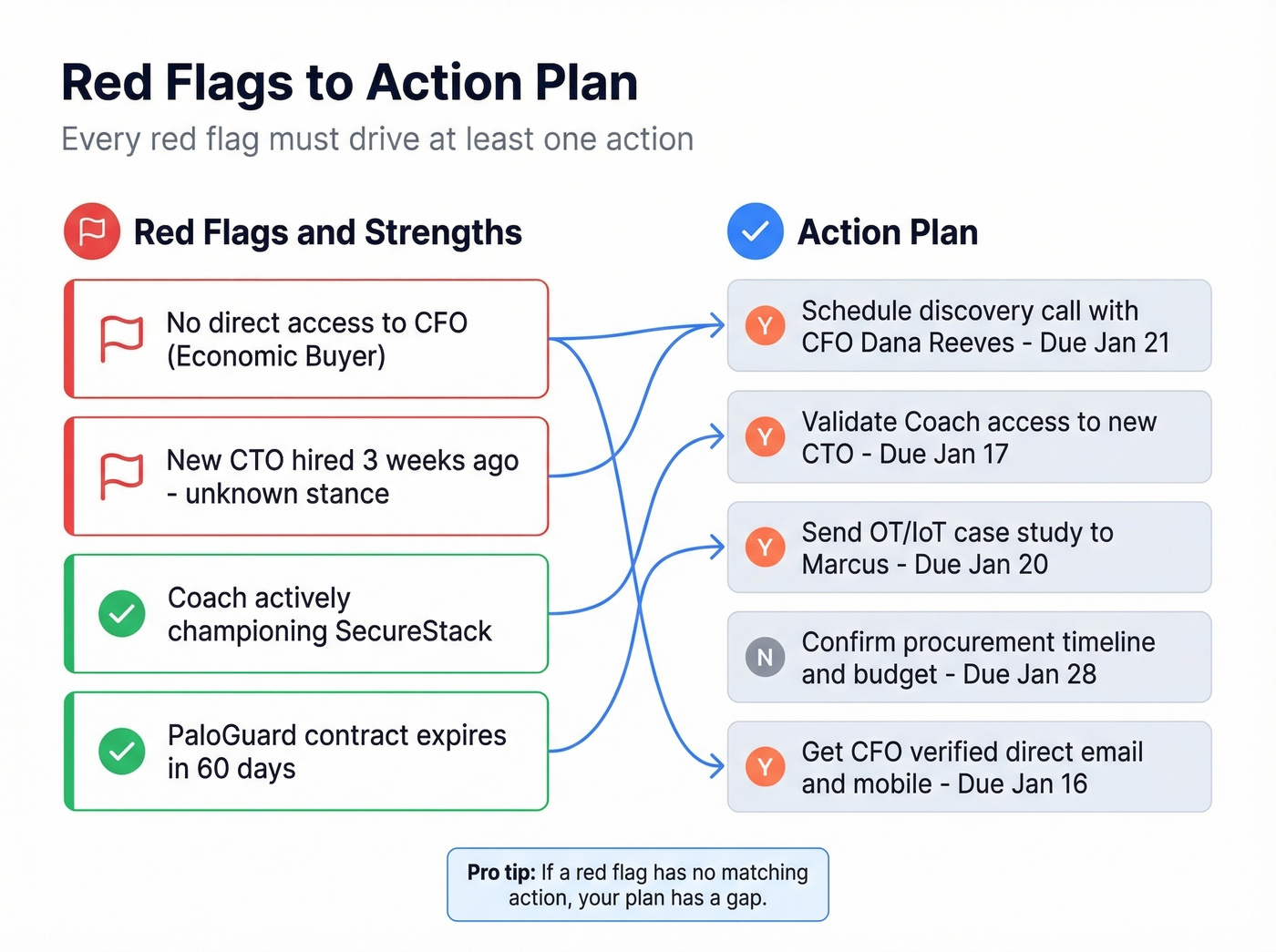
Red Flags aren't problems to ignore - they're the items that drive your Action Plan. Every Red Flag should map to at least one action below.
Action Plan
| Action | Owner | Priority | Due Date |
|---|---|---|---|
| Schedule discovery call with CFO (Dana Reeves) | You | Y | Jan 21 |
| Validate Coach's access to new CTO | You + Lisa | Y | Jan 17 |
| Send OT/IoT competitive displacement case study to Marcus | SE team | Y | Jan 20 |
| Confirm procurement timeline and budget approval process | You | N | Jan 28 |
| Get CFO's verified direct email and mobile | You | Y | Jan 16 |
That last action is where most reps stall. You've mapped the buying committee, you know Dana Reeves is the Economic Buyer, but you don't have her direct contact info. Prospeo handles exactly this - search by name and company, get a verified email in seconds with 98% accuracy, and skip the "can you forward this to your CFO?" chain entirely.
If you're building this into your outbound motion, pair it with sales prospecting techniques that match the buying mode you're seeing.

Your Blue Sheet identified the Economic Buyer. Now you need their direct line. Prospeo gives you 98% accurate emails and verified mobile numbers for 300M+ professionals - so you skip the gatekeeper chain and reach Dana Reeves directly.
Stop asking contacts to forward your emails. Find the Economic Buyer yourself.
Rating Scale Reference
| Rating | Label |
|---|---|
| +5 | Enthusiastic Advocate |
| +4 | Strongly Supportive |
| +3 | Supportive |
| +2 | Comfortable |
| +1 | Neutral-Positive |
| 0 | Neutral |
| -1 | Unconvinced |
| -2 | Skeptical |
| -3 | Resistant |
| -4 | Strong for Competition |
| -5 | Antagonistic Anti-Sponsor |
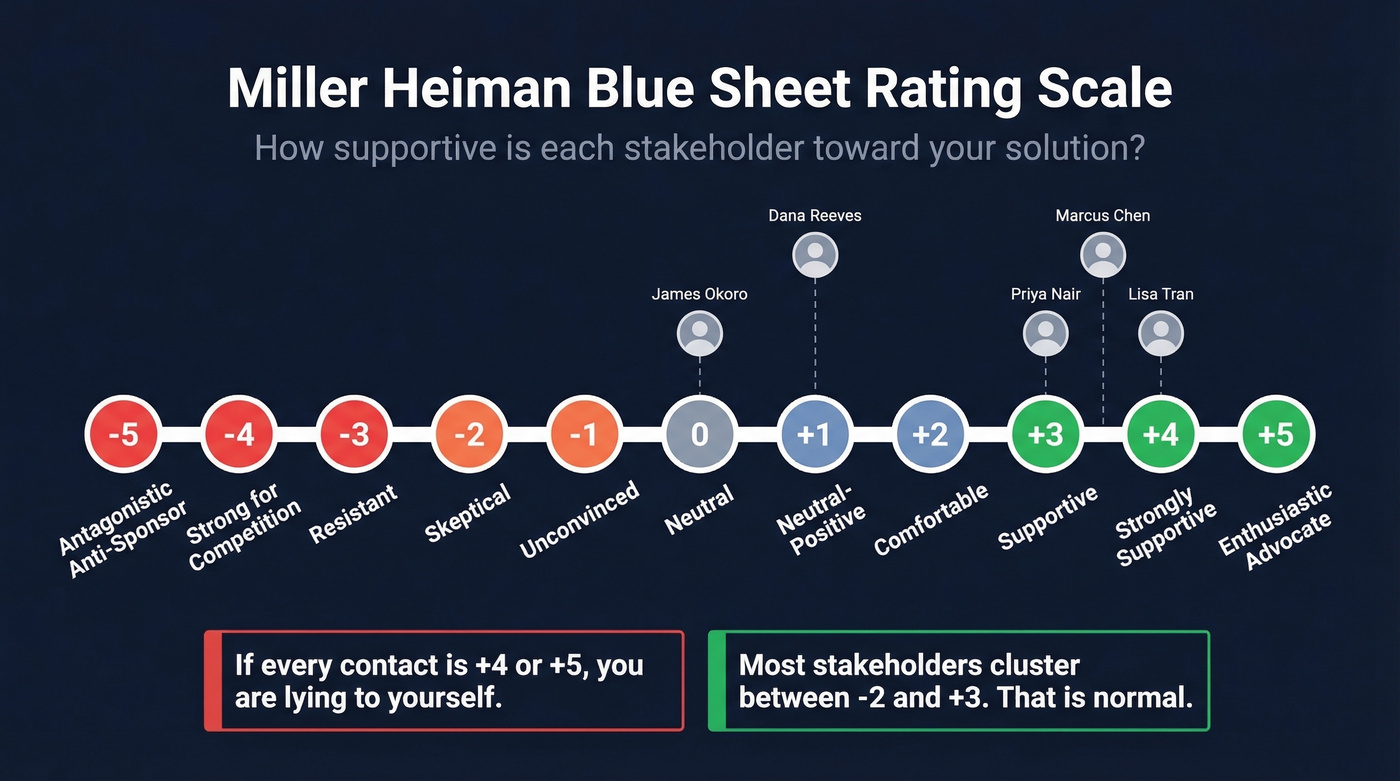
A +5 means they'll advocate internally without being asked - they're selling for you when you're not in the room. A -5 means they'll actively work to kill the deal. Most stakeholders cluster between -2 and +3. If every contact on your sheet is a +4 or +5, you're lying to yourself.
Common Blue Sheet Mistakes
Stale data. We've seen deals die because the sheet was filled out once in January and never touched again. Update it at every stage gate - new stakeholder identified, competitive intel changes, timeline shifts. A stale plan is worse than no plan because it creates false confidence.
Garbage in, garbage out. Guessing at buying modes instead of running real discovery makes the whole exercise theater. If you haven't had a conversation with a stakeholder, mark their mode as unknown and flag it as a Red Flag. The consensus on r/sales is that most teams skip this step and then wonder why their "strategic" plans don't predict outcomes.
If your discovery is weak, fix the inputs first with a tighter set of discovery questions.
Treating it as compliance. If your reps fill these out to survive pipeline reviews rather than to win deals, you've already lost. The tool works when it drives action. The moment it becomes a checkbox, it's dead weight. In our experience, the teams that get the most value are the ones where managers use the sheet to coach during pipeline reviews, not to audit.
This is also where sales execution breaks down: the plan exists, but it doesn't change behavior.
Skip the Blue Sheet entirely for transactional deals under $25K with one or two decision-makers. It'll slow you down without adding insight. The framework earns its keep on deals with genuine political complexity.
Blue Sheet vs Green Sheet
Blue Sheet: "How do we win this deal?" It's Strategic Selling, opportunity-level planning.
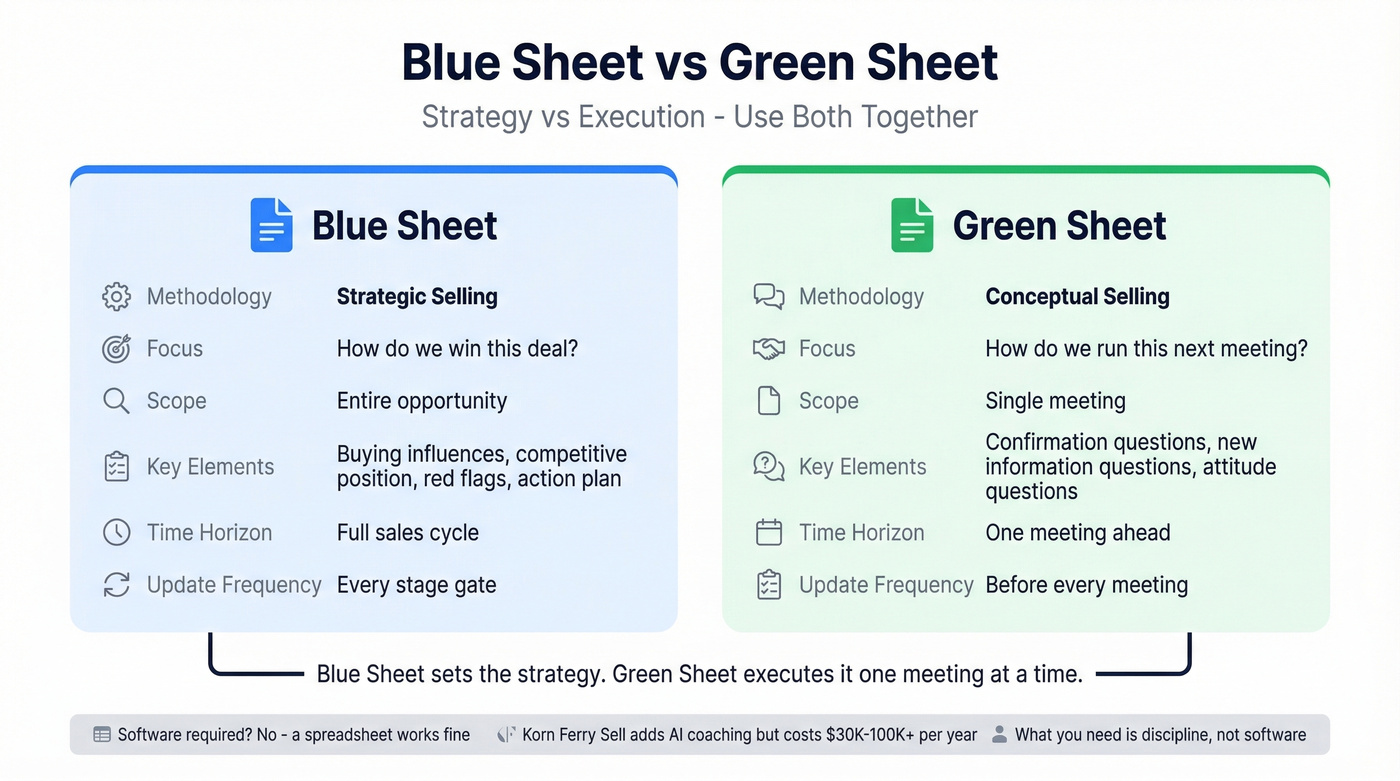
Green Sheet: "How do we run this next meeting so it moves the deal forward?" That's Conceptual Selling, meeting-level planning. The Green Sheet centers on three question types: Confirmation, New Information, and Attitude. It defines the buyer's concept of success before you pitch anything.
Use both. The Blue Sheet sets the strategy; the Green Sheet executes it one meeting at a time. You don't need Korn Ferry Sell for either - a spreadsheet works fine. What you need is discipline.
To keep the plan actionable, many teams tie it into pipeline health reviews and a consistent sales process optimization cadence.
FAQ
How long does it take to complete a Blue Sheet?
Initial completion takes 3-5 hours for a single opportunity. New reps typically need 90-120 days to become proficient with the framework. The time investment pays off on deals above $50K where a single missed stakeholder can kill the deal.
Do I need Korn Ferry Sell software?
No. The framework works in a spreadsheet, Word doc, or on paper. Korn Ferry Sell adds an AI-enabled engine around opportunity planning and coaching workflows, but carries enterprise pricing - typically $30K-100K+/year. The methodology matters more than the software.
How do I reach stakeholders I've mapped?
Once you've identified buying influences, you need verified contact data to execute your action plan. Prospeo gives you 98%-accurate emails and 125M+ verified mobile numbers across 300M+ professional profiles - with a free tier to start. Search by name and company, verify in real time, and push contacts into Salesforce or HubSpot via native integrations.
When should I use a Blue Sheet instead of MEDDIC?
Use both - they solve different problems. MEDDIC qualifies whether a deal is worth pursuing (metrics, decision process, champion). The Blue Sheet plans how to win a qualified deal by mapping every stakeholder's mode, rating, and win-results. On complex deals above $100K with 4+ buyers, running both frameworks together gives you qualification rigor and execution clarity.
A Blue Sheet is only as good as its data. Stale contacts and missing phone numbers turn your deal strategy into deal hope. Prospeo refreshes every record on a 7-day cycle and delivers emails at $0.01 each - so every stakeholder on your sheet has a real, reachable contact attached.
Fill every row on your Blue Sheet with contacts you can actually reach.