

The Complete Mock Sales Call Playbook: Scripts, Scoring Rubric & Practice Scenarios
You just got the calendar invite: Mock Cold Call Exercise - Tomorrow, 2pm. Your stomach drops. You've done maybe two practice calls in your life, both awkward, both useless.
Here's the thing: [70% of what reps learn](https://www.gartner.com/en/documents/5672855) in traditional sales training is forgotten within a week, according to Gartner research. That stat alone explains why most reps walk into a mock sales call unprepared and walk out having learned nothing. Companies that run structured sales call roleplaying consistently see up to 30% higher conversion rates. The difference isn't talent - it's preparation.
If your mock call is tomorrow, you need three things: a prospect character sheet, a two-sided script, and a scoring rubric. This guide gives you all three. Short on time? Jump straight to the scripts section.
What Is a Mock Sales Call?
A mock sales call is a simulated sales conversation where one person plays the rep and another plays the prospect - no real money on the line, no real prospect getting annoyed.
Two distinct use cases require different approaches. The first is team training: managers running weekly roleplays to sharpen discovery skills, test new objection-handling frameworks, or onboard new hires. The second is interview prep - candidates practicing for the mock cold call that's become standard in SDR and AE hiring loops. Both share the same fundamentals, but the stakes and scoring criteria differ. We'll cover both.
How to Prepare for Your Next Roleplay
Preparation is where most people fail. A post on r/techsales about bombing a mock cold call made this painfully clear: the interviewer's feedback was that the opener and problem pitch were solid, but the discovery questions didn't match the persona. The candidate had prepared generic questions for a generic buyer instead of role-specific questions for an HR Director. The interviewer noticed immediately.
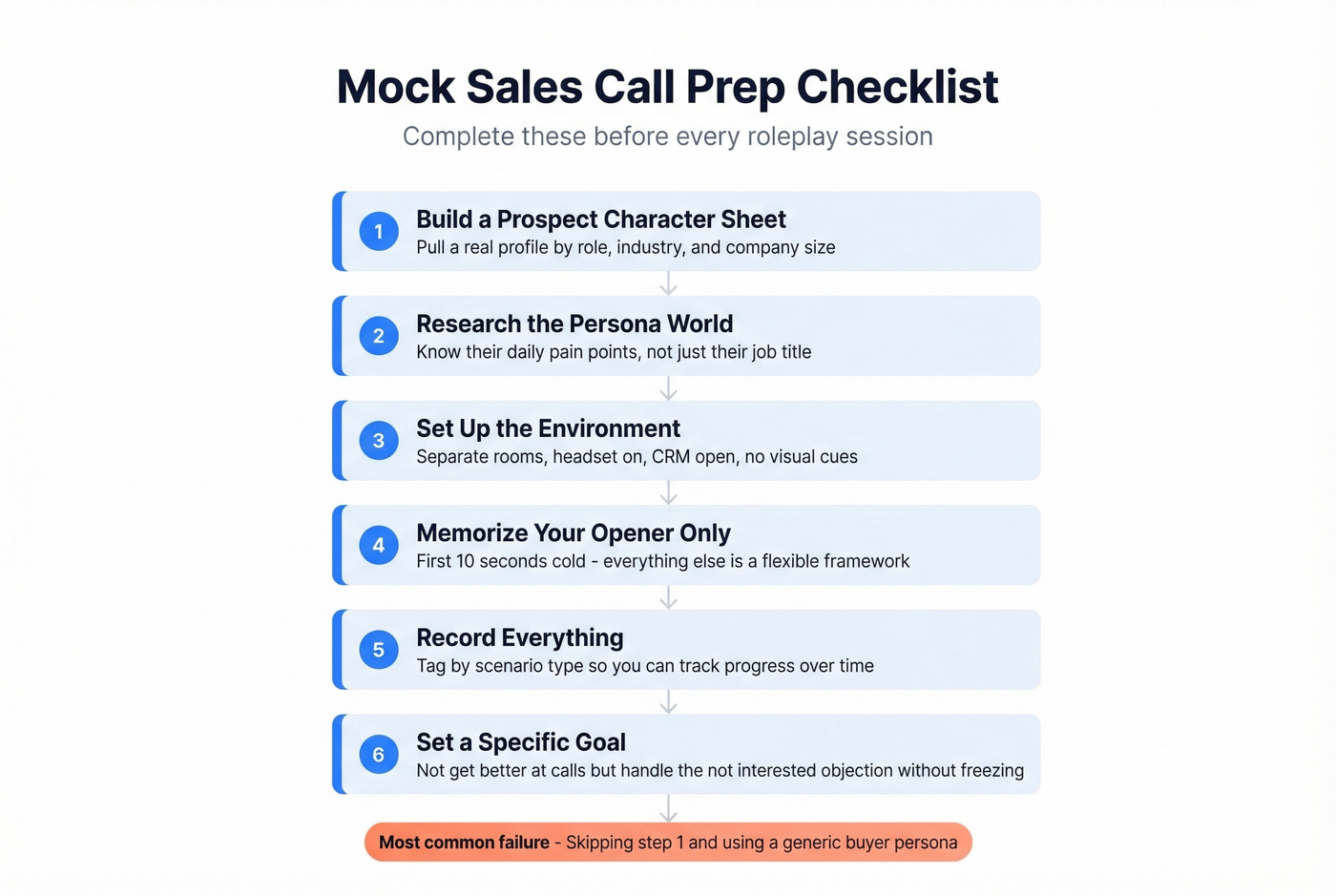
Here's your prep checklist:
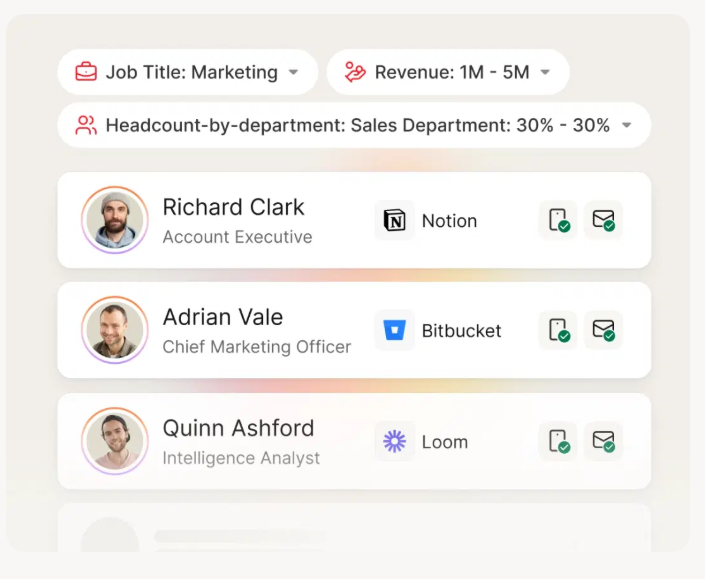
1. Build a prospect character sheet. Before anything else, create a detailed profile of the person you're calling - name, company, role, daily challenges, what they care about, their likely mood when they pick up. This is the single most important prep step. Instead of inventing a fictional buyer, pull a real prospect profile from a data platform like Prospeo - search by role, industry, and company size to find an actual VP of Marketing with real challenges. That's infinitely more useful than "Jane from Acme Corp."
2. Research the persona's world. If your prospect is a CFO, know what keeps CFOs up at night. If they're in healthcare SaaS, understand their compliance headaches. Generic discovery questions are the #1 failure mode in mock calls. If you need a tighter framework, use a set of role-based discovery questions to guide your prep.
3. Set up the environment. Separate rooms or at least face away from each other. Use a headset. Have your CRM open. Remove visual cues - you need to learn to read tone, not body language, because that's how real cold calls work.
4. Have your opener memorized, not your whole script. You should know your first 10 seconds cold. Everything after that should be a framework you can adapt. If you want more options, borrow from these talk track examples.
5. Record everything. You can't improve what you can't review. Use your phone, Zoom, or a call recorder. Tag it by scenario type so you can track progress over time.
6. Set a specific goal for each session. "Get better at cold calls" isn't a goal. "Improve my permission-based opener and handle the 'not interested' objection without freezing" - that's a goal.
Mock Sales Call Scripts
Every roleplay guide tells you to "practice objection handling" and then gives you zero scripts. Here are full two-sided dialogues you can use immediately.
These are adaptive frameworks, not word-for-word recitations. Use them for structure and rhythm, then make them yours.
Cold Call to a New Prospect
Rep: "Hi Sarah, this is Mike from [Company]. I know I'm calling out of the blue - do you have three minutes? If it's not relevant, I won't call again. Does that sound fair?"
Prospect: "...Three minutes. Go ahead."
Rep: "Appreciate it. I work with VPs of Marketing who are spending 10+ hours a week on lead qualification that should be automated. Curious - how are you handling [inbound lead scoring](https://knowledge.hubspot.com/scoring/understand-the-lead-scoring-tool) right now?"
Prospect: "We've got a system. It's not perfect, but it works."
Rep: "Got it. When you say not perfect - is that a volume problem, a quality problem, or both?"
Prospect: "Mostly quality. Half the leads my team follows up on aren't a fit."
Rep: "That's exactly what I hear from most marketing leaders. We helped [similar company] cut unqualified follow-ups by 40% in about six weeks. Would it make sense to block 20 minutes next Tuesday so I can show you how that worked?"
Getting Past the Gatekeeper
This one trips up even experienced reps. The instinct is to bulldoze - but the real goal is to leave a specific, intriguing message and gather intel for the next attempt.
Rep: "Hi, this is Alex from [Company]. I'm trying to reach David Chen in procurement - could you transfer me?"
Gatekeeper: "He's not available right now. Can I take a message?"
Rep: "Sure - could I also grab his direct extension or email? I want to make sure I reach him directly next time."
Gatekeeper: "I can take a message, but I can't give out extensions."
Rep: "Totally understand. Would you mind letting him know Alex from [Company] called about reducing vendor onboarding time? I'll try back Thursday morning. Is he usually available before 10?"
Notice the specificity. You're not just leaving a name - you're leaving a reason to call back, a timeframe, and a question that gives you scheduling intel for free.
Handling "I'm Not Interested"
Prospect: "Yeah, I'm not really interested."
Rep: "Totally fair - most people aren't when they get a cold call. Can I ask one quick question before I let you go? How are you currently handling [specific pain point]?"
Prospect: "We've got it covered internally."
Rep: "Makes sense. The reason I ask is that [similar company] said the same thing, and when we dug in, they were spending 15 hours a week on something we automated in two. Give me two minutes to explain - and if it's not for you, I won't call again."
Prospect: "...Fine. Two minutes."
Objections aren't rejection - they're engagement. A prospect who says "not interested" is still on the phone. A prospect who hangs up gave you nothing to work with. For more reps, see these cold call rejection scripts and fixes.
Handling the Price Objection
This scenario is worth practicing separately because price pushback requires a fundamentally different response than "not interested." You can't reframe price with more features - you reframe it with ROI.
Prospect: "That's way more than we budgeted for this."
Rep: "I hear you - and I wouldn't want you to overspend. Can I ask what you're spending right now on [the problem], including the team hours?"
Prospect: "I don't know, maybe $3K a month plus two people part-time."
Rep: "So roughly $5-6K when you factor in the labor. Our clients in your space typically cut that total cost by 30-40% within the first quarter. Would it help if I mapped out the math for your specific situation on a quick call next week?"
100-Point Scoring Rubric
If your manager tells you to "just be natural" without giving you a rubric, they're not coaching - they're vibing. Here's a rubric you can actually use.
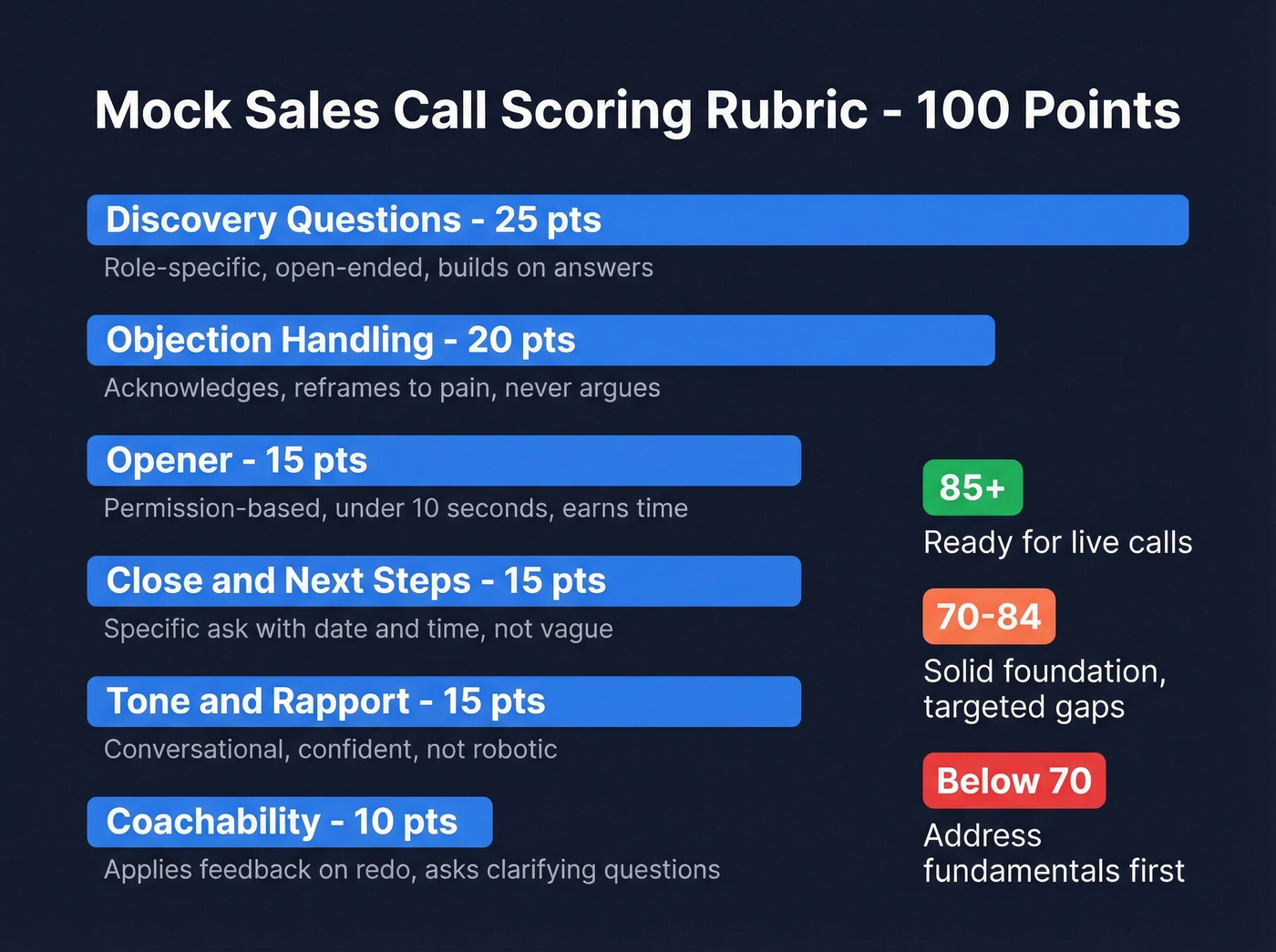
| Category | Points | What "Good" Looks Like |
|---|---|---|
| Opener | 15 | Permission-based, under 10 sec, earns time |
| Discovery Questions | 25 | Role-specific, open-ended, builds on answers |
| Objection Handling | 20 | Acknowledges, reframes to pain, doesn't argue |
| Close / Next Steps | 15 | Specific ask with date/time, not "let's chat sometime" |
| Tone & Rapport | 15 | Conversational, confident, not robotic or rushed |
| Coachability | 10 | Applies feedback on redo, asks clarifying questions |
Scoring thresholds: 85+ is strong - this rep is ready for live calls. 70-84 means a solid foundation with targeted gaps to work on. Below 70 signals fundamental issues that need addressing before anyone goes live.
The coachability category matters more than most people realize. In that bombed mock call thread on Reddit, the candidate got a second attempt after feedback. That redo is common in interviews - hiring managers want to see if you can adjust in real time. We've seen candidates make a massive jump on the redo simply by applying one piece of feedback immediately and visibly. That's the kind of coachability that gets you hired.

Stop inventing fake personas for your mock sales calls. Prospeo's 30+ search filters let you pull real prospect profiles by role, industry, company size, and tech stack - so your roleplay mirrors an actual cold call, not a made-up scenario.
Practice on real buyer profiles, not fictional "Jane from Acme Corp."
Talk-to-Listen Benchmarks
An analysis of over 25,000 sales calls found the ideal talk-to-listen ratio for reps is 43:57 - you talk 43% of the time, the prospect talks 57%. A separate Demodesk study of 328 B2B meetings confirmed that host talk ratios between 40-60% correlated with higher engagement and deal progression.
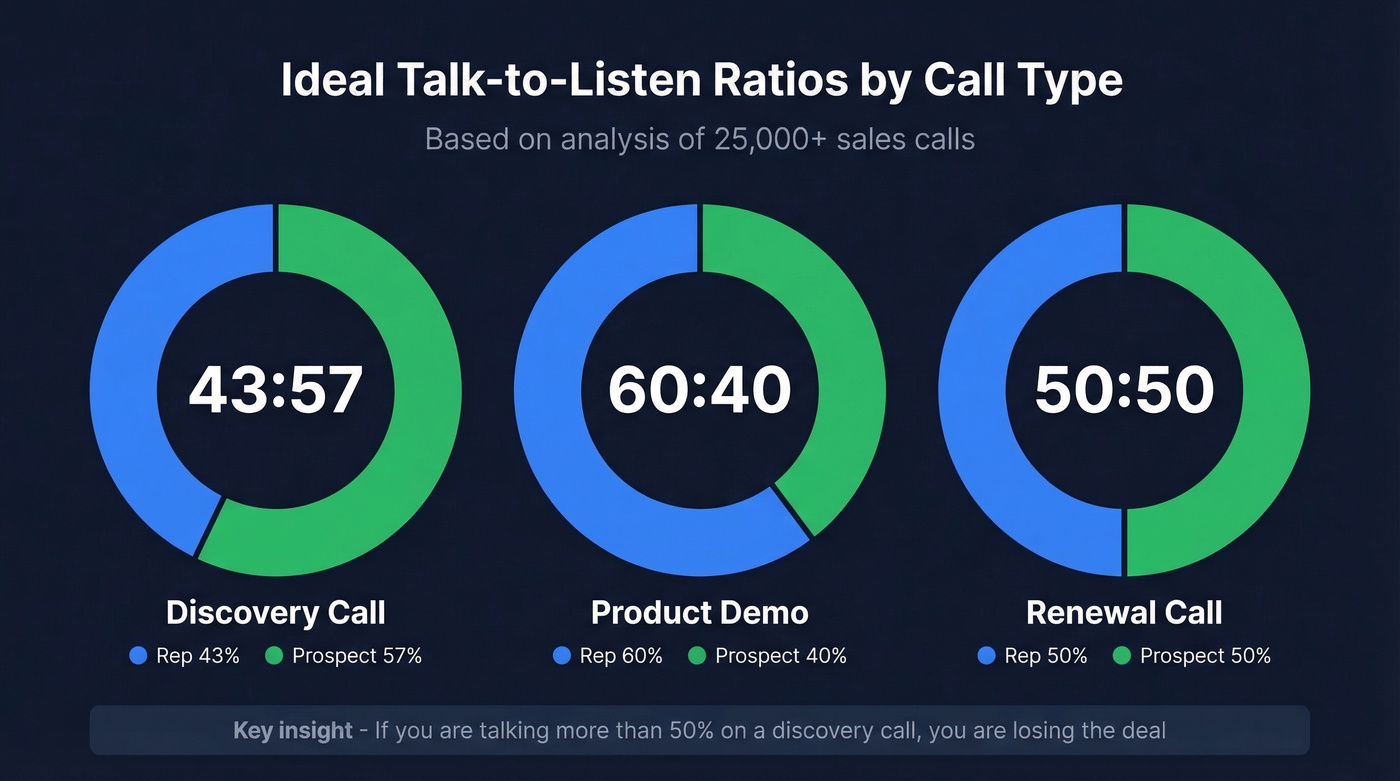
The target shifts by call type:
| Call Type | Rep Talk | Prospect Talk |
|---|---|---|
| Discovery | 43% | 57% |
| Product Demo | 60% | 40% |
| Renewal | 50% | 50% |
The calculation is straightforward: agent talk time divided by total call time. If you're recording your mock calls, most conversation intelligence tools calculate this automatically. During practice, have your observer track it manually with a stopwatch - it's low-tech, but it works.
Mistakes That Kill Your Score
1. Pitching before discovery. The most common mistake in practice calls and real calls alike. If you haven't asked at least two open-ended questions, you haven't earned the right to pitch.
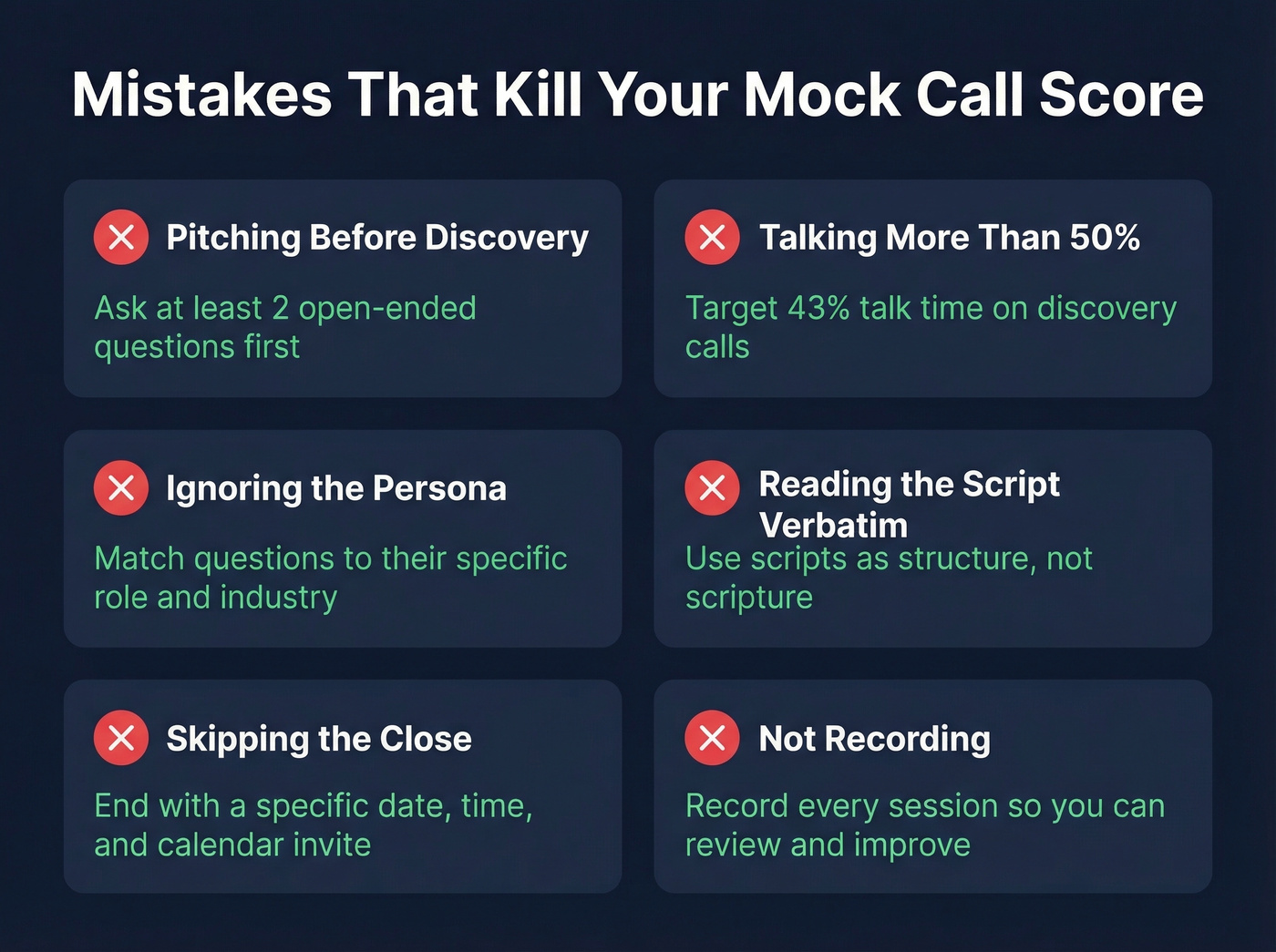
2. Talking more than 50% of the call. Successful reps average around 43% talk time. If you're dominating the conversation, your observer should flag it immediately.
3. Ignoring the persona. The Reddit candidate who bombed their roleplay had a decent opener - but asked generic discovery questions that didn't match an HR Director's world. If your character sheet says CFO, ask about budget cycles and board reporting, not marketing attribution.
4. Reading the script verbatim. Scripts are structure, not scripture. The moment you sound like you're reading, you've lost.
5. Skipping the close. Every practice call should end with a specific next step - a date, a time, a calendar invite. "I'll send you some info" isn't a close. If you need post-call messaging, keep a few sales follow-up templates ready.
6. Not recording. If you didn't record it, you can't review it. And if you can't review it, you're relying on memory - which loses 70% of training content within a week.
7. Only practicing once. One roleplay isn't enough to build muscle memory. You need 5-10 reps across different scenarios to develop real confidence.
How to Run Training Sessions
For managers building a roleplay program, here's the framework that actually works. B2B sales reps average 52 calls a day - your team needs to practice at a pace that reflects reality, not a sanitized version of it.
Create character sheets in advance. Don't wing it. Write out the prospect's name, role, company, challenges, mood, and likely objections. Distribute these to whoever's playing the prospect at least a day before the session.
Play the full call. Start from the dial tone. Include the ring, the "hello," the awkward first three seconds. Skipping the intro trains reps for a scenario that never happens in real life.
Remove visual cues. Separate rooms, back-to-back seating, or phone-only. Reps need to learn voice-only communication because that's what cold calling actually is. If you're building a repeatable process, document it as a cold calling system.
Record every session. Tag recordings by rep, scenario type, and date. This creates a coaching library you can reference during 1:1s - and it compounds in value over months.
Progress the difficulty. Start with friendly prospects, then add gatekeepers, then hostile objections, then multi-stakeholder calls. End with an intentionally hostile scenario - the worst call imaginable - to inoculate reps against real-world stress. Skip this if your team is brand new; beginners shouldn't face the hardest scenarios first.
Have reps self-critique first. Before you give feedback, have the rep listen to their recording and identify what they'd change. This builds self-awareness and reduces defensiveness when your notes come next.
Debrief with the rubric. Use the 100-point scorecard above. Specific scores beat vague feedback like "that was pretty good" every time.
Let's be honest: a quarterly roleplay session is a box-checking exercise. Weekly practice builds the repetition that actually changes behavior. If you’re formalizing onboarding, plug this into a 30-60-90 day plan for sales reps.
AI Tools for Solo Practice
Not everyone has a manager willing to run weekly roleplays. And even if you do, sometimes you need extra reps on your own time. 43% of enablement leaders already use AI-powered roleplay for coaching, and the tools have gotten genuinely good - AI call scoring can significantly reduce ramp time.
As one enablement leader at Visa University put it: "Leaders are busy - spending one or two hours in role plays isn't scalable. We're using AI to give reps real-time feedback."
We've tested several of these tools. Hyperbound's custom personas felt the most realistic, but Yoodli's free tier is hard to beat for solo practice on a budget.
| Tool | Price | Best For | Key Strength |
|---|---|---|---|
| Yoodli | Free-$8/user/mo | Free solo practice | No-cost entry, speech analytics |
| Second Nature | ~$30-40/user/mo | Team value play | Structured scenarios, coaching feedback |
| Hyperbound | ~$150-250/user/mo | Most realistic AI prospect | Custom personas, advanced objections |
For enterprise teams, Mindtickle and Allego offer full enablement suites with AI roleplay baked in - expect $20K-80K/year depending on team size and modules.
Here's our take: if your average deal size is under $15K, you probably don't need Hyperbound-level tooling. Yoodli plus a willing colleague will get you 80% of the way there. Save the budget for better prospect data. (If you're evaluating stacks, start with this list of generative AI sales tools.)
Acing a Mock Call in a Sales Interview
If you're prepping for an interview mock call specifically, here's what separates candidates who advance from those who don't.
Research the company's ICP before the call. If you're interviewing at a cybersecurity company, your discovery questions should reference CISO pain points, not generic "what challenges are you facing?" softballs. This single step puts you ahead of 80% of candidates. Use an ideal customer profile template to structure your notes.
Ask persona-specific discovery questions. This is the #1 differentiator. Generic questions signal you didn't prepare. Role-specific questions signal you understand the buyer's world.
Expect a redo. Most interviewers give feedback and ask you to run it again. This isn't a second chance - it's a coachability test. Apply the feedback immediately and visibly.
Treat it like a real call. Same energy, same pacing, same professionalism. If you'd use a notepad on a real call, use one here.
Prepare for non-standard objections. The interviewer will throw objections that mirror what their real SDRs face daily. Research the company's product and think about what their actual prospects push back on - pricing, implementation timeline, switching costs. That level of preparation shows you've done the work.
The best mock calls start with real research. Prospeo gives you 50+ data points per contact - job title, company revenue, headcount growth, tech stack - so your discovery questions land exactly like they would on a live call.
Nail your next mock call with prospect intel that's refreshed every 7 days.
FAQ
How long should a mock sales call last?
Five to ten minutes for cold call practice, 15-20 minutes for discovery roleplays. Always play from dial tone to hang-up - skipping the intro removes the hardest part.
How many practice calls should I do before a sales interview?
Run at least 5-10 across different scenarios - gatekeeper, discovery, objection-heavy. Record each one and review it before the next session to compound improvements.
Can I practice mock calls alone?
Yes. AI tools like Yoodli (free) or Second Nature (~$30-40/mo) simulate realistic prospect conversations with real-time feedback on pacing, filler words, and talk-to-listen ratio.
What do hiring managers score during a mock sales call?
Opener quality (15 pts), discovery relevance (25 pts), objection handling (20 pts), tone (15 pts), close specificity (15 pts), and coachability (10 pts). Discovery and objection handling carry the most weight.
How do I make roleplay scenarios more realistic?
Use real prospect data instead of fictional companies. Build your character sheet around an actual decision-maker with real challenges - search by role, industry, and company size to pull genuine profiles. Pair that with separate rooms and phone-only communication.