

How to Send Multiple Follow-Up Emails Without Killing Your Reply Rate
You sent a solid cold email on Monday. It's Thursday. No reply. You type "Just wanting to follow up..." and immediately delete it. Good instinct - that email was going to do nothing.
Here's the thing: 48% of reps never send a second email, yet 42% of replies come from follow-ups. The gap between sending one message and running a real B2B cold email sequence is where deals live.
How Many Follow-Ups Should You Actually Send?
The vendors can't agree, because the right number depends on your list quality, not your persistence.
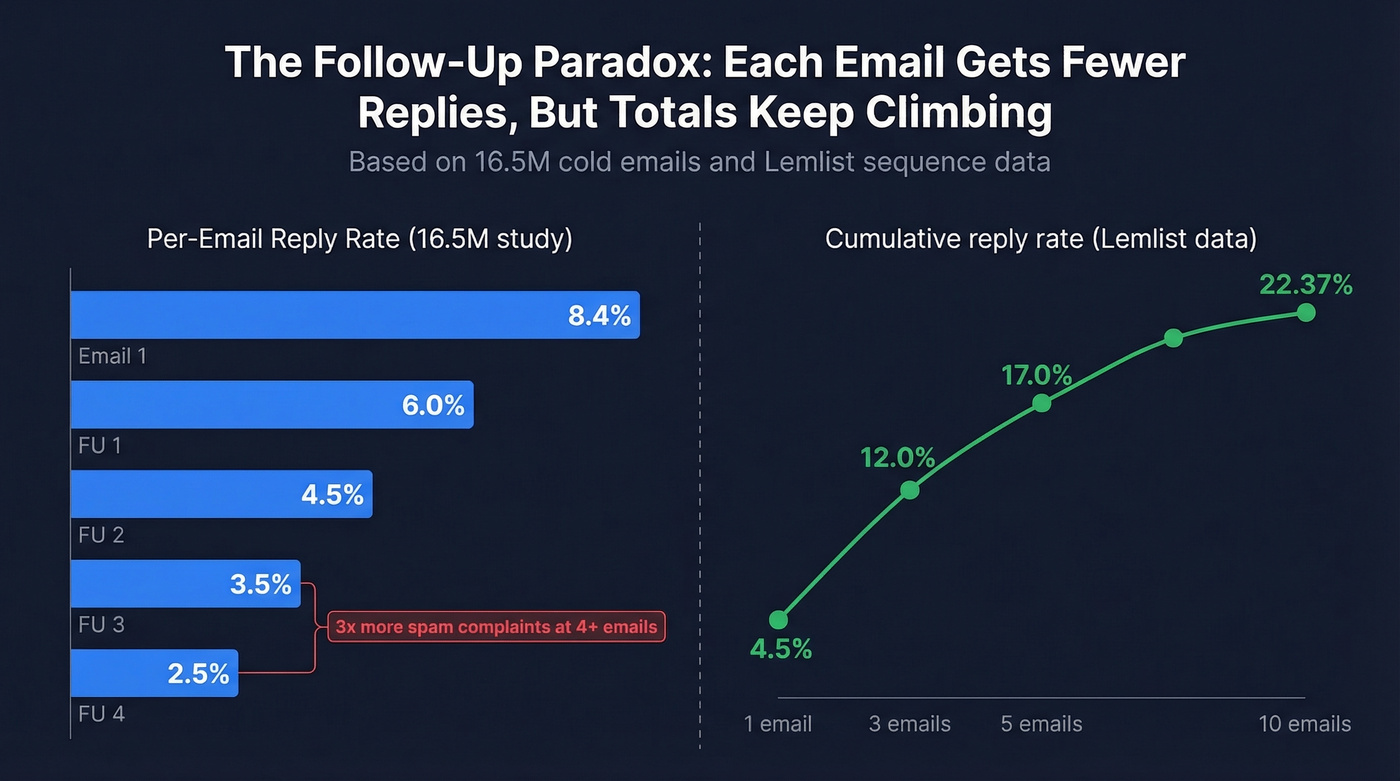
A study of 16.5 million cold emails found the highest per-email reply rate - 8.4% - comes from the initial send, with performance declining on each subsequent touch. Sending 4+ emails in a sequence more than triples unsubscribes and spam complaints. That's a strong argument for restraint.
Lemlist's data tells a different story: cumulative reply rates climb from 4.5% on a single email to 22.37% across a 10-email sequence. And Woodpecker's benchmarks show seasoned senders jumping from 16% to 27% with at least one follow-up. Both are right - Lemlist counts cumulative replies across the full sequence while the 16.5M-email dataset measures per-email performance, so each follow-up generates fewer replies but the total keeps climbing.
Outreach's customer benchmarks reinforce why this matters: the average sequence reply rate is just 2.9%. Every follow-up has to earn its spot.
Company size changes the math. Small companies (2-50 employees) bounce back to 8.4% on the second follow-up - they're forgiving. Enterprise prospects? Allergic to persistence. Founder personas peak at 6.94% on the second follow-up, then crater to 3.01% by the fourth. Some industries hold up better - manufacturing and transportation maintain ~6.5%+ through two follow-ups.
Our recommendation for most B2B teams: 3-5 follow-ups. Fewer if you're targeting enterprise B2B sales. More only if your list is warm and verified.
The Right Cadence for Scheduled Follow-Ups
Spacing matters as much as volume. Lemlist's data suggests increasing gaps between touches, keeping the total sequence between 10 and 25 days. Woodpecker recommends at least 2-3 days minimum between any two emails.
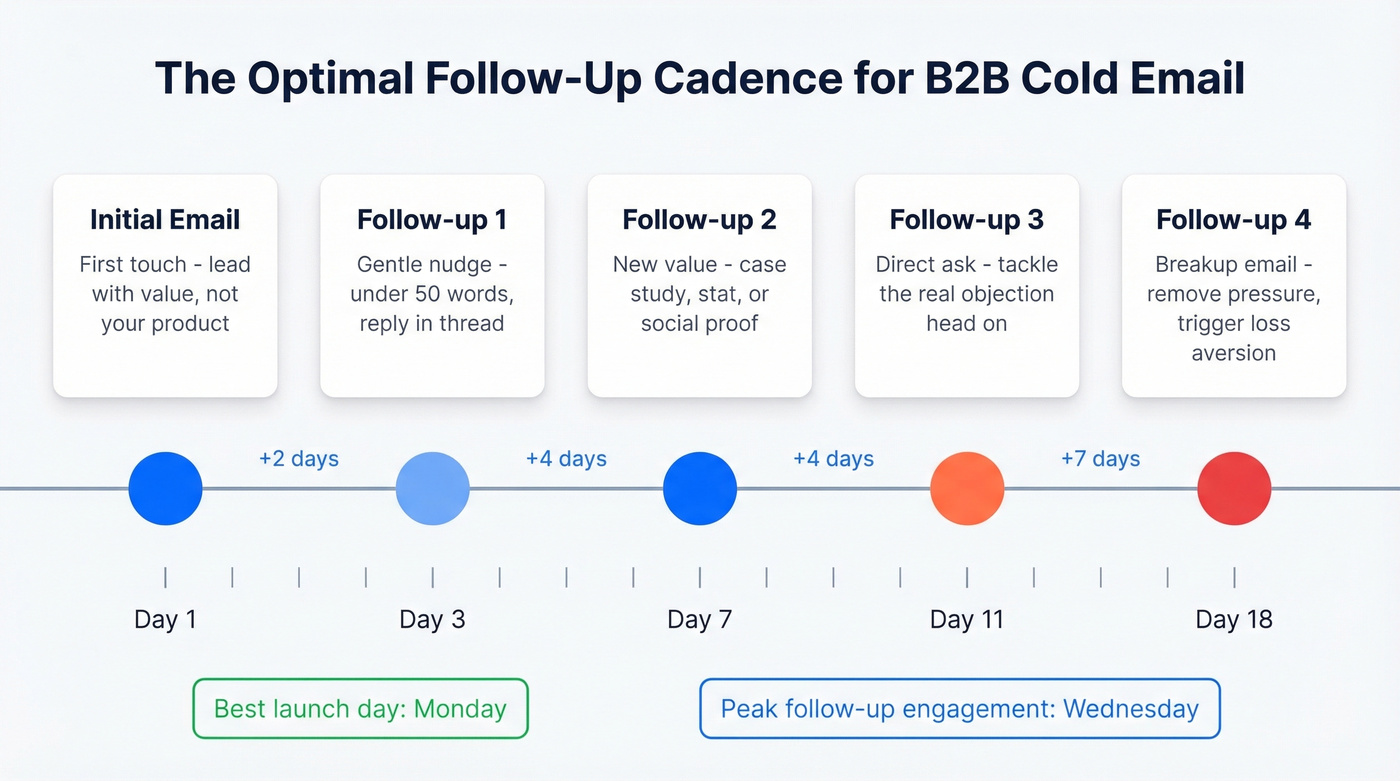
| Follow-Up | Day | Spacing | Purpose |
|---|---|---|---|
| Initial email | Day 1 | - | First touch |
| Follow-up 1 | Day 3 | +2 days | Gentle nudge |
| Follow-up 2 | Day 7 | +4 days | New value / social proof |
| Follow-up 3 | Day 11 | +4 days | Different angle |
| Follow-up 4 | Day 18 | +7 days | Final email |
Monday is the best day to launch new sequences, with Wednesday showing peak engagement for follow-ups. Before you implement this cadence, verify your list - bounced follow-ups destroy sender reputation faster than no follow-ups at all. We've seen teams run beautiful 5-touch sequences that land entirely in spam because 12% of their addresses were invalid from the start.

Every bounced follow-up compounds domain damage. Prospeo's 5-step verification delivers 98% email accuracy on a 7-day refresh cycle - so your 3-5 touch sequence actually reaches real inboxes. At ~$0.01/email, cleaning your list costs less than a single wasted follow-up.
Verify your list before you send follow-up #1.
What to Say in Each Follow-Up
The cardinal sin of follow-ups is bumping with no new information. "Just checking in" tells your prospect you have nothing new to offer. A continuous follow-up that repeats the same ask trains your recipient to ignore every message in the thread.
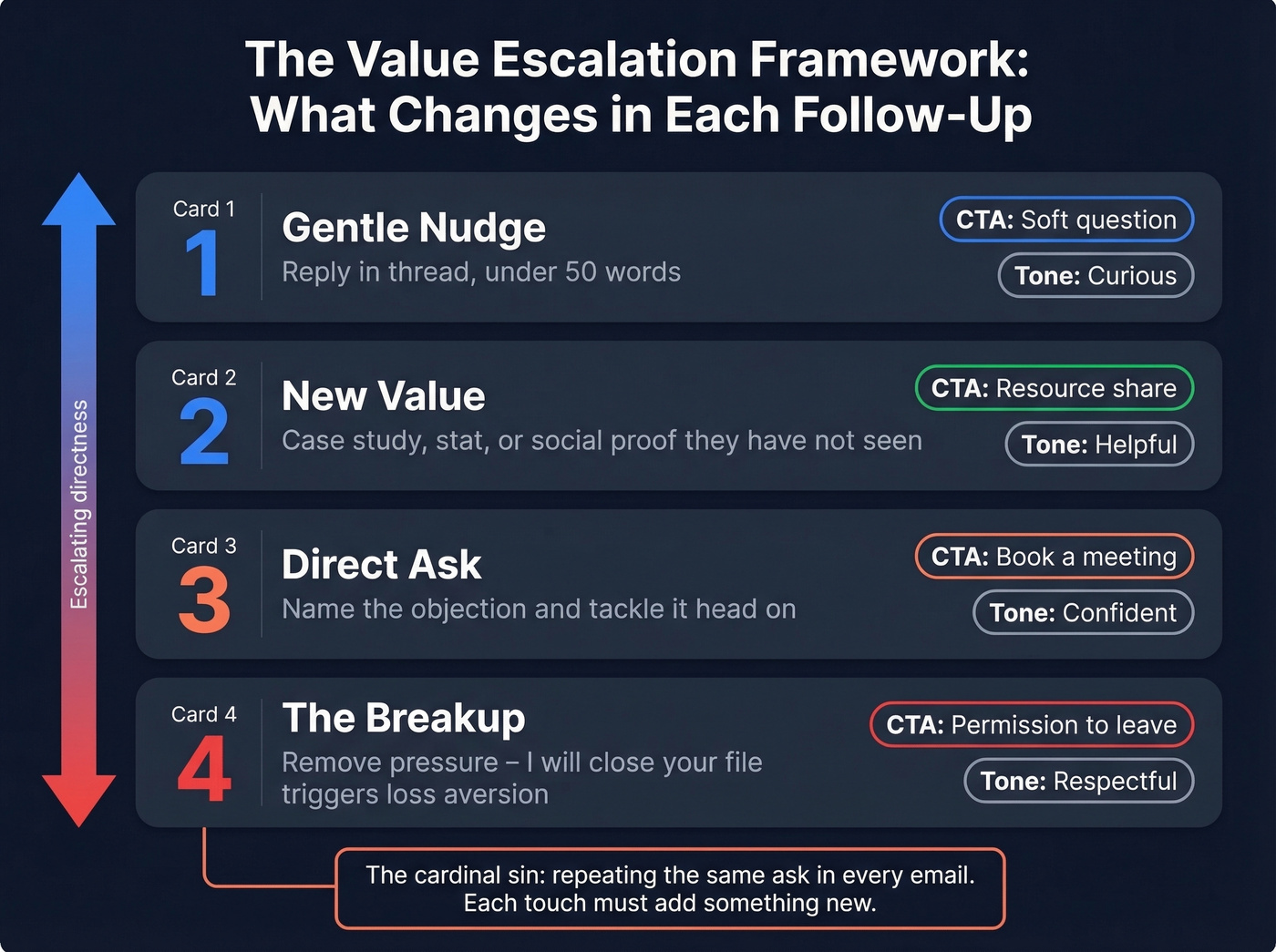
Follow-Up 1 - The Gentle Nudge
Reply in-thread. Keep it under 50 words. Reframe your core value prop as a question with a soft CTA.
Hey {{first_name}}, wanted to make sure this didn't get buried. Does reducing {{pain point}} by {{specific metric}} even matter for your team right now? Happy to share how {{company}} did it.
Follow-Up 2 - New Value
This is where you earn the reply. Add a case study, a relevant stat, or social proof your first email didn't include.
{{first_name}}, quick data point - {{similar company}} cut their {{metric}} by {{number}} in {{timeframe}} using this approach. Wrote up a 2-min breakdown [here]. Worth a look if {{pain point}} is on your radar this quarter.
Follow-Up 3 - Direct Ask
By email three, stop hinting. GMass identifies five objection categories: no need, value vs. cost, no urgency, don't want it, and don't trust you. Pick the most probable one for your persona and tackle it head-on:
{{first_name}}, most {{title}}s I talk to say they've already tried solving {{problem}} internally. The issue usually isn't effort - it's that {{specific insight about why internal solutions fail}}. Let's block 15 minutes this week to compare approaches.
Follow-Up 4 - The Breakup
The breakup email works because it removes pressure. "I'll close your file" triggers loss aversion without being pushy.
{{first_name}}, I haven't heard back, so I'll assume the timing isn't right. I'm closing your file - but if {{pain point}} becomes a priority later, just reply to this thread. No hard feelings either way.
These four cover the core cold outreach sequence. For scenario-specific follow-ups - post-meeting, post-proposal, post-event - the same value-escalation framework applies. Just swap the context.
Mistakes That Kill Your Sequence
"Just checking in" with no new info. Every empty email trains your prospect to ignore you. We've audited sequences where all four follow-ups were essentially the same sentence reworded. Don't do this. (If you need better language, borrow from these sales follow-up templates.)
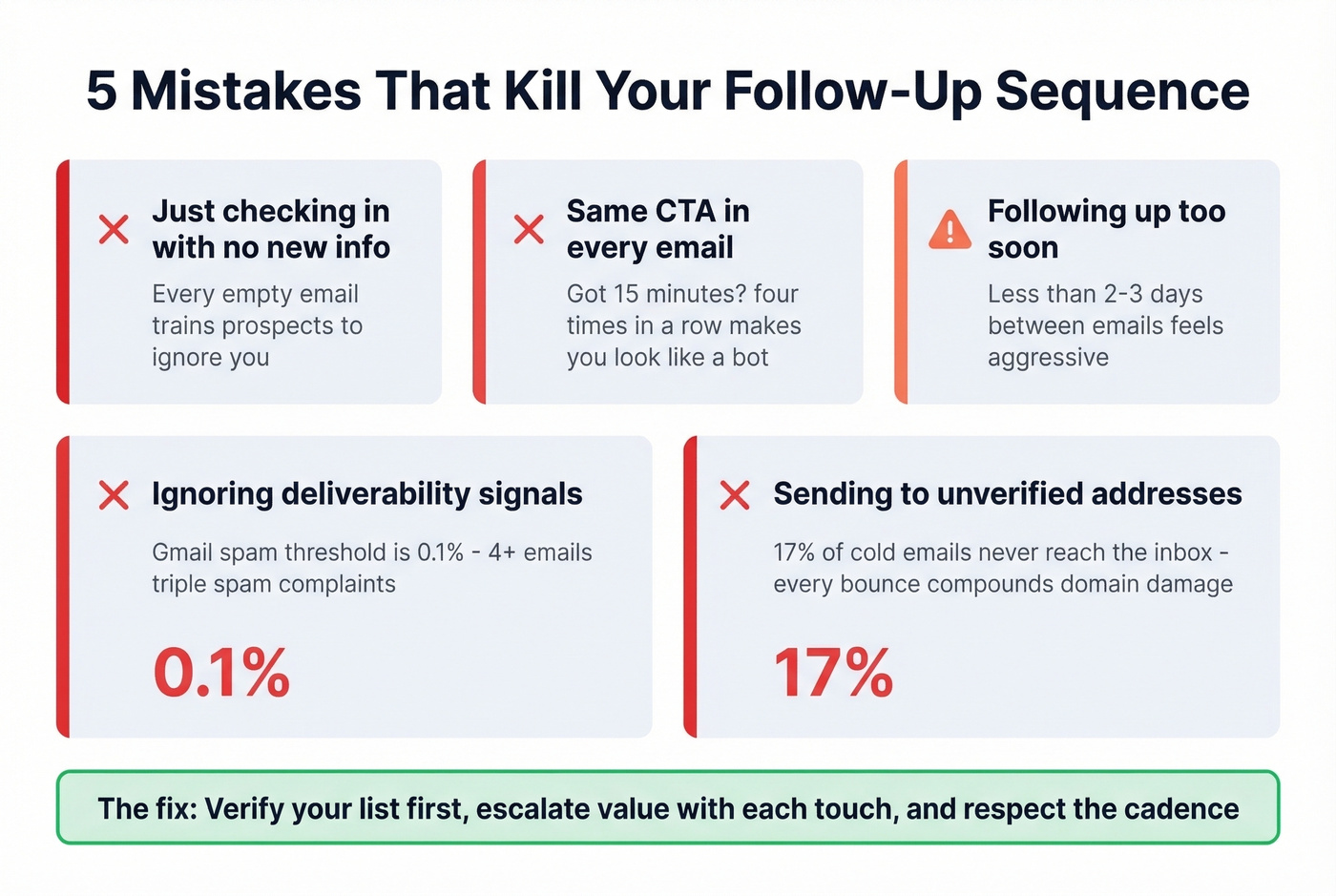
Same CTA in every email. Progress from soft (question) to medium (resource) to direct (meeting) to breakup (permission to leave). If your prospect sees "Got 15 minutes?" four times in a row, they'll assume you're a bot.
Following up too soon. Less than 2-3 days between emails feels aggressive. Your prospect noticed - they're just not ready.
Ignoring deliverability signals. Gmail's spam complaint threshold is 0.1%. Exceed that and your entire domain gets throttled. The 16.5M-email dataset shows 4+ emails in a sequence more than tripling unsubscribe and spam complaint rates. (If you're troubleshooting, start with an email deliverability guide and then check how to improve sender reputation.)
Sending to unverified addresses. 17% of cold emails never reach the inbox. Every bounce compounds the damage to your sender reputation. Skip this step and your carefully crafted follow-up sequence is performing for nobody. (Use email reputation tools and track your email bounce rate.)
Protect Your Domain First
Look, the real follow-up problem isn't your copy. It's your data.
Your sequence tool says 3 of your last 10 follow-ups bounced. That's not a follow-up problem - that's a data problem. At Gmail's 0.1% spam complaint threshold, bad data torches your domain reputation for every other campaign you're running. Even a perfectly structured multiple follow-up email cadence lands in spam if your underlying list is dirty.

A clean list is the foundation everything else depends on. (If you're building lists, pair verification with data enrichment services to keep records current.)
The data says 42% of replies come from follow-ups - but only if those follow-ups land. 17% of cold emails never reach the inbox. Prospeo's 143M+ verified emails and catch-all domain handling mean your carefully crafted breakup email actually gets read, not bounced.
Stop crafting perfect follow-ups for invalid addresses.
FAQ
How many follow-up emails is too many?
Data from 16.5 million cold emails shows 4+ emails in a sequence more than triple unsubscribes and spam complaints. Stick to 3-5 follow-ups over 14-21 days - fewer for enterprise buyers, where founder personas crater to 3% reply rates by the fourth touch.
Should I use the same subject line for every follow-up?
Reply in-thread for the first two follow-ups to maintain context. For later touches, a fresh subject line can re-engage prospects who mentally filed away the original thread - test a new angle referencing a recent trigger event or industry stat.
What's the difference between a structured sequence and a continuous follow-up approach?
A structured sequence escalates value with each touch - new proof points, different angles, and shifting CTAs across 3-5 emails. A continuous approach that simply repeats "circling back" adds no new information and trains prospects to tune you out. The distinction is strategic progression versus mindless repetition.
What should I do before sending any follow-up sequence?
Verify every email address on your list first. Invalid addresses, spam traps, and catch-all domains cause bounces that damage sender reputation before your sequence even starts. Prospeo's free tier lets you verify 75 addresses per month at 98% accuracy - enough to clean a targeted outbound list before launch.