


NC Squared Pricing, Reviews, and Honest Pros and Cons (2026)
Most lead routing problems aren't "strategy" problems. They're basic math problems: leads come in, humans get busy, and the queue piles up.
The average B2B company takes 42 hours to respond to a new lead, and responding within five minutes makes you 100x more likely to connect. That gap is why routing tools exist, and why NC Squared's Distribution Engine keeps popping up in Salesforce admin circles. If you're comparing NC Squared pricing, reviews, pros and cons before you commit, the annoying part is the same for everyone: pricing looks different depending on where you check, and NC Squared doesn't make it easy to sanity-check.
Let's break it down, then talk about who should buy it (and who really shouldn't).
30-second verdict
Distribution Engine is a strong fit for mid-market Salesforce teams (roughly 10-50+ reps) that need fair, automated routing without building a mini product inside Flow and Assignment Rules. Expect to land around ~$45/user/month on a common plan configuration with a 5-user minimum, or about $31K/year for a typical enterprise deal.
Skip it if you have fewer than five users, don't run Salesforce, or you're actually shopping for inbound scheduling (that's a different category).
What is NC Squared Distribution Engine?
NC Squared is a UK-based company founded in 2011. Distribution Engine is their flagship product and it's Salesforce-native: you install it via Salesforce AppExchange and your data stays in your Salesforce org.
Distribution Engine routes records across multiple Salesforce objects: leads, cases, opportunities, and standard or custom objects. It holds a 4.9/5 rating on G2 (10 reviews) and a 4.9 rating on AppExchange.
One real-world note from our side: on r/sales and r/salesforce, lead routing threads come up constantly, but NC Squared isn't the default name people throw out. The chatter usually centers on LeanData, Chili Piper, and "can we just do this with native rules?" That doesn't mean Distribution Engine isn't good; it means it's more common in admin/operator circles than in rep-led tool discussions.
NC Squared pricing (what you'll actually pay)
Here's the thing: Distribution Engine pricing is easy to misunderstand because you'll see different numbers across directories and deal sizes. We pulled the tier structure from multiple public listings and then sanity-checked it against benchmark data.
Published tiers (per user/month)
| Tier | Price/User/Mo | Best for |
|---|---|---|
| Starter | $20 | Basic round-robin |
| Advanced | $35 | Territory logic + SLA rules |
| Unlimited | $55 | All features + advanced routing |
| Booking Engine | $10 | Meeting scheduling add-on |
| Premier Support | +20% of plan | Priority support |
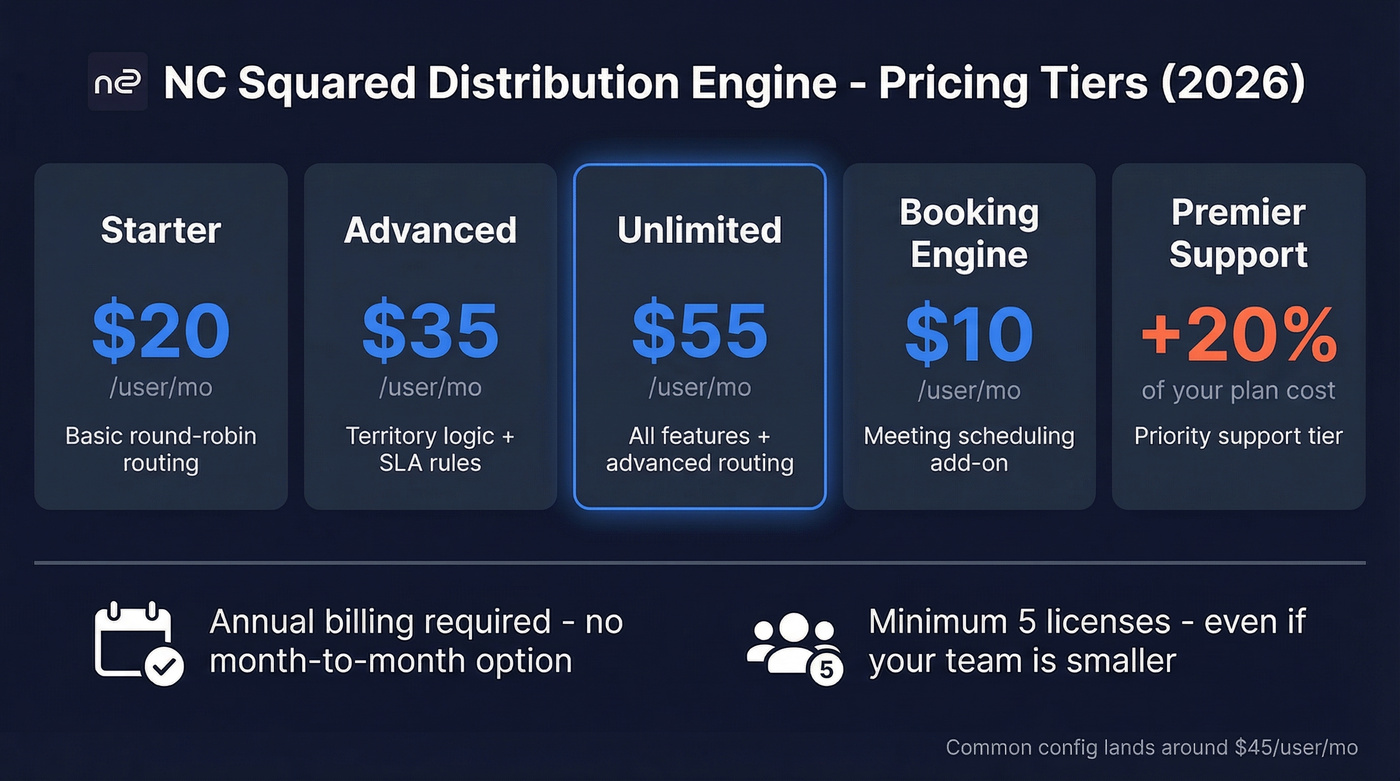
A commonly cited number is ~$45/user/month, which shows up on Capterra and likely reflects a typical packaged configuration.
A few important pricing mechanics matter more than the exact tier:
- Annual billing: you're paying for the year, not month-to-month.
- Minimum 5 licenses: even if you have three SDRs, you're paying for five seats.
- Support can be a real line item: Premier Support is often priced as a percentage uplift.
What the deal benchmarks suggest
Vendr's marketplace page for NC Squared lists a median enterprise deal of $31,231/year, with a wide range depending on seat count and plan mix.
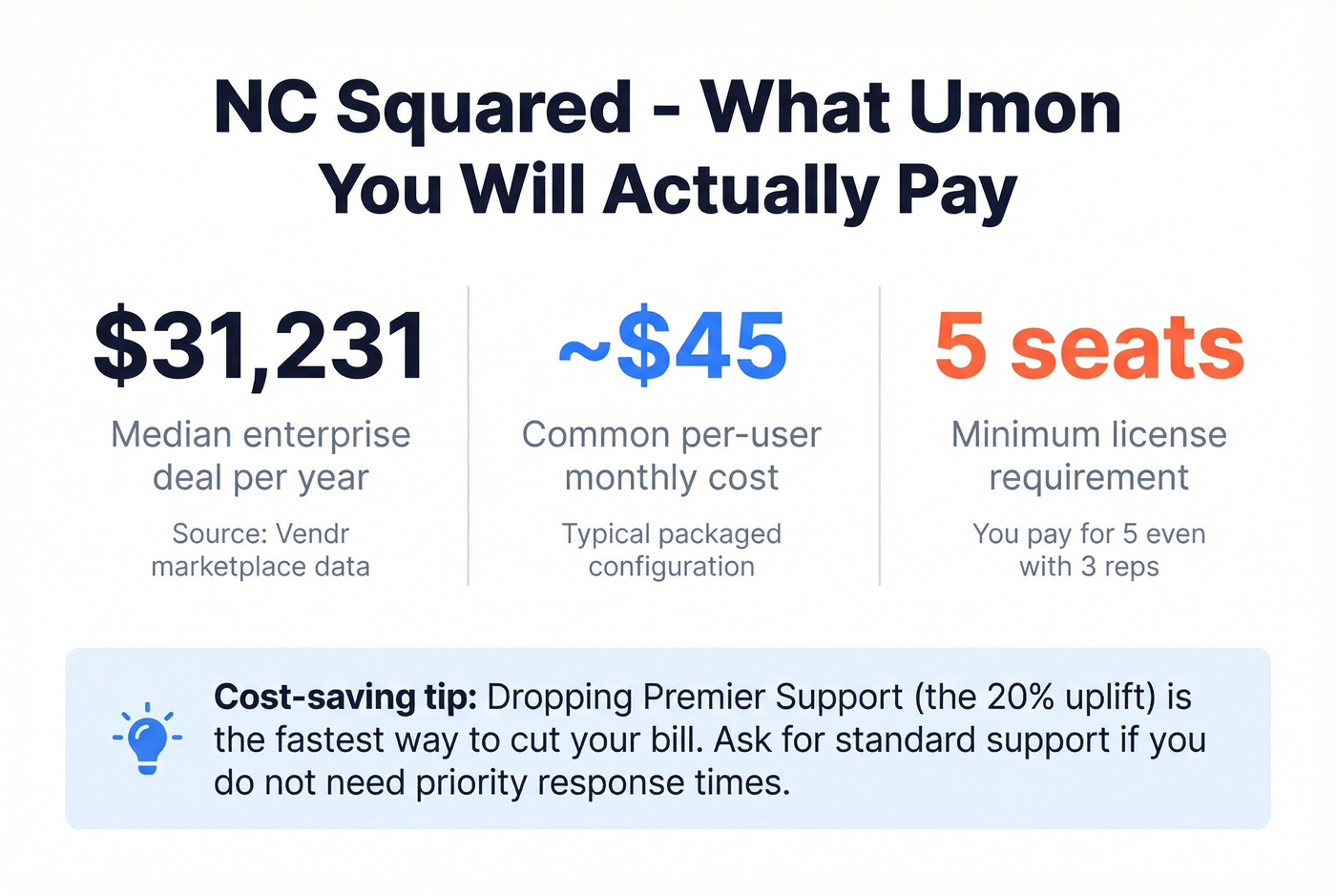
One Vendr community note that matches what we've seen with other SaaS vendors: dropping the Premier Support add-on can cut the bill fast (it's commonly shown as a 20% uplift). If your team doesn't need priority response times, ask for standard support and put the savings into better data or faster follow-up.
And yes, we find the lack of a clear public pricing page frustrating. You shouldn't have to triangulate your budget from directories and benchmark sites.
Reviews: what users consistently praise (and what they complain about)
Because the review footprint is small, you can't treat the ratings like a statistical truth. But you can treat them like signal: the same themes show up again and again, and they're the themes you'd expect from a routing tool that either fits your org or doesn't.
What users like
- Fair distribution that sticks. Reviewers talk about "leveling the playing field" and stopping reps from grabbing leads out of turn. If you've ever had a top rep quietly cherry-pick while everyone else plays nice, you know why this matters.
- Setup is straightforward. Multiple reviews call it easy to set up and manage. For Salesforce-native tooling, that's a bigger compliment than it sounds.
- Support gets real praise. Implementation and onboarding feedback is consistently positive.
- It routes more than leads. Cases, opportunities, and custom objects are in scope, which makes it useful beyond pure SDR lead queues.
A scenario we see a lot: a RevOps manager inherits a messy "assignment rules + spreadsheet + Slack pings" process, and the first win isn't fancy logic. It's simply making routing predictable, auditable, and hard to game. Distribution Engine is built for that kind of win.
Where it falls short
- Criteria-based assignment can feel limiting. The most concrete complaint on G2 is about flexibility: not being able to assign leads based on criteria "when necessary." If your routing depends on deep conditional logic, exceptions, and edge cases, pay attention here.
- The 5-user minimum hurts small teams. A three-person SDR pod ends up paying for seats they don't use.
- Annual commitment adds pressure. The 30-day trial helps, but the real test is what happens in month three when territories change, headcount shifts, and someone asks for an exception "just this once."
- Small review sample. Ten G2 reviews is not a lot. The scores are excellent, but you should still do your own trial with your own data.

You just read it yourself: routing bad data faster doesn't close deals. Before spending $31K/year on Distribution Engine, make sure the leads hitting your Salesforce org have verified emails and direct dials. Prospeo delivers 98% email accuracy with a 7-day refresh cycle - so every record your routing tool touches is actually reachable.
Fix the data before you optimize the routing.
Best fit (and clear deal-breakers)
Distribution Engine makes the most sense for Salesforce teams where routing fairness is a real operational problem: reps cherry-picking, uneven workloads, managers spending hours manually assigning, and SLA follow-up slipping because nobody trusts the queue.
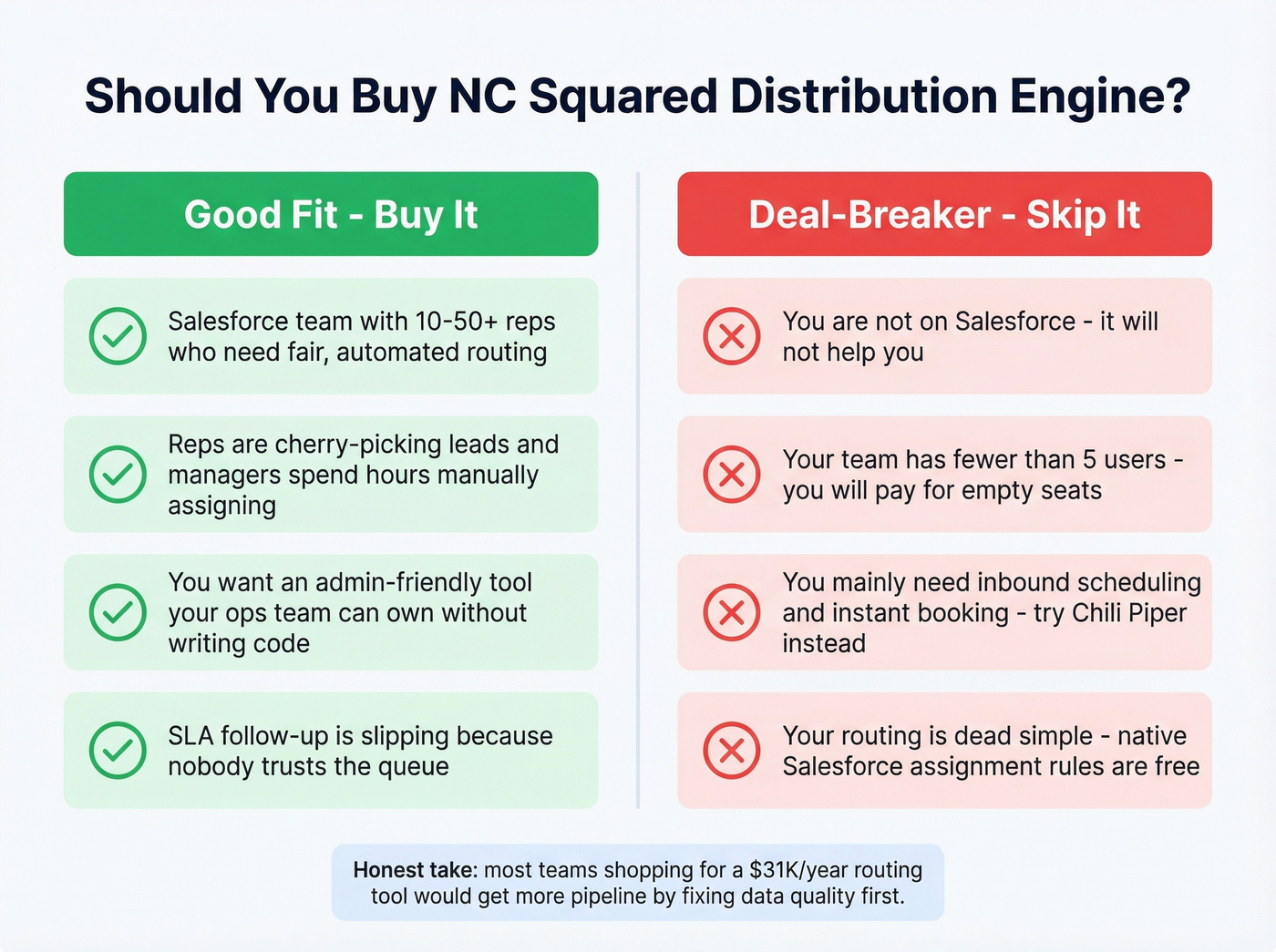
It also fits teams that want an admin-friendly tool. If your ops team wants something they can own without writing code or building a fragile web of automations, that's a point in NC Squared's favor.
Walk away if any of these are true:
- You're not on Salesforce. It won't help you.
- You have fewer than five users.
- You're primarily trying to solve inbound scheduling and instant booking. Chili Piper is built for that.
- Your routing is dead simple. Native Salesforce assignment rules are free, and "free" is a strong feature.
Look, here's the frustrating truth: most teams shopping for a ~$31K/year routing tool would get more pipeline by fixing data quality and speed-to-lead first. Routing bad data faster doesn't close deals. It just creates faster disappointment.
If you're tightening the rest of your funnel, it also helps to standardize your sales follow-up so reps respond consistently once routing does its job.
Alternatives (quick comparison)
| Tool | Starting price | Best for | SF-native? | Key limitation |
|---|---|---|---|---|
| NC Squared Distribution Engine | ~$45/user/mo (common config) | Mid-market routing | Yes | Advanced conditional logic can feel limited |
| Prospeo | Free tier, then credit-based (~$0.01/email) | Verified emails + mobiles before routing | Integrates | Not a routing engine |
| Kubaru | $20/user/mo | Budget-friendly routing | Yes | Smaller install base |
| LeanData | Not public (custom) | Enterprise lead-to-account + complex routing | Yes | Setup can be heavy |
| Chili Piper | ~$15-$45/user/mo (plan-dependent) | Inbound scheduling + handoffs | No (integrates) | Not a pure routing tool |
| Native Salesforce assignment rules | Free | Simple assignment | Yes | Limited round-robin/SLA management |
A few notes, since these tools get mixed up in buying conversations:
- Kubaru (site) is the budget option at $20/user/month with all features included. If cost is tight and your routing needs aren't exotic, it's a sensible trial.
- LeanData is the enterprise pick when lead-to-account matching and complex routing are the core problem. It's powerful, but you pay for that power in setup time and admin overhead.
- Chili Piper is great at booking and routing meetings. That's not the same thing as "fair distribution inside Salesforce," even though the outcomes overlap.
If you're evaluating the broader stack around SDR workflows, compare options in our SDR tools roundup.
Clean data before you route (or you'll hate every routing tool)
If your reps are getting leads with dead emails and wrong phone numbers, no routing logic in the world will save you. You'll just distribute failure more evenly.

This is where tools like Prospeo fit naturally. We use it to clean up the inputs before any routing rules fire: verified emails at 98% accuracy, 125M+ verified mobile numbers, and enrichment that returns 50+ data points per contact with an 83% match rate. Data refreshes every 7 days, which matters more than most teams think because territories, roles, and deliverability change constantly.
If you're running Salesforce, the practical workflow is simple: enrich and verify first, then route. Your reps get fewer "no such person" bounces, managers get cleaner reporting, and your routing tool stops taking the blame for data problems it can't control. If you want to go deeper on enrichment vendors, see our guide to data enrichment services and the basics of lead enrichment.
Also: if you're seeing bounces, it's worth benchmarking against a normal email bounce rate and tightening your email deliverability setup before scaling outbound.
Speed-to-lead only matters if you can actually reach the lead. NC Squared routes records fast, but if 15-35% of your emails bounce, you're routing into a void. Prospeo's 5-step verification and 143M+ verified emails mean your reps connect on the first touch - not the fifth. At $0.01 per email, it costs less than one wasted seat on your routing tool.
Stop routing leads your reps can't reach.
Final verdict
NC Squared Distribution Engine is one of the better pure Salesforce routing tools for mid-market teams. The high ratings line up with what it does well: fairness, ease of setup, and support that doesn't leave admins hanging.
The trade-offs are real: pricing isn't clearly published, the 5-user minimum blocks small teams, and the flexibility complaints around criteria-based assignment are worth testing hard during the trial. Install it, run it with real territories and real exceptions, and see how it behaves when your sales manager asks for "one special rule" that somehow becomes ten.