

Sales Negotiation Skills: Scripts, Math, and Frameworks Your Manager Never Gave You
You just got off a call where the buyer asked for 20% off, and you blinked. You offered 15%, got nothing in return, and now your manager wants to know why the deal margin shrank. That call didn't fail because you lacked charisma - it failed because you didn't have a framework.
Negotiation doesn't start when the buyer asks for a discount. It starts the moment you frame the problem in discovery. And the biggest negotiation loss isn't a bad discount - it's the deal that dies because no one made a decision at all.
The Three Things That Actually Matter
If you take three things from this article, make it these: the ICON prep framework, the decreasing-concession pattern, and the conditional concession script. Everything else is refinement. Up to 50% of negotiation outcome variance ties to the first-offer anchor, which means the work you do before the call matters more than anything you say during it.
Why Most Sales Negotiation Advice Fails
Most negotiation content reads like a TED talk transcript. Lots of "build rapport" and "seek win-win outcomes" - zero scripts you can actually use when a procurement lead says "your price is too high" with 48 hours left in the quarter.
Here's the thing: 73% of B2B buyers actively avoid sellers who send irrelevant outreach, 57% of sales professionals say cycles are getting longer, and Outreach's data shows opportunities closed within 50 days hit a 47% win rate - after that threshold, win rates crater to roughly 20%. Every negotiation that drags, every discount you give to "keep things moving," costs more than you think. Speed and structure aren't nice-to-haves. They're the difference between a 47% and a 20% close rate.
The ICON Prep Framework
Stop trying to "build rapport" before you negotiate. Demonstrate that you understand their problem instead. Rapport follows competence, not the other way around.
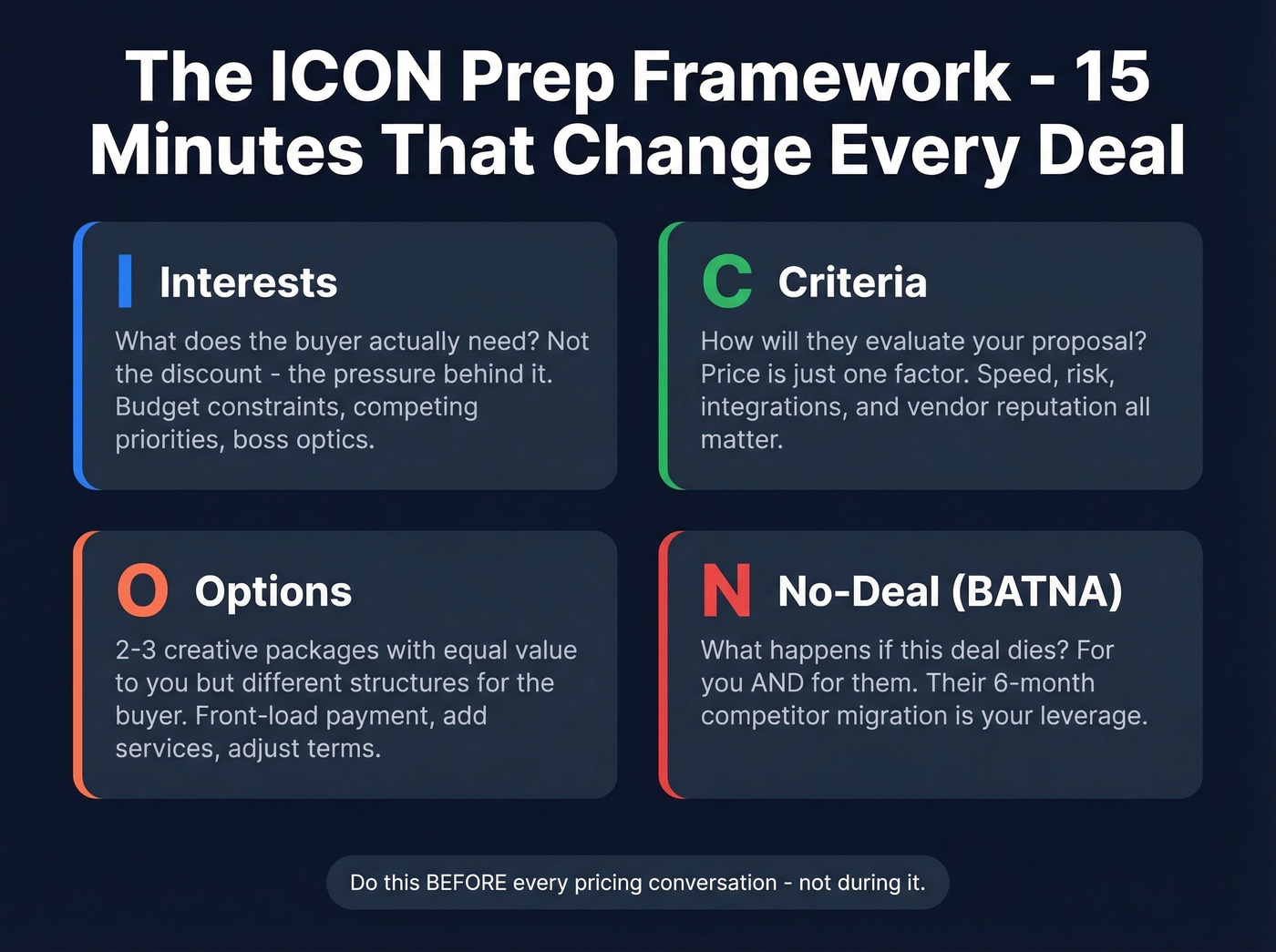
ICON gives you a four-step prep checklist that takes 15 minutes and changes the entire dynamic of the call. Let's walk through it with a real scenario: it's the last week of the quarter, and a buyer just asked for 20% off your $48,000 annual license.
Interests - What does the buyer actually need? Not the discount they're requesting, but the pressure behind it: budget constraints, a competing priority, a boss who needs to see cost savings. Write down three possible interests before every pricing conversation.
Criteria - How will they evaluate your proposal? Price is one criterion. Implementation speed, risk reduction, integration with existing tools, vendor reputation - these all factor in. If you don't know their criteria, you can't frame your offer correctly.
Options - What creative packages can you offer? Two or three options with roughly equal value to you, but different structures for the buyer. One might front-load payment for a bigger discount. Another might add services instead of cutting price. Options give you room to move without just slashing numbers.
No-deal (BATNA) - What happens if this deal dies? For you and for them. If their alternative is a 6-month implementation with a competitor, that's leverage. If your pipeline is thin and you need this deal, that's a vulnerability you need to plan around.
All of this prep is worthless if you're calling the wrong person. We've seen reps spend an hour preparing for a negotiation call only to discover the "decision-maker" was actually a project manager with no budget authority. Prospeo's 30+ search filters - including department headcount, job change, and buyer intent - let you verify decision-maker contacts before you invest that prep time.
BATNA, ZOPA, and Anchoring Math
You're selling an annual platform license. List price: $48,000/year. Your walk-away floor: $36,000. Through discovery, you've learned the buyer's budget ceiling is $42,000. That gives you a ZOPA (zone of possible agreement) between $36,000 and $42,000. Every dollar you negotiate within that range is margin you either keep or give away.
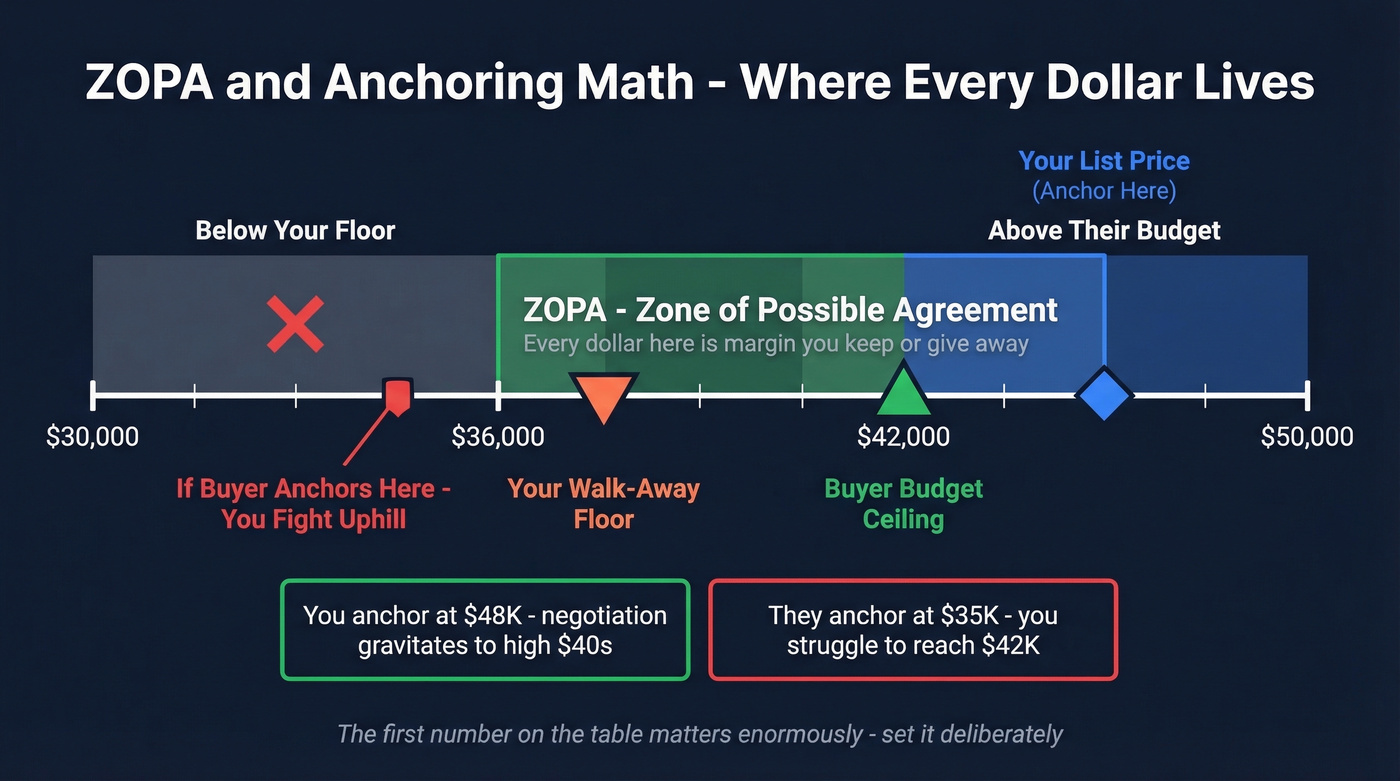
Now, anchoring. If you open at $48,000, the negotiation gravitates toward the mid-to-high $40s. If you let the buyer anchor at $35,000, you're fighting uphill to get back to $42,000. The first number on the table matters enormously - set it deliberately.
One concept from Harvard's Program on Negotiation that most reps miss: your alternative isn't just a number, it's an equivalent-value comparison. A buyer might wave a competitor's quote that's 30% cheaper, but if that competitor's implementation takes twice as long and doesn't include the integrations your platform offers, the "cheaper" option isn't actually cheaper. Normalize alternatives to equivalent terms before you compare.
The Decreasing-Concession Pattern
When you do concede, signal that you're approaching your limit by shrinking each concession: $10,000 -> $5,000 -> $2,000 -> $500. The decreasing increments tell the buyer - without you saying it - that there's almost nothing left to give.
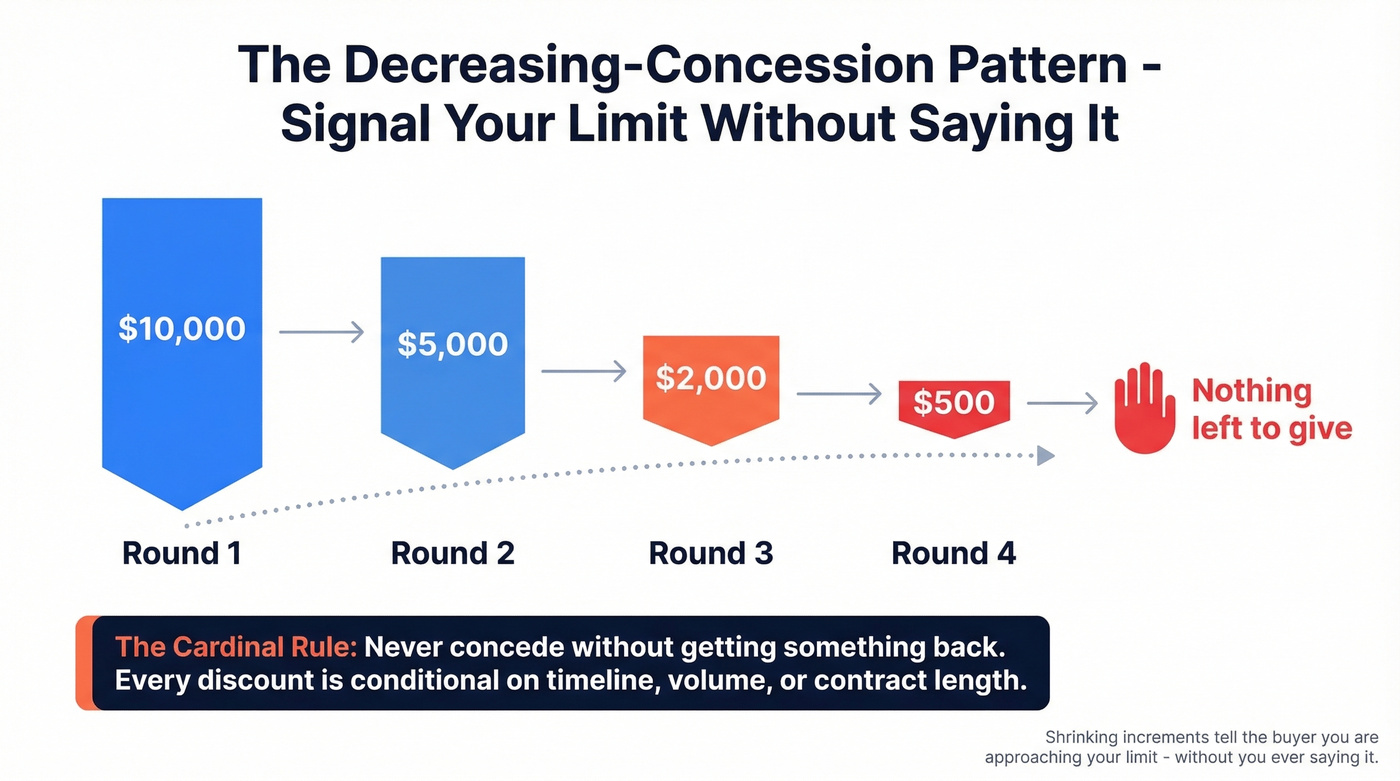
The cardinal rule: never concede without getting something in return. Every discount should be conditional on timeline, volume, or contract length. Mastering this pattern is one of the clearest ways to sharpen sales negotiation techniques across your entire team.
Scripts That Actually Work
Before you script a response, diagnose what you're hearing. An objection is a real concern about fit or value - "we're worried about integration with our CRM" or "the ROI timeline feels long." An obstruction is an excuse to get off the phone: "I'm too busy" or "just send me an email." BANT categories (Budget, Authority, Need, Timing) help you classify which one you're facing, so you don't waste a negotiation script on someone who's just trying to end the conversation.
The Conditional Concession
When a buyer says "your price is too high," don't immediately counter with a lower number:
"I'll try my best to get it lowered for you, but would you be against meeting me at [X] in case I can't get there?"
This script - pulled straight from r/sales - does two things simultaneously. It signals flexibility while anchoring a fallback number that protects your margin. The buyer feels heard without you giving anything away yet.
The Diagnostic Opener
"Before we discuss pricing, what does success look like for you in the first 90 days?"
This reframes the conversation from cost to value. It also surfaces criteria you can use to justify your price later.
The Silence Close
After you've made your ask - whether it's the price, the contract terms, or the close - stop talking. The first person to speak loses. Silence feels uncomfortable, but it forces the buyer to respond to your terms rather than you filling the gap with a concession.
Multiple-Offer Packaging
Present two or three options with roughly equal value to you but different structures for the buyer. Option A: annual upfront at $40,000. Option B: quarterly billing at $44,000. Option C: two-year commitment at $37,000/year. Packaging gives the buyer a sense of control while keeping every path within your acceptable range.

Your ICON prep is only as good as the contact behind it. Prospeo's 30+ search filters - including buyer intent, job change, and department headcount - let you confirm you're negotiating with actual decision-makers, not gatekeepers. 98% email accuracy means your follow-up lands.
Stop burning prep time on the wrong stakeholder.
Tactical Empathy in B2B Deals
Chris Voss's techniques from Never Split the Difference translate directly to B2B sales - but you need to know what to do when they stall.
Mirroring works by repeating the last 1-3 words of what the buyer said, with an upward inflection. Buyer says "the timeline is really tight." You say "the timeline is really tight?" and wait. But sometimes the buyer just responds "yeah." When mirroring gets a one-word answer, follow with "tell me more" or "elaborate for me" to reopen discovery. Reddit's r/sales community flags this exact failure mode - the fix is simpler than most people think.
Labeling names the emotion behind what the buyer is saying. "It sounds like there's a lot of internal pressure on this timeline." This doesn't solve their problem, but it lowers defensiveness and opens the door to creative solutions.
No-oriented questions feel counterintuitive but work because people are more comfortable saying no than yes. "Is it ridiculous to think your board would see the ROI in this implementation?" The expected answer is "no, it's not ridiculous" - which is actually a yes.
The late-night FM DJ voice - slow, calm, downward-inflecting - is Voss's de-escalation tool. When a negotiation gets tense, dropping your vocal register and pace signals confidence without aggression. We've tested this in our own sales calls and the difference is immediate: the buyer's tone shifts within seconds.
Procurement Counter-Tactics
Buyers aren't winging it either. Procurement teams have their own playbook, and if you don't recognize the tactics, you'll get outmaneuvered.
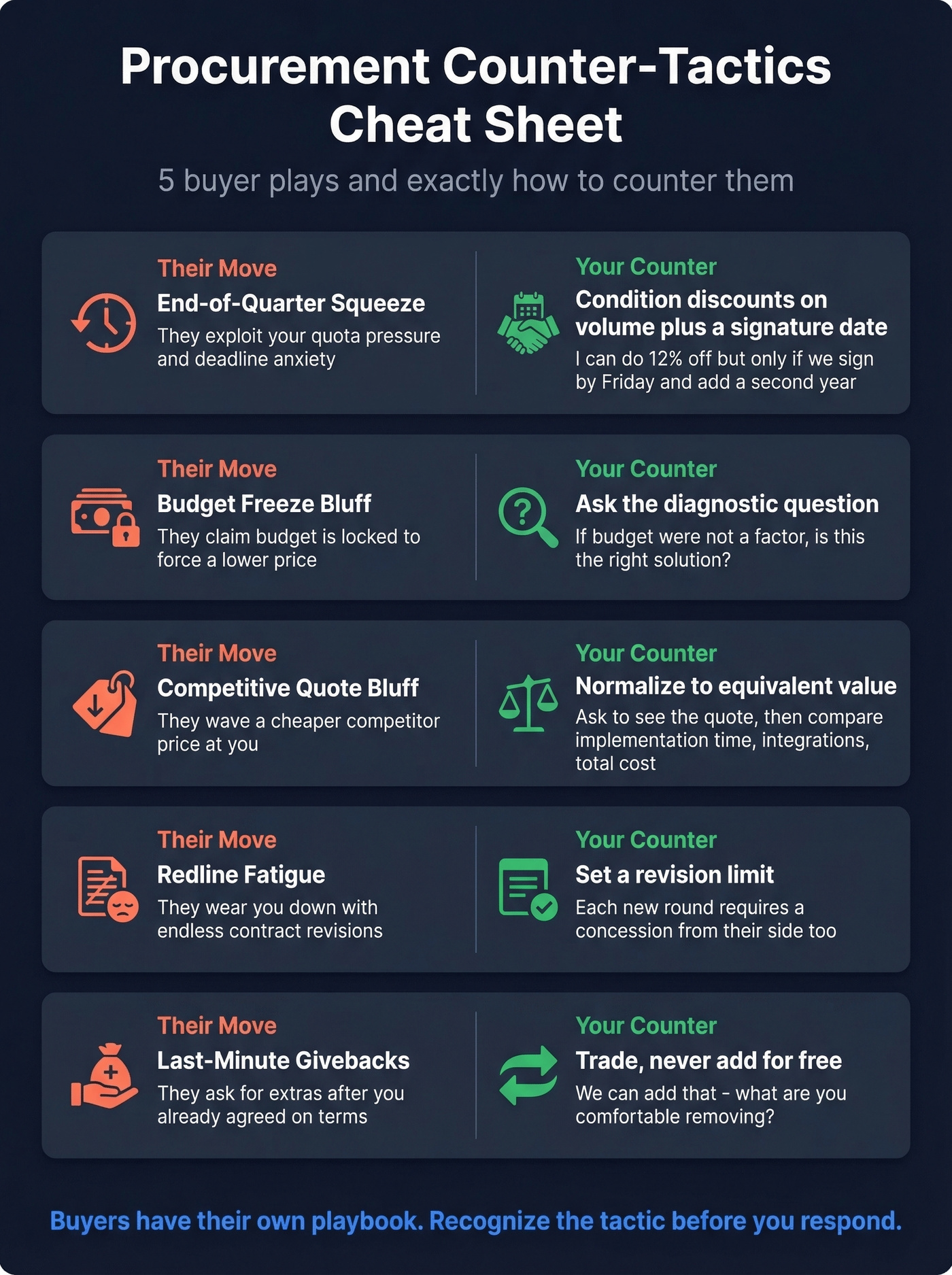
| Buyer Tactic | What They're Doing | Your Counter |
|---|---|---|
| End-of-quarter squeeze | Exploiting your quota pressure | Condition discounts on volume + signature date |
| Budget freeze bluff | Forcing a lower price | "If budget weren't a factor, is this the right solution?" |
| Competitive quote bluff | Waving a lower competitor price | Ask to see the quote; normalize to equivalent value |
| Redline fatigue | Wearing you down with revisions | Set a revision limit; each round requires their concession too |
| Last-minute givebacks | Asking for extras after agreement | "We can add that - what are you comfortable removing?" |
As HubSpot's sales blog points out, buyers who delay to the last week of the quarter know exactly what they're doing. The counter is conditional discounting: "I can do 12% off, but only if we sign by Friday and add a second year." Apply Cialdini's scarcity principle: "We have two implementation slots left this quarter."
The Psychology Behind Every Tactic
Every tactic in this article maps back to a handful of psychological principles.
Reciprocity - Send a genuinely valuable insight before the pricing call. A relevant case study, a competitive analysis, a benchmark they haven't seen. When you give first, the buyer feels a subtle obligation to reciprocate with flexibility.
Consistency - Get small yeses before the big ask. "Does this timeline work?" "Does this scope match what you described?" Each small commitment makes it psychologically harder to say no to the final proposal.
Social proof - "Three companies in your space signed with us last month." Be specific - name the industry, the company size, the use case. Vague social proof is noise. Specific social proof is persuasion.
Scarcity - Implementation slots, pricing windows, team availability. Real scarcity is persuasive. Manufactured scarcity is transparent and damages trust. Skip this if you can't point to a genuine constraint.
Authority - Lead with data, not opinions. Case study results, ROI calculations, third-party benchmarks.
Gong's research shows top-performing reps speak about 46% of a sales call. Underperformers speak 70%. Listening isn't passive - it's the ultimate persuasion tool. Every principle above works better when the buyer feels heard first.
Five Mistakes That Kill Deals
1. Talking too much. The 46% vs 70% talk-time ratio isn't a suggestion - it's a pattern across thousands of calls. If you're speaking more than half the time, you're not negotiating. You're pitching.
2. Discounting without getting something in return. Every free concession trains the buyer to ask for more. Attach a condition to every discount: timeline, volume, contract length, case study participation. No exceptions.
3. Not identifying the actual decision-maker. In our experience, this is the most expensive mistake on the list. We've watched reps run flawless negotiations with people who couldn't sign. Use a B2B data platform with filters for department headcount and job change to confirm you're negotiating with someone who has actual signing authority.
4. Breaking silence after asking for the close. The urge to fill silence is almost irresistible. Resist it. The buyer needs processing time, and your silence communicates confidence.
5. Going rogue on terms your company can't honor. Understand how flexible your finance and legal teams actually are before the call. Promising terms you can't deliver destroys trust and kills deals in legal review. A sales manager with strong negotiation instincts sets these guardrails for the team before anyone picks up the phone.
Why Negotiation Training Pays
The numbers on negotiation training ROI are striking. A Forbes Council analysis found 353% ROI from sales training - roughly $4.53 returned per $1 invested. RED BEAR Negotiation reports their customers see $54 back per $1 invested on average, with one Fortune 1000 case study showing a $37.7M increase in projected annual revenue - a 46.7:1 ROI.
Yet only 25% of sales organizations directly measure leading-indicator behaviors like talk-time ratio, concession patterns, or discovery question quality. Companies are spending the money. Most just aren't measuring whether it's working.
Let's be honest: you don't need a $50,000 training program to improve. If your average deal size is under $25k, the frameworks in this article - ICON, ZOPA math, conditional concessions, tactical empathy - cover 80% of what those programs teach. Practice them on your next five calls and track what changes.
If you want to go deeper on the math and psychology behind opening numbers, start with anchoring and set a clear walk-away floor before every pricing call.
Deals that drag past 50 days see win rates crater to 20%. Speed kills in negotiation - and bad contact data is the silent deal killer. Prospeo refreshes 300M+ profiles every 7 days so your outreach connects instantly, not after a bounce-back loop.
Close faster when every email and direct dial actually connects.
FAQ
What's the most important negotiation skill in sales?
Preparation. Up to 50% of negotiation outcome variance ties to the first-offer anchor, which you can only set correctly after calculating your BATNA, ZOPA, and concession floor before the call. Charisma helps. Math helps more.
How do you respond when a buyer says "your price is too high"?
Use a conditional concession: "I'll try to get it lowered, but would you be against meeting me at [X] in case I can't?" This signals flexibility while anchoring a fallback that protects margin. Never discount without getting something - timeline, volume, or contract length - in return.
Do Chris Voss techniques work in B2B sales?
Yes - mirroring, labeling, and no-oriented questions all translate to B2B. If mirroring gets a one-word response, follow with "tell me more" to reopen discovery. The techniques work; they just need a recovery plan for when buyers give flat answers.
How do you confirm you're negotiating with the right person?
Verify decision-maker contacts before the call using a B2B data platform with filters for department headcount and job change. Prospeo's 30+ filters and 7-day refresh cycle let you confirm signing authority so you don't run a flawless pitch for someone who needs to "check with their boss."