

How to Respond to a "Not Interested" Email (Templates That Convert)
Three "not interested" replies sitting in your inbox aren't dead leads. They're the only prospects who bothered to respond. A single not interested email response template generated a 39% response rate across 400+ sends. In our experience, those rejections are often the warmest leads in your pipeline - because at least you know someone's reading.
Quick Version: The Best Reply
"Not interested" means they read your email. That puts them ahead of most of your list.
The best response? A feedback ask - no pitch, no pushback:
"Would you be so kind as to tell me why you're not interested so I can learn a little more about your company?"
That template hit a 39% response rate. The principle is simple: shrink the ask. You asked for a meeting. They said no. Now ask for 15 seconds of feedback instead.
Why Prospects Say "Not Interested"
Here's the thing - many "not interested" replies are reflexive, not rational. Their brain has already decided. Loss aversion makes change feel roughly twice as painful as an equivalent gain, and 95% of purchasing decisions happen subconsciously.
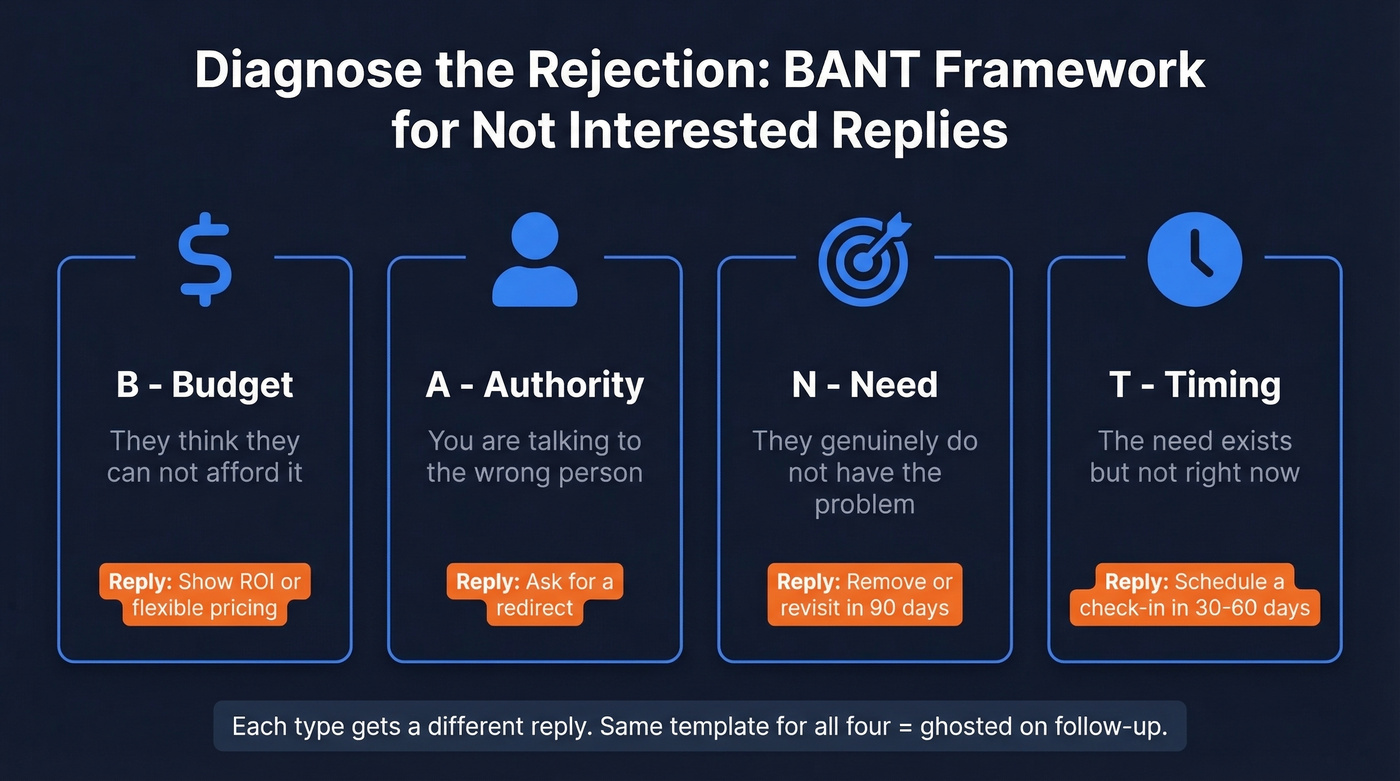
The real question is which kind of rejection you're dealing with. Use the BANT framework as a quick diagnostic:
- Budget - they can't afford it (or think they can't)
- Authority - you're talking to the wrong person
- Need - they genuinely don't have the problem you solve
- Timing - the need exists, but not right now
Each type gets a different reply. Sending the same template to all four is why most reps get ghosted on the follow-up.
Reply Templates by Objection Type
Here's a quick reference before the full scripts:
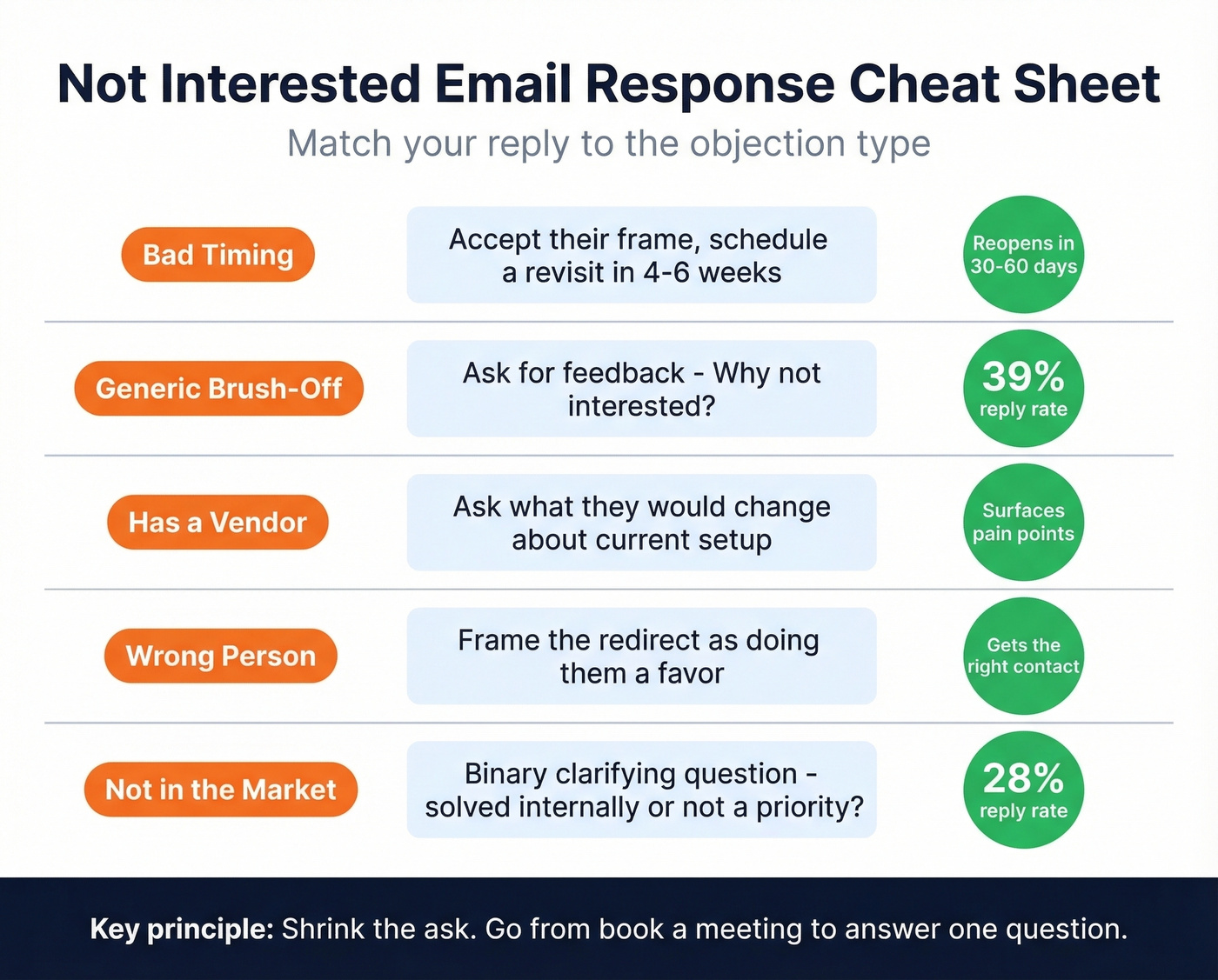
| Objection Type | Template Approach | Expected Outcome |
|---|---|---|
| Bad Timing | Accept + schedule revisit | Reopens in 30-60 days |
| Generic "Not Interested" | Feedback ask | 39% response rate |
| Has a Vendor | Ask what they'd change | Surfaces pain points |
| Wrong Person | Redirect as a favor | Gets you the right contact |
| "Not in the Market" | Binary clarifying question | 28% response rate |
Bad Timing
"Totally understand - timing is everything. Mind if I check back in [month]? Happy to share what's changed on our end by then."
This works because you're not arguing. You're accepting their frame and giving yourself a reason to follow up. Keep the gap to around 4-6 weeks.
An alternative that works well when you sense hesitation: "Before I let you go - is it that the timing's bad, or does this just not seem relevant to what you're working on?" This binary question forces a more specific answer, and either response gives you a clear next move.
Generic Brush-Off
"No worries at all. Would you be so kind as to tell me why you're not interested so I can learn a little more about your company?"
This is the 39% response rate template. It works because you've replaced a sales ask with a human one. Of every approach we've tested for handling rejection emails, this feedback-first method consistently outperforms everything else we've tried - and we've tried a lot.
Want something shorter? "If you could give me just 30 seconds - what made this a no?" Longer replies can feel pushy, which is exactly why the feedback-ask approach lands. You're not selling. You're listening.
Has a Vendor
"Makes sense - most companies in your space already have something in place. Quick question: if you could change one thing about your current setup, what would it be?"
You're not asking them to switch. You're asking them to complain. Much lower bar. And the answer tells you exactly where to shape your next email. We've seen reps turn these into demos within two weeks just by listening to the initial gripe and responding with something specific.
Wrong Person
"Appreciate the honesty. Who on your team would be the right person to talk to about [specific problem]? Happy to take it from here so it's off your plate."
Frame the redirect as doing them a favor. Nobody wants to be the bottleneck for emails that aren't theirs.
"Not in the Market"
"Totally fair. Out of curiosity, is that because you've solved [problem] internally, or is it just not a priority right now?"
This template generated a 28% response rate. The binary question makes it easy to answer, and both answers give you useful intel for timing your next touch.

Wrong person, bad timing, no need - most "not interested" replies trace back to bad targeting, not bad copy. Prospeo's 30+ filters (buyer intent, job changes, technographics) put your emails in front of prospects who actually have the problem you solve.
Send fewer emails. Get fewer rejections. Book more meetings.
Principles That Apply Across Every Objection
Beyond individual templates, handling negative email responses is a skill that compounds. Every rejection reply you craft well does two things: it keeps the door open for a future conversation, and it builds your reputation as someone who respects a prospect's time.
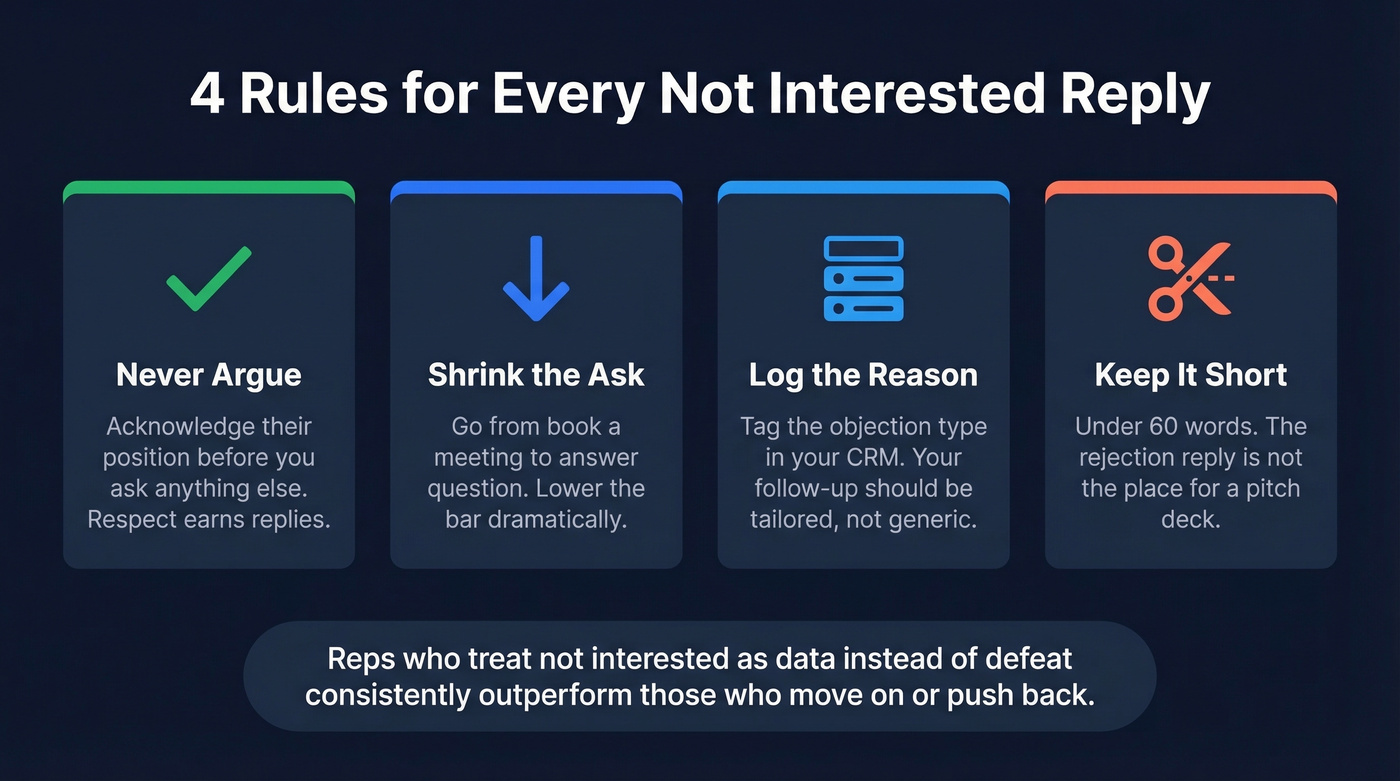
Never argue. Acknowledge their position before asking anything else. Shrink the ask - go from "book a meeting" to "answer one question." Log the reason in your CRM so your follow-up is tailored, not generic. And keep it short. Your reply should be under 60 words. The rejection reply isn't the place for a pitch deck.
The reps who treat "not interested" as data instead of defeat consistently outperform those who move on or push back. Let's be honest - most of us have sent that one desperate follow-up we regretted. Don't be that rep.
If You're the One Declining
Sometimes you're on the receiving end. The Muse's advice still holds:
Unsubscribe link exists? Use it. Done. Personal email from a real rep? One-liner: "Thanks for reaching out. We're not in the market for [service] - could you remove me from your list?" Might be open later? Punt: "I'm swamped this quarter, but reach out again in Q3 and I'd be happy to take a look."
Five seconds of your time. Keeps the door open if you want it open, closes it cleanly if you don't.
When to Follow Up (and When to Stop)
"Bad timing" warrants a follow-up in 30-60 days. "Genuinely not a fit" means 90 days minimum - or removal. Send your follow-up on a Thursday if you can; it has the highest positive reply rate at 10.5%. Always frame follow-ups as replies to the original thread, not fresh emails. Threading boosts open rates significantly.
If you want more scripts for the next touch, pull from these sales follow-up templates or these cold email follow-up templates.
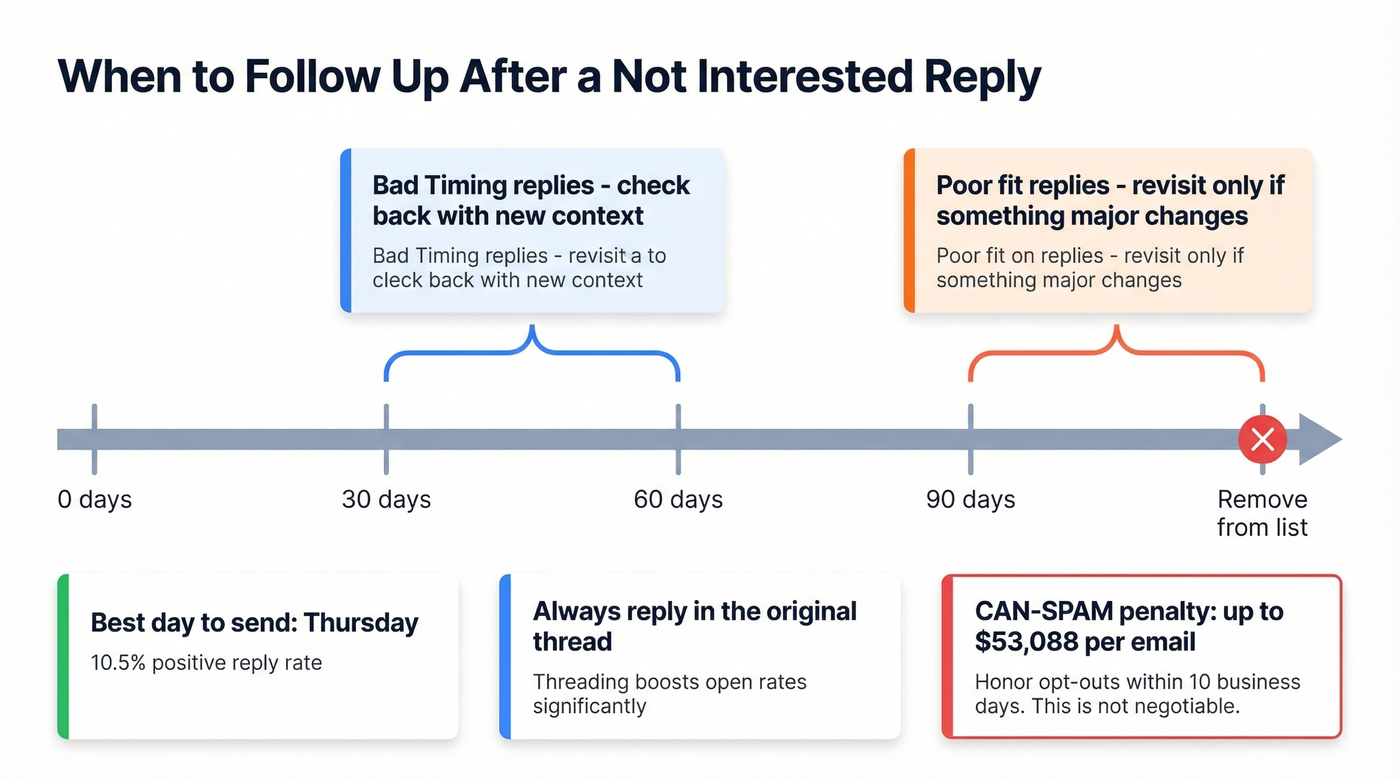
Compliance isn't optional. CAN-SPAM applies to all commercial email - B2B included - with penalties up to $53,088 per email. You must honor opt-out requests within 10 business days. Under GDPR, a documented Legitimate Interest Assessment is standard practice when relying on legitimate interest. If someone says "take me off your list," that's not a negotiation.
How to Prevent Rejections Entirely
The best not interested email response is never needing one.
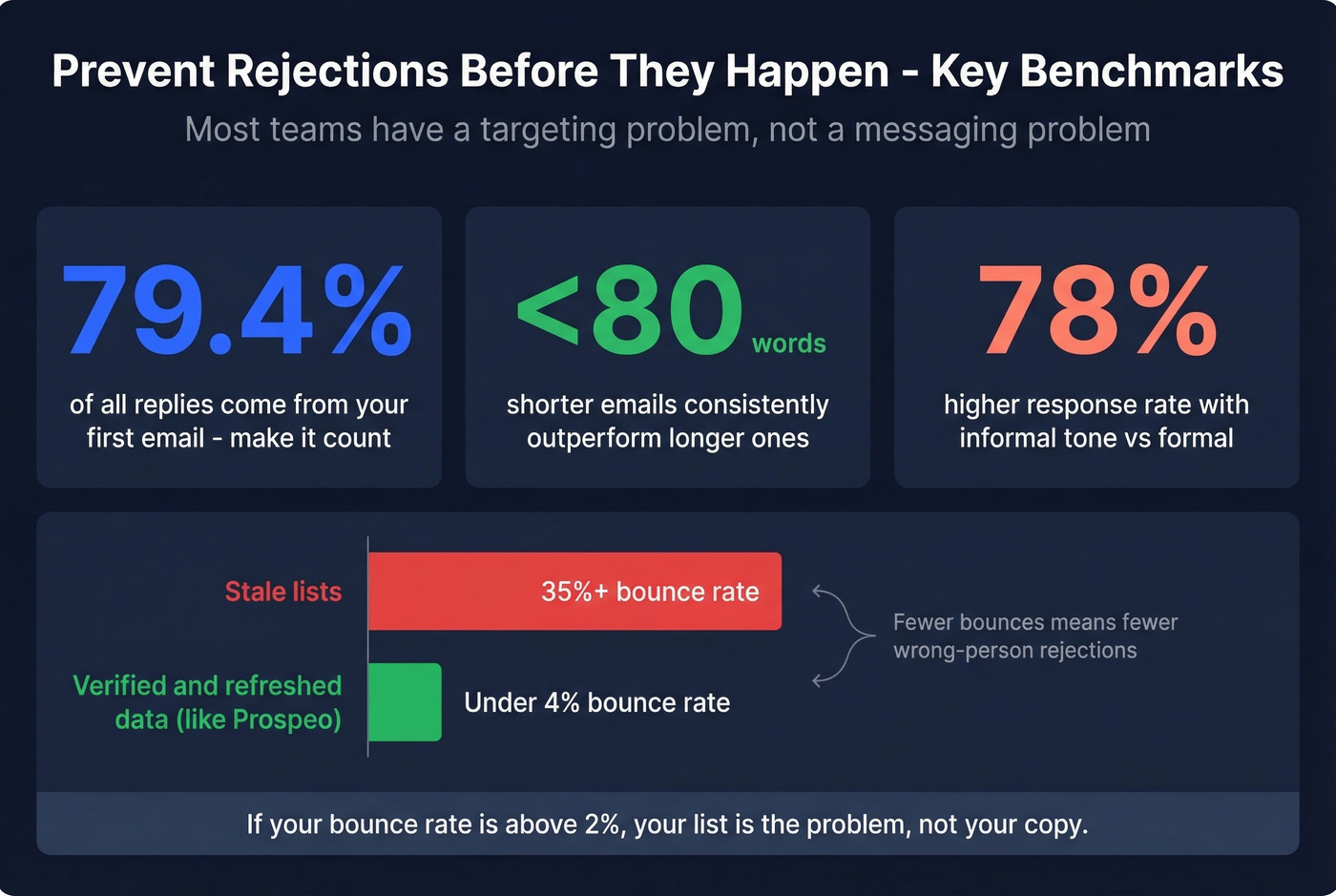
Hot take: most teams don't have a messaging problem - they have a targeting problem. If you're emailing someone who left the company six months ago, or targeting the wrong title entirely, "not interested" is the polite outcome. We've seen teams cut their rejection rate dramatically just by cleaning their list before sending. A polished reply template means nothing if it lands in the wrong inbox.
Your first email drives 79.4% of all replies, so make it count. Benchmarks show that under 80 words tends to outperform, a single CTA beats multiple asks, and an informal tone can outperform formal by 78%. If you want to go deeper on structure and wording, this email copywriting guide is a solid next read.
If your bounce rate is above 2%, your list is the problem, not your copy. Prospeo verifies emails in real time with 98% accuracy and refreshes records every 7 days, so you're not emailing someone who changed roles two quarters ago. Pair that with 30+ search filters to nail the right title and company profile, and you're cutting wrong-person sends before they happen. (If you're troubleshooting deliverability, start with email bounce rate benchmarks and this email deliverability guide.)

The article's last section nailed it: most teams have a targeting problem, not a messaging problem. Prospeo refreshes 300M+ profiles every 7 days - so you're never emailing someone who left six months ago. 98% email accuracy means your replies are real conversations, not bounces.
Replace rejection templates with conversations that convert.
FAQ
What's the best not interested email response?
A feedback ask - "Why not interested?" - hit a 39% response rate across 400+ sends. It works because you've removed all sales pressure and replaced it with genuine curiosity. No pitch, just a question that invites a real answer.
How should I match my reply to the objection type?
Bad timing gets a revisit request for 30-60 days out. A generic brush-off gets the feedback ask. A wrong-person reply gets a redirect request framed as a favor. Diagnosing the reason before choosing your template is the difference between a 5% and 39% reply rate.
How long should I wait before following up?
30-60 days for bad timing, 90+ days for poor fit. Send on Thursdays for the highest positive reply rate (10.5%). Always reply in the original thread rather than starting a new email - threading boosts open rates significantly.
How do I reduce "not interested" replies in the first place?
Verify your contact data, email the right decision-maker, keep messages under 80 words, and use one CTA. Teams using verified, regularly refreshed data report bounce rates under 4% versus 35%+ on stale lists - and fewer bounces means fewer wrong-person rejections clogging your pipeline.