

Objection Handling Skills: What 300M+ Sales Calls Reveal About Getting Past "No"
You're 45 seconds into a cold call. The prospect says "I'm not interested" before you've finished your opener. Most reps freeze, fumble a rebuttal, or hang up defeated.
But that moment - the pushback - is the single most coachable moment in sales. Objection handling skill isn't a personality trait. It's a competency built through practice, coaching, and repetition, and the data backs that up clearly.
Why This Skill Separates Top Reps
72% of B2B buyers expect reps to understand their business needs before contact. They show up armed with opinions, competitor comparisons, and reasons to say no. Meanwhile, 69% of reps fell short of quota in recent years, and the average seller spends only 30% of their time actually selling. Fewer conversations, better-prepared buyers, and most reps aren't ready for the pushback.
Highspot's competency research frames it well: structured rubrics and call analysis build this skill faster than any motivational speech. More than 60% of salespeople lose business because of improperly resolved objections - which makes this the highest-ROI skill gap most teams ignore.
What 300M Cold Calls Reveal
A study of 300M+ cold calls found something most reps get wrong. The objection breakdown: 49.5% dismissive, 42.6% situational, 7.9% existing-solution. Half the objections you hear aren't real objections - they're brush-offs. Treating a brush-off like a genuine concern is the number-one rookie mistake.
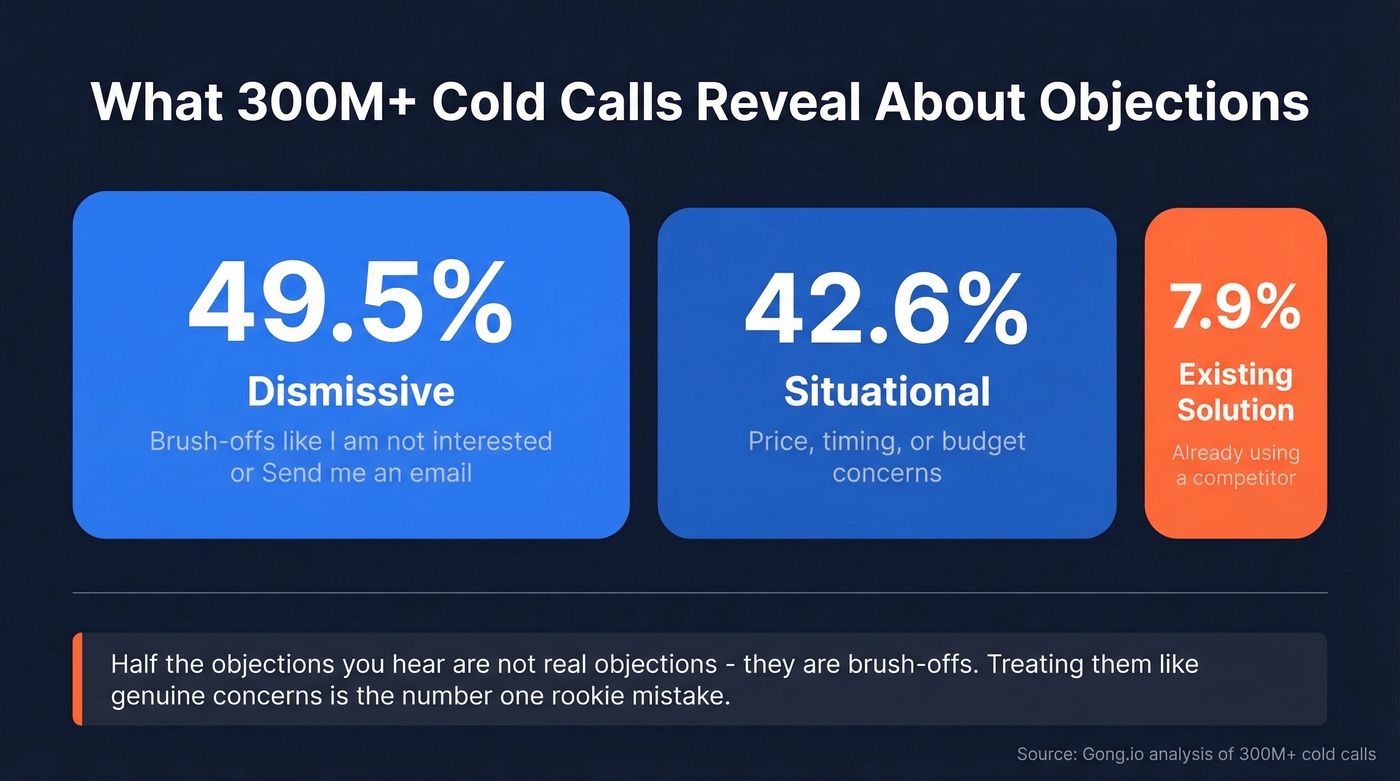
For dismissive objections, the data recommends disarming bluntness - transparency and humor to cut through the brush-off rather than a scripted rebuttal. The top 5 objections account for 74% of everything you'll face. Master those five and you've covered three-quarters of the game.
Here's the part that surprised us: a separate study of 67,149 calls found top performers pause 5x longer after hearing an objection than their peers. That silence isn't awkward. It's strategic.
The 4 Objection Types
Every objection falls into one of four buckets, and recognizing which one you're facing changes your entire response.
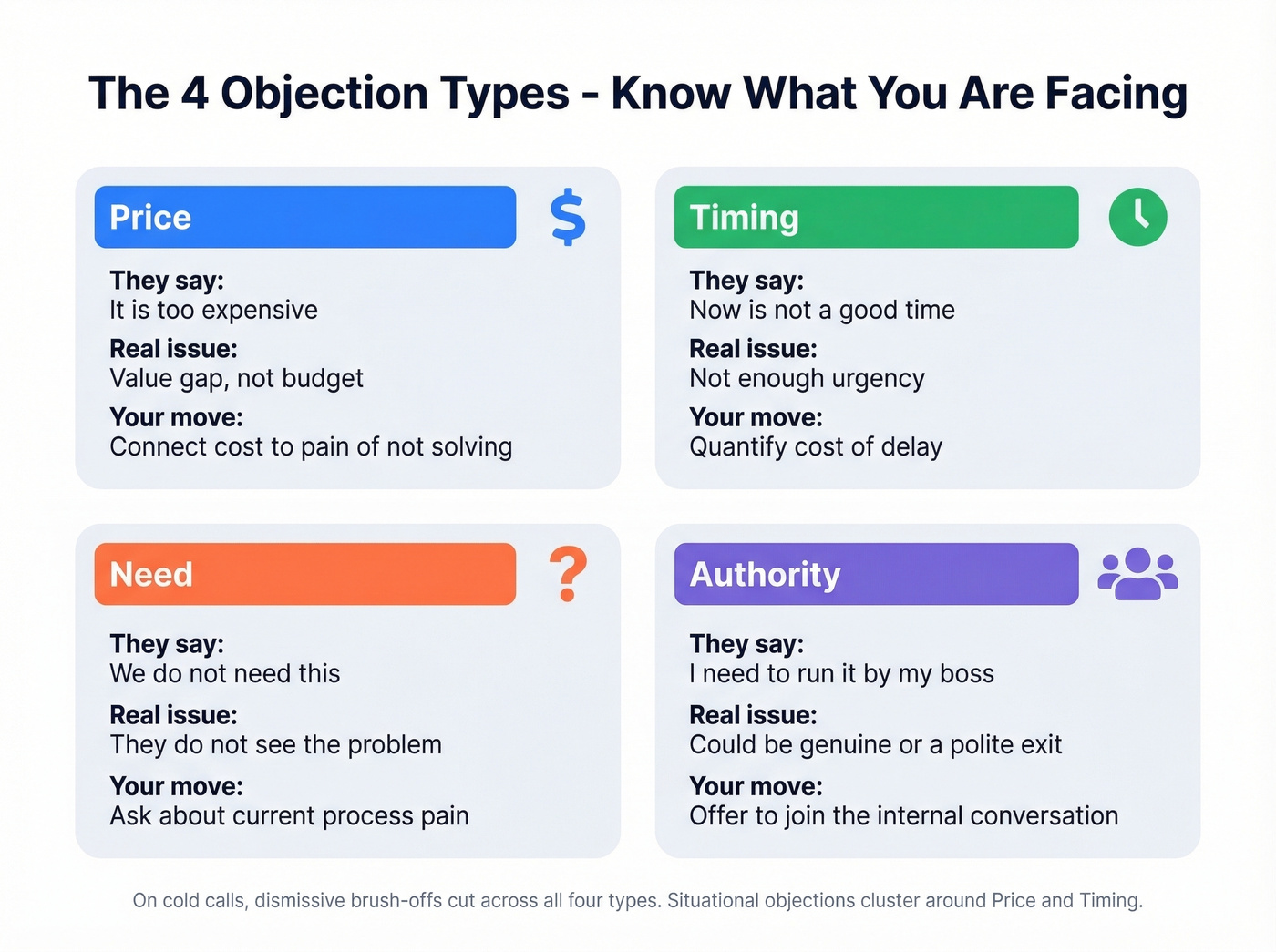
Price objections ("It's too expensive," "Your competitor is cheaper") sound final but usually signal you haven't connected cost to value. Timing objections ("Now's not a good time," "Maybe next quarter") mean you haven't created enough urgency. Need objections ("We don't need this," "We're fine with our current process") mean the prospect doesn't understand the problem you solve - or doesn't believe they have it. Authority objections ("I need to run it by my boss") are sometimes genuine and sometimes a polite exit.
On cold calls, dismissive brush-offs cut across all four types, while situational objections cluster around price and timing.

Half of cold-call objections are brush-offs - but you can't practice handling them if you're dialing wrong numbers. Prospeo gives you 125M+ verified mobile numbers with a 30% pickup rate, so your reps spend time handling real objections instead of hitting voicemail.
Stop rehearsing for conversations that never happen. Start reaching real buyers.
6 Frameworks Compared
| Framework | Steps | Best For |
|---|---|---|
| ARC | Acknowledge, Respond, Close | Quick cold-call rebuttals |
| LAARC | Listen, Ack, Assess, Respond, Confirm | Full-cycle deals |
| LAIR | Listen, Ack, Identify, Reverse | Competitive objections |
| LACE | Listen, Accept, Commit, Explicit Action | Enterprise negotiation |
| FFF | Feel, Felt, Found | Empathy-driven selling |
| SOLVE | Support, Obtain, Listen, Validate, Explain | Complex technical sales |
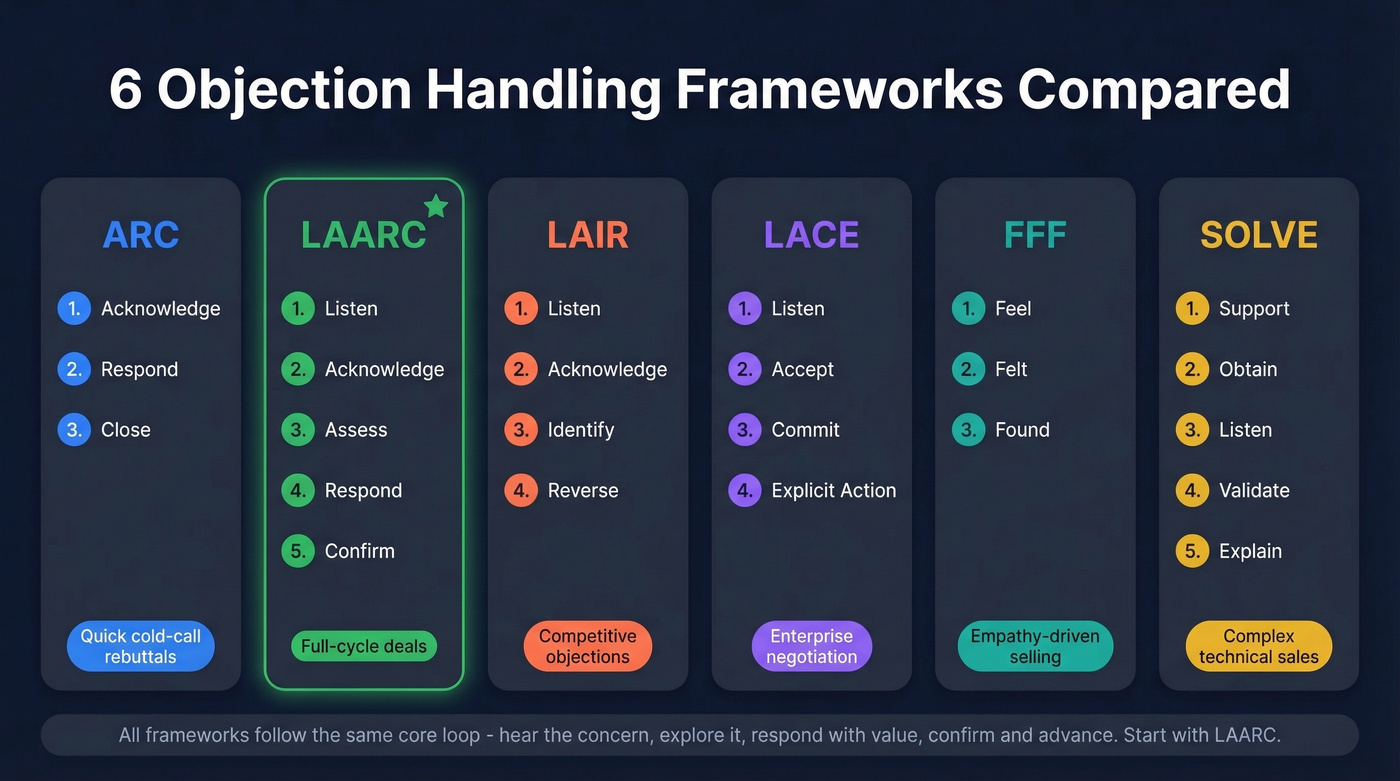
Every framework follows the same core loop: hear the concern, explore it, respond with value, confirm and advance. If you only learn one, make it LAARC. It's the most complete and the hardest to skip steps on.
Let's be honest, though - frameworks are training wheels, not crutches. Use them to build muscle memory, then ditch the acronyms and respond naturally.
Scripts That Work by Deal Stage
Cold Calls: The Deflect Technique
When half of cold-call objections are dismissive, a full rebuttal is overkill. SalesScripter's model gives you three options: comply, overcome, or deflect. Deflect wins most of the time.
"I understand - I can be extremely brief, or I can call you back later. Which works better?"
The goal isn't to win the argument. It's to earn 30 more seconds. Push past the brush-off two or three times before complying. After that, you're just annoying.
Discovery: Ask, Don't Argue
Stop memorizing scripts. Start memorizing questions.
Gong's call analysis shows the best reps avoid monologues and keep the conversation healthy by switching back and forth between speakers, using simple check-ins like "Does that make sense?" to make sure the buyer is tracking. When a prospect says "it's too expensive," ask: "What makes the price a concern right now?" That diagnoses whether it's a budget issue, a value gap, or a negotiation tactic - three completely different problems requiring three completely different responses.
A common field-tested move is to shift the conversation to the pain of not solving the problem. The price objection often dissolves on its own.
If you want a tighter set of prompts, start with a simple bank of discovery questions your whole team can drill.
Closing: The Authority Reframe
"I need to run it by my boss" kills deal velocity. Outreach's data shows deals closed within 50 days have a 47% win rate; after 50 days, it drops to roughly 20%. The reframe:
"Absolutely - what questions do you think they'll have? Let's make sure you've got the answers. Would it help if I joined that conversation?"
Then lock in a specific date. Not "sometime next week." A calendar invite with an agenda.
To keep momentum after that meeting, use a few proven sales follow-up templates instead of winging it.
5 Mistakes That Kill Deals
Your manager tells you to "handle objections better" but never gives you a rubric, a drill, or a single recorded example of what "better" sounds like. That's not coaching - that's a wish.
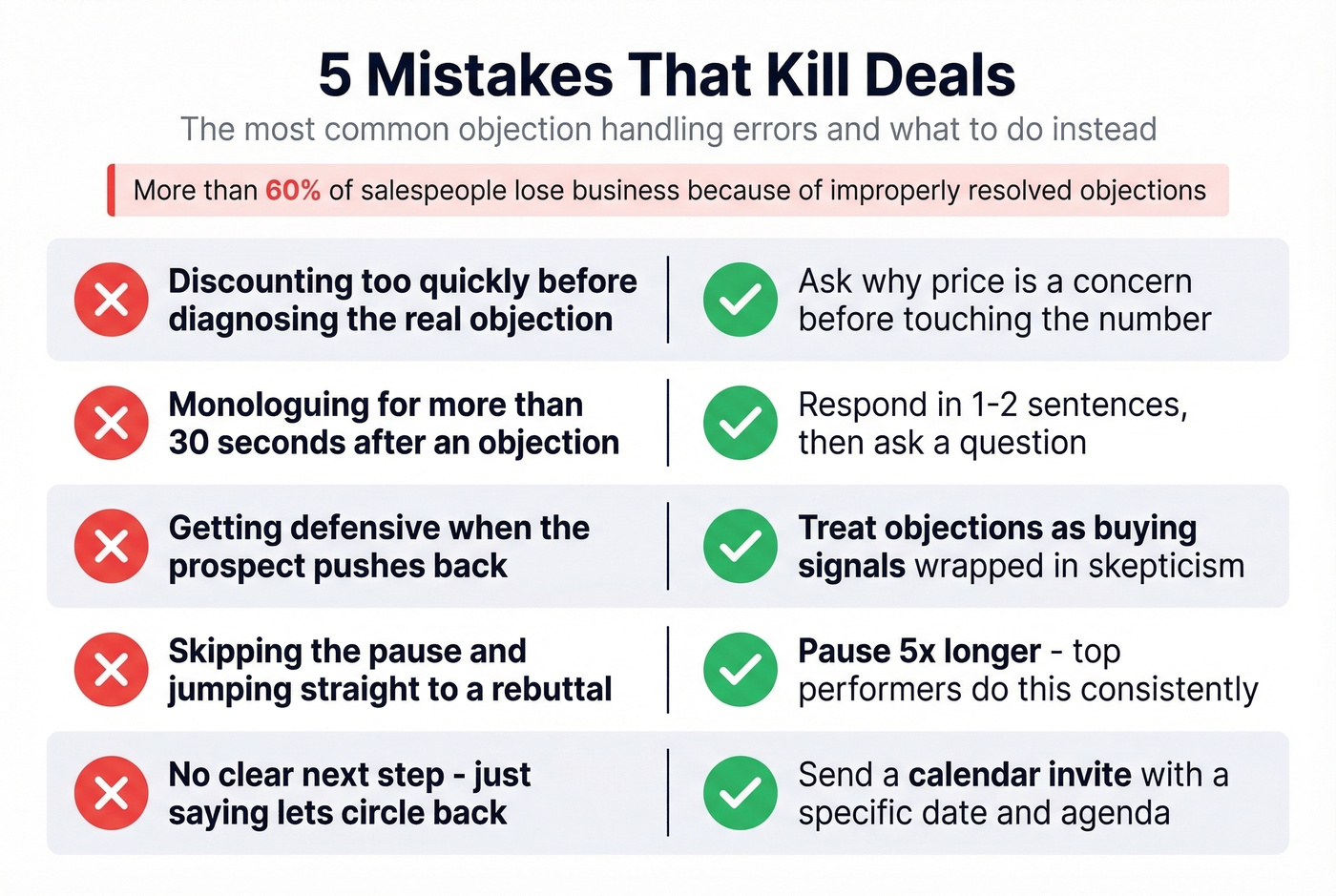
Here are the five mistakes we've seen sink the most deals:
- Discounting too quickly. The moment you drop price before diagnosing the real objection, you've trained the prospect to push harder next time.
- Monologuing. If you're talking for more than 30 seconds after an objection, you've lost the thread.
- Getting defensive. Objections aren't personal attacks. They're buying signals wrapped in skepticism.
- Skipping the pause. Top performers pause 5x longer. That silence lets the prospect elaborate and gives you time to think.
- No clear next step. "Let's circle back" isn't a next step. A calendar invite is.
If your team is hearing the same pushback over and over, it’s worth auditing your sales communication patterns across calls and emails.
A Weekly Practice Plan
If your team isn't practicing weekly, you're leaving quota on the table. This takes less than 15 minutes per meeting.
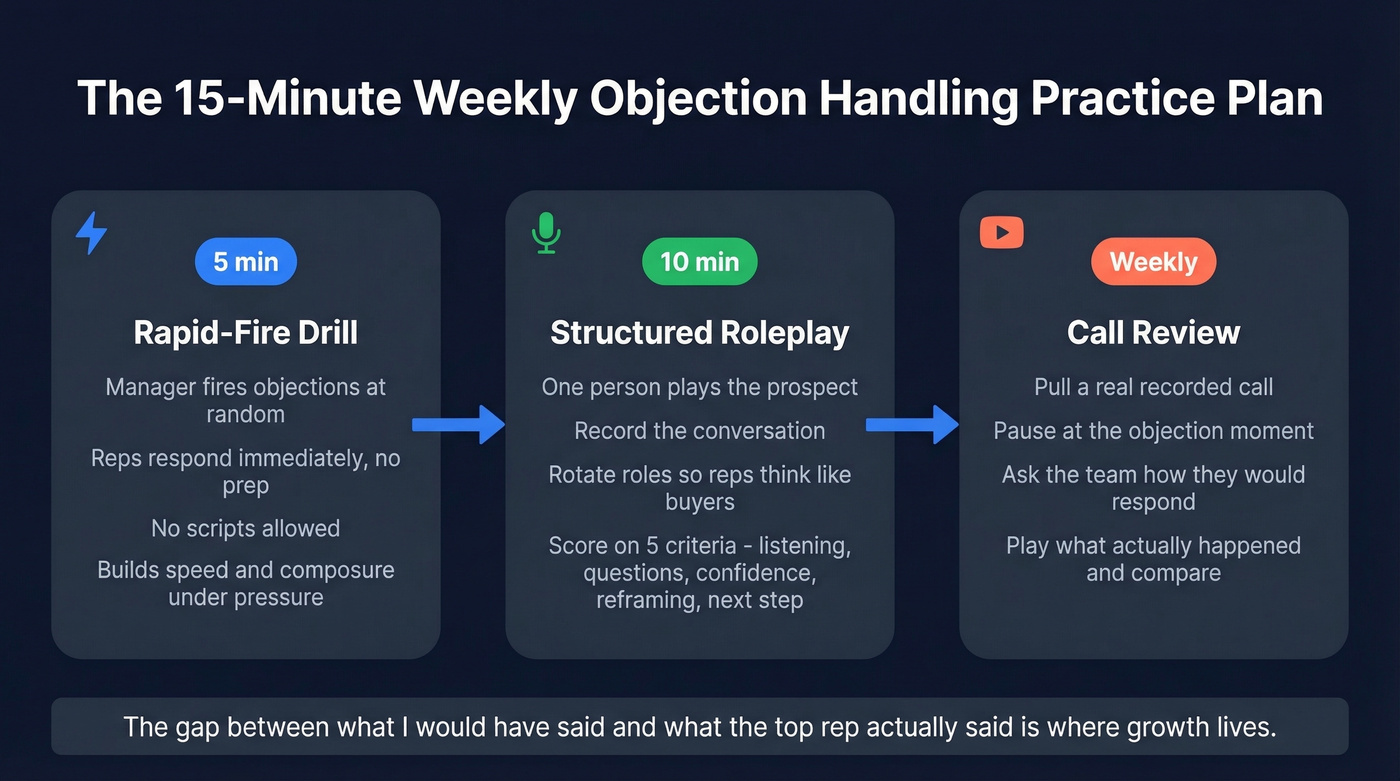
Rapid-fire drill (5 min). Manager fires objections. Reps respond immediately. No prep, no scripts. This builds speed and composure under pressure, and it's the single fastest way to get reps comfortable with silence and spontaneity.
Structured roleplay (weekly). One person plays the prospect, one plays the rep. Record it. Debrief. Rotate roles so reps learn to think like buyers. Score on five criteria from Bigtincan's rubric: active listening, open-ended questions, confidence, reframing to value, and closing the loop with a clear next step.
Call review. Pull a real recorded call. Pause at the objection. Ask the team how they'd respond. Then play what actually happened. Compare. The gap between "what I would have said" and "what the top rep actually said" is where growth lives.
The fastest way to sharpen any objection handling skill is to get on more calls - and that starts with accurate contact data. Verified emails and direct dials, not generic info@ addresses. We use Prospeo for this, but any quality data provider works. More at-bats means more reps in real objection scenarios, which is where the real learning happens.
If you’re rebuilding your outbound motion, pair this with a few modern sales prospecting techniques so the objections you practice match the buyers you’re targeting.
And if you’re cleaning up lead quality, a lightweight data enrichment services workflow can reduce “wrong person” objections before they happen.
Look - if your deal sizes are under $10k, you probably don't need a six-figure sales training platform. You need a weekly 15-minute drill, a shared doc of your top 5 objections, and enough live conversations to practice on. The reps who improve fastest aren't the ones with the best training budget. They're the ones making the most calls.
If your team is still ramping, bake objection drills into a simple 30-60-90 day plan so practice doesn’t get skipped.
Every deal that stalls past 50 days loses half its win rate. Bad contact data wastes the reps' sharpest objection handling reps on bounced emails and dead numbers. Prospeo's 98% email accuracy and 7-day data refresh mean your team reaches decision-makers while the deal is still warm.
Your best rebuttal is worthless if it never reaches the buyer.
FAQ
How long does it take to improve at handling objections?
With weekly drills plus call reviews, most reps see measurable improvement in 4-6 weeks. The 5x pause technique from Gong's research produces results almost immediately - try it on your next three calls and see what happens.
What's the best framework for beginners?
LAARC. It forces you through the full loop - listen, acknowledge, assess, respond, confirm - instead of jumping straight to a rebuttal. Once the steps feel automatic, drop the acronym and trust your instincts.
How do I practice if I'm not getting enough live calls?
Volume is the bottleneck. Build targeted prospect lists with verified direct dials so you're reaching decision-makers, not voicemails. Even a free tier from a data provider can give you enough contacts to fill a pipeline with real conversations to learn from.