

The Only Objection Handling Template You Need - Built on Data
Your newest SDR just froze mid-demo. The prospect said "we're not ready right now," and the rep launched into a 22-second monologue about product features nobody asked about. The deal died right there.
No form, no gate - scroll down and copy this objection handling template. One framework, five practiced scripts, all backed by 67,149 analyzed sales calls.
The 6-step framework: Pause → Mirror → Clarify → Isolate → Respond → Confirm
Jump to: Copy-paste scripts | Email templates | Five deal-killing mistakes
What 67,149 Sales Calls Reveal
Gong Labs analyzed 67,149 call recordings from a broader database of over one million recorded sales calls - specifically screen-share demos - and found a clear behavioral split between top performers and everyone else.
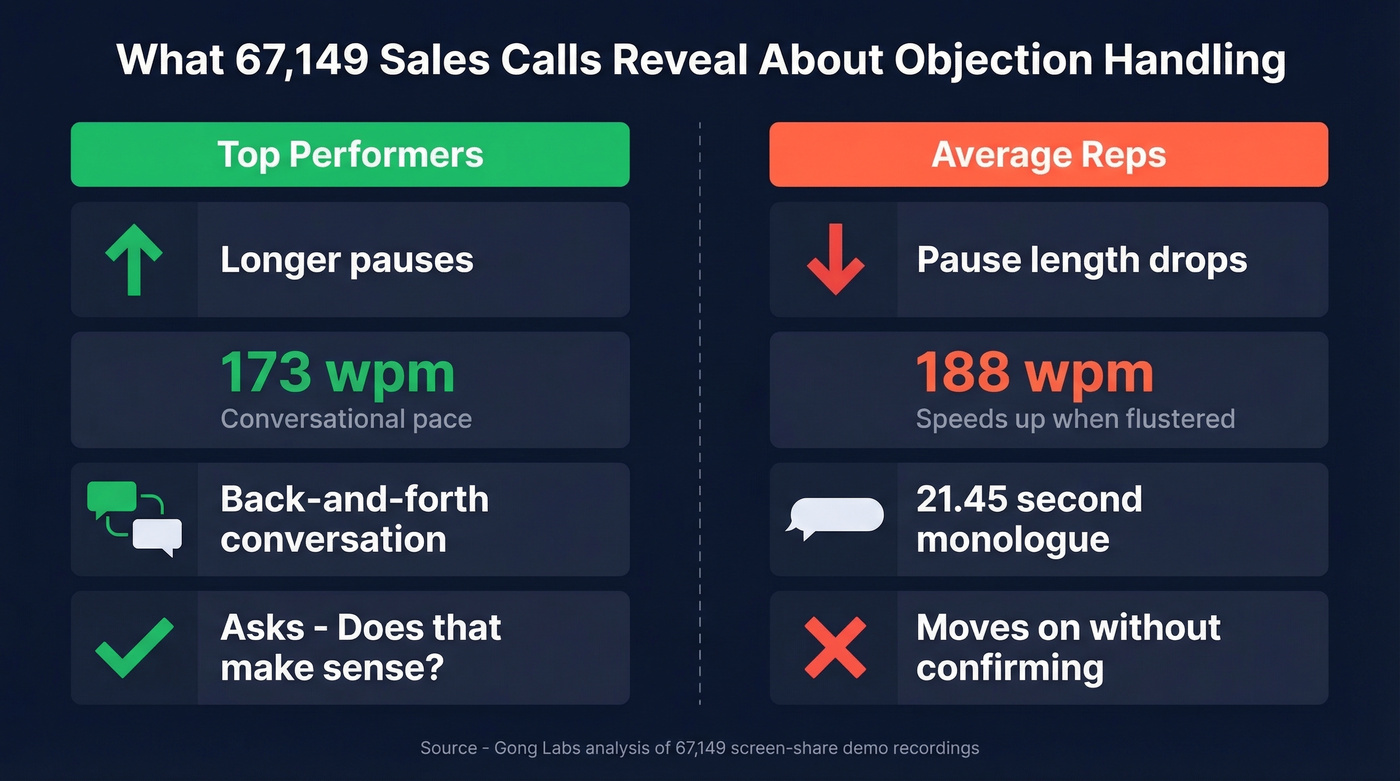
Top reps pause longer after hearing an objection. Average reps pounce. Their pause length actually drops. That instinct to fill silence is the single biggest predictor of a blown objection.
Average reps respond with a 21.45-second uninterrupted monologue and speed up to 188 words per minute compared to a conversational 173 wpm. Top reps keep their pace steady and speaker switches consistent, turning objections into conversations. They close the loop with "Does that make sense?" - a small habit that correlates with higher win rates.
We've watched reps cut their objection-to-close time in half just by adding the pause step. If you want to build an objection analysis sheet from your own call data, start by tagging every objection type and measuring rep response time - the patterns jump out fast.
The 6-Step Framework
Here's what that frozen SDR should have done:
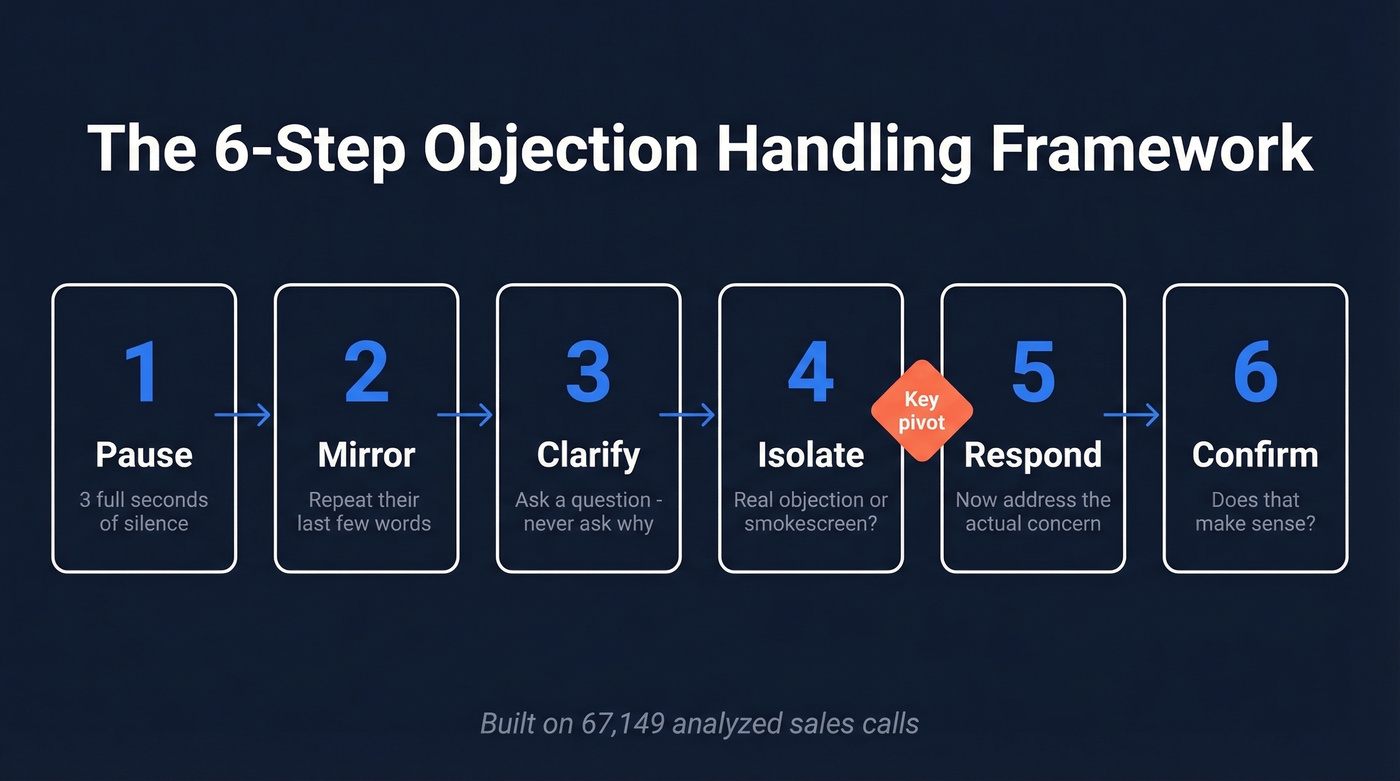
- Pause. Three full seconds. It feels eternal. It works.
- Mirror. Repeat the prospect's last few words with an upward inflection. Chris Voss popularized this - Gong's data confirms it prompts elaboration.
- Clarify. Ask a question, but never ask "why" - it triggers defensiveness. Try "Can you help me understand what's driving that concern?"
- Isolate. Diagnose whether it's the real objection or a smokescreen. "Setting that aside, how do you feel about everything else?"
- Respond. Now - and only now - address the actual concern.
- Confirm. "Does that make sense?" or "Did I answer that fully?"
If six steps feel heavy, Reddit practitioners share a simpler version called H-I-I: Hypothesize, Isolate, Inform. Either way, print this as a cheat sheet and keep it next to your monitor until the steps become muscle memory.
The Copy-Paste Scripts
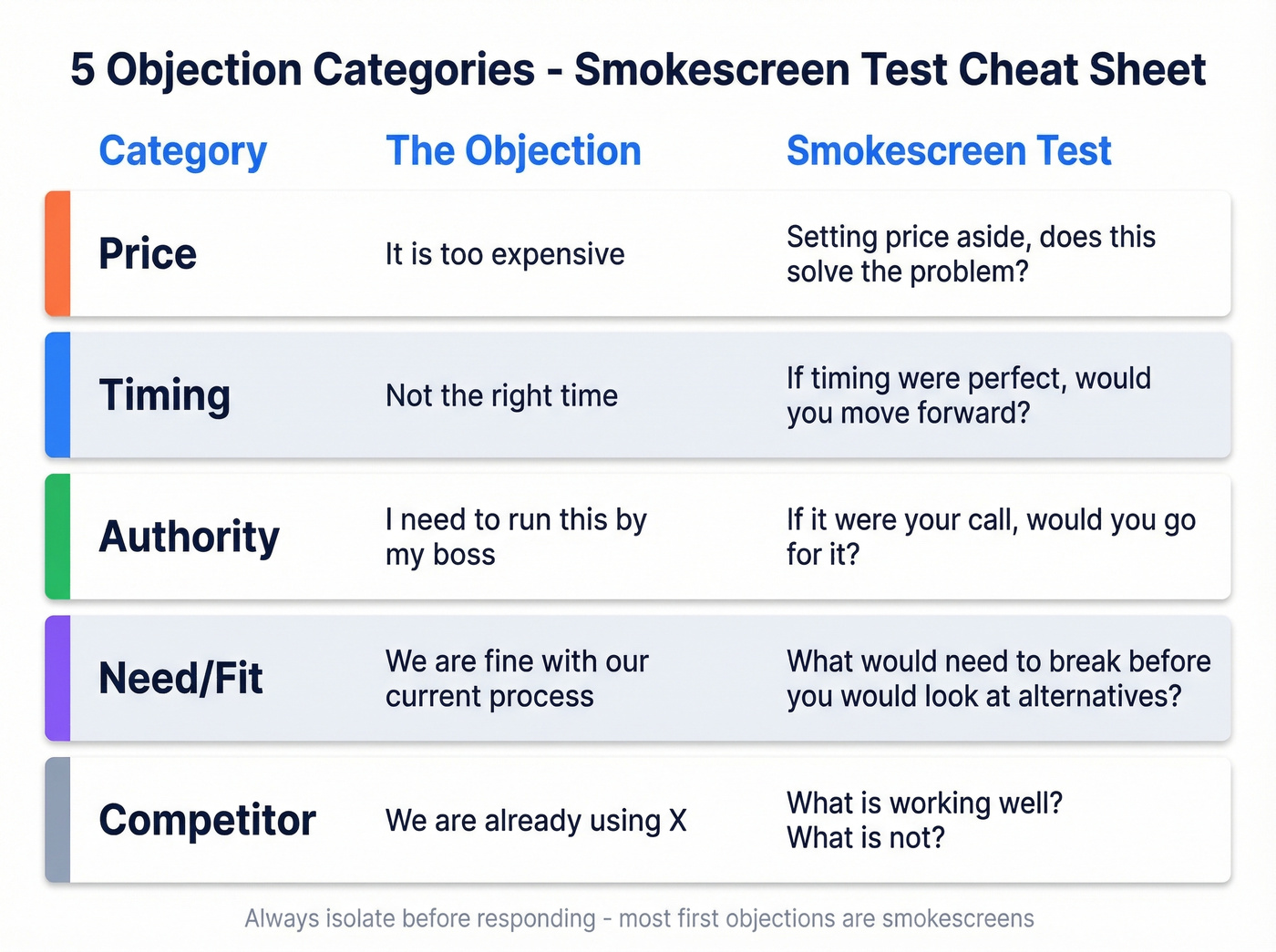
Five categories. Each includes a real objection, a smokescreen test, a rebuttal script, and the reasoning.
Hot take: If your average deal size is under five figures, most objections you hear aren't real - they're polite exits from a conversation that never should have started. Fix your targeting before you fix your rebuttals.
Price
Objection: "It's too expensive."
Smokescreen test: "Setting price aside, does this solve the problem?"
Rebuttal: "Totally fair. Is it that the value isn't clear yet, or that there's genuinely no budget allocated?"
This works because those are two completely different problems. A "too expensive" objection often masks a deeper concern - a prospect who says "it costs too much" might actually doubt durability or ROI. Isolating the real issue prevents you from discounting when you should be building value.
Timing
Objection: "Not the right time."
Smokescreen test: "If timing were perfect, would you move forward?"
Rebuttal: "What changes in Q3 that makes this easier? Most teams find the cost of waiting is higher than they expect."
Forces the prospect to articulate what "better timing" actually means - which often reveals it means nothing specific.
Authority
Objection: "I need to run this by my boss."
Smokescreen test: "If it were your call, would you go for it?"
Rebuttal: "Makes sense. What would help you make the strongest case internally? I can build a one-pager for that conversation."
This turns a stall into collaboration. You become an ally, not a vendor waiting for a callback.
Need/Fit
Objection: "We're fine with our current process."
Smokescreen test: "What would need to break before you'd look at alternatives?"
Rebuttal: "When you last evaluated this, what were the top two things you wished were different?"
"We're fine" is almost never true - it's comfortable. The question forces honest reflection. Retention scenarios follow the same principle: when existing customers say "we're thinking of canceling," the smokescreen test is identical. Isolate the real concern before offering a save.
Competitor
Objection: "We're already using [X]."
Smokescreen test: "What's working well? What isn't?"
Rebuttal: "Solid tool. Most teams using [X] mention [specific gap]. Have you run into that?"
Acknowledging the competitor builds credibility. Leading with a known gap opens the door without attacking.
Industry note: These scripts adapt beyond SaaS. In insurance, "I'm not interested" is almost always a knee-jerk smokescreen. The same isolate-then-probe pattern works: "Most people say that before they see how this compares to what they're paying now. Five minutes?"
Half of "not interested" objections happen because you reached the wrong person entirely. Verify your prospect data before you dial - bad contact info creates preventable objections. Tighten your Ideal Customer Profile and use firmographic filters so you’re not pitching to the wrong accounts in the first place.

You just learned that bad targeting creates preventable objections. Prospeo's 300M+ verified profiles with 30+ filters - including buyer intent, job changes, and headcount growth - put you in front of the right decision-maker before you ever pick up the phone. 98% email accuracy means fewer bounces, fewer "who are you?" moments, and more real conversations.
Stop rehearsing rebuttals for prospects who were never a fit.
Handling Objections Over Email
Here's the thing - email objections are actually easier to handle than live ones. You have time to diagnose before you respond.
Price objection:
Subject: Quick question about budget
Hi [Name], totally understand. Setting price aside - does the solution fit what you're trying to accomplish? If so, I have options that might work. If not, I'd rather know now.
"Not interested" brush-off:
Subject: Fair enough - one question
Hi [Name], no worries. Was it timing, fit, or something else? If it's not relevant, I'll move on. But if there's a specific concern, I'd rather address it than guess.
Both templates follow a qualification-first approach: diagnose the smokescreen before pitching the solution. Save these in a shared doc so every rep on your team has the same playbook for async conversations. If you need more reply-driving sequences, keep a set of sales follow-up templates and proven email subject lines ready to go.
Five Mistakes That Kill Deals
- Treating the first objection as real. Most first objections are smokescreens. Always isolate before responding.
- Monologuing for 21+ seconds. Gong's data shows average reps go into a 21.45-second uninterrupted monologue after objections. That's an eternity.
- Asking "why." Triggers defensiveness instantly. Replace with "help me understand."
- Discounting too fast. Leading with a discount tells the prospect your price was inflated. Lead with ROI - always. A premature discount anchors every future negotiation lower. (If you want a deeper negotiation lens, study the idea of an anchor in negotiation.)
- Speeding up when flustered. That 173-to-188 wpm jump is a tell. Prospects hear panic.
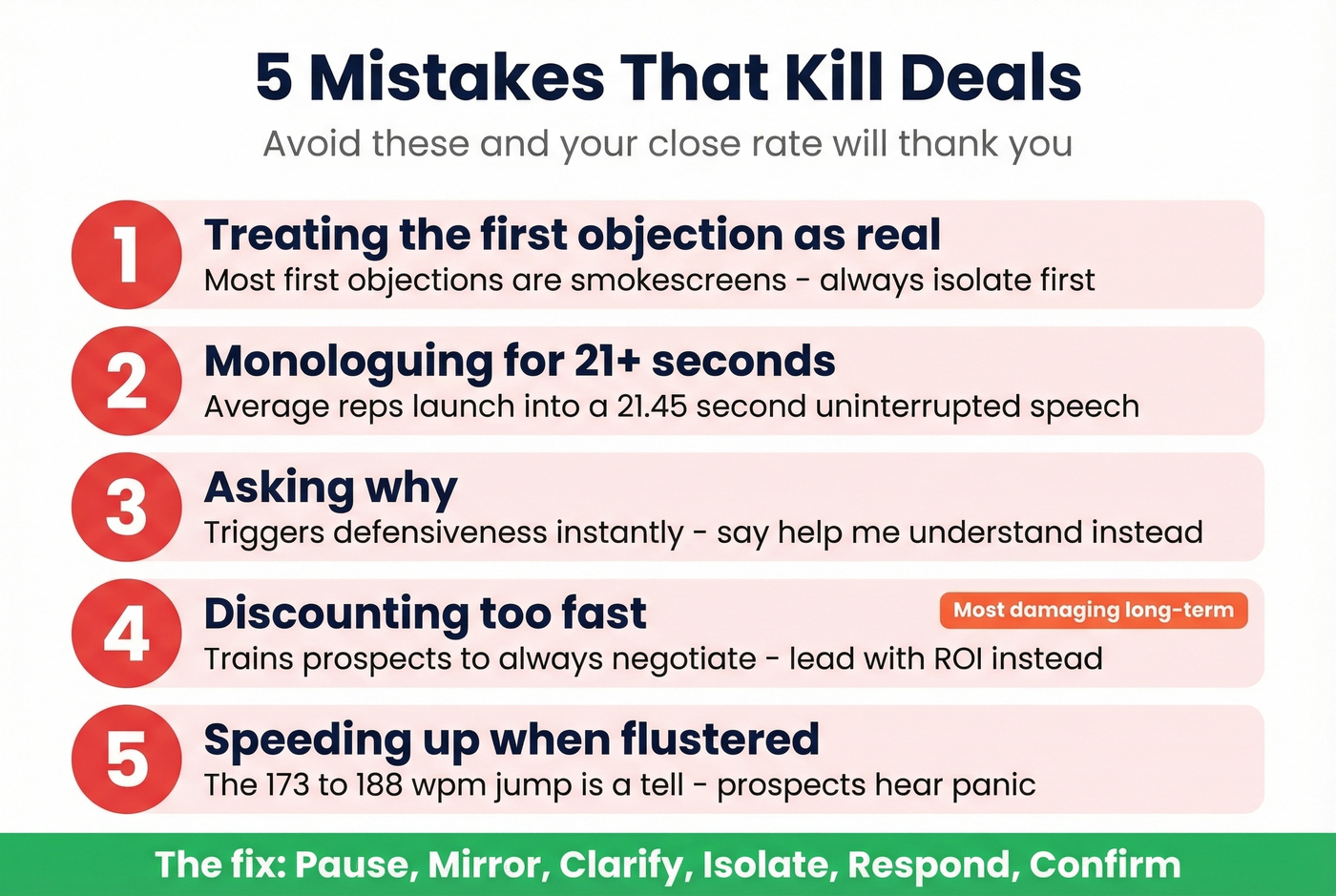
In our experience, mistake #4 causes the most long-term damage. Once you train a prospect to expect discounts, every future deal starts with "what can you do on price?" Skip the discount reflex and build the value case instead - even if it means losing a deal today to protect your margins on the next twenty.
The "I need to run this by my boss" objection disappears when you reach the actual decision-maker. Prospeo's database lets you filter by seniority, department, and title across 300M+ profiles - with verified direct dials (125M+ mobiles, 30% pickup rate) so you skip the gatekeeper entirely. At $0.01 per email, fixing your contact list costs less than one blown demo.
Reach the decision-maker directly. Kill the authority objection before it starts.
Coaching Reps With Real-Time Tools
Once your team has internalized the framework, real-time AI coaching is the multiplier. These tools detect objections mid-call and surface responses based on similar closed-won deals. Teams often track up to +45% success-rate improvement as a benchmark KPI for AI-assisted programs.
The best coaching approach combines two things: structured activities like weekly role-play sessions, and data from recorded calls that show reps exactly where they deviated from the framework. Even 15 minutes of paired role-play before a dial block dramatically reduces freeze-ups on live calls. Let's be honest - most teams skip the role-play because it feels awkward, and then wonder why reps choke on real calls. If you’re building a repeatable outbound motion, pair this with a cold calling system and a tighter set of sales prospecting techniques.
| Tool | Starting Price | Best For |
|---|---|---|
| Gong | ~$1,200-$1,600/user/yr + platform fee | Full conversation intelligence |
| Highspot | ~$50-$80/user/mo | Content + coaching combo |
| Chorus (ZoomInfo) | ~$100-$150/user/mo | ZoomInfo ecosystem teams |
| Hyperbound | ~$40/user/mo | AI role-play practice |
| Spekit | From ~$25/user/mo | Lightweight enablement |
FAQ
What are the five types of sales objections?
Price, timing, authority, need/fit, and competitor - every objection maps to one of these five categories. The scripts above cover all five with smokescreen tests and ready-to-use rebuttals.
What's the best objection handling framework?
Pause → Mirror → Clarify → Isolate → Respond → Confirm, built on Gong's 67,149-call analysis. For a lighter alternative, try H-I-I (Hypothesize, Isolate, Inform) - three steps that cover the same core logic.
How do you prevent objections before they happen?
Qualify harder upfront and verify you're reaching the right person with accurate contact data. When reps target verified decision-makers instead of stale contacts, "not interested" rates drop because the conversation is relevant from the first sentence.
How often should reps practice handling objections?
Weekly at minimum - schedule 15-minute paired role-plays before dial blocks. Teams that combine live practice with recorded call reviews build reflexes faster than those relying on scripts they've never rehearsed.