

Ocean.io vs Power Almanac: Two Very Different Tools Compared
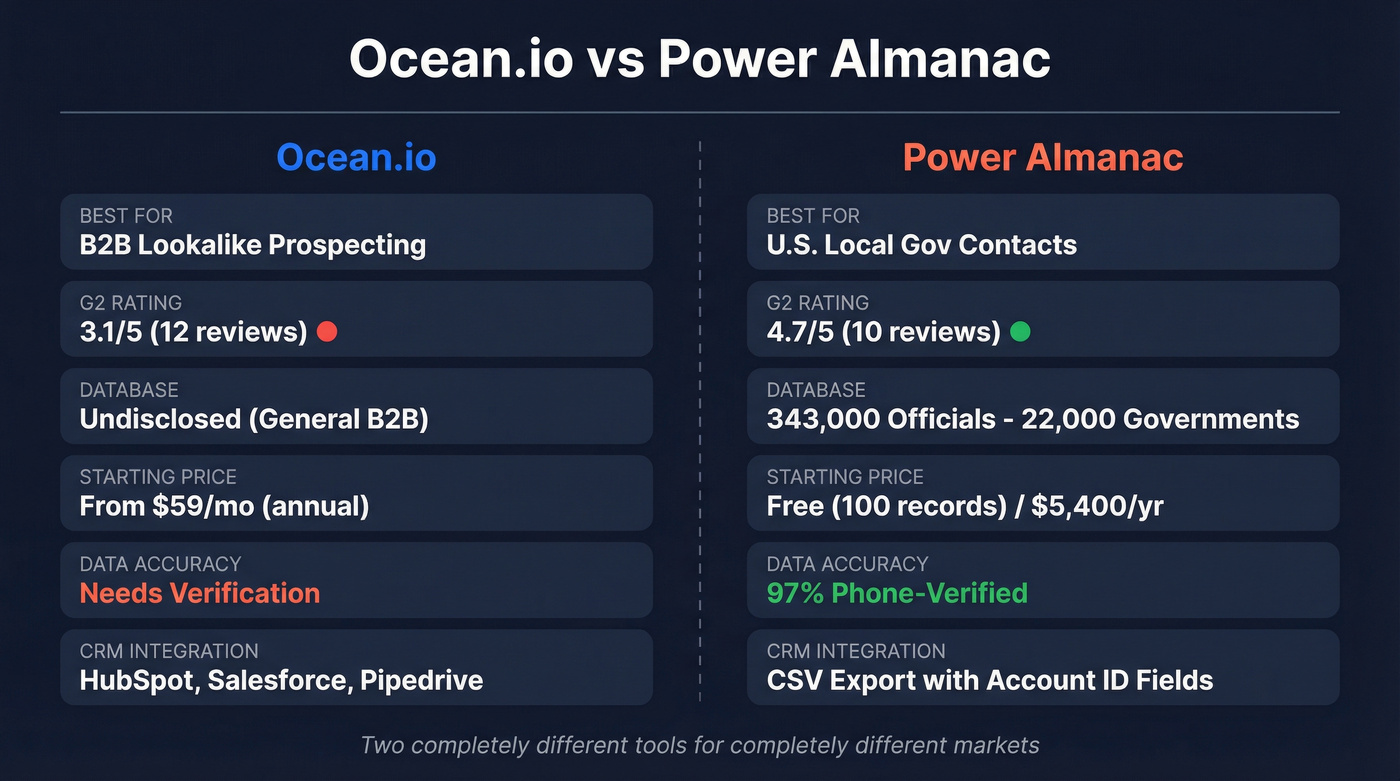
Ocean.io and Power Almanac don't compete. Comparing them is like comparing a Swiss Army knife to a scalpel - one is an AI-driven lookalike prospecting tool for commercial B2B sales, the other is a phone-verified database of U.S. local government officials. If you're weighing them against each other, you're probably solving a problem neither tool was built for.
Let's break down where each one actually makes sense.
30-Second Verdict
Power Almanac wins if you're selling to local government - IT directors, purchasing managers, city managers. Nothing else comes close for that niche.
Ocean.io wins if you need AI lookalike targeting to find commercial companies that resemble your best customers. Just plan to verify the output.
Side-by-Side Snapshot
| Dimension | Ocean.io | Power Almanac |
|---|---|---|
| Best for | B2B lookalike prospecting | U.S. local gov contacts |
| G2 Rating | 3.1/5 (12 reviews) | 4.7/5 G2 rating (10 reviews) |
| Database Size | Undisclosed (general B2B) | 343,000 officials across 22,000 governments |
| Starting Price | From $59/mo (annual) | Free (100 records) / $5,400/yr paid |
| Data Accuracy | Needs verification | 97% phone-verified |
| Email Verification | ZeroBounce | Bi-weekly revalidation including ZeroBounce |
| CRM Integration | Native: HubSpot, Salesforce, Pipedrive | CSV export with Account ID + Person ID fields |
| Ideal Buyer | B2B sales teams | GovTech vendors |
What Is Ocean.io?
Ocean.io's core pitch is lookalike search. Feed it your best customers, and its AI finds companies and contacts that match the same profile. For teams running ABM or vertical-focused outbound, that goes beyond basic industry-code filtering - and the concept is genuinely useful.
The problem is execution. Ocean.io's G2 rating sits at 3.1/5 across 12 reviews, with recurring complaints about data accuracy and cost. One Reddit practitioner described a workflow where they start with Ocean.io for lookalike targeting, then run everything through Clay for verification - because "Ocean is solid, but it's not perfect."

Pricing is credits-based. Premium starts at $59/month on annual billing, and Professional runs $109/month on annual billing. Higher tiers require custom quotes, typically landing in the mid-to-high four figures annually. Ocean.io uses ZeroBounce for email verification, but if you're doing outbound at scale, plan on a second verification pass before you sequence.
We've tested lookalike tools like this before, and the pattern is consistent: the targeting logic is strong, but the contact data that comes out the other end isn't ready to send cold email to without scrubbing. Budget accordingly.
Use this if you're building targeted account lists based on lookalike modeling and you have a verification tool downstream. Skip this if you need accurate contact data out of the box.

Ocean.io's lookalike lists still need a verification pass before you can safely send. Prospeo skips that step entirely - 300M+ profiles with 98% email accuracy, refreshed every 7 days, so your data is ready to sequence the moment you export it.
Stop paying for targeting that still needs a second tool to verify.
What Is Power Almanac?
Power Almanac is a completely different animal. It does one thing: provide verified contact data for decision-makers across 22,000 U.S. local governments - covering 99% of local governments serving populations of 1,000 or more. That's 343,000 records spanning 22 critical roles, from heads of IT and purchasing to city managers and mayors.

What makes it credible is the verification methodology. Eighteen full-time researchers call every government every 90 days. Emails get revalidated every two weeks using ZeroBounce and an independent validation program. The result is 97% accuracy, and with a 4.7/5 G2 rating, users back that up. The main complaint? People want more roles and deeper org charts.
That refresh cadence isn't overkill. 4.1% of government contact records change every month, compounding to 40.5% annual turnover. Without constant verification, your list goes stale fast. Power Almanac tracks this with update statuses (CHANGED, SAME, ADDED, DELETED) on downloaded records, so you always know what shifted since your last export.
Here's the thing about govtech sales: most general-purpose databases are terrible at it. Government orgs don't show up on standard firmographic feeds the way private companies do. If this is your market, Power Almanac earns its price.
Power Almanac Pricing
| Tier | Records | Price/Year | Per Record |
|---|---|---|---|
| Power Entry | 100 | Free | Free |
| Power 15 | 15,000 | $5,400 | $0.36 |
| Power 75 | 75,000 | $12,000 | $0.16 |
| Power Max | 340,000+ | $16,900 | $0.05 |
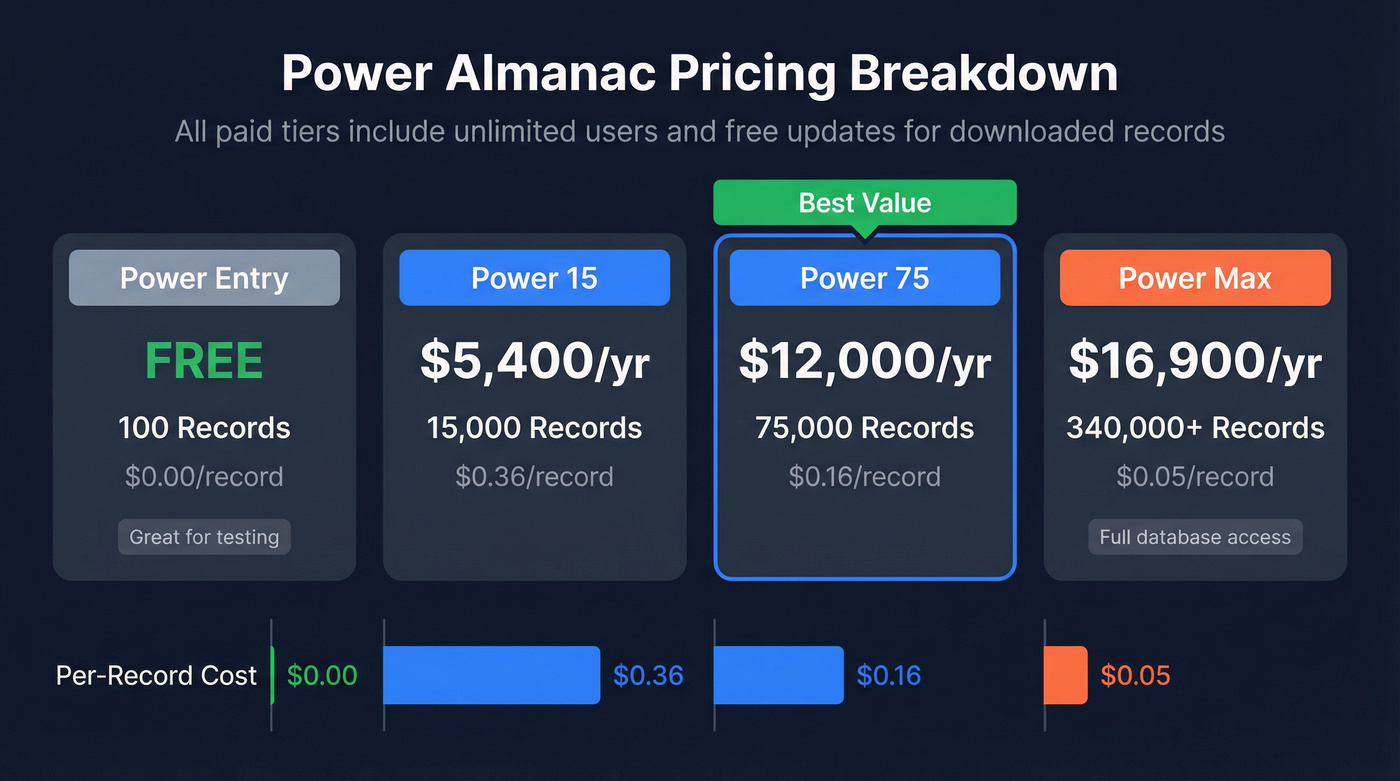
All paid tiers include unlimited users and free updates for downloaded records.
When to Use Each Tool
Selling to municipal IT departments. You need the head of IT for every city over 10,000 people in Texas. Power Almanac is the obvious choice. Ocean.io's lookalike model doesn't apply to government entities, and general B2B databases aren't designed for this niche. Download your CSV, import to your CRM using Power Almanac's Account ID fields, and start sequencing.
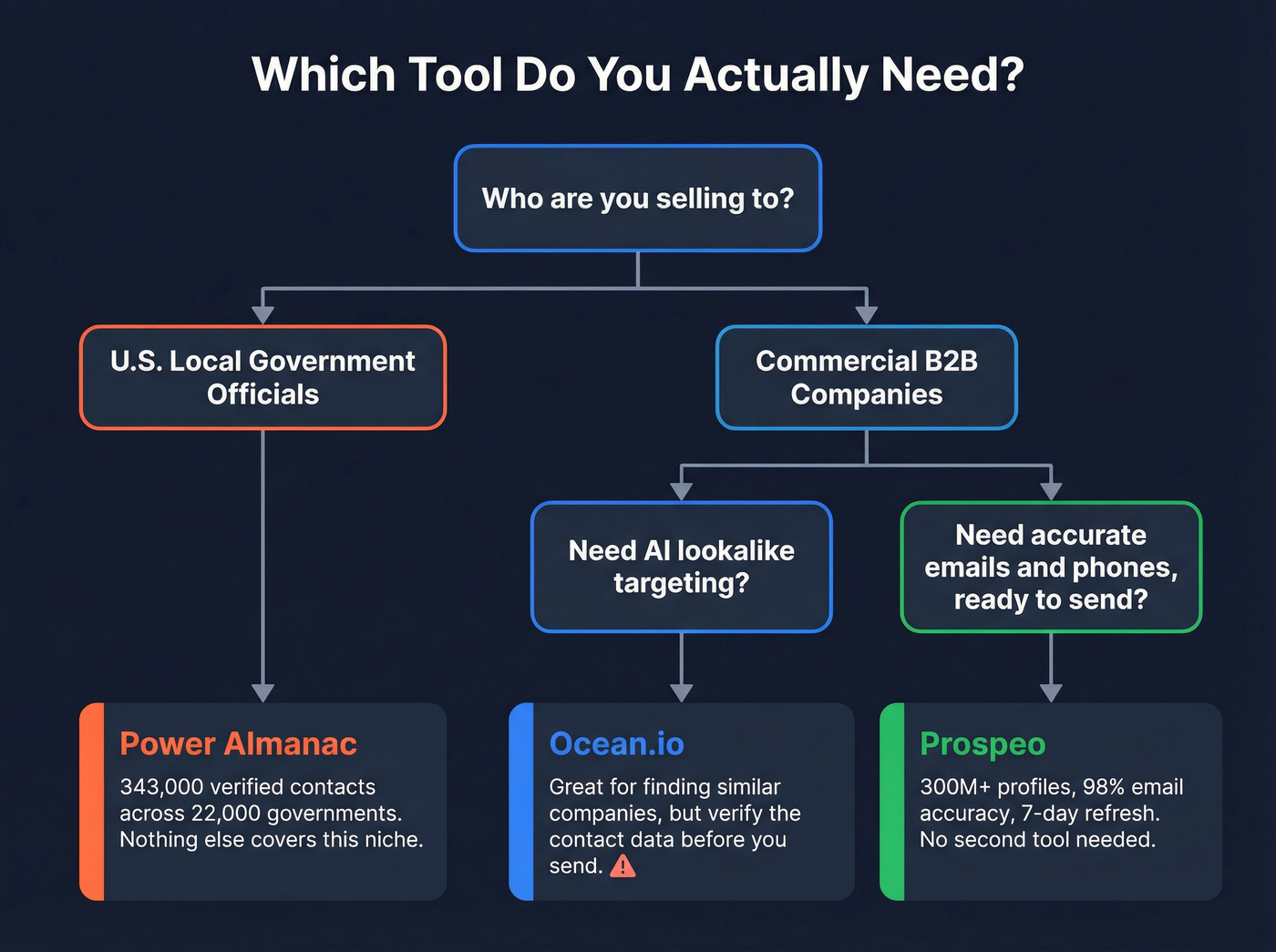
Finding companies that mirror your best accounts. You're an SDR team at a SaaS company trying to find mid-market companies that resemble your top 20 customers. Ocean.io's lookalike search is built for exactly this - feed in your best customers, get a target list, push it to HubSpot, Salesforce, or Pipedrive. But verify before you sequence. We've seen teams burn sender reputation on unverified exports, and recovering from that is painful.
Hot take: If your total addressable market is under 5,000 accounts, you probably don't need AI lookalike modeling at all. Build the list manually, verify it properly, and spend your budget on better copy instead. (If you want a clean way to sanity-check that, start with an addressable market breakdown.)
If Neither Tool Fits
Most teams comparing Ocean.io vs Power Almanac realize pretty quickly that they don't actually need either one. They need broad B2B coverage with accurate contact data - not a niche government database or an AI targeting layer that still requires downstream verification.
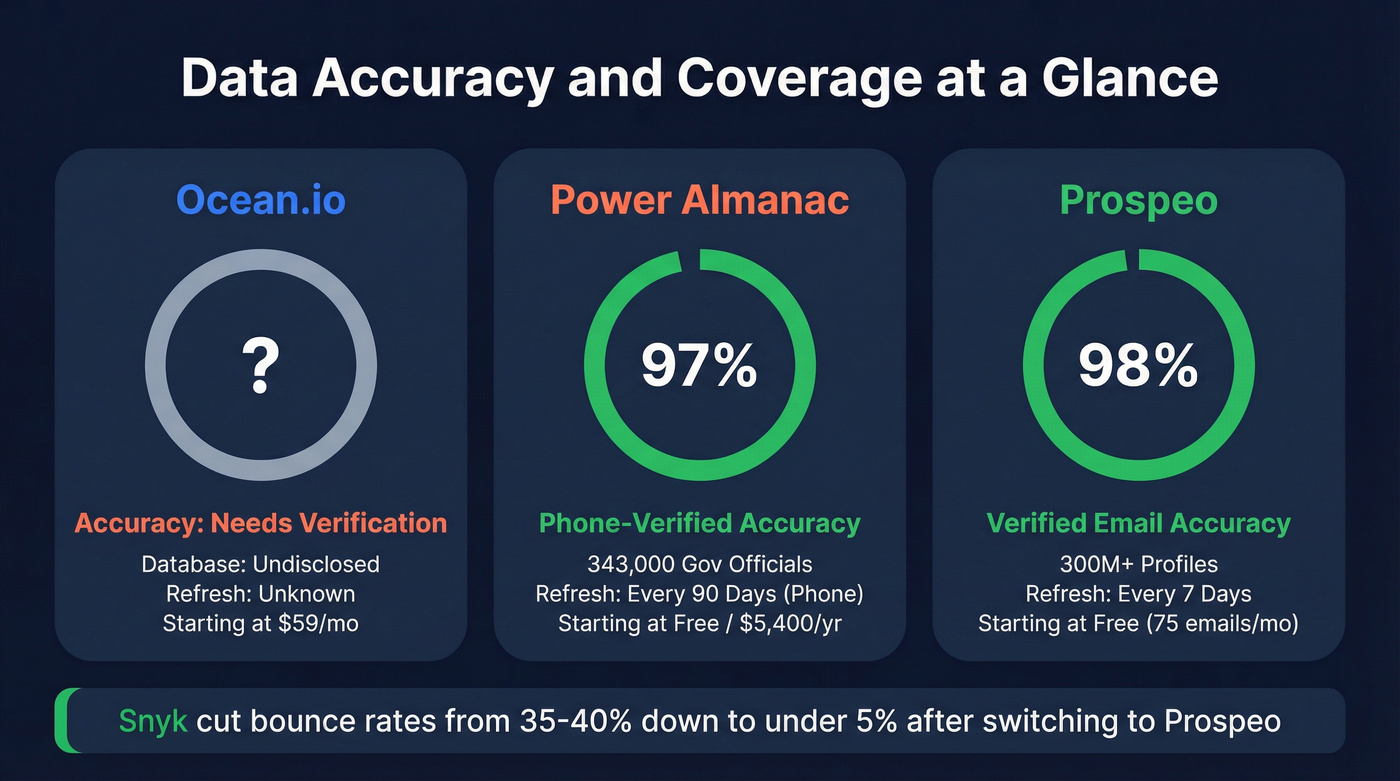
Prospeo handles that end-to-end: 300M+ professional profiles, 98% email accuracy, and 125M+ verified mobile numbers on a 7-day refresh cycle. The free tier gives you 75 emails per month, and paid plans run about $0.01 per email with no contracts. For context, our team at Prospeo has seen customers like Snyk cut bounce rates from 35-40% down to under 5% after switching - that's the kind of difference fresh, verified data makes in real outbound campaigns. (If you're comparing options, see our roundup of data enrichment services.)

If your market is broader than U.S. local government and you're tired of scrubbing unverified exports, Prospeo gives you 143M+ verified emails and 125M+ mobile numbers at ~$0.01/email. Snyk cut bounce rates from 35-40% to under 5% - no downstream verification required.
Accurate data out of the box. 75 free emails to prove it.
FAQ
Can Ocean.io find government contacts?
No. Ocean.io is built for commercial B2B lookalike prospecting - finding companies that resemble your existing customers. For U.S. local government decision-makers, Power Almanac is purpose-built with 343,000 phone-verified records across 22,000 governments. These tools serve entirely different markets.
Is Power Almanac useful outside government sales?
Not at all. Power Almanac exclusively covers U.S. local government officials across 22 role types. If you sell to commercial businesses, you need a general-purpose B2B data platform with broad coverage and verified contact info.
Does Ocean.io verify its email data?
Ocean.io uses ZeroBounce for verification, but G2 reviewers and Reddit users consistently run an additional enrichment step - often with tools like Clay - to clean results before launching outbound campaigns. Budget for a second pass.
What's a good alternative if neither tool fits?
For teams that need broad B2B coverage with high accuracy, Prospeo offers 98% verified emails, 125M+ mobile numbers with a 30% pickup rate, and a 7-day data refresh cycle. It's self-serve with no annual contracts, and the free tier includes 75 emails per month.