


10 Best Odoo Alternatives in 2026
You just opened the renewal invoice for your Odoo Enterprise subscription. What started as a "free open-source ERP" somehow turned into $30-50+/user/month once you added the modules you actually need - and the last upgrade broke your inventory workflow for two weeks. Odoo has 7+ million users globally and a 4.5/5 on G2, but the gap between the marketing promise and the operational reality is where the frustration lives.
Here are 10 Odoo alternatives worth evaluating, with real pricing and zero "contact vendor for details" cop-outs.
Our Picks (TL;DR)
| Use Case | Pick | Starting Price |
|---|---|---|
| Best open-source ERP | ERPNext | Free self-hosted |
| Best all-in-one SMB suite | Zoho One | $37/employee/mo |
| Best for Microsoft shops | Dynamics 365 BC | $80/user/mo |
| Best for enterprise scale | NetSuite | ~$999/mo base |
| Best for CRM data quality | Prospeo | Free (75 emails/mo) |
Most teams don't need to replace all of Odoo - just the two or three modules causing pain. That changes the calculus entirely.
Why People Switch from Odoo
Three themes dominate r/Odoo, G2 reviews, and every ERP migration conversation we've had.
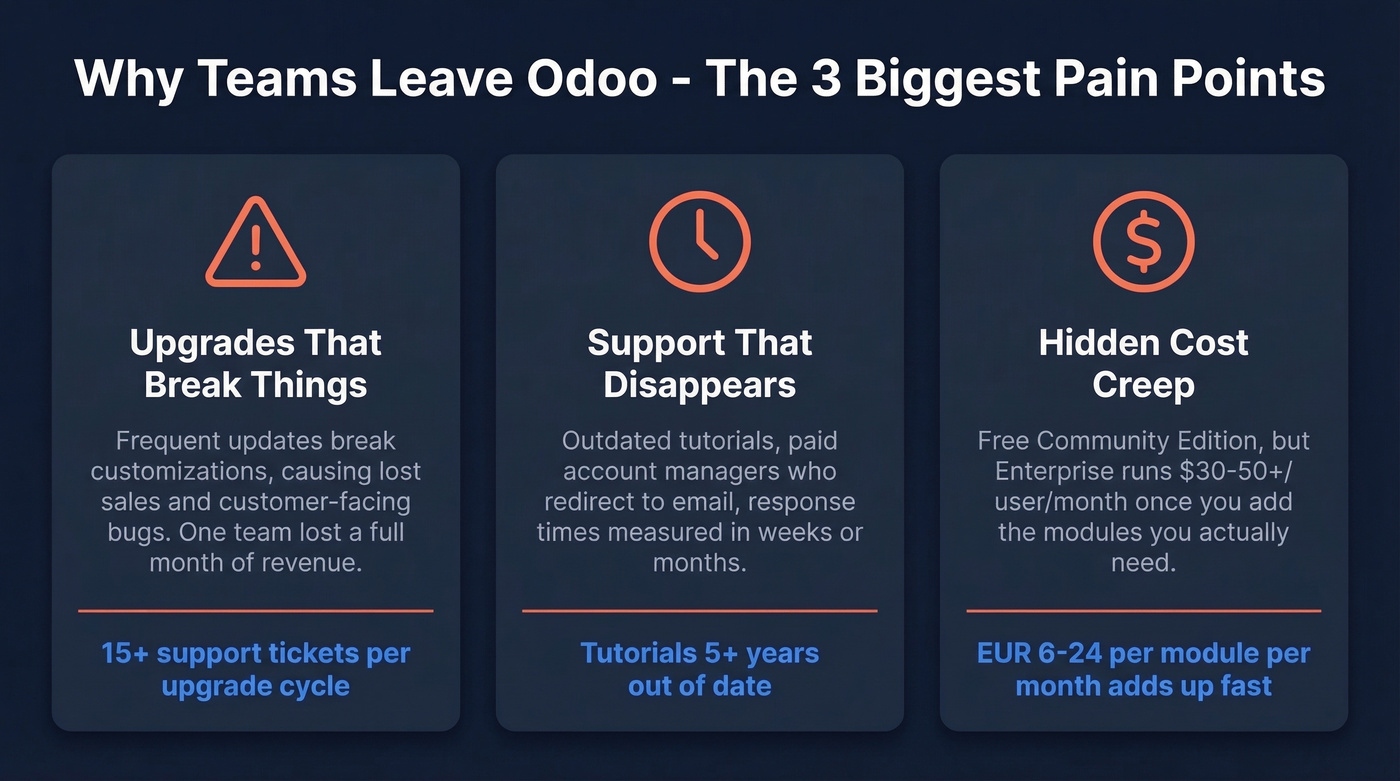
Upgrades That Break Things
One Reddit user described their experience as "awful" - and the details back it up. They opened fifteen support tickets, an upgrade introduced website bugs that customers discovered before the team did, and they lost a full month of sales before migrating to Shopify. Not an isolated story. G2's review summary flags "frequent updates can break customizations" as a recurring theme across dozens of accounts.
Support That Doesn't Show Up
Another r/Odoo thread captures the support problem perfectly: tutorials 5+ years old that don't match the current platform, a paid account manager who redirects you to email, and response times measured in weeks - sometimes months. For a platform that markets itself as beginner-friendly, that's a serious disconnect.
Cost Creep in Open-Source Clothing
Odoo Community Edition is genuinely free under an LGPL license. But on Odoo Enterprise, each additional app/module costs EUR 6-24 per month, and some modules require other modules to function. By the time you've assembled the stack you actually need - CRM, inventory, accounting, ecommerce - you can easily land in the $30-50+/user/month range. That's not open-source pricing. That's freemium dressed up in open-source clothing.
And here's the thing: your CRM is only as good as the data inside it. A shiny new ERP won't fix stale contacts and bounced emails.
The 10 Best Odoo Alternatives for 2026
1. ERPNext
ERPNext is the only Odoo competitor that delivers on the open-source promise without a bait-and-switch. The software is free under AGPL-3.0 - genuinely free, not "free until you need the good modules" free. You can self-host and pay Frappe nothing, or use Frappe Cloud starting at $5/month for sites and $20/month for servers.
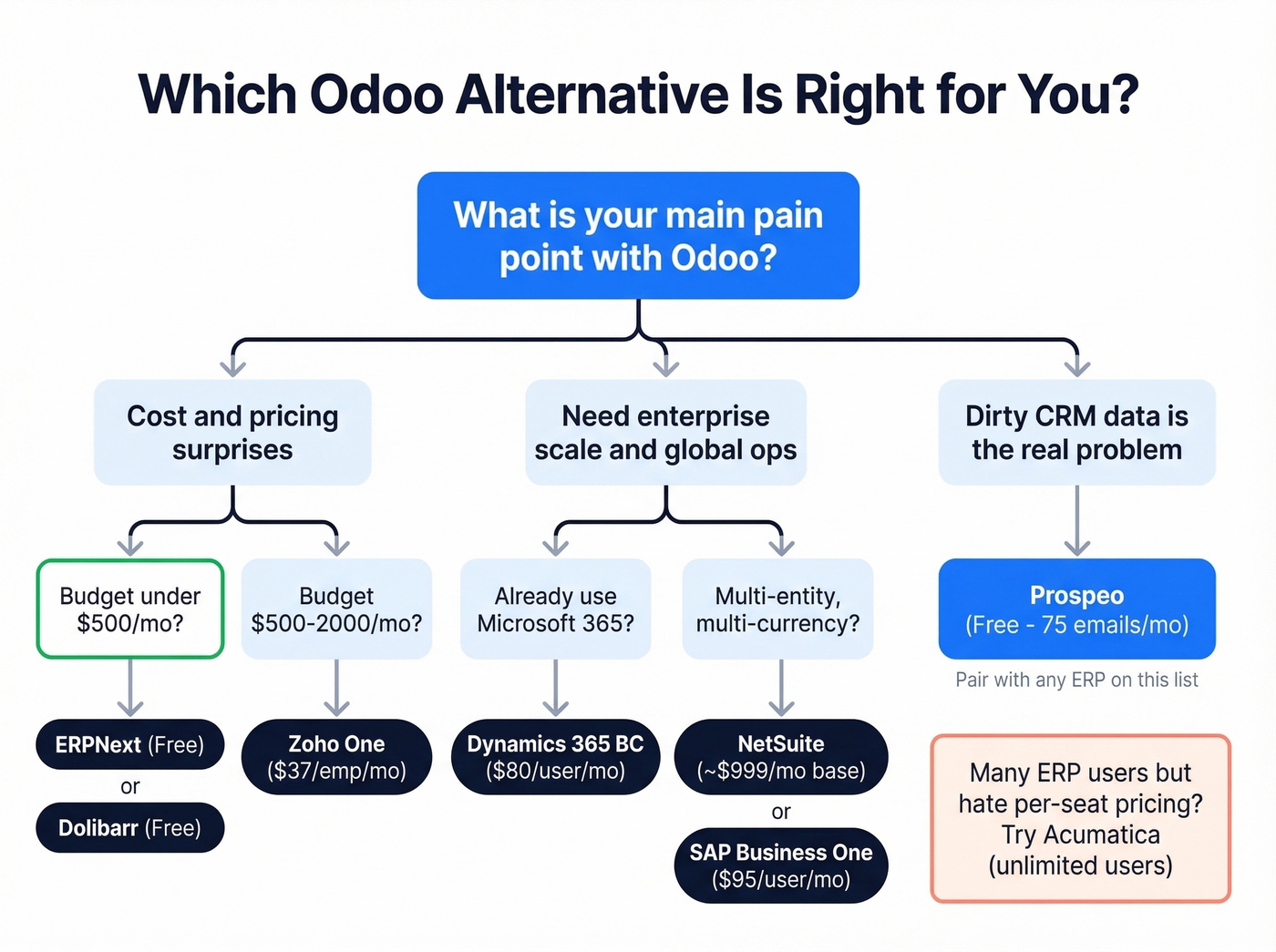
ERPNext's ecosystem is smaller than Odoo's, but it's still backed by a network of 200+ implementation partners. Typical SMB implementations run $5k-$50k depending on complexity. That's real money, but it's a one-time cost rather than a recurring per-module tax.
Community sentiment on r/ERPNext is generally positive, with users praising the lack of module gating, though the learning curve for self-hosting comes up frequently. One common refrain: "It's not as polished as Odoo, but at least it doesn't nickel-and-dime you."
Best for: Teams who want Odoo's original promise - actually delivered.
Skip this if: You need a massive partner ecosystem or white-glove onboarding.
2. Zoho One
What you pay: $37/employee/month (all employees) or $90/user/month (flexible). That's it.
Zoho One is the anti-Odoo in one important way: pricing is predictable. You get 50+ apps - CRM, accounting, HR, project management, marketing automation - for one flat rate. Annual billing. No per-module surprises.
The "all employees" requirement on the cheaper plan matters, though. If you have 50 employees but only 20 need the software, you're still paying for all 50 at $37/head. The flexible plan at $90/user lets you license selectively. Monthly billing bumps those to roughly $45 and $105 respectively.
Individual Zoho apps aren't best-of-breed - Zoho CRM isn't Salesforce, Zoho Books isn't NetSuite. But the integrated suite is genuinely good for SMBs who want one vendor, one login, and one bill.
Best for: SMBs wanting everything under one roof without per-module cost creep.
Skip this if: You need deep functionality in any single module.
3. Prospeo
Not an ERP - but the tool that makes any ERP replacement actually work.
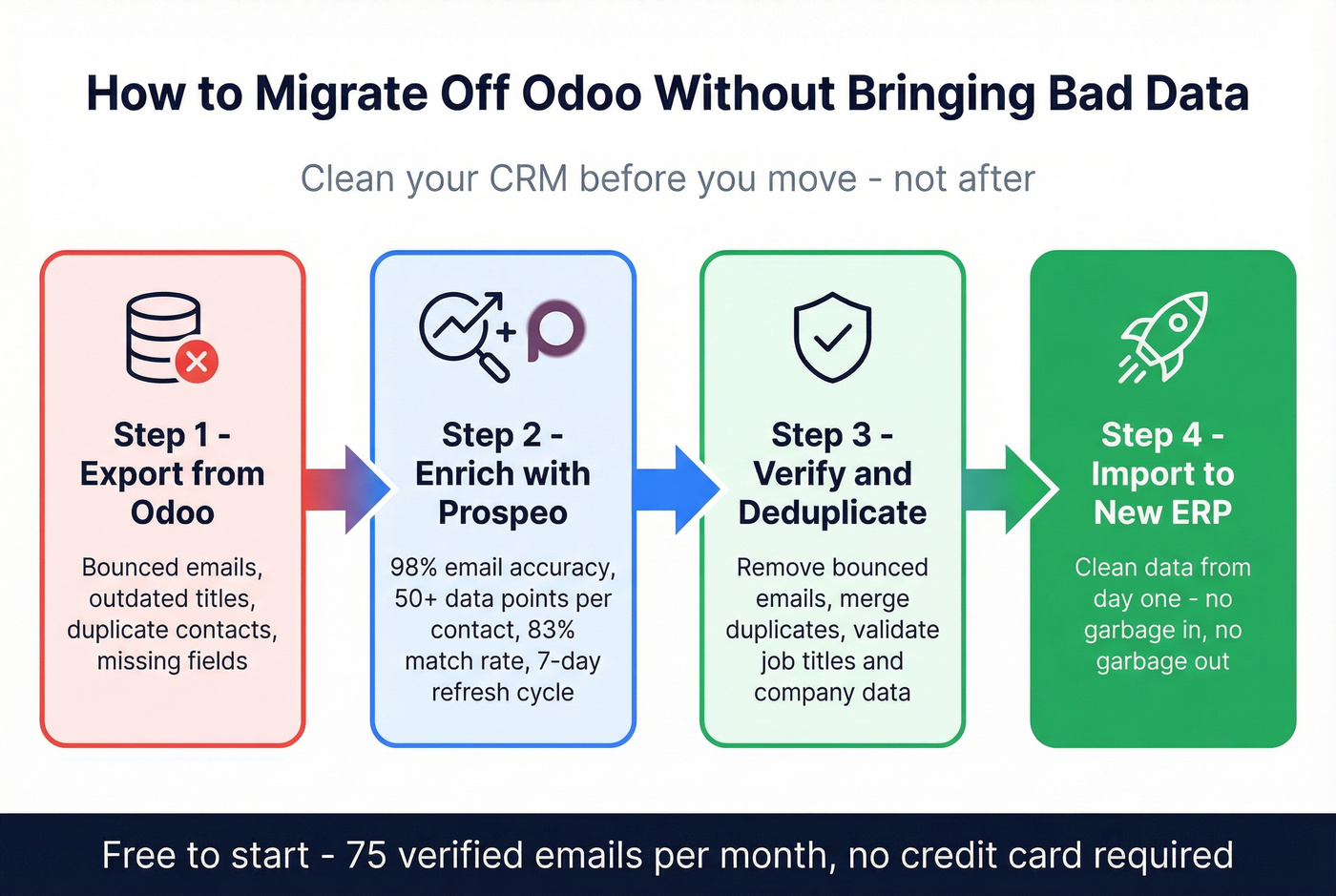
Let's be honest: if your Odoo CRM is full of bounced emails and outdated job titles, migrating that mess into a new system just moves the problem. We've watched teams spend months picking the perfect ERP replacement, then import garbage data on day one. Prospeo solves that specific problem. It covers 300M+ professional profiles with 98% email accuracy, and every record refreshes on a 7-day cycle - the industry average is six weeks. Intent data tracking 15,000 topics helps you prioritize accounts actively researching solutions, so you're not just enriching contacts but finding the ones ready to buy.
The Chrome extension (40,000+ users) lets you verify contacts directly from any website or CRM in one click, and CRM enrichment returns 50+ data points per contact with an 83% match rate. Free tier gives you 75 verified emails per month - no credit card required - and paid plans work out to roughly $0.01/email with native integrations into Salesforce, HubSpot, Lemlist, and Instantly.
If you're comparing tools in this category, start with our breakdown of data enrichment options and how they differ.
Best for: Teams whose real Odoo problem is dirty CRM data, not missing ERP features.
Skip this if: You genuinely need a full ERP replacement - pair Prospeo with one of the other tools on this list instead.
4. Microsoft Dynamics 365 Business Central
Who this is NOT for: Startups, solopreneurs, or anyone without an existing Microsoft 365 footprint. The licensing complexity alone will eat your implementation timeline.
If your company already runs on Microsoft 365, Teams, and Outlook, Dynamics 365 Business Central is the path of least resistance. The integration with Excel, Power BI, and Copilot is native - not bolted on.
Pricing went up for the first time in 5+ years, effective November 2025. Essentials jumped from $70 to $80/user/month and Premium from $100 to $110/user/month. Team Members remain at $8/user/month, and Device licenses sit at $45/device/month. Premium adds Manufacturing and Service Management on top of Essentials. Licensing is named-user only - no concurrent pooling - and monthly terms run ~20% higher than annual commitments.
Best for: Companies already deep in the Microsoft ecosystem.
Key tradeoff: Licensing complexity and the recent price bump make it harder to justify for smaller teams.
5. Oracle NetSuite
| Details | |
|---|---|
| Base platform | ~$999/month |
| Full user license | $129/user/month |
| Advanced modules | $499-$899/month each |
| First-year total (mid-market) | $50k-$200k |
| Ongoing annual | $50k-$150k |
| Implementation | $25k-$500k+ |
This is overkill for any company under $10M in revenue. NetSuite is the enterprise answer to "we outgrew Odoo," and it handles multi-entity, multi-currency, and global compliance better than anything else on this list.
Reddit's r/netsuite is full of implementation horror stories - but also full of finance teams who say they'd never go back once it's running. The consensus: painful to set up, powerful once it's live.
Best for: $10M+ revenue companies with global operations and multi-entity complexity.
Skip this if: You're an SMB. You'll pay enterprise prices for features you won't touch for years.
6. SAP Business One
SAP Business One targets manufacturing and distribution SMBs - the segment where Odoo's inventory and MRP modules tend to fall short. Cloud subscriptions run $95-$250/user/month. On-premise perpetual licenses cost $1,350-$5,500/user plus 18-20% annual maintenance.
Implementation is where the budget balloons: consulting ($15k-$50k+), customization ($5k-$50k+), data migration ($2.5k-$10k), training ($1k-$5k), and integrations ($3k-$15k each). Budget $15k-$150k total for a realistic deployment, and don't let anyone tell you otherwise.
Best for: Manufacturing and distribution SMBs who need deep supply chain functionality.
Skip this if: You're cost-sensitive. The hidden costs are real and they compound.
7. Acumatica
Acumatica's differentiator is its pricing model: resource and consumption-based, not per-user. Unlimited users - you pay based on transaction volume and computing resources instead of headcount. For companies with large teams touching the ERP, this can be dramatically cheaper than per-seat alternatives.
The SaaS licensing model offers four editions: Essentials, Select, Prime, and Enterprise. Budget $25k-$150k/year depending on your resource tier and modules. Implementation typically runs 1.5-2.5x the software cost.
Best for: Companies with many ERP users who want to avoid per-seat pricing.
Skip this if: You want transparent, predictable pricing. Acumatica's model requires a sales conversation to understand - ironic for a tool that markets itself on pricing flexibility.
8. QuickBooks Online
Plans from ~$30-$200/month. If you're using Odoo primarily for accounting and invoicing, QuickBooks Online does that job well without the ERP overhead. It's not an ERP - it's accounting software. That's a feature, not a limitation, for businesses that don't need inventory management or manufacturing workflows. Stop overcomplicating it.
9. Bitrix24
Free tier for unlimited users. Paid plans from $49/month flat. Bitrix24 combines CRM, project management, and internal communication in a single platform. The UI is cluttered and the ERP functionality is minimal, but for teams that mainly used Odoo's CRM and project modules, it's a viable free starting point.
If you're weighing it against a mainstream CRM, see our Bitrix24 vs HubSpot comparison.
10. Dolibarr
Free, open-source, lightweight. Hosting runs ~$12-$30/month. Dolibarr covers basic ERP and CRM for micro-businesses that don't need the complexity of ERPNext or the cost of Zoho. The ecosystem is minimal and the UI is dated, but it works for simple use cases.
If you're considering open-source CRMs in the same weight class, this Dolibarr vs SuiteCRM breakdown is a useful sanity check.

Migrating off Odoo with dirty CRM data is like moving into a new house and bringing the roaches. Prospeo enriches your contact database with 98% verified emails, refreshed every 7 days, so your new ERP starts with data you can actually trust. 83% match rate on CRM enrichment, 50+ data points per contact.
Fix the data before you migrate. 75 free verified emails, no credit card.
Pricing Comparison
| Tool | Starting Price | Pricing Model | Best For |
|---|---|---|---|
| ERPNext | Free (self-hosted) | Hosting-based | Open-source ERP |
| Zoho One | $37/employee/mo | Per-employee or per-user | All-in-one SMB suite |
| Prospeo | Free (75 emails/mo) | Per-credit (~$0.01/email) | CRM data quality |
| Dynamics 365 BC | $80/user/mo | Per-user, named | Microsoft ecosystem |
| NetSuite | ~$999/mo base + $129/user | Per-user + platform | Enterprise scale |
| SAP Business One | $95-$250/user/mo | Per-user (cloud) | Manufacturing/distro |
| Acumatica | ~$25k-$150k/yr | Resource/consumption | Unlimited users |
| QuickBooks Online | ~$30-$200/mo | Flat monthly | Accounting only |
| Bitrix24 | Free (paid from $49/mo) | Flat monthly | Free CRM + PM |
| Dolibarr | Free (hosting ~$12-$30/mo) | Self-hosted | Micro-business ERP |
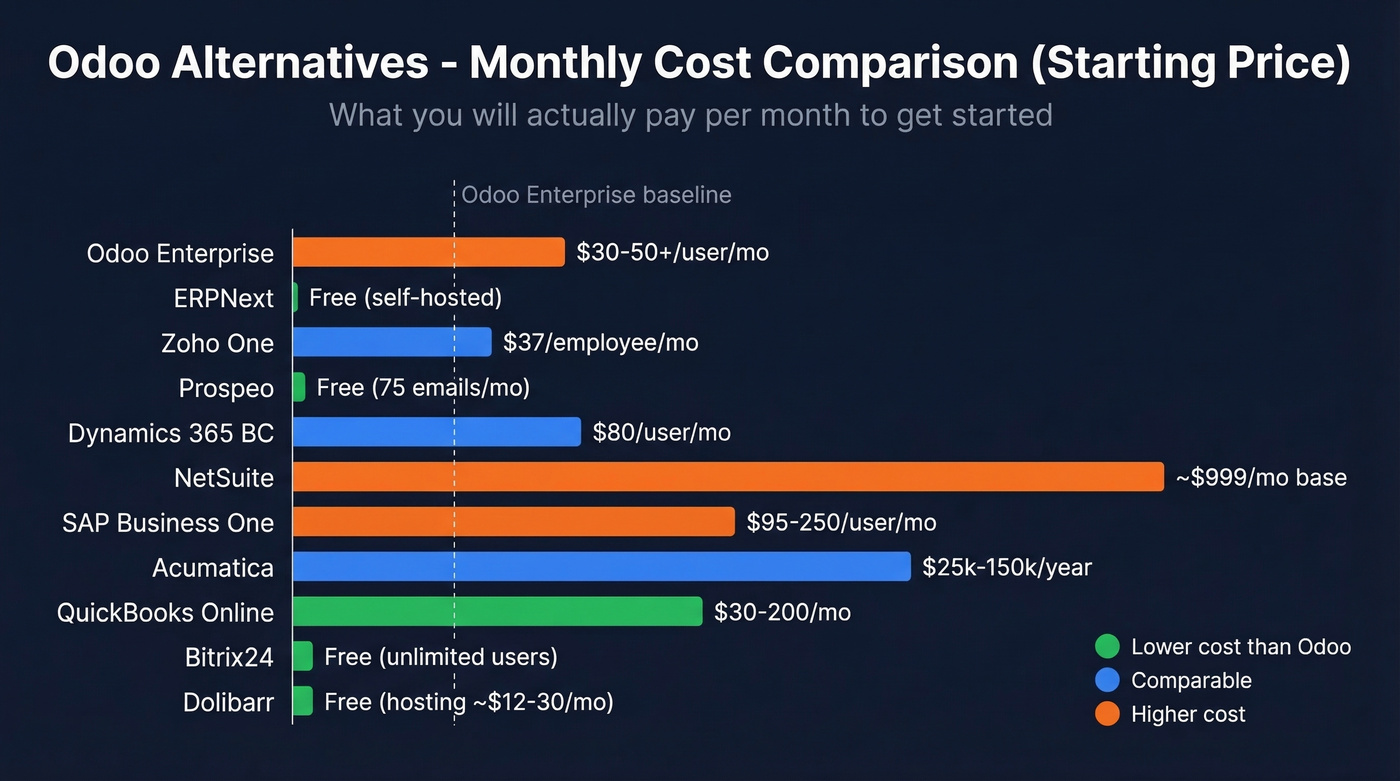
All prices reflect 2026 list prices where published and typical market ranges where pricing is negotiated.
How to Choose the Right Replacement
Most of you don't need a full ERP replacement. You need to replace the two or three Odoo modules that aren't working and keep - or replace - the rest with purpose-built tools.
Hot take: Most articles comparing Odoo competitors assume you need to swap everything at once. You probably don't. If your average deal size is under $50k and you have fewer than 100 employees, a modular approach - best-of-breed tools for the broken pieces - will get you running faster and cheaper than any monolithic ERP migration.
You want true open-source ERP: ERPNext. The only alternative that's genuinely free without module gating. Budget for implementation ($5k-$50k) and either self-host or use Frappe Cloud.
You want an affordable all-in-one: Zoho One. Fifty-plus apps, one price, no surprises. The $37/employee/month plan is hard to beat for SMBs under 100 people.
You're in the Microsoft ecosystem: Dynamics 365 Business Central. The native integration with M365, Power BI, and Copilot makes it the natural choice. Budget for the recent price increase.
You're $10M+ revenue with global operations: NetSuite. Expensive and complex, but it handles multi-entity, multi-currency, and global compliance better than anything else here.
You just need accounting: QuickBooks Online. Don't overthink it.
Your real problem is dirty CRM data: Pair Prospeo with any lightweight CRM. Clean data is the foundation every other tool depends on.
Migrating from Odoo
ERP migrations are never painless, but they don't have to be catastrophic either. Typical Odoo implementations take 1-3 months for mid-market deployments. Larger or heavily customized projects can stretch to six months - and in our experience, the customization rebuild is what kills timelines, not the data migration itself.
Export your data early. Odoo uses PostgreSQL, so your data isn't locked in a proprietary format. Export it, validate it, and clean it before you move anything.
Customizations don't transfer. If you've built custom modules in Odoo Studio, plan to rebuild them in the new platform. This is usually the biggest time sink, and teams consistently underestimate it by 2-3x.
Audit your contact data before migration. This is the step most teams skip - and regret. Bad data follows you to any new system. Verify and enrich your existing contact records before you move them, so you're starting clean instead of importing garbage. If email quality is part of the mess, use an email deliverability checklist before you start outreach from the new system.
Run parallel systems. Keep Odoo live for 2-4 weeks after go-live on the new platform. The overlap costs money but saves you from discovering data gaps in production.
If you're doing outbound during (or right after) the switch, it helps to standardize your sales prospecting techniques so reps aren't improvising in a half-migrated stack.
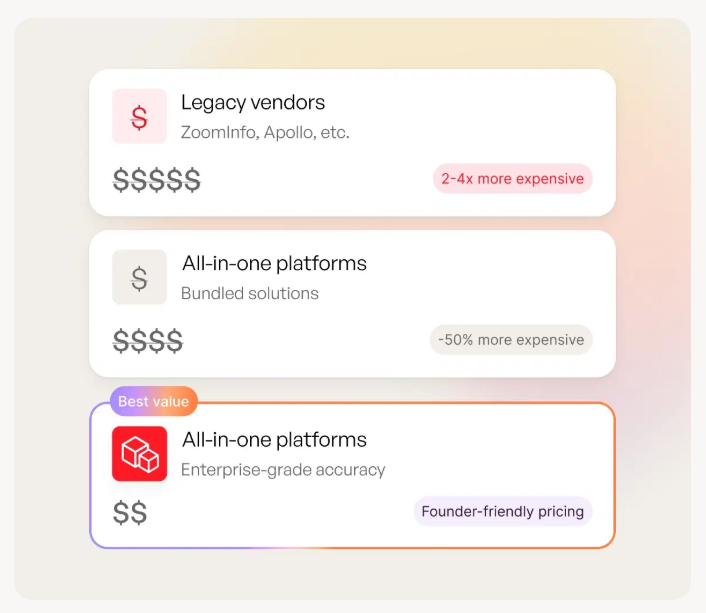
Odoo's cost creep isn't just modules - it's the hidden cost of bounced emails and stale contacts tanking your outreach. Prospeo covers 300M+ profiles at $0.01/email with intent data on 15,000 topics, so you reach buyers who are actually in-market. Native integrations with Salesforce, HubSpot, and every major outbound tool.
Stop paying for bad data on top of expensive modules.
FAQ
Is Odoo really free?
Odoo Community Edition is free under an LGPL license, but Enterprise modules cost EUR 6-24/month each, and many require dependencies. Most businesses end up paying $30-50+/user/month once they assemble the modules they need. The "free" framing is technically accurate but practically misleading for production use.
What's the best free Odoo alternative?
ERPNext is the strongest free option - fully open-source under AGPL-3.0, self-hostable, with no module gating. Budget $5k-$50k for implementation, but the software itself costs nothing. Dolibarr is a lighter option for micro-businesses with simpler needs.
How long does it take to migrate from Odoo?
Typical mid-market migrations take 1-3 months; heavily customized environments can stretch to six months. Customizations built in Odoo Studio won't transfer - plan to rebuild them. Run parallel systems for 2-4 weeks after go-live to catch data gaps before they hit production.
Which Odoo alternative is best for small businesses?
Zoho One at $37/employee/month gives you 50+ apps in one subscription - CRM, accounting, HR, and more. If you primarily need accounting, QuickBooks Online ($30-200/month) is simpler and cheaper. Don't buy a full ERP if you only need two modules.