

Best Open Source Sales CRMs in 2026 (Honest Guide)
A RevOps lead we know switched from HubSpot's free tier to a self-hosted open source sales CRM last year. Three months in, the team had spent more on a freelance developer than they would've paid for HubSpot Starter. The CRM worked - eventually - but "free" wasn't the word anyone used to describe the experience.
That's the tension with every self-hosted CRM: the software costs nothing, but everything around it has a price tag. SMBs adopting CRM improve customer retention up to 40% and sales up to 30%, so picking the right one matters a lot more than most "top 10" lists let on.
Our Picks
- Best free plan for sales teams: Vtiger - email sequences, pipeline management, and a mobile app, all at $0 for up to 10 users
- Most complete feature set: SuiteCRM - the closest thing to a Salesforce alternative that works without paid add-ons
- Best for dev teams: Twenty - modern stack, beautiful UI, fast-moving project, but real feature gaps remain
What "Open Source" Actually Means for CRMs
Not every tool calling itself "open source" means the same thing. Twenty uses AGPL-3.0, so you can self-host, modify, and redistribute, but derivative works must stay open. Frappe CRM uses MIT, the most permissive license on this list. Odoo's Community Edition is LGPLv3, which sits somewhere in between.
HubSpot isn't open source. Neither is Pipedrive, Close, or Salesforce. If you see them on an "open source CRM" list, that list is padding.
And Odoo's "one app free" model deserves its own asterisk. The moment you need a second Odoo app, you're on paid pricing at $20-25/user/month, and Odoo's dependency system means some "free" apps pull in others, making the one-app boundary genuinely confusing. That's open-core, not open source in the spirit most people mean.
Pricing Compared
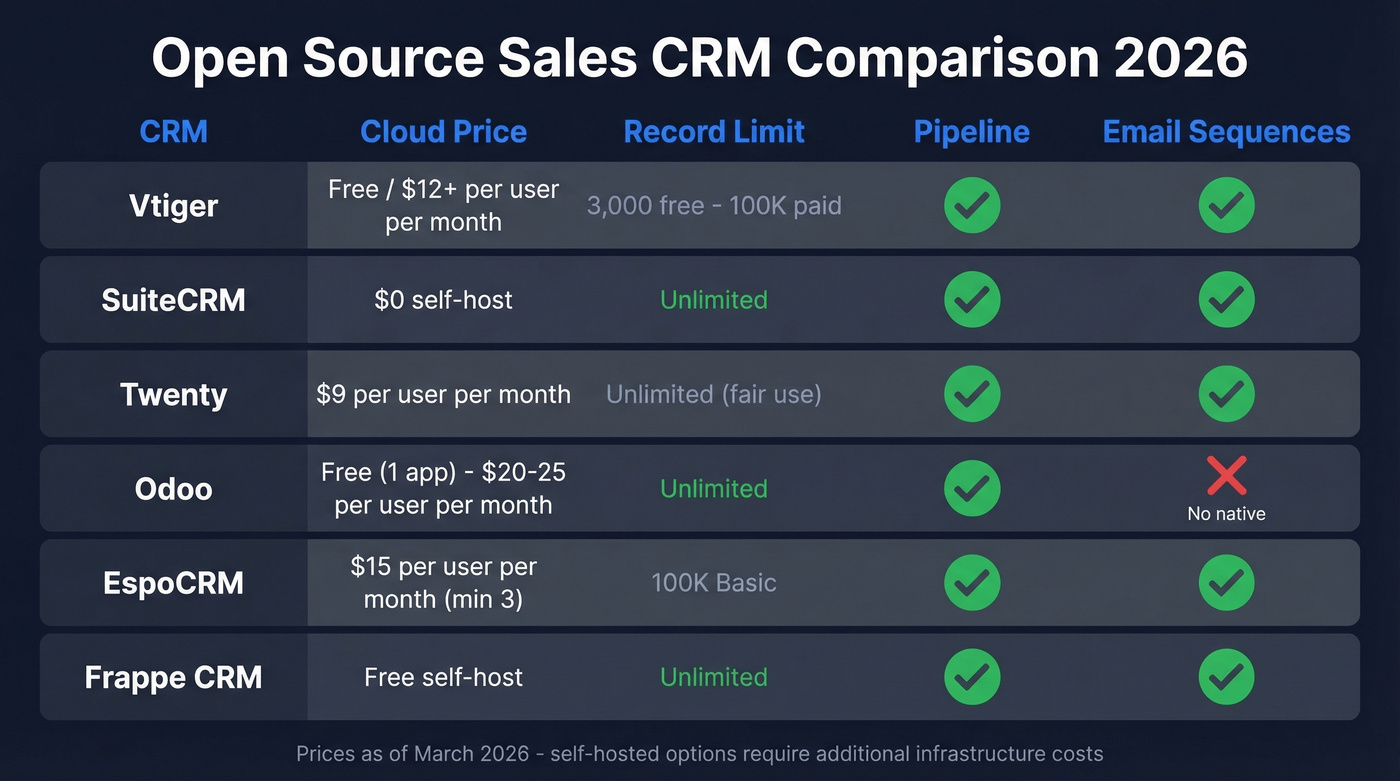
| Tool | Price (Cloud) | Records Limit | Best For | Pipeline | Email Sequences |
|---|---|---|---|---|---|
| Vtiger | Free / $12+/user/mo | 3,000 free; 100K paid | Free sales CRM | ✅ | ✅ |
| SuiteCRM | $0 self-host; paid managed hosting | Unlimited | Salesforce replacement | ✅ | ✅ |
| Twenty | $9/user/mo; $19 w/ SSO | Unlimited (fair usage) | Developer teams | ✅ | ✅ |
| Odoo | Free (1 app); $20-25/user/mo | Unlimited | ERP-first orgs | ✅ | ❌ native |
| EspoCRM | $15/user/mo (min 3) | 100K Basic; unlimited Ultimate | Lightweight self-hosting | ✅ | ✅ |
| Frappe CRM | Free self-host | Unlimited | ERPNext ecosystem | ✅ | ✅ |

An open source CRM with empty pipelines is just an expensive server bill. Prospeo's 300M+ verified profiles with 30+ filters - intent data, technographics, funding, headcount growth - let you fill any CRM with real buyers. Export directly or enrich via API at $0.01/email with 98% accuracy.
Your CRM doesn't have a feature problem. It has a data problem.
The Best Options, Reviewed
Vtiger - Best Free Plan for Sales Teams
Vtiger's free plan supports 10 users, 3,000 records, a full sales pipeline with kanban views, email sequences, workflows, and a mobile app with push notifications, a business card scanner, and voice notes. That's more than most paid CRMs offer at their entry tier - and over 300,000 businesses run on Vtiger, so it isn't some fringe experiment.
The jump to One Growth at $12/user/month gets you 100,000 records and 15 users. Professional tiers run $30-42/user/month with a Single App User option at $20/user/month for cost-conscious teams.
Skip this if you're scaling past 15 reps. At that point, you should be evaluating Pipedrive, Close, or a proper enterprise CRM.

SuiteCRM - The Salesforce Alternative That Works
SuiteCRM is the Toyota Camry of open source CRMs. Not exciting. The UI feels like 2014. But it's reliable, deeply customizable, and free to self-host, with 4.5M+ downloads and 5M+ users.
You get a full feature set without paid add-ons: pipeline, campaigns, reporting, workflows, cases, quotes. The module builder lets non-developers create custom objects, and the community is massive enough that finding help isn't hard. We've seen teams run SuiteCRM for years without hitting a wall they couldn't solve with a forum search and a couple hours of tinkering.
The tradeoff: self-hosting requires real sysadmin work, managed hosting costs money, and the PHP codebase is fine for maintenance but don't expect a modern developer experience.

Twenty - Beautiful UI, Not Quite Ready
Twenty earned a 9/10 from Marmelab's open source CRM benchmark. The stack is Node/Nest/React/TypeScript, the UI is gorgeous, and custom objects work via a GUI without touching code. Y Combinator-backed, $9/user/month for cloud or free to self-host. SSO requires the Organization plan at $19/user/month.
Here's the thing: the gaps are real. No dashboards, no charts, no mobile UI, no tags. For a sales team that needs reporting and on-the-go access, those are dealbreakers today. Twenty is a bet on the future - it'll likely be excellent in 12 months, but right now it's a dev team's CRM, not a sales team's CRM.
Odoo CRM - Free Until You Need a Second App
Odoo's pitch is seductive: one app free, unlimited users, 13M+ users worldwide. The CRM module itself is solid with pipeline views, lead scoring, and activity scheduling.
The catch nobody mentions upfront: the moment you add Invoicing, Email Marketing, or any other module, you're paying $20-25/user/month for Enterprise. The Community Edition is genuinely free but lacks mobile apps, official support, and many advanced automations. Odoo's "free forever" marketing is misleading for anyone who'll need more than a basic pipeline. If you're already running Odoo for accounting or inventory, adding CRM is a no-brainer. If CRM is your starting point, look elsewhere.
EspoCRM - Lightweight and Underrated
EspoCRM's admin UI lets you customize fields and layouts without code, and G2 users rate it 4.6/5. Cloud plans start at $15/user/month with a 3-user minimum and 100,000 records on Basic. Enterprise bumps to $25/user/month for 1,000,000 records, and Ultimate at $69/user/month with a 10-user minimum gets you unlimited records.
Watch the add-on costs, though. The Advanced Pack runs $395, VoIP Integration is $388, and Project Management costs $230/year. A team that needs all three is paying more than many SaaS CRMs charge out of the box.
If you want a deeper breakdown of plans and tradeoffs, see our EspoCRM pricing guide.
Frappe CRM - Sales-First, Not ERP-First
The Frappe team built Frappe CRM in 2023 because ERPNext's built-in CRM was too rigid for sales workflows. It uses a Leads & Deals pipeline model with stage-based workflows, expected close dates, and win probabilities. WhatsApp and Twilio integrations come standard, and the mobile experience runs as a PWA - not native, but functional.
The MIT license makes Frappe the most permissive option here. If you're already in the Frappe/ERPNext ecosystem, it's the obvious choice since won deals push directly to ERPNext for quotation generation. If you're not, the Vue-based UI is clean but the community is smaller than SuiteCRM's or Odoo's, which means you'll be solving more problems on your own.
Honorable Mentions
Atomic CRM is built on React + Supabase with an MIT license. Marmelab scored it 8/10 - full disclosure, Marmelab built it. It's the only open source CRM on this list offering SSO and a solid mobile UI, making it a good starting point for developers who want something lightweight.
Krayin CRM targets PHP/Laravel teams. Clean architecture if you're already in that ecosystem, but the UX is clunky and performance lags behind per Marmelab's 2026 benchmark.
OroCRM targets B2B ecommerce teams. If you're running OroCommerce, it's the native CRM. Otherwise, it's overkill for a standard sales pipeline.
The Real Cost of "Free"
Let's be honest about what self-hosting actually costs.
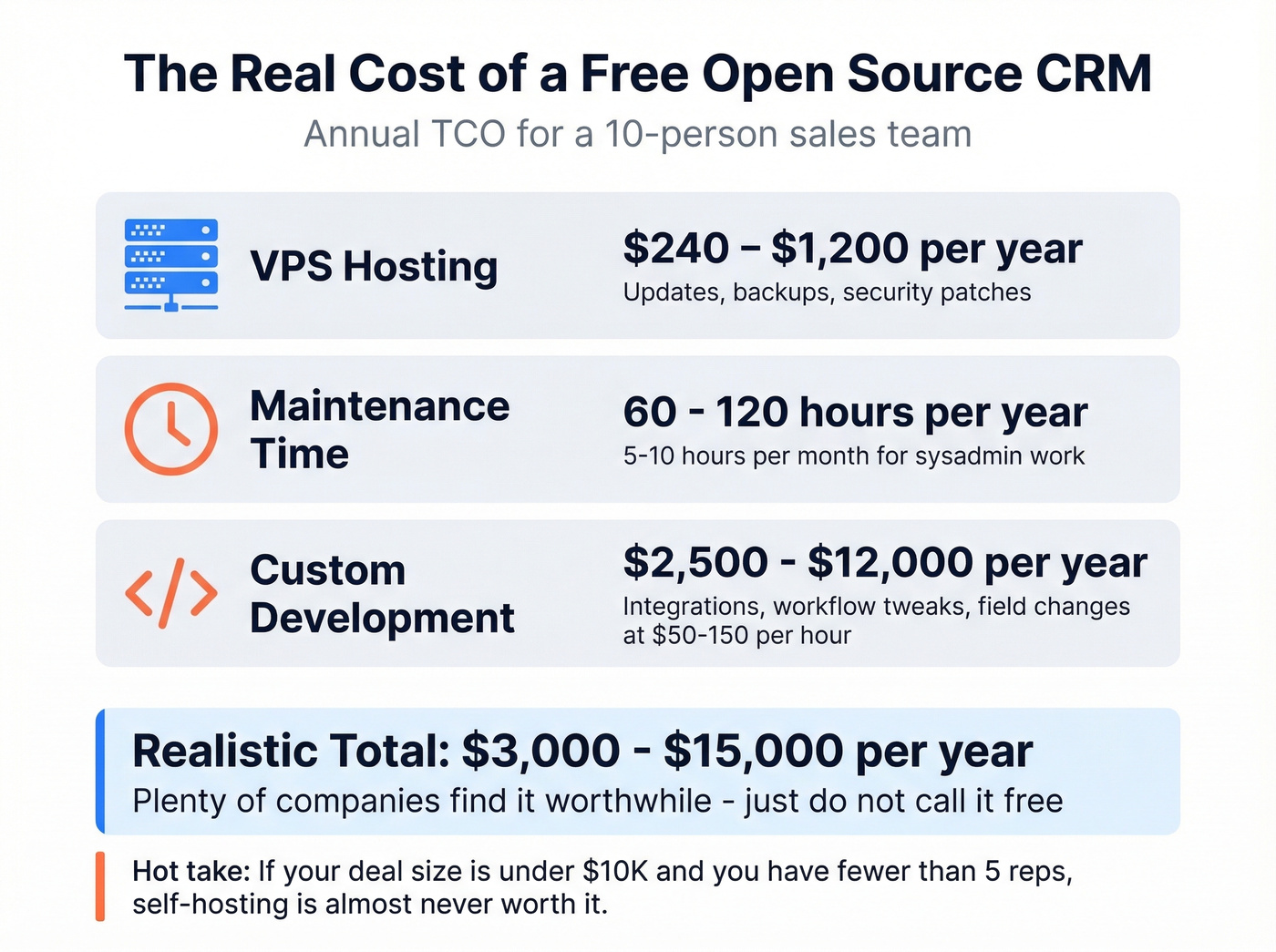
A VPS capable of running SuiteCRM or Odoo for a 10-person team runs $20-100/month. Budget 5-10 hours per month for updates, backups, security patches, and troubleshooting. Custom development from a freelancer runs $50-150/hour, and you'll need it for integrations, workflow tweaks, and the inevitable "can we add a field here" requests that pile up faster than you'd expect.
Realistic annual TCO for a 10-person team self-hosting: $3,000-15,000/year. Plenty of companies find the tradeoff worthwhile. Just don't call it free.
Our hot take: if your average deal size is under $10K and your team is fewer than 5 reps, self-hosting is almost never worth it. Use Vtiger's free cloud plan or pay for a $15/user SaaS tool. Save the self-hosting adventure for when you have a dedicated ops person who actually wants to maintain it.
Three Mistakes That Kill CRM Implementations
The consensus on r/sales and r/CRM threads about CRM failures keeps circling back to the same three killers:
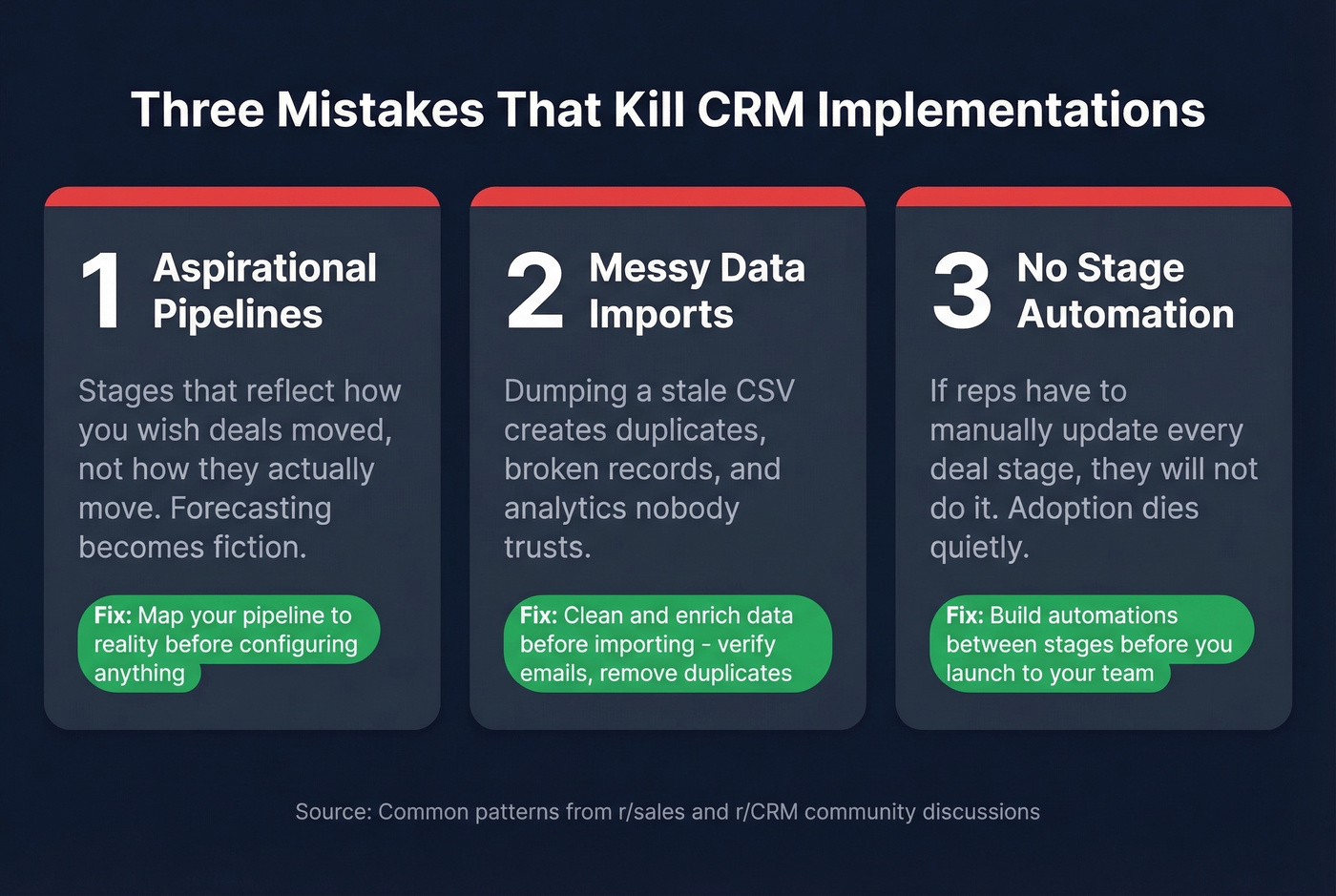
Pipelines that don't match your actual sales process. If your stages are aspirational instead of real, forecasting and reporting become fiction. Map your pipeline to how deals actually move before you configure anything.
Messy data imports. Dumping a stale CSV into a fresh CRM creates duplicates, broken records, and analytics nobody trusts. Clean before you import - or better, enrich on the way in with a tool like Prospeo, which verifies emails at 98% accuracy and refreshes contact records on a 7-day cycle.
No automation between stages. Open source gives you full control, which means these mistakes are entirely yours to make. If reps have to manually update every deal stage, they won't. Build the automations before you launch.
Your CRM Is Only as Good as Your Data
We've seen this pattern repeatedly: a team spends two weeks setting up SuiteCRM or Vtiger, imports a year-old CSV, and wonders why nobody uses the system three months later. The CRM isn't the problem. The data is.
Open source sales CRMs don't come with a built-in data marketplace. You're starting from zero, and a one-time CSV import goes stale fast as people change jobs, get new emails, and switch companies. Connecting a data enrichment layer via API keeps records current with verified emails and direct dials automatically. Prospeo's free tier gives you 75 email lookups per month to start, with an enrichment match rate of 83% and 50+ data points returned per contact. It integrates natively with Salesforce and HubSpot, plus offers API access for any CRM on this list.
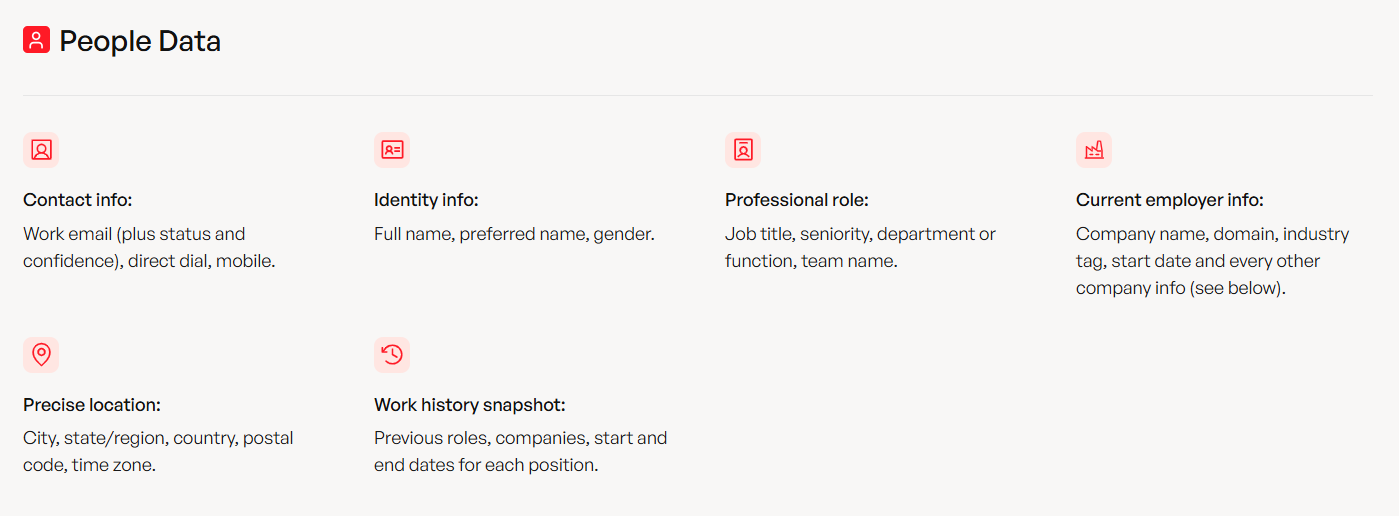
Self-hosting a CRM saves you software costs. Prospeo saves you the hours spent hunting for contact data to put in it. Enrich your CRM records with 50+ data points per contact - verified emails, direct dials, job titles, intent signals - at a 92% match rate. Works with any CRM via API, CSV, or native integrations.
Stop building the CRM and start filling it with buyers who pick up the phone.
FAQ
Is an open source sales CRM really free?
The software license is free. Hosting, maintenance, security patches, and developer time aren't. For a 10-person team self-hosting, budget $3,000-15,000/year in total cost of ownership depending on complexity and customization needs.
Which free CRM is best for small sales teams?
Vtiger's free plan gives you pipeline management, email sequences, workflows, and a mobile app for up to 10 users and 3,000 records. It's the most complete free offering for sales-specific workflows without any self-hosting required.
Can I use Odoo CRM for free?
Yes, but only if CRM is the only Odoo app you use. Adding a second module - Invoicing, Email Marketing, anything - moves you to paid pricing at $20-25/user/month. The Community Edition is free but lacks mobile apps and official support.
How do I keep CRM data accurate after setup?
Use a data enrichment tool to verify emails and refresh contact records automatically. A one-time CSV import goes stale within weeks as contacts change roles. Prospeo refreshes data every 7 days compared to the 6-week industry average, and its free tier covers 75 lookups per month - enough to validate your most active pipeline contacts.