

Outbound Appointment Setting: Benchmarks, Scripts, and the Playbook Nobody Else Wrote
Your SDR burned through 500 dials this week and booked two meetings. One was a no-show. The other wasn't a decision-maker. Meanwhile, Belkins reported their cold email lead-to-appointment conversion dropped from 2.7% to 0.8% as market conditions shifted. Outbound appointment setting isn't dead - but the version most teams are running is.
The playbook that worked in 2022 doesn't work in 2026. Buyers screen calls, ignore templated emails, and have more vendor options than ever. What still works is a disciplined, multi-channel process built on verified data, structured cadences, and scripts that respect the prospect's time.
What You Need (Quick Version)
- Fix your data first. Manually built, verified lists produce 5x higher closed-won rates than purchased lists.
- Run a 17-21 day multi-channel cadence across phone, email, and social with 8-12 touchpoints.
- Know the real numbers. 2% cold call appointment rate, 18 dials to connect, and outsourced meeting-booking costs $300-600 per qualified appointment.
Everything below expands on those three points.
What Is Outbound Appointment Setting?
The setter isn't the closer - and most teams that blur this line waste half their AE capacity on cold calling. This process involves proactively reaching out to prospects who haven't raised their hand, via phone, email, or social, to schedule a meeting with a closer. It sits at the very top of the sales funnel, and its only job is to create qualified conversations.
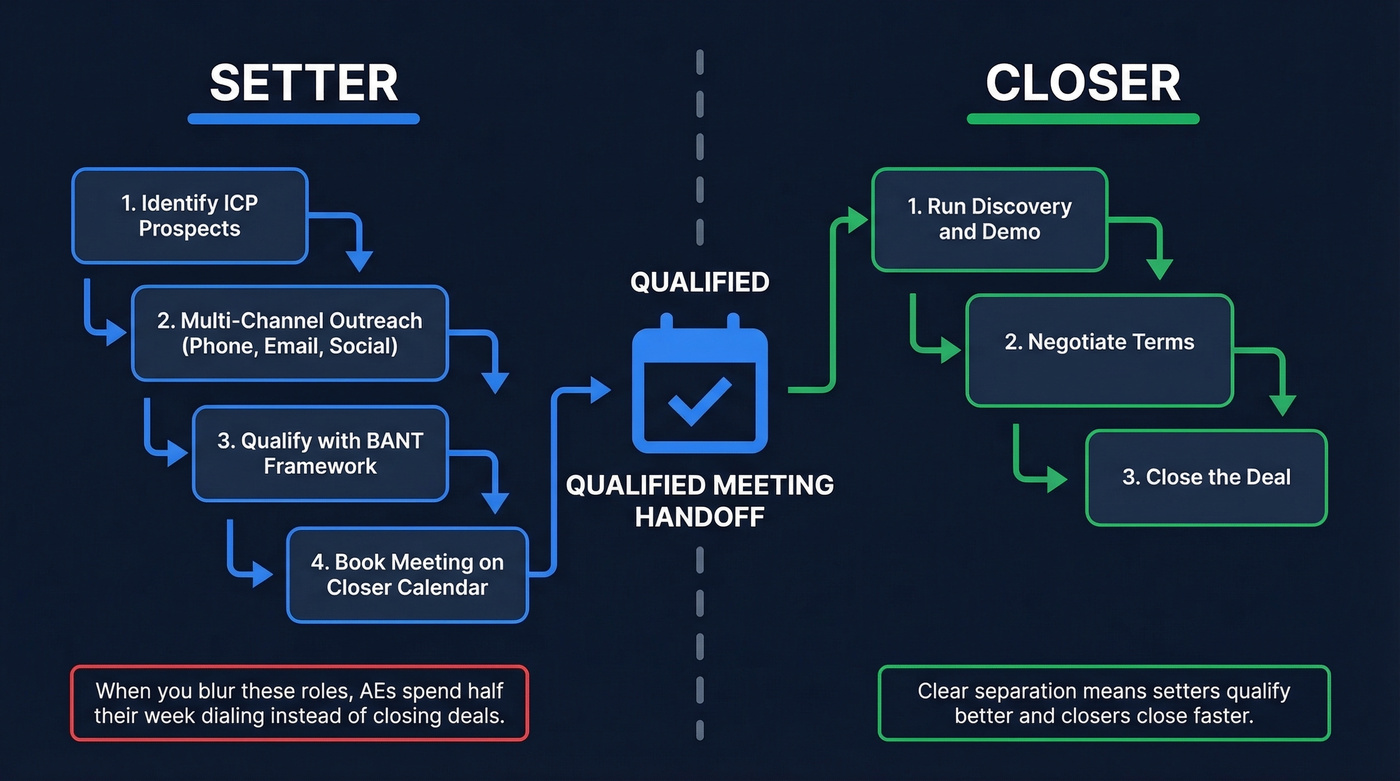
Setters identify, qualify, and schedule. Closers demo, negotiate, and sign. When you collapse these roles, you get AEs spending half their week dialing instead of running deals - or worse, setters trying to pitch on a 4-minute call and scaring off prospects who weren't ready. We've seen this setter/closer misalignment tank AE productivity more than almost any other structural mistake in outbound orgs.
The setter's output is a qualified meeting on the closer's calendar. Every touchpoint, script, and cadence exists to make that handoff happen more often and more reliably.
The Step-by-Step Process
Build a List Worth Calling
Most outbound campaigns fail before the first dial because the list is garbage. Purchased lists feel efficient - thousands of contacts for a few hundred dollars. The downstream numbers tell a different story.
| Metric | Purchased List | Manually Built List |
|---|---|---|
| ICP fit | 80% | 95% |
| MQL rate | 40% | 75% |
| SQL rate | 2% | 5% |
| Closed-won | 0.1% | 0.5% |
That 5x difference in closed-won rate isn't marginal. It's the difference between a pipeline that works and one that burns your domain reputation. Here's the thing: buying lists is a waste of money for any team that cares about conversion.
Prospeo covers 300M+ professional profiles, 143M+ verified emails, and 125M+ verified mobile numbers with 98% email accuracy and a 7-day data refresh cycle - so your setters aren't calling numbers that went dead last month. The 30+ search filters let you build lists filtered by buyer intent, technographics, headcount growth, and funding, then export verified contacts directly into your sequencer.

Multi-Channel Outreach Mix
Single-channel outbound is a losing bet. One practitioner on r/sales shared their outbound mix as 80% cold call, 5% email, 15% social - a common starting ratio for phone-heavy teams. But multi-channel strategies lift sales revenue 20-30% over single-channel approaches, and buyers typically need around 8 touchpoints before they'll commit to a meeting.
Enterprise prospects respond better to phone plus social. SMB buyers often engage faster through email plus retargeting. Test your ratio, but don't default to one channel because it's comfortable.
What about AI? Automated outbound pipelines are producing 8-12 qualified calls per month per client for some agencies, and the AI booking market is projected to hit $3.5B by 2027. AI pipelines work for templated outreach at scale, but they fall apart for complex B2B sales where qualification requires human judgment. If your average deal size exceeds $25K, keep a human in the loop.
Qualify Before You Book
A meeting with the wrong person is worse than no meeting - it wastes your closer's time and inflates vanity metrics. Booking too early, before you've confirmed authority and need, is one of the most common mistakes we see. Setters should run a lightweight BANT qualification on every call before scheduling anything.
Cold calls should run 3-7 minutes. Warm follow-ups can stretch to 5-10. The setter's job is to qualify and schedule, not demo. If a prospect starts asking deep product questions, that's your signal to book the meeting, not to wing a pitch.
Confirm and Reduce No-Shows
No-shows kill pipeline velocity. A SaaS operator on Reddit flagged a 3-4 day delay between lead capture and first outreach - by the time the meeting happened, the prospect had gone cold. Show rates for outbound-booked meetings typically range 60-75%, and speed-to-lead is the single biggest lever for pushing toward the higher end.
Reduce no-shows with this checklist:
- Send a calendar invite with a clear agenda within 5 minutes of booking
- Include the closer's name, title, and a one-line value prop in the invite
- Send a confirmation 24 hours before with the two-time-option CTA: "Still good for Tuesday at 2 PM, or would Thursday morning work better?"
- If the prospect reschedules once, that's fine. Twice means they're not qualified - move on.
Cold Call Benchmarks and Scripts
The Numbers That Matter
Before you optimize anything, know the baseline:
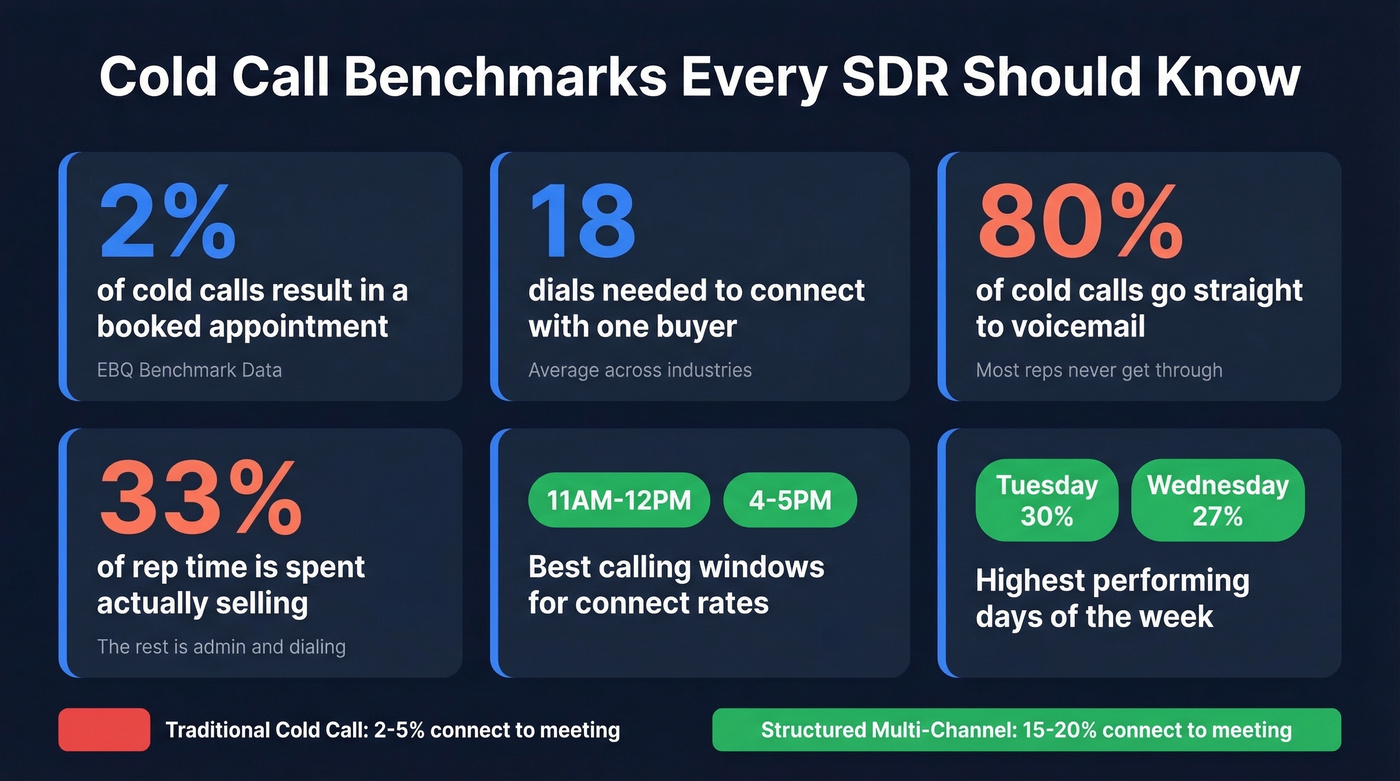
- 2% of cold calls result in a booked appointment per EBQ's benchmark data
- It takes 18 dials to connect with a buyer
- Best calling times: 11 AM-12 PM and 4-5 PM
- Best days: Tuesday (30%) and Wednesday (27%)
- 80% of calls go to voicemail
- Reps spend only 33% of their time actively selling
Modern connect-to-meeting rates for teams running structured multi-channel cadences hit 15-20% - a massive jump from the 2-5% traditional cold call rate. If your numbers are significantly below these baselines, the problem is usually data quality or script structure, not effort.
Scripts That Actually Book Meetings
Without a structured script, cold call appointment rates average around 2.3%. With one, top teams push to 3-5%. The difference isn't about reading from a page - it's about having a framework that keeps the call moving forward. We've tested dozens of script structures across different verticals, and this four-part framework consistently outperforms everything else:
Opener (5 seconds): Name, company, and a pattern interrupt. "Hey Sarah, this is Mike from [Company] - I know I'm calling out of the blue, so I'll be quick."
Credibility (10 seconds): One sentence that proves you're relevant. "We help [similar company type] solve [specific problem] - just wrapped up a project with [reference client]."
Relevance check (15 seconds): Ask a question that surfaces pain. "Are you still handling [process] manually, or have you automated that?"
Direct CTA (5 seconds): Two-time option close. "Would Thursday at 2 or Friday at 10 work for a 15-minute conversation?"
Warm calls follow the same structure but reference the prior touchpoint: "I sent you that case study last week about [topic] - did you get a chance to look at it?"
Handling Objections
Every objection follows the same framework: acknowledge, clarify, reframe.
"Now's not a good time." "Totally fair - when would be better? I can send a calendar link for next week so it's on your terms."
"We're happy with our current vendor." "That's great to hear. Most of our clients said the same thing before they saw how we handle [specific differentiator]. Worth a 15-minute look?"
The goal isn't to overcome every objection. It's to keep the door open for a future touchpoint. And another common mistake: tracking dials and meetings booked while ignoring connect rates and qualification accuracy. If you're not measuring the right metrics, you're optimizing blind.

Purchased lists produce 0.1% closed-won rates. Prospeo's 300M+ profiles with 98% email accuracy and 125M+ verified mobiles give your setters ICP-fit contacts that actually pick up - with 30+ filters for intent, technographics, and headcount growth.
Stop burning dials on dead data. Build a list worth calling.
Build Your Multi-Channel Cadence
44% of reps quit after one follow-up. Meanwhile, 80% of sales require five or more. The gap between those two numbers is where most pipeline dies.
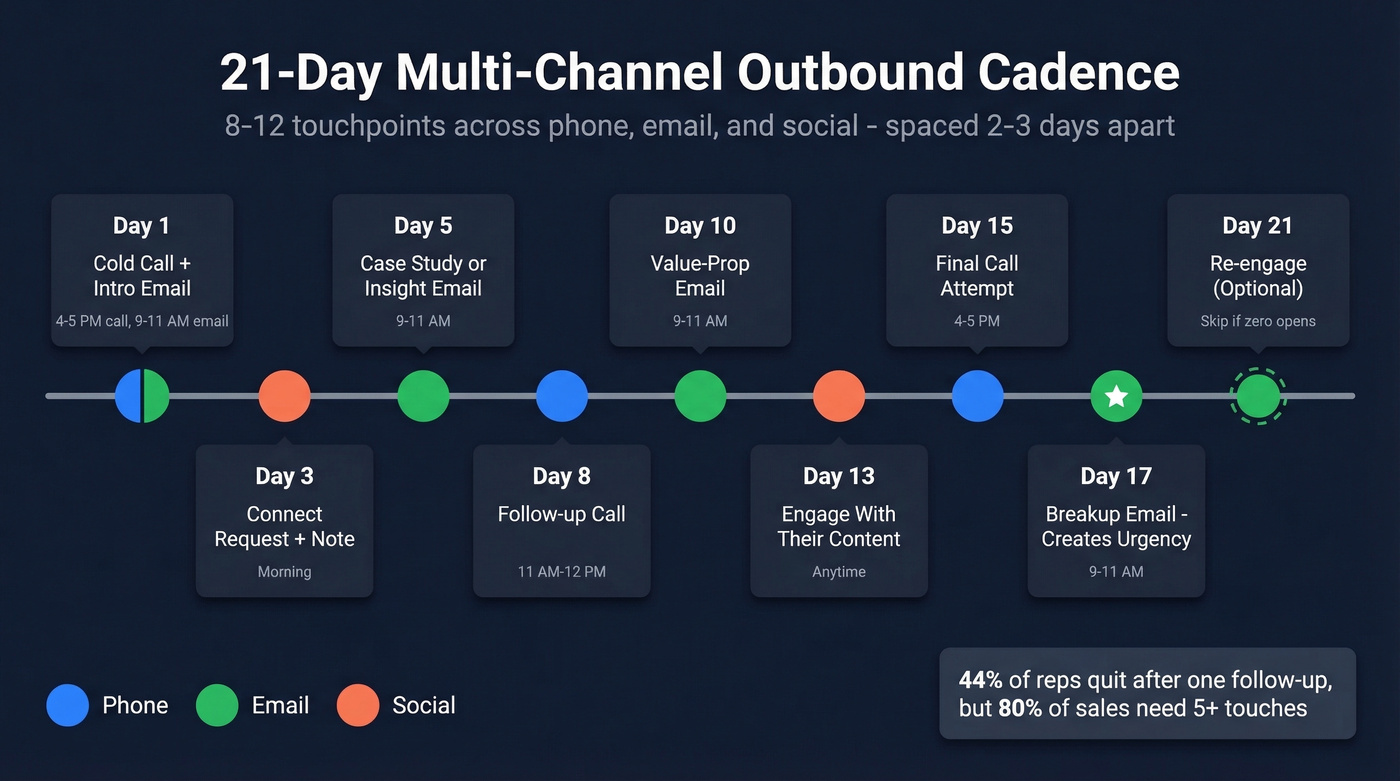
A strong cadence runs 17-21 days with 8-12 touchpoints, spaced 2-3 days apart:
| Day | Channel | Action | Best Time |
|---|---|---|---|
| 1 | Phone + Email | Cold call + intro email | 4-5 PM call, 9-11 AM email |
| 3 | Social | Connect request + note | Morning |
| 5 | Case study or insight | 9-11 AM | |
| 8 | Phone | Follow-up call | 11 AM-12 PM |
| 10 | Value-prop email | 9-11 AM | |
| 13 | Social | Engage with content | Anytime |
| 15 | Phone | Final call attempt | 4-5 PM |
| 17 | Breakup email | 9-11 AM | |
| 21 | Re-engage (optional) | 9-11 AM |
The breakup email on Day 17 isn't a gimmick - it consistently outperforms mid-sequence emails because it creates urgency. Something like: "Looks like the timing isn't right. I'll close out my notes on this - if things change, here's my calendar link."
Skip the re-engage on Day 21 if the prospect hasn't opened a single email in the sequence. You're better off recycling them into a nurture track and trying again in 90 days.
Outsource vs. In-House
The Real Cost Comparison
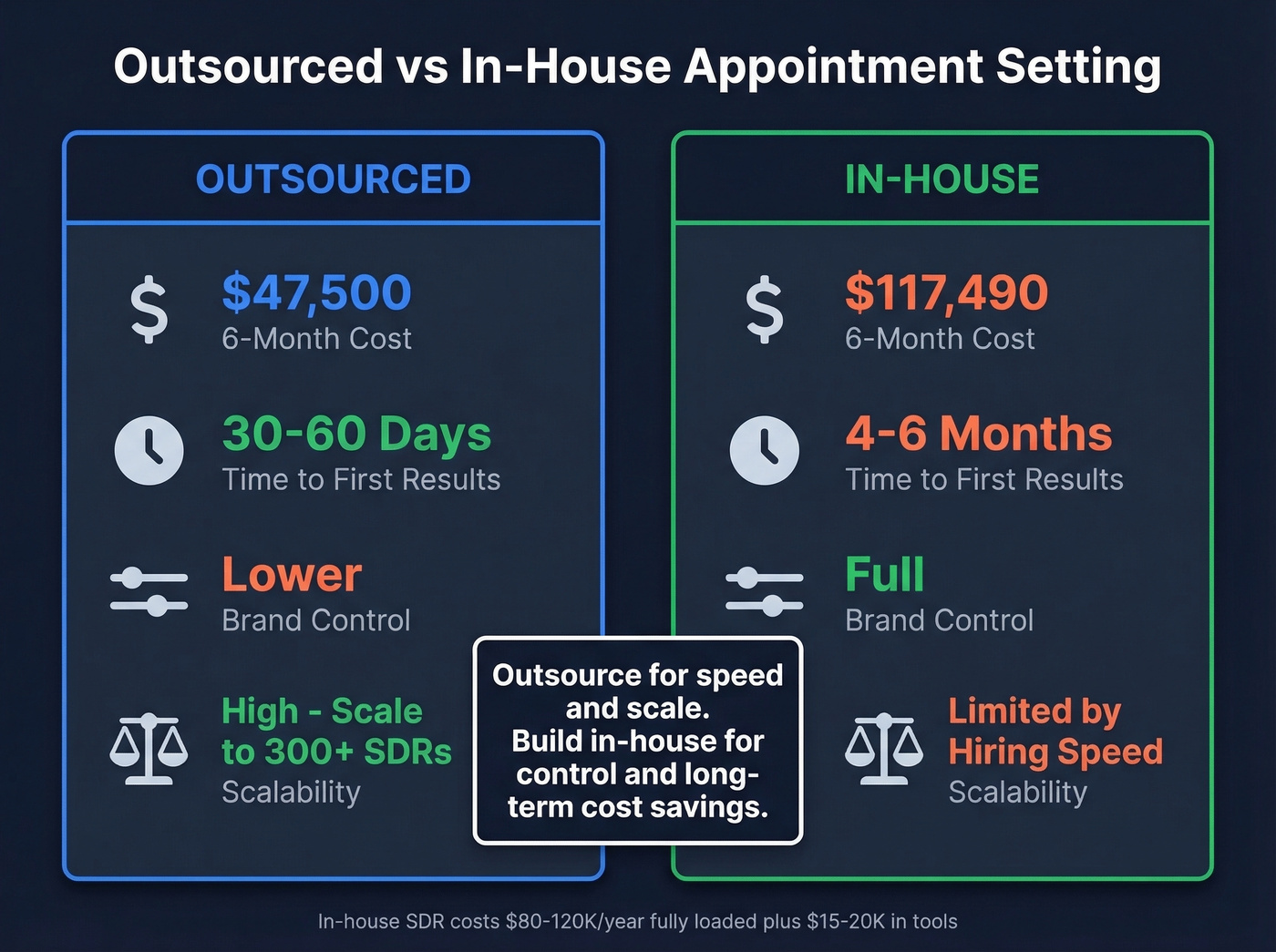
The build-vs-buy decision comes down to speed, cost, and control:
| Factor | Outsourced | In-House |
|---|---|---|
| 6-month cost | ~$47,500 | ~$117,490 |
| Time to results | 30-60 days | 4-6 months |
| Control | Lower | Full |
| Scalability | High - providers like Operatix run 300+ SDRs across 22 languages | Limited by hiring speed |
An in-house SDR costs $80-120K/year fully loaded, plus $15-20K in tools. Outsourcing gets you producing pipeline in a month. The tradeoff is brand control and institutional knowledge.
Pricing Models
| Model | Price Range | Best For |
|---|---|---|
| Pay-per-meeting | $300-600/appt | Testing the waters |
| Monthly retainer | $3K-15K/mo | Predictable pipeline |
| Hybrid | $2,500 base + $150-300/mtg | Balanced risk |
| Dedicated SDR | $4K-8K/mo per rep | Scale + consistency |
One SaaS operator on Reddit described the exact profile where a hybrid model shines: 100+ leads per week, 8-10 meetings booked, but $10K/month felt steep and hiring an SDR felt too expensive. The hybrid gives accountability without the overhead.
Let's be honest: if your average contract value is under $10K, you probably don't need an in-house SDR team at all. Outsource for volume, close deals yourself, and reinvest the savings into better data. Most pre-Series A companies that try to build an SDR team end up with an expensive experiment that takes six months to produce mediocre results.
Your Tech Stack
The minimum viable stack for running appointment-setting campaigns is a CRM, a dialer, and a verified data source. Everything else is a nice-to-have until you're booking 20+ meetings per month.
- CRM: HubSpot has a free tier; paid plans start around $20-$100/user/mo. Salesforce starts around $25/user/mo. (If you're evaluating options, start with these examples of a CRM.)
- Dialer: $50-150/user/mo. Tools like Orum or PhoneBurner for parallel dialing. (If you're building a repeatable process, a cold calling system matters more than the dialer brand.)
- Data + verification: Prospeo combines the lead database and email verification in one platform - 30+ search filters including buyer intent, real-time verification, and native integrations with HubSpot, Salesforce, Smartlead, Instantly, and Lemlist. Meritt's bounce rate dropped from 35% to under 4% after switching. (More on keeping bounces down in our email bounce rate guide.)
- Engagement platform: Outreach or Salesloft typically run $100-200/user/mo for sequence automation. (If you're standardizing outreach, use proven sales follow-up templates.)
- Scheduling: Calendly starts around $10-$20/user/mo; Chili Piper runs higher for teams.
Compliance - The Section Nobody Else Wrote
Most guides on outbound appointment setting skip compliance entirely, which tells you they're written by content marketers, not practitioners. Meanwhile, TCPA lawsuits surged roughly 95% year-over-year, and class actions spiked 285% in September 2025.
The FCC classified AI-generated voices as "artificial or prerecorded" in February 2024. Any AI voice outreach now requires prior express written consent - no exceptions. If you're using AI dialers with synthetic voices, you're one lawsuit away from a very expensive lesson.
Texas SB 140 went into effect September 1, 2025, expanding solicitation definitions to include texts and images, with violations tied to treble damages under the Texas DTPA. And the FCC's consent revocation rule - allowing consumers to revoke consent by any reasonable method - hits full enforcement in April 2026.
Your compliance checklist:
- Maintain and scrub against DNC lists before every campaign
- Vet every lead source - purchased lists with unclear opt-in provenance are a liability (and yes, is it illegal to buy email lists depends on jurisdiction and use case)
- Record calls and disclose recording where required by state law
- Don't "snowshoe" - spreading high volume across many numbers to evade detection is exactly what regulators are watching for
- Train setters that verbal opt-outs count as consent revocation, immediately
At 18 dials per connect, every wrong number kills your setter's momentum. Prospeo's 7-day data refresh and 30% mobile pickup rate mean your team spends less time chasing ghosts and more time booking qualified meetings.
Triple your connect rate with mobiles that actually ring.
FAQ
What's a good appointment setting rate?
About 2% of cold calls result in a booked appointment. With a structured script and verified data, top teams push to 3-5%. Multi-channel cadences reach 15-20% connect-to-meeting rates - the biggest lever is data quality and consistent follow-up across channels.
How much does outsourced appointment setting cost?
Pay-per-meeting runs $300-600 per qualified appointment. Monthly retainers range $3,000-$15,000, and dedicated outsourced SDRs cost $4,000-$8,000/month per rep. An in-house SDR costs $80-120K/year fully loaded plus $15-20K in tools.
How many touchpoints does it take to book a meeting?
Most successful cadences use 8-12 touchpoints over 17-21 days across phone, email, and social. 80% of sales require five or more follow-ups, yet 44% of reps quit after just one - that gap is where pipeline dies.
Should I outsource or build in-house?
Outsource if you need results in under 60 days or your monthly budget is below $10K. In-house teams take 4-6 months to ramp and cost roughly $117,490 over six months versus $47,500 outsourced. Transition to in-house once you're consistently booking 20+ meetings per month.
How do I keep my email domain safe during outbound?
Use verified email data - sending to unverified lists causes bounces that damage domain reputation and tank deliverability. Warm up new sending domains for at least two weeks before scaling volume, and keep bounce rates under 4% as a hard ceiling.