

Outbound Cold Email: The Infrastructure-First Playbook for 2026
A lot of teams learn this the hard way. They launch an outbound cold email campaign from their company's primary domain with an unverified list, no warmup, and way too much volume on day one. Within a week the domain gets flagged and everything starts landing in spam - marketing newsletters, transactional receipts, password resets, the works. We've watched it happen to smart teams who just didn't know what they didn't know.
This playbook covers the infrastructure and data quality work that actually determines whether cold prospecting emails work or quietly destroy your sender reputation.
The Short Version
- Infrastructure before copy. Domain setup, authentication, and warmup matter more than your subject line.
- Verified data is non-negotiable. Sending to unverified lists risks 40% hard bounce rates and instant domain damage.
- Realistic math. Expect one qualified meeting per 2,000-3,000 emails sent. Plan volume and budget around that, not fantasy reply rates.
The Math Behind Cold Email Outreach
The "10% reply rate" is a myth. A study of 16.5M cold emails found an average reply rate of 5.8% - and that's from a managed agency with optimized infrastructure. Martal's platform-wide average sits at 3.43%. At scale, 1-2% is a decent baseline many teams see.
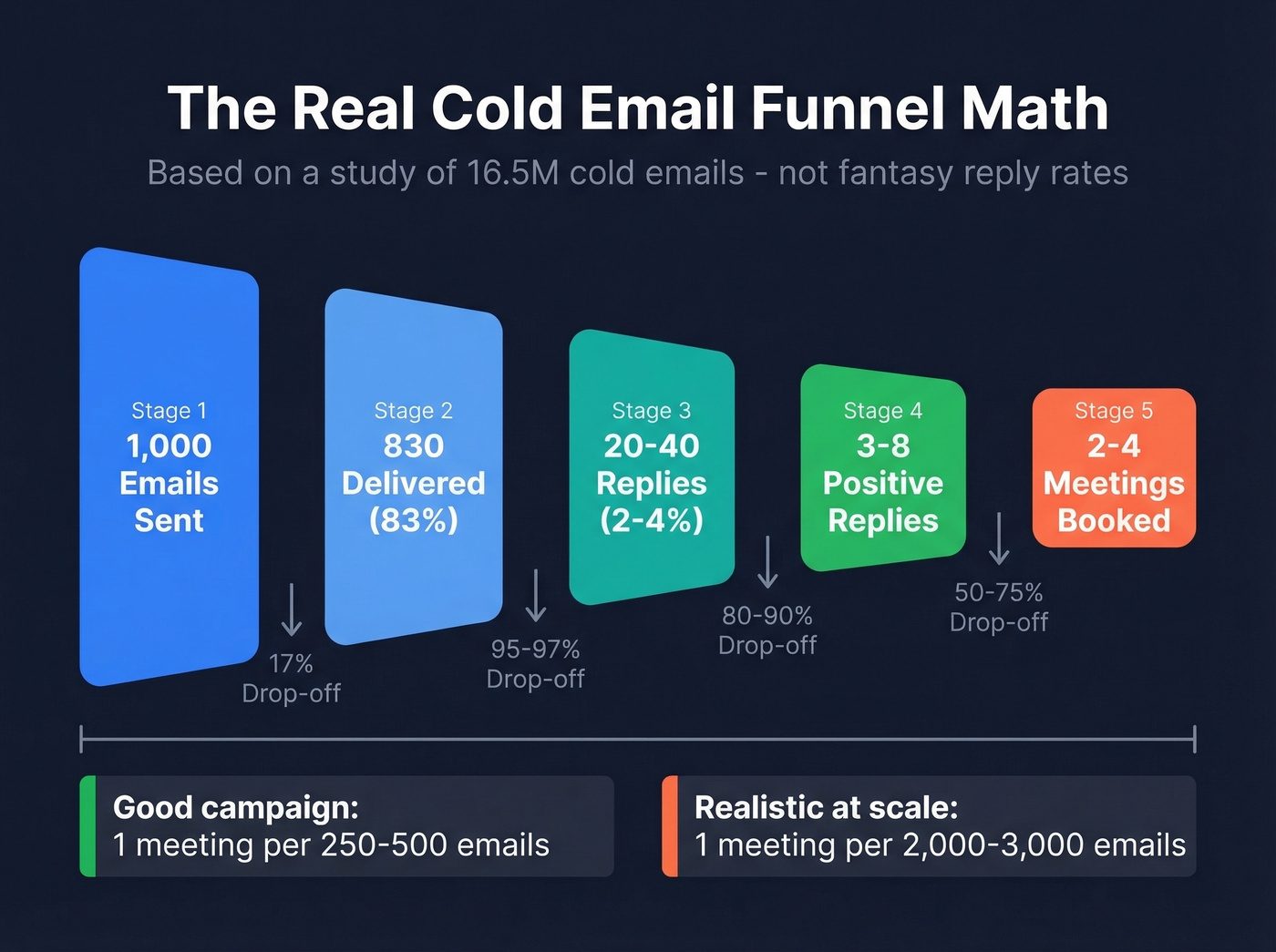
Roughly 17% of cold emails never reach the inbox. Here's how the funnel shakes out:
| Stage | Rate | Per 1,000 Emails |
|---|---|---|
| Delivered | ~83% | 830 |
| Replies | 2-4% | 20-40 |
| Positive replies | 15-20% of replies | 3-8 |
| Meetings booked | ~50% of positive | 2-4 |
That's one meeting per ~250-500 emails sent in a good campaign, or one per 2,000-3,000 sent emails when you factor in deliverability losses and weaker sequences. If your reply rate is below 8% in the first two weeks, stop sending and optimize. Don't throw more volume at a broken campaign.

When cold email isn't worth it: if your total addressable market is under ~30,000 contacts or your customer lifetime value is below $800, the infrastructure costs alone make the channel uneconomical. You're better off with warm outbound or content-led inbound.
Infrastructure Setup
Never send cold prospecting emails from your primary domain. Buy secondary domains - variants like getacme.com or acmehq.com - and set up dedicated Google Workspace inboxes on each. If a cold domain gets flagged, your main domain stays clean. This is the single most important decision you'll make.
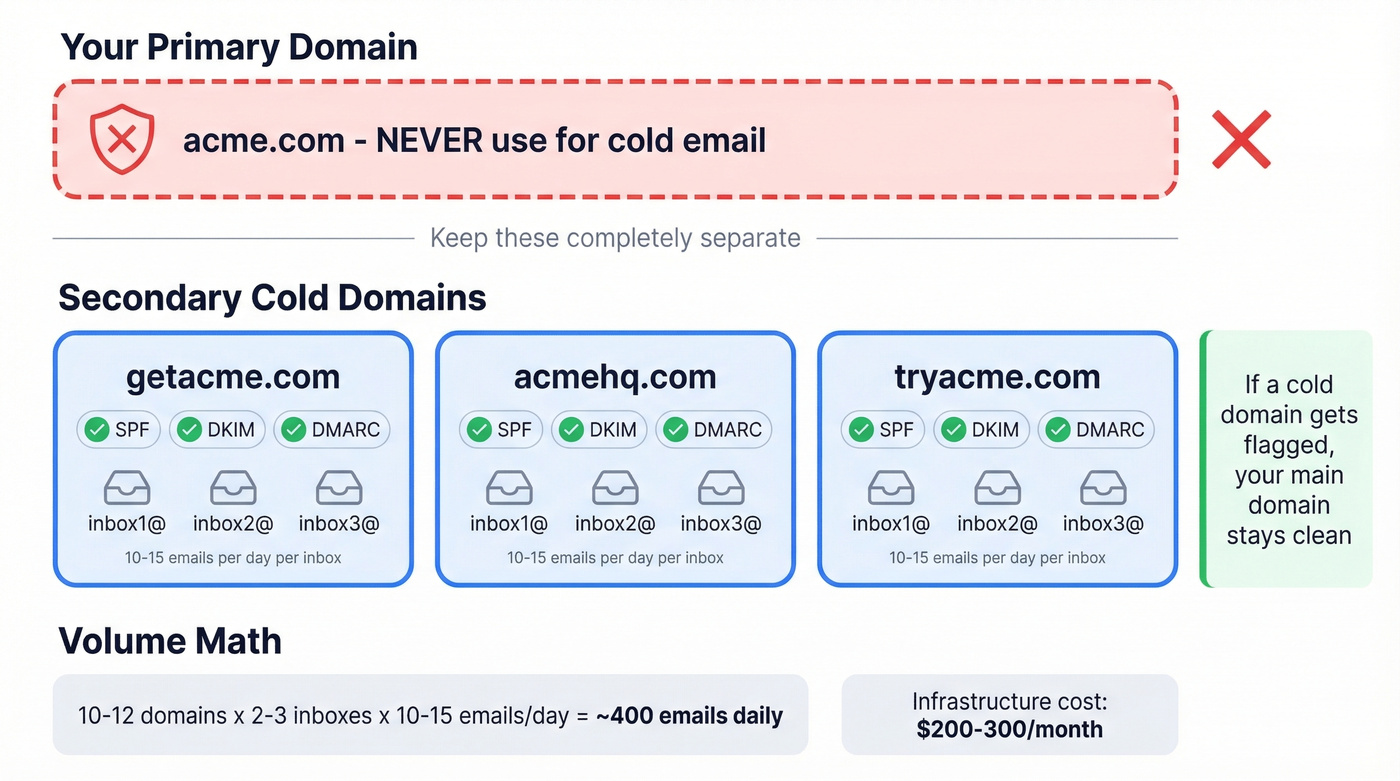
Here's the volume math: 2-3 inboxes per domain, 10-15 emails per day per inbox. To send 400 emails daily, you need roughly 10-12 domains. Infrastructure cost runs $200-300/month for domains and inboxes alone.
Authentication is mandatory. Gmail has required SPF, DKIM, and DMARC since February 2024. Outlook followed in May 2025. Three DNS records per domain - skip this and your emails go straight to spam. Start DMARC at p=none with reporting enabled, then tighten to quarantine or reject once you've confirmed alignment. Monitor domain reputation with Gmail Postmaster Tools and Microsoft SNDS.
Warmup Ramp Schedule
Plan for 14 days minimum warmup, 21 days preferred, before sending any campaign traffic.
| Week | Daily Volume/Inbox | Guardrails |
|---|---|---|
| 1 | 30-50 | Bounce <3%, no images/trackers |
| 2 | 50-80 | Monitor spam complaints |
| 3 | 80-120 | Complaints <0.1% per mailbox |
| 4 | 120-150 | Only if all metrics green |
Keep warmup at 20-60% of total inbox activity after campaigns start - 60% if you're sending to cold databases, 20% if you're running trigger-based lists. The consensus on r/coldemail is clear: teams that skip warmup or rush the ramp burn domains fast.
List Building and Data Quality
The best infrastructure in the world can't save a bad list.
Trigger-based targeting - job posts, funding rounds, new hires, leadership changes - consistently outperforms static database pulls. You're reaching people during a moment of change, not blasting a stale CSV. This is where prospecting succeeds or fails, and it's where we've seen the biggest difference between campaigns that book meetings and campaigns that just burn credits.
The 16.5M-email study found that emailing 1-2 contacts per company yields a 7.8% reply rate versus 3.8% when you email 10+ people at the same organization. Precision beats volume every time.
Prospeo refreshes its 300M+ professional profile database every 7 days - the industry average is about six weeks. You can filter by buyer intent, job changes, or funding signals using 30+ search filters, then export verified contacts to your sequencer via native integrations or CSV. The free tier includes 75 verified emails plus 100 Chrome extension credits per month, which is enough to test before committing. Stack Optimize built to $1M ARR using Prospeo with 94%+ deliverability and sub-3% bounce rates across every client campaign.


Bad data is the fastest way to burn your cold email domains. Prospeo's 5-step verification delivers 98% email accuracy with a 7-day refresh cycle - so your carefully warmed infrastructure doesn't get wrecked by bounces. Stack Optimize built to $1M ARR with sub-3% bounce rates across every client campaign.
Start with 75 free verified emails and see the bounce rate difference yourself.
Writing Emails Prospects Actually Reply To
Forget templates. Structural rules matter more than any script.
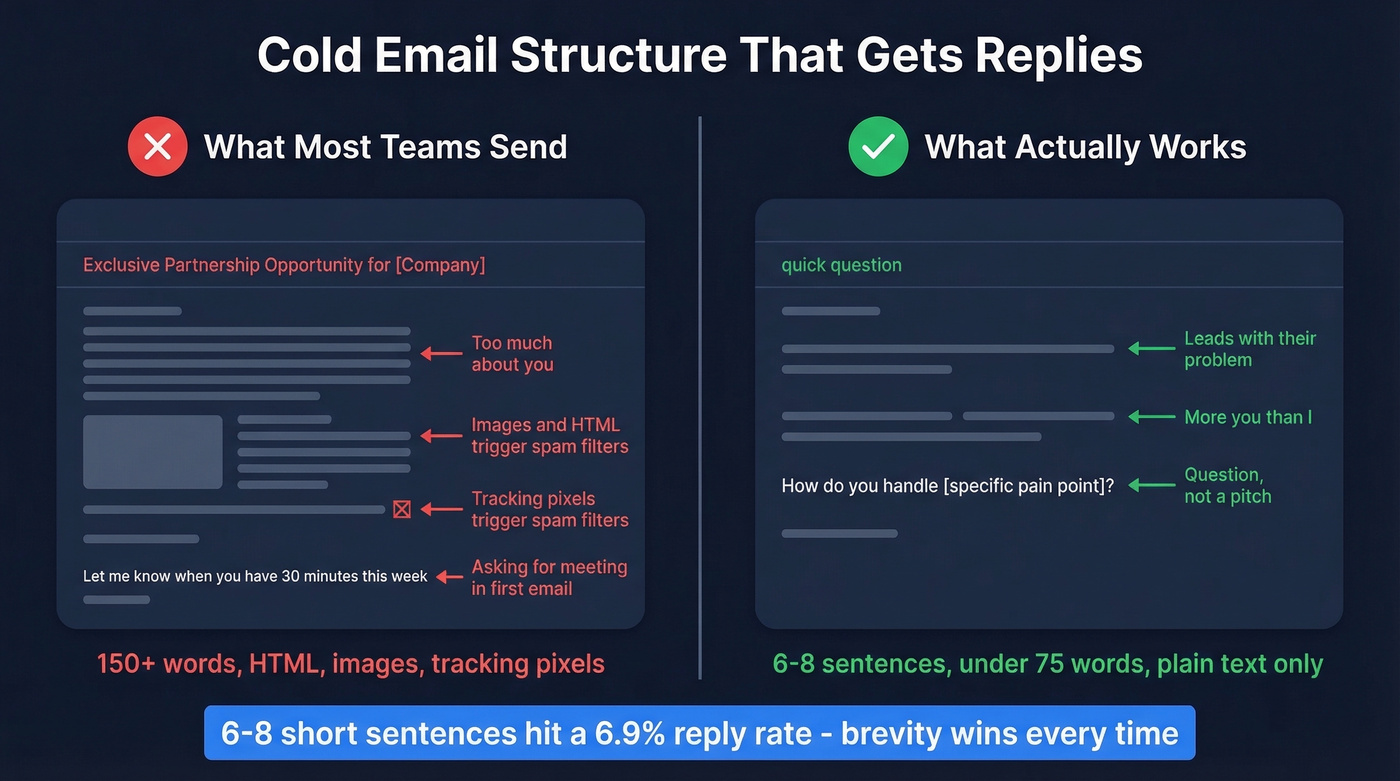
The 16.5M-email dataset shows 6-8 short sentences hit a 6.9% reply rate. Practitioners recommend keeping total word count under 75. Both point the same direction: brevity wins.
- 2-word lowercase subject line. "quick question" beats "Exclusive Partnership Opportunity for [Company]" in real-world prospecting. (If you need ideas, pull from these subject line examples.)
- Plain text only. No images, no HTML formatting, no tracking pixels.
- More "you" than "I." Count the pronouns. If you're talking about yourself more than the prospect's problem, rewrite.
- Don't ask for a meeting in the first email. Lead with relevance and a question. The pitch comes later.
Here's the thing: if your deal size sits below $10K, you don't need a 12-step sequence with custom videos and personalized landing pages. A clean three-email sequence with verified data and solid infrastructure will outperform the overengineered approach every time. Complexity is where most cold email programs go to die.
Follow-Up Strategy
Two follow-ups. That's it.
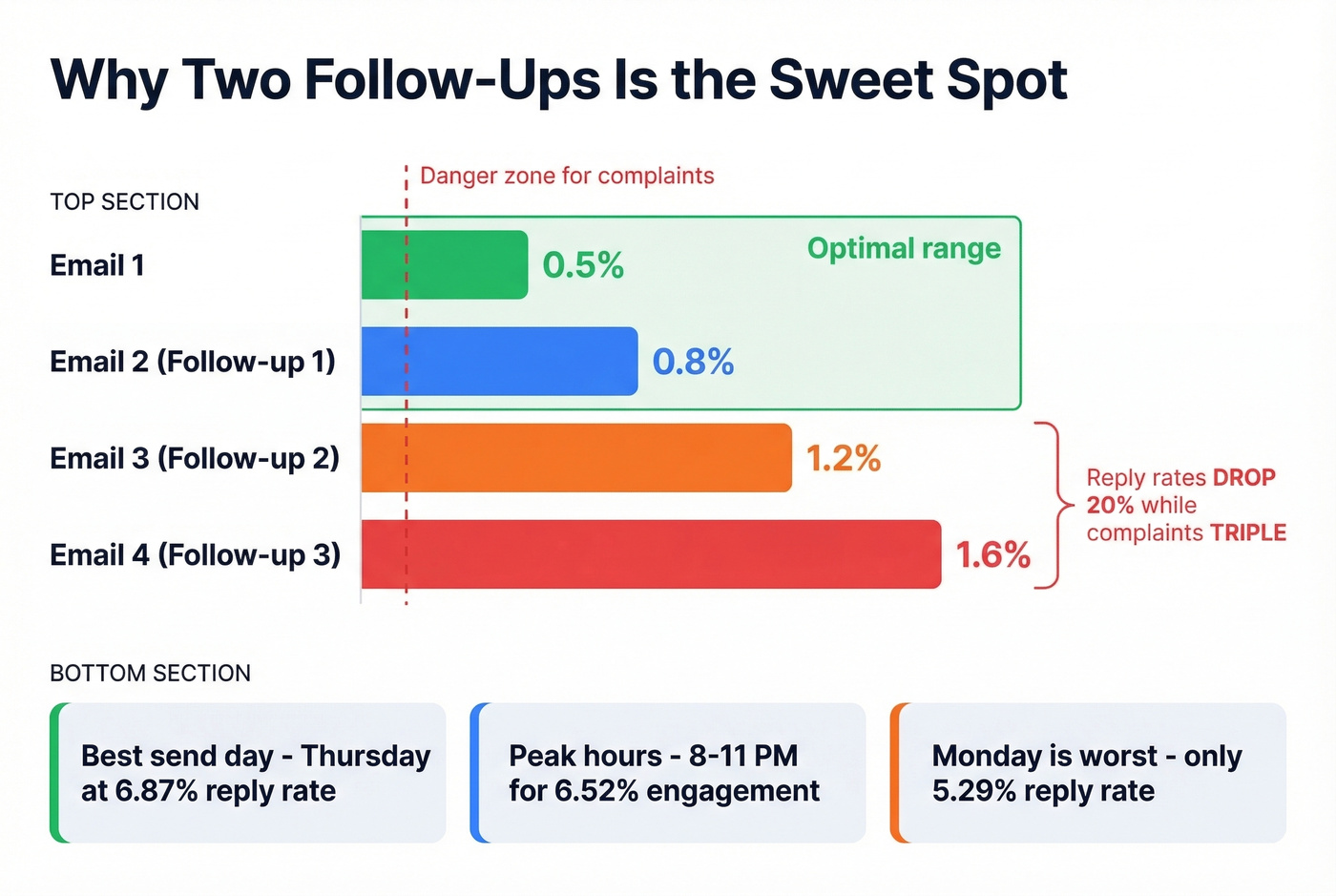
Three to five follow-ups is spammer territory, and the data backs that up. Spam complaints jump from 0.5% on email one to 1.6% by email four. Unsubscribes go from 0.1% to 2% over the same span. Your first follow-up lifts replies substantially, but adding a third email drops reply rates by up to 20%. In our experience, the second follow-up is where you either get the reply or move on.
Thursday is the best send day at 6.87% reply rate versus Monday's 5.29%. Evenings between 8-11 PM drive peak engagement at 6.52%. Space follow-ups a few days apart and don't change the thread subject. (If you want a deeper breakdown, see best time to send cold emails.)
Once your infrastructure is solid, layer in professional-network touches. Multichannel sequences can lift results by 2-3x. You can also run "pretargeting" - serving ads to the same list before your first email lands. It's an advanced play, but it warms up cold prospects before they ever see your name in their inbox.
Compliance Quick Reference
| Regulation | Key Requirements | Max Penalty |
|---|---|---|
| CAN-SPAM (US) | Address, opt-out in 10 days, honest ID | $50,120/violation |
| GDPR (EU/UK) | Consent/legit interest, opt-out | EUR 20M or 4% turnover |
| CASL (Canada) | Express/implied consent, 60-day unsub | $10M/violation |
Don't use deceptive "Re:" subject lines, don't fake the sender name, and honor every unsubscribe request. The penalties are per violation, and violations stack fast. Any B2B cold email strategy run at scale needs compliance baked in from day one, not bolted on after a warning.
Your Outbound Cold Email Stack
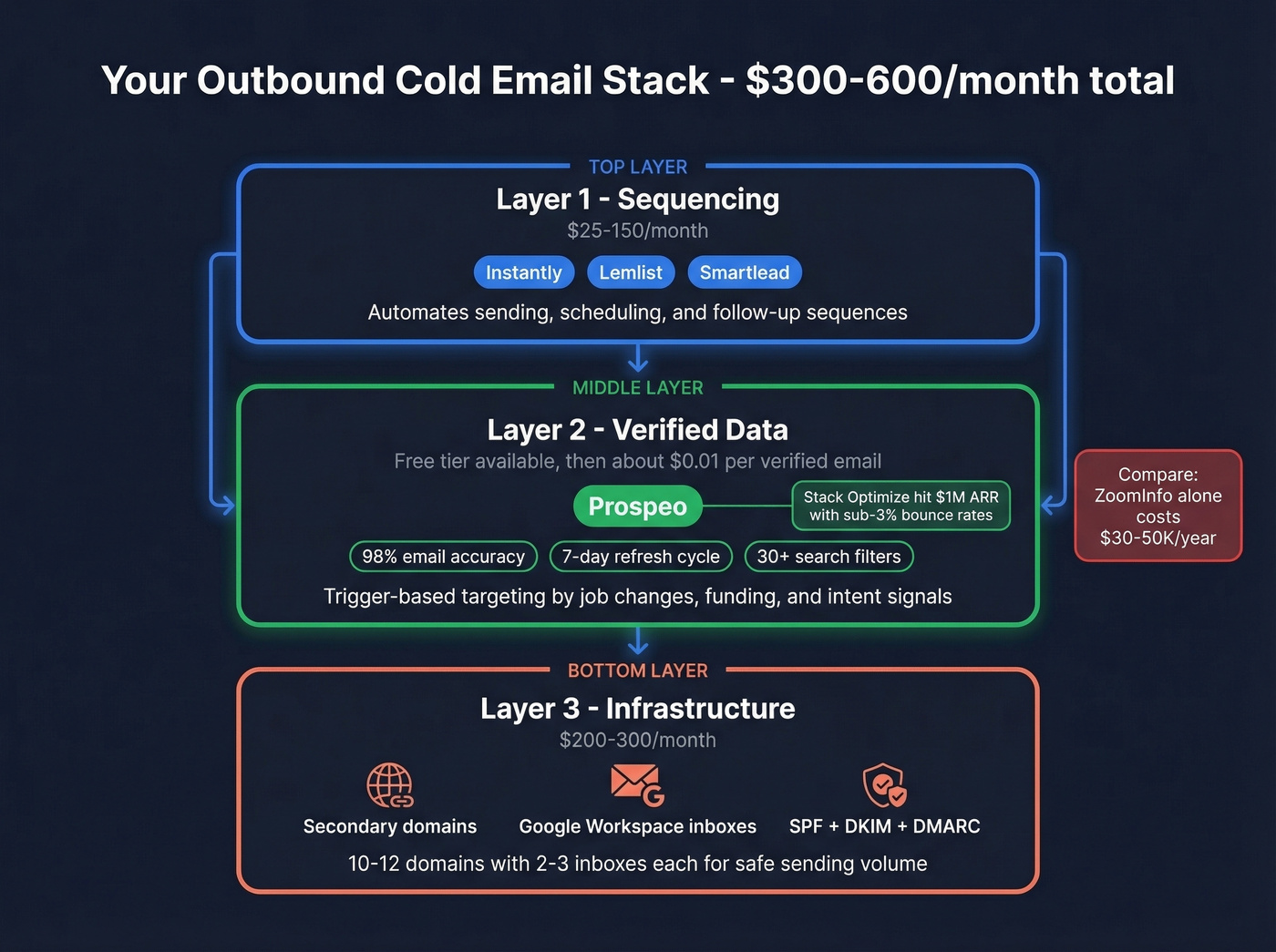
A functional outbound operation runs three layers:
| Layer | Tool Examples | Monthly Cost |
|---|---|---|
| Sequencing | Instantly, Lemlist, Smartlead | $25-150/mo |
| Verified data | Prospeo | Free tier; ~$0.01 per verified email on paid plans |
| Infrastructure | Domains + Workspace inboxes | $200-300/mo |
Total for a basic operation: $300-600/month.
A ZoomInfo-class database alone runs $30-50K/year. Apollo starts at $59/month per user. For teams focused on B2B lead generation through cold outreach, verified data matters more than a bigger database - and at $0.01/lead with 98% email accuracy and a weekly refresh cycle, the economics aren't close. (If you're comparing providers, start with these data enrichment services and sales prospecting databases.)
Trigger-based targeting beats static lists - the data in this article proves it. Prospeo's 30+ filters let you target by job changes, funding rounds, and buyer intent signals across 300M+ profiles, then export verified contacts directly to your sequencer.
Stop blasting stale CSVs. Send to prospects who are actually in-market right now.
FAQ
Is cold emailing for B2B sales legal?
Yes. In the US, EU, and Canada, cold email is legal when you identify yourself honestly, include a physical address, offer a clear opt-out, and honor unsubscribe requests within 10 days. CASL is stricter - it requires implied or express consent before sending.
How many emails should I send per inbox per day?
10-15 per inbox. With 2-3 inboxes per domain and 10-12 domains, that's roughly 400 emails per day. Scale by adding domains, not by pushing more volume through existing inboxes - exceeding 15/day per inbox triggers spam filters.
What's a realistic reply rate?
The 16.5M-email study found a 5.8% average from an optimized agency. At scale, 2-4% is realistic. Anything consistently above 8% reflects strong targeting and verified data with sub-3% bounce rates.
Should I use my main domain?
Never. Buy separate domains and set up dedicated inboxes. If a cold domain gets flagged, your primary domain - and all its marketing and transactional email - stays clean.
What's the cheapest way to get verified contact data?
Prospeo's free tier gives you 75 verified emails and 100 Chrome extension credits monthly - enough to test campaigns before committing. Paid plans run about $0.01 per verified email with 98% accuracy. Hunter's free tier caps at 25 searches with no enrichment.