

How to Build an Outbound Sales Motion That Actually Generates Pipeline
Your CEO just said "build an outbound motion" and gave you 90 days to show pipeline. The problem: only 3% of your market is ready to buy right now. Another 67% is "timing not right." You're not building a campaign - you're building an outbound sales motion that works the other 97% until they're ready.
Here's the thing: if your average deal size is under $25K, you probably don't need a full motion like this. Executives at that price point fill out forms. Above $25K, buying committees grow, inbound dries up, and outbound becomes one of the most reliable ways to create pipeline. Everything below assumes you're in that territory.
What Is a Sales Motion?
A strategy is the "why" - which markets, segments, positioning. A campaign is one-off execution against a specific list. A sales motion is the repeatable operating system that runs daily: ICP definition, data sourcing, channel mix, cadence, roles, measurement, iteration. If you can't hand it to a new SDR on Day 1 and have them producing pipeline by Week 3, you don't have a motion. You have a collection of ad hoc plays.
Benchmarks Worth Knowing
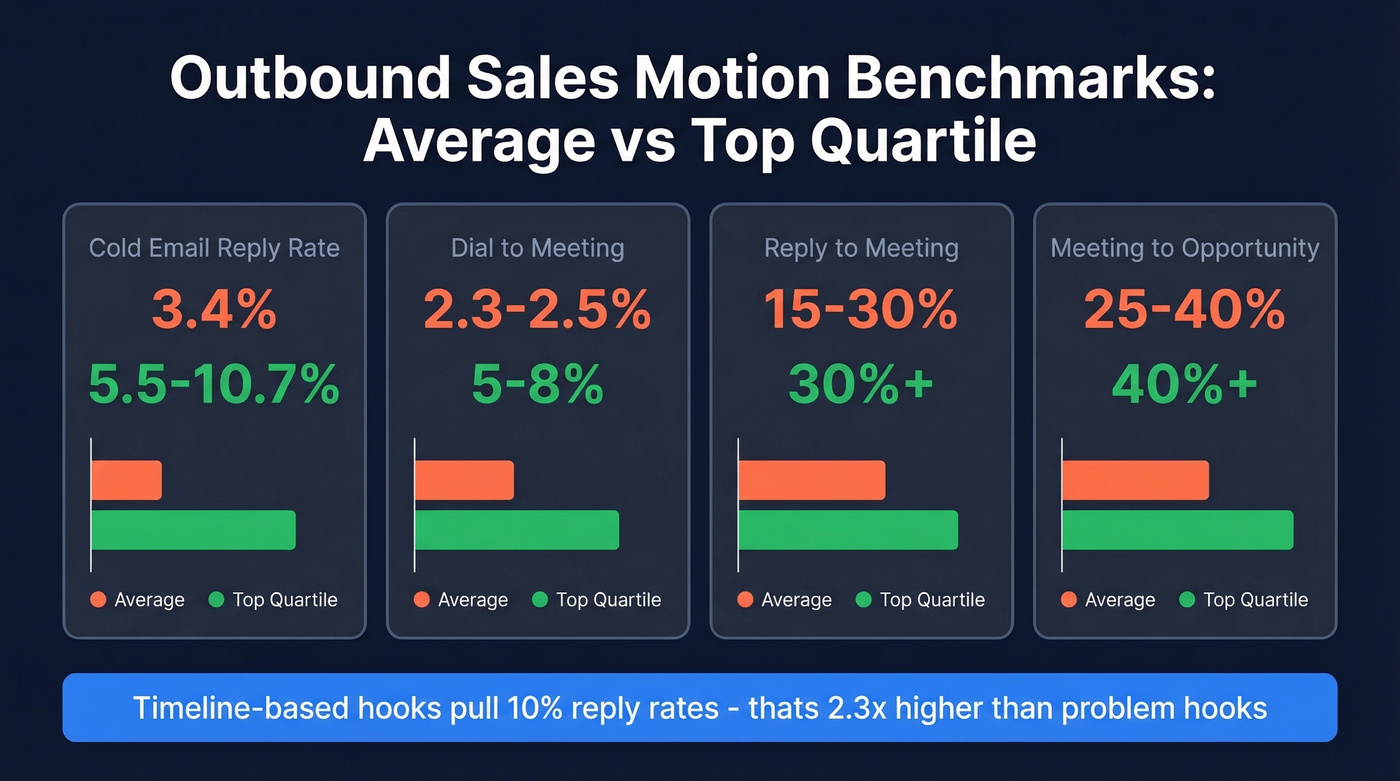
Before you build anything, know what good looks like. These ranges come from compiled 2026 benchmarks across 100+ SaaS teams:
| Metric | Average | Top Quartile |
|---|---|---|
| Cold email reply rate | 3.43% | 5.5-10.7% |
| Dial-to-meeting | 2.3-2.5% | 5-8% |
| Reply to meeting | 15-30% | 30%+ |
| Meeting to opportunity | 25-40% | 40%+ |
Two numbers worth highlighting. 58% of replies come from the first email - your opener matters more than your follow-up sequence. And timeline-based hooks pull a 10.01% reply rate versus 4.39% for problem hooks. That's a 2.3x lift from changing one sentence.
Quick formula to keep in your back pocket: Pipeline Velocity = (Opportunities x Win Rate x Avg Deal Size) / Sales Cycle Length. Every component of your motion should move at least one of those levers.
The 21-Day Cadence
Aim for 8-12 touchpoints across 21 days. The 3-7-7 follow-up rule captures 93% of replies by Day 10, so front-load your effort:
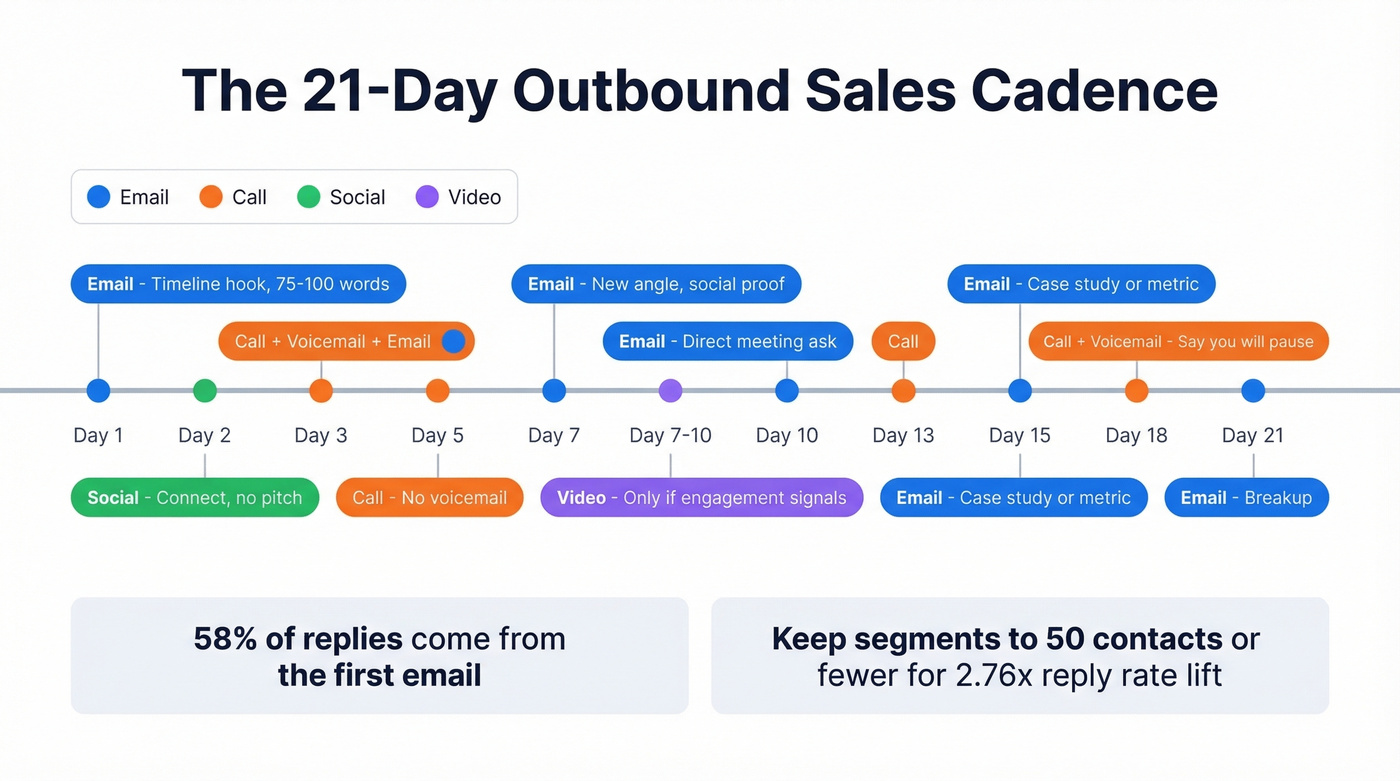
- Email - Day 1 (75-100 words, timeline hook)
- Social - Day 2 (connection request, no pitch)
- Call + voicemail + email - Day 3
- Call - Day 5 (no voicemail)
- Email - Day 7 (new angle, social proof)
- Video - Day 7-10 (only if engagement signals detected)
- Email - Day 10 (direct meeting ask)
- Call - Day 13
- Email - Day 15 (case study or metric)
- Call + voicemail - Day 18 (say you'll pause)
- Email - Day 21 (breakup)
Keep segments tight - cohorts of 50 contacts or fewer produce a 2.76x reply rate lift over larger blasts. For calling, 8-9am and 4-5pm windows lift connect rates 40-70%.
A common SDR:AE ratio is around 2:1 to 3:1, but adjust based on deal complexity and how much outbound your AEs run themselves. We've seen teams with complex enterprise deals succeed at 1:1 because AEs need to own the relationship from first touch.
Let's be honest: traditional email-plus-call sequences have been getting harder over the past 12 months, especially when teams run generic messaging and stale lists. The teams still winning are the ones layering in intent signals and keeping their data fresh enough that emails actually land.

Your cadence doesn't matter if emails bounce. Snyk's 50 AEs cut bounce rates from 35% to under 5% and grew AE-sourced pipeline 180% after switching to Prospeo's 7-day refresh cycle. Bad data doesn't just kill one campaign - it torches your domain reputation and every campaign after it.
Build your outbound motion on data that actually lands.
The Right Tech Stack
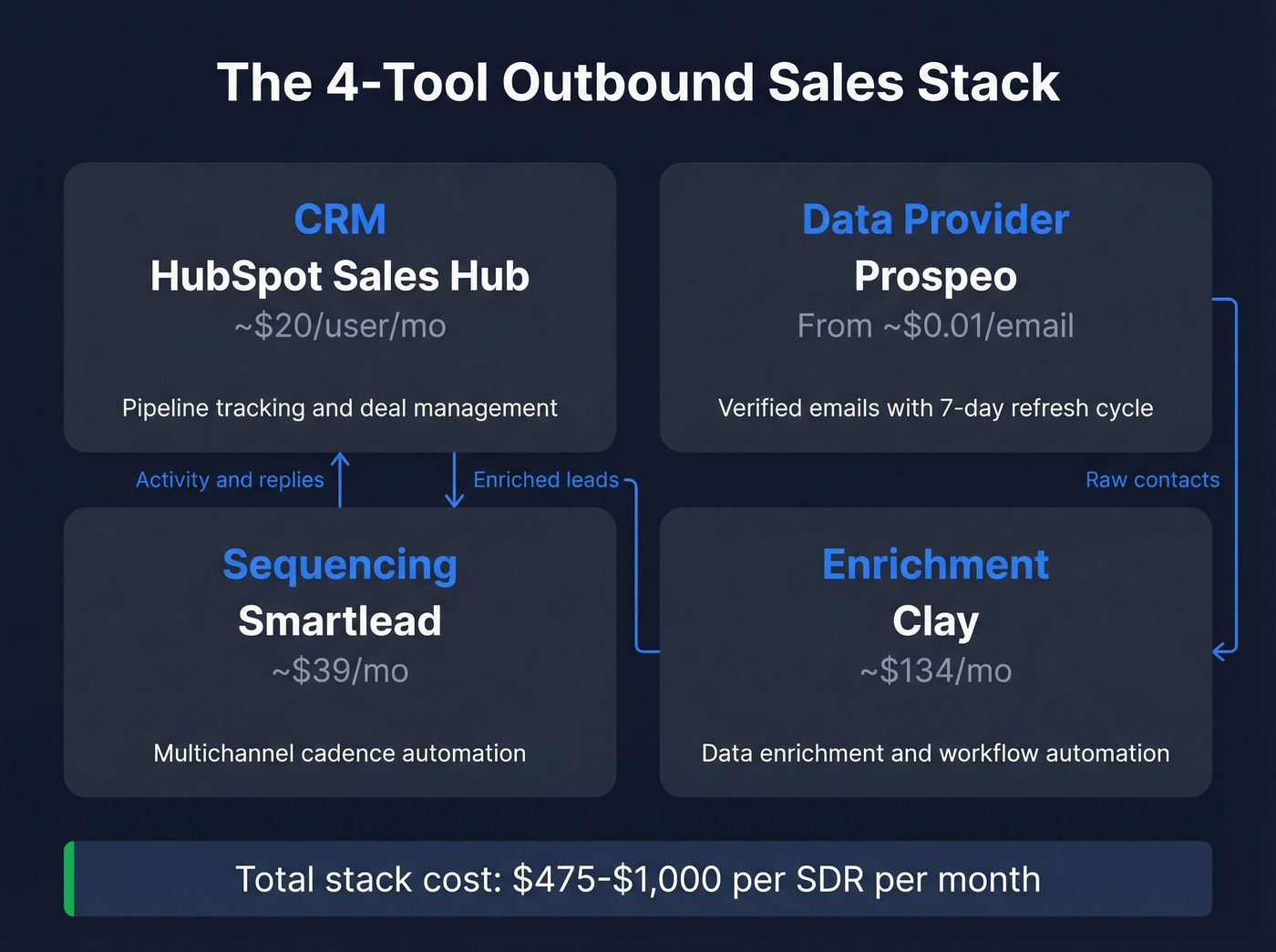
You need four tools, not fifteen. I've seen teams running seven-figure tech stacks where reps only touch the search bar and the dialer. Skip anything your reps won't use daily.
| Category | Tool | Starting Price |
|---|---|---|
| CRM | HubSpot Sales Hub | ~$20/user/mo |
| Data provider | Prospeo | Free tier; paid from ~$0.01/email |
| Sequencing | Smartlead | ~$39/mo |
| Enrichment/workflow | Clay | ~$134/mo |
Total stack cost: roughly $475-$1,000 per SDR/month once you include the rest of the typical stack - CRM seat, sequencing, dialer, data, and the usual add-ons.
Your data provider is the foundation everything else sits on. Bad contact data means bounced emails, which means domain reputation damage, which means your entire motion dies - not just one campaign, all of them. When Snyk's 50-person AE team switched to Prospeo, their bounce rate dropped from 35-40% to under 5% and AE-sourced pipeline jumped 180%. That's the difference between verified data on a 7-day refresh cycle and the industry-standard six-week refresh most providers run.
AI-powered prospecting tools are reclaiming 4-7 hours per rep per week on list building and data cleanup. If your reps are still manually researching prospects, that's the first bottleneck to fix - before messaging, before cadence design, before anything else. (If you want a quick shortlist, start with these SDR tools.)

At $0.01 per email, your data costs less than a single SDR's coffee run. Prospeo's 30+ search filters - buyer intent, technographics, job changes, headcount growth - let you build the tight 50-contact cohorts that drive 2.76x reply rates. No contracts, no sales calls, 75 free emails to start.
Stop paying enterprise prices for data that bounces.
What It Actually Costs
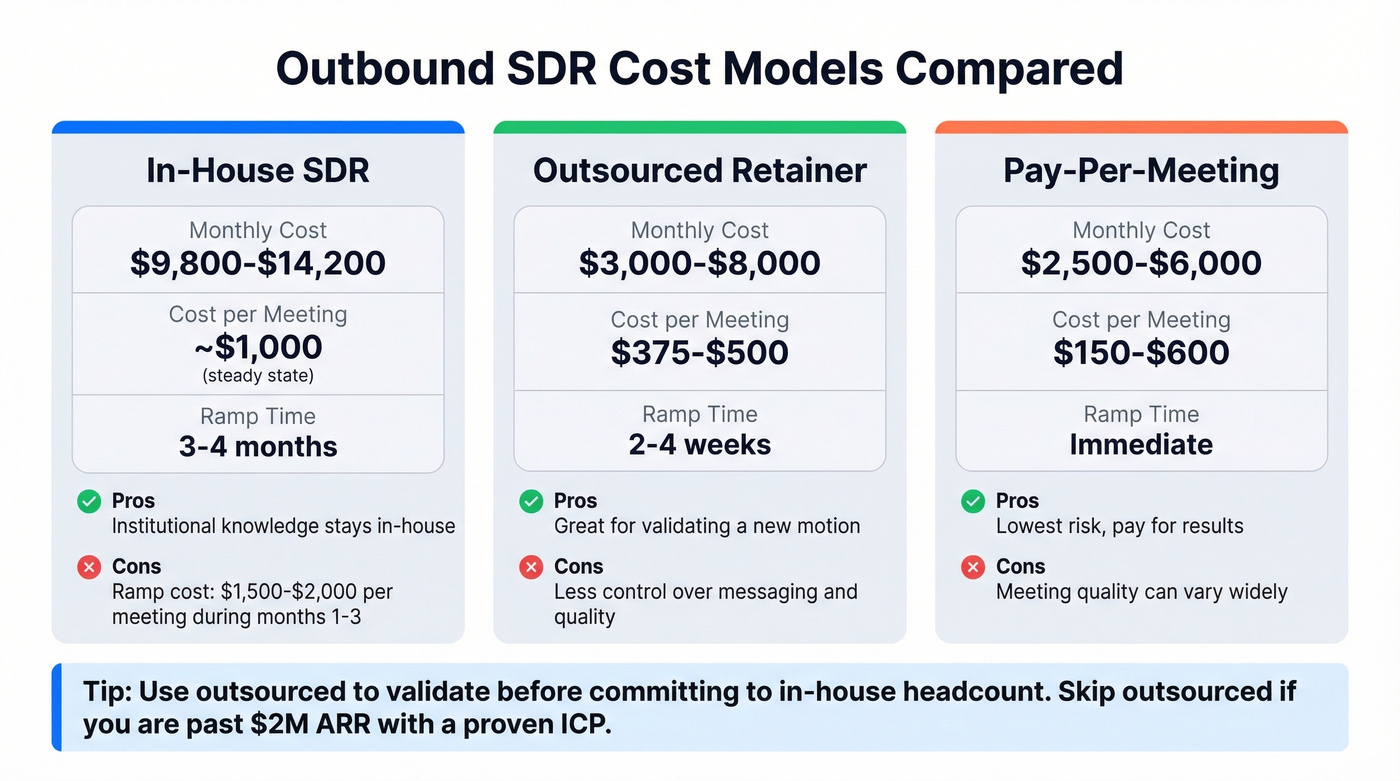
Unit economics most teams don't model until it's too late:
| Model | Monthly Cost | Cost per Meeting |
|---|---|---|
| In-house SDR (loaded) | $9,800-$14,200 | ~$1,000 (steady state) |
| Outsourced retainer | $3,000-$8,000 | $375-$500 |
| Pay-per-meeting | $2,500-$6,000 (volume-dependent) | $150-$600 |
In-house reps take 3-4 months to ramp. During that period, your cost per meeting runs $1,500-$2,000. That's real money before you see real pipeline. For teams testing outbound for the first time, an outsourced retainer can validate the motion before you commit to full-time headcount - skip this option if you're already past $2M ARR with a proven ICP, though, because you'll want the institutional knowledge in-house.
One compliance note that isn't optional: SPF, DKIM, and DMARC authentication are table stakes after Gmail/Yahoo's 2024 requirements and Outlook's May 2025 sender rules. Keep spam complaints under 0.3% and include one-click unsubscribe. Skip this and your motion is dead on arrival. (If you need a checklist, start with this email deliverability guide and a quick DMARC alignment review.)

Mistakes That Kill a Scalable Motion
Spray-and-pray volume over relevance. Sending 500 generic emails beats sending 50 researched ones exactly never. The consensus on r/sales is pretty clear on this - relevance beats hyper-personalization, and both beat volume. The teams that build a truly scalable outbound sales motion do it by tightening segments and templatizing research workflows, not by blasting bigger lists. (If you want more ideas, borrow from these sales prospecting techniques.)
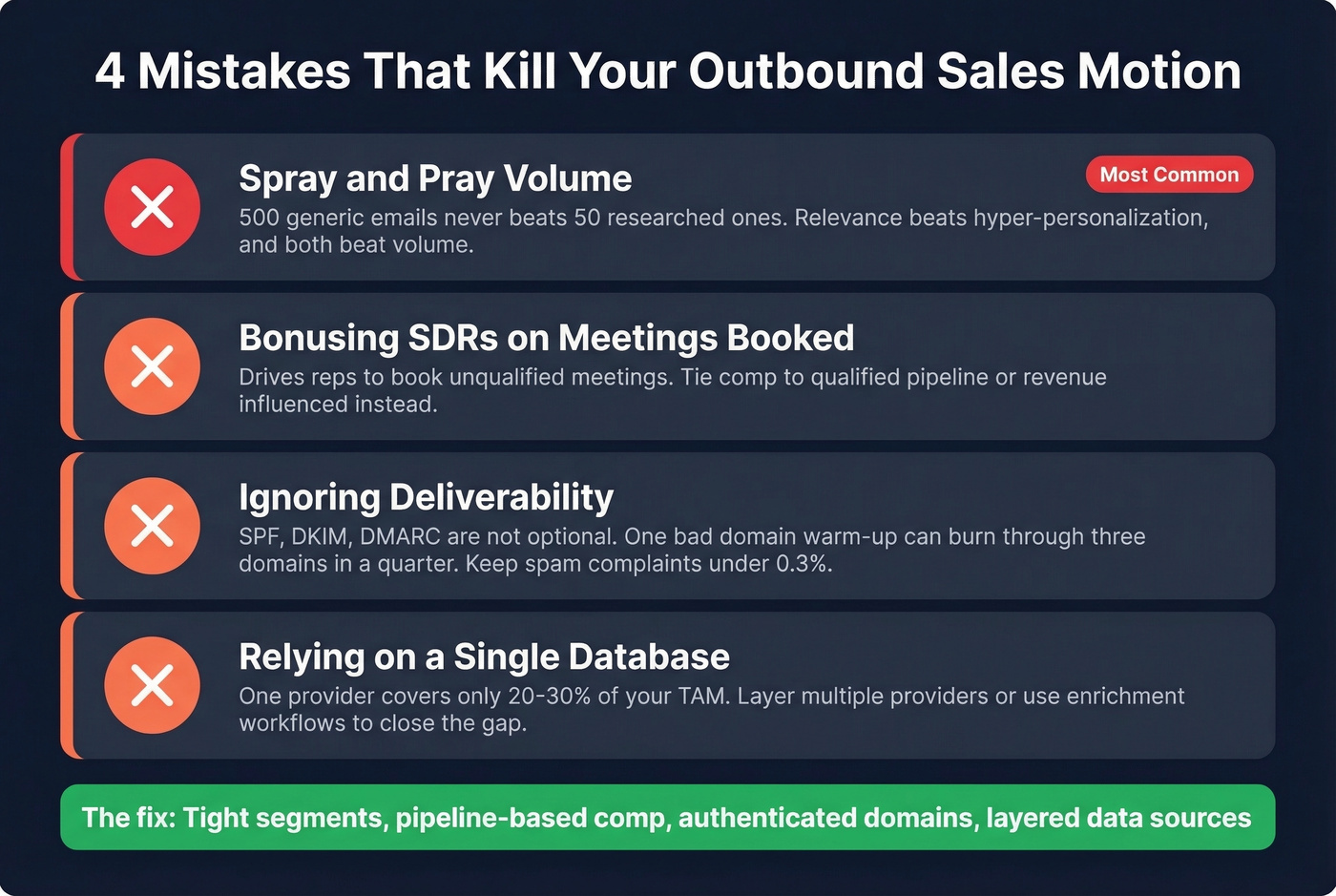
Bonusing SDRs on meetings booked instead of pipeline influenced. This drives terrible behavior. Reps book meetings with anyone who'll say yes, AEs waste cycles on unqualified calls, and leadership wonders why meeting volume is up but pipeline isn't. Tie comp to qualified pipeline or revenue influenced, and watch behavior change overnight.
Ignoring deliverability. If your domain reputation is shot, nothing else matters. Authentication, warm-up, complaint rates - this is infrastructure, not a nice-to-have. In our experience, the single fastest way to kill a new motion is sending 1,000 emails on Day 1 from an unwarmed domain. We've watched teams burn through three domains in a quarter doing exactly this. (Track it like a KPI: email bounce rate and sender reputation are leading indicators.)
Relying on a single database. One provider typically covers 20-30% of your TAM. Layer providers or use enrichment workflows to close the gap.
FAQ
How is a motion different from a strategy?
A strategy defines which markets to pursue and why. A motion is the repeatable daily system - ICP, data, cadence, channels, roles, measurement - that executes the strategy. You can have a great strategy and a broken motion. Pipeline only comes from the motion running consistently.
How long does it take to build one?
The system itself takes 2-4 weeks to stand up. Rep ramp takes 3-4 months to reach steady-state productivity. The bottleneck is always people, not process - plan your hiring timeline accordingly.
What's the most important tool in the stack?
Your data provider. Bad contact data destroys domain reputation and kills every channel downstream. Start with a provider that verifies emails in real time and refreshes data weekly - not monthly - so your first emails actually land in inboxes.
What reply rate should I expect in the first 90 days?
Expect 2-3% cold email reply rates during ramp, climbing to 5%+ as you refine messaging and tighten ICP targeting. Teams hitting 8-10% are typically running tight 50-contact segments with timeline-based hooks and verified data.