

How to Structure Your Outbound Sales Team in 2026 (With Org Charts and Benchmarks)
Seventy percent of sales reps miss quota, per Xactly Insights data. Not because they can't sell - because their outbound sales team structure sets them up to fail. Reps prospect, qualify, demo, and close all at once, then wonder why nothing scales.
The frustrating part? Almost every guide on this topic gives you theory without a single org chart or cost number. We've spent the last year watching teams restructure, and the pattern is always the same: they build the wrong model, burn six months of runway, then rebuild. Let's skip that part.
Structure by Company Stage
Match your company stage to the right structural model and you'll avoid the most expensive mistake in sales ops - reorganizing a team you built wrong six months ago.
| Stage | Model | Sales Headcount | SDR:AE | Key Hire |
|---|---|---|---|---|
| Pre-seed/Seed | Island | 1-3 | N/A | Founder closes |
| Series A (~50) | Assembly line | 4-10 | 1:2 | VP Sales, first SDRs |
| Series B (~125) | Assembly line | 10-15 | 1:2-1:2.5 | Dir. Sales Dev, Ops |
| Series C (~400) | Pods | 15+ | 1:2.5-1:3 | Segment leaders |
These thresholds come from the Sacks SaaS org chart framework and hold up well against what we've seen in practice. The model you pick matters less than picking one and committing.
Three Structural Models
Before choosing a model, understand that your org operates on two layers. The first is segmentation - who you sell to, whether that's geography, account size, or vertical. The second is workflow - how work moves through your team. The Rox.com framework calls these the market layer and the execution layer. Most teams conflate the two and end up with a structure that fits neither.
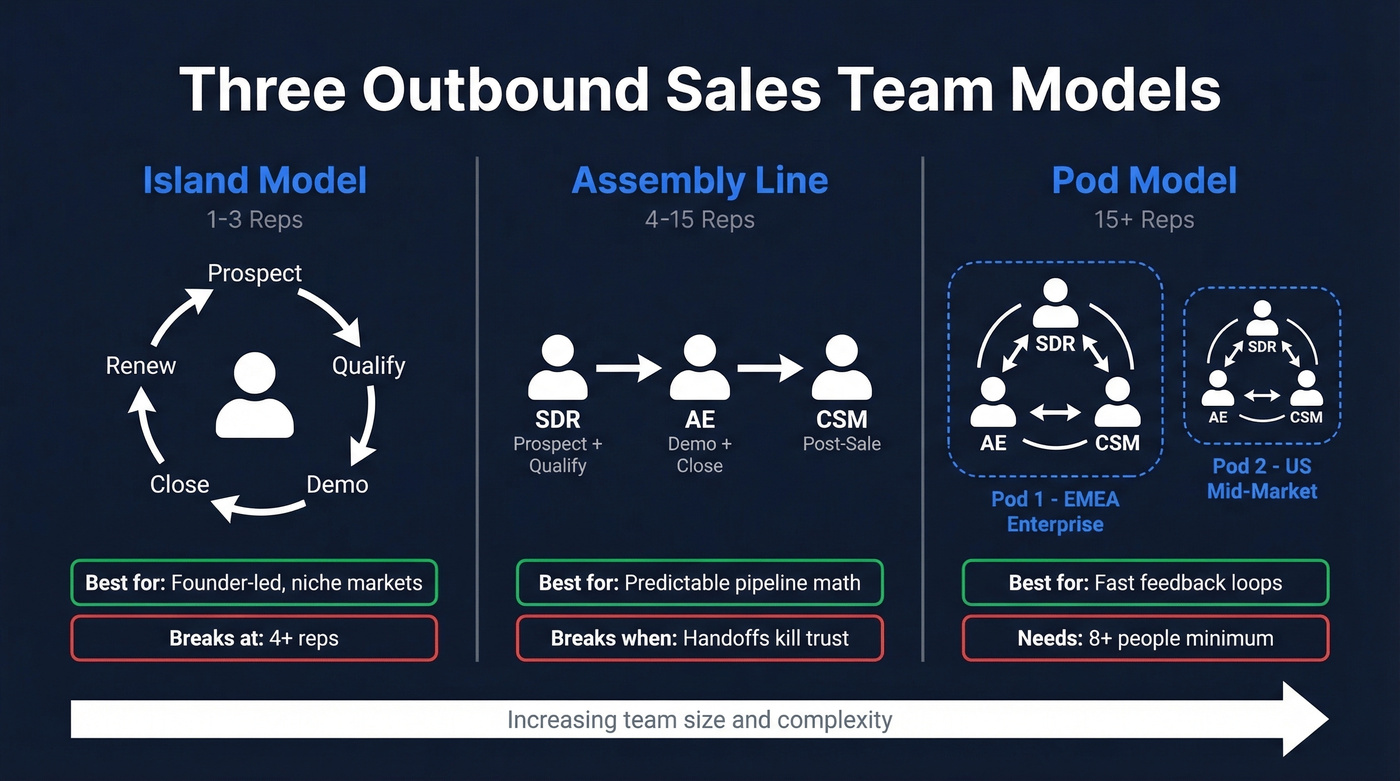
The three models below address the workflow layer. Segmentation sits on top.
Island Model (Full-Cycle Reps)
Each rep owns the entire cycle - prospecting through close through renewal. One person, one account, zero handoffs. This is the default for teams of 1-3 reps, founder-led sales motions, and markets so niche that splitting prospecting from closing would lose critical context.
The island model breaks past 4 reps. There's no way to diagnose whether a rep is failing at prospecting or closing when they do both, and pipeline forecasting becomes guesswork. If your volume outstrips what generalists can handle, it's time to specialize.
Assembly Line (Specialized Handoffs)
SDRs prospect and qualify. AEs demo and close. CSMs handle post-sale. Each role is optimized for one stage of the funnel, with structured handoffs between them.
Use this if: You have 4-15 reps and need predictable pipeline math. The assembly line's biggest advantage is diagnostic clarity - when conversion drops, you know exactly which stage broke. It's also far easier to hire and ramp specialists than generalists.
Skip this when your deal cycle runs under two weeks and handoffs create more friction than value, or when buyers expect one relationship from first touch to renewal. Forcing a handoff there kills trust.
Pod Model (Cross-Functional Clusters)
Cognism documented their shift from assembly line to pods, and the results explain why this model keeps gaining traction. They grouped each cluster - one SDR, one AE, one CSM, sometimes a marketer - around a vertical or region. One pod for EMEA enterprise, another for US mid-market. Shared KPIs across each pod reduced internal competition and improved customer experience.
The pod model's killer advantage is feedback speed. When the SDR, AE, and CSM sit together, churn insights flow back into prospecting messaging within days, not quarters. But you need at least two full pods to justify the structure - that's 8+ people minimum. Running a single pod is just an assembly line with a different name.
Your segments also need to be distinct enough that each pod genuinely requires different messaging and expertise. If your SMB and mid-market motions look identical, pods add overhead without adding value.
Org Charts by Company Stage
Series A (~50 Employees)
At this stage, the Sacks framework puts roughly 12 people under a VP of Sales. Here's the typical breakdown:
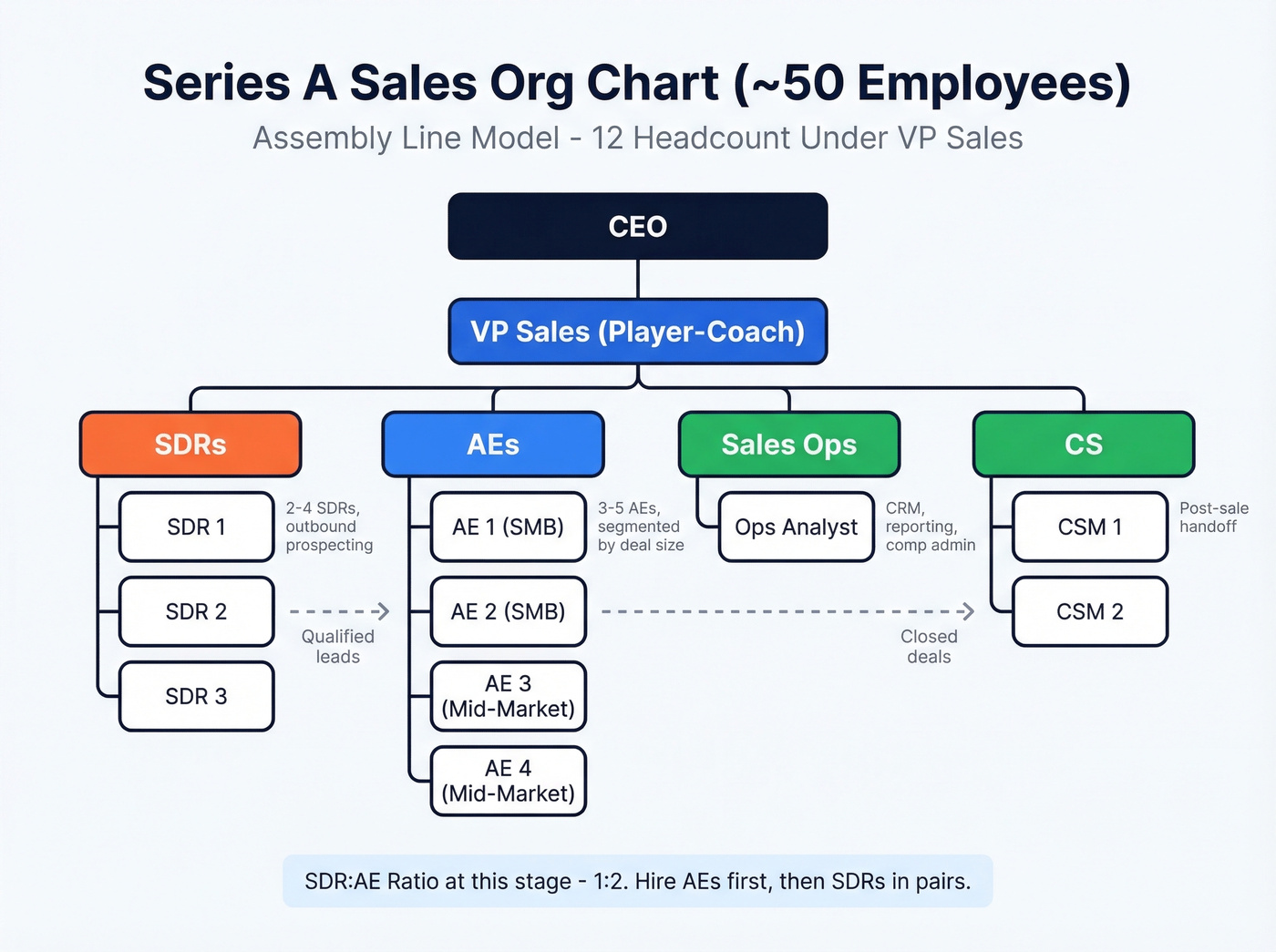
- VP Sales who acts as player-coach and reports directly to the CEO
- 2-4 SDRs handling outbound prospecting
- 3-5 AEs segmented by deal size, typically SMB vs. mid-market
- 1 Sales Ops managing CRM hygiene, reporting, and comp administration
- 1-2 CS/Implementation handling post-sale handoff
The hiring sequence matters more than the chart - more on that below.
Series B (~125 Employees)
The org gets a management layer. A CRO now sits above the VP of Sales, and you're adding a Director of Sales Development to manage a growing SDR team. If your company is around $5M ARR with 100-125 employees, you're in Series B territory - these are the ratios to target:
- Director of Sales Development managing 5 SDRs
- VP/Director of Sales overseeing 8-12 AEs segmented across SMB, mid-market, and enterprise
- Director of Sales Ops with 2 ops analysts
- CS/Implementation team of 5-8 people
The ratios that hold at this stage: 1 SDR per 2 AEs, 1 Sales Ops per 10 AEs, 1 manager per 5-10 direct reports. If you're significantly above or below those ARR numbers, adjust headcount proportionally - the ratios stay the same.
Series C (~400 Employees)
Now you're running a segmented org. SMB, mid-market, and enterprise each get their own sales leadership, SDR teams, and potentially their own pods. The key additions:
- Segment-specific VP/Directors for SMB, mid-market, and enterprise
- SDR management layers per segment, not one manager for all SDRs
- A dedicated sales enablement and training function - real headcount, not a side project
- Multiple pods if you've transitioned from assembly line
Here's the thing about the Series C org chart: this is where most companies either nail specialization or drown in complexity. The test is simple - does each segment operate with enough autonomy to move fast while sharing enough infrastructure (ops, enablement, data) to avoid redundancy?
SDR:AE Ratios and Benchmarks
Ratios by Segment
An Optifai analysis of 939 B2B companies provides the most granular ratio data available:
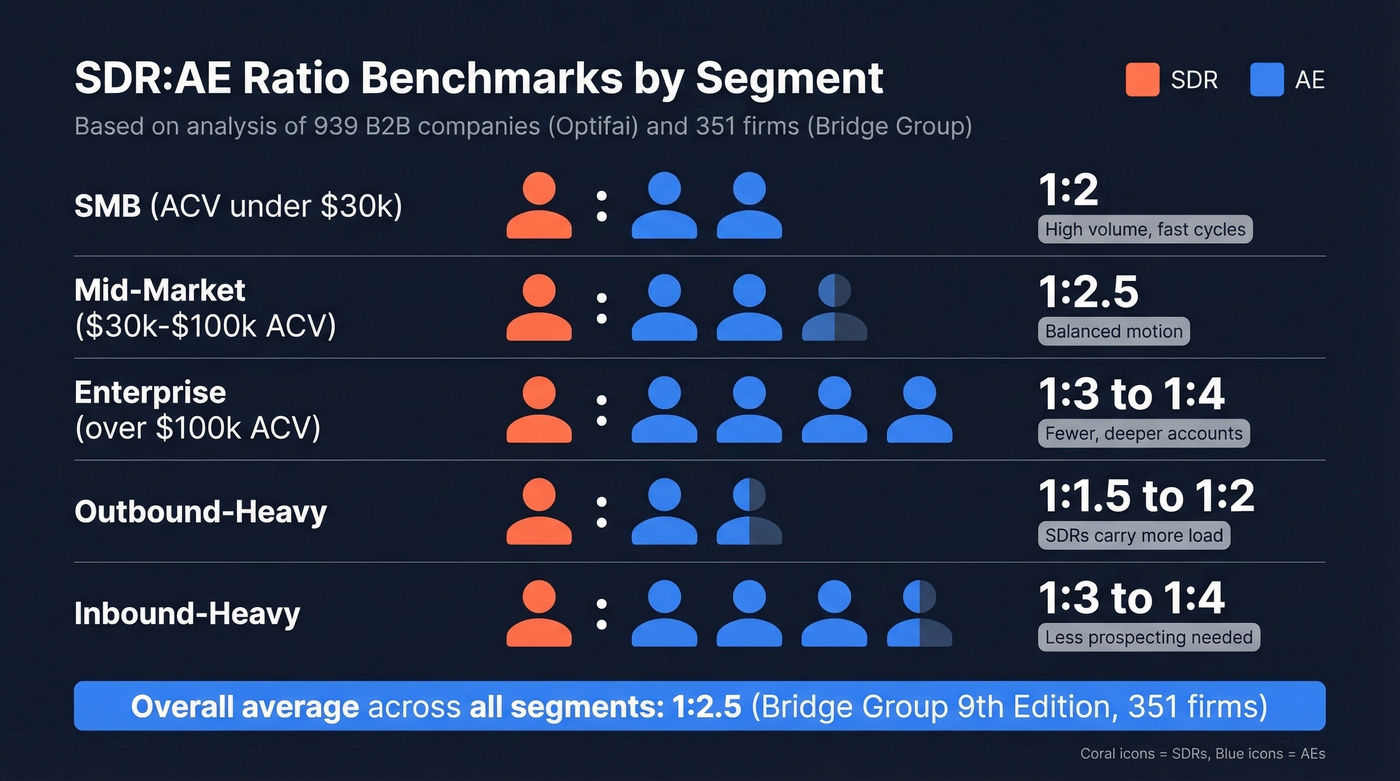
| Segment | ACV | SDR:AE Ratio | Notes |
|---|---|---|---|
| SMB | <$30k | 1:2 | High volume, fast cycles |
| Mid-market | $30-100k | 1:2.5 | Balanced motion |
| Enterprise | >$100k | 1:3-1:4 | Fewer, deeper accounts |
| Outbound-heavy | Any | 1:1.5-1:2 | SDRs carry more load |
| Inbound-heavy | Any | 1:3-1:4 | Less prospecting needed |
The overall average across all segments lands at roughly 1:2.5.
Bridge Group's SDR metrics research, now in its 9th edition covering 365+ B2B companies, puts the average SDR:AE ratio at 1:2.4 across 351 firms. That number hasn't moved meaningfully since 2018, which tells you something - this ratio is structural, not trendy.
Activity and Comp Benchmarks
| Metric | Number |
|---|---|
| Dials/day | 44 |
| Emails/day | 41 |
| Quality conversations/day | 4.1 |
| Attempts per prospect | 10.6 |
| Ramp time | 3 months |
| Average tenure | 1.9 years |
| Annual turnover | 40% (median) |
| Base salary | $55k |
| OTE | $80k, 68:32 base-to-variable split |
| Manager span | 1:6.4 SDRs |
The sweet spot for attempts per prospect sits between 9 and 12 touches in a sales cadence - below that you're leaving pipeline on the table, above it you're burning contacts.
That 40% annual turnover number is the one that should keep you up at night. It means your average SDR delivers about 17 months of full productivity after ramp before they leave. Every structural decision you make - comp, promotion paths, manager ratios - should be optimized against that clock. The manager span dropping from 8:1 to 6.4:1 over recent years reflects teams investing more in coaching to extend that productive window.

Your SDR:AE ratio only works if SDRs spend time selling, not cleaning bad data. Prospeo gives outbound teams 300M+ profiles with 98% email accuracy and 125M+ verified mobiles - refreshed every 7 days. That's how teams like Snyk scaled to 50 AEs and 200+ new opportunities per month.
Stop restructuring your team. Start fixing your data.
Hiring Sequence and Decision Triggers
The order you hire determines whether your team scales or stalls.
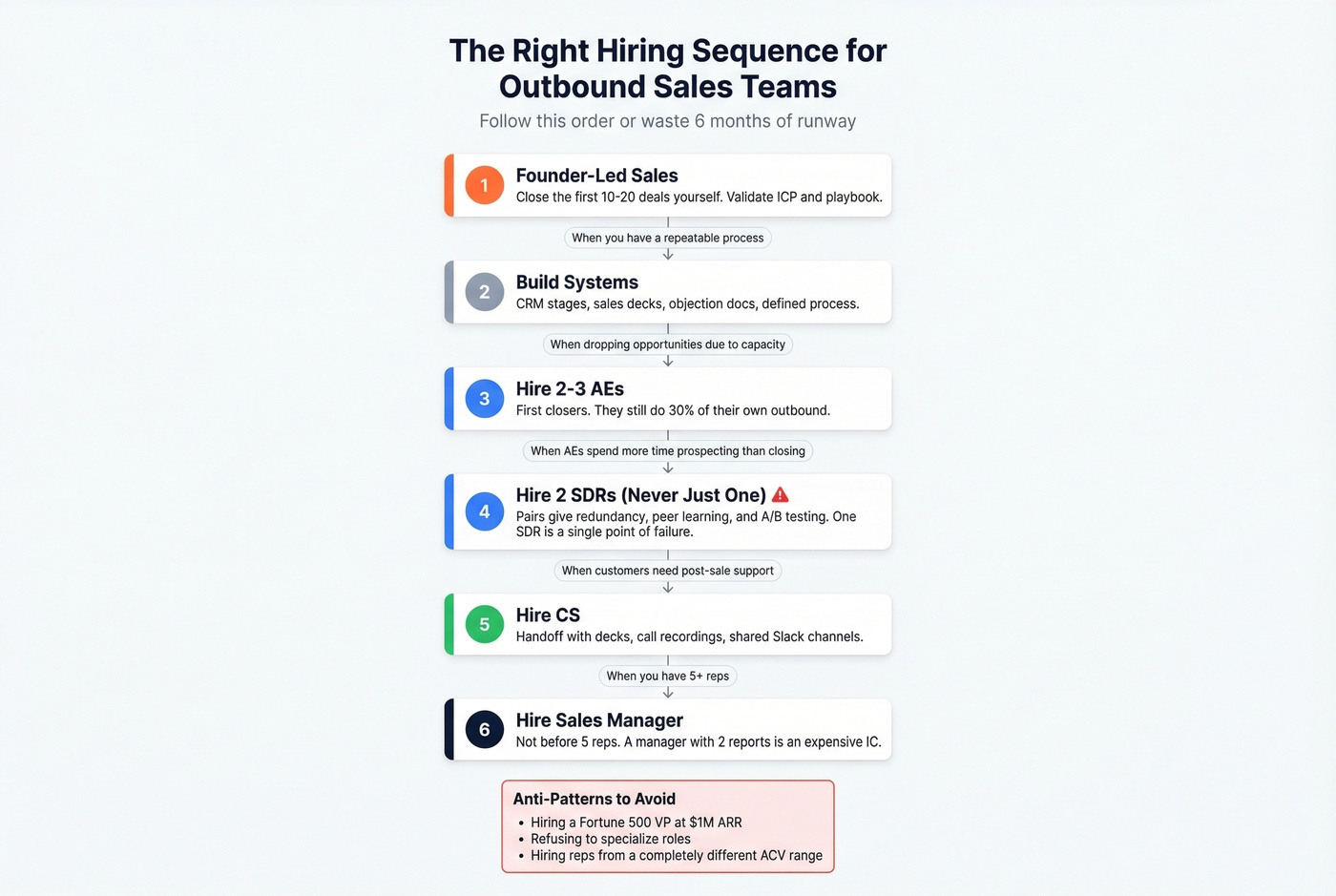
- Founder-led sales. Close the first 10-20 deals yourself. You can't hire someone to do a job you don't understand. Validate your ICP and sales playbook before spending on headcount.
- Build systems. CRM stages, sales decks, objection docs, a defined process. Without this, your first hire inherits chaos.
- Hire AEs. Your first 2-3 closers. They should still do roughly 30% of their own outbound - AE prospecting doesn't go to zero just because you plan to hire SDRs. The heuristic for timing: ask yourself, "If we got 10 more opportunities this month, how many would we drop the ball on?" If the answer is most of them, hire now.
- Hire SDRs - and hire two, not one. This is counterintuitive but backed by operators who've learned the hard way. A single SDR has no peer to learn from, no healthy competition, and if they churn - and at 40% annual turnover, they probably will - you're back to zero pipeline overnight. Two SDRs give you redundancy, a built-in training dynamic, and a realistic A/B test for messaging.
- Hire CS. Handoff with decks, call recordings, and shared Slack channels so CS sees the full deal history.
- Hire a Sales Manager. Not before you have 5+ reps. A manager with 2 reports is an expensive individual contributor.
The anti-patterns are just as important. SaaStr's breakdown of first-sales-team mistakes highlights the ones we've seen kill momentum: hiring a VP Sales from a Fortune 500 company when you're at $1M ARR (they'll build for a company you're not yet), refusing to specialize roles, overcomplicating comp plans with accelerators nobody understands, and hiring reps whose experience is at a completely different ACV than yours. A rep who's sold $300k enterprise deals won't thrive selling $5k self-serve contracts. Closers close, openers open - period.
Hot take: If your average deal size is under $10k, you probably don't need a traditional SDR team at all. An AI-assisted outbound motion with one GTM engineer and two AEs will outperform four SDRs and two AEs at that price point. Save the headcount for when deal complexity justifies it.
Cost Modeling - Human vs. AI SDR
What Outbound Actually Costs
Here's the math most sales leaders avoid until budget season forces it:
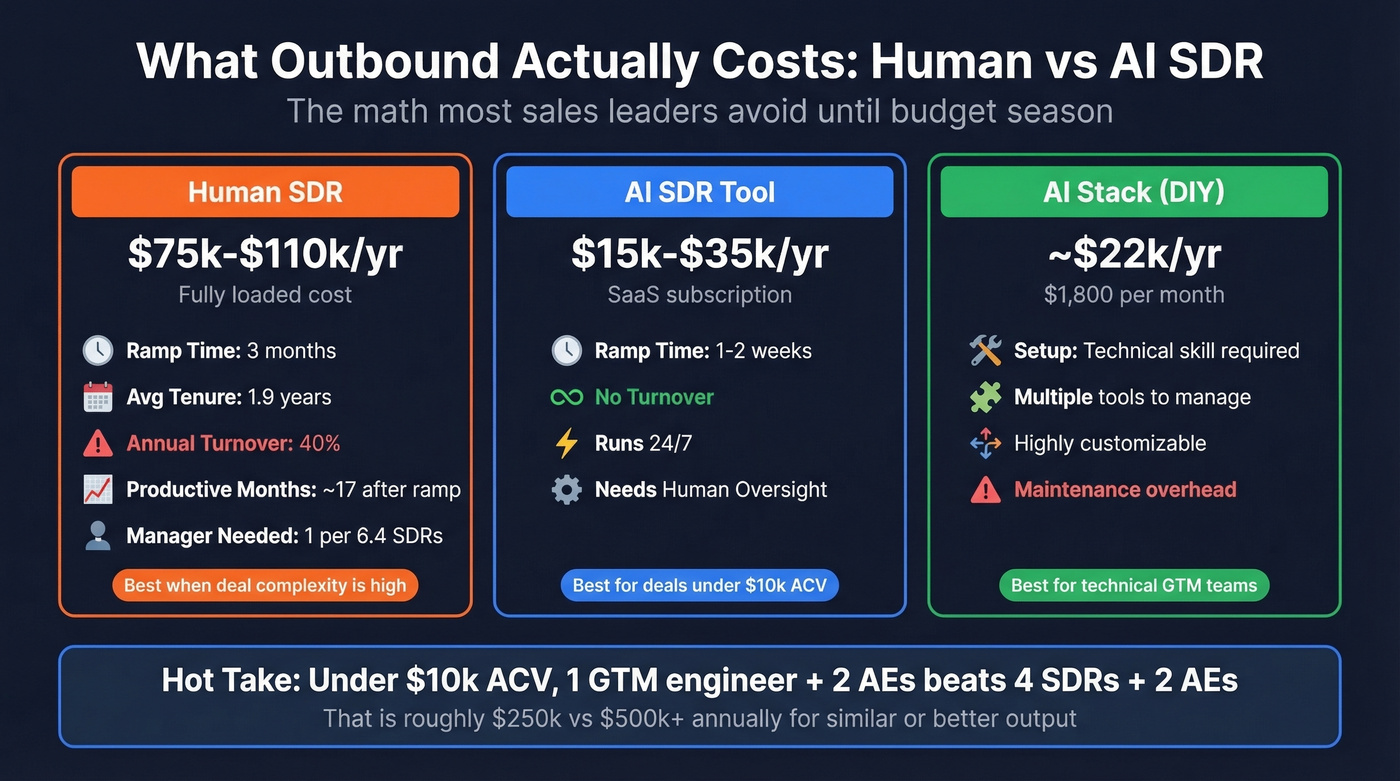
| Human SDR | AI SDR Tool | AI Stack (DIY) | |
|---|---|---|---|
| Annual cost | $75k-$110k loaded | $15k-$35k/yr | ~$22k/yr ($1,800/mo) |
| Ramp time | 3 months | 1-2 weeks | 2-4 weeks |
| Monthly output | ~40 meetings | 20-60 meetings | ~14 meetings |
| Cost per lead | ~$262 | ~$39 | ~$130/meeting |
| Break-even | 8.7 months | 3.2 months | 2-3 months |
The human SDR numbers include fully loaded costs - salary, benefits, tools, management overhead. One operator on r/sales broke down their AI stack at ~$1,800/month covering domains, inboxes, a sequencer, Clay, enrichment, scraping tools, and AI APIs - processing roughly 20k prospects per month and generating 14 meetings and 3 new customers.
SaaStr's 20 AI agents booked 130+ meetings over 90 days - about 43 meetings per month.
How AI SDRs Change Your Org Chart
SaaStr reported 25% of new pipeline generated in 90 days from those AI agents, with 60,000+ hyper-personalized emails and 130+ meetings booked automatically. Their re-engagement campaigns hit 70% open rates. The operational playbook that worked: segment contacts into 800-1,000 person batches, create persona-specific sub-agents for CROs, churned accounts, and event attendees, and start with low-stakes segments like ghosted leads that humans won't follow up on anyway.
Even a fully AI-powered outbound motion still needs two humans: a vendor support contact and an internal GTM engineer to orchestrate the system. AI is terrible at closing live calls, making judgment calls on edge cases, and handling angry replies. Let's be honest - the takeaway from every operator running AI-heavy outbound is the same: let AI do the work humans avoid, keep humans for the conversations that matter.
The Tech Stack That Makes Structure Work
Your org chart is only as good as the data flowing through it. Priority order matters: data provider first, CRM second, sequencer third. If 30-40% of your emails bounce, no amount of structural optimization will save you.
The core stack for a 2026 outbound team:
- Data provider - the foundation. Prospeo delivers 98% email accuracy, a 30% mobile pickup rate, and a 7-day data refresh cycle at ~$0.01 per email.
- CRM - HubSpot (free to start, then $100-$150/user/month at higher tiers) or Salesforce at $100-$150/user/month. Pick based on your complexity needs, not brand prestige. (If you’re evaluating options, start with these examples of a CRM.)
- Sequencer - Outreach or Salesloft at $110-$165/user/month for enterprise; Smartlead or Instantly at $30-$100/month for teams optimizing on cost. If you’re comparing options, see our breakdown of SDR tools.
- Enrichment/orchestration - Clay at $150-$500/month for waterfall enrichment and workflow automation.
- Conversation intelligence - Gong at $115-$135/user/month once you have enough call volume to justify it.
The proof that data quality is a structural decision, not a tool decision: Snyk had 50 AEs prospecting 4-6 hours per week with a 35-40% bounce rate. After switching to verified data, bounces dropped under 5% and AE-sourced pipeline jumped 180%. GreyScout saw rep ramp time cut from 8-10 weeks to 4 weeks because new hires weren't wasting their first month sorting good contacts from bad.

Look - your sequencer doesn't matter if your data is garbage. We've run bake-offs where the team with the cheapest sequencer and the best data outperformed the team running Outreach with a 30% bounce rate. Fix your data first, then optimize everything else. (If you need a baseline, start with email bounce rate benchmarks and fixes.)
The GTM Engineer - 2026's Newest Role
GTM Engineer job postings grew 205% year-over-year from 2024 to 2025, and the role is now a fixture in scaling outbound teams. A GTM Engineer uses AI, automation, and data to build systems that directly drive pipeline - not just maintain them. That's the key distinction from RevOps, which governs and maintains existing systems, and from Sales Engineers, who support individual deals.
Think of the GTM Engineer as the person who wires Clay to your data provider to your sequencer so SDRs spend zero time on manual research. They build persona-specific enrichment workflows, automate lead routing, and create the infrastructure that lets AI agents operate at scale.
Not everyone's sold on the title lasting. Some ops leaders on r/SalesOperations argue the GTM Engineer role will fold back into RevOps as no-code tools mature and the automation skills become table stakes. They might be right long-term. But right now, if you're running 5+ tools in your stack, reps spend hours on manual prospect research, data quality issues keep surfacing, and you can't test new outbound motions without a two-week ops project - this is your next hire, whatever you call it.
Whether you're running an assembly line or pods, every structure breaks when reps bounce 35% of emails. Prospeo's 5-step verification and proprietary email infrastructure cut bounce rates below 4% - at $0.01 per email with no contracts. Your org chart is the strategy. Clean data is the execution.
Give every rep on your org chart data that actually connects.
FAQ
What's the ideal SDR:AE ratio for outbound teams?
For outbound-heavy teams, target 1:1.5 to 1:2. The overall industry average is 1:2.4 across all motion types, but outbound SDRs carry heavier prospecting loads and need fewer AEs per rep. An analysis of 939 B2B companies confirmed enterprise segments can stretch to 1:3-1:4 because deal cycles are longer and account research is deeper.
When should I hire my first SDR?
After your founding AEs are consistently dropping opportunities. The heuristic: ask "if we got 10 more opportunities this month, how many would we lose?" If the answer is more than half, your AEs are capacity-constrained. Hire two SDRs - a single SDR has no peer to learn from and creates a single point of failure at 40% annual turnover.
Should I use AI SDRs or human reps?
Start AI on low-stakes segments - ghosted leads, re-engagement campaigns, event follow-ups. Keep humans for live conversations, complex objection handling, and closing. The economics favor AI at $39/lead vs. $262/lead for humans, but AI still can't handle judgment calls or angry replies. Most teams in our experience run a hybrid.
How long does it take to ramp an SDR?
About 3 months on average, per Bridge Group benchmarks across 351 firms. Verified contact data cuts that significantly - GreyScout reduced ramp from 8-10 weeks to 4 weeks after switching to clean data because new hires weren't burning their first month sorting good contacts from bad.
What's the biggest outbound sales team structure mistake?
Refusing to specialize roles. Asking one rep to prospect, qualify, demo, close, and manage accounts is the fastest way to burn out talent and make pipeline unpredictable. Specialize as soon as you have 4+ reps, and use role-play interviews during hiring to test whether candidates can execute the specific motion you need.