Outbound vs Paid Ads: The Numbers to Actually Decide
You just got out of a board meeting. The CEO wants to know why you spent $8K on Google Ads last quarter and booked three demos. Meanwhile, the SDR you hired six weeks ago has already generated twelve meetings from cold email. The answer to outbound vs paid ads isn't picking a winner - it's finding the right ratio for your deal size, budget, and sales cycle.
The Cheat Sheet
Before we get into the math:
- Deals under $10K ACV - lean into paid ads and inbound. SDR time costs too much per deal.
- Deals over $25K ACV - outbound-led, with paid retargeting as air cover.
- In between - split your budget (ratio framework below) and fix your data quality first, because bad emails will destroy both channels.
Quick Definitions
Outbound means modern B2B prospecting: cold email, cold calling, and social selling. Not TV spots, not radio, not direct mail. We're talking about an SDR sending targeted sequences to a curated list of decision-makers.
Paid ads means pay-per-click and pay-per-impression channels - Google Search, Google Display, LinkedIn Ads, and Meta retargeting. You're buying attention from people who may or may not be in-market right now.
What Paid Ads Actually Cost
Let's start with the channel everyone defaults to. The global average cost per lead across industries is roughly $198, but that number hides massive variance. E-commerce companies pay around $91 per lead. Higher education? Nearly $982. Your industry matters more than any benchmark average.
Google Search is still the workhorse for demand capture. Average CPC runs about $5.26 with a 3.04% conversion rate, putting CPL often in the $70-150+ range depending on your vertical and keyword intent. That's solid if your keywords have volume and intent.
LinkedIn is where things get expensive fast. The platform drives roughly 80% of B2B social media leads, which explains why 89% of B2B marketers use it despite the brutal economics. Lead Gen Forms convert at roughly 13%, which sounds great until you realize CPCs run $8-12 and the resulting CPL often lands in the $300-500+ range. For high-ACV deals, that math works. For anything under $20K ACV, it's a tough ROI to justify.
Here's the thing nobody mentions in the pitch deck: CPL rises as you scale spend. Auction dynamics mean your first $5K/month performs better than your next $5K. You're bidding against more competitors for the same finite pool of in-market buyers.
| Channel | Avg CPC | Avg CVR | Avg CPL / CPA | Best For |
|---|---|---|---|---|
| Google Search | $5.26 | 3.04% | ~$70-150+ | Demand capture |
| Google Display | $1-3 | 0.80% | ~$130 CPA | Retargeting only |
| LinkedIn Ads | $8-12 | ~13% (Lead Gen) | $300-500+ | ABM / high-ACV |
| Meta (retargeting) | $1-5 | Varies | $50-150 | Warm audience nurture |
What Outbound Actually Costs
Outbound economics work differently. Instead of bidding in an auction, you're paying for people and data. A fully loaded SDR - salary, benefits, management overhead - runs $6K-10K/month. Tooling like a sequencer, dialer, and CRM adds $50-200/month. Then there's data.
Data cost is the hidden variable most teams underestimate. With Prospeo, you're paying roughly $0.01 per verified email. A comparable contact from ZoomInfo runs closer to $1/lead. That 100x difference compounds fast when you're sending thousands of emails per month. Model this on 1,000 cold emails:
| Stage | Rate | Volume |
|---|---|---|
| Emails sent | - | 1,000 |
| Delivered (98% accuracy) | 98% | 980 |
| Opened | 45% | 441 |
| Replied | 5% | 49 |
| Meetings booked | 1% | 10 |
| Cost per meeting | - | $200-400 |
That $200-400 cost-per-meeting assumes clean data and decent copy. The number we see most often for SMB targets is around $250. Mid-market deals push it to $300-800 because you're targeting harder-to-reach buyers.
Notice something: that 98% delivery rate is doing serious work. Drop it to 80% and your cost-per-meeting nearly doubles - and your domain reputation starts cratering. We've watched teams burn through three sending domains in a quarter because they skipped verification. Don't be that team.

That 98% delivery rate in the funnel model above isn't hypothetical - it's what Prospeo delivers with 5-step verification, catch-all handling, and spam-trap removal. At $0.01/email vs $1 on ZoomInfo, your outbound CPM drops 100x before you even write a subject line.
Cut your cost-per-meeting in half by fixing the data layer first.
Head-to-Head Comparison
| Factor | Outbound | Paid Ads |
|---|---|---|
| Time to first meeting | 1-2 weeks | 2-4 weeks (learning phase) |
| Cost per meeting | $200-800 | $350-700 |
| Scales linearly? | Yes (add volume) | No (CPL rises) |
| Targeting precision | Very high (1:1) | Medium (audience-level) |
| Compounds over time? | No (stops when you stop) | No (stops when budget stops) |
| Attribution clarity | High (direct reply) | Medium (multi-touch murky) |
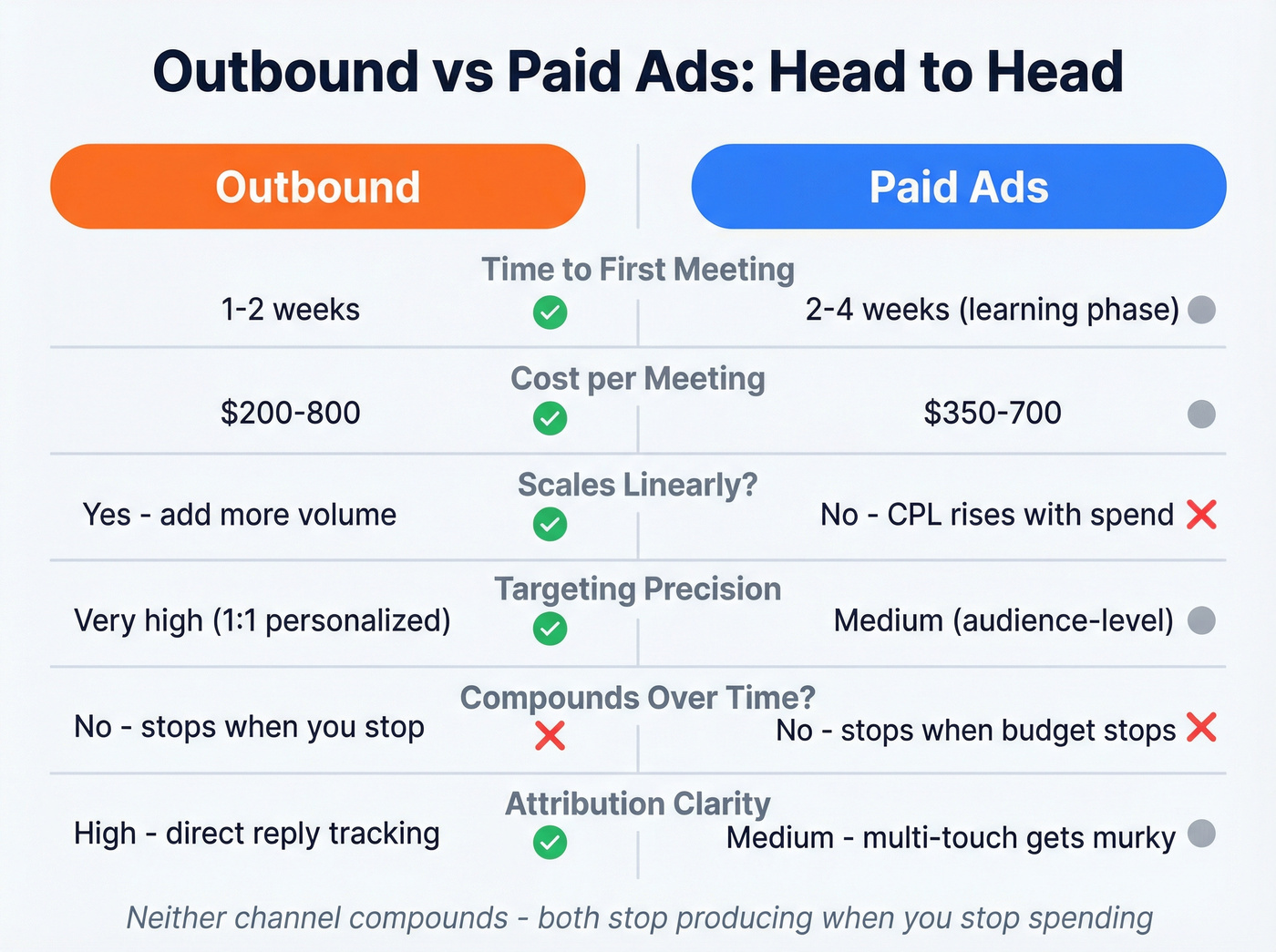
Neither channel compounds. SEO and content marketing build equity over time, but expect a 3-12 month ramp before they contribute meaningfully to pipeline. Both outbound and paid stop producing the moment you stop spending.
Paid ads attribution also gets murky fast in B2B. A prospect clicks a Google ad, visits your site, leaves, sees a retargeting ad two weeks later, then converts through a direct visit. Most teams end up over-crediting the last touch. Outbound attribution is dead simple: someone replied to your email and booked a call.
In our experience, the pattern is consistent - outbound wins on cost-per-meeting for higher-ACV deals, while teams selling lower-ACV products see better ROI from paid search. The real debates happen in the messy middle, which is exactly where a ratio-based approach pays off.
The $10K ACV Rule
Baremetrics makes a clean argument that if your ACV is under $10K, outbound becomes prohibitively expensive. The math checks out: a $250 cost-per-meeting against a $5K deal leaves almost no margin after close rates and sales cycle costs.
Only 10-15% of potential buyers are in-market at any given time. Outbound lets you reach the other 85-90% proactively, but that only makes economic sense when the deal size justifies the effort.
If your ACV is under $10K and you're hiring SDRs, you're lighting money on fire. Put that budget into Google Search and content. Outbound is a high-ACV game - the unit economics don't lie.
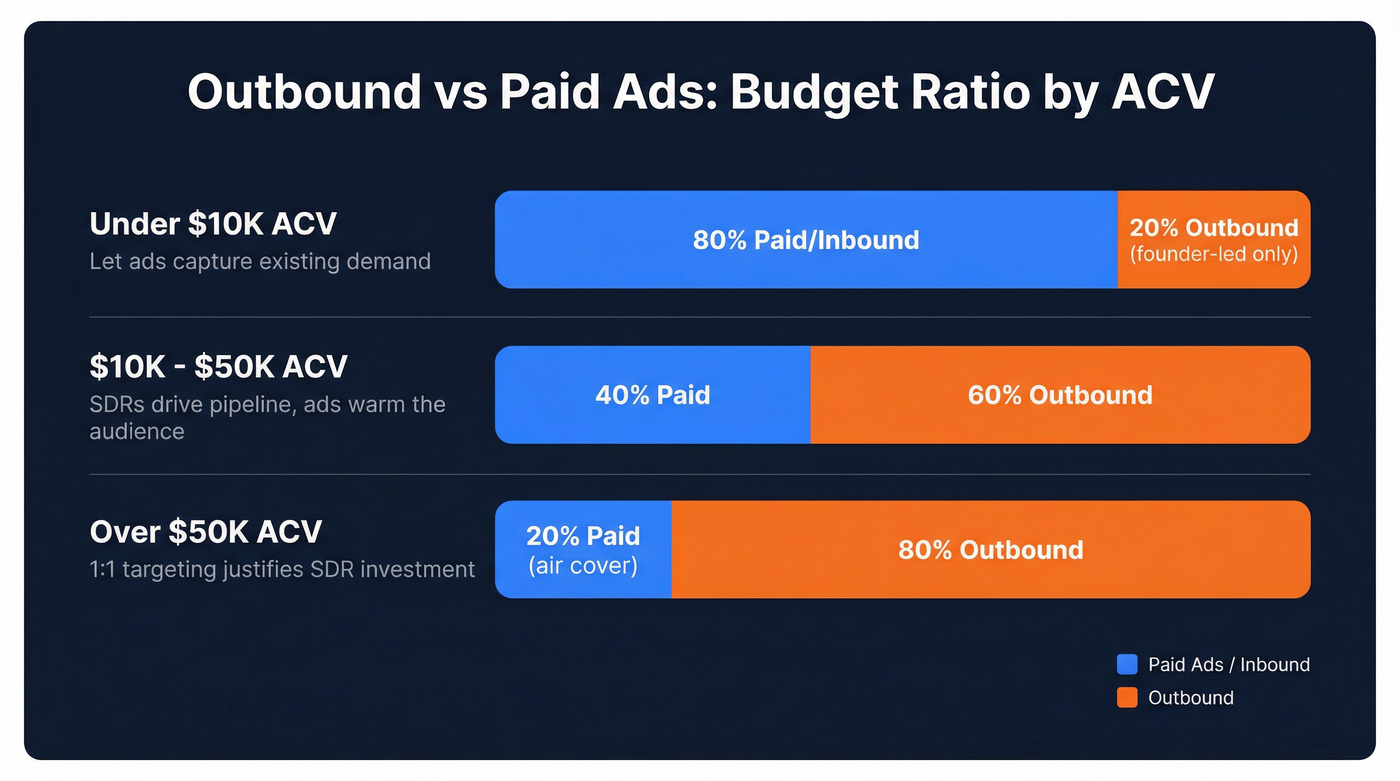
Use this as your starting framework:
- Under $10K ACV - 80% paid/inbound, 20% outbound (founder-led only). Let ads capture existing demand.
- $10K-$50K ACV - 60% outbound, 40% paid. SDRs drive pipeline; ads warm the audience and retarget.
- Over $50K ACV - 80% outbound, 20% paid. At this deal size, 1:1 targeting and multi-threading justify the SDR investment. Ads play air cover.
The Hybrid Playbook
The best-performing teams don't choose - they run both channels as one system. 81% of B2B buyers research independently before ever talking to a vendor. If your prospect sees your brand in an ad before your cold email lands, reply rates go up.
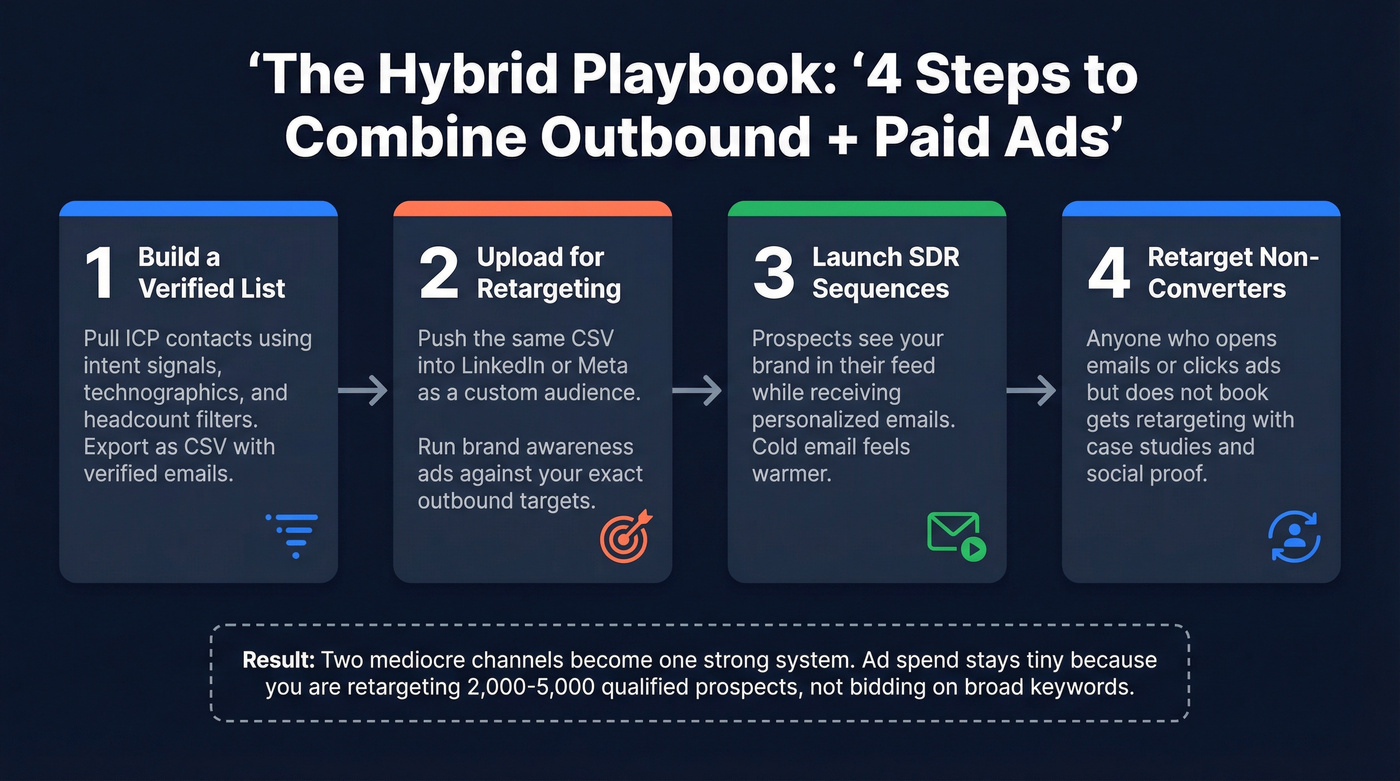
Here's the four-step workflow we've seen work repeatedly:
- Build a verified prospect list. Pull contacts matching your ICP using 30+ search filters - buyer intent, technographics, headcount growth - then export as a CSV with verified emails.
- Upload the list for retargeting. Push that same CSV into LinkedIn or Meta as a custom audience. Run awareness ads against your exact outbound targets.
- Launch SDR sequences. Your prospects are now seeing your brand in their feed while receiving personalized emails. The cold email feels warmer.
- Retarget engaged non-converters. Anyone who opens emails or clicks ads but doesn't book gets retargeting ads with case studies and social proof.
This hybrid approach turns two mediocre channels into one strong system. The ad spend is tiny - you're retargeting a list of 2,000-5,000 people, not bidding on broad keywords. It's the most efficient form of paid outreach for B2B because you're only spending ad dollars on prospects you've already qualified through your ICP filters.
Why Most Outbound Fails
Most outbound campaigns don't fail because of bad copy or wrong timing. They fail because of bad data.
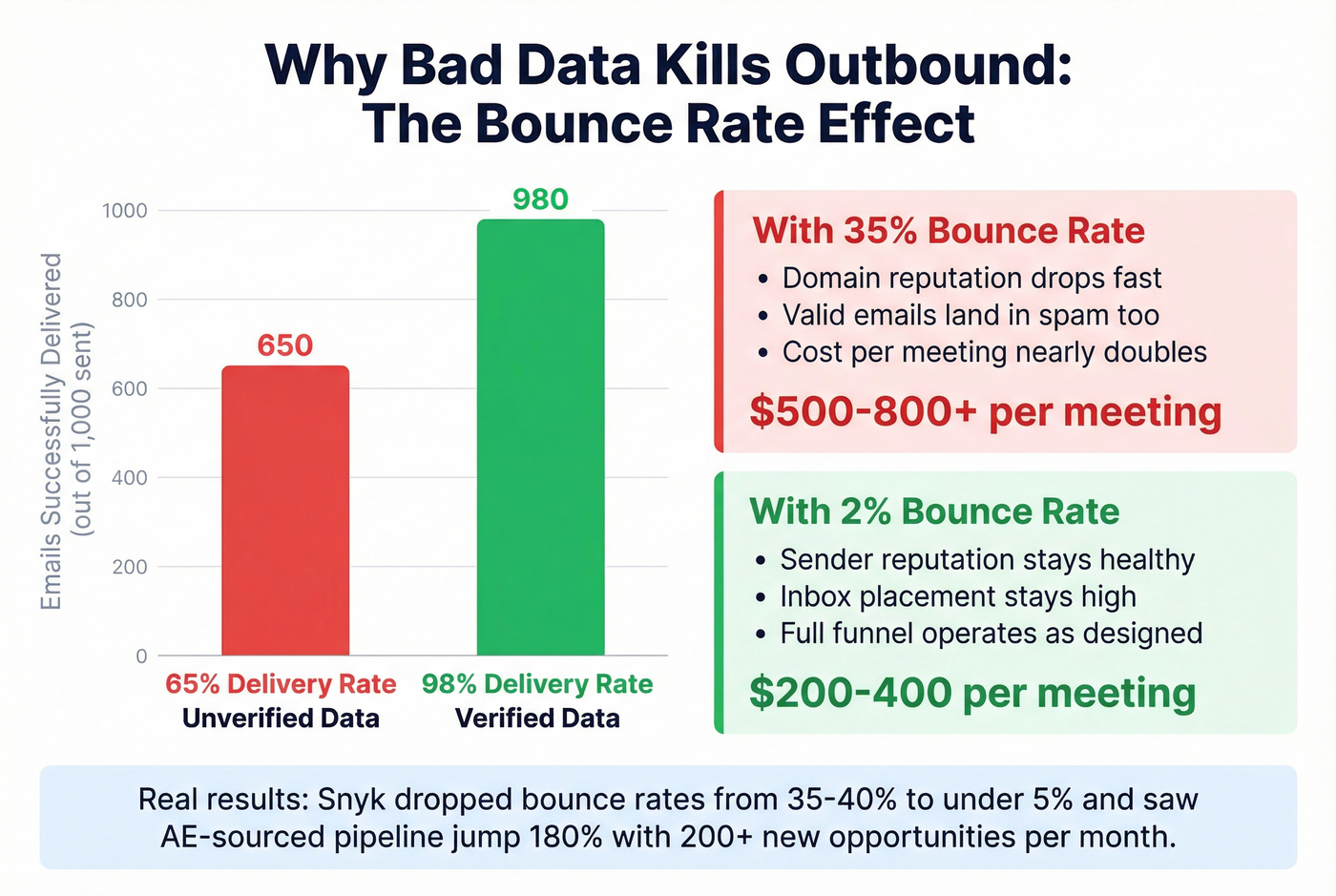
When 20-35% of your emails bounce, three things happen simultaneously: your sender domain reputation drops, your deliverability craters (even the valid emails start landing in spam), and your cost-per-meeting skyrockets because you're paying SDR time to send emails nobody receives. I've seen teams blame their messaging for months before realizing the real problem was a 30% bounce rate silently killing every campaign they launched.
Snyk ran into exactly this. Their 50-person AE team was prospecting 4-6 hours per week with bounce rates hitting 35-40%. After switching to 98% verified emails on a 7-day refresh cycle, bounce rates dropped under 5%. AE-sourced pipeline jumped 180%, generating 200+ new opportunities per month.
Meritt saw a similar shift - pipeline tripled from $100K to $300K per week once they fixed their data foundation, with bounce rates dropping from 35% to under 4%.
The difference between a 65% and 98% delivery rate isn't a rounding error. It's the difference between a functioning outbound program and one that's actively damaging your domain.
Budget Allocation by Tier
Split your budget based on what you're actually working with:
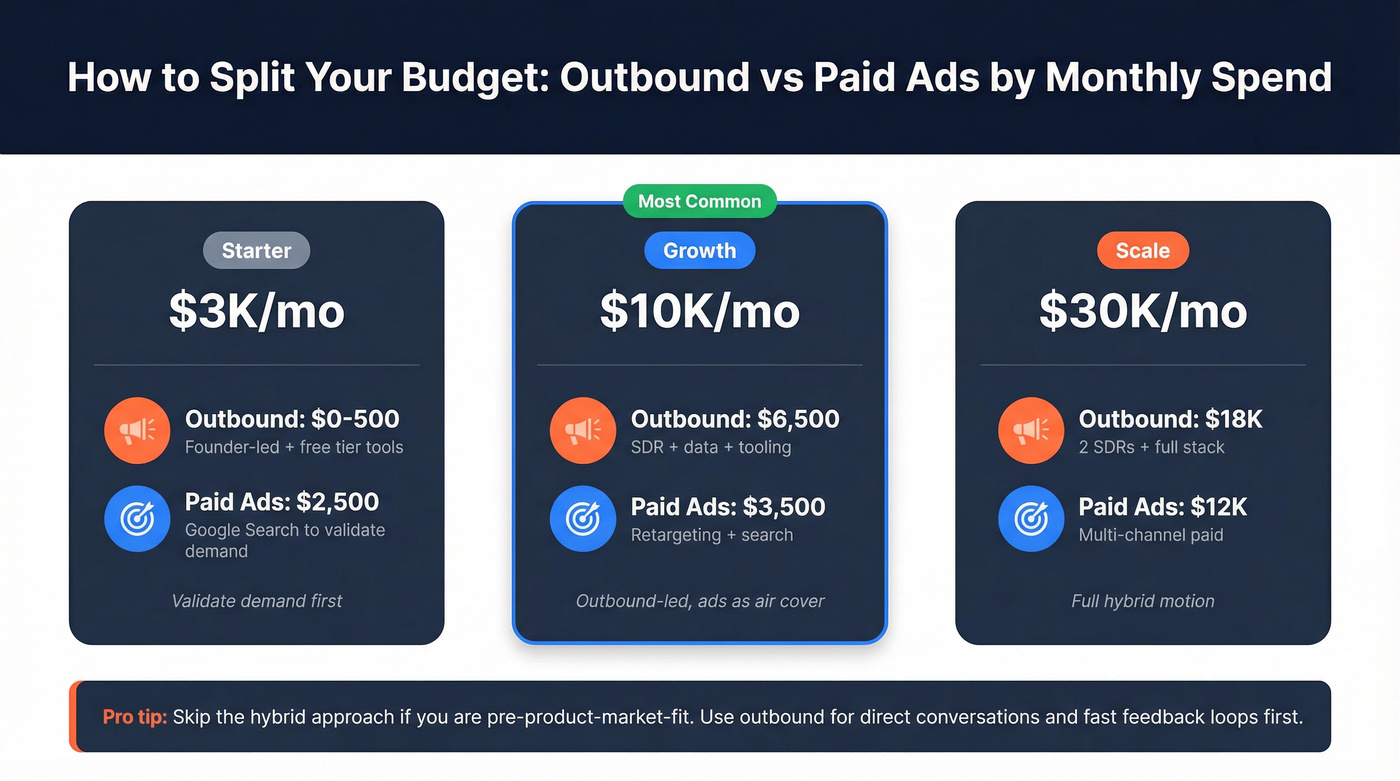
| Monthly Budget | Outbound | Paid Ads | Notes |
|---|---|---|---|
| $3K/mo | $0-500 (founder-led + free tier tools) | $2,500 (Google Search) | Validate demand first |
| $10K/mo | $6,500 (SDR + data + tooling) | $3,500 (retargeting + search) | Outbound-led, ads as air cover |
| $30K/mo | $18K (2 SDRs + full stack) | $12K (multi-channel paid) | Full hybrid motion |
At $5K/month with a $30K+ ACV, outbound is the clear primary channel. You can't afford enough ad spend to move the needle on LinkedIn, but you can absolutely fund an SDR with clean data and a sequencer. Add $500-1,000 in retargeting against your outbound list and you've got a hybrid motion running on a startup budget.
Skip the hybrid approach if you're pre-product-market-fit. Burn your budget on learning what resonates through direct conversations first - outbound gives you that feedback loop faster than any ad campaign.
Let's be honest about the bottom line on outbound vs paid ads: stop treating them as competing line items. Use the ACV framework to set your ratio, fix your data quality so outbound actually works, and layer retargeting on top to make every cold email warmer. The consensus on r/sales backs this up - the teams posting wins aren't debating channels, they're running both in lockstep.
Running the hybrid playbook? Prospeo's 30+ filters - buyer intent, technographics, headcount growth, funding - let you build laser-targeted outbound lists that mirror your best-performing paid ad audiences. Same ICPs, fraction of the cost.
Stop bidding $12/click for prospects you could email for a penny.
FAQ
Is cold email cheaper than Google Ads?
For B2B deals above $15K ACV, yes. Fully loaded cost-per-meeting via cold email runs $200-400 for SMB targets versus $350-700 through Google Search ads. Below $10K ACV, SDR time costs make paid search more efficient per dollar spent.
Should you run outbound and paid ads together?
Together - always. Upload your outbound prospect list to ad platforms as a custom audience for retargeting. Prospects who see your brand in ads before receiving a cold email reply at significantly higher rates. The channels reinforce each other rather than competing.
What's the biggest reason outbound campaigns fail?
Bad contact data. When 20-35% of emails bounce, domain reputation drops, deliverability craters, and cost-per-meeting skyrockets. Keeping bounce rates under 5% is the threshold for maintaining healthy sender reputation - and that requires verified, recently refreshed contacts.
What's a good free tool for building outbound lists?
Prospeo offers 75 free email credits plus 100 Chrome extension credits per month - enough to test outbound viability before committing budget. For teams running real campaigns, that free tier covers enough ground to validate your ICP and messaging before scaling spend.