Stop Writing "Please Find Attached" - Here's What to Say Instead
You've done it again. Halfway through an email, you typed "please find attached," stared at it for two seconds, felt a flicker of doubt, and hit send anyway. You're not alone - the average professional handles 120+ emails a day, and most of them run on autopilot. Here's the kicker: 25% of professionals now use AI to write or edit their emails, and AI reproduces the exact same stale phrases you were already tired of. The robots are "reaching out" and "circling back" right alongside us.
Phrases like "attached find" formulas aren't wrong. They're lazy. And lazy compounds across every message you send.
What You Need (Quick Version)
The phrase isn't a grammar error - it's dead weight. A Belkins study of 16.5 million emails found that messages under 200 words outperform everything longer, which means every filler phrase costs you. The one replacement to memorize: "I've attached [specific thing] - [what to do with it]." That's it. But if you're emailing someone in France, Japan, or a legal context, formal phrasing is still correct. Read the cultural section below before you casualize everything.

Where "Please Find Attached" Came From
The phrase traces back to 19th-century commercial correspondence - the era of wax seals, carbon copies, and letters that opened with "Dear Sir, I beg to acknowledge receipt of your esteemed favor of the 14th inst." A typical 1880s business letter might begin: "Dear Sir, Enclosed please find the invoice for goods shipped per the 12th inst." The original version was "enclosed please find," referring to physical documents tucked inside a paper envelope. Variants like "please see attached" and "attached herewith" followed, each more legalistic than the last. When email replaced letters, the phrase migrated to digital without anyone stopping to ask whether it still made sense.
Bryan Garner, the usage authority behind Garner's Modern American Usage, has been calling it "deadwood" and "commercialese" since at least the 1990s. His argument is simple: "find" is used in an archaic imperative sense meaning "you will discover." You're commanding someone to locate a thing you've already given them. It's linguistically bizarre - like saying "please notice the door" when you're holding it open.
Yet here we are, decades into the email era, still writing it. Not because it's useful, but because nobody taught us anything better. "Please find attached" is the cockroach of email language - impossible to kill, not because it's strong, but because nobody bothers to replace it.

You just optimized your email language. Now optimize who receives it. Prospeo gives you 98% verified email addresses for every prospect - so your perfectly crafted message actually lands in a real inbox, not a bounce.
Great copy deserves a real inbox. Start finding verified emails at $0.01 each.
Why It's Outdated (and What the Data Says)
Every word in your email is competing for attention, and the data says you don't have many words to spare.

Belkins analyzed 16.5 million cold emails across 93 business domains and found that emails with 6-8 sentences hit the sweet spot: 42.67% open rate, 6.9% reply rate. Messages under 200 words outperform anything longer. Cold email open rates dropped from 36% to under 28% in a single year. Reply rates fell 15% year-over-year. When attention is shrinking this fast, "please find attached the aforementioned document for your review and consideration" is a luxury you can't afford.
Modern email clients already show attachment icons, file previews, and thumbnail images right in the message. Gmail displays a paperclip icon and the filename before you even open the email. Outlook shows file cards with size and type. The announcement is redundant.
Then there's the AI problem. A ZeroBounce study of 1 million business emails identified the most overused buzzwords: "reaching out," "follow up," "check in," "aligned," "please advise." CEO Liviu Tanase put it well: "The bots are 'reaching out' and 'circling back.' We laugh at corporate jargon, but we keep using it, and we've trained machines to sound just like us."
AI isn't fixing email - it's calcifying the worst habits. When 25% of professionals use AI to draft messages, and the AI learned from millions of emails that all say "please find attached," you get an inbox full of identical-sounding messages. Personalized emails see 2-3x better response rates than generic templates. Formulaic phrasing is the opposite of personalization.
Here's my hot take: the phrase you use to introduce an attachment matters far less than whether you said anything useful about it. "Please find attached" tells the reader nothing about what the file is, why it matters, or what they should do with it. That's the real problem. Swap the phrase and change nothing else, and your emails will still underperform.
When Formal Language Is Still the Right Call
Before you go replacing every formal phrase with "here ya go," pump the brakes. Formality isn't dead - it's contextual. And the instinct to make everything casual is wrong for about half the world.
A cross-cultural communication consultant at CultureGaps - someone who's worked with multinational companies and government agencies in Japan - recommends formal tone for:
- First emails to new contacts
- Infrequent correspondence
- Messages to senior recipients
- Requests, complaints, and apologies
Informal tone works for colleagues you know well and routine internal communication. The rule of thumb: mirror the tone of whoever emailed you first. And remember - neutral can read as cold. Adding light signals like "Thanks for handling this" or "Appreciate the quick turnaround" warms a message without making it casual.
In French business culture, "Veuillez trouver ci-joint" (please find attached) is still standard. French professionals always use "vous" (formal you), never "tu," unless explicitly invited. They address recipients as "Monsieur" or "Madame" followed by the last name. And French email closings are multi-line formal constructions - "Veuillez agreer, Madame, l'expression de mes salutations distinguees" - that have no real English equivalent. Dropping a casual "Cheers!" at the end of an email to a French executive would land badly.
Japanese business email norms are similarly formal. Hierarchy matters. Titles matter. The structure of the message signals respect.
Think of it as a spectrum. An intern emailing their team lead about a shared doc? "Here's the file." A sales rep sending a proposal to a VP at a Fortune 500 company they've never met? "Please find attached our proposal for your review" is perfectly appropriate. Context determines register. The goal isn't to eliminate formality - it's to stop using formal language on autopilot when the situation doesn't call for it.
15 Alternatives to "Please Find Attached" for Any Situation
Formality Spectrum Table
| Phrase | Formality | Best For |
|---|---|---|
| Please find attached... | Formal | Legal filings, first contact with C-suite |
| Attached herewith... | Formal (archaic) | Avoid - overly legalistic |
| Please see attached... | Formal | Proposals to new clients |
| Attached is the... | Formal | Contracts, formal bids |
| I've enclosed the... | Formal | Physical mail or paper-style follow-ups |
| I'm sharing the... | Neutral | Weekly reports, team updates |
| I've attached the... | Neutral | Most business emails (default choice) |
| Attached is [file] for your review | Neutral | Review requests with a deadline |
| You'll find [file] attached | Neutral | Vendor you've met before |
| See the attached [file] | Neutral | Internal status updates |
| Here's the [file] | Casual-neutral | Colleagues, internal teams |
| Take a look at the attached... | Casual | Team collaboration, brainstorms |
| Attaching [file] here | Casual | Slack-adjacent email culture |
| Here's [file] - let me know... | Casual | Peer-to-peer feedback loops |
| Linking the [file] below | Casual | Cloud file shares, Google Docs |

The one-line rule that replaces all of these: "I've attached [specific thing] - [what to do with it]." That single structure works in 90% of situations.
Full Email Examples
Sending a proposal to a new client (formal):
Subject: Proposal for Q3 Partnership - Acme Corp
Dear Ms. Chen,
Thank you for the conversation last Thursday. I've attached our partnership proposal covering scope, timeline, and pricing for the Q3 initiative.
I'd appreciate your feedback by Friday the 18th so we can align on next steps before the board meeting.
Best regards, James
Sharing a report with your team (neutral):
Subject: March pipeline report
Hey team,
Here's the March pipeline report. Key takeaway: stage 2 conversion dropped 8% - I've flagged the accounts on page 3.
Let's discuss in tomorrow's standup.
Thanks, Sarah
Following up on a job application (formal):
Subject: Application - Senior Product Designer, Ref #4821
Dear Mr. Okoro,
I've attached my portfolio and updated resume for the Senior Product Designer role. The portfolio includes three case studies from my work at Stripe, each with measurable outcomes.
I'd welcome the opportunity to discuss how my experience aligns with your team's goals.
Sincerely, Priya Mehta
Sending a file to a colleague (casual):
Subject: Updated deck
Hey Tom,
Attaching the updated deck - I reworked slides 8-12 based on the feedback from Lisa. Take a look when you get a chance and let me know if the positioning feels right.
Thanks! Ava
Cold outreach with an attachment (neutral-professional):
Subject: Reducing churn at [Company] - one-pager attached
Hi David,
I noticed [Company] expanded its CS team by 40% last quarter. I've attached a one-pager on how we helped a similar SaaS company cut churn by 22% in 90 days.
Worth a 15-minute call next week?
Best, Marcus
Notice what every example has in common: the attachment is referenced naturally, the reader knows exactly what it is, and there's a clear next action. No stiff "attached find" formula needed.
Attachment Etiquette Beyond the Phrase
The phrase is a symptom. The real disease is emails where the attachment arrives with zero context, no clear ask, and a filename like "Document_final_v3_FINAL(2).pdf."
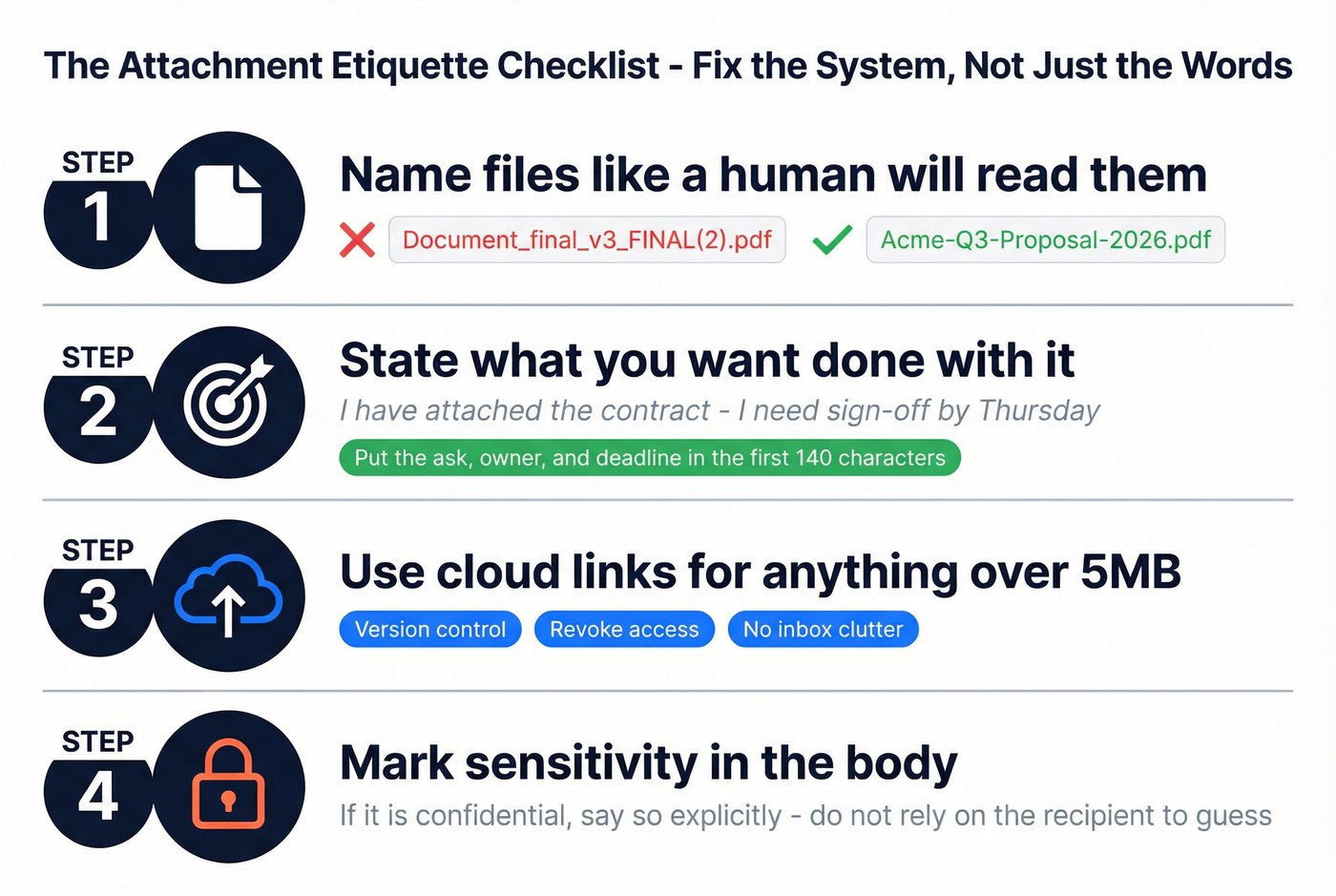
Fix the system, not just the words.
Name files like a human will read them. "Acme-Q3-Proposal-2026.pdf" beats "proposal_draft.pdf" every time. Your recipient shouldn't have to open a file to figure out what it is.
State what you want done with it. "I've attached the contract - I need sign-off by Thursday" is infinitely more useful than "attached for your reference." The BLUF principle (Bottom Line Up Front) says to put the ask, the owner, and the deadline in the first 140 characters. That's what mobile previews and AI summaries grab first.
Use cloud links for anything over 5MB. You get version control (one source of truth), the ability to revoke access, and you don't clog someone's inbox. Set permissions explicitly - view-only vs. edit - and consider expiring links for sensitive files.
Mark sensitivity in the body. If it's confidential, say so. Don't rely on the recipient to figure out that the attached term sheet shouldn't be forwarded.
Never drop naked links. An unexplained URL is a phishing red flag. Always add context: "Here's the shared folder with all deliverables: [link]."
90% of employees blame workplace misunderstandings on communication started via email. Most of those misunderstandings aren't about the phrase you used to introduce an attachment - they're about missing context, unclear asks, and files that arrive without explanation.

Look, your phrasing matters, but so does your data. Nearly 17% of emails never reach the inbox at all - and bad data is a leading cause. I've seen teams spend hours crafting the perfect outreach email, only to send it to addresses that bounced months ago. A perfectly written email to a dead address is worse than any clunky attachment phrase sent to the right person. If you're running outbound, verify your list first - tools like Prospeo check email addresses in real time with 98% accuracy, so your carefully crafted message actually lands. If you want a full workflow, start with this guide on verify your list and the bigger picture on email deliverability.
Personalized emails get 2-3x better response rates - and that starts with reaching the right person. Prospeo's 300M+ profile database lets you find decision-maker emails and direct dials so every word you write counts.
Stop perfecting emails that bounce. Find the right contacts first.
Other Professional Email Phrases to Retire in 2026
Since you're already cleaning up "please find attached," you might as well sweep the whole inbox.
"Per my last email" - 33% of respondents in a Perkbox Insights study voted this the most hated email phrase. As communications consultant Arianny Mercedes put it, it's "the written version of an exasperated sigh." If you need to re-state something, just re-state it without the passive-aggressive preamble.
"Just checking in" - 19% most annoying in the same study. It says nothing. Replace it with the actual reason you're emailing: "Following up on the contract - do you need anything else to move forward?" (If you need ideas, steal from these follow up structures.)
"Let's circle back" - The Ladders dubbed it the most used and most hated work phrase. Say "let's revisit this on Thursday" instead. Give a date. Be specific. Or build a real email cadence so follow-ups happen automatically.
"Hope this email finds you well" - Overused to the point of insincerity. Recipients scan past it like banner ads. If you want to open warmly, reference something real: "Congrats on the Series B" or "Saw your talk at SaaStr - great stuff." For more options, use these first lines.
"Sorry to bother you" - Skip this entirely. It undermines your credibility before you've said anything. You're not bothering them; you're doing your job.
"Bandwidth" - Lauren Schneider said it best: "Just say time or capacity. You're not a router."
The ZeroBounce study of 1 million emails flagged "reaching out," "follow up," "please advise," "aligned," and "check in" as the top offenders. Labor attorney Alejandro Perez nailed the core issue: "You can't automate emotional intelligence... write like you're talking to someone you respect." If you're using AI, avoid the common traps in AI personalization and use a system that actually works for AI cold email campaigns.
That's the whole principle. Not casual. Not formal. Just human. Retire the old "attached find" boilerplate and write like you actually mean it.
FAQ
Is "please find attached" grammatically correct?
Yes - technically. "Find" is used in an archaic imperative sense meaning "you will discover," so it's not a grammar error. It's outdated business jargon that adds nothing to your email. Use "I've attached" or "here's" instead - both are shorter and clearer.
What's the difference between "attached" and "enclosed"?
"Enclosed" refers to physical documents inside a paper envelope; "attached" refers to digital files appended to an email. Using "enclosed" in an email is technically incorrect - nothing is enclosed in a digital message. Stick with "attached" for email, reserve "enclosed" for physical mail.
Should I say "attached please find" or "please find attached"?
Neither is wrong, but "attached please find" sounds more stilted because it front-loads the adjective unnaturally. Both should be replaced with natural language like "I've attached the report" or "here's the document" - clearer, shorter, and more human.
Is "kindly find attached" correct?
It's grammatically fine but sounds overly formal and slightly passive-aggressive in modern American and British English. "Kindly" as an adverb meaning "please" is falling out of use in Western business correspondence, though it remains common and perfectly appropriate in South Asian business email. Know your audience.
How do I make sure my email attachments actually reach the right person?
Name files clearly, reference them in the body, and state what action you need. For outbound emails, verify the recipient's address before sending - nearly 17% of emails never reach the inbox. Prospeo's free tier lets you verify 75 emails per month at 98% accuracy, alongside tools like NeverBounce and ZeroBounce.