The Multi-Channel Prospecting Strategy That Actually Books Meetings
It's Monday morning. Your SDR team blasted 500 cold emails on Friday. The reply rate? 0.8%. And there's a deliverability warning sitting in your inbox from Google Postmaster Tools.
The average cold email reply rate in 2026 sits at 3.43% - and that's the average. Email-only outbound isn't just underperforming. It's actively damaging your domain. A multi-channel prospecting strategy fixes this by distributing risk and multiplying touchpoints across the surfaces where buyers actually respond.
The Playbook at a Glance
If you're short on time, here's the whole thing in five bullets:
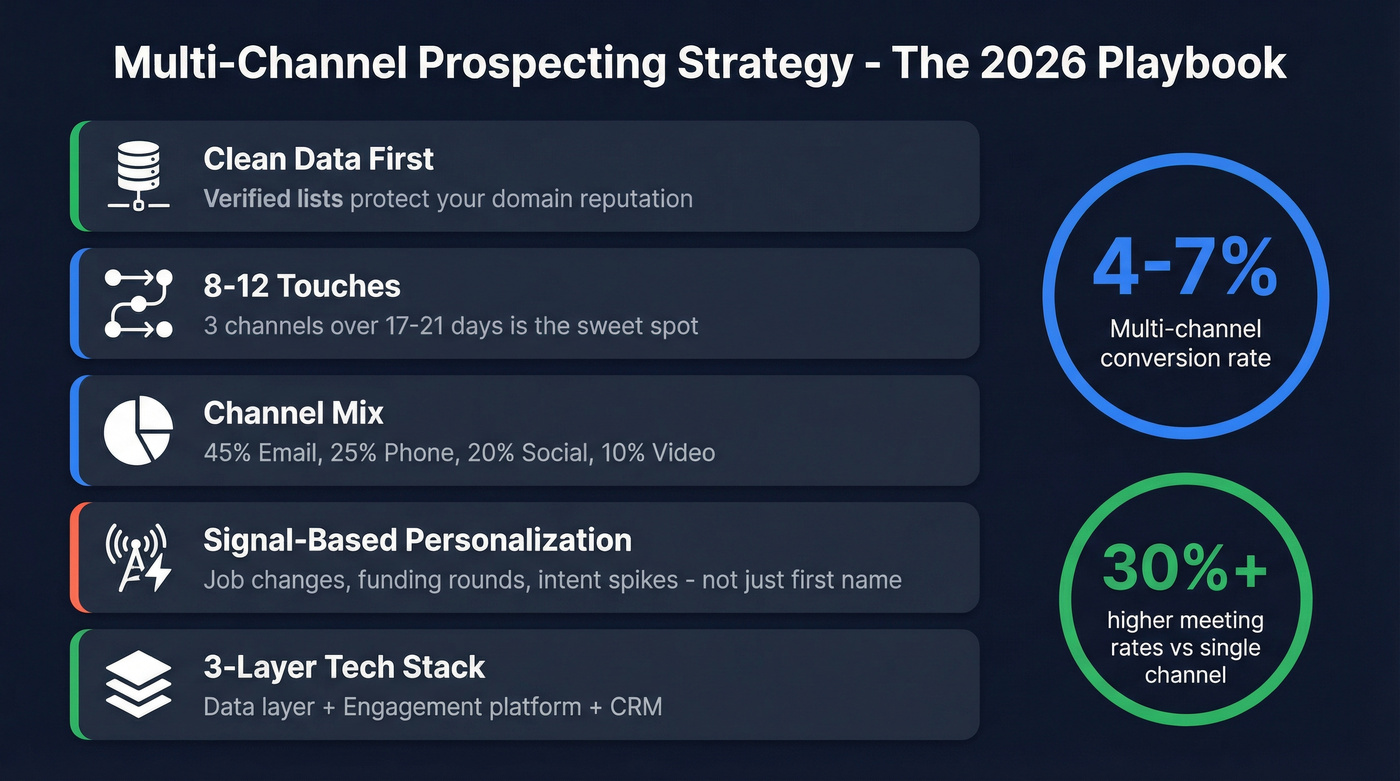
- Clean, verified data first - cadences built on stale lists destroy your domain reputation.
- 8-12 touches across 3 channels over 17-21 days. That's the sweet spot.
- Channel mix: ~45% email, ~25% phone, ~20% social, ~10% video.
- Personalize by signal - job changes, funding rounds, intent spikes - not just {first_name}.
- Three tools: a data layer, an engagement platform, a CRM. That's it.
Now let's build the thing.
What Multichannel Prospecting Actually Means
Multichannel prospecting is coordinating outreach across email, phone, social, and sometimes video in a deliberate sequence designed to build familiarity and earn a reply. The key word is coordinating.
Here's the thing: the Ehrenberg-Bass Institute's 95-5 rule tells us that roughly 95% of your prospects are out of market at any given time. You're not trying to catch them at the perfect moment on the perfect channel. You're trying to become a familiar name across multiple surfaces so that when the timing shifts, you're the person they remember.
The anti-pattern is blasting the same pitch across every channel simultaneously - what one agency aptly called "a mosh pit" instead of a dance. If your prospect gets a generic email, a connection request, and a cold call on the same Tuesday morning, that's not coordinated outreach. That's harassment with extra steps.
Why Multi-Channel Outreach Is Non-Negotiable in 2026
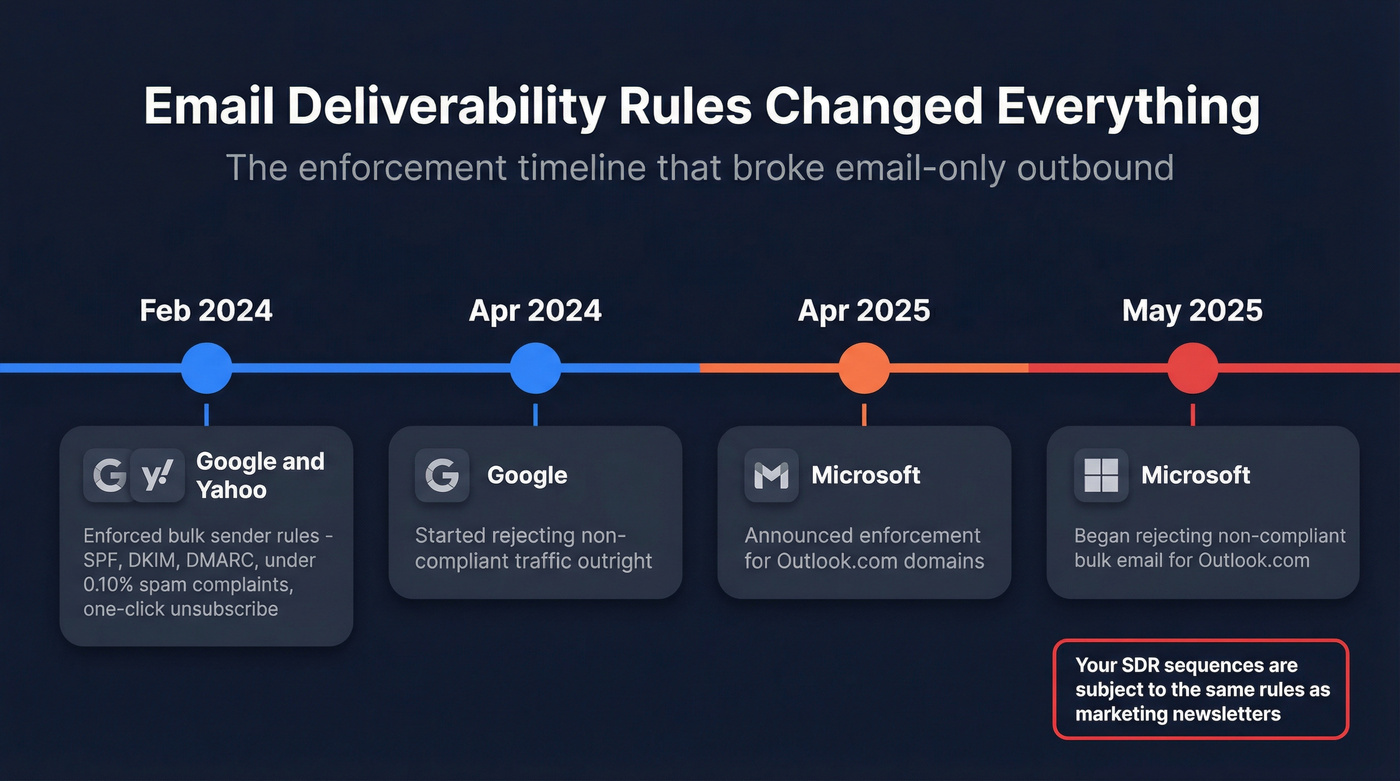
Email deliverability rules have fundamentally changed in the last two years, and most outbound teams haven't caught up.
| Date | Provider | Action |
|---|---|---|
| Feb 2024 | Google & Yahoo | Enforced bulk sender requirements - SPF, DKIM, DMARC, <0.10% spam complaints, one-click unsubscribe |
| Apr 2024 | Started rejecting non-compliant traffic outright | |
| Apr 2025 | Microsoft | Announced enforcement for Outlook.com domains |
| May 2025 | Microsoft | Began rejecting non-compliant bulk email for Outlook.com |
These requirements apply at the domain level. Your SDR team running Outreach or Salesloft sequences at volume is subject to the same rules as your marketing team's newsletters. A bad stretch of bounces can hurt deliverability for the entire company.

The conversion math tells the rest of the story. Email alone converts at 1-3%. Phone alone hits 5-8% but doesn't scale. Multi-channel coordinated outreach lands at 4-7% with 30%+ higher meeting conversion rates than single-channel approaches - and that's across a much larger addressable pool because you're reaching prospects where they actually respond.
Data Quality Comes First
Before you build a single cadence, you need to solve the data problem. We've watched teams invest weeks designing beautiful multi-channel sequences, only to torch their domain reputation in the first send because 15% of their list bounced.
The death spiral works like this: bad emails bounce, bounces damage your sender reputation, damaged reputation means more emails land in spam, which means even your good contacts never see your outreach. A Belkins study found that campaigns targeting 500+ recipients averaged just 2.1% response rates, while smaller targeted campaigns of 50 or fewer hit 5.8%. The difference isn't just personalization - it's data quality. Smaller lists get cleaned more carefully.
Your bounce rate needs to stay under 2%. Period.
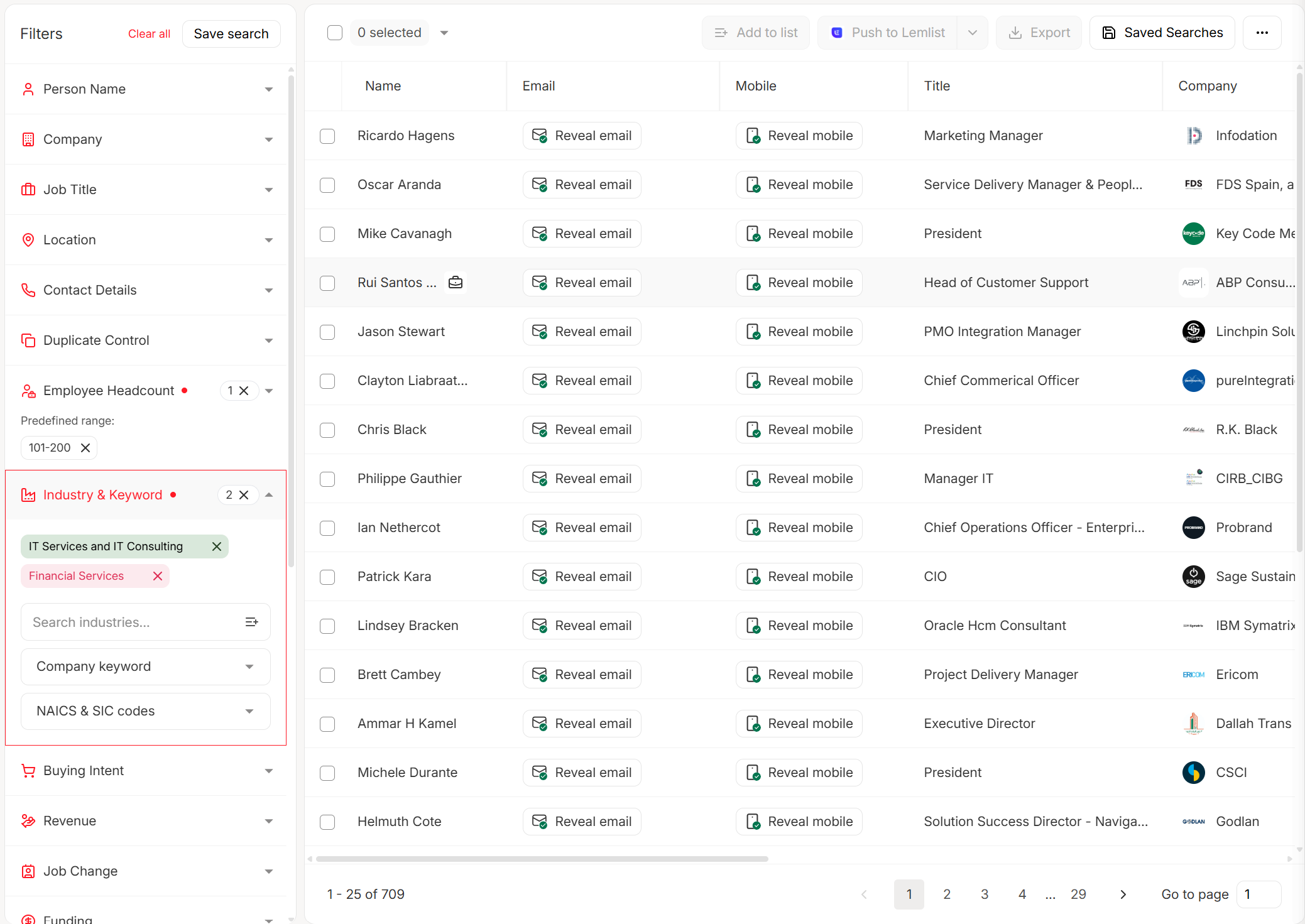
For our outbound cadences, we use Prospeo as the data layer. The 7-day refresh cycle means you're never sending to contacts who changed jobs six weeks ago, and 98% email accuracy across 300M+ professional profiles keeps bounce rates well below that 2% threshold. One customer, Meritt, went from a 35% bounce rate to under 4% after switching, and tripled their pipeline from $100K to $300K per week.

Your multi-channel cadence is only as good as the data feeding it. One bounced email doesn't just waste a touch - it damages your domain and kills deliverability across every channel. Prospeo's 98% email accuracy and 7-day refresh cycle keep your bounce rate under 2%, so every email, call, and social touch in your sequence reaches a real person.
Stop torching your domain. Start every cadence with data you can trust.
Choosing Your Channels
The right channel mix depends on your ICP, not on what's trendy. Clement Dumont from The Growth Syndicate puts it well: be channel agnostic and choose based on where your buyers actually spend time.
Phone belongs in the mix. It generates disproportionate response rates relative to its share of touches. It's uncomfortable, which is exactly why it works. Most of your competitors have abandoned it (and the data backs it up in our breakdown of the benefits of cold calling).
| Channel | % of Touches | Best For | Avg. Conversion |
|---|---|---|---|
| 40-50% | Scale, nurture, micro-assets | 1-3% | |
| Phone | 20-30% | Decision-makers, warm follow-up | 5-8% |
| Social | 15-25% | Relationship building | 2-4% |
| Video | 5-10% | Differentiation, complex value | 3-8% when personalized |
Maryna Nikitchuk at Expandi runs 10-14 step sequences that start with social engagement, include several calls, and end with a breakup email. The point isn't "social first" as a rule - it's that early touches create context so later touches don't feel random (especially if you're running a real social selling strategy alongside outbound).
Building Your Prospecting Cadence
Signal-Triggered Cadence (3 Weeks)
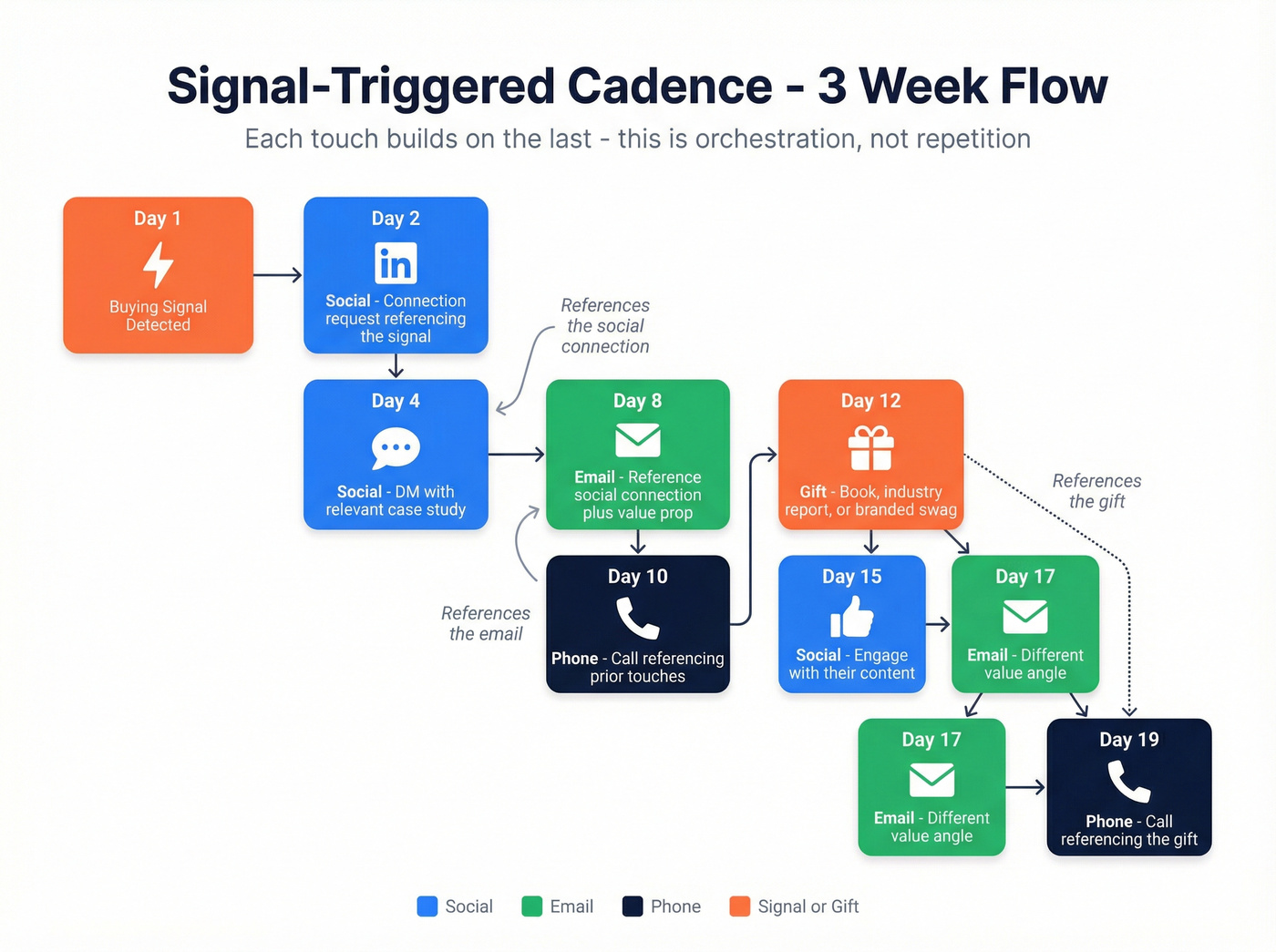
Use this when you have a trigger event - a job change, funding round, product launch, or intent signal. The trigger gives you a reason to reach out that isn't "I found you in a database" (more on this in signal-based outbound).
| Day | Channel | Action |
|---|---|---|
| 1 | - | Buying signal detected |
| 2 | Social | Connection request referencing the signal |
| 4 | Social | Direct message with relevant case study |
| 8 | Reference the social connection + value prop | |
| 10 | Phone | Call referencing prior touches |
| 12 | Gift | Strategic gift: a book, industry report, or branded swag |
| 15 | Social | Engage with their content |
| 17 | Follow-up with different value angle | |
| 19 | Phone | Call referencing the gift |
Notice how each touch builds on the last. Day 8's email references the social connection. Day 10's call references the email. Day 19's call references the gift. This is orchestration, not repetition.
Cold Outbound Cadence (8 Touches, 21 Days)
Use this for ICP-fit prospects where you don't have a specific trigger. The structure comes from a proven 8-touch framework that balances persistence with respect. Before you automate anything, test a new cadence manually with 10-15 prospects - you'll catch messaging issues that A/B tests miss (and you can borrow patterns from our sales cadence example library).
| Day | Channel | Action |
|---|---|---|
| 0 | Short intro, 3 lines max | |
| 2 | Phone | Call with specific opener |
| 4 | Social | Connection with brief note |
| 6 | Include a micro-asset: a one-pager, 60-second clip, or third-party benchmark | |
| 9 | Phone | Voicemail under 20 seconds |
| 12 | Bump, 1 sentence at top | |
| 15 | Social | Community or value invite |
| 19 | Email/Phone | Breakup - close politely |
The micro-asset on touch 4 is the move most teams skip. A 60-second video walkthrough, a one-page industry benchmark, or a relevant case study snippet - something that tips interest into action without requiring a meeting commitment. Don't limit yourself to your own content here. Sharing a relevant third-party report or analyst insight in early touches builds credibility faster than a product one-pager.
Personalization Tiers
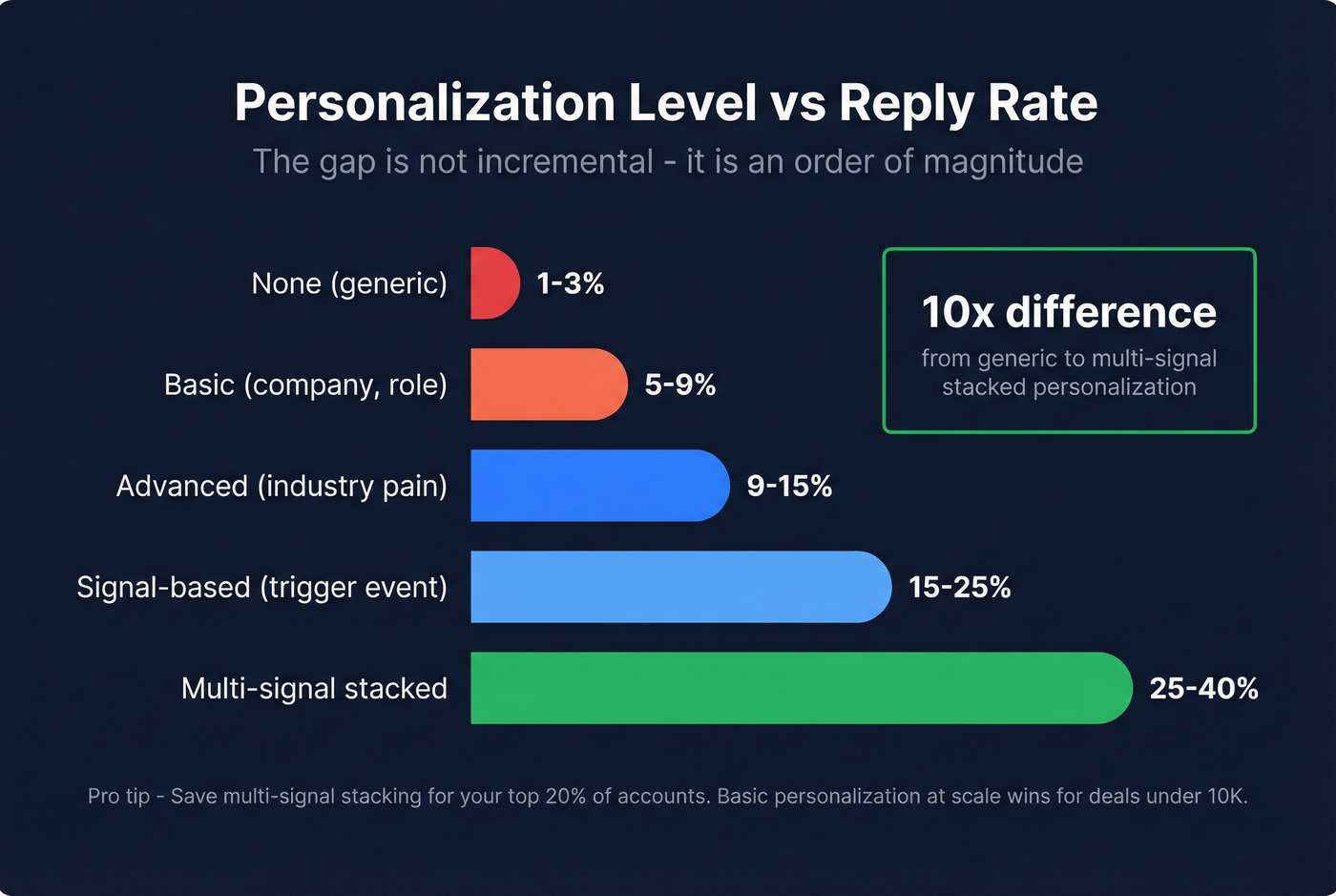
The gap between generic and signal-based outreach isn't incremental. It's an order of magnitude (and it’s easier to systematize with a clear personalization in outbound sales framework).
| Personalization Level | Reply Rate |
|---|---|
| None (generic) | 1-3% |
| Basic ({company}, {role}) | 5-9% |
| Advanced (industry pain) | 9-15% |
| Signal-based (trigger event) | 15-25% |
| Multi-signal stacked | 25-40% |
At the company level, watch for product launches, feature updates, and funding rounds. At the contact level, track promotions, new hires, and job changes. Layer post-engagement targeting on top - people who liked or commented on relevant content are warmer than a cold list.
A note on proportionality: If your deals typically close under $10K, you probably don't need signal-based personalization on every prospect. Basic personalization at scale will outperform hyper-personalized outreach to a tiny list. Save the multi-signal stacking for your top 20% of accounts.
Let's be honest about the biggest mistake here: it isn't choosing the wrong personalization level. It's building disconnected sequences where each channel operates in its own silo. If your email says one thing and your social message says something completely different, you've lost the thread. Every touch should reference or build on the previous one.
Mistakes That Kill Cadences
Disconnected sequences. Your email, phone, and social cadences run as separate workflows with no awareness of each other. The prospect gets three unrelated pitches in a week.
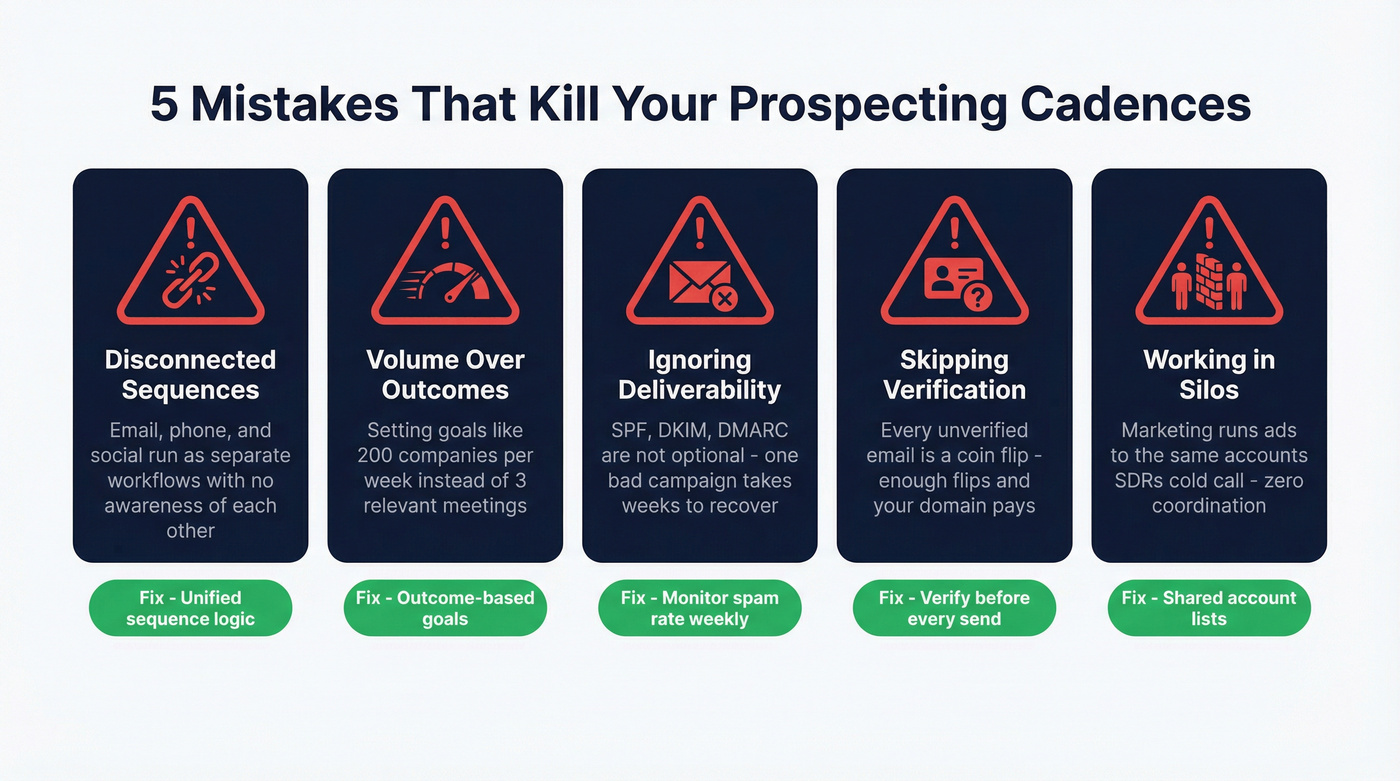
Volume over outcomes. Dumont nails this one: teams set goals like "200 companies per week" instead of "book 3 relevant meetings." The volume goal incentivizes spray-and-pray, and we've seen it burn through entire TAMs in a quarter with nothing to show for it.
Ignoring deliverability hygiene. SPF, DKIM, DMARC aren't optional anymore. Neither is monitoring your spam complaint rate. One bad campaign can take weeks to recover from (use a real email deliverability checklist instead of guessing).
Skipping data verification. Every unverified email is a coin flip. Enough coin flips and your domain pays the price (this is exactly why teams use an email id validator before scaling).
Working in silos. Your marketing team is running ads to the same accounts your SDRs are cold-calling. Neither team knows. The prospect gets 12 touches in a week from the same company with zero coordination. If that sounds familiar, skip the new cadence and fix your internal communication first (RevOps alignment is the real fix - see Revenue Operations Alignment).
Measuring What Matters
Track channel-specific KPIs, but don't optimize channels in isolation.
| Channel | Primary KPI | Target Benchmark |
|---|---|---|
| Reply rate | 5%+ | |
| Phone | Connect rate | 8-12% |
| Social | Acceptance + reply rate | 30%+ acceptance, 10%+ reply |
For attribution, keep it simple. A 40/40/20 model across first touch, middle touches, and last touch before meeting gives you directional insight without requiring a data science team. The prospect who replied to email #3 was probably influenced by the social engagement on day 2 and the voicemail on day 5.
Your north star metric is cost-per-meeting. Not reply rate, not open rate, not connection acceptance rate. Cost-per-meeting captures data costs, tool costs, and rep time in a single number that the CFO actually cares about (and it ladders into pipeline predictability over time).
The Tech Stack You Need
You need three layers. Not ten tools. Three.
| Layer | Tool | Starting Price | Notes |
|---|---|---|---|
| Data | Prospeo | Free; ~$0.01/email | 98% accuracy, 7-day refresh, 300M+ profiles |
| Data | Apollo.io | $49/user/mo | Database + engagement combo |
| Data | ZoomInfo | Not public | Enterprise-grade, annual contracts |
| Engagement | Instantly | $30/mo | Email-scale, primarily email-first |
| Engagement | Reply.io | $60/user/mo | Email, social, calls, SMS |
| Engagement | Lemlist | $55/user/mo | Email + social sequences |
| Engagement | La Growth Machine | ~$50-150/mo | Multi-channel automation |
| CRM | HubSpot Sales Hub | $50/user/mo | Good for SMB/mid-market |
| CRM | Salesforce | $50/user/mo+ | Enterprise standard |
The sales engagement market generated $2.3B in revenue in 2025. There's no shortage of tools.
The mistake is buying five overlapping platforms when you need a clean data source, a sequencer that handles multiple channels, and a CRM to track outcomes. Pick one from each layer and commit for 90 days before adding complexity. In our experience, teams drowning in tool sprawl would book more meetings with three solid tools and a disciplined cadence. Prospeo integrates natively with Salesforce, HubSpot, Instantly, Lemlist, and Clay, so your data flows into whichever engagement and CRM layer you choose without manual CSV exports (if you're rebuilding from scratch, start with a lean B2B sales stack).
A multi-channel strategy needs emails, direct dials, and social profiles for the same contact. Prospeo gives you all three from one platform - 143M+ verified emails, 125M+ verified mobiles with a 30% pickup rate, and 30+ filters including buyer intent and job changes to trigger your cadences.
Every channel in your cadence, powered by one data layer at $0.01 per lead.
FAQ
How many channels should a prospecting cadence include?
Three is the sweet spot for most teams - email, phone, and one social channel. Add video once your core cadence is converting consistently. More channels only help if each touch connects logically to the last; adding channels for the sake of it just creates noise.
What's the ideal number of touches before giving up?
Eight to twelve touches over 17-21 days. RAIN Group's benchmark shows meetings take about 8 touches on average. After 12 with no response, move the prospect to a nurture track rather than continuing to push.
How do I keep my domain safe while scaling outbound?
Verify every email before sending and keep your bounce rate under 2%. Authenticate with SPF, DKIM, and DMARC. Stay below 0.10% spam complaint rate. Use a data provider with a weekly refresh cycle - stale addresses from providers that refresh every 4-6 weeks are the single biggest source of preventable bounces.
What's the best free tool to start multi-channel prospecting?
Prospeo's free tier gives you 75 verified emails and 100 Chrome extension credits per month - enough to test a cadence against 50-75 prospects. Apollo.io also offers a free plan, but its 79% email accuracy means higher bounce risk. For engagement, Instantly's $30/mo entry plan handles email sequences at low volume.