

Outsourced Appointment Setting: What It Costs, What Works, and What to Put in the Contract
Your outsourced team booked 20 meetings last month. Your closers showed up to 11. Of those, maybe 6 were actually qualified.
That's the reality of outsourced appointment setting when the details aren't nailed down - and it's why this market is booming and broken at the same time. The lead generation services industry is projected to grow from $2.4B to $6.5B by 2032 at an 11.8% CAGR, and cold calling alone takes 9.5 attempts to reach a prospect with roughly 1.5% of dials converting to an appointment. The math makes this model attractive. But only if you know what you're buying.
What You Need (Quick Version)
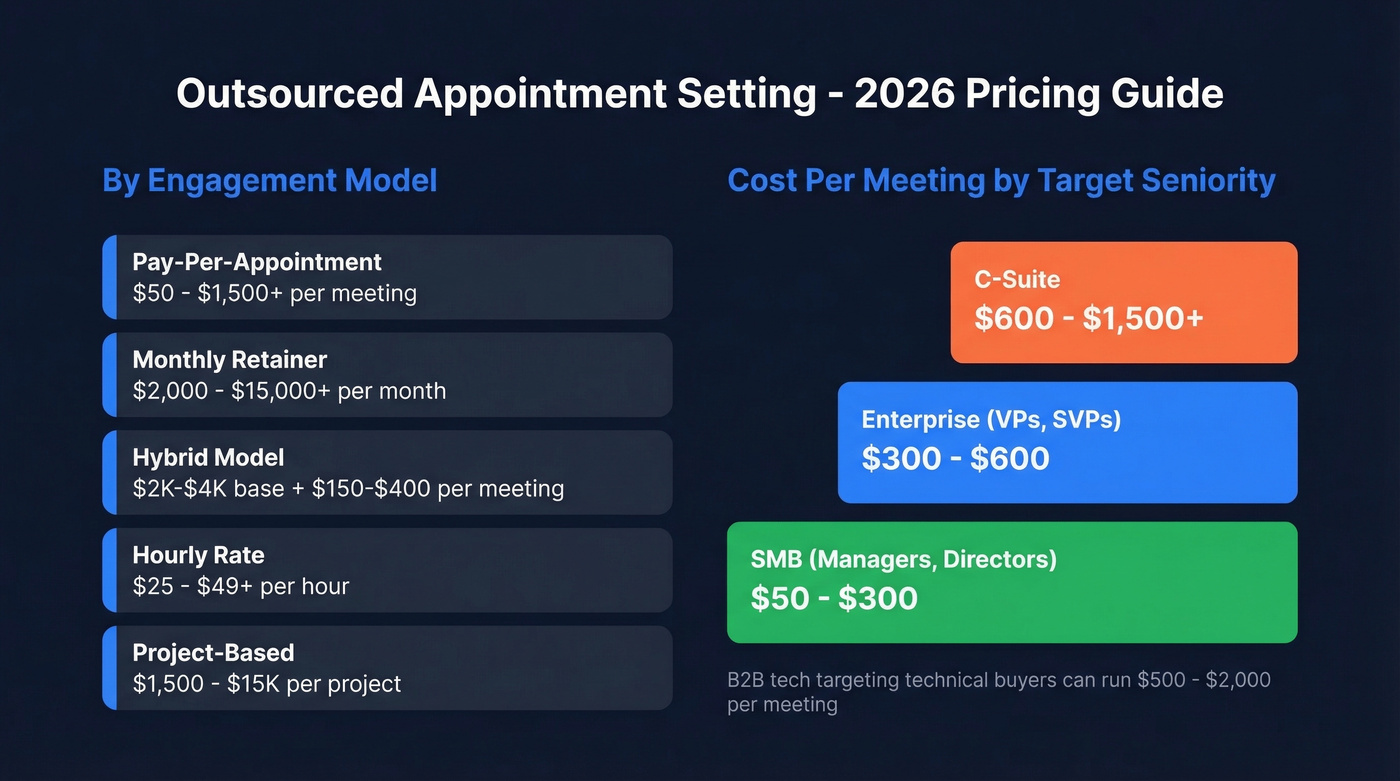
1. What does it cost? $2,000-$15,000/month on retainer, or $50-$1,500 per meeting depending on target seniority. C-suite meetings at enterprise companies run $600-$1,500+. SMB meetings can drop as low as $50-$300.
2. What should you measure? Show rate (60-70% is healthy), quality pass rate (90%+), and cost per qualified meeting. Not cost per booked meeting - cost per meeting where the prospect actually shows up and fits your ICP.
3. What's the biggest mistake? Not defining "qualified meeting" in writing before you sign. Without that definition, you're buying calendar activity, not pipeline.
How the Process Works
The process follows a predictable arc regardless of vendor. First, you define your ICP together - titles, industries, company size, geography. Then the vendor builds or sources a prospect list. Some buy from third-party data providers, others use client-provided lists, and a few maintain proprietary databases. How they source that list matters more than most buyers realize: vendor-sourced data is often months old, which tanks deliverability and connect rates before outreach even begins.
From there, they run multi-channel outreach - cold calls, cold email sequences, and social selling in some combination. When a prospect expresses interest and meets your qualification criteria, the setter books a meeting on your AE's calendar and handles the handoff.
The appointment setter's job ends at the handoff. They're not closing deals, running demos, or handling pricing objections. They're opening doors. That distinction shapes what you should expect from the engagement and what you should measure.
Cold calling remains the backbone for most providers despite the difficulty benchmarks. Cold email adds scale and lets setters work accounts asynchronously. Social selling rounds out the mix for higher-seniority targets. The best vendors blend all three based on your ICP, not their preference.
2026 Pricing Breakdown
This is the section everyone skips to. Let's make it worth the scroll.
Pricing by Model
| Model | Typical Range | Best For |
|---|---|---|
| Pay-per-appointment | $50-$1,500+/meeting | Teams wanting risk-sharing |
| Monthly retainer | $2,000-$15,000+/mo | Predictable pipeline needs |
| Hybrid | $2K-$4K base + $150-$400/mtg | Balanced accountability |
| Hourly | $25-$49+/hr | Short projects, overflow |
| Project-based | $1,500-$15K/project | Market tests, launches |
Cost per Meeting by Seniority
| Target Level | Cost per Meeting |
|---|---|
| SMB (managers, directors) | $50-$300 |
| Enterprise (VPs, SVPs) | $300-$600 |
| C-suite | $600-$1,500+ |
A few things these tables don't show. Setup and onboarding fees run $500-$2,000, though many vendors waive them on annual contracts. If you're in B2B tech specifically, expect the higher end - $500-$2,000 per meeting is common when you're targeting technical buyers at enterprise accounts.
For context, the average cost per B2B lead runs around $200, so a $300-$600 cost per qualified meeting that actually converts is competitive when you factor in the time and infrastructure you're not building internally.
Then there are the hidden costs. Data fees get passed through if the vendor is sourcing lists on your behalf. Software license costs for sequencers, dialers, and CRM seats sometimes show up as line items. And setup fees from some providers land in the $400-$600 range even when the retainer looks competitive.
Here's the thing: the sticker price on a retainer means nothing without context. A $3,000/month vendor delivering 8 qualified meetings with a 70% show rate is dramatically cheaper than a $2,000/month vendor delivering 15 "meetings" where half are no-shows and a third don't match your ICP.
In-House vs. Outsourced SDRs
Your SDR quit three months in. You spent $8,000 recruiting, $5,000 onboarding, and they never fully ramped. Now you're starting over. This is the scenario that makes outsourced appointment setting look brilliant - and it's more common than most sales leaders admit.
The Real Cost Gap
The fully-loaded cost multiplier for an in-house SDR runs 1.7-2.5x base salary. That's not just compensation - it's recruiting, ramp time, management overhead, and the replacement cost when they leave. SDR turnover is notoriously high, and every departure resets the clock.
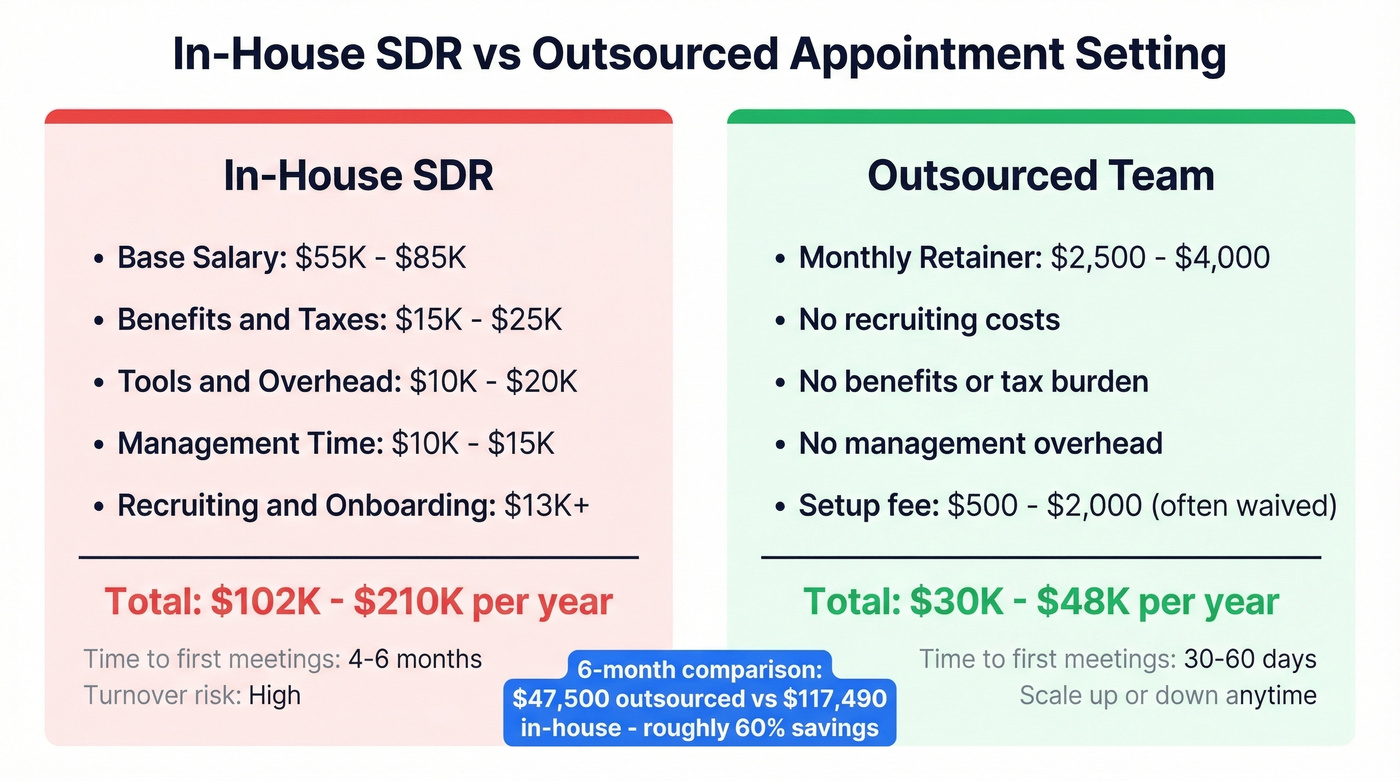
Over a 6-month window, outsourced engagement runs roughly $47,500 versus $117,490 for in-house - about 60% lower. The time-to-first-meetings gap is even more dramatic: 30-60 days outsourced versus 4-6 months to fully ramp an in-house SDR. When you add it all up - base salary of $55K-$85K, benefits and taxes of $15K-$25K, tools and overhead of $10K-$20K, and management time of $10K-$15K - an in-house SDR costs $102K-$210K annually. A managed outsourced engagement runs $30K-$48K per year.
Outsource when:
- You're entering a new market and need meetings fast
- You want to test outbound before committing headcount
- You need seasonal or surge capacity
- You don't have SDR infrastructure yet
Hire in-house when:
- Appointment setting is your core growth motion
- You're selling high-touch enterprise deals with long cycles
- Your product requires deep technical knowledge on every call
- Your ACV justifies the overhead
We've seen teams try to outsource complex technical sales and regret it - the setter can't answer the first objection, and the prospect checks out before the AE ever gets involved. Skip outsourcing entirely if your product requires a 20-minute technical qualification before a meeting even makes sense.
The Hybrid Option
There's a third path that gets overlooked: outsource for volume and new-market testing while keeping a small in-house team for high-touch accounts. This gives you speed and scale on the outsourced side with depth and product expertise on the in-house side. For teams with 3+ AEs, the hybrid model is the approach we see working most consistently.
If your average deal size is under $15K, you almost certainly shouldn't hire a full-time SDR. The math doesn't work. Outsource until your pipeline justifies the headcount, then bring the motion in-house once you know exactly what messaging and ICP targeting converts.
Benchmarks - What Good Looks Like
Numbers without context are useless.
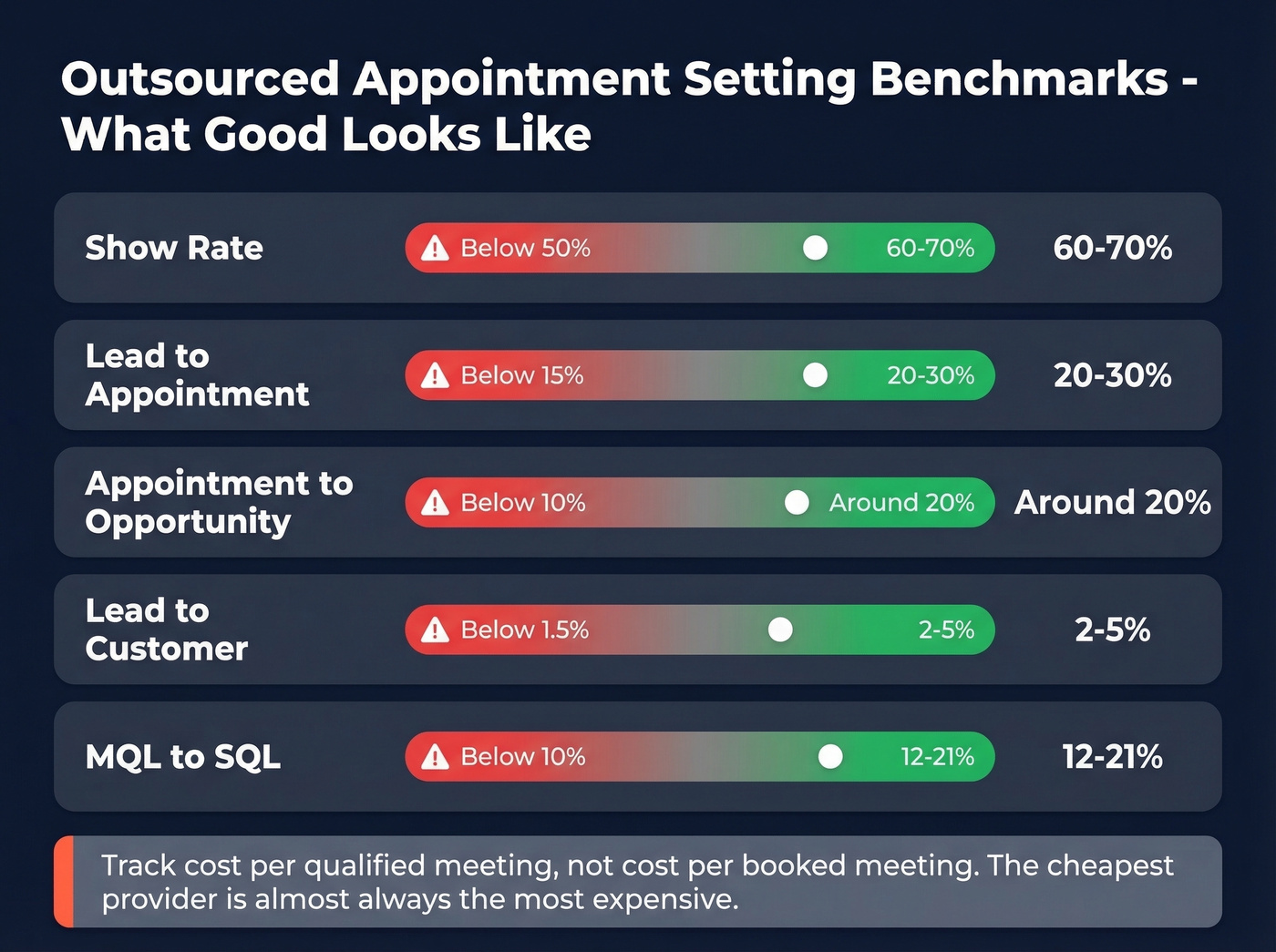
| Metric | Healthy Range | Red Flag |
|---|---|---|
| Show rate | 60-70% | Below 50% |
| Lead-to-appointment | 20-30% | Below 15% |
| Appointment-to-opportunity | ~20% | Below 10% |
| Lead-to-customer | 2-5% | Below 1.5% |
| MQL-to-SQL | 12-21% | Below 10% |
The ROI Math
Let's run a realistic scenario. You're spending $10,000/month with a vendor delivering 15 appointments at a CPA of ~$667. At a 60% show rate, that's 9 actual meetings. Apply a 20% appointment-to-opportunity conversion and you get 1.8 opportunities. At a 25% close rate with a $50,000 ACV, that's roughly $22,500 in revenue against $10,000 in spend - 125% ROI.
Not every month will hit those numbers. But the framework tells you exactly where to look when results slip. Is the show rate dropping? That's a qualification or confirmation process problem. Are opportunities not converting? That's a targeting or messaging issue, not necessarily the vendor's fault.
The cheapest provider is almost always the most expensive. A $50/meeting vendor delivering 80% unqualified prospects will cost you more in wasted AE time than a $300/meeting vendor with a 70% show rate and tight ICP alignment.

Most outsourced appointment setters use stale, vendor-sourced data that's months old - tanking deliverability before outreach even starts. Prospeo refreshes 300M+ profiles every 7 days (not the 6-week industry average) and delivers 98% email accuracy. Give your outsourced team data that actually connects.
Stop paying $600 per meeting when half bounce from bad data.
What to Put in the Contract
SLA Benchmarks
| Metric | Acceptable | Good | Excellent |
|---|---|---|---|
| Held appointment rate | 60% | 75% | 85%+ |
| Quality pass rate | 85% | 90% | 95%+ |
| Next-step rate | 40% | 50% | 60%+ |
| Response time | <24 hrs | <1 hr | <5 min |
| Ramp timeline | 90-120 days | 45 days | 30 days |
| Reporting cadence | Monthly | Bi-weekly | Weekly |
The single most important thing you can do before signing: write down your definition of a "qualified meeting." Use BANT, MEDDIC, or a custom framework - it doesn't matter which. What matters is that both sides agree on what counts. If qualification isn't defined in writing, you're buying calendar activity, not pipeline.
Any vendor that won't commit SLAs in writing is telling you everything you need to know.
Pre-Signature Checklist
Before you sign anything, confirm these four items are in the contract:
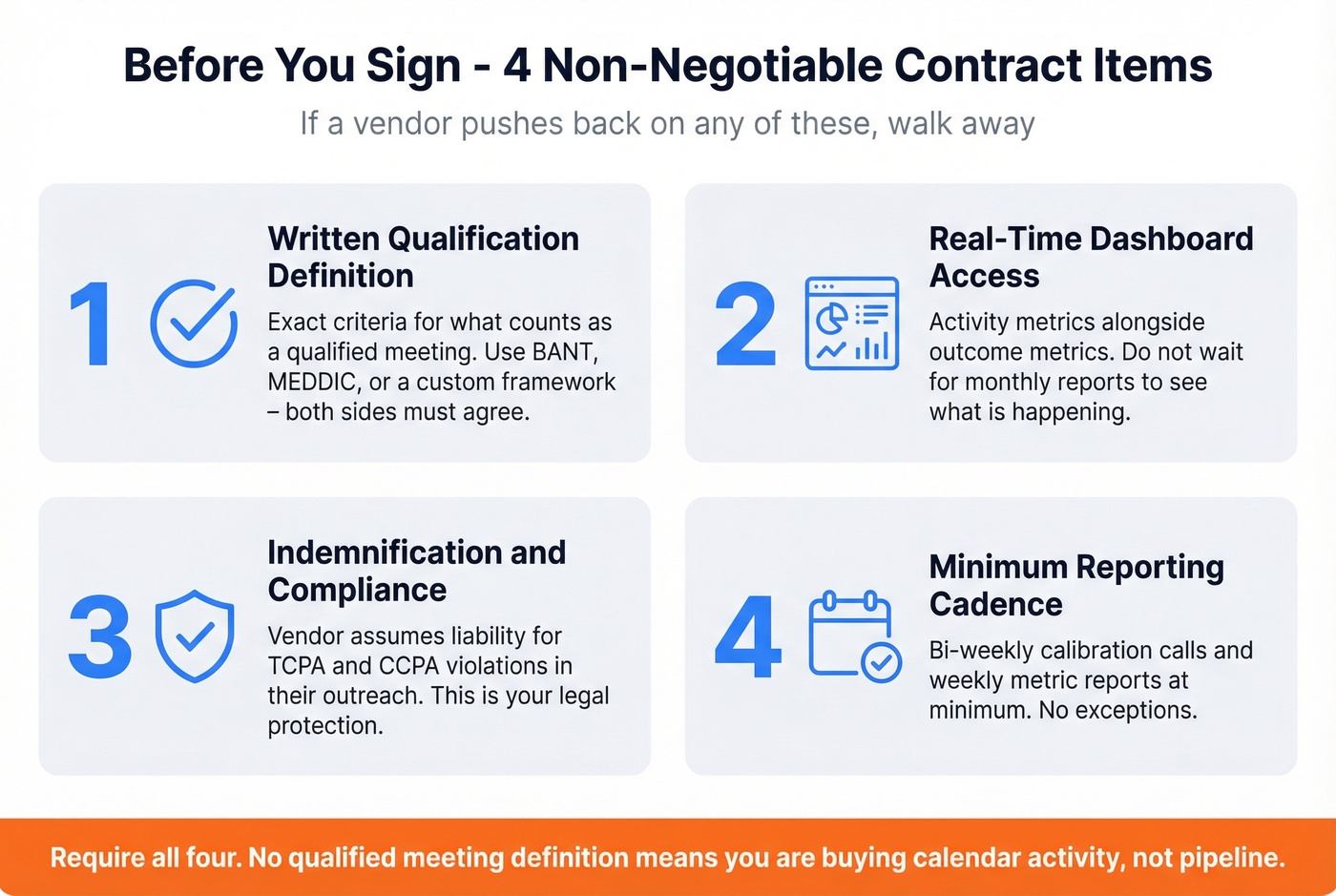
- Written qualification definition - exact criteria for what counts as a "qualified meeting," agreed by both sides
- Real-time dashboard access - activity metrics alongside outcome metrics, without waiting for a monthly report
- Indemnification and compliance clause - the vendor assumes liability for TCPA/CCPA violations in their outreach
- Minimum reporting cadence - bi-weekly calibration calls and weekly metric reports at minimum
Require all four. A vendor that pushes back on any of them is a red flag.
Five Mistakes That Kill Results
1. No written qualification definition. This is the #1 failure mode. Without it, "qualified meeting" means whatever the vendor needs it to mean to hit their numbers. A common pattern is "calendar stuffing" - vendors booking meetings that technically meet the letter of the SLA but not the spirit. Your qualification definition is the only defense.
2. Treating the vendor as a black box. Handing over a product sheet and expecting appointments is a recipe for generic messaging and low-quality meetings. The best results come from collaborative onboarding - share objection handling docs, competitive intel, and real call recordings. I've watched a team triple their show rate just by giving their vendor access to Gong recordings from their best AEs.
3. Optimizing for cost and volume instead of quality. Fifteen cheap meetings that waste your AEs' time are worse than five expensive ones that convert. Track cost per qualified meeting, not cost per booked meeting.
4. No feedback loops. If your AEs aren't reporting back on meeting quality within 24 hours, the vendor can't adjust targeting or messaging. Bi-weekly calibration calls should be non-negotiable. The consensus on r/sales is that most outsourced programs fail because of poor communication between the buyer and vendor, not because the vendor is incompetent.
5. Expecting results in month one. Most outsourced partnerships don't hit stride until month 2-3. The first 30-60 days are about testing messaging, refining ICP targeting, and building cadence. If you're judging a vendor on week-three results, you're going to churn through providers and never find one that works.
Most outsourced appointment setting failures are the buyer's fault, not the vendor's. That's uncomfortable, but we've seen it play out repeatedly.
Compliance - What You're Liable For
Even when a vendor is making the calls and sending the emails, you're on the hook legally. Don't assume otherwise.
TCPA penalties run $500-$1,500 per call for violations, with higher fines for willful infractions. Operational requirements include calling only during the 8am-9pm local time window, maintaining internal DNC suppression lists for 4 years, and honoring opt-outs within 10 business days. The FCC's TCPA page has the full breakdown.
CCPA/CPRA is the one that catches B2B teams off guard. The B2B exemption expired January 1, 2023. Fines run up to $7,988 per intentional violation. If your vendor is prospecting California-based contacts, you need a data processing agreement and clear consent workflows. The California AG's CCPA resource page is worth bookmarking.
The practical rule: require indemnification and compliance warranties in every contract. Your vendor should maintain their own DNC lists, document consent, and carry insurance. If they won't put compliance commitments in writing, walk away.
The Data Quality Problem
Bad contact data inflates your effective cost per meeting by 20-40%. On a $10,000/month retainer, that's $2,000-$4,000 burned on dials to disconnected numbers and emails that bounce.
Outsourced teams typically use whatever data they have on hand, and it's often months old. Stale data means bounced emails that damage your domain reputation and disconnected numbers that waste dial time. According to Gartner's data quality research, poor data quality costs organizations an average of $12.9 million per year - and for outbound teams, the damage shows up as wrecked sender reputation and inflated CPAs.
If you're seeing bounce issues, start with email deliverability fundamentals and fix list hygiene before you scale volume.
The fix is straightforward: verify your entire prospect list before the vendor touches it. Prospeo runs a 7-day data refresh cycle versus the 6-week industry average, with 98% email accuracy and 125M+ verified mobile numbers. Upload a CSV, get results in minutes, and hand over only verified contacts. Your cost per qualified meeting drops, your domain stays clean, and your vendor's show rate improves because they're reaching real people.
If you need a broader view of vendors and workflows, compare data enrichment services and sales prospecting databases before you lock in a provider.
Building prospect lists for your outsourced SDRs shouldn't cost you hidden data fees on top of your retainer. Prospeo gives you verified emails at $0.01 each and 125M+ direct dials with a 30% pickup rate - so your setters spend time talking, not chasing dead numbers.
Own your data and cut your outsourced team's cost per qualified meeting in half.
Top Appointment Setting Companies
| Company | Est. Monthly Range | Best For |
|---|---|---|
| CIENCE | $2,000-$9,000/mo | Mid-market, multi-channel |
| Belkins | $5,000-$14,800+/mo | Premium, high-touch |
| SalesRoads | $5,400-$9,500+/mo | US-based SDRs |
| Martal Group | $3,000-$11,000+/mo | Tech companies |
| EBQ | $3,500-$10,000/mo | Full-service |
| Callbox | $50K-$200K/yr | Enterprise, annual deals |
| Outbound Sales Pro | $2,500-$6,500/mo | SMBs, lower entry point |
| SalesBread | $3,000/mo + setup | Smaller engagements |
Setup fees of $1,000-$3,000 are typically additional across all providers.
For SMBs just getting started, Outbound Sales Pro and SalesBread offer the lowest entry points without locking you into massive annual commitments. For mid-market teams running serious pipeline, CIENCE, Belkins, and EBQ provide the multi-channel infrastructure and dedicated SDR capacity you need - CIENCE in particular stands out for teams that want a data-driven approach with detailed reporting, while Belkins is the go-to when you're willing to pay a premium for white-glove service and higher show rates. For enterprise with complex sales cycles and large budgets, SalesRoads and Callbox have the depth, though Callbox's annual contract structure means you're committing $50K+ before seeing a single meeting.
What to Ask Before Signing
Before committing to any provider, run through these questions:
- "Can I see a sample SLA?" If they don't have a template ready, they're not operationally mature enough.
- "Can you connect me with two references in my vertical?" Generic references are useless. You need someone who sold to similar buyers.
- "How do you source prospect data, and how old is it?" This single question will tell you more about likely results than anything on their website.
- "What's your guaranteed ramp timeline?" Vague answers like "a few weeks" mean they haven't done this enough.
If you're building your own outbound motion alongside a vendor, keep a short list of sales prospecting techniques and a repeatable lead generation workflow so you can compare performance apples-to-apples.
FAQ
How long before outsourced appointment setting produces results?
Most providers book first qualified meetings within 30-60 days. The partnership typically hits full stride by month 2-3 as messaging gets refined and ICP targeting tightens. In-house SDRs, by comparison, take 4-6 months to fully ramp. Don't judge a vendor on week-three performance.
What's a good cost per appointment?
$150-$600 for mid-market B2B is the healthy range. C-suite targets at enterprise companies run $600-$1,500+. Below $100 per meeting, scrutinize quality hard - low-cost meetings are almost always unqualified calendar filler.
Should I outsource or hire in-house SDRs?
Outsource if you need speed, lack SDR infrastructure, or want to test a new market without committing headcount. Hire in-house when appointment setting is a core motion requiring deep product knowledge. For most teams, a hybrid approach - outsource for volume, keep a small in-house team for strategic accounts - works best.
How do I verify the quality of outsourced meetings?
Define "qualified meeting" in writing before signing - ICP match, budget authority, timeline, and need. Track show rate (target 60-70%), quality pass rate (90%+), and next-step rate (50%+). If any metric consistently falls short, it's a targeting or qualification problem that needs a calibration call, not a new vendor.
How does data quality affect appointment setting results?
Bad contact data inflates cost per meeting by 20-40% through bounced emails and disconnected numbers. Verify prospect lists before handing them to your vendor. Clean data improves every downstream metric from connect rates to show rates - it's the single highest-ROI fix for an underperforming outsourced program.