

The Complete Guide to Outsourced Sales Teams in 2026
Your CEO just told you to "scale outbound." You've got two open SDR seats, a three-month hiring timeline, and a pipeline target that doesn't care about your recruiting problems. This is the exact moment most B2B leaders start searching for an outsourced sales team - and it's the right instinct. The global B2B sales outsourcing market hit $105B in 2024 and keeps growing, largely because outsourcing can save over 60% compared to a fully loaded in-house SDR in year one.
But most outsourced sales programs fail for reasons that have nothing to do with the reps.
The Short Version
- Outsourced SDR programs cost $3,000-$15,000/month and deliver first meetings in 3-6 weeks.
- The #1 reason programs fail isn't bad reps - it's bad contact data.
- Start with a managed SDR pod, give it 3-6 months, and verify every email before it ships.
What Is an Outsourced Sales Team?
An outsourced sales team is a third-party group - SDRs, BDRs, appointment setters, sometimes full-cycle AEs - that runs part or all of your outbound sales motion on your behalf. They prospect, qualify, and book meetings so your closers can close.
This isn't a "lead gen agency" that hands you a CSV and disappears. A real outsourced sales partner integrates with your CRM, follows your ICP, and represents your brand on calls and emails. Think of them as an extension of your team that you didn't have to recruit, train, or manage through a three-month ramp.
When Does Sales Outsourcing Make Sense?
Not every company needs this. But if you're in one of these situations, outsourcing is the fastest path forward.
You want to prove a motion before building in-house. Outsource first, validate the playbook, then bring outbound internal once the motion is clear. Some providers like Sales Focus Inc. even let you acquire the team they built for you after 12 months, making the transition seamless. Outsource, prove, internalize - that's the smartest sequence for any company without a proven outbound playbook.
You're a startup without a sales hire. You need pipeline now, not in six months after you've recruited, onboarded, and ramped an SDR.
You're entering a new market. Testing EMEA or mid-market before committing headcount? An outsourced team gives you signal without the fixed cost.
Your existing team is maxed out. Adding an outsourced pod to handle a new vertical or territory keeps your in-house reps focused.
You need to scale fast. A funded company with aggressive targets can't wait for sequential hires. Outsourced teams go live in 2-4 weeks.
Five Outsourcing Models Compared
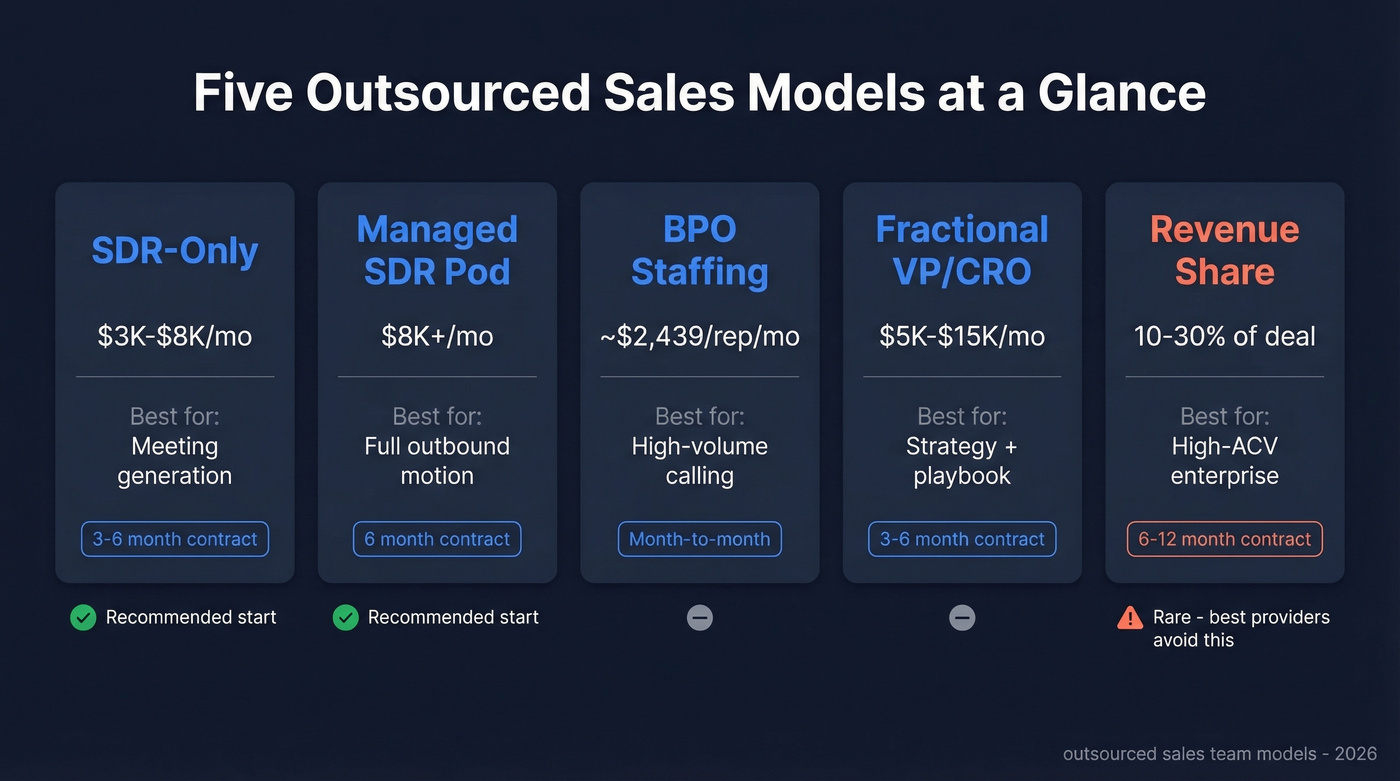
Not all B2B sales outsourcing looks the same. Here are the five models you'll encounter, with real cost ranges.
| Model | Monthly Cost | Best For | Typical Contract |
|---|---|---|---|
| SDR-only | $3K-$8K | Meeting generation | 3-6 months |
| Managed SDR pod | $8K+/mo | Full outbound motion | 6 months |
| BPO staffing | ~$2,439/rep | High-volume calling | Month-to-month |
| Fractional VP/CRO | $5K-$15K | Strategy + playbook | 3-6 months |
| Revenue share | 10-30% of deal | High-ACV enterprise | 6-12 months |
SDR-only is the most common entry point. You get dedicated sales development representatives running email, phone, and multichannel outreach against your ICP. Expect $3,000-$8,000/month depending on whether you're working with an offshore or US-based provider.
Managed SDR pods include the reps plus a campaign manager, researcher, and sometimes a dedicated strategist. Bandalier's pods, for example, start at $8,000/month including a $1,000 performance incentive. We've seen the best results from this model because the provider owns the full workflow - research, messaging, execution, and optimization all sit under one roof.
BPO staffing is the budget option - you're renting a seat. Expect ~$110/rep/day, or roughly $2,439/month. You'll need to provide training and management yourself.
Fractional VP/CRO is for companies that need the strategy, not just the execution. A part-time sales leader works 2-3 days per week to build your playbook, hire your first reps, and set up the infrastructure.
Revenue share / commission-only arrangements are rare and typically reserved for high-ACV deals ($50K+). The provider takes 10-30% of first-year revenue. It sounds attractive because there's no upfront cost, but the best providers don't work this way - they know their value and charge retainers.
What It Actually Costs
The Real In-House Number
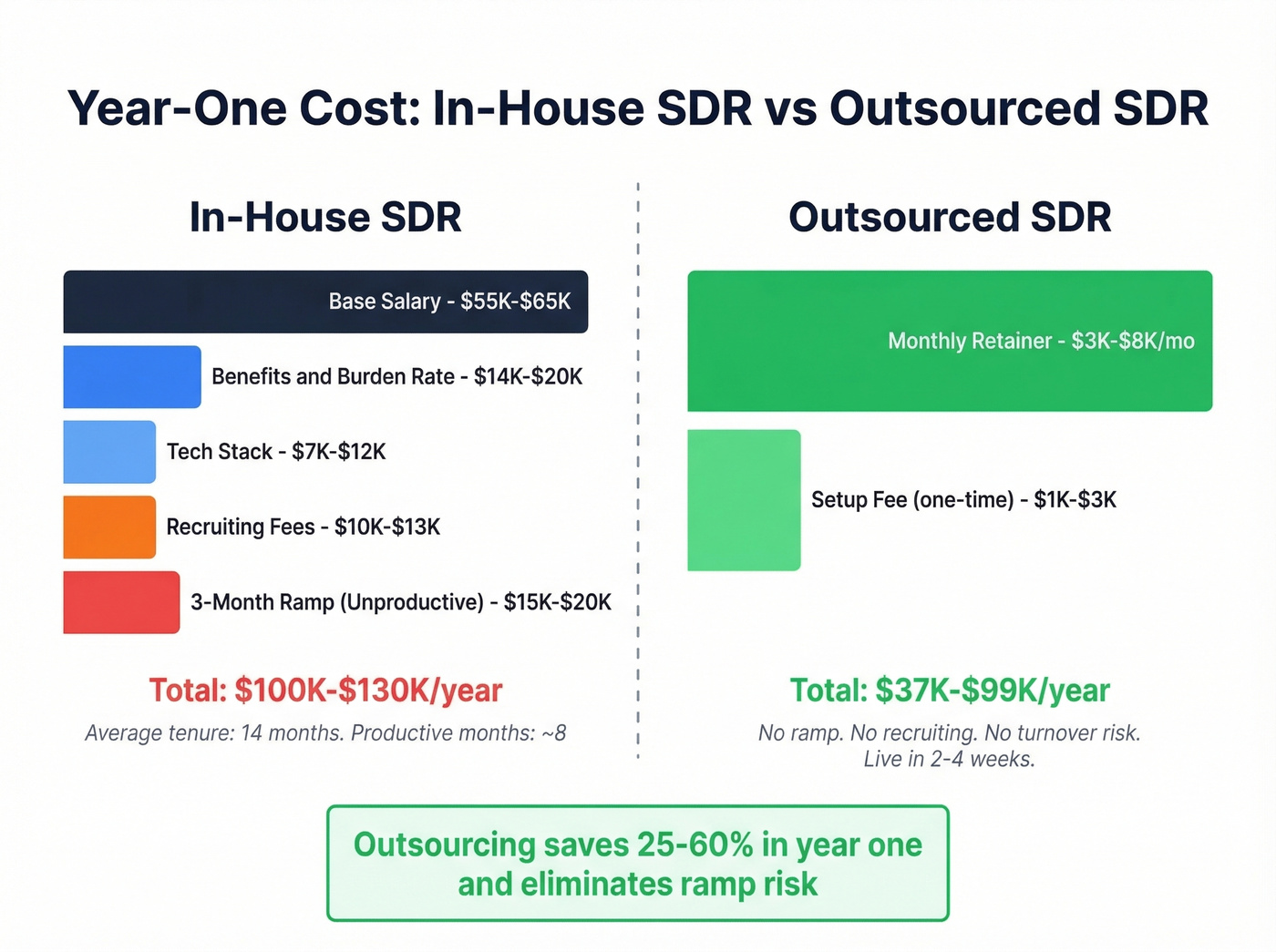
Before you compare outsourced pricing, you need the honest in-house number. It's higher than most founders think.
| Line Item | Annual Cost |
|---|---|
| Base salary | $55K-$65K |
| Burden rate (25-30%) | $14K-$20K |
| Tech stack ($600-$1K/mo) | $7K-$12K |
| Recruiting fees (15-20%) | $10K-$13K |
| 3-month ramp (unproductive) | ~$15K-$20K |
| Year-one total | $100K-$130K |
The tech stack alone is brutal. CRM runs $100-$175/user, sales engagement tools $100-$160/user, prospecting platforms $100-$150/user, and data tools $250+/user. That's before you've made a single dial.
Here's the kicker: average SDR tenure is ~14 months. Subtract three months of ramp and you get roughly eight months of productive output before you're recruiting again. When you outsource, you eliminate that ramp risk entirely - the provider absorbs turnover and keeps the pipeline moving.
Outsourced Pricing by Model
| Pricing Model | Range | Notes |
|---|---|---|
| Monthly retainer | $3K-$15K/mo | Most common |
| Pay-per-meeting (Year 1) | $3K-$5K/meeting | Drops over time |
| Pay-per-meeting (Mature) | ~$250/meeting | After 3+ years |
| Per-contact | $2.50-$10 | Volume-based |
| BPO staffing | ~$2,439/mo/rep | You manage |
| Setup fees | $1K-$3K | One-time |
The pay-per-meeting model deserves special attention. Mid-level B2B companies start at $3,000-$5,000 per meeting booked in year one. By year two, that drops to ~$2,000. By year three, ~$1,000. With heavy optimization, mature programs reach ~$250 per meeting.
That optimization curve is real - but only if you stick with it long enough. Push for a 30-60 day pilot before committing to anything longer.

Bad contact data is the #1 reason outsourced sales programs fail - not bad reps. Prospeo's 98% email accuracy and 7-day data refresh mean your outsourced team hits real inboxes from day one. At $0.01/email, you spend less on data than a single meeting booked with bad contacts.
Stop paying $5,000 per meeting because your data bounces.
Top Providers in 2026
| Provider | Monthly Range | Best For | Notable |
|---|---|---|---|
| Belkins | $5,500+ | B2B appointment setting | G2 4.8/89 reviews |
| SalesRoads | $6,950-$10K+ | Full SDR service | US-based reps |
| CIENCE | $2,000-$9K | Modular outbound | Transparent pricing |
| Callbox | $2K-$5K | Multi-channel outbound | Mid-market focus |
| Martal Group | $3K-$11K+ | Tech/SaaS | Flexible tiers |
| Superhuman | $2.50/contact | Per-contact model | Budget-friendly |
| MarketStar | $15K-$30K+ | Enterprise scale | Large team builds |
| memoryBlue | $5K+ min | SDR-to-hire pipeline | Talent development |
Belkins is the most visible player in the space - Clutch 4.9 across 223 reviews, G2 4.8 across 89. They start at $5,500/month and specialize in B2B appointment setting with strong deliverability and ICP research. If you want a proven, well-reviewed partner, Belkins is the safe bet.
SalesRoads runs a full outbound service at $9,500/month with US-based reps. That's premium pricing, but you're getting dedicated, onshore talent with real sales training. Their fractional retainer starts at $6,950/month.
CIENCE takes a modular approach: $5,000 one-time GTM setup, $2,000/month strategic execution, $499/month for their graph8 platform, plus per-SDR rates from $1,500 (offshore) to $5,500 (US-based). Their modular structure lets you build toward a managed pod over time.
Callbox is strong for multi-channel outbound with common project sizes of $10,000-$49,999. Martal Group starts at $3,000/month and scales to $11,000+ for full-service multi-channel. Superhuman Prospecting offers a per-contact model at $2.50/contact, with call campaigns at $1,125/month - the most budget-friendly option on this list. MarketStar handles enterprise-scale builds with dedicated teams, running $15,000-$30,000+/month depending on team size and geography. memoryBlue has a $5,000+ minimum and doubles as a talent pipeline, often transitioning outsourced SDRs into full-time hires.
Skip MarketStar if you're under $5M ARR - their minimums and contract lengths are built for larger orgs. For early-stage companies, CIENCE or Martal Group offer more flexibility.
What Results to Expect
Meeting Benchmarks
A productive outsourced SDR books 8-15 meetings per month. Using Operatix's funnel math: 15 meetings/month, minus a 20% no-show rate, gives you 12 completed meetings. Apply a 60% meeting-to-opportunity conversion and you're looking at 7-10 qualified opportunities per month.
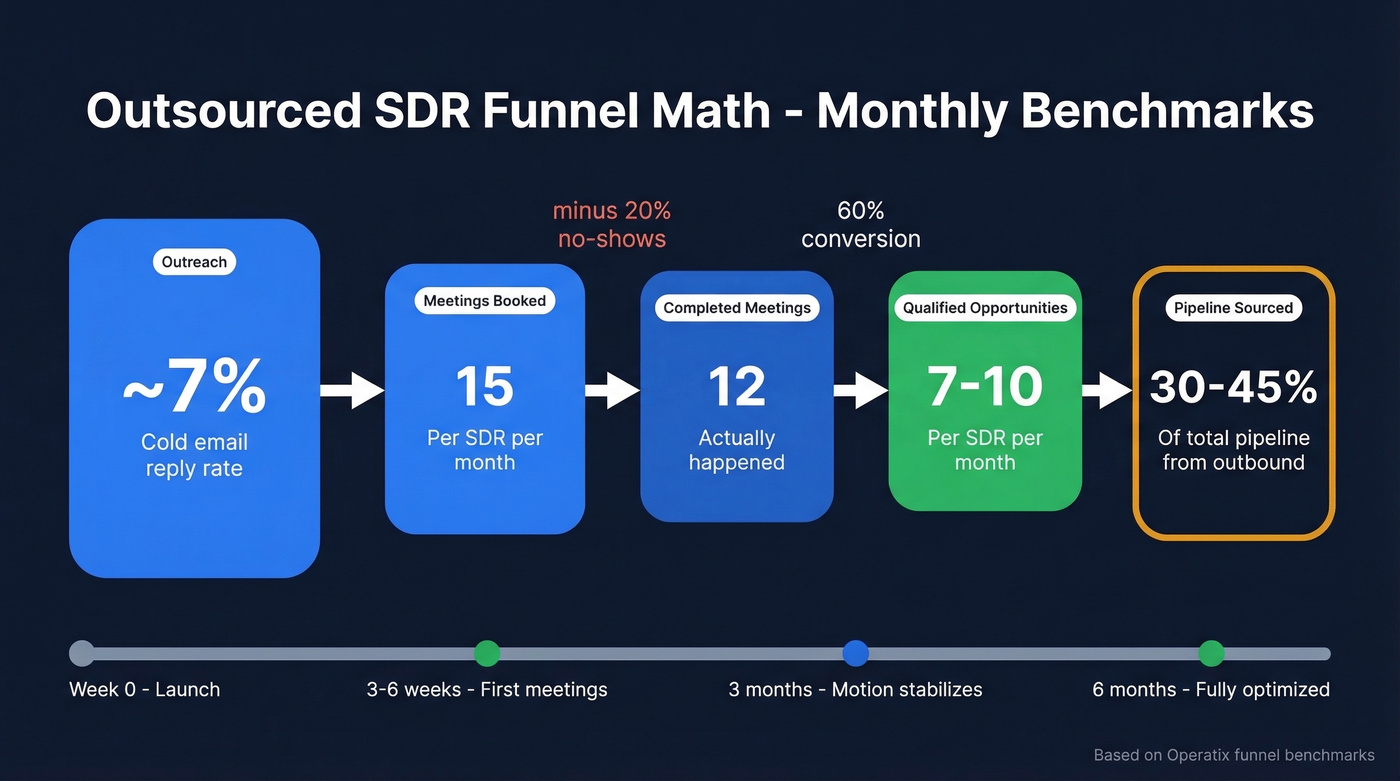
Time to first meeting is typically 3-6 weeks. Cold email reply rates average ~7%, and high-performing outbound orgs source 30-45% of their pipeline through SDR-generated activity. Don't expect magic in week two - budget 3-6 months before the motion is fully optimized.
The ECC Case Study
ECC, a Midwest systems integrator, used outsourced sales management to build a repeatable playbook and improve margin discipline. Margins on sold work increased by nearly 5%, the team tracked at 102% of gross profit quota, and sales growth held steady at 10-12% year-over-year. That's what a well-run outsourced engagement looks like when you give it time and the right inputs.
7 Mistakes That Kill Programs
Here's the thing - in our experience, most outsourced programs don't fail because the reps are bad. They fail because of these seven things.
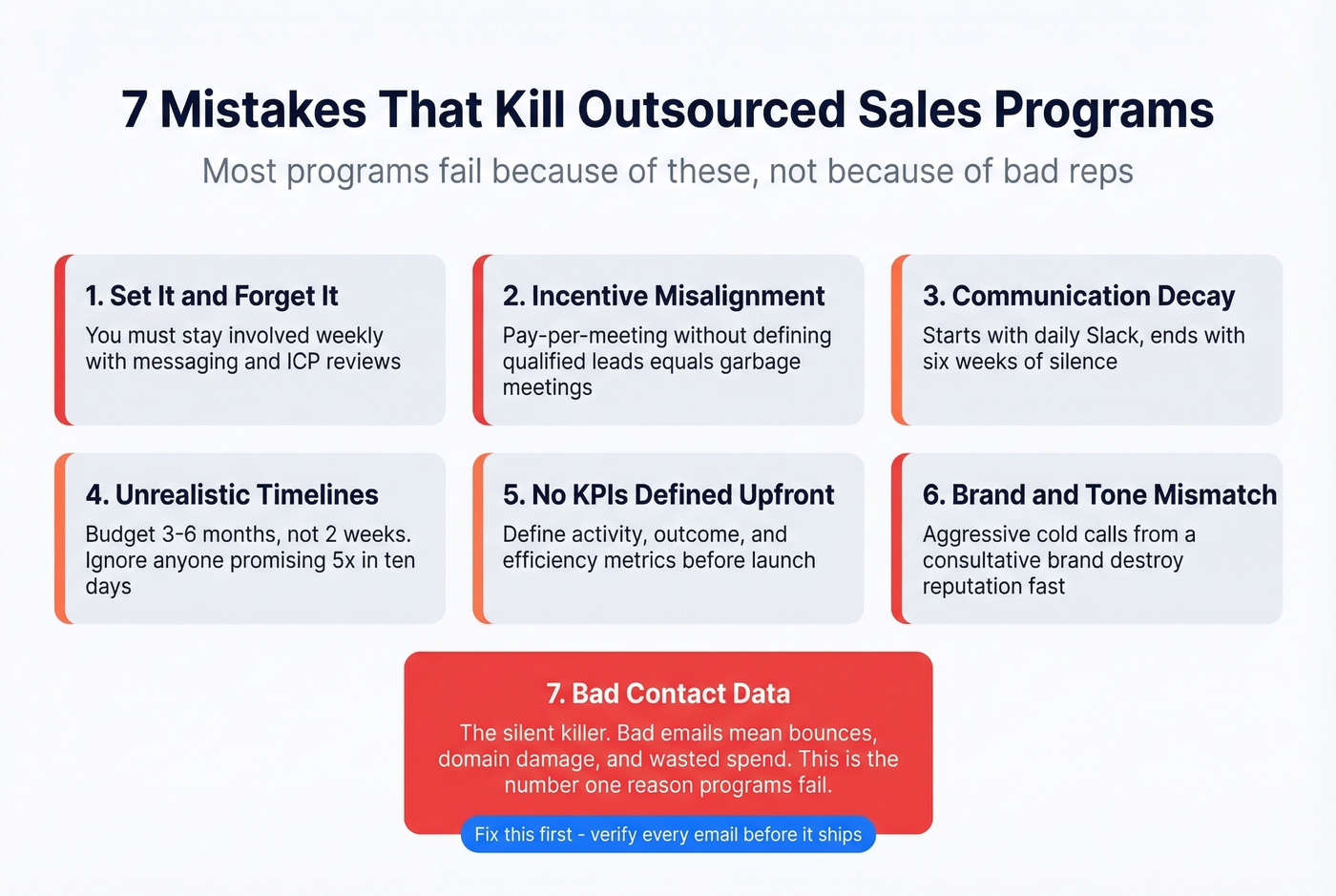
1. Set it and forget it. You can't hand off outbound and disappear. The best programs require weekly involvement: reviewing messaging, refining ICP, adjusting targeting. Treat your outsourced team like your own team.
2. Incentive misalignment. Pay-per-meeting sounds great until your provider starts booking garbage meetings to hit volume. Define "qualified meeting" in writing before the contract starts.
3. Communication decay. It always starts strong - daily Slack, weekly calls. Then it's biweekly. Then monthly. Then you realize nobody's talked in six weeks and the campaign has drifted off-ICP.
4. Unrealistic timelines. Expecting results in two weeks is a recipe for disappointment. Budget 3-6 months for the motion to mature. Be skeptical of providers promising 5x revenue in ten days - those guarantees always come with fine print.
5. No KPIs defined upfront. "More meetings" isn't a KPI. Define activity metrics like calls and emails, outcome metrics like meetings and SQLs, and efficiency metrics like cost per meeting and conversion rates - all before launch. (If you need a starting point, use these sales activities as your baseline.)
6. Brand and tone mismatch. If your brand is consultative and your outsourced reps are running aggressive cold calls, you'll damage your reputation faster than you build pipeline. Audit call recordings early and often.
7. Bad contact data. This is the silent killer. Bounced emails burn your sender domain. Dead phone numbers waste dial time. Stale lists mean your reps are reaching out to people who changed jobs six months ago. If you want the deeper fix, start with an email deliverability guide and track your email bounce rate like a core KPI.
The Data Problem Nobody Talks About
Let's be honest: if your deal sizes are under $50K, bad data will cost you more than a bad sales outsourcing company. Most outsourced sales teams work off databases that refresh every 4-6 weeks. Stale data doesn't just reduce connect rates - it actively damages your infrastructure. Bounced emails tank sender reputation. Burned domains take weeks to recover. Every dead-end dial is money you're paying your provider to waste.
The single highest-ROI thing you can do - whether you're handing a list to an outsourced team or auditing the one they give you - is verify every contact before it ships. Prospeo refreshes 300M+ professional profiles every 7 days and delivers 98% email accuracy, with 125M+ verified mobile numbers that hit a 30% pickup rate. At ~$0.01 per email versus $1+ per lead on enterprise platforms, it's the cheapest insurance against a burned domain. Stack Optimize built from $0 to $1M ARR using Prospeo-verified data, maintaining 94%+ deliverability and under 3% bounce across all their clients. Meritt saw bounce rates drop from 35% to under 4% after switching.
The consensus on r/sales is that data quality makes or breaks outsourced programs - and we've seen that play out firsthand with our own customers. If you're comparing vendors, start with a shortlist of data enrichment services and best sales prospecting databases before you sign a long retainer.

Whether you're arming an outsourced SDR pod or ramping an in-house team, the tech stack costs add up fast - $250+/user just for data tools. Prospeo replaces that line item with 300M+ profiles, 125M+ verified mobiles, and intent data across 15,000 topics, all self-serve with no contracts.
Cut your outsourced team's data costs by 90% without cutting quality.
How to Evaluate a Provider
Before you sign anything, run through this checklist.
Ask about data sources and refresh cycles. If they can't tell you where their contact data comes from or when it was last refreshed, that's a red flag. Hand them a verified list and measure the difference - you'll know immediately whether their data is the bottleneck. (This is also where a solid lead generation workflow prevents handoff chaos.)
Demand a pilot period. 30-60 days, ideally month-to-month. Any provider confident in their work will agree to this.
Define "qualified meeting" in writing. Title, company size, budget authority, specific pain point - spell it out. Ambiguity here is where pay-per-meeting models go sideways. If your team needs a framework, use an ideal customer profile template and a consistent qualification method like MEDDIC sales qualification.
Require CRM integration. Separate systems mean duplicate outreach, broken handoffs, and zero visibility. HubSpot's guide to sales outsourcing covers integration best practices worth reviewing.
Set weekly check-ins. Not biweekly. Not monthly. Weekly.
Review meeting recordings in week one. Listen to how they represent your brand before bad habits set in.
Negotiate contract terms. Push for month-to-month or a 3-month pilot before committing to six months. Setup fees of $1,000-$3,000 are standard, but long lock-ins aren't.
Ask for named case studies with real numbers. Not "we helped a SaaS company grow." Actual company names, actual metrics, actual timelines. Pavilion's sales outsourcing benchmarks and Forrester's B2B sales research are good external references for validating what providers claim.
FAQ
How long before an outsourced sales team delivers results?
Most programs deliver first qualified meetings in 3-6 weeks. Expect 3-6 months before cost-per-meeting drops meaningfully and the motion is fully optimized. Providers promising results in week one are either overselling or booking low-quality meetings.
Is outsourcing sales cheaper than hiring in-house?
A fully loaded in-house SDR costs $100K-$130K in year one including ramp, recruiting, and tech stack. Outsourced programs run $3,000-$15,000/month ($36K-$180K/year) with zero ramp time. For most mid-market companies, outsourcing saves 30-60% in the first year.
How do I prevent bad data from killing my outsourced program?
Verify every contact list before it ships - whether you built it or your provider did. A 7-day refresh cycle catches job changes and role shifts that 4-6 week refresh databases miss entirely. Meritt cut bounce rates from 35% to under 4% by switching to verified data.
Can I outsource just appointment setting?
Yes - most sales outsourcing companies offer SDR-only or appointment-setting packages starting at $3,000-$6,000/month. You keep the closing in-house. This is the most popular entry point and the lowest-risk way to test the model.
How do I transition from outsourced to in-house?
Run the outsourced engagement for 3-6 months to validate messaging, ICP, and cadences. Document the playbook, objection handling, and sequences that convert. Then hire your first SDR and have them shadow the outsourced team for 2-4 weeks before the handoff. Some providers like Sales Focus Inc. build this transition into their model, letting you acquire the reps directly after 12 months.