

Pain Point Discovery Questions That Win Deals (2026)
Your SDR booked 15 discovery calls this week. Four no-showed, three turned out to be the wrong persona, and the eight who actually picked up got the same generic "What keeps you up at night?" opener. Two moved forward. That's not a discovery problem - it's a system failure that starts before the call even happens.
96% of buyers research solutions before they ever talk to a rep. 71% prefer researching independently over talking to a rep at all. Flat lists of "50 discovery questions!" don't prepare you for that reality. What works is fewer, better pain point discovery questions - sequenced inside a framework, adapted to the person across the table, and backed by data that actually gets you to the right contact in the first place.
The Short Version
- 11-14 targeted questions per call - that's the benchmark from analysis of thousands of sales calls. Fewer misses pain. More feels like an interrogation.
- Two frameworks, not one. SPIN gives you breadth across four question types. Sandler's Pain Funnel gives you depth on a single problem. Use both.
- Sequencing beats selection. The order you ask matters more than which questions you memorize. The 6-phase call structure below is the biggest gap we see on most sales floors.
- Fix your data first. None of this works if you're calling the wrong person at a dead email address.
How Many Questions to Ask
The sweet spot is 11-14 targeted questions. Research across thousands of recorded calls backs this up, and top-performing reps consistently ask more questions during discovery than their average peers. Push past 15 and the conversation starts feeling like a deposition. Drop below 10 and you'll leave pain on the table.
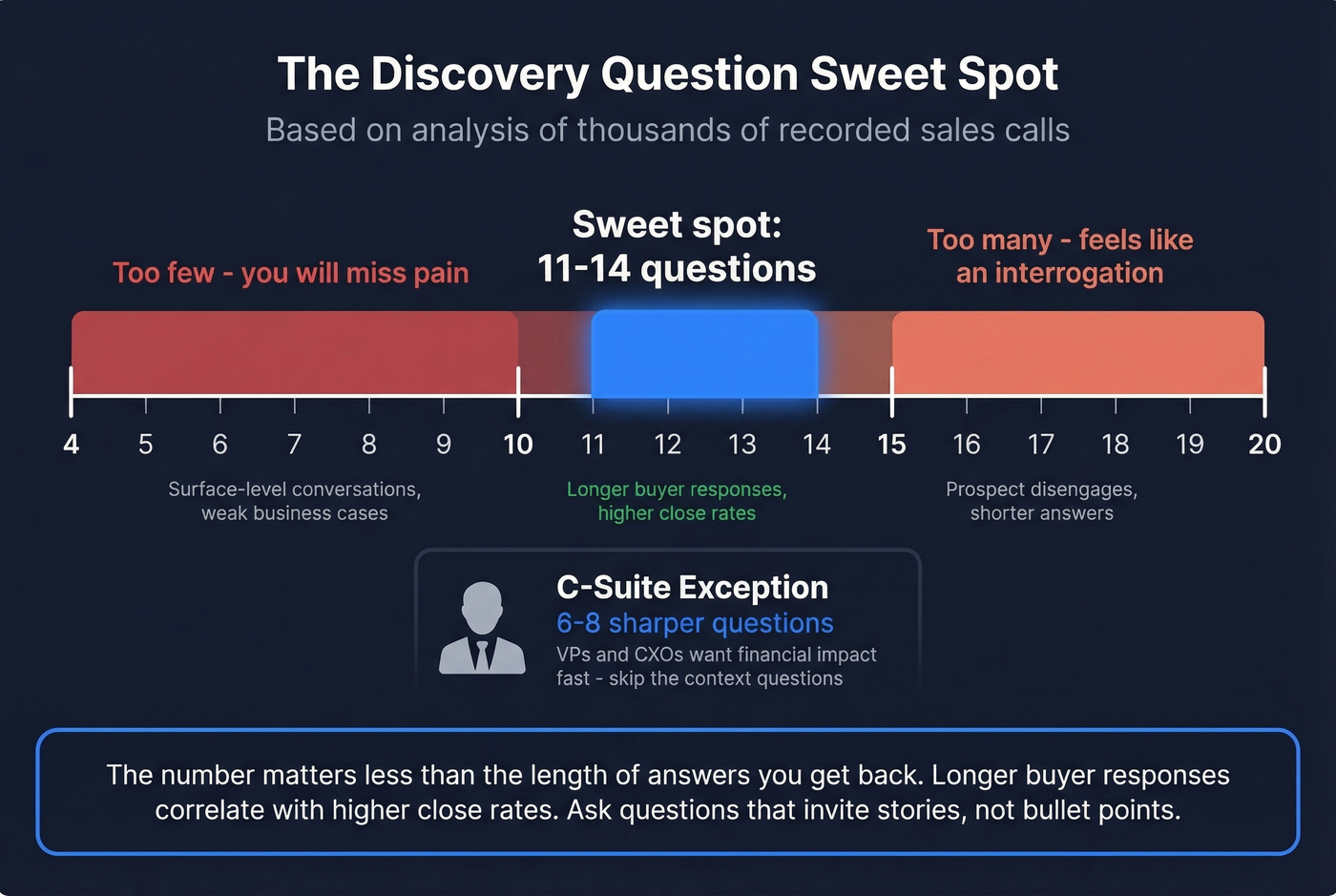
One exception: C-suite. Executives don't have patience for long question sequences. With a VP or CXO, aim for 6-8 sharper questions that get to financial impact fast.
Here's the thing, though - the number of questions matters less than the length of the answers you get back. Longer buyer responses correlate strongly with higher close rates. You want the prospect telling stories, not giving one-word answers. A simple phrasing shift helps: "Can you help me understand your biggest challenge with X?" invites a narrative. "What's your biggest challenge?" invites a bullet point.
Discovery Questions by Framework
SPIN Questions
SPIN - Situation, Problem, Implication, Need-Payoff - came out of research spanning 35,000+ sales calls, 10,000 sales professionals, 23 countries, over 12 years. It's one of the most empirically validated discovery frameworks in B2B sales, and it holds up.
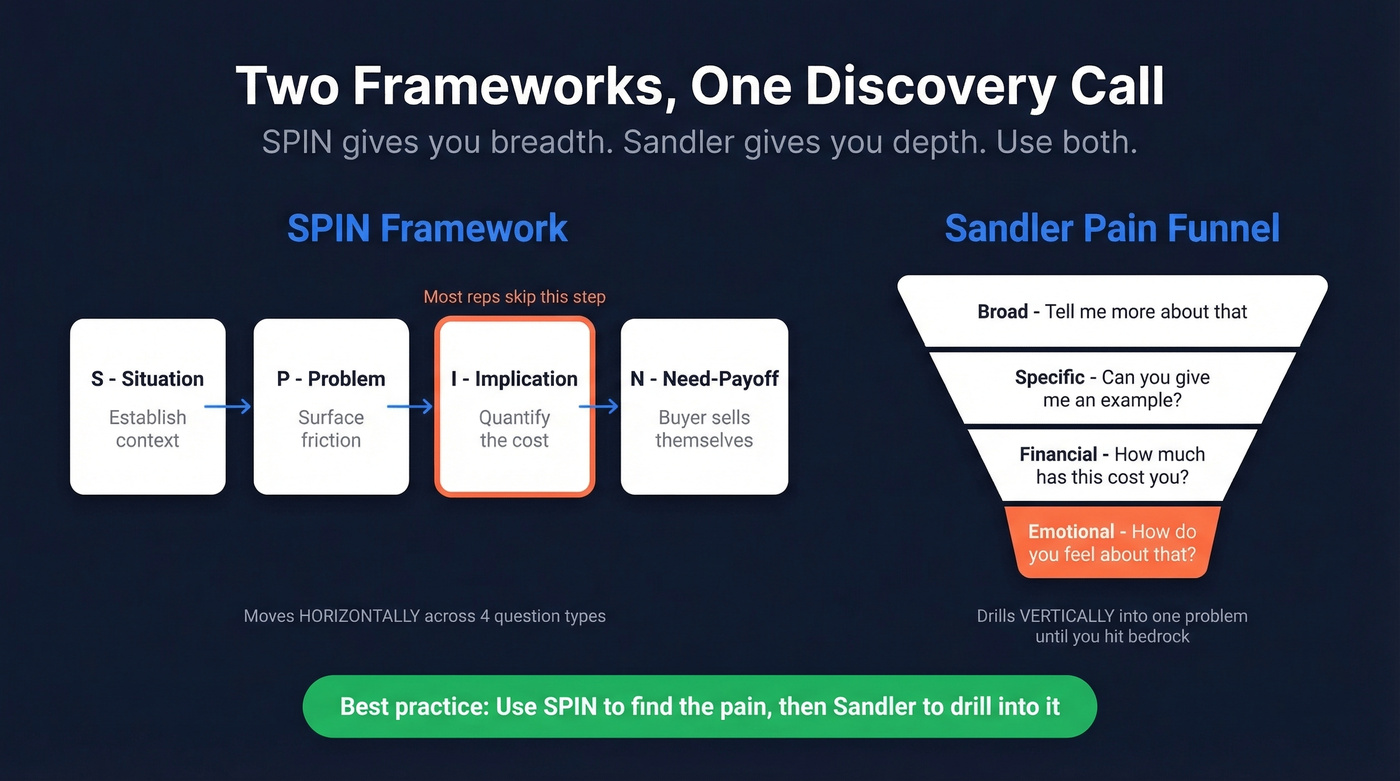
The sequence moves from broad context to specific pain to business consequences to the buyer articulating their own solution:
Situation (establish context - keep these brief):
- What does your current process for [X] look like end to end?
- How many people touch this workflow today?
Problem (surface friction): 3. Where does that process break down most often? 4. What's the most time-consuming part of [X] for your team?
Implication (quantify the cost of inaction): 5. When that breaks down, what's the downstream impact on revenue? 6. How does that affect your team's ability to hit quarterly targets?
Need-Payoff (let the buyer sell themselves): 7. If you could cut that cycle time in half, what would that free up? 8. What would solving this mean for your team's capacity next quarter?
The #1 SPIN mistake, per Highspot, is skipping Implication questions. Reps jump from "what's the problem?" straight to "here's our solution." Without Implication, the buyer never feels the weight of the problem - and your deal stalls in pipeline purgatory.
Sandler Pain Funnel
Where SPIN moves horizontally across four question categories, Sandler Pain Funnel drills vertically into one problem until you hit emotional and financial bedrock. The classic 8-question sequence is a masterclass in uncovering prospect pain:
- "Can you tell me more about that?"
- "Can you give me an example?"
- "How long has that been a problem?"
- "What have you tried to do about it?"
- "Has that worked?"
- "How much do you think this has cost you?"
- "How do you feel about that?"
- "What kind of impact does this have on your business?"
The progression moves from broad to specific to historical to financial to emotional. By question 7, you're past the rational layer and into what actually drives decisions. Use permission language - "Would it be okay if I asked a follow-up on that?" - to keep the conversation collaborative rather than aggressive.
Let's be honest: most teams pick one framework and ignore the other. That's a mistake. Use SPIN for breadth across multiple pain areas, then drop into Sandler when you find the one that makes the prospect lean forward. We've coached teams through this combination and the difference in deal velocity is noticeable within a quarter.
Questions by Pain Category
Every buyer pain falls into one of four buckets. When a prospect gives you a surface-level answer, identify which category it falls into, then probe the other three:
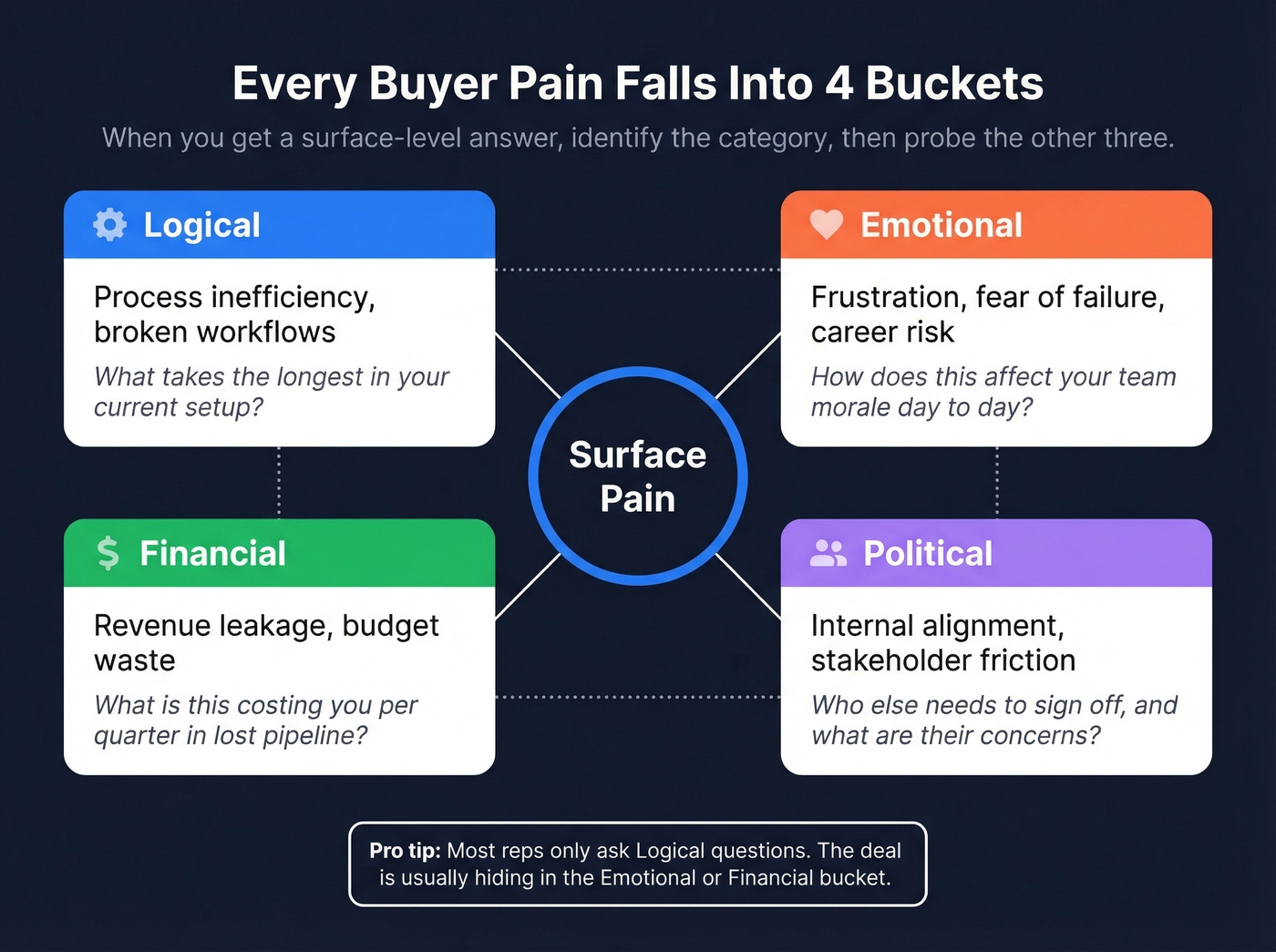
- Logical: Process inefficiency, broken workflows. "What takes the longest in your current setup?"
- Emotional: Frustration, fear of failure, career risk. "How does this affect your team's morale day to day?"
- Financial: Revenue leakage, budget waste. "What's this costing you per quarter in lost pipeline?"
- Political: Internal alignment, stakeholder friction. "Who else needs to sign off, and what are their concerns?"

Your discovery framework is only as good as the data feeding it. When 3 out of 15 booked calls are the wrong persona, the problem isn't your questions - it's your contact data. Prospeo's 30+ search filters let you target by job title, department headcount, buyer intent, and tech stack so every discovery call starts with the right person.
Stop wasting SPIN questions on prospects who were never a fit.
How to Structure a Discovery Call
Most reps wing the structure. Don't.
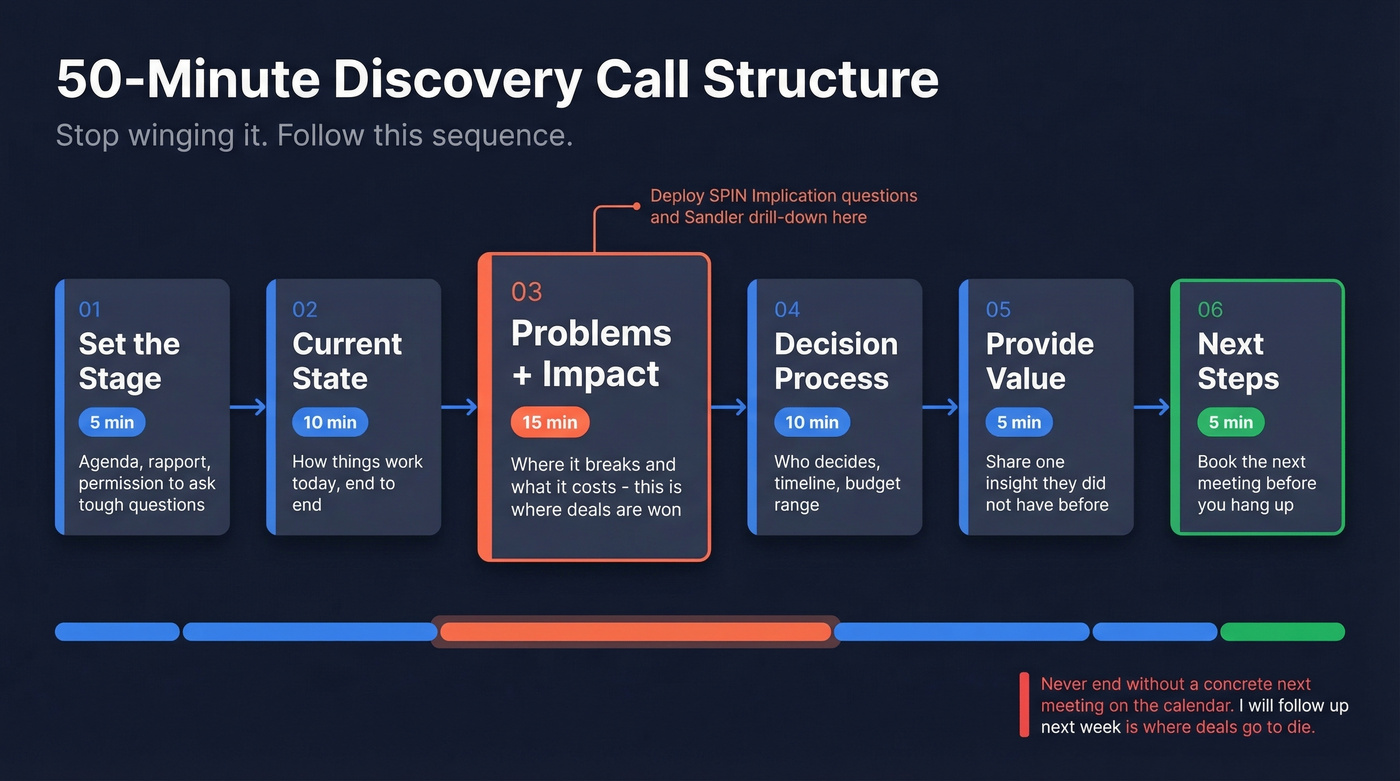
Here's a 6-phase framework with time boxes for a 50-minute call:
| Phase | Focus | Time |
|---|---|---|
| Set the stage | Agenda, rapport, permission | 5 min |
| Current state | How things work today | 10 min |
| Problems + impact | Where it breaks, what it costs | 15 min |
| Decision process | Who decides, timeline, budget | 10 min |
| Provide value | One insight they didn't have | 5 min |
| Next steps | Schedule the next meeting | 5 min |
Phase 3 gets 15 minutes because that's where pain lives. This is where you deploy SPIN's Implication questions and Sandler's vertical drill-down - the questions that actually move deals forward.
The "So what?" technique belongs in Phase 3. When a prospect says "We spend 10 hours a week on manual data entry," your follow-up is "So what does that mean in terms of pipeline?" Push until you get a dollar figure. "10 hours of manual entry" is a symptom. "$500K in missed pipeline per quarter" is a business case.
Two tactics that separate great discovery from good: First, use silence. After asking an Implication question, resist the urge to fill the pause. Three seconds of quiet after "What does that cost you per quarter?" produces better answers than any follow-up prompt. Second, ask one deliberate deal-killer question early: "What would make this a non-starter for you?" It feels counterintuitive, but surfacing objections early saves you from wasting cycles on dead opportunities - and the consensus on r/sales is that reps who ask this question early close at higher rates because they stop chasing ghosts.
Never end a discovery call without a concrete next meeting on the calendar. "I'll follow up next week" is where deals go to die. If you need a repeatable post-call system, keep a set of sales follow-up templates ready to go.
Mistakes That Kill Discovery
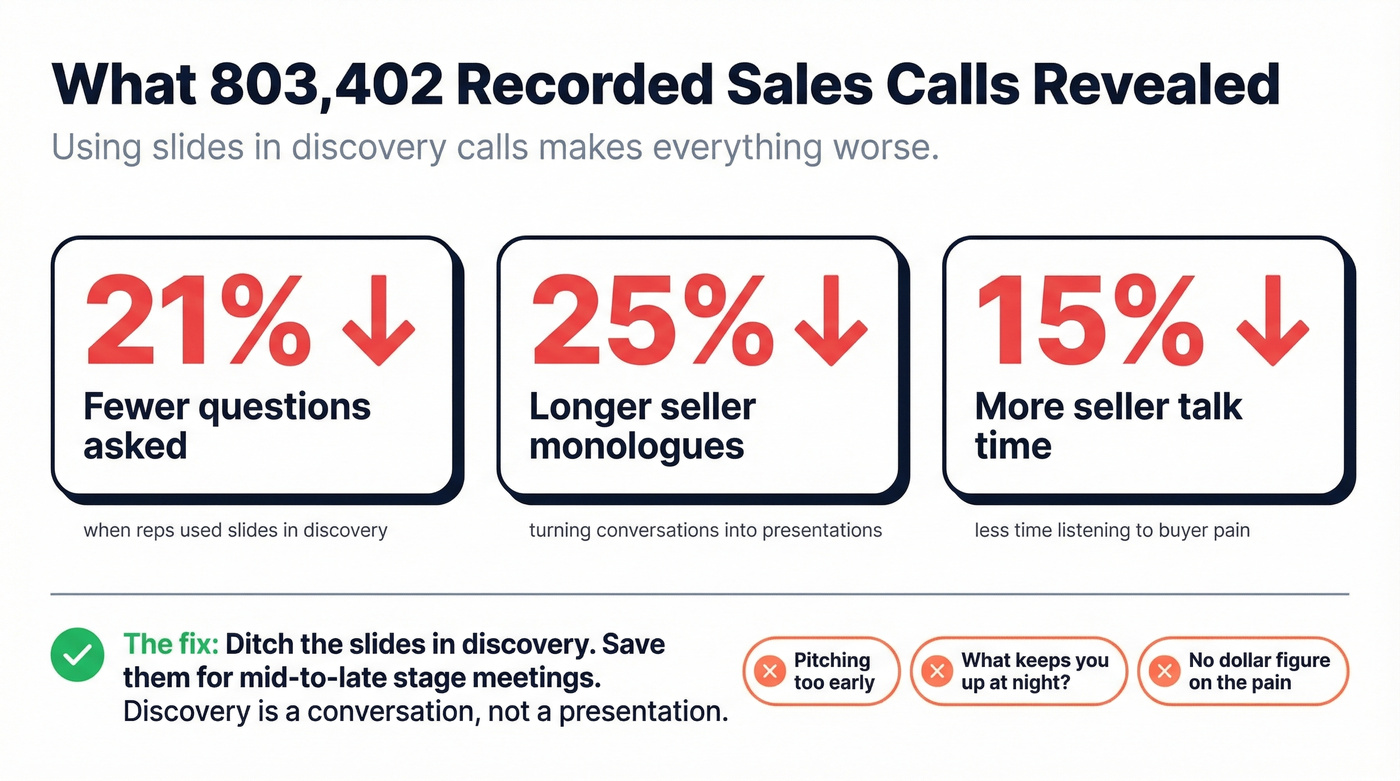
Analysis of 803,402 recorded sales meetings found something counterintuitive: using slides in discovery calls correlates with worse outcomes - 21% fewer questions asked, 25% longer seller monologues, and 15% more seller talk time. Slides work in mid-to-late-stage meetings. In discovery, they're a crutch that turns a conversation into a presentation.
Other mistakes we see repeatedly:
Pitching before understanding. The moment you hear a pain point that maps to your product, the instinct is to jump in with a feature. Resist it. You haven't earned the right to pitch until you've quantified the cost of the problem.
Asking "What keeps you up at night?" It's the most overused discovery question in B2B sales. Prospects have a canned answer ready. Instead, follow the Mom Test principle: ask about specific past behavior. "Walk me through the last time [X] went wrong" gets you real data. "What keeps you up at night?" gets you a rehearsed soundbite.
We've seen teams run SPIN training for weeks, then watch reps revert to this exact question on the first live call. Old habits die hard, which is why sequencing and structure matter more than memorizing individual questions. If you're building a full outbound motion around this, pair it with proven sales prospecting techniques.
Not quantifying pain. If you leave a discovery call without a dollar figure or a metric attached to the problem, you don't have a business case. You have a conversation. The best customer pain questions always push toward a number.
Ignoring nonverbal cues. On video calls, watch for the prospect leaning forward, pausing before answering, or shifting tone. These signals tell you which pain point to drill into with Sandler's funnel. On phone calls, listen for changes in speaking pace and energy - they reveal the same thing.
Adapting Questions by Persona
The same question lands differently depending on who's across the table.
| Persona | They care about | Lead with |
|---|---|---|
| CFO | Quantifiable ROI, timeline to value | "What financial goals are top priority this half?" |
| Ops buyer | Workflow friction, team capacity | "Where does your team lose the most time?" |
| Technical buyer | Integration risk, migration pain | "What breaks with your current stack?" |
CFOs want numbers and timelines - jump to Implication and Need-Payoff fast. Operational buyers want to vent about broken workflows, so give Phase 3 extra time and let them talk. Technical buyers want to know what can go wrong, so lean into risk questions and integration specifics. If you're selling into complex orgs, it helps to map the technical buyer vs economic buyer early.
Before You Dial - Fix Your Data
Look, the best pain point discovery questions in the world don't help if your SDR is calling the wrong person. B2B contact data decays at roughly 2.1% per month - that's about 25% of your database going stale every year. The list you built in January is already degrading by March.
We've seen this pattern too many times: a team invests in SPIN training, builds a beautiful call structure, then watches half their dials go to voicemail or bounce because the underlying contact data is garbage. The upstream data problem silently kills discovery before it starts. Tools like Prospeo solve this with 300M+ professional profiles, 98% email accuracy, and a 7-day data refresh cycle - so your frameworks actually get used on real conversations instead of collecting dust. If you're evaluating options, start with a shortlist of data enrichment services and compare coverage and refresh rates. You can also tighten targeting with firmographic filters so the right persona shows up to the call.
You just spent 15 minutes uncovering a $500K pipeline gap - now imagine that email bounces. With 98% verified email accuracy and a 7-day data refresh cycle, Prospeo ensures the contacts you discover pain with actually receive your follow-up. 15,000+ sales teams trust it to connect discovery to pipeline.
Great discovery dies at a bounced email. Fix that for $0.01 per contact.
FAQ
What's the ideal number of discovery questions per call?
11-14 targeted questions is the research-backed sweet spot. Fewer than 11 and you'll miss critical pain. More than 15 and the call feels like an interrogation. For C-suite conversations, aim for 6-8 sharper questions focused on financial impact.
What's the difference between SPIN and Sandler for discovery?
SPIN moves across four question types to map the buyer's full situation. Sandler's Pain Funnel drills vertically into one problem until you hit emotional and financial bedrock. Use SPIN for breadth, then Sandler to go deep on the pain that matters most - they're complementary, not competing.
How do I avoid sounding scripted during discovery?
Mirror the prospect's own words back and prioritize follow-up questions over memorized lists. Pre-call research matters: pulling verified contact details and company context ahead of time means your questions feel informed rather than generic. Preparation beats memorization every time.
What are the best questions to ask customers about their pain?
Start with open-ended questions about their current process, then use Implication questions to quantify the cost. Effective sequences follow a logical arc: understand the situation, surface friction, measure impact, and let the buyer articulate what solving it would mean. Avoid leading questions that telegraph your product's features.
How do I uncover pain when the prospect won't open up?
Ask about their team's goals for the quarter, then explore the gap between current state and target. Sharing a relevant industry benchmark - like "teams in your space typically lose 15-20% of pipeline to bad data" - lowers their guard and prompts honest conversation. Indirect questions outperform direct ones with guarded buyers.