

How to Build a Partner GTM Strategy That Doesn't Die After the Press Release
A practitioner on r/smallbusiness put it bluntly - they'd signed "many partnership agreements" only to realize none moved the needle. Every customer came from direct efforts. The partners just collected logos "for just in case situations."
That's not a bad-partner problem. It's a structural one. Most partner GTM strategy efforts fail for four predictable reasons: direct sales bias cannibalizes partner deals, no dedicated budget line exists, ownership sits in the wrong department, and nobody set up ROI tracking. Partnership platform vendors push "scale your partner program" because they profit when you add partners. The truth is simpler: two or three activated partners beat 50 signed agreements every time.
What You Actually Need
- Start with 2-3 partners, not 20. "Activated" means one qualified conversation within 90 days. Everything else is a signed PDF collecting dust.
- Set up CRM attribution before you sign a single agreement. No proof, no program survival.
- Use the one-page plan template below to align internally before you pitch a single partner.
When a Partner Go-to-Market Strategy Works
| Benchmark | Source | Result |
|---|---|---|
| Revenue growth | Forrester 2026 | 67% expect >30% growth |
| Close rates | Bridge Partners | 68% report higher close rates |
| Close rate ceiling | Firmable | Up to 70% close rate |
| Pipeline to ARR | Firmable | 5-10% pipeline grows to 15-20% ARR |
| Deal quality | Partner2B | 40% higher AOV, 53% higher close rates |
| Speed | Partner2B | 46% faster conversion |
| CAC reduction | Partner2B | 72% report lower CAC |
| Revenue share | Pavilion benchmark | 30% of revenue, 1.3x conversion |
Partner-sourced deals close faster, at higher values, with better win rates. But those numbers come from programs that actually activate - not from the median program sitting on 15 signed agreements and zero pipeline.
How to Build a Go-to-Market Strategy With Partners
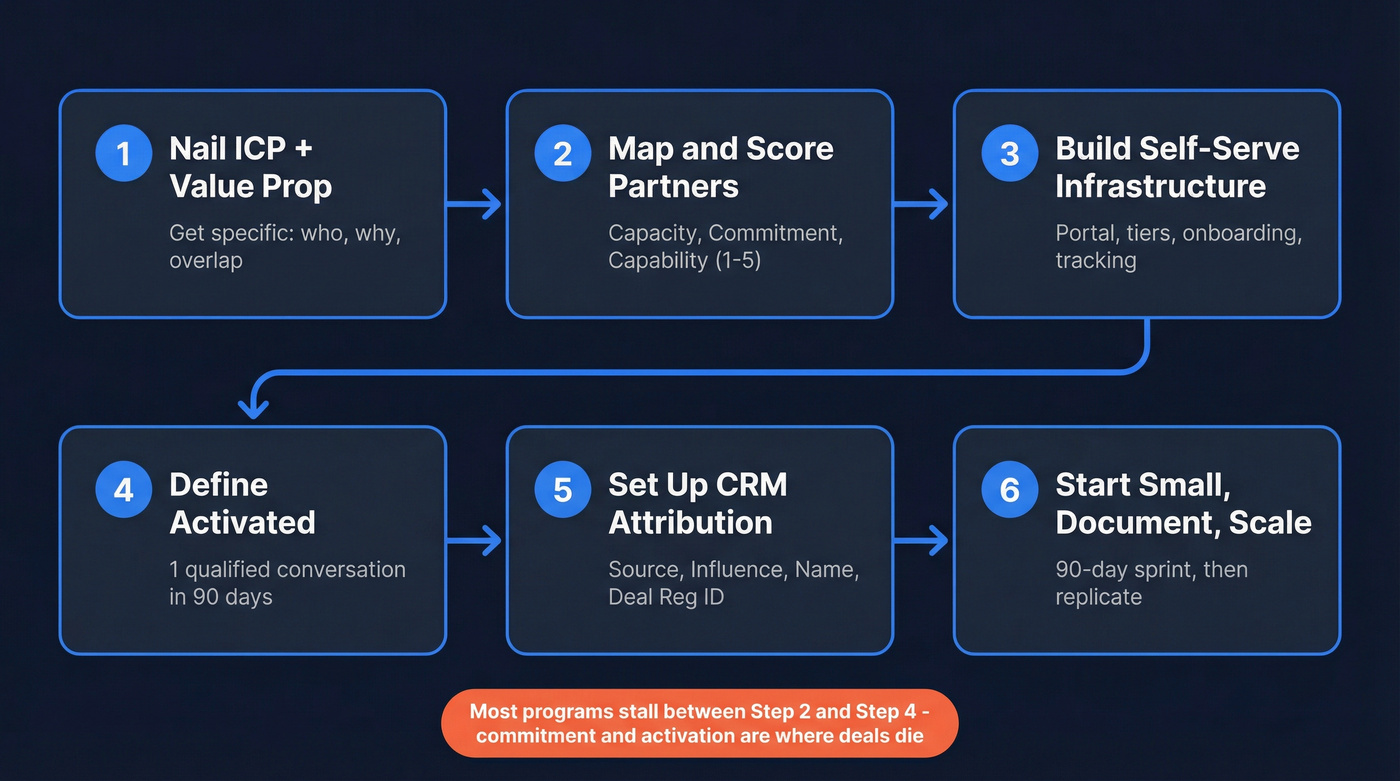
Step 1: Nail Your ICP and Partner Value Prop
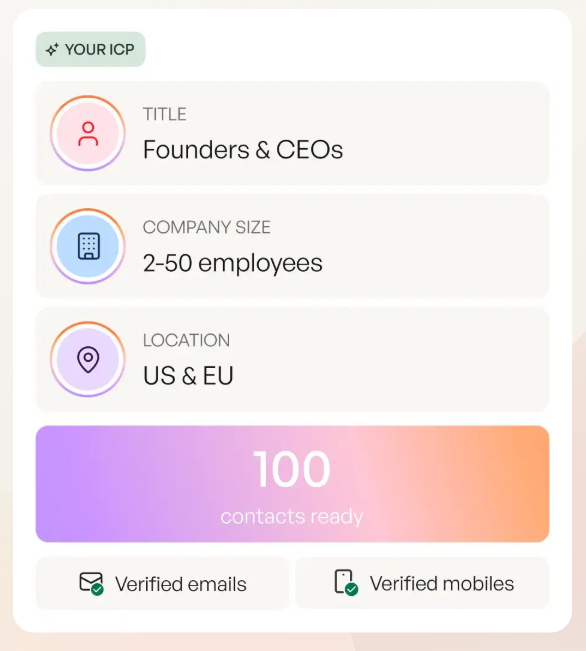
Get ruthlessly specific. Not "mid-market SaaS" - more like "Series B fintech companies with 50-200 employees running HubSpot." Partners don't care about your product. They care whether your customers overlap with theirs and whether co-selling makes their deals bigger.
ISV sales teams, for example, often look for integration partners whose product makes their own platform stickier. Lead with that angle if it fits your model. If you can't articulate why a partner's reps would bring you into a deal unprompted, you haven't found the value prop yet.
Step 2: Map and Prioritize Partners
Score potential partners on three dimensions - Capacity (do they have the team?), Commitment (will leadership prioritize this?), and Capability (can they deliver value to your shared ICP?). Rate each 1-5. Anyone below a 3 on Commitment gets cut immediately.
We've watched teams spend months courting capable partners who never had leadership buy-in. It's the single most common waste of time in partner programs, and it's avoidable if you just ask the hard question upfront: "Who on your side owns this, and what's their quota tied to?"
Step 3: Build Self-Serve Infrastructure
Your program needs a discoverable page, a clear value prop, tiered requirements, onboarding materials, and activity tracking. If a partner can't self-serve their way to understanding your program in 15 minutes, you've already lost them. Misaligned positioning and inadequate enablement kill more partnerships than bad partner fit ever will.
Step 4: Define "Activated"
"Signed agreement" isn't a metric. Activated means one qualified conversation between your partner and a prospect within 90 days. Set this expectation upfront in every agreement. If a partner hasn't hit it in three months, they're a logo, not a partner.
Step 5: Set Up CRM Attribution
Build this before you sign your first partner. Minimum viable fields:
- Partner Source - did the partner originate the deal?
- Partner Influence - did the partner touch an existing deal?
- Partner Name
- Deal Registration ID
Without these, you can't pull the number when leadership asks. And they will ask.
Step 6: Start Small, Document, Then Scale
Pick your highest-scoring partners, run a 90-day activation sprint, and document every workflow. The documentation is the product - it's what lets you onboard partner #4 without reinventing the process from scratch, and it's what keeps your program from becoming tribal knowledge locked in one person's head.
Here's the thing: if your average deal size is under $10K, commissions-based partner incentives are a waste. Pay partners for implementation work instead. Commissions on small deals don't move the needle for anyone.

You nailed your ICP and scored your partners. Now you need verified contact data to actually activate co-sell motions. Prospeo's 30+ search filters - including buyer intent, technographics, and headcount growth - let you build shared prospect lists with 98% email accuracy and 125M+ verified mobiles.
Stop co-selling into dead email addresses. Start with data that connects.
Channel-Led GTM vs. Ecosystem-Led Growth
Not every partner go-to-market strategy follows the same playbook. A channel-led GTM model routes most or all revenue through resellers, distributors, or VARs - the partner owns the customer relationship and you supply the product. An ecosystem-led growth strategy treats partners as force multipliers across the entire buyer journey: co-selling, co-marketing, data sharing through overlap tools, and joint customer success.
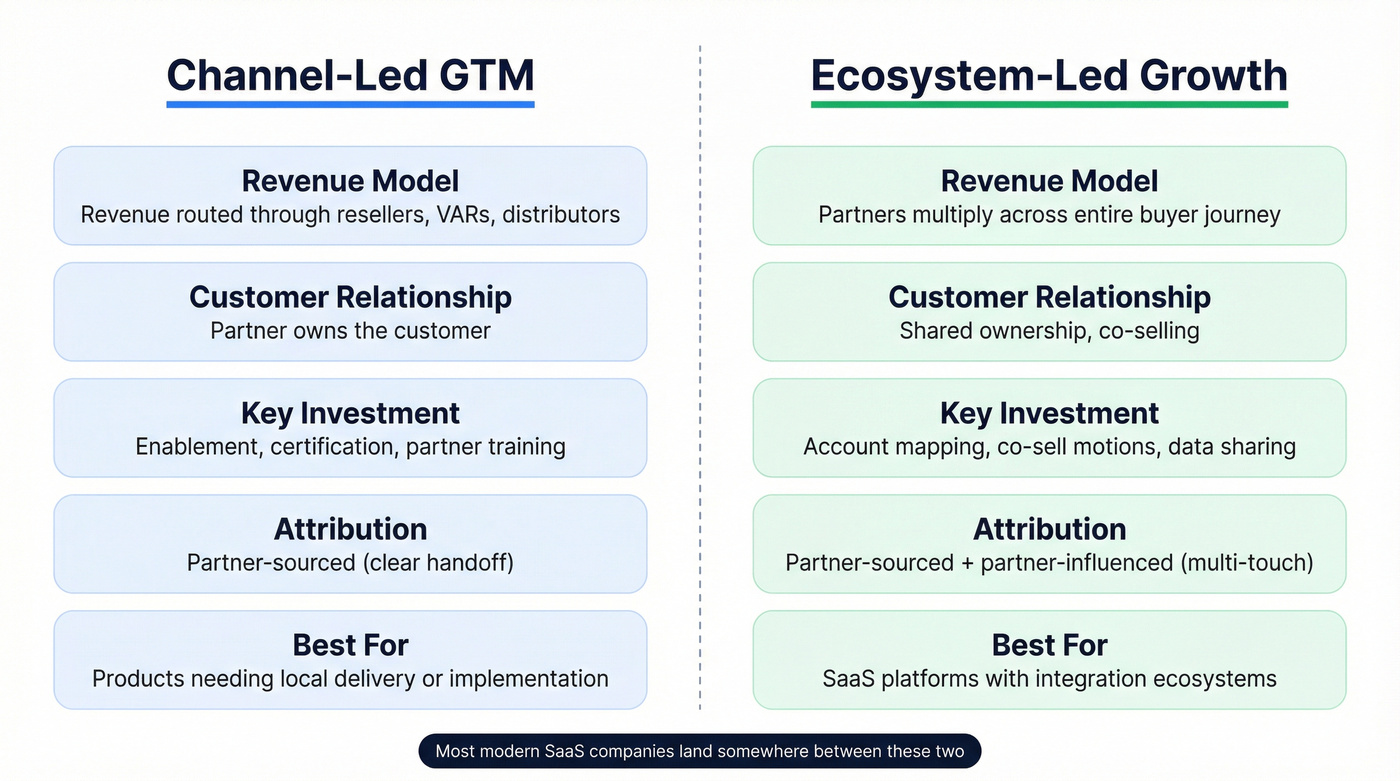
Most modern SaaS companies land somewhere between these two poles. The distinction matters because it determines your incentive structure, your attribution model, and how much control you retain over the sales process. Building a channel-led model? Expect to invest heavily in partner enablement and certification. Leaning ecosystem-led? Invest in shared account mapping and co-sell motions instead.
One-Page Partner GTM Plan
| Field | Your Answer |
|---|---|
| Target ICP | e.g., Series B SaaS, 50-200 employees |
| Partner types | e.g., implementation consultants, adjacent SaaS |
| Partner value prop | Why partners should care |
| Co-marketing plan | Joint webinar, co-authored content |
| Activation metric | 1 qualified conversation in 90 days |
| 30 / 60 / 90-day KPIs | Enabled - Co-sell started - Pipeline generated |
| Owners | Internal + partner-side |
| Budget/headcount | Dedicated or shared? What's the number? |
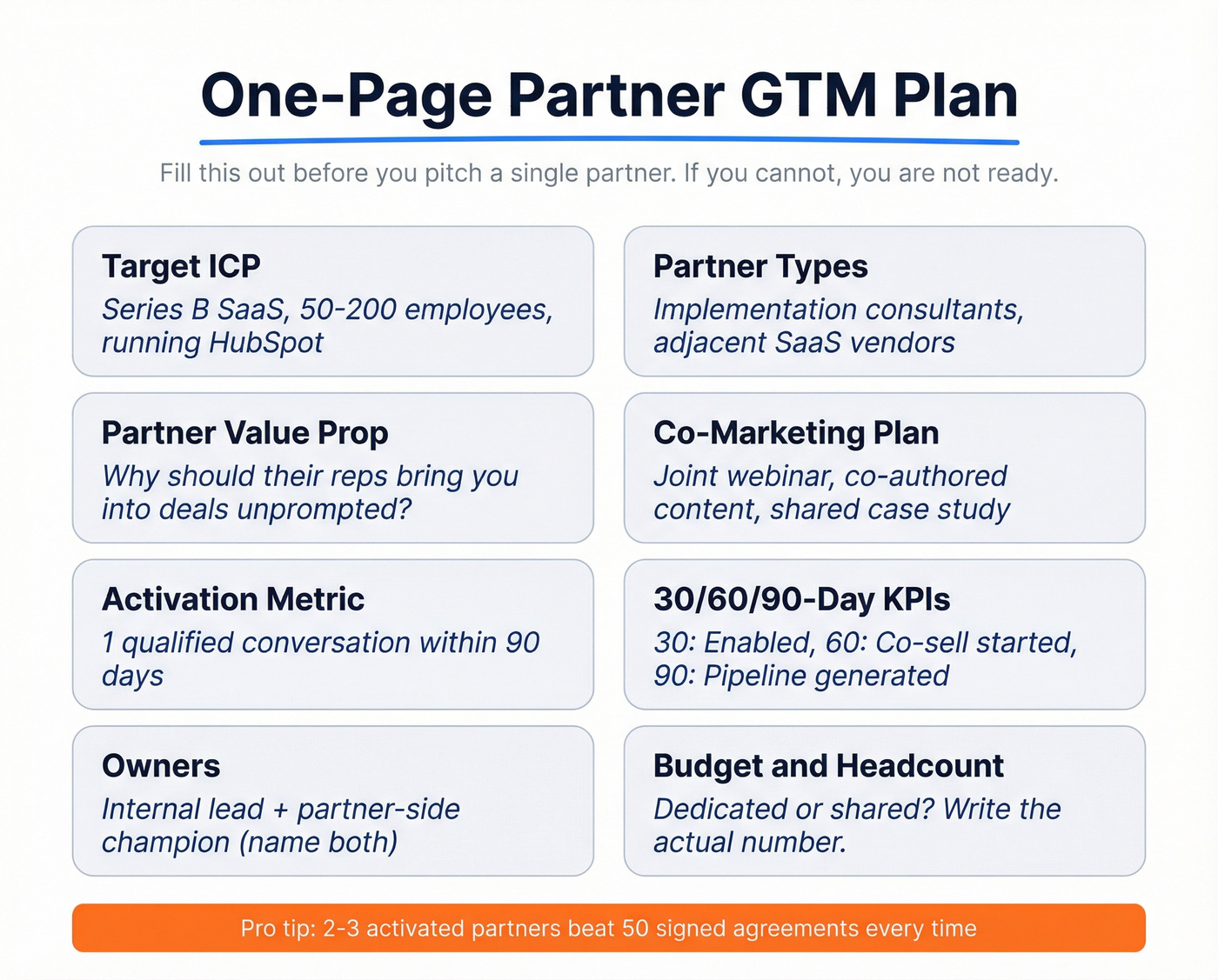
Fill this out before you pitch a single partner. If you can't, you're not ready.
How to Measure Partner GTM
Crossbeam distinguishes two core categories: partner-sourced revenue (the partner originated the deal) and partner-influenced revenue (the partner contributed at any stage but didn't originate).
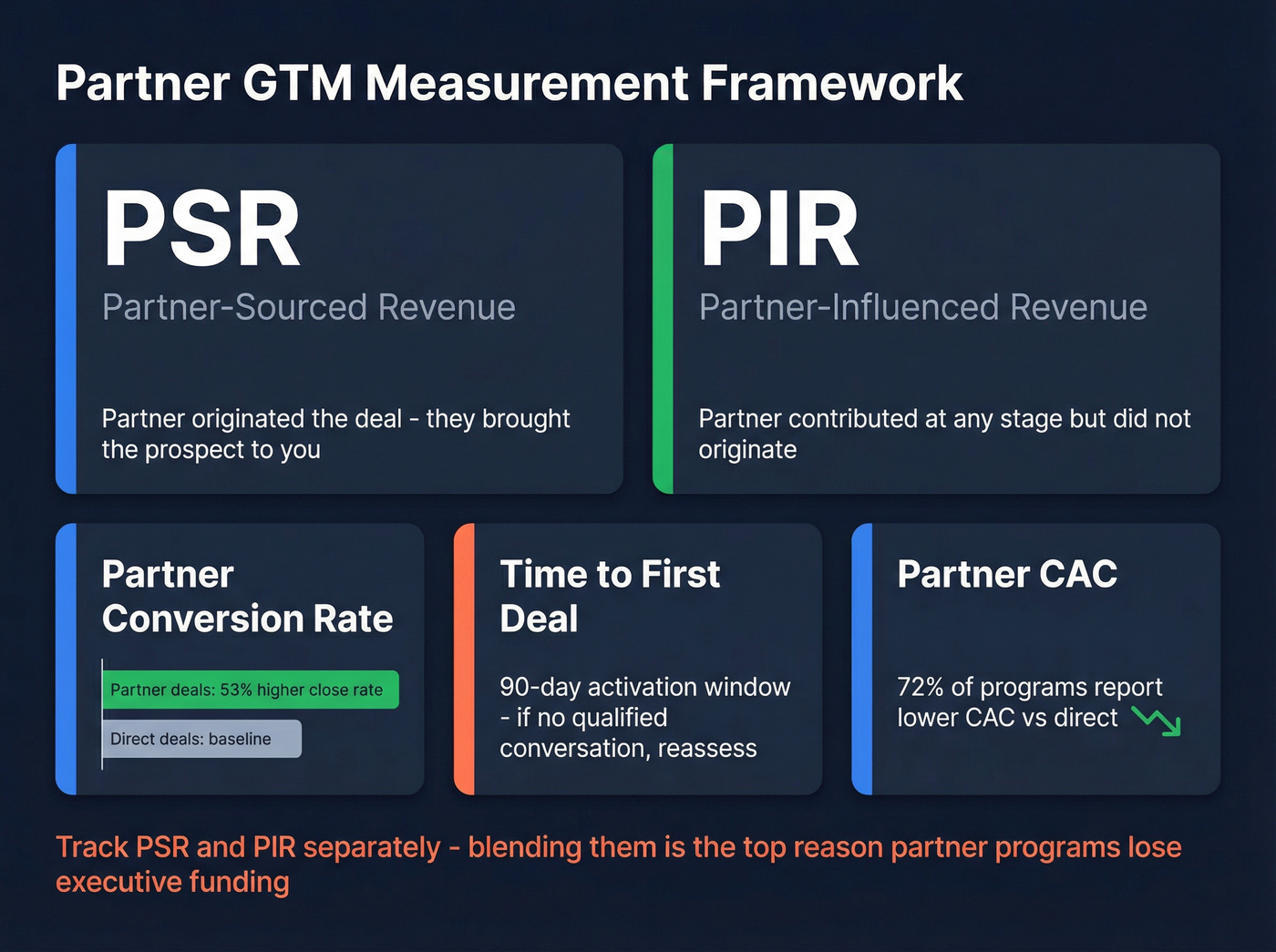
Track these separately. Blending them makes your program look either better or worse than reality, and it's the top reason partner programs lose executive funding - a point that came up repeatedly in a r/PartnerPrograms thread where multiple operators shared post-mortems. The metrics that matter: PIR, PSR, partner conversion rate, time to first deal, and partner CAC. In our experience, teams that track PIR and PSR independently get 2x the executive buy-in because they can tell a clean story about what's working and what isn't.
How to Find Channel Partners
Sourcing and Outreach
The biggest mistake teams make is treating partner recruitment like demand gen - blasting a list and hoping for replies. Skip that. Start with your existing customer base: which consultants, agencies, or adjacent vendors already touch your buyers? Ask your sales team which tools prospects mention on discovery calls. Check integration marketplaces, industry Slack communities, and professional groups where your ICP congregates.
For companies exploring partnerships for market entry - especially in new geographies like France or DACH - local channel partners with established customer relationships dramatically shorten your ramp time compared to building a direct sales team from scratch. You'll navigate language, compliance, and buyer expectations in weeks instead of quarters.
Once you've built a shortlist, the outreach itself needs to be personal and specific. Reference a shared customer, a complementary integration, or a concrete co-sell scenario. Generic "let's partner" emails get ignored.
PRM Platforms
| Tool | Starting Price | Best For |
|---|---|---|
| Kiflo | Free + $249/mo | SMBs building a first PRM |
| Salesforce PRM | $25/user/mo | Teams already on Salesforce CRM |
| Impact.com | $30/mo | Affiliate-heavy programs |
| PartnerStack | ~$1,500+/mo | SaaS marketplace distribution |
| Channeltivity | ~$1,399/mo | Mid-market channel |
| Impartner | ~$2,000+/mo | Enterprise |
The GTM Strategy Blueprint on Miro offers 14 guided boards including KPI trackers - solid for workshopping your plan before buying software.
Data Quality for Partner Outreach
Most partner programs silently fail at step one: your first email to a partner decision-maker bounces, and you've damaged credibility before the relationship starts. We've seen this pattern enough times that we built our outreach around Prospeo's 98% email accuracy and 7-day refresh cycle specifically to avoid it. The free tier gives you 75 emails plus 100 Chrome extension credits per month - enough to launch your first partner outreach campaigns without spending a dollar. Teams like GreyScout cut bounce rates from 38% to under 4% after switching, which matters when every partner touchpoint counts.

CRM attribution only works when your contact data is clean. Prospeo enriches your CRM with 50+ data points per contact at a 92% match rate, refreshed every 7 days. That means your partner-sourced and partner-influenced deals track to real, reachable buyers - not stale records from six weeks ago.
Give your partner program the data infrastructure it deserves.
FAQ
What's the difference between partner-sourced and partner-influenced revenue?
Partner-sourced revenue means the partner originated the deal and brought the prospect to you. Partner-influenced revenue means the partner contributed - a referral, a co-sell call, enablement - but didn't originate. Track both separately; blending them is the top reason partner programs lose executive funding.
How many partners should I start with?
Two or three. Define "activated" as one qualified conversation within 90 days, document what works, then scale. Programs that launch with 10+ partners almost always spread resources too thin and activate none of them.
How do I avoid bounced emails when reaching out to partner contacts?
Use a B2B data platform with real-time verification. A single bounced email to a VP of Partnerships can kill credibility before the relationship starts. Look for providers with accuracy rates above 95% and refresh cycles measured in days, not weeks.
What's the difference between channel-led and ecosystem-led GTM?
A channel-led model routes revenue through resellers or distributors who own the customer relationship. An ecosystem-led approach uses partners as co-sell and co-marketing multipliers while you retain the direct relationship. Your choice shapes incentive design, attribution, and how much sales control you keep.