

Co-Sell: What It Is, How It Works, and Why 80% of Partnerships Fail
Co-selling works. It also fails constantly.
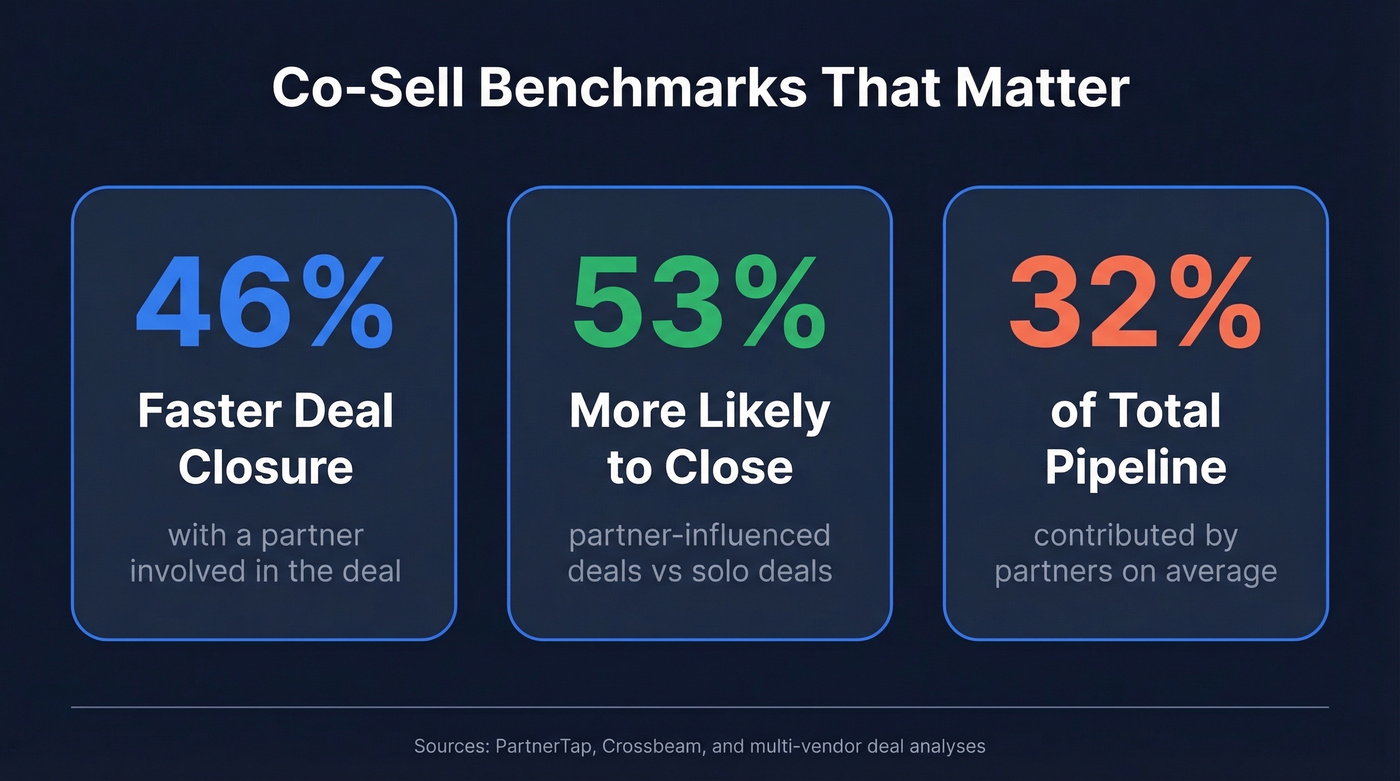
When partner teams get the motion right, deals close 46% faster and are 53% more likely to close. But 80% of partnerships fail because most companies treat co-selling like "send intros and hope." The difference between the winners and the graveyard is operational discipline: shared ICP, shared accounts, shared rules, and clean attribution.
The Quick Version
Co-selling in one sentence: a joint sales motion where two or more companies actively collaborate to source, influence, and close the same deal - without one partner "owning" the customer relationship.
Benchmarks worth anchoring on:
- Deals close 46% faster with a partner involved
- Likelihood of closing is 53% higher
- Partners contribute 32% of total pipeline on average
Other datasets confirm the pattern. Multi-vendor deals close roughly 38% faster and are 24% more likely to close across different sample sets. The signal is consistent regardless of who measures it.
What Is Co-Selling?
Co-selling is multiple companies aligning sales efforts to sell complementary solutions. In practice, that means joint account planning, coordinated outreach, shared discovery, and a clear agreement on who does what in the deal.
The mistake we see most often: teams call anything "partner-led" co-selling. A referral isn't co-selling. A webinar isn't co-selling. A marketplace listing isn't co-selling. Co-selling is a coordinated sales execution motion where both sides show up, do work, and share the outcome.
The Motion vs. the Transaction
PartnerTap draws a useful distinction here: co-selling is the motion - salespeople collaborating across companies to source, influence, or accelerate a deal. The co-sell transaction (especially in cloud ecosystems) refers to the marketplace mechanics at the end of the cycle: private offers, procurement flow, and revenue attribution.
That distinction matters because teams over-invest in the transaction mechanics and under-invest in the motion. Account mapping, stakeholder mapping, joint discovery, mutual action plans - that's where deals actually get built. The motion creates the deal. The transaction closes it cleanly.
Co-Selling vs. Reselling vs. Co-Marketing
Co-selling sits in a family of partner motions, and mixing them up creates comp fights and buyer confusion.
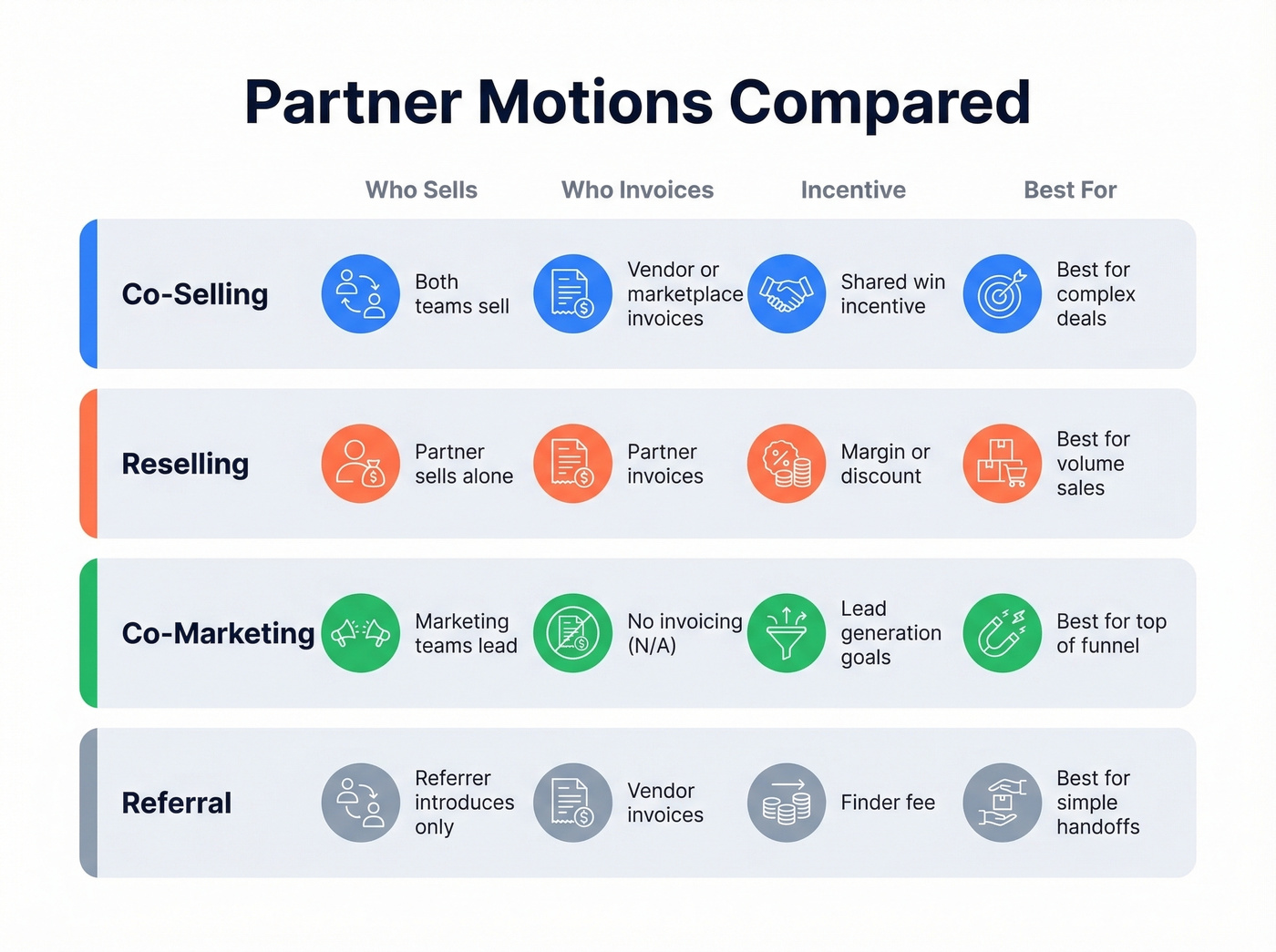
| Motion | Who Sells | Who Invoices | Incentive | Best For |
|---|---|---|---|---|
| Co-selling | Both teams | Vendor or marketplace | Shared win | Complex deals |
| Reselling | Partner | Partner | Margin/discount | Volume sales |
| Co-marketing | Marketing teams | N/A | Lead goals | Top funnel |
| Referral | Referrer | Vendor | Finder's fee | Simple handoffs |
Reselling is the biggest contrast: the reseller owns the commercial relationship entirely. Co-selling keeps both parties involved in positioning and execution, with the commercial path handled by the vendor or marketplace. The buyer experience reflects this - co-selling feels like "one team," while reselling is partner-led from the buyer's perspective.
Why B2B Co-Selling Works
The core reason is simple: it reduces buyer risk. A trusted partner vouching for you and showing up in the deal compresses evaluation time and increases confidence. Partner-involved deals also run about 40% higher AOV because partners tend to introduce you into higher-stakes, multi-stakeholder initiatives where the budget is already approved.
The case studies make it concrete:
- Everflow cut its sales cycle from 9 months to 5 months and saw a 10:1 close-rate advantage on partner-involved deals.
- Census used partner intel to pursue 34% higher ACVs.
We've seen the same pattern in competitive bake-offs: the "best" outbound team doesn't win if they're selling alone. The team that shows up with credible partners and a tight joint plan wins because they look safer to buy from.
Here's the thing - if your average deal size is under $15k, you probably don't need a formal co-sell program. A lightweight referral motion with good data hygiene will get you 80% of the value at 20% of the operational overhead. Partner co-selling earns its complexity in mid-market and enterprise B2B sales deals where multiple stakeholders need convincing.

Account mapping is stage 2 of co-selling - but mapped accounts are worthless without verified contact data. Prospeo gives you 98% accurate emails and 125M+ verified mobile numbers so both partner teams can reach the right stakeholders instantly.
Turn every mapped account into a reachable buyer for $0.01 per email.
The 7-Stage Co-Sell Lifecycle
Most programs fail because they skip from "we should partner" to "send me accounts." Use this lifecycle as your operating system.
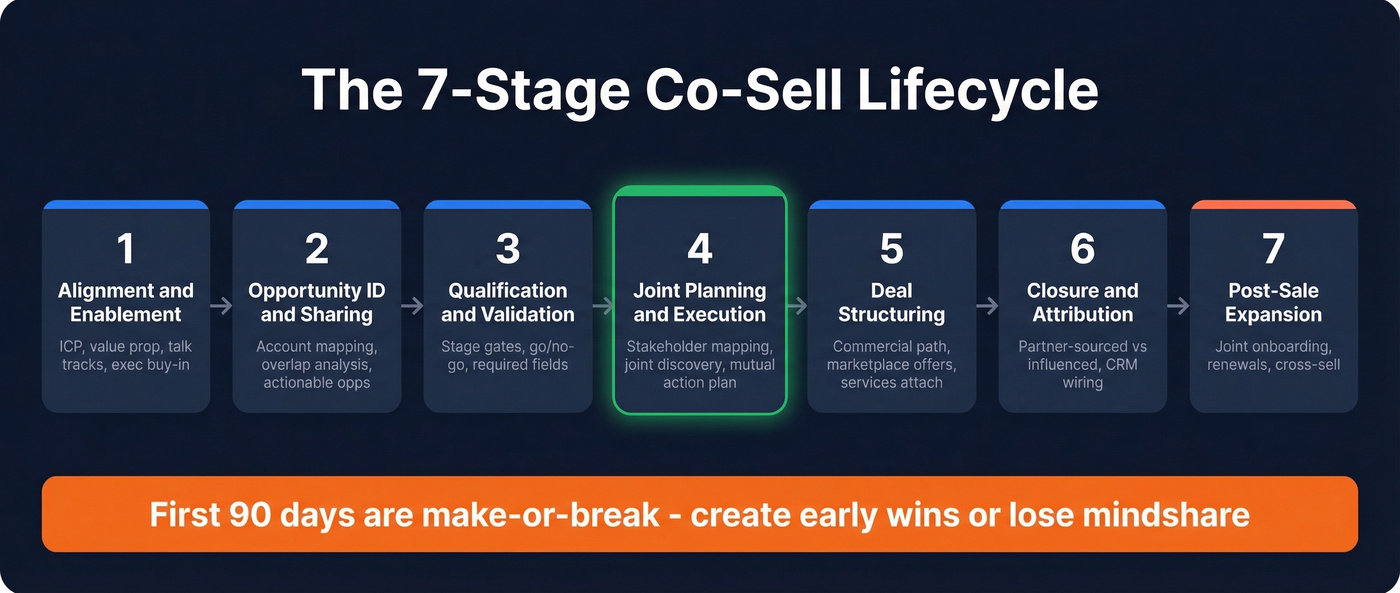
1. Partner alignment and enablement. Align on ICP, use cases, and a joint value prop. Then enable both sides with talk tracks, mutual qualification rules, and shared assets. Executive buy-in matters here - without it, the program becomes a side quest that dies the first time quota pressure spikes.
2. Opportunity identification and sharing. This is where account mapping earns its keep. Identify overlaps, whitespace, and "friendly" accounts where one partner already has trust. Automation helps, but the real unlock is agreeing on what an "actionable" opportunity looks like before you start sharing lists.
3. Qualification and validation. Ecosystems (especially hyperscalers) often require qualification criteria before field teams engage. Internally, you need the same discipline: stage gates, required fields, and a quick go/no-go so AEs don't waste cycles on partner noise.
4. Joint account planning and execution. The heart of the process. Stakeholder mapping, coordinated outreach, joint discovery, and a shared mutual action plan. Co-selling isn't just sales-to-sales - implementation, CS, and support teams often have deeper account context than the partner AE, so pull them in early.
5. Deal structuring and procurement. Decide the commercial path early: direct paper, marketplace private offer, multi-party structure, services attach. If you wait until legal/procurement, you'll lose momentum and the partner will disengage.
6. Deal closure and revenue attribution. Define partner-sourced vs. partner-influenced up front, and wire it into CRM stages. We've watched teams lose a quarter to attribution arguments because nobody agreed on definitions before the first deal hit commit. Don't be that team.
7. Post-sale expansion. The motion doesn't end at closed-won. Joint onboarding, adoption plays, renewals, and cross-sell are where partner-led growth compounds. The best programs treat CS as a co-sell channel, not an afterthought.
The first 90 days are the make-or-break window. If you don't create early wins and a repeatable cadence, you'll lose mindshare and the motion stalls. If you want a simple rollout structure, borrow the logic from a 30-60-90 day plan and adapt it to partners.
Co-Selling with Hyperscalers
Hyperscalers turn co-selling into a structured machine: field engagement, deal sharing, and marketplace procurement. The upside is real leverage. The downside is process overhead and eligibility gates.
| Program | Platform | Eligibility | Key Incentive |
|---|---|---|---|
| AWS ACE / ISV Accelerate | ACE Pipeline Manager | APN + ACE opportunity sharing | Field support + SaaS benefits |
| Microsoft co-sell | Partner Center | Azure IP co-sell eligible: $100K MBS/ACR | Field + marketplace |
| Google Cloud Partner Advantage | Partner Advantage | Level-based (Member through Premier) | Field alignment |
AWS
AWS's motion runs through ACE and the ISV Accelerate pathway. The tooling is unusually concrete: ACE Pipeline Manager, Slack Connect, Partner Connections, and Partner Central APIs for automating opportunity creation from your CRM.
Real outcomes: IBM drove 117% growth in co-sell opportunities, and Starburst accelerated co-selling 50% using Tackle's ACE CRM integration. AWS also has a COSS (Characteristics of Successful Sellers) 6-step framework that maps the partner journey from initial listing through scaled execution - worth studying before you engage their field teams. The expanded ISV Accelerate SaaS benefits announced at re:Invent 2024 make the program increasingly attractive for SaaS vendors willing to invest in the motion.
Microsoft Azure
Microsoft's model is more tiered and eligibility-driven. The key gating metric: Azure IP co-sell eligibility requires a transactable Azure offer, technical validation, and at least $100K in Marketplace Billed Sales or Azure Consumed Revenue (MBS/ACR). Once you're in, the operational center of gravity is Partner Center reporting and referrals - that's where teams end up living day-to-day.
Google Cloud
Google Cloud's Partner Advantage levels (Member through Premier) shape how much attention you get and how repeatable the motion becomes. The playbook is consistent: "better together" narrative, early rep engagement, and starting with pilots before you try to scale across the whole patch.
The Maturity Gap
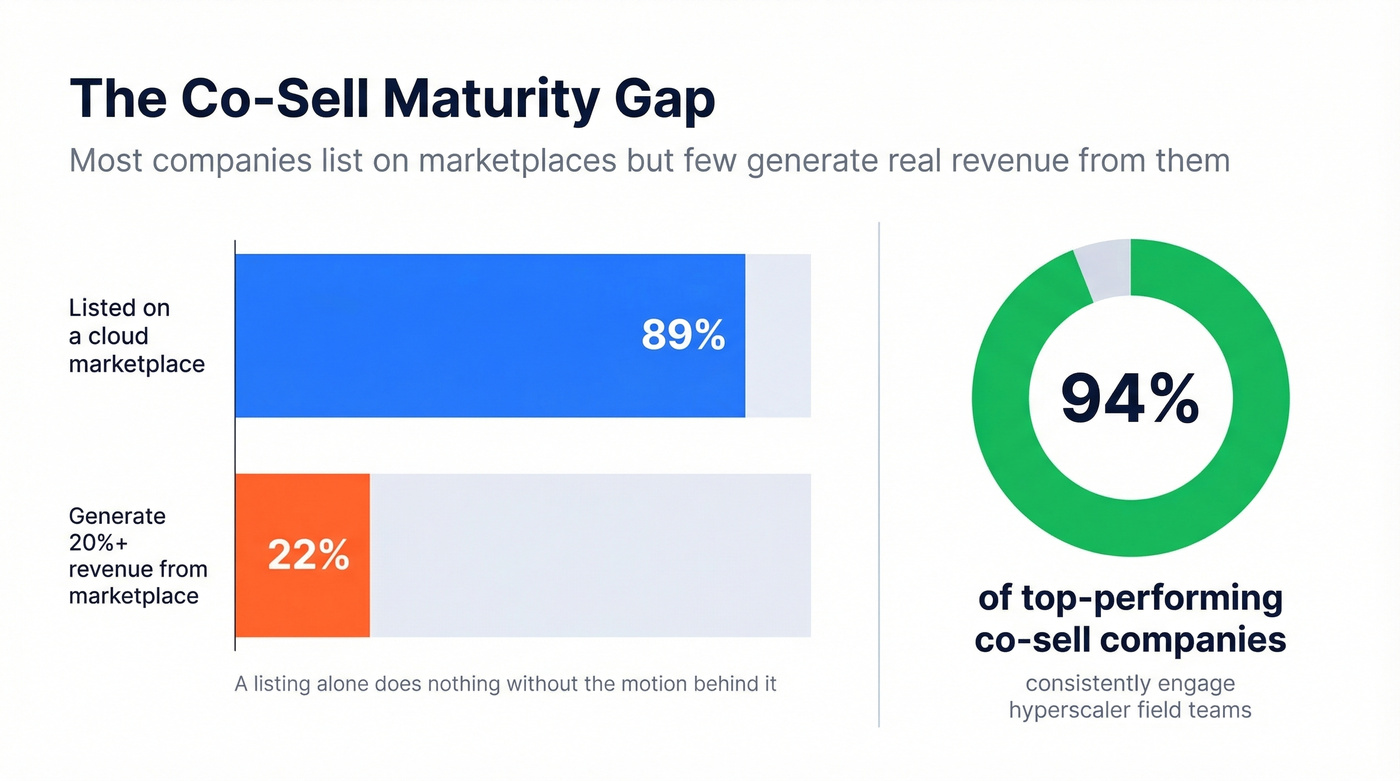
Cloud marketplace presence is common; marketplace-driven revenue isn't. 89% of companies are listed, but only 22% generate more than 20% of revenue through it. Meanwhile, 94% of top-performing co-sell companies consistently engage hyperscaler field teams. The listing alone does nothing without the motion behind it.
Essential Tools for Co-Selling
Co-selling doesn't need 12 tools. It needs the right few, wired together cleanly: CRM as the source of truth, account mapping for overlap, data quality for contacts, and attribution so nobody argues about credit.
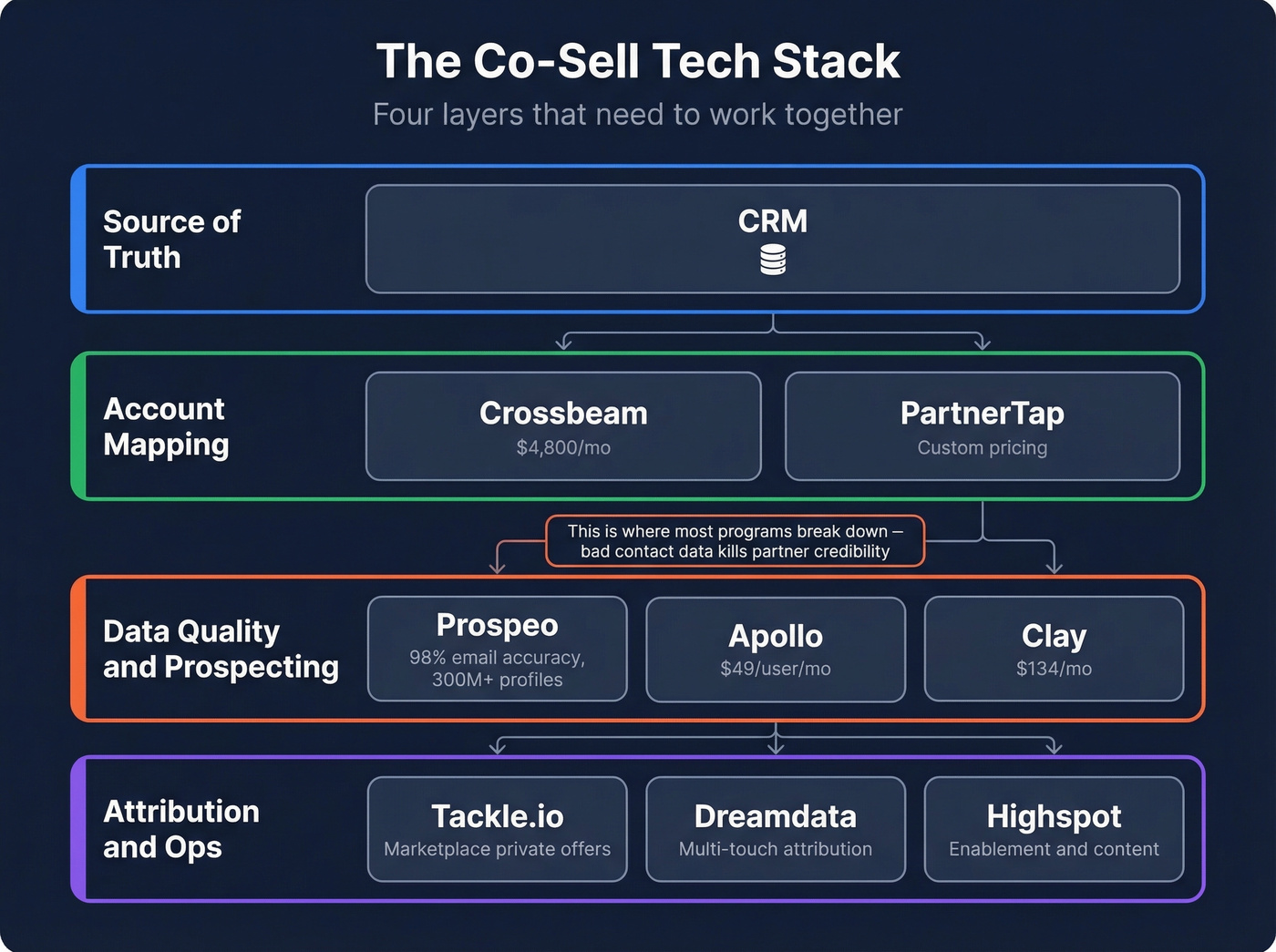
| Category | Tool | Starting Price | What It Does |
|---|---|---|---|
| Account mapping | Crossbeam | $4,800/mo | Overlap + sharing |
| Account mapping | PartnerTap | Custom | Enterprise mapping |
| Data quality | Prospeo | Free; paid plans available | Verified contacts |
| Prospecting | Apollo | $49/user/mo | Leads + outreach |
| Enrichment ops | Clay | $134/mo | Enrich + workflows |
| Marketplace ops | Tackle.io | Custom | Private offers |
| Attribution | Dreamdata | $750/mo (Starter) | Multi-touch ROI |
| Enablement | Highspot | Custom | Content + training |
Crossbeam is the default for account mapping in SaaS ecosystems - secure data comparison, overlap discovery, and governance so you're not emailing spreadsheets around. At $4,800/month for paid plans, make sure you've got real partner motion before you roll it out broadly.
PartnerTap plays in the same space with more enterprise-grade data controls and territory insights. Pricing is custom.
Let's be honest about where most programs actually break down: contact data. You can map accounts perfectly, build a gorgeous joint plan, and then share five "warm intros" where three emails bounce. That kills credibility with partners faster than anything else. Prospeo covers 300M+ professional profiles with 98% email accuracy on a 7-day refresh cycle, which means shared account lists stay usable instead of becoming dead-letter lists. If you're comparing vendors, start with a shortlist of data enrichment services.
Apollo bundles leads and sequencing at $49/user/month - useful for executing on mapped accounts fast. Clay ($134/month) turns account overlap into automated enrichment and routing workflows.
For early-stage programs, your CRM can double as a lightweight PRM. Skip the dedicated partner relationship management tool until you've outgrown spreadsheet tracking. If you need a baseline, use these examples of a CRM to sanity-check your setup.
Why Co-Sell Programs Fail
That 80% failure rate isn't because the concept is flawed. It's because most programs are run like a vibe, not an operating model.
In partner ops communities on Reddit and Slack, the same complaints surface repeatedly: attribution fights that stall deals for weeks, hyperscaler field reps who never show up after the initial intro, and partners who go dark after the first meeting. These aren't edge cases - they're the default experience when you skip the operational foundation.
Comp misalignment is the silent killer. If co-sell deals don't count toward quota - or worse, create double-counting fights - AEs will route around the partner every time. Make the motion at least comp-neutral, ideally comp-positive.
No governance or SLAs means every handoff is improvised. Define response times, handoff rules, and escalation paths before the first deal enters pipeline. Lock attribution definitions (partner-sourced vs. partner-influenced) before the first shared opp hits commit.
Take-first mentality poisons the well fast. Lead with value: intros, enablement, and joint wins. Partners who feel used once don't come back.
Missing the 90-day window is how most programs quietly die. Start with 3-5 accounts and ship a weekly cadence fast. Prove the motion works before you try to scale it.
MDF gets wasted at an alarming rate - 60% of MDF goes unclaimed. Assign an owner and a calendar, or you're leaving money on the table.
Bad data kills credibility faster than anything else. I've watched a co-sell motion die from one avoidable mistake: partners got a list, tried five people, and nothing connected. After that, every request felt like work instead of an advantage. Verify contacts before you share them - this is the cheapest insurance your partner program can buy. If bounces are a recurring issue, track and fix your email bounce rate before scaling outreach.
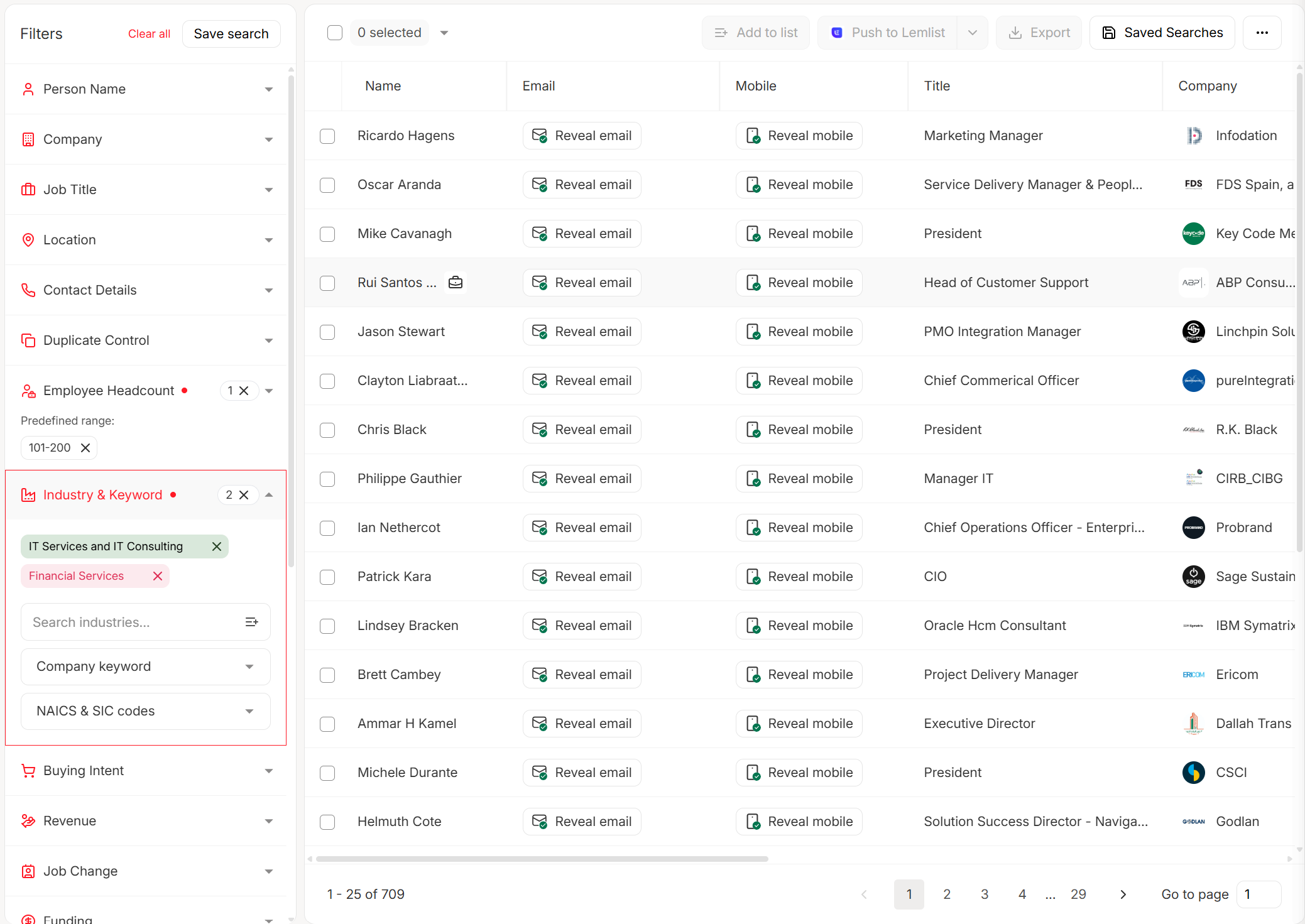
Joint account planning falls apart when AEs on either side can't reach decision-makers. Prospeo's 30+ search filters - including buyer intent, headcount growth, and technographics - let you build stakeholder maps with verified direct dials that pick up 30% of the time.
Stop co-selling blind. Start with contacts that actually connect.
FAQ
What's the difference between co-selling and reselling?
Co-selling means both companies stay involved in discovery, positioning, and closing, while the vendor or marketplace handles invoicing. Reselling means the partner is seller of record and owns the commercial relationship entirely. Choose co-selling for complex, multi-stakeholder deals; reselling for high-volume, lower-touch motions.
How do I start co-selling with AWS?
Register in AWS Partner Central, join APN, list on AWS Marketplace, then share opportunities through ACE Pipeline Manager. Build a cadence with AWS field teams using Slack Connect and apply for ISV Accelerate to unlock SaaS-specific benefits and deeper field engagement.
What does Azure IP co-sell eligible mean?
It's a Microsoft designation requiring a transactable Azure marketplace offer, technical validation, and at least $100K in Marketplace Billed Sales or Azure Consumed Revenue. It unlocks deeper field engagement, co-sell reporting in Partner Center, and priority visibility to Microsoft sellers.
How long does it take to see results from a co-sell program?
Most teams need 3-6 months to see measurable pipeline impact, with the first 90 days being critical. Start narrow with 3-5 mapped accounts, prove a repeatable cadence, and expand only after you've closed or advanced at least two partner-influenced deals.
What tools do I need to run a co-sell motion?
At minimum: a CRM to track accounts and attribution, an account mapping tool like Crossbeam or PartnerTap to find overlap, and a verified contact data source so intros don't bounce. Add marketplace ops tooling like Tackle once you're transacting through AWS or Azure.