

Account Mapping: Map Stakeholders, Win Deals, and Stop Single-Threading
Your champion just left the company mid-deal. The VP who was "totally bought in" got reorged into a different business unit. And the only person left on your side is a mid-level manager who can't sign anything over $5,000.
This is what happens when you single-thread enterprise deals - and it's why account mapping isn't optional anymore. It's the difference between deals that close and deals that die in committee.
The Short Version
Account mapping means visually charting every stakeholder, their influence level, and their relationships at a target account so you can multi-thread deals instead of betting everything on one champion. Two types exist: sales account mapping (mapping stakeholders inside a prospect org) and partner account mapping (overlapping CRMs with ecosystem partners for co-selling).
Here's what most guides won't tell you: your map is only as good as the data feeding it. Stale contacts, wrong titles, and bounced emails make the whole exercise pointless. Verify your contacts before you map them.
What Account Mapping Actually Is
The process involves visually representing the stakeholders, decision-makers, influencers, and their relationship dynamics at a target company. The goal is to identify the best path to a closed deal - not just who reports to whom, but who actually holds influence.
This isn't an org chart. An org chart shows reporting lines. A stakeholder map shows informal hierarchies, political dynamics, and communication flows. The Director of IT Security who technically reports three levels below the CIO might be the person who kills your deal in week eight. An org chart won't tell you that. A proper map will.
Two distinct meanings float around, and they solve different problems. Sales account mapping is what most people mean: mapping stakeholders inside a single prospect organization to navigate a complex deal. Partner account mapping is the other flavor - overlapping your CRM with a channel partner's CRM to find co-selling opportunities. Both matter. We'll cover both.
Why Buying Committees Keep Growing
Buying committees aren't getting smaller. They're getting dramatically larger, and every new stakeholder adds friction to your deal.
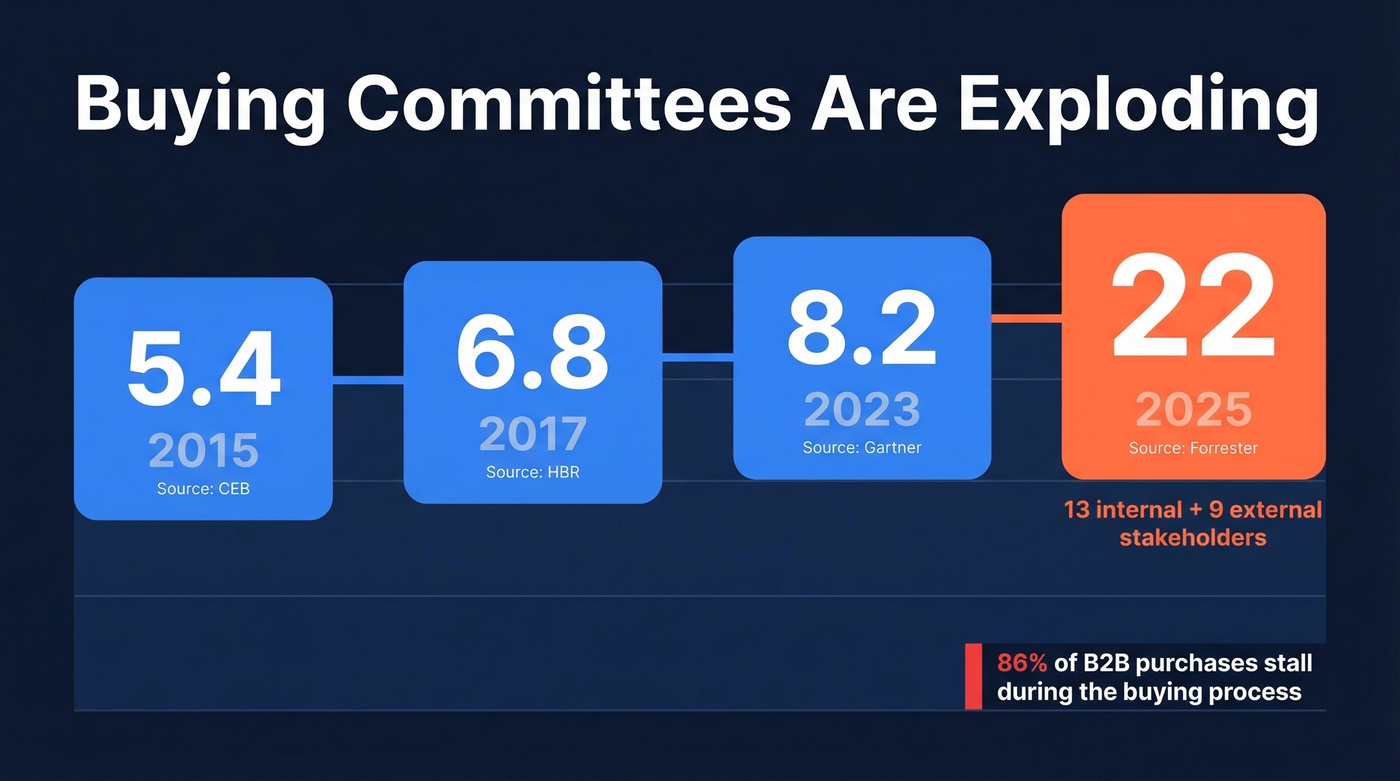
| Year | Avg. Stakeholders | Source |
|---|---|---|
| 2015 | 5.4 | CEB |
| 2017 | 6.8 | HBR |
| 2023 | 8.2 | Gartner |
| [2025 | 13 internal + 9 external](https://www.forrester.com/blogs/three-realities-about-b2b-buying-networks/) | Forrester |
That's not a gradual increase - it's an explosion. 53% of procurement stakeholders now identify as decision-makers from the earliest stages of a purchase. If you're not mapping procurement and legal from day one, you're already behind.
The downstream effects are brutal. 86% of B2B purchases stall during the buying process. 81% of buyers end up dissatisfied with the provider they choose. Sales cycles compressed from 11.3 months to 10.1 months between 2024 and 2025, meaning you've got less time to navigate more people.
Buyers define their requirements 83% of the time before they ever talk to a sales rep. If you haven't mapped the buying committee by then, you're playing catch-up against a decision that's already half-made. This is especially true for teams running account-based marketing strategies, where identifying and engaging the full buying group early is the entire premise.
And here's the thing: fewer than 20% of companies have fully embedded account planning into their operations. Most teams are winging it - relying on a single champion and hoping the deal doesn't get ambushed by a VP they never met. Mapping stakeholders is how you stop hoping and start executing.
If your average deal size is under $25K and involves fewer than three stakeholders, you probably don't need a formal map. A good discovery call covers it. But the moment you're selling into a buying committee of five or more, this isn't a nice-to-have. It's the entire game.
How to Build a Sales Account Map
Six steps, each one building on the last. Expect to spend 30-90 minutes building the initial map for a new account, and 10-20 minutes per week maintaining it for active deals. That's a fraction of the time you'll waste chasing the wrong stakeholder.
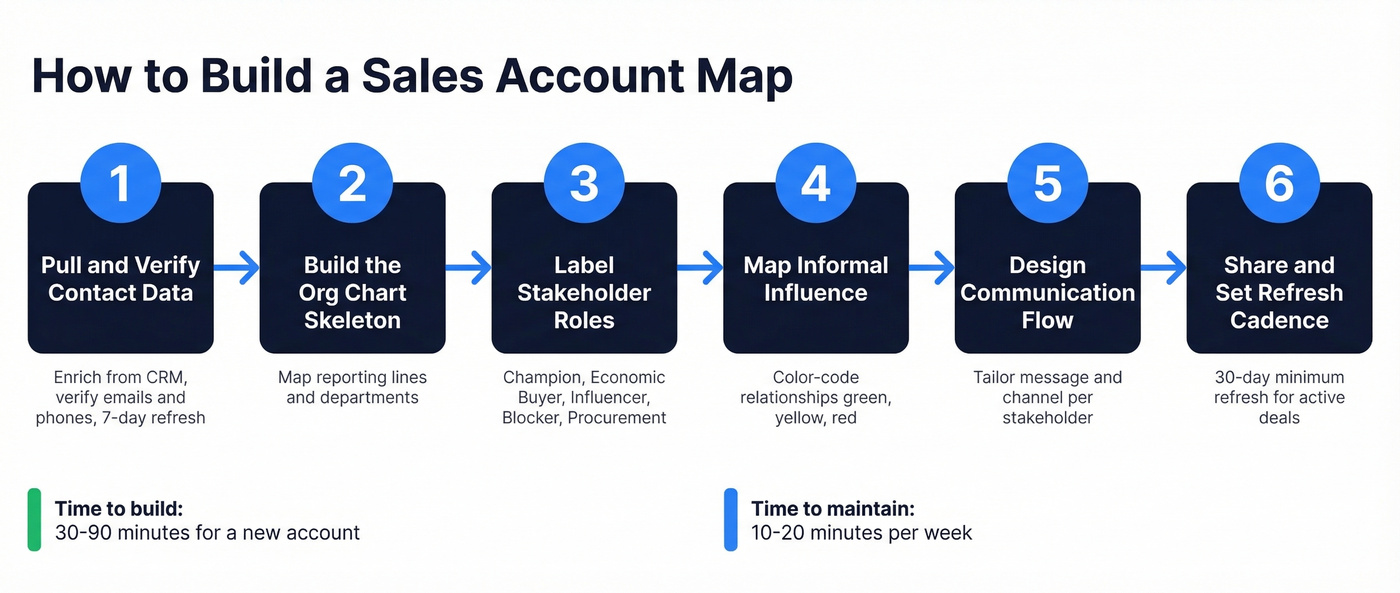
Step 1: Pull and Verify Contact Data
Your map starts with data, not strategy. Pull every contact associated with the target account from your CRM, then enrich the gaps. You need names, titles, departments, emails, and phone numbers - and you need them to be current.
This is where most maps fail before they start. If your contact data is six months old, you're mapping ghosts. People change roles, leave companies, and get promoted constantly. We've found that running target accounts through Prospeo's CRM enrichment catches the gaps fast - 50+ data points per contact come back, including verified emails and verified mobile numbers, all on a 7-day refresh cycle. That's your raw material.
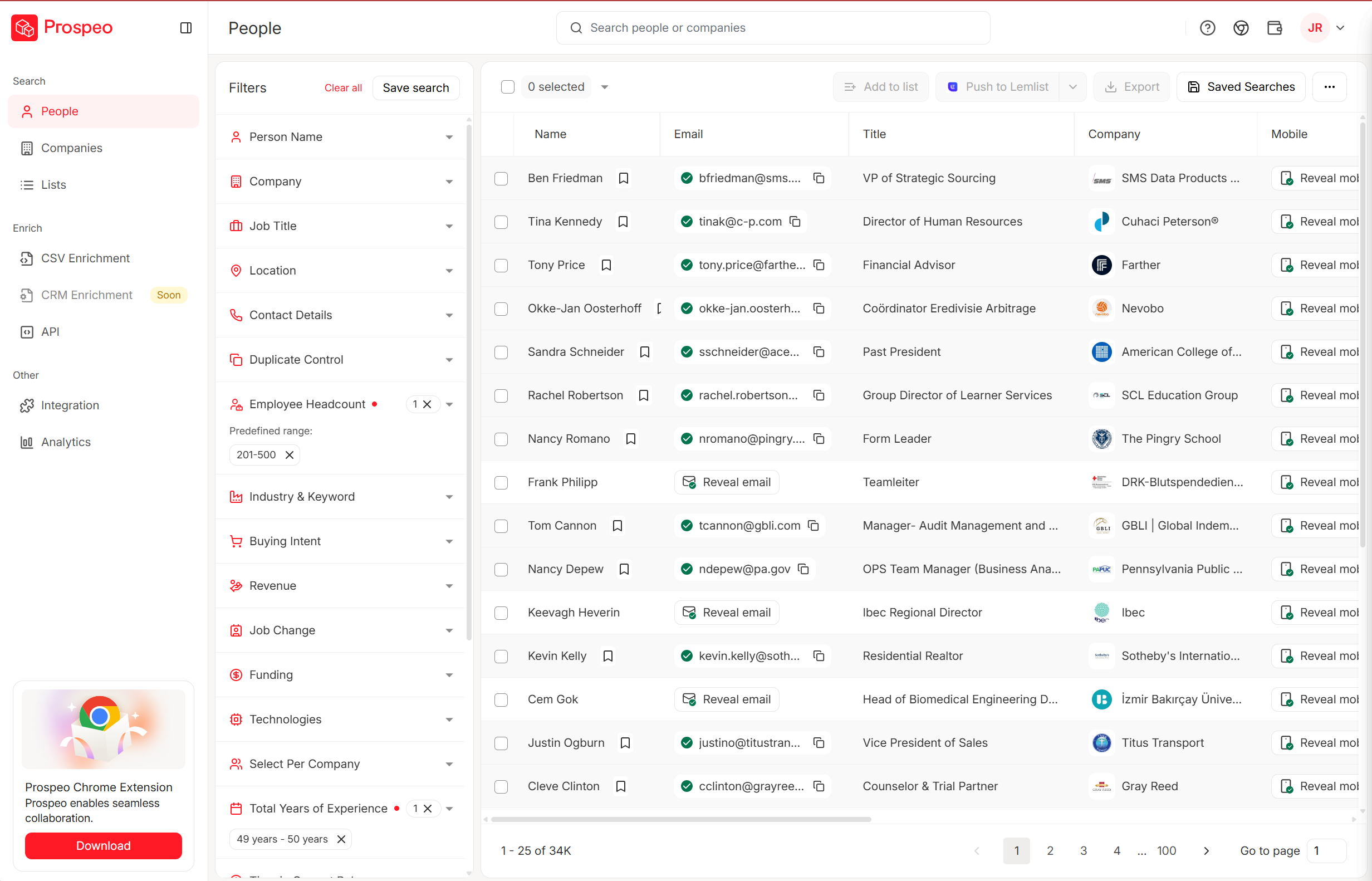
The practitioner workflow from experienced enterprise reps is consistent: find the champion first (often a mid-level daily user of whatever you're selling), then map upward to the economic buyer and decision-maker, then map sideways into adjacent departments that touch the problem. Target 4-5 relevant contacts per account minimum.
Step 2: Build the Org Chart Skeleton
With verified contacts in hand, lay out the basic reporting structure. Who reports to whom? Which departments are involved? This is the scaffolding - not the finished product.
Don't overthink this step. A whiteboard, a Lucidchart diagram, or even a spreadsheet works. The point is to get the hierarchy visible so you can layer influence on top of it.
Step 3: Label Stakeholder Roles
Every contact gets a role label. The standard framework works well:
- Champion - your internal advocate who sells when you're not in the room
- Economic Buyer - controls the budget and signs the check
- Influencer - shapes the decision but doesn't make it
- Blocker - actively or passively working against you
- Procurement/Legal - controls the paper process and timeline
One person can hold multiple roles. Your champion might also be an influencer. The economic buyer might also be a blocker if they're pushing for a competitor. Label what you know, flag what you don't.
Step 4: Map Informal Influence
This is where stakeholder mapping separates from org charting. Reporting lines tell you structure. Influence lines tell you reality.
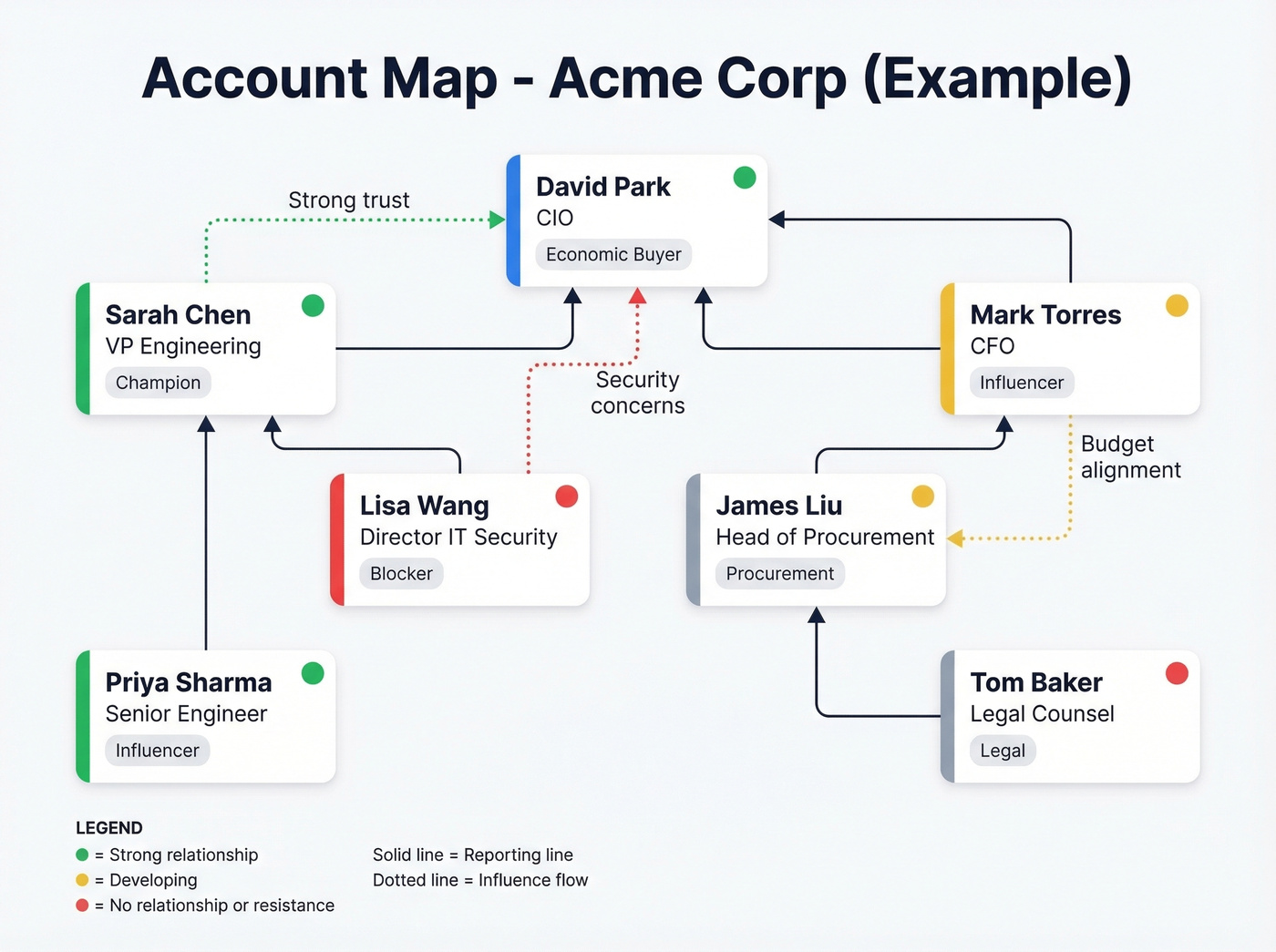
Use a simple color-coding system: green for strong relationships where you have access and trust, yellow for developing relationships where you've engaged but haven't built trust, and red for no relationship or active resistance. Draw dotted lines between people who influence each other outside the formal hierarchy.
The Fluint framework calls this "designing the flow of internal communications" rather than documenting structure. Enterprises are sense-making loops, not static hierarchies. Your map should reflect how information actually moves - who talks to whom before a decision gets made. This kind of stakeholder mapping is what separates reps who multi-thread effectively from those who get blindsided by someone they never knew existed.
Step 5: Design the Communication Flow
Now you're planning, not just documenting. For each stakeholder, define who on your team talks to them, what message they need, and through which channel.
Your champion gets a technical deep-dive on API latency and implementation timelines. The CFO gets a two-slide ROI model showing payback in nine months. The decision-maker gets strategic alignment with their annual priorities. Procurement gets timeline and compliance assurance. Tailoring touches by role consistently produces better response rates than generic outreach - we've seen this play out across dozens of deal reviews.
If you need a repeatable way to keep touches consistent across stakeholders, build it into your sales follow-up templates and sequences.
Step 6: Share and Set a Refresh Cadence
A map that lives in one rep's head is worthless. Share it with your team - AEs, SEs, managers, anyone involved in the deal. Use it in deal reviews and QBRs.
Set a 30-day refresh cadence minimum for active deals. Contacts change. Champions leave. New stakeholders appear. If your map hasn't been updated in a month, treat it as unreliable.

Account maps built on stale data are just pretty diagrams. Prospeo enriches every contact with 50+ verified data points on a 7-day refresh cycle - so the stakeholders you map are reachable, not ghosts. 98% email accuracy. 125M+ verified mobiles.
Stop mapping contacts you can't actually reach.
Stakeholder Map Template
Copy this into a Google Sheet or Salesforce custom object. Each row is one stakeholder; each column drives a specific deal action.
| Field | Example |
|---|---|
| Name | Sarah Chen |
| Title | VP Engineering |
| Department | Engineering |
| Role in Decision | Economic Buyer |
| Motivations | Reduce infra costs 30% |
| Likely Objections | Migration risk, team capacity |
| Relationship (G/Y/R) | Yellow |
| Engagement Strategy | ROI case study + CTO intro |
| Last Verified | 2026-01-15 |
The "Last Verified" column is the one most teams skip - and it's the most important. If that date is more than 30 days old for an active deal, the rest of the row is suspect. One wrong title leads to a misrouted email, which leads to a missed meeting, which leads to a deal that stalls because you never engaged the real decision-maker.
How MEDDPICC and Your Map Work Together
If your team runs MEDDPICC, your stakeholder map should align directly to it. They're not separate exercises - they're the same exercise viewed from different angles.
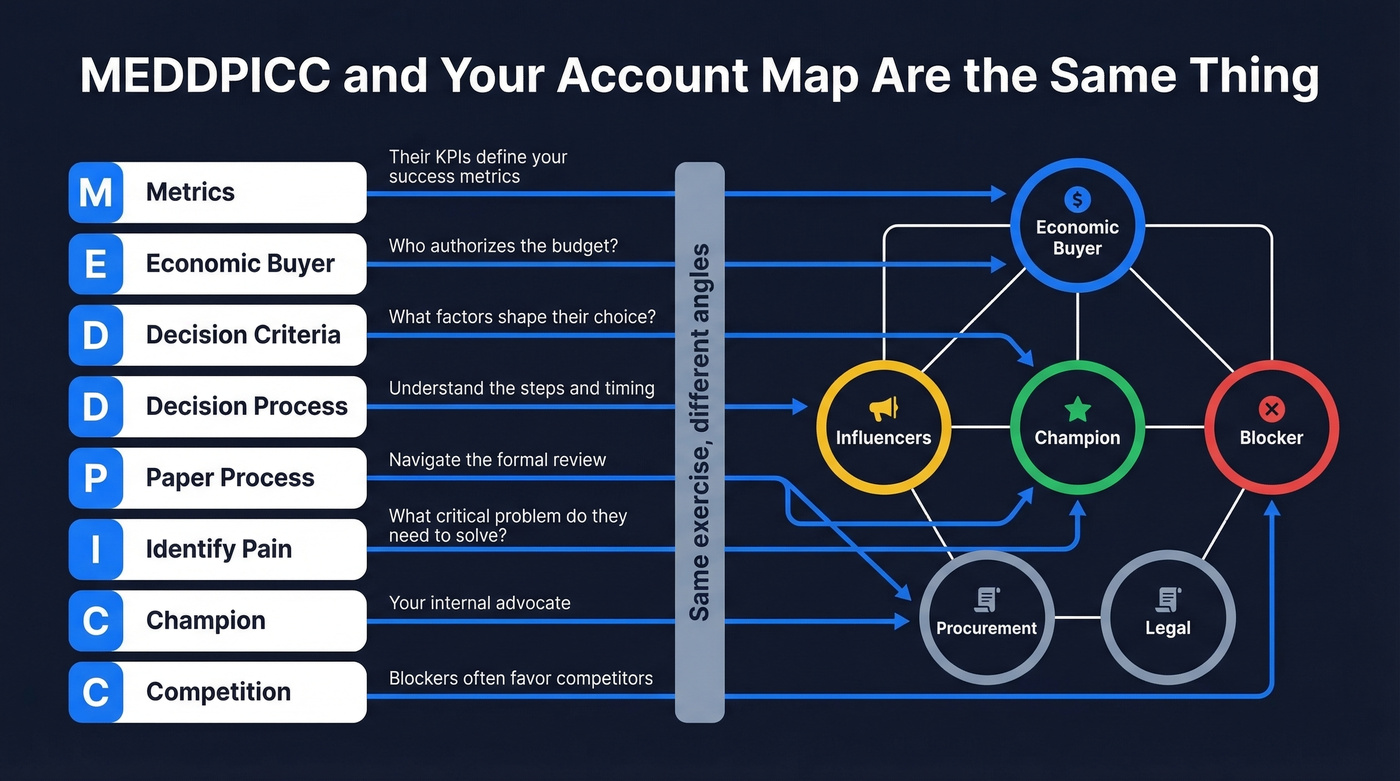
| MEDDPICC | What It Maps To | Map Node |
|---|---|---|
| Metrics | Success criteria | Champion's KPIs |
| Economic Buyer | Budget authority | Economic Buyer node |
| Decision Criteria | Eval framework | Influencer inputs |
| Decision Process | How they decide | Communication flow |
| Paper Process | Legal/procurement | Procurement/Legal nodes |
| Identify Pain | Business problem | Champion's motivations |
| Champion | Internal advocate | Champion node |
| Competition | Alternatives | Blocker intel |
The MEDDPICC framework helped PTC grow from $300M to $1B in four years. The reason it works is the same reason mapping stakeholders works: it forces you to identify and engage every person who can kill or accelerate your deal. The qualification framework tells you what you need to know, and the map tells you who you need to know it from.
"Enthusiasm doesn't sign contracts - procurement departments do." That's straight from HubSpot's MEDDPICC breakdown, and it's the single best argument for mapping procurement and legal early. MEDDPICC fits best for deals above $50K with sales cycles longer than six months - exactly where detailed stakeholder maps deliver the most value.
If you're formalizing qualification alongside mapping, align your process with a consistent MEDDIC sales qualification workflow.
Five Mistakes That Kill Deals
Mistake 1: Mapping Titles, Not Influence
A "Director" title doesn't mean someone has decision-making power. A "Senior Manager" might be the person the CEO trusts most on technical purchases. Map influence, not hierarchy. Ask your champion directly: "Who does [Economic Buyer] listen to on decisions like this?"
Mistake 2: Ignoring Legal, Security, and EAs
Most reps map the buying committee and stop. They miss the people who control the paper process - legal review, security questionnaires, procurement negotiations. They also miss executive assistants, who control calendar access. Add a "Paper Process" section to every map with at least two contacts.
Mistake 3: Treating the Map as Static
We've seen teams lose six-figure deals because their map was three months stale. A champion quietly left, a new VP joined with a competing vendor relationship, and nobody updated anything. By the time the AE found out, the deal was dead.
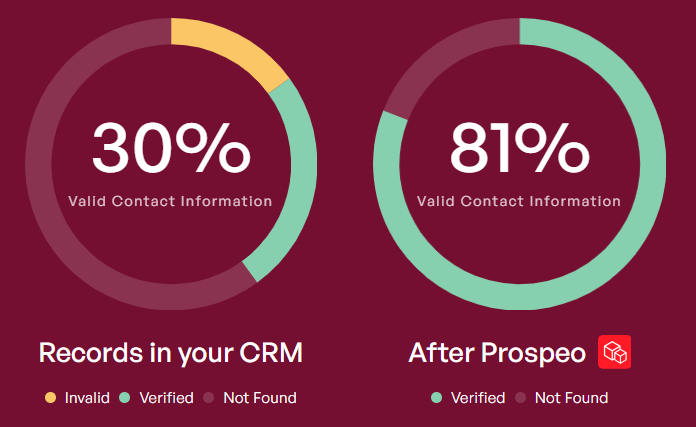
Set a calendar reminder. Update every active deal map at least monthly. Automate the data layer so you're spending time on strategy, not manual re-verification.
If you're evaluating vendors for the data layer, start with a shortlist of data enrichment services.
Mistake 4: Tribal Knowledge Traps
Your best AE knows exactly who the blocker is, what motivates the champion, and which VP is quietly evaluating a competitor. That intel is in their head - not in the CRM. When they go on vacation or leave the company, it vanishes. Every deal review should include a five-minute map update. If it's not in the system, it doesn't exist.
Mistake 5: Mapping Without Relationship Strength
Drawing a line between two stakeholders tells you nothing useful on its own. Is that a strong relationship or a cold one? Do you have access or are you guessing? Use the green/yellow/red system for every connection. A map full of red lines tells you exactly where to focus next week.
Partner Account Mapping
Partner account mapping solves a completely different problem. Instead of mapping stakeholders inside one company, you're overlapping your CRM with a channel partner's CRM to find co-selling opportunities.
The process has four steps: connect your CRM to a partner mapping platform, invite your partner to do the same, choose what account-level data to share, and review the overlaps. The output tells you which of your prospects are already customers of your partner (warm intros), which of their prospects are your customers (expansion plays), and where you're both prospecting the same accounts (co-selling).
| Tool | Network | Free Tier | Paid Pricing | Best For |
|---|---|---|---|---|
| Crossbeam | 18K+ companies | Yes (up to 3 seats) | $150/user/mo (annual) | Enterprise ecosystems |
| Reveal | 12K+ companies | Yes | ~$1K-$5K/yr | European partners |
| PartnerTap | Enterprise | No | ~$15K-$60K/yr | Fortune 500 co-selling |
Crossbeam is one of the biggest platforms in this space, with 18,000+ companies on the network. Reveal positions as the lower entry point with a strong European footprint. PartnerTap is purpose-built for large enterprise partner programs - skip it unless you're running a complex channel strategy with Fortune 500 partners.
Best Tools for the Job
You don't need ten tools. You need accurate data and a visualization layer.
| Tool | Best For | CRM Integration | Price Range |
|---|---|---|---|
| Prospeo | Contact data and enrichment | Salesforce, HubSpot | Free-~$0.01/lead |
| Lucidchart | Visual org charts | Salesforce | Free-~$15/user/mo |
| Miro | Collaborative mapping | HubSpot, Salesforce | Free-~$15/user/mo |
| DemandFarm | Enterprise key accounts | Salesforce | ~$30-$80/user/mo |
| Gong | Stakeholder sentiment | Salesforce, HubSpot | ~$100-$200/user/mo |
Prospeo is the data foundation. No visualization tool matters if the contacts underneath are wrong. With 98% email accuracy, 125M+ verified mobiles, and a 7-day refresh cycle versus the 6-week industry average, it ensures the names and numbers on your map are current. CRM enrichment returns 50+ data points per contact at a 92% match rate - meaning you spend time on strategy, not data cleanup.
Lucidchart is the default for visual org-chart mapping. The Salesforce integration pulls contact data directly into diagrams, and the green/yellow/red relationship coding works natively. For drag-and-drop relationship visualization, start here.
Miro is the better pick if your team already lives in Miro for other workflows. Real-time collaboration is smoother, and the infinite canvas handles complex maps with 10+ stakeholders well.
DemandFarm is an enterprise key account management platform. Skip it unless you're running Fortune 500 account planning with whitespace analysis and multi-year strategic plans.
Gong isn't a mapping tool, but conversation intelligence reveals stakeholder sentiment and relationship signals that should feed your map. If a VP expressed concerns on the last call that your champion didn't mention, Gong catches it.
The r/sales consensus is that most teams want a tool that builds org charts and integrates with their CRM - and most can't find exactly what they need. No single tool does everything. Pick a visualization layer, pair it with accurate contact data, and build the discipline of updating maps regularly.
If you're building the top of funnel for mapped accounts, use proven sales prospecting techniques to open doors across the buying group.
Multi-threading a deal means reaching 4-5+ stakeholders per account with verified contact info. Prospeo's 30+ search filters let you find every champion, economic buyer, and blocker - with emails and direct dials that actually connect.
Find the full buying committee in minutes, not weeks.
FAQ
What's the difference between account mapping and account planning?
Account mapping is one component of account planning. The map visualizes stakeholders and relationships; the plan adds revenue goals, whitespace analysis, competitive positioning, and milestones. Fewer than 20% of companies have fully embedded account planning - most stop at the map.
How often should you update a stakeholder map?
Every 30 days minimum for active deals. Contacts change roles and leave companies constantly. Automate the data layer with a tool that refreshes regularly so you're spending time on strategy, not manual re-verification.
Can you do this in a CRM without extra tools?
Yes - Salesforce and HubSpot both support contact roles and account hierarchies natively. For simple deals with 3-5 stakeholders, CRM fields are enough. For enterprise deals with 10+ stakeholders, a visual tool like Lucidchart or Miro makes the map usable in deal reviews.
How does buying committee mapping fit into ABM?
Buying committee mapping is the connective tissue between marketing and sales in any ABM program. ABM buying groups typically include 5-13 stakeholders across multiple departments. When marketing identifies and warms committee members before sales engages, deal velocity increases because reps aren't starting cold with half the group.