

Pattern Interrupt Cold Call Openers That Actually Book Meetings
A pattern interrupt cold call works because prospects decide whether to hang up in the first few seconds - and your first sentence is doing almost all the work. "Hi, this is Mike from Acme" stopped working years ago. Pattern interrupts work in emails, demos, and follow-ups too, but this piece focuses on the phone, where the stakes are highest.
Cold calling success rates have climbed from roughly 2.3% in 2022 to 4.8% in 2026, and 82% of B2B buyers say they've accepted a meeting from a sales call. Gartner projects 75% of B2B buyers will favor human interaction over AI by 2030. The phone isn't going anywhere.
What You Need (Quick Version)
- Best opener to test this week: The honesty interrupt - "This is a cold call. Give me 18 seconds?" A rep on r/Entrepreneur tracked 30% of prospects staying past 30 seconds with this line, versus 22% for permission-based openers and 14% for a direct pitch. One team reported a 37% increase in meeting rates within the first month of switching to interrupt-style openers.
- Full call structure: Interrupt, reason, one-line value, open question, meeting ask. Keep it under a minute before you hand the conversation over. (If you want a full outbound system, see a complete cold calling system.)
Why Pattern Interrupts Work
A pattern interrupt triggers what psychologists call the orienting response - the reflexive shift in attention when something unexpected enters your environment. Think of it like a record scratch in a movie scene: everything stops, and the audience leans in.
On a cold call, the prospect's brain is running a script: sales call, polite rejection, hang up. A well-placed interrupt breaks that loop and buys you a short window of genuine attention. The guardrail is simple - the interrupt has to be surprising and connected to the conversation. Saying something random grabs attention but destroys trust. Saying something honest and slightly unexpected, like admitting it's a cold call, does both. (If you're new to dialing, start with cold calling for beginners.)
Pattern Interrupt Cold Call Data
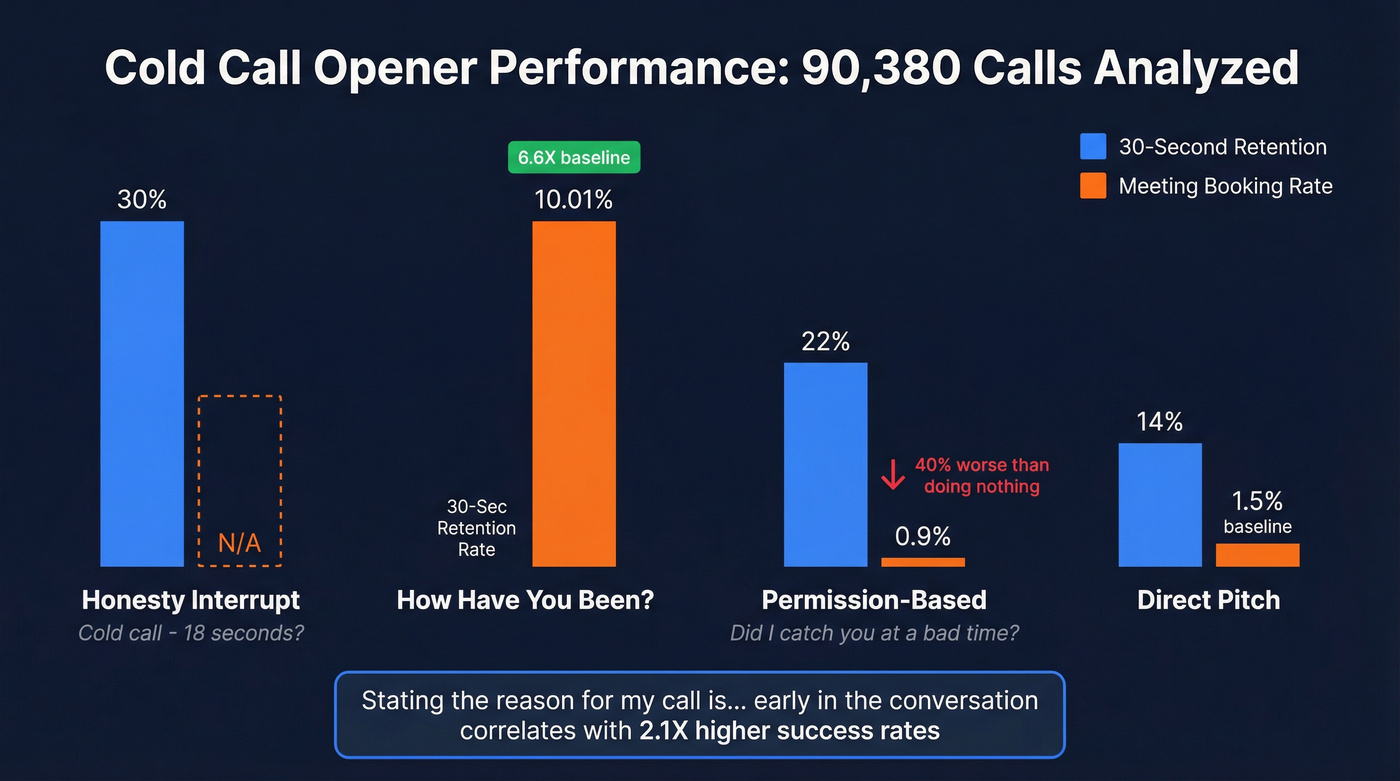
An analysis of 90,380 cold calls is still the largest public dataset on opener performance. Pair it with a Reddit rep's real-world A/B test and the picture gets clear fast.
| Opener Type | Example | 30-Sec Retention | Meeting Rate |
|---|---|---|---|
| Honesty interrupt | "Cold call - 18 seconds?" | 30% | Not reported separately |
| "How have you been?" | "Hey [Name], how have you been?" | Not measured separately | 10.01% - 6.6X baseline |
| Permission-based | "Did I catch you at a bad time?" | 22% | 0.9% |
| Direct pitch | "Hi, I'm calling because we help companies like yours reduce..." | 14% | 1.5% baseline |
The permission-based opener - "Did I catch you at a bad time?" - is 40% less likely to book a meeting than saying nothing special at all. It hands the prospect an easy exit. Meanwhile, stating "the reason for my call is..." early in the conversation correlates with 2.1X higher success rates. Prospects don't want to be asked for permission. They want a reason to stay.
If you're building a broader outbound motion, these sales prospecting techniques pair well with interrupt-style openers.
7 Openers Worth Testing
1) The Honesty Interrupt
"Hey [Name], this is a cold call. You can hang up, but give me 18 seconds first."
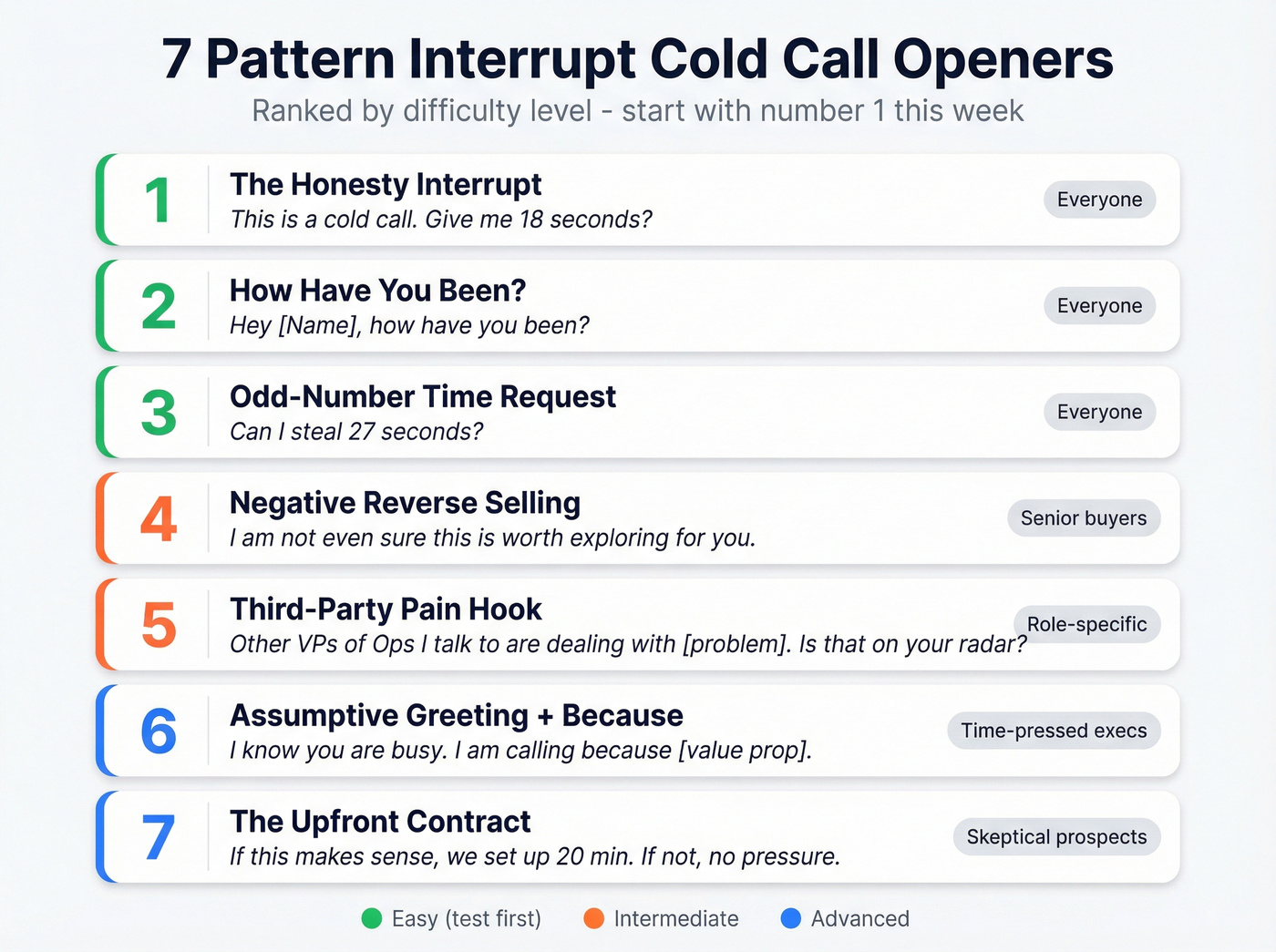
Disarming, direct, and it reframes the dynamic - you're not pretending to be anything other than a salesperson. If you're only going to test one line this week, test this one.
2) "How Have You Been?"
"Hey [Name], how have you been?"
This hit a 10.01% success rate in the 90,000-call study - 6.6X the baseline. The dataset classifies it as a rapport opener, but it functions as an interrupt because nobody expects a stranger to ask it. The prospect's brain stalls for a beat, and that beat is your window.
3) The Odd-Number Time Request
"Can I steal 27 seconds?"
Specific, slightly weird numbers signal that you've thought about this. It's a micro-interrupt inside the opener. We've seen reps use 17, 27, and 22 seconds - the exact number matters less than the fact that it isn't a round one.
4) Negative Reverse Selling
Here's how this plays out in practice:
Prospect: "What do you want?" You: "Honestly, I'm not even sure this is worth exploring for you." Prospect: "...go on."
Borrowed from Sandler's playbook, this invites the prospect to convince themselves there's a reason to talk. Best reserved for skeptical, senior buyers who've heard every pitch. Skip it with mid-level contacts who don't have the ego investment to push back - they'll just say "okay, bye."
5) Third-Party Pain Hook
"Other VPs of Ops I talk to are dealing with [specific problem]. Is that on your radar?"
This shifts the frame from "let me pitch you" to "let me see if you have this problem." It works best when the pain is genuinely common in their role. Skip this one if you can't name a real, specific pain - vague versions like "other leaders are struggling with efficiency" sound like a template and kill trust instantly.
6) Assumptive Greeting + "Because"
"Hi [Name], I know you're busy - I'll be brief. I'm calling because [one-sentence value prop]."
No permission-seeking, just straight into the reason. The word "because" signals a reason is coming, which keeps people listening - Ellen Langer's classic "copy machine" study demonstrated this decades ago.
7) The Upfront Contract
| Without upfront contract | With upfront contract |
|---|---|
| Prospect fears being trapped in a 10-minute pitch | Prospect knows there's an exit ramp |
| Defensive posture from second one | Guard drops because you set the terms |
| "I'm not interested" at the 5-second mark | "Okay, what do you have?" |
The line: "If what I share makes sense, we'll set up 20 minutes. If not, we part ways - no pressure."
This removes the prospect's fear of being trapped, which is the real reason most people hang up.

A perfect opener means nothing if you're calling the wrong number. Prospeo gives you 125M+ verified mobile numbers with a 30% pickup rate - so your pattern interrupt actually reaches a decision-maker, not a gatekeeper or a dead line.
Stop wasting killer openers on bad phone numbers.
Call Structure After the Opener
Once the opener lands, you've got a short window before the prospect re-evaluates. Here's the five-part framework, adapted from Alex Berman's 14,000-call methodology:
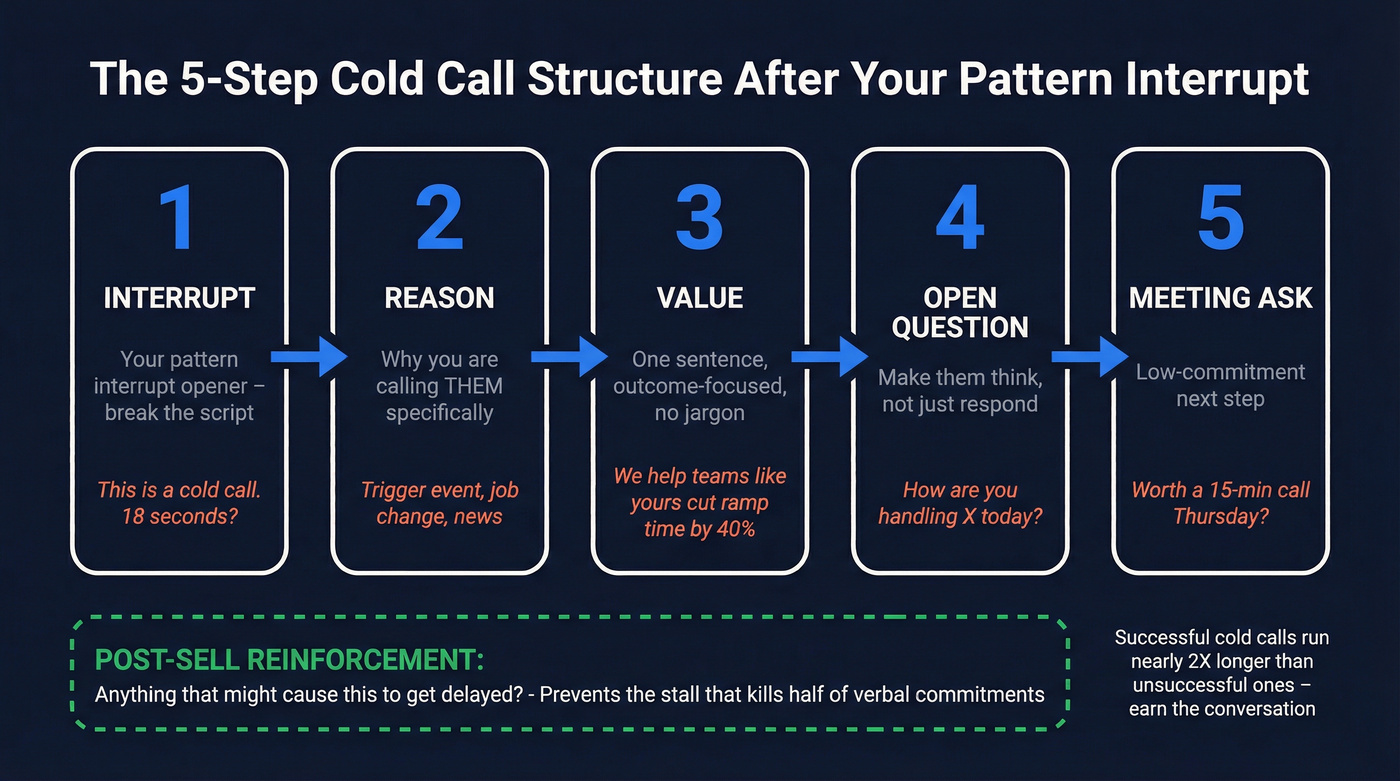
- Interrupt - your opener from above
- Reason - why you're calling them, specifically (trigger event, news, role-based pain)
- Value statement - one sentence, outcome-focused, no jargon
- Open question - make them think, not just respond ("How are you handling X today?")
- Meeting ask - low-commitment next step ("Worth a 15-minute call Thursday?")
After they agree, lock it down. "Anything that might cause this to get delayed?" This post-sell reinforcement - borrowed from Sandler's methodology - prevents the stall that kills half of verbal commitments before they hit the calendar.
The 90,000-call dataset shows successful cold calls run almost 2X longer than unsuccessful ones. That doesn't mean you should monologue. It means the goal is to earn enough time for a real exchange. Talk-to-listen ratio on cold calls skews higher than discovery calls because you're selling the meeting, not running a needs analysis. (For the next step after the meeting is booked, use a discovery questions framework.)
Timing and Missed-Call Recovery
Timing matters more than most reps think. Tuesday through Thursday, 10:00-11:30 AM local time hits a 19% connect rate. Monday mornings drop to 9%. Friday afternoons? 5%. Stop dialing after lunch on Fridays.
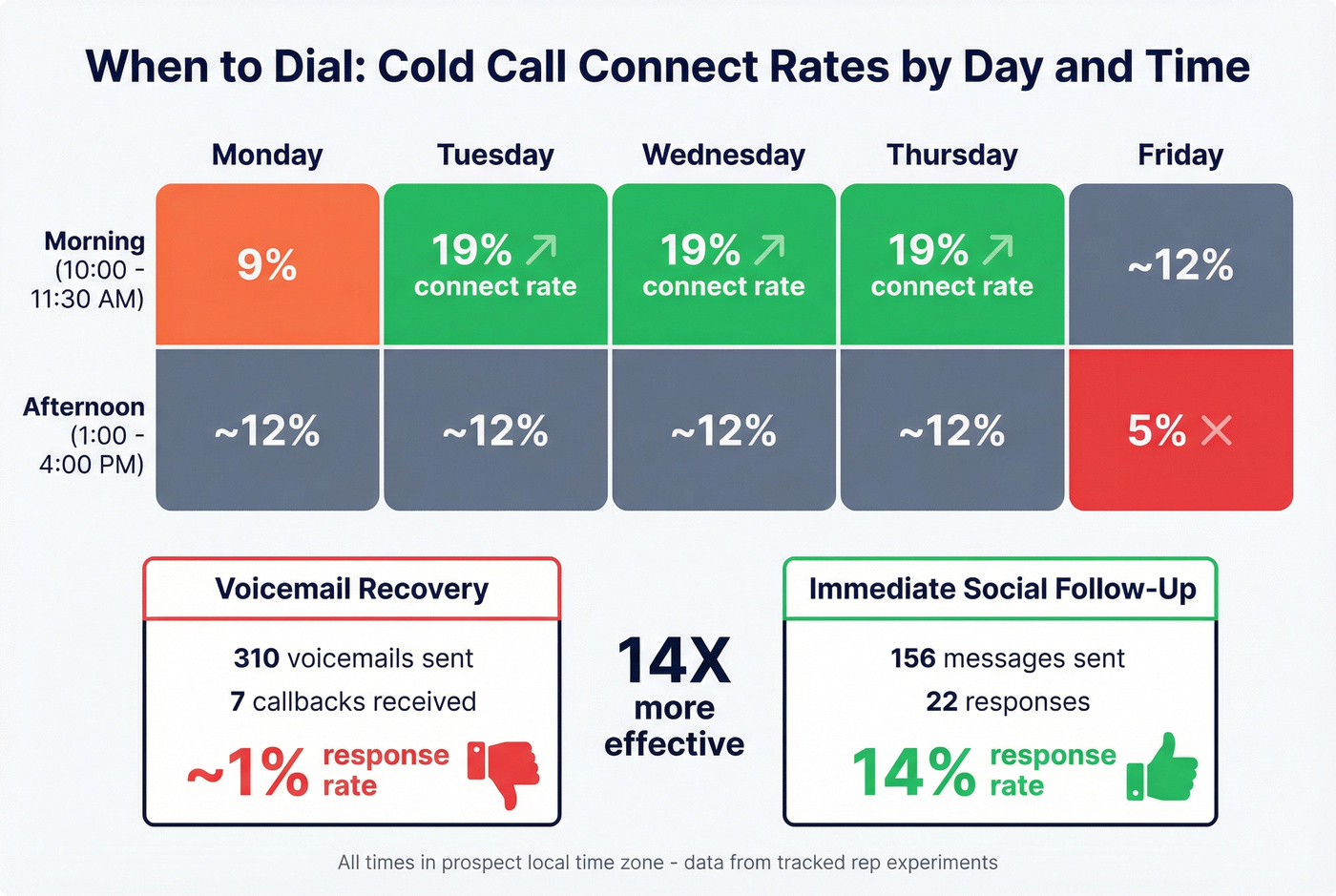
When you miss, skip the voicemail. The same r/Entrepreneur rep tracked 310 voicemails and got 7 callbacks - roughly 1%. Instead, fire off a follow-up message within 5 minutes on the channel you know they check. That rep saw a 14% response rate from immediate social messages out of 156 attempts. If social isn't an option, a quick email works as a complementary channel - Prospeo gives you verified emails alongside mobile numbers, so you can pivot without switching platforms. (If you need copy, keep a set of sales follow-up templates handy.)
Before You Dial: Fix Your Data
Here's the thing: if your average deal size is north of a few thousand dollars and you're still dialing unverified lists, your opener doesn't matter. We've watched teams rewrite their first line five times while half their numbers ring out to voicemail boxes that don't exist.
The benchmark from one tracked rep: 820 dials produced 124 connects, a 16% connect rate. That's roughly 696 dials that went nowhere.
Prospeo's mobile database covers 125M+ verified numbers with a 30% pickup rate and a 7-day refresh cycle - so you're not working off month-old records. At roughly $0.01 per lead, fixing your data is the cheapest improvement you can make to your cold call program. Your opener is step two. Step one is making sure a human picks up. (If you're cleaning and augmenting lists, compare data enrichment services.)
You've got the opener. Now you need the trigger event to make your 'reason' step land. Prospeo tracks 15,000 intent topics, job changes, and headcount growth - so you call prospects who already have the pain you're interrupting them about.
Call prospects who are already in-market - not cold-cold.
Quick Compliance Check
Before you start dialing, make sure you're not handing your company a five-figure fine:
- TSR penalties run up to [$43,280 per violation](https://fastercapital.com/content/Compliance - How-to-Comply-with-the-Laws-and-Regulations-of-Telemarketing-and-Avoid-Fines.html). TCPA penalties hit up to $1,500 per violation.
- No calls before 8 AM or after 9 PM in the prospect's local time zone.
- Honor the Do Not Call registry. Scrub your lists before every campaign.
- Disclose your name, company, and purpose early in the call. The honesty interrupt handles this naturally.
- If someone asks to be removed, remove them immediately. No exceptions, no "let me check."
A pattern interrupt cold call works because it treats the prospect like a human, not a lead. Nail the data, nail the opener, and the meetings follow. (If you want to reduce hang-ups, see cold call rejection.)
FAQ
What is a pattern interrupt in cold calling?
A pattern interrupt is a deliberate opener that breaks the prospect's expected "sales call" script and buys you 10-30 seconds of real attention. The best ones combine surprise with honesty - not gimmicks - so the prospect pauses, listens, and gives you enough time to deliver a clear reason for the call.
What's the best cold call pattern interrupt opener in 2026?
The honesty interrupt - "This is a cold call, give me 18 seconds" - is the best all-around opener to test because it's disarming and fast. It drove 30% of prospects staying past 30 seconds in a practitioner A/B test, and it avoids the easy "yes, it's a bad time" exit that kills permission-based openers.
How many cold calls does it take to book a meeting?
Expect roughly 70-80 dials per meeting booked based on practitioner tracking (820 dials produced 12 meetings). If you're consistently worse than that, fix list quality and targeting first, then tighten your opener and your "reason + question" sequence to keep people on past the first 30 seconds.
What's a good tool for verified direct dials?
Prospeo is a strong option when you need direct dials that actually connect: 125M+ verified mobile numbers, a 30% pickup rate, and a 7-day refresh cycle. For teams running multi-channel follow-up, it also provides 143M+ verified emails with 98% accuracy, so missed calls can immediately turn into email touches.