

People Data: The Complete Guide to Types, Providers, and Quality
You uploaded 50,000 leads into your sequencer last quarter. The bounce rate hit 12%. Your domain reputation tanked, and marketing spent two weeks warming it back up. That's not a lead gen problem - it's a people data problem. 82% of organizations spend at least one full day per week fixing master data issues, and two-thirds rely on manual reviews to catch them. The baseline is broken, and picking the right data source matters more than most teams admit.
The Short Version
People data is individual-level business information: name, title, employer, email, phone, skills, employment history. The market is multi-billion-dollar and fragmented. Three things matter when choosing a provider: accuracy, freshness, and compliance.
What Is People Data?
People data is the individual-level layer of B2B intelligence. It covers everything tied to a person rather than a company: name, job title, employer, work email, direct phone number, education, skills, seniority, and employment history.
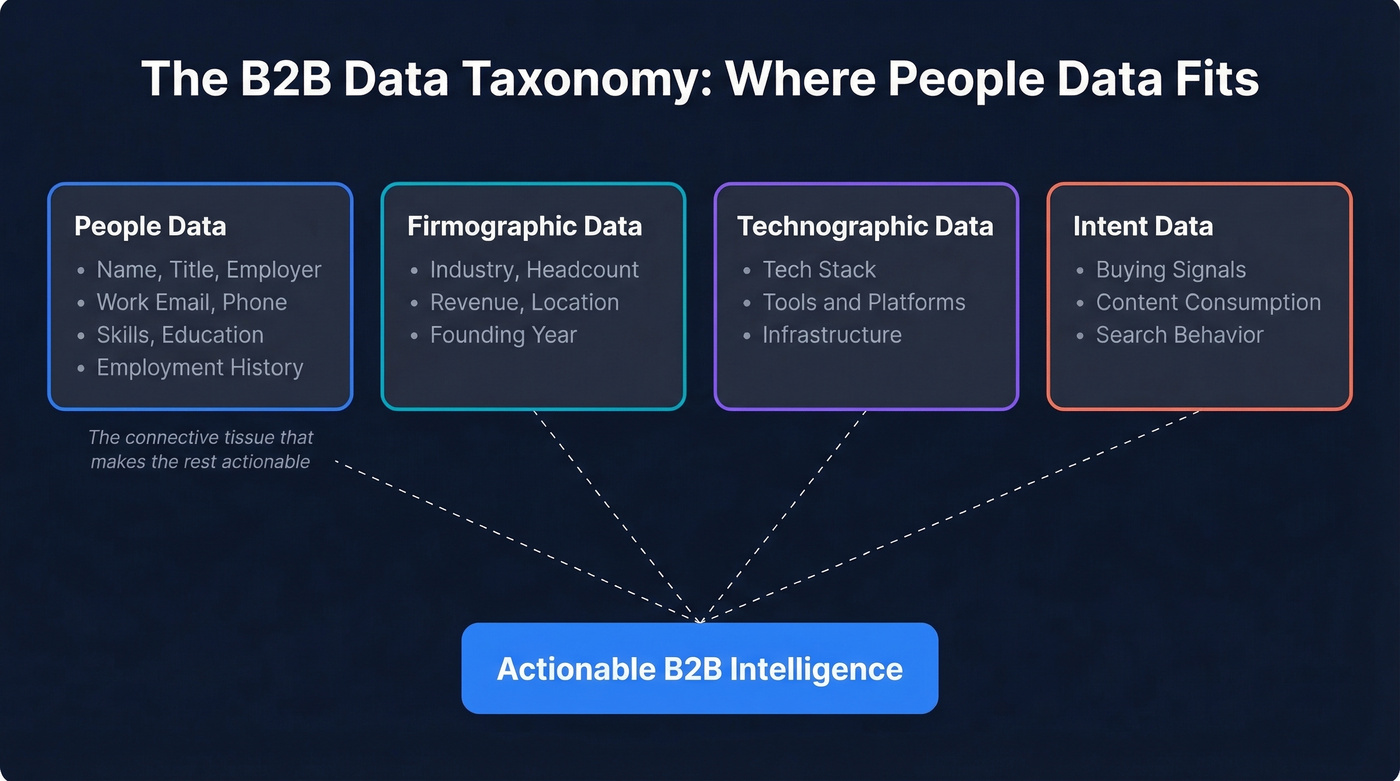
It sits alongside three other categories in the B2B data taxonomy. Firmographic data describes companies - industry, headcount, revenue. Technographic data maps a company's tech stack. Intent data signals buying behavior. Contact-level records are the connective tissue that turns all of those into something actionable: a real person you can actually reach.
The term means different things in different industries. In sales, it's contact data for lead generation - emails, phones, titles. In finance, it's identity mastering; LSEG (formerly Refinitiv) assigns each person a unique, permanent identifier to connect individuals across datasets for compliance. In HR and talent intelligence, it's workforce analytics - skills taxonomies, job flows, tenure patterns. And in venture capital, founder profile data helps investors map leadership backgrounds, prior exits, and professional networks before making funding decisions.
The common thread: a structured record about a human being, linked to their professional identity.
What's Inside a Record?
Coverage varies wildly by provider and geography. Here's what a typical record includes:
| Field | Example | Coverage Notes |
|---|---|---|
| Full name | Jane Chen | Near-universal |
| Job title | VP of Engineering | High for white-collar |
| Employer | Stripe | High |
| Work email | jane@stripe.com | 60-90% by provider |
| Direct phone | +1 415-555-0123 | 30-70% coverage |
| Education | Stanford, MS CS | Moderate |
| Skills | Python, Kubernetes | Often inferred |
| Employment history | 3 prior roles | Varies by source |
| Inferred compensation | $180-220K | Coarse estimates only |
People Data Labs maintains 3B+ person profiles and an identity graph with 800M+ resumes - impressive scale, but coverage is strongest in white-collar, English-speaking markets and drops significantly for blue-collar roles and non-Western geographies. If you're targeting manufacturing managers in Southeast Asia, temper your expectations.
How It's Collected
There are three primary sourcing methods. Understanding them helps you evaluate what you're actually buying.
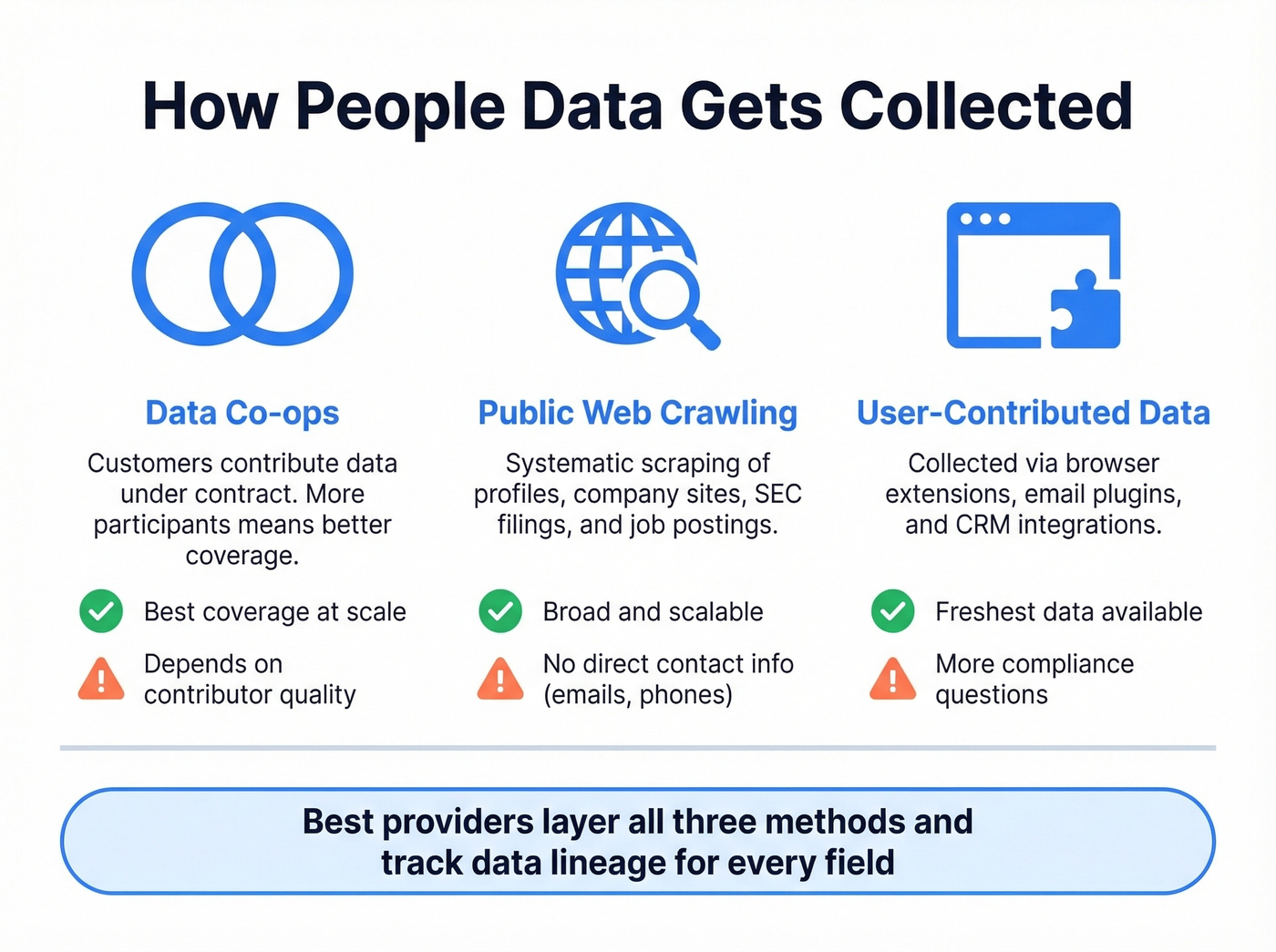
Data co-ops. Providers like People Data Labs operate a co-op - sometimes called the Data Union model - where customers contribute data under contract with legal warrants of compliant acquisition. More participants means better coverage.
Public web crawling. Providers systematically crawl professional profiles, company websites, press releases, SEC filings, and job postings. This data gets standardized, deduplicated, and matched against existing records. Coresignal takes this approach, scraping public platforms without collecting PII like emails or phone numbers - useful for enrichment and analytics, less so for outbound prospecting.
User-contributed data. Some platforms collect data from users who opt in through browser extensions, email plugins, or CRM integrations. This tends to be fresher but raises more compliance questions.
The best providers layer all three methods and track data lineage - where each field came from and when it was last validated. That lineage separates a reliable record from a guess.
How the Market Works
The market serves far more than sales teams. Josh Bersin's taxonomy breaks the vendor landscape into three tiers:
Tier 1 - Data aggregators. Companies like People Data Labs, Coresignal, Revelio Labs, and Lightcast collect and standardize raw individual-level data at massive scale, selling via API to recruiters, data scientists, and financial analysts.
Tier 2 - Enrichment and organizers. These vendors build taxonomies, skills models, and standardized job titles on top of raw data, packaging them through connectors and APIs.
Tier 3 - End-user platforms. These embed contact intelligence into products for sales prospecting, recruiting, and workforce planning. Prospeo, ZoomInfo, Apollo, and Cognism sit in this layer.
Four segments buy this data: enterprise and corporate (sales, HR, strategy), education and research institutions, government agencies, and sales and marketing teams. The sales use case gets the most attention, but finance, HR, and research are equally significant markets.

Bad people data cost you that 12% bounce rate. Prospeo's 5-step verification delivers 98% email accuracy across 300M+ profiles - refreshed every 7 days, not every 6 weeks. At $0.01 per email, you fix your data quality problem for 90% less than ZoomInfo.
Start with 75 free verified emails and see the difference yourself.
Top Providers Compared
| Provider | Database | Email Accuracy | Refresh | Pricing | Best For |
|---|---|---|---|---|---|
| People Data Labs | 3B+ profiles | N/A (raw) | Monthly | $0.20-$0.55/credit | Raw data APIs |
| ZoomInfo | Not public | ~87% | ~6 weeks | $15K+/yr | Enterprise US |
| Apollo | 275M+ contacts | ~79% | Varies | $588/user/yr | SMB all-in-one |
| Cognism | Not public | >90% | Not public | ~$1-3K/mo | European compliance |
| Kaspr | 120M+ European contacts | Not public | Not public | $49/user/mo | EMEA on a budget |
| Clearbit | Not public | Not public | Not public | $30-$700/mo | HubSpot enrichment |
Prospeo
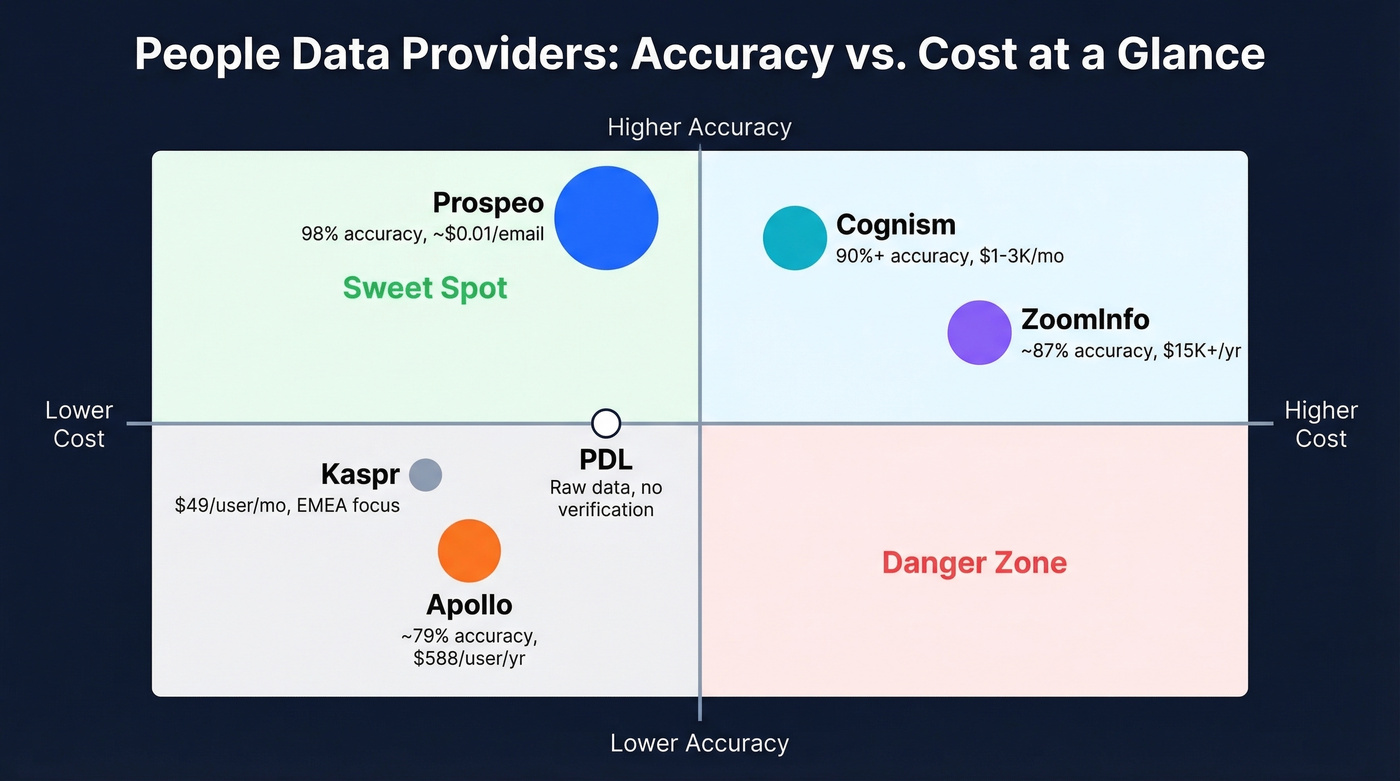
Use this if you're an outbound team or agency that needs verified emails and direct dials without a $15K annual contract. The 98% email accuracy is the highest in production we've tested, and the 7-day refresh cycle is 6x faster than the industry average. The database covers 300M+ profiles with 143M+ verified emails and 125M+ verified mobile numbers. At roughly $0.01 per email with a free tier of 75 emails/month, the unit economics are hard to beat. One customer, Stack Optimize, built from $0 to $1M ARR while maintaining 94%+ deliverability and sub-3% bounce rates across all their clients - zero domain flags.

People Data Labs
A developer's tool, not a sales tool. PDL's 3B+ profiles and 800M+ resumes make it one of the largest raw datasets in the market. Credit-based pricing starts at $0.28/credit for person enrichment, dropping to $0.20/credit on annual plans at volume. If you're a data team building products on top of APIs, PDL is the foundation. If you need verified contact info ready to sequence, look elsewhere - PDL is raw infrastructure, and you'll still need a verification layer on top.
ZoomInfo
Here's the thing about ZoomInfo: it's one of the deepest US-focused databases with intent, chat, and workflow tools baked in, but the common complaint on G2 and Reddit is price - and paying for modules you never activate. The email accuracy benchmarks we've seen land around 87%. At $15K+/year starting, that's expensive per usable contact. If your team is under 10 seats or your budget is under $15K, skip this one. You'll overpay for features you never touch.
Apollo.io
The obvious starting point for most SMB teams: 275M+ contacts, a built-in sequencer, and a genuine free tier. Paid plans start at $588/user/year. The catch is accuracy - benchmarks put Apollo around 79%, meaning roughly 1 in 5 emails won't land. For low-volume outbound, that's manageable. For high-volume campaigns, that gap compounds fast and your domain pays the price.
Cognism
Cognism leads with compliance: 15 DNC lists checked and a case study putting US accuracy above 90%. Intent data comes via Bombora. Custom pricing typically runs $1,000-$3,000/month for small teams. The US database doesn't match ZoomInfo's depth, but if you're selling into Europe, Cognism is the safest bet.
Kaspr
European-focused with 120M+ contacts checked against 150 sources. Starts at $49/user/month. Solid for EMEA prospecting on a budget, limited outside Europe.
Clearbit (Breeze Intelligence)
Now part of HubSpot. Credit packs run $30-$700/month. Best for enrichment workflows inside HubSpot, not standalone prospecting.
Revelio Labs
Workforce analytics - labor market data, job flows, skills taxonomies. An alternative to PDL for research and talent intelligence, not for outbound sales. Pricing is custom and enterprise-oriented, typically $20K-$50K/year depending on data scope.
What It Costs
| Provider | Model | Cost | Annual Estimate |
|---|---|---|---|
| People Data Labs | Per-credit (API) | $0.20-$0.55/credit | $2,400-$6,600+ |
| ZoomInfo | Per-seat + modules | $15K+/yr starting | $15-60K+ |
| Apollo | Per-user | $588/user/yr | $588-$5K+ |
| Cognism | Custom per-seat | ~$1-3K/mo | $12-36K/yr |
| Amplemarket | Per-user | ~$300/user/mo | ~$3,600/user/yr |
| Kaspr | Per-user | $49/user/mo | $588/user/yr |
| Clearbit | Credit packs | $30-$700/mo | $360-$8,400 |
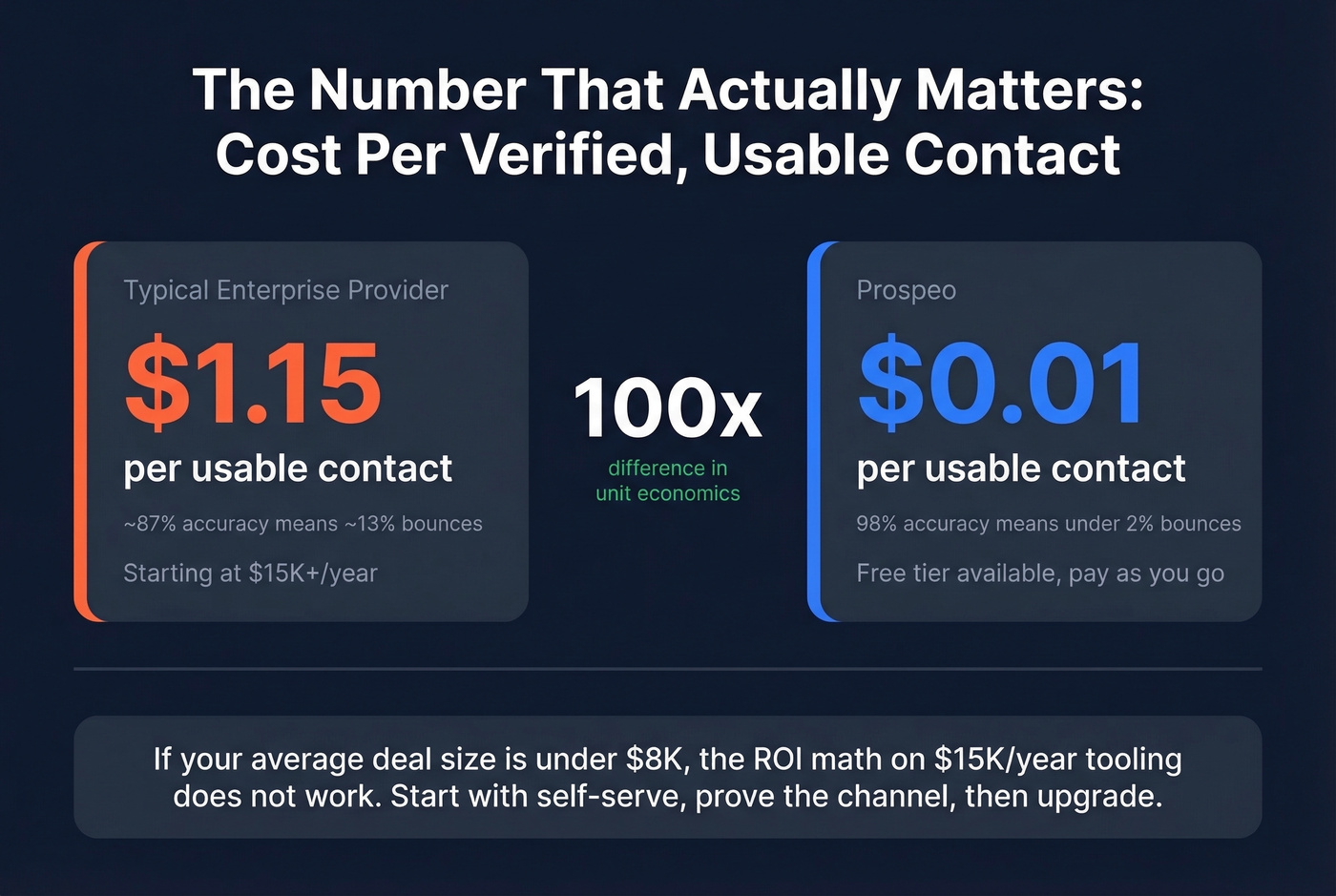
The number that actually matters isn't cost per record - it's cost per verified, usable contact. ZoomInfo at ~87% email accuracy means roughly 13% of your contacts bounce. At a common mid-tier estimate of $1/lead, your effective cost per usable contact is closer to $1.15. Prospeo at 98% accuracy and ~$0.01/email puts that number at about $0.0102. That's a 100x difference in unit economics.
One recruiting community thread on Reddit called PDL's $0.28 per profile "expensive" - and that's before factoring in that PDL provides raw data, not verified contacts. You'd still need a verification layer on top.
Let's be honest: if your average deal size is under $8K, you probably don't need ZoomInfo-level tooling. The ROI math doesn't work when you're paying $15K/year for a prospect database and your deals close at half that. Start with a self-serve tool, prove the channel, then upgrade if the numbers justify it.
Data Quality Benchmarks
Data quality is the single biggest variable in whether your outbound actually works. Everything else - copy, timing, targeting - sits downstream of it.
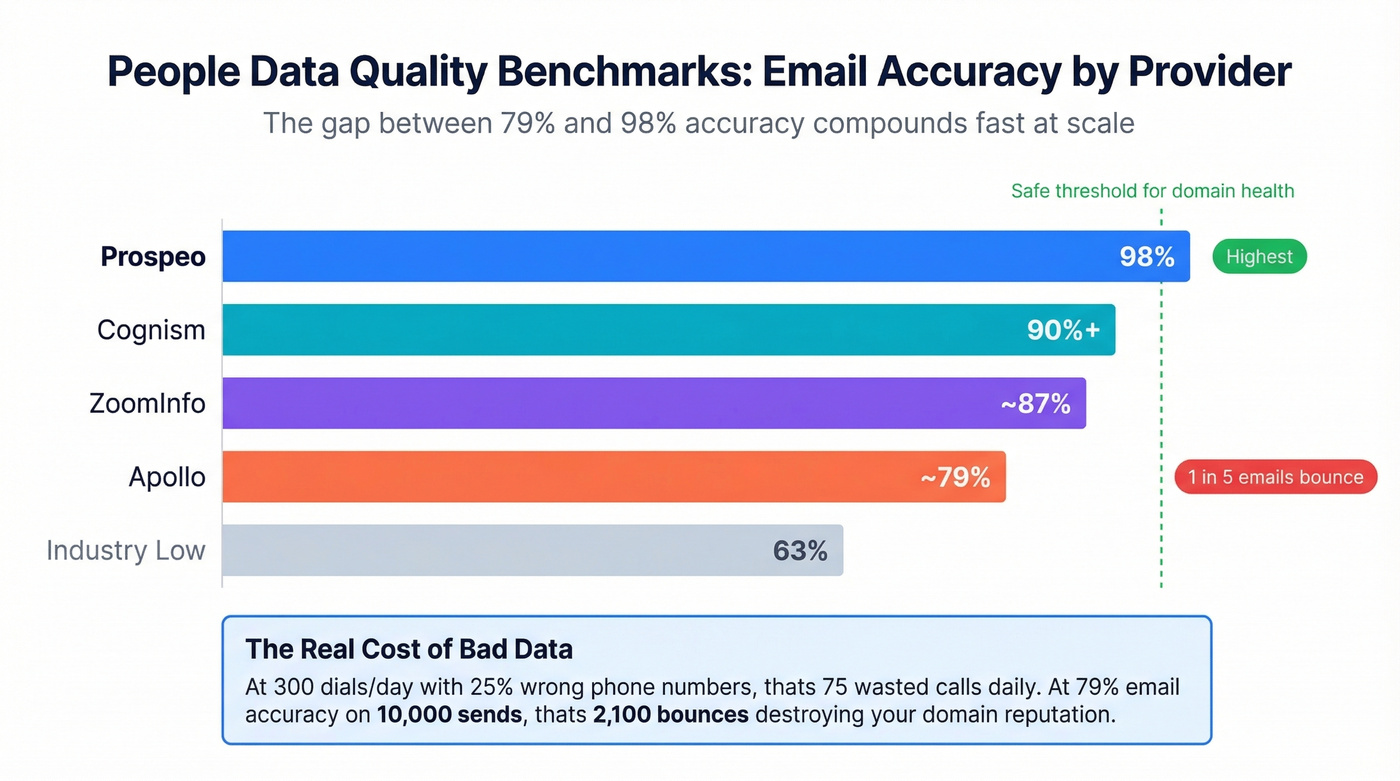
Phone accuracy spans 63% to 91% across nine providers in a controlled benchmark of 307 verified contacts. Email accuracy ranges from roughly 79% (Apollo) to 98% (Prospeo). That gap isn't academic - if 25% of your phone data is wrong and an SDR makes 300 dials per day, that's 75 wasted calls daily. In our testing, providers claiming 90%+ accuracy often fall short when you run your own ICP data through them. Always validate with a sample before committing.
The freshness problem is equally brutal. B2B contact records decay at roughly 2-3% per month, meaning about 30% of your database is stale within a year. The consensus on r/sales and r/recruiting is consistent: live crawl options fail frequently, recent job changes don't get caught, and outdated titles end up in production data. We've seen this firsthand running enrichment for agency clients - a quarterly refresh cycle is basically a guarantee that you're emailing people who've already changed jobs.
If your provider can't tell you exactly how they verify emails, they're probably not verifying them. The difference between a basic MX check and a multi-step verification process that handles catch-all domains, strips spam traps, and filters honeypots is the difference between 79% and 98% accuracy. That gap will either build or destroy your domain reputation.
The practical recommendation: don't rely on a single provider. Waterfall enrichment - running contacts through multiple sources sequentially - fills coverage gaps no single vendor solves alone.
Privacy and Compliance
The compliance picture has gotten dramatically more complex. As of 2026, 20+ US states have enacted comprehensive privacy regulations, with Indiana, Kentucky, and Rhode Island going effective January 1, 2026.
Common requirements across these laws include consumer rights to access, correct, delete, and opt out of data processing; data minimization and retention limits; privacy impact assessments for high-risk processing; vendor contract requirements; and opt-out signal recognition (California requires Global Privacy Control). California's CPPA approved a $1.35M enforcement action against Tractor Supply Company - notably covering CCPA compliance for job applicants and employees, not just consumers. New risk assessment requirements apply to new processing starting on or after January 1, 2026, and automated decision-making technology rules take effect January 1, 2027.
Consumers are increasingly aware of how their information gets collected and sold. Reddit threads regularly surface from individuals surprised to receive data-processing notices from providers like People Data Labs, asking whether to request deletion. That awareness is driving stricter enforcement.
For buyers, the checklist is straightforward: verify your provider offers opt-out enforcement, has DPAs available, checks against DNC lists where applicable, and can demonstrate GDPR compliance if you're touching European data.
Stack Optimize built a $1M agency on Prospeo's people data - 94%+ deliverability, sub-3% bounce, zero domain flags. 143M+ verified emails and 125M+ verified mobiles with no annual contracts or sales calls required.
Replace your broken data source in under five minutes.
How to Evaluate a Provider
Before you sign anything, run every provider against these criteria:
Accuracy benchmarks. Ask for third-party validation. Email accuracy below 90% will damage your domain reputation. Phone accuracy below 70% wastes SDR time.
Geographic and industry coverage. Test with your actual ICP, not their demo data. A provider strong in US tech may be weak in European manufacturing.
Refresh cycle. Seven days is the gold standard. Six weeks is common. Quarterly is unacceptable for outbound.
Compliance infrastructure. DNC list coverage, GDPR compliance, opt-out enforcement, and available DPAs. Non-negotiable in 2026.
Pricing model. Calculate cost per verified contact, not cost per record. Per-credit, per-seat, and flat-rate models have very different economics at different volumes.
Integration and verification. CRM push, API access, CSV export. And ask how many verification steps they run - catch-all handling, spam-trap filtering, and honeypot removal separate real verification from a basic MX check.
If you're building a stack around outbound, also sanity-check your email deliverability setup and sender reputation before scaling volume.
FAQ
Is people data legal?
Yes. Collecting and selling publicly available business information is legal in most jurisdictions. Providers must comply with GDPR, CCPA, and 20+ US state privacy laws as of 2026. Always verify your provider offers opt-out enforcement and DPAs before purchasing.
How fast does contact data go stale?
B2B records decay at 2-3% per month - about 30% per year. Providers with weekly refresh cycles keep records significantly more current than those updating monthly or quarterly.
How accurate are the top providers?
Phone accuracy ranges from 63% to 91% across major vendors. Email accuracy ranges from 79% to 98%. Always test with your own ICP data - a 500-contact sample reveals real-world accuracy faster than any vendor's marketing page.
How much does a people data provider cost?
From free (Apollo and Prospeo both offer free tiers) to $15,000+/year (ZoomInfo). Per-record pricing ranges from ~$0.01/email to $0.55/credit. Most mid-market teams spend $50-$500/month; the key metric is cost per verified, deliverable contact.
What's the difference between raw data and verified contacts?
Raw data providers like People Data Labs deliver unverified profiles at scale via API - ideal for data teams building products. Verified contact providers deliver ready-to-sequence emails and phones with accuracy guarantees. Raw data requires an additional verification layer before outbound use.