

Personalized Email Sequences: What the Data Actually Says
You spent a full day building AI-generated custom first lines for 2,000 prospects. Scraped their websites, pulled technographics, crafted unique openers. The result? A 1.9% reply rate versus 1.8% for the control group with simple, relevant messaging. That's personalization theater - and it's where most personalized email sequences go wrong.
The Short Version
- Keep sequences to 2-3 emails over 14-20 days. Two-step sequences outperformed five-step by 50% across 12 tested campaigns.
- Clean your list first. Bounces over 2% will tank your domain before any copy trick saves you.
- Relevance beats AI fluff. Small, targeted cohorts of 50 or fewer contacts outperform broad blasts by 2.76x.
Behavior-Triggered Sequences vs. Drip Campaigns
A personalized email sequence isn't a drip campaign. Drip campaigns are static - same content, same timing, everyone gets the same thing. A real sequence adapts based on behavior: opens, clicks, replies, or the absence of all three. If someone opens but doesn't reply, the next email shifts angle. If they reply, the sequence stops automatically.
Think of a behavior-triggered welcome flow - Day 0, Day 2, Day 5, Day 10 - where each step responds to what the recipient did or didn't do. That distinction matters because behavior-triggered sequences are where the $36 ROI per $1 spent in email marketing actually comes from.
What the Benchmarks Say
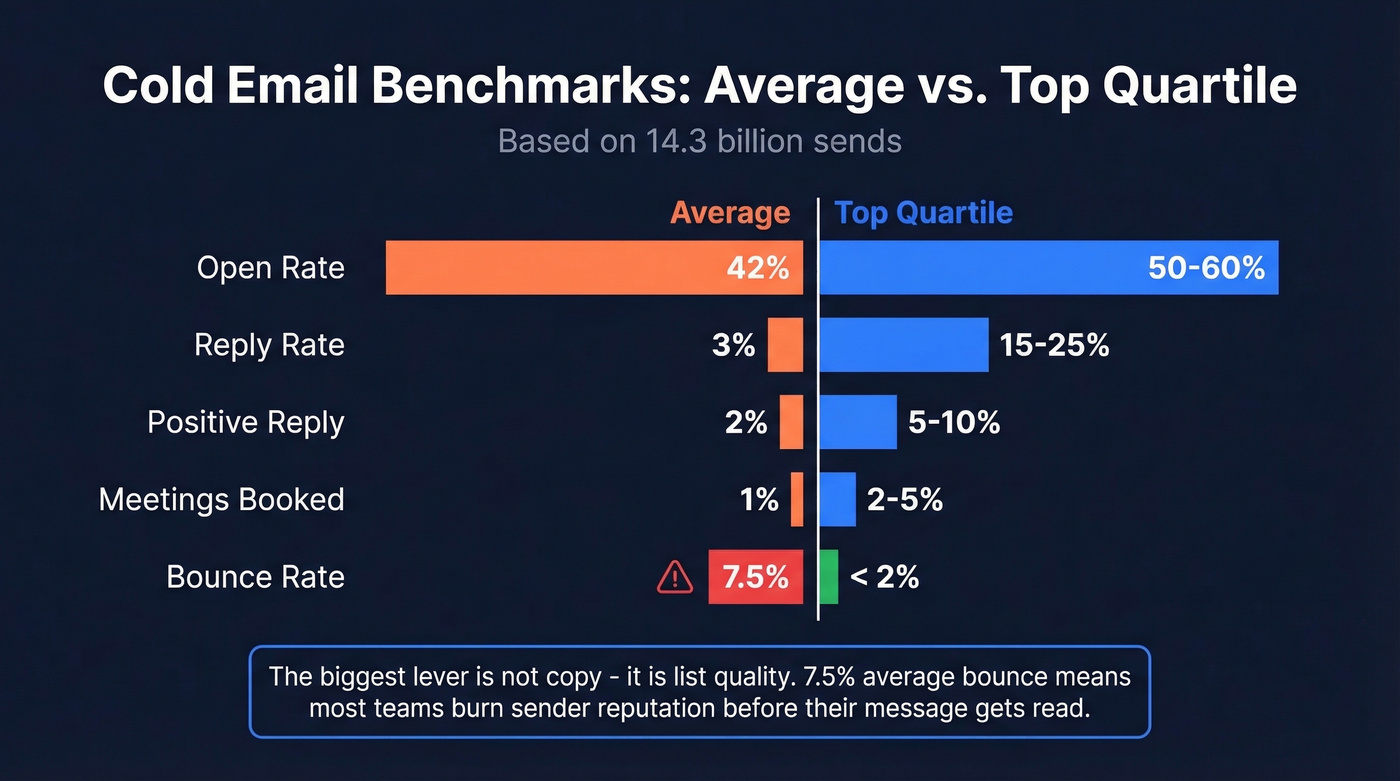
Here's what cold email performance actually looks like, based on aggregated data from Smartlead's 14.3 billion sends:
| Metric | Average | Top Quartile |
|---|---|---|
| Open rate | ~42% | 50-60% |
| Reply rate | ~3% | 15-25% |
| Positive reply | ~2% | 5-10% |
| Meetings booked | ~1% | 2-5% |
| Bounce rate | ~7.5% | <2% |
The gap between average and top quartile is enormous. And the biggest lever isn't copy. It's list quality. Look at that bounce rate: 7.5% average means most teams are burning sender reputation before their message even gets read.
One practitioner's dataset tells the full story: 500K emails sent, 694 positive replies, 85 closed clients. The funnel works when the fundamentals are right. In our experience, the single biggest reply-rate lever is always data quality, not copywriting.
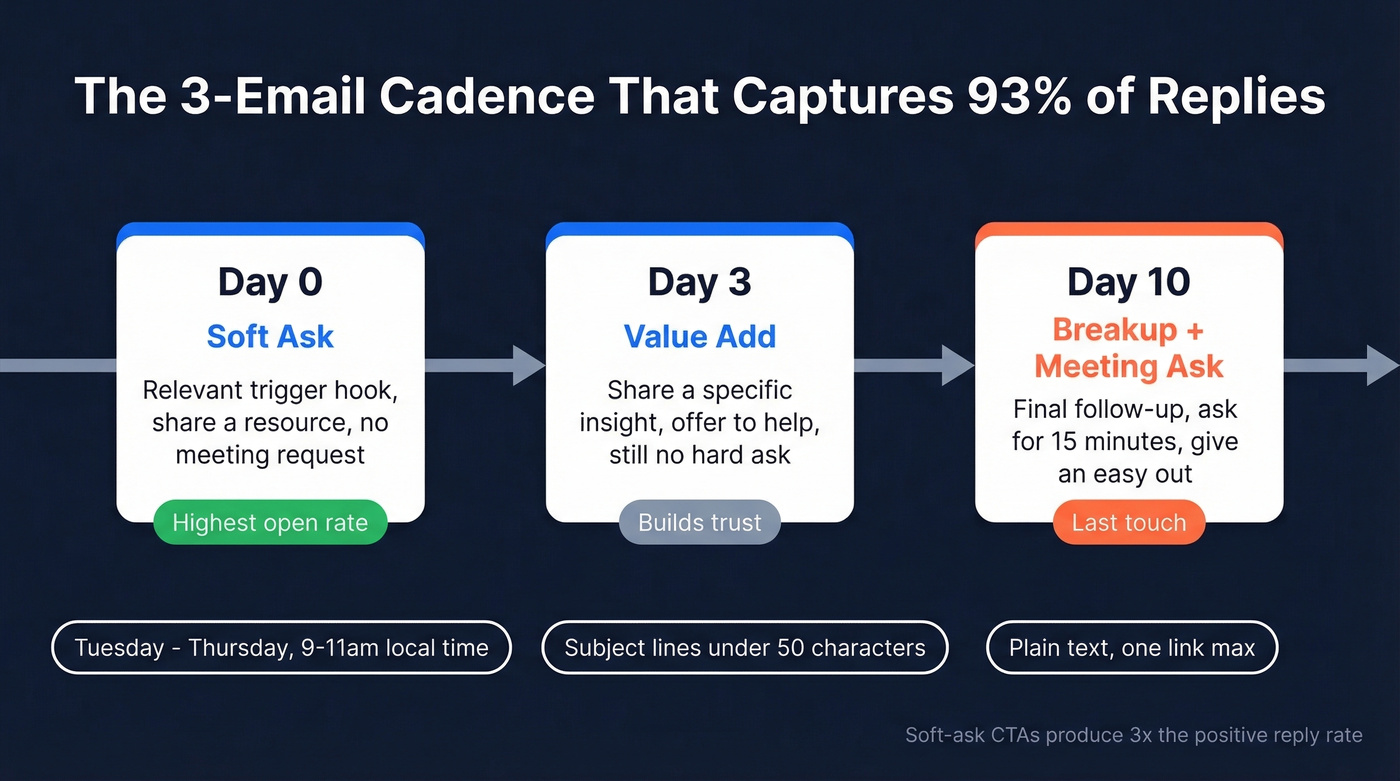
Two-step sequences outperformed five-step by roughly 50% across 12 campaigns. Emails three through five almost never converted and just increased complaints. Soft-ask CTAs - offering a resource or case study instead of requesting a meeting - produced about 3x the positive reply rate.

The data is clear: bounces over 2% kill your domain before any sequence magic saves you. Prospeo's 5-step verification delivers 98% email accuracy at ~$0.01 per lead - refreshed every 7 days, not every 6 weeks like most providers.
Stop burning domains. Start with data that actually delivers.
Clean Data First, or Don't Bother
Here's the thing: none of the copy advice matters if your emails bounce. Since May 2025, Google, Yahoo, and Microsoft enforce SPF, DKIM, and DMARC authentication plus one-click unsubscribe headers. The thresholds are clear:
- Spam complaints under 0.3%
- Bounces under 2%
- New domains warmed at 5-10 emails per day, ramping over 4-6 weeks
- Custom tracking domain (not shared)
- Plain text preferred, one link max
"Verified" purchased lists routinely bounce at 8-15%. That's domain-killing territory within 30 days.
A verification waterfall - running contacts through multiple verification layers - keeps bounces under 3% at roughly $0.01 per lead with a platform like Prospeo, compared to $0.50-$1.00 from database providers who skip proper verification. As one practitioner on r/coldemail put it, the money you save on cheap lists you'll spend ten times over recovering burned domains. We've seen teams triple their reply rates just by switching from purchased lists to properly verified data.

Building Your Outbound Email Cadence
The structure that captures the most replies is simpler than you'd think. A Day 0, Day 3, Day 10 cadence captures 93% of replies by Day 10 . Send Tuesday through Thursday, 9-11am in the recipient's local time zone. Keep subject lines under 50 characters - personalized subject lines are 26% more likely to be opened.
If you want more tested timing patterns, start with a proven cold email cadence before you tweak copy.
Here's a three-email template:
Email 1 (Day 0) - Soft ask:
Subject:
{{relevantTrigger}} at {{companyName}}Hey {{firstName}}, noticed {{relevantTrigger}} - we helped a similar team [specific result]. Put together a quick breakdown that might be relevant: {{resourceLink}}
Worth a look?
Email 2 (Day 3) - Value add:
Subject:
Quick thought on {{painPoint}}{{firstName}}, one thing we've seen with teams going through {{relevantTrigger}}: [specific insight]. Happy to share how we approached this.
Email 3 (Day 10) - Breakup with meeting ask:
Subject:
Closing the loop{{firstName}}, wanted to follow up one last time. If {{painPoint}} is a priority, I'd love 15 minutes to walk through what worked for [similar company]. If not, no worries either way.
Personalization That Actually Moves the Needle
What works:
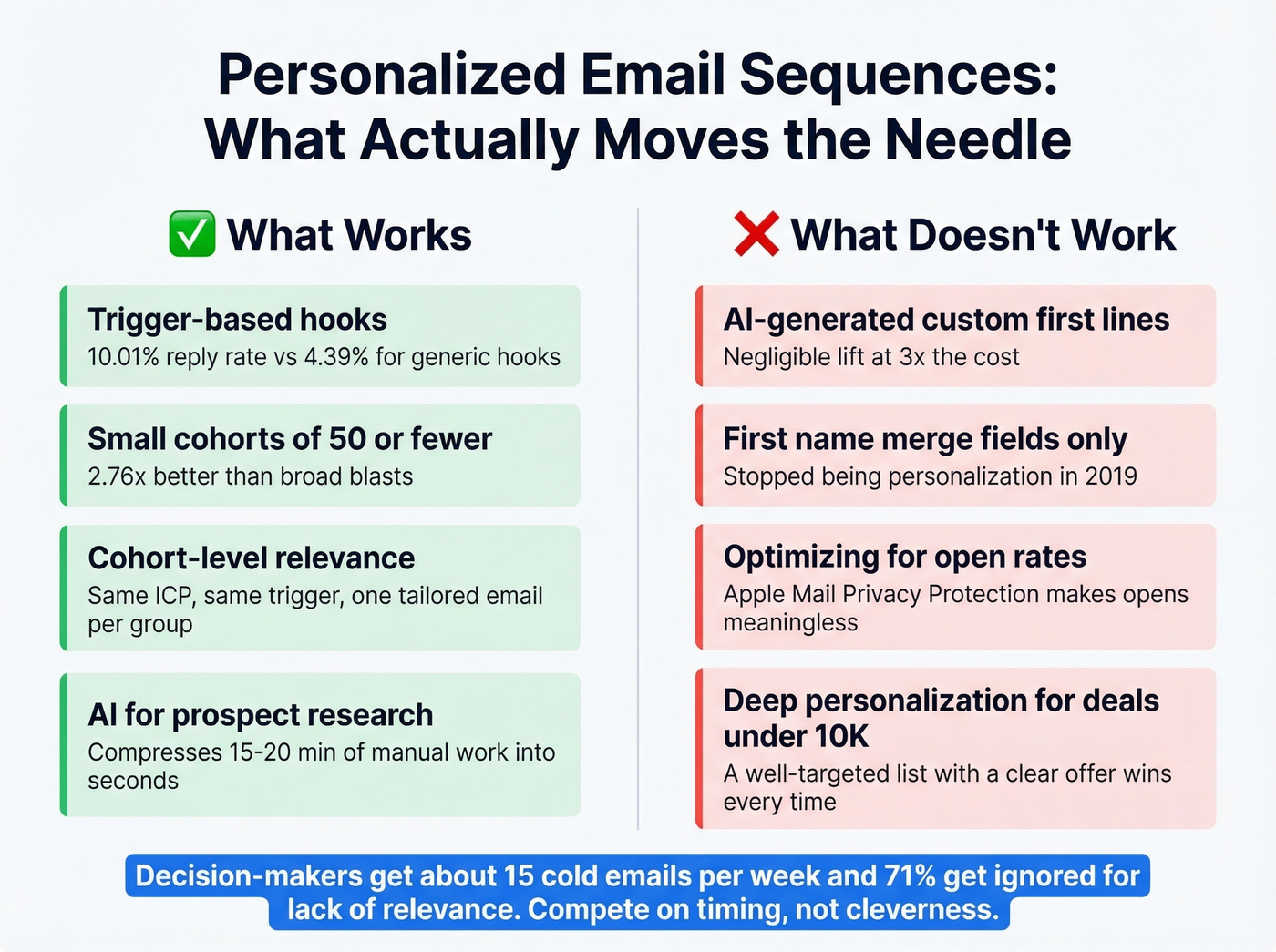
Relevance to a real trigger - a job change, funding round, or hiring signal. Timeline-based hooks average a 10.01% reply rate versus 4.39% for generic problem hooks. Small, tightly targeted cohorts matter too. Fifty contacts or fewer, same ICP, same trigger. When you build sequences around a shared trigger event, every email in the cadence feels relevant rather than templated. Decision-makers get roughly 15 cold emails per week, and 71% get ignored for lack of relevance. Compete on timing, not cleverness.
If you’re pressure-testing your approach, compare it against current cold email personalization data (not opinions).
What doesn't:
AI-generated custom first lines. Negligible lift at 3x the cost. AI is useful for accelerating prospect research - compressing 15-20 minutes of manual work per account into seconds - but using it to write custom openers produces almost no measurable improvement. And {{first_name}} merge fields alone? That stopped being personalization in 2019. Also skip optimizing for open rates entirely. Apple Mail Privacy Protection makes opens meaningless. Track replies and meetings only.
For more angles that consistently lift replies, borrow from these field-tested cold email tactics.
Let's be honest: if your average deal size is under $10K, you probably don't need deep personalization at all. A well-targeted list with a clear, relevant offer will outperform a heavily personalized campaign sent to the wrong people every single time.
Go Multichannel When Email Stalls
Email alone caps out. Data from 2.5 million touches makes this clear: email-only campaigns hit 5.2% reply rates. Add social touches and that jumps to 11.7%. Layer in phone and you're at 18.3% with a 4.9% meeting booking rate.
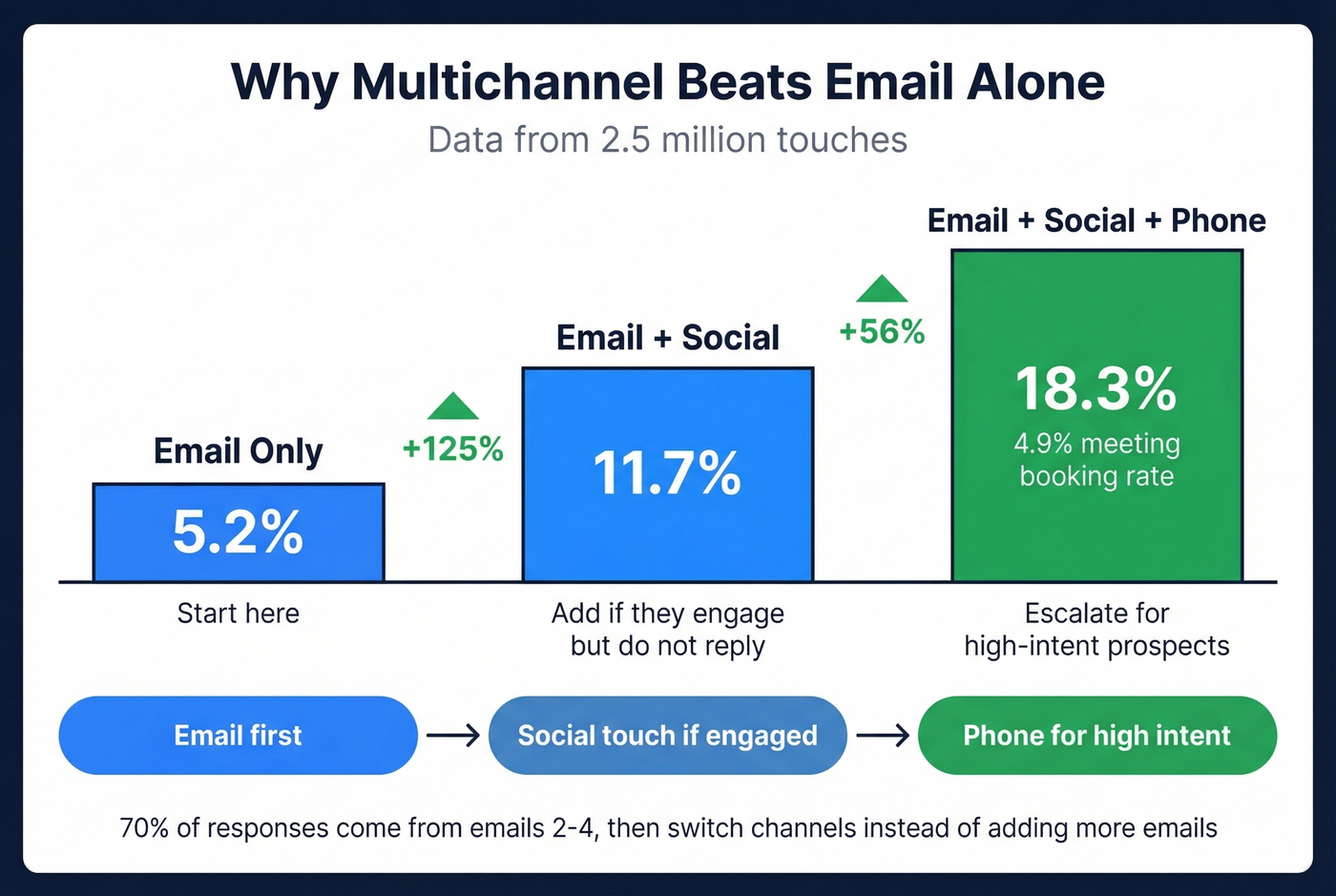
The key is sequential escalation, not parallel blasting. Email first. If they engage but don't reply, add a social touch. If they're high-intent, pick up the phone. About 70% of responses come from emails two through four - after that, switch channels instead of adding more emails. Multichannel follow-up sequences that blend social touches with email see the strongest conversion rates because each channel reinforces the other rather than competing for attention. Prospeo's mobile finder gives you verified direct dials with a 30% pickup rate when it's time to escalate from inbox to phone.
If you need a system for the “no reply” segment specifically, use a dedicated follow-up sequence instead of adding more steps to the same thread.
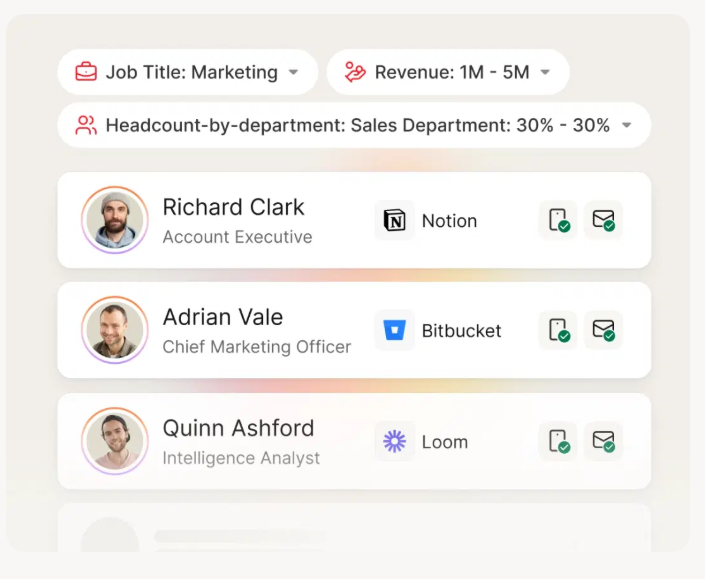
Small, trigger-based cohorts outperform broad blasts by 2.76x. Prospeo's 30+ filters - buyer intent, job changes, funding, technographics - let you build those tight 50-person segments in minutes, not hours.
Build the targeted lists that make personalized sequences actually convert.
FAQ
How many emails should a sequence have?
Two to three. Two-step sequences outperformed five-step by 50% across 500K+ sends. Emails three through five rarely convert and increase spam complaints. If your first two don't land, revisit targeting and data quality before adding more touches.
What reply rate should I expect?
Average B2B cold email reply rates sit at 3-5.1%. Top-quartile campaigns with tight ICP targeting hit 15-25%. Under 2%? Check deliverability and data quality before tweaking copy - bad data is almost always the bottleneck.
How do I personalize without spending hours per prospect?
Focus on cohort-level relevance rather than one-to-one customization. Group prospects by shared trigger - a recent funding round, a new hire in a specific role, or a technology adoption signal - then write one tailored email per cohort of 30-50 contacts. This cuts research time by 90% while maintaining the relevance that drives replies.
What's the cheapest way to get verified emails?
Prospeo's free tier includes 75 email credits per month with 98% accuracy and full verification. For scaling beyond that, credits run about $0.01 per email - roughly 90% cheaper than enterprise providers, with higher accuracy and a 7-day data refresh cycle.