

How to Build a Cold Email Cadence That Books Meetings in 2026
Every guide on cold email cadence tells you to "personalize at scale" and "write better subject lines." Almost none mention that you often need around 10-12 separate domains to send 400 emails a day without torching your sender reputation. The #1 reason cadences fail isn't bad copy - it's bad data and broken infrastructure.
Here's the actual math, the sequences, and the operational playbook.
What the Data Says
Before building anything, here's what "good" actually looks like. Billions of cold email interactions across thousands of active workspaces break down like this:
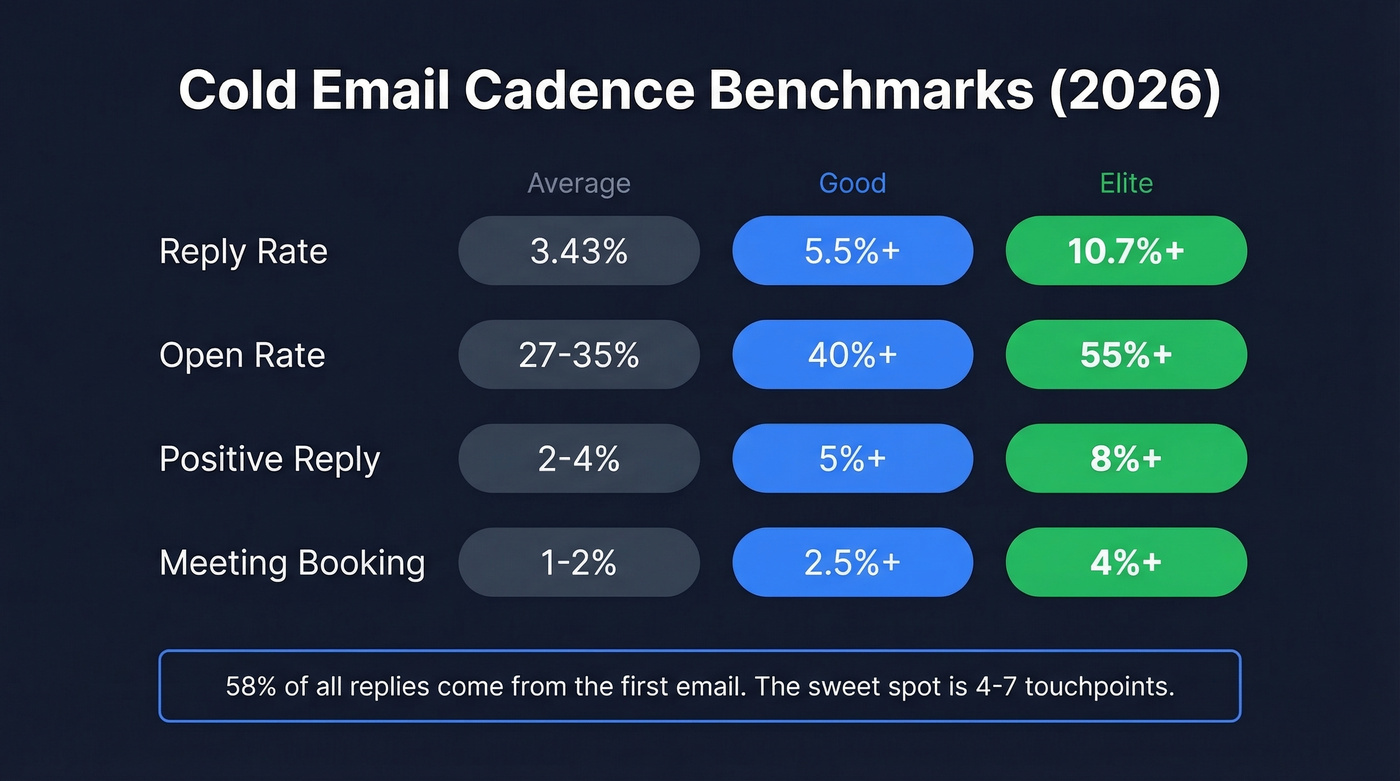
| Metric | Average | Good | Elite |
|---|---|---|---|
| Reply rate | 3.43% | 5.5%+ | 10.7%+ |
| Open rate | 27-35% | 40%+ | 55%+ |
| Positive reply | 2-4% | 5%+ | 8%+ |
| Meeting booking | 1-2% | 2.5%+ | 4%+ |
The critical insight: 58% of all replies come from the first email. Follow-ups generate the remaining 42% - still significant, but if your first touch is weak or lands in spam, no amount of follow-ups saves you.
The sweet spot is 4-7 touchpoints. Tuesday and Wednesday tend to be peak days, with Wednesday usually the strongest.
Infrastructure Before Cadence
This is the section every "cadence guide" skips, and it's the reason most campaigns die before they start.
- Buy dedicated sending domains. Never send cold email from your primary domain.
- Three inboxes per domain max. More concentrates risk.
- Cap at 20 cold emails/day per inbox after warm-up. (More on safe limits in our email velocity guide.)
- SPF, DKIM, and DMARC with proper alignment on every domain before sending a single email.
- Disable open tracking. Tracking pixels are increasingly flagged by spam filters. Track replies instead. (If you want the technical why, see email tracking pixels.)
- Stagger sends - 20-40 emails every 10-15 minutes. Bulk spikes look like spam because they are. (More deliverability fundamentals: email deliverability guide.)
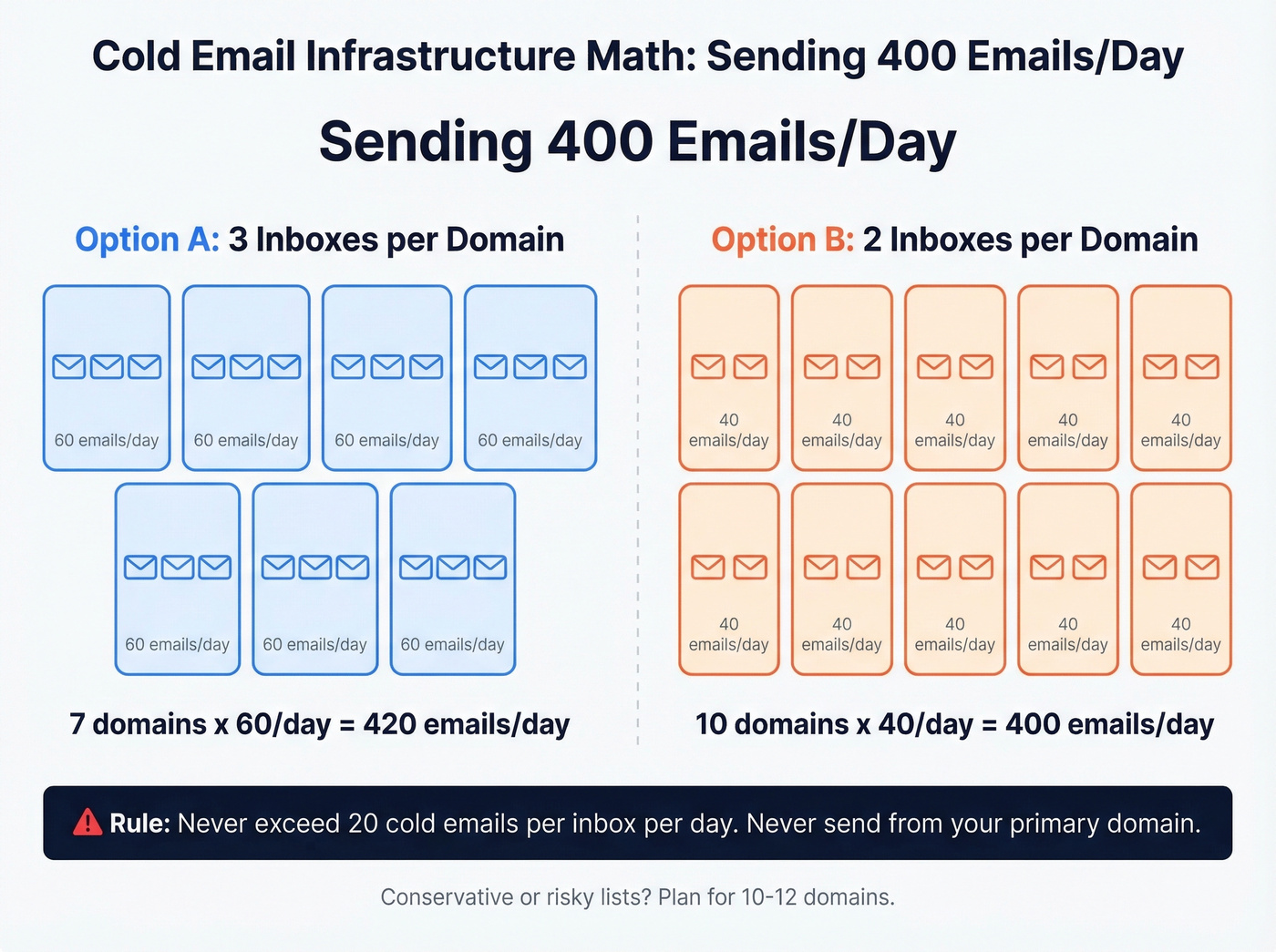
Here's the part most people get wrong: the "domains needed" number depends entirely on how many inboxes you run per domain.
- 3 inboxes/domain at 20/day each = ~60/day per domain. 400/day needs ~7 domains.
- 2 inboxes/domain = ~40/day per domain. 400/day needs ~10 domains.
- If you're extra conservative or your lists are risky, you'll land in the 10-12 domain range fast.
And here's the warm-up ramp that keeps your reputation intact:
| Week | Daily Volume | Condition |
|---|---|---|
| 1 | 30-50 | Monitor bounce, complaints |
| 2 | 50-80 | Only if bounce <3% |
| 3 | 80-120 | Only if complaints <0.1% |
| 4 | 120-150 | Full launch ready |
These volumes include warm-up tool sends. Your actual cold sends should stay at 20/day per inbox or less after warm-up completes.
The funnel math: 400 sends/day = 12,000/month = ~360 replies at 3% = roughly 90-100 meetings if half convert. As one r/coldemail practitioner put it, that's the ceiling for a single SDR's infrastructure. Scale beyond that and you need more domains, not more emails per inbox.
Your List Is the Cadence's Foundation
Look - if your bounce rate is above 3%, stop writing new email copy and fix your list first. Every bounced email damages your sender reputation, and once Gmail or Microsoft flags your domain, even perfect copy lands in spam. The hard thresholds: bounce under 3%, spam complaints under 0.1%. (Benchmarks + fixes: email bounce rate.)
Prospeo's 5-step verification catches bad addresses before they ever hit an inbox. The platform draws from 143M+ verified emails, running each address through catch-all handling, spam-trap removal, and honeypot filtering to deliver 98% email accuracy on a 7-day refresh cycle. That refresh matters because an email valid last month can bounce today if someone changed jobs.
Stack Optimize built from $0 to $1M ARR using Prospeo, keeping client bounce rates under 3% with zero domain flags across all campaigns. The free tier gives you 75 email verifications per month - enough to validate a test campaign before you risk your domain.

You just read the math: bounce above 3% and your cadence is dead on arrival. Prospeo's 5-step verification delivers 98% email accuracy with catch-all handling, spam-trap removal, and a 7-day refresh cycle - so the contacts you loaded last week are still valid today.
Stop burning domains. Start with data that keeps you under 3% bounce.
Two Cadences That Actually Work
5-Touch Email-Only (14 Days)
This is the workhorse. Five emails, two weeks, no fluff. (If you want a deeper build, see our B2B cold email sequence guide.)
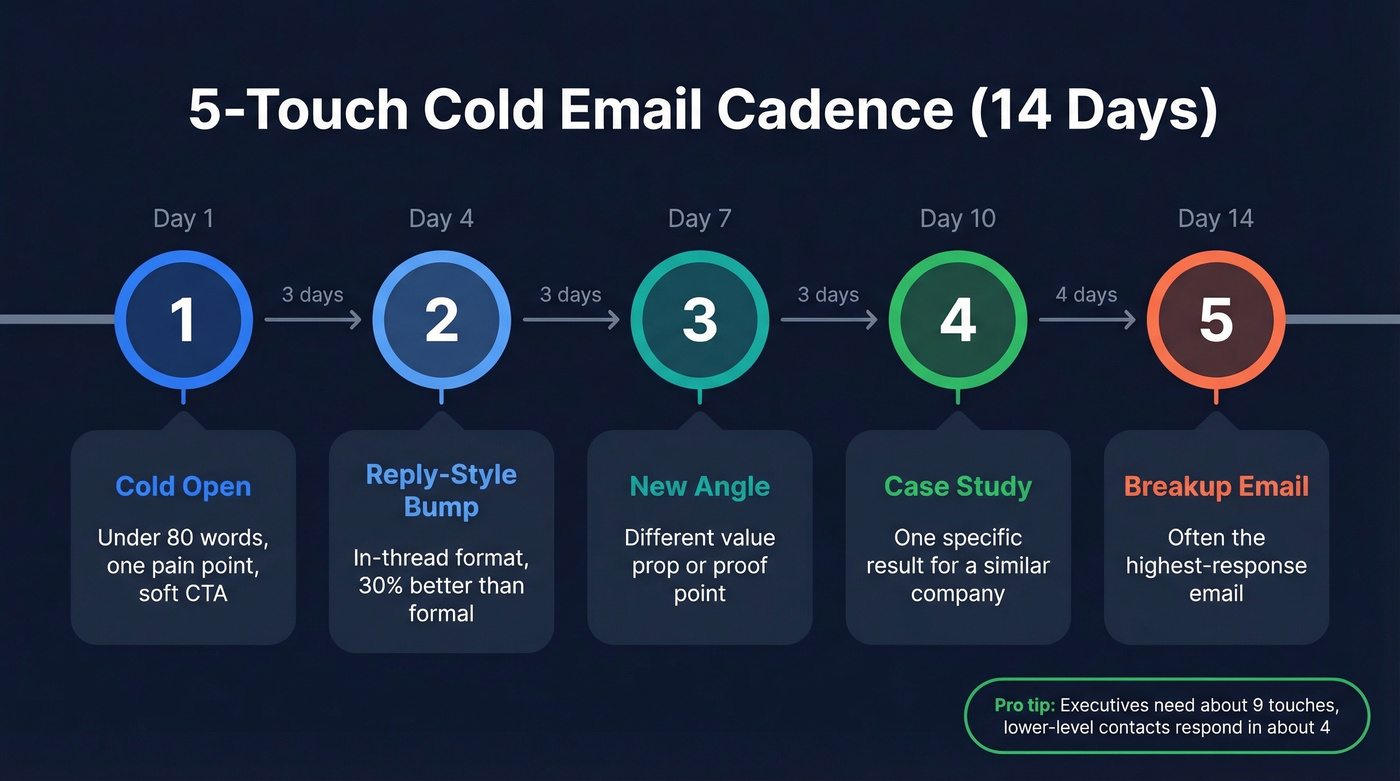
| Day | Action | Copy Notes |
|---|---|---|
| 1 | Email #1 - cold open | <80 words, one pain, soft CTA |
| 4 | Email #2 - reply-style | In-thread bump, ~30% better than formal |
| 7 | Email #3 - new angle | Different value prop or proof point |
| 10 | Email #4 - case study | One specific result for a similar company |
| 14 | Email #5 - breakup | Often the highest-response email |
Email 1 template:
Subject: quick question about {{company}}
Hi {{firstName}},
Noticed {{company}} is {{specific observation - hiring, expanding, using competitor tool}}. Most teams in that position struggle with {{pain point}}.
We helped {{similar company}} {{specific result}} in {{timeframe}}.
Worth a 15-min look?
Keep every email under 80 words. One CTA. No links in the first touch. Plain text formatting. (More copy rules: email copywriting.)
Here's the thing: if you're already hitting >5% reply rate, you don't need more touches - you need more prospects.
One nuance worth noting by seniority. Executives typically need ~9 touches to engage, while lower-level contacts respond in ~4. Adjust your sequence length based on who you're targeting, not a one-size-fits-all template.
14-Day Multi-Channel Sequence
Adding calls and social touches lifts response rates 2-3x over email-only sequences.
| Day | Channel | Action |
|---|---|---|
| 1 | Cold open - pain point, soft CTA | |
| 2 | Social | Connection request, no pitch |
| 4 | Reply-style follow-up, new value | |
| 5 | Phone | Call attempt, reference emails (8-9am or 4-5pm local) |
| 7 | Social | Engage with their content |
| 9 | Different angle, proof point | |
| 11 | Social | Direct message if connected |
| 14 | Breakup email |
An alternative worth testing is the "cluster" approach - 3 emails in rapid succession (Day 1, 2, 3) then a 48-hour gap before the next cluster. This mimics natural conversation rhythm rather than evenly-spaced marketing cadence, and we've seen it outperform traditional spacing in about a third of our tests.
What Happens After the Breakup
Most guides stop at the breakup email. Don't.
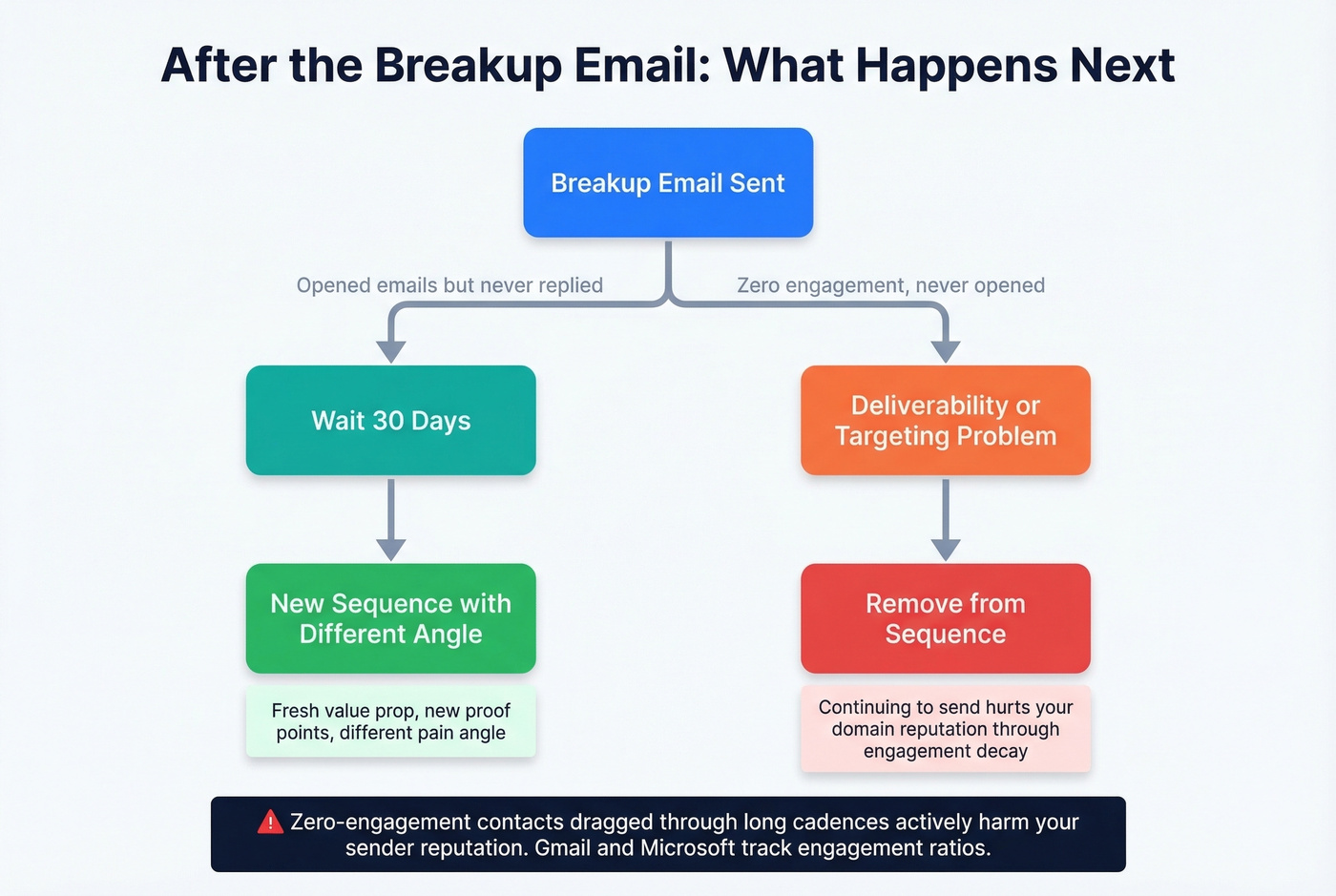
Build branching logic based on engagement signals. If a prospect opened multiple emails but never replied, move them to a different sequence with a new angle in 30 days. If they never opened a single email, the problem is deliverability or targeting - don't waste more sends on them.
Zero-engagement contacts dragged through long cadences actively harm your domain reputation through engagement decay. Gmail and Microsoft track sender-level engagement ratios, so sending to people who consistently ignore you makes it harder to reach people who wouldn't. We learned this the hard way watching a client's entire domain get throttled after they ran a 12-touch sequence against a stale list with 40% zero-engagement contacts. (More on fixing this: how to improve sender reputation.)
How to Optimize Your Outreach Sequence
A/B test one variable at a time - subject line, body copy, CTA, or sender name. Never all at once. Use 250+ contacts per variant, and push to 500+ for high confidence. Anything less and you're reading noise.
Track positive reply rate as your primary metric, not opens. Clickbait subjects spike opens but tank replies and hurt reputation. Keep subject lines to 25-45 characters since longer gets truncated on mobile. (Need ideas? See cold email subject line examples.) Send on Wednesday - Tuesday is second best, Monday inboxes are cluttered, and Friday is an auto-reply graveyard. (Timing data: best time to send cold emails.)
Getting your email cadence frequency right matters just as much as copy. Sending too often triggers unsubscribes and spam complaints, while too much spacing lets prospects forget you entirely. Weekly iteration compounds fast: a campaign that's 5% better each week is 2x better in three months. In our testing, the breakup email generated more replies than the opener in roughly a third of campaigns - so don't treat it as throwaway copy.
Sequencing tools worth considering: Instantly ($47/month Growth plan) is a top pick for email-only cadences. Smartlead starts around $39/month and is a strong alternative with similar infrastructure features. Both integrate natively with Prospeo for verified contact data. For teams that need full multi-channel orchestration, Outreach or Salesloft typically run $100-200+/user/month but are overkill for most teams under 10 SDRs. Skip them unless you're already at that scale. (More stack options: SDR tools.)
Seven Mistakes Killing Your Cadence
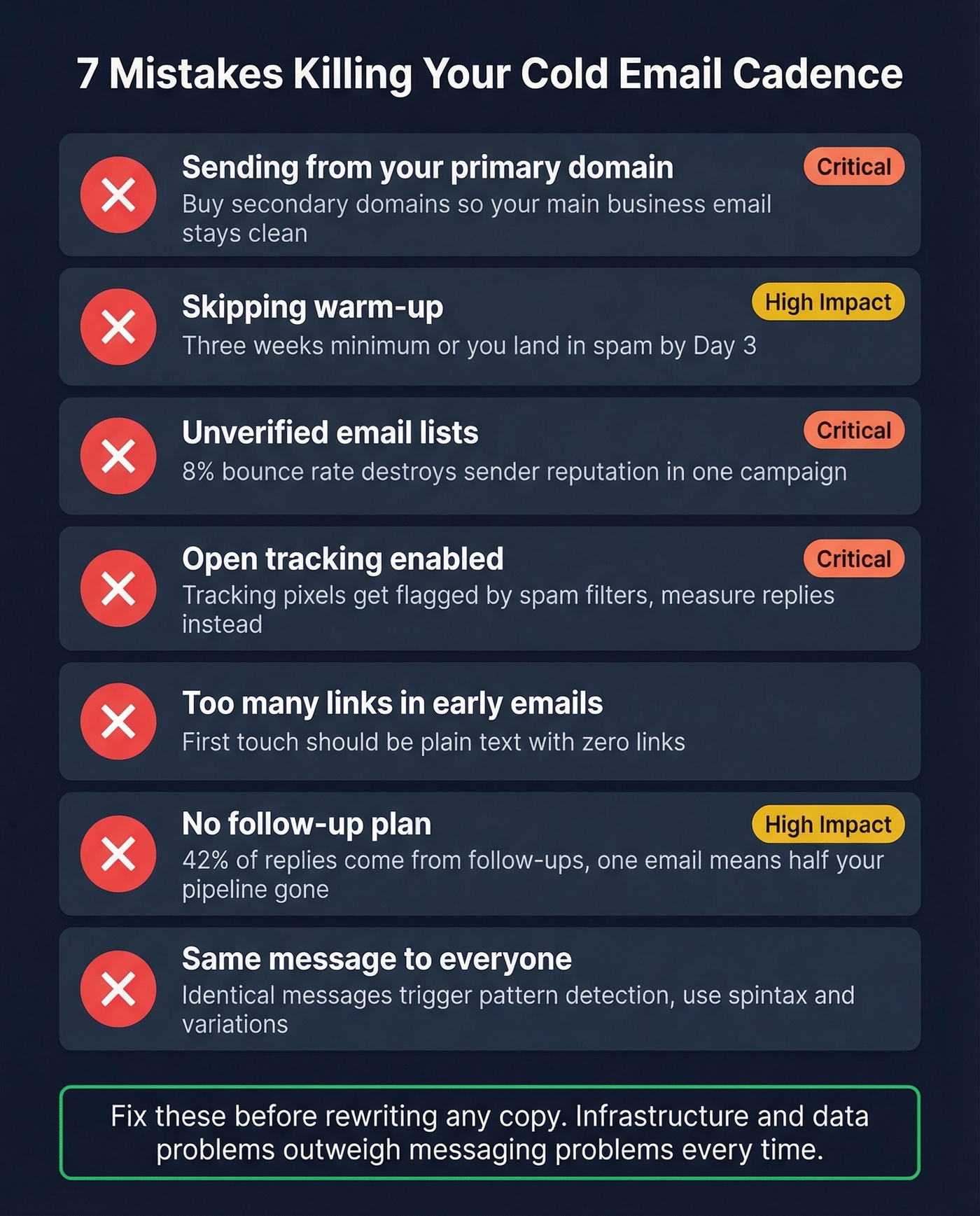
- Sending from your primary domain. Buy secondary domains. If one gets burned, your main business email stays clean.
- Skipping warm-up. Three weeks minimum. We've seen teams launch on Day 1 and land in spam by Day 3.
- Unverified lists. An 8% bounce rate destroys your sender reputation in a single campaign. Verify before you send - target under 1% bounce.
- Open tracking enabled. Tracking pixels are increasingly flagged by spam filters. Disable them. Measure replies.
- Too many links in early emails. First touch should be plain text with zero links. Add a single link in touch 3 or later.
- No follow-up plan. 42% of replies come from follow-ups. One email and done means half your pipeline left on the table. (Templates: cold email follow-up templates.)
- Same message to everyone. Use spintax and variations. Identical messages across hundreds of recipients trigger pattern detection. Even small word swaps help.
Running a multi-channel cadence means you need more than emails - you need direct dials. Prospeo gives you 125M+ verified mobile numbers with a 30% pickup rate, plus 143M+ verified emails, all searchable with 30+ filters including buyer intent and job changes.
Fill every channel in your sequence with contacts that actually connect.
FAQ
How many emails should a cold email cadence have?
Four to seven emails is the proven range. Start with five touches over 14 days. Beyond seven shows diminishing returns unless each message introduces a genuinely new value angle - most sequences plateau after touch five.
What's a good reply rate for cold email in 2026?
Average is 3.43% across billions of sends. Good campaigns hit 5-6%, and elite performers exceed 10%. Below 2% means your list quality or deliverability infrastructure needs fixing before you rewrite any copy.
What email cadence frequency works best?
Space touches 2-4 days apart during the first week, then stretch to 4-5 days in week two. This keeps you visible without overwhelming the prospect's inbox or triggering spam filters. Cluster sends - 3 emails in 3 days, then a gap - are worth testing as an alternative.
How do I keep cold emails out of spam?
Verify your list to under 1% bounce rate. Warm up domains for 3+ weeks, cap sends at 20 per inbox per day, authenticate with SPF/DKIM/DMARC, and disable open tracking. Plain text outperforms HTML every time.