

The 10 Best Leads Databases in 2026: Real Pricing, Real Bounce Rates
You exported 5,000 leads last quarter, loaded them into your sequencer, and watched 1,800 bounce before a single reply came in. Your domain reputation took a hit, your SDRs wasted a week of sequences, and your ops team spent two days cleaning Salesforce. That's what a bad leads database actually costs - and it never shows up on the invoice.
Here's the deeper problem: large databases mean your competitors are emailing the same overused contacts. Practitioners on Reddit's r/b2bmarketing say 70% of phone numbers in major databases are wrong, and cold outreach reply rates have dropped from 6.8% to 5.8% in two years. The provider you pick determines whether your sequences, your domain, and your pipeline actually work.
Quick Picks
| Pick | Best For | Starting Price |
|---|---|---|
| Prospeo | Accuracy & value | ~$0.01/email, free tier |
| Apollo.io | Free starting point | Free, paid from $49/mo |
| Lead411 | Trigger-based prospecting | $49/mo, 7-day trial |
What Actually Matters in a Leads Database
Email accuracy vs. inbox placement. A tool might report 98.16% deliverability - meaning emails didn't hard bounce - but inbox placement sits around 84.3%. Bad data widens that gap. You need a provider that verifies before export, not one that hands you guessed emails and hopes for the best. (If you want the benchmarks and fixes, see our email bounce rate guide.)
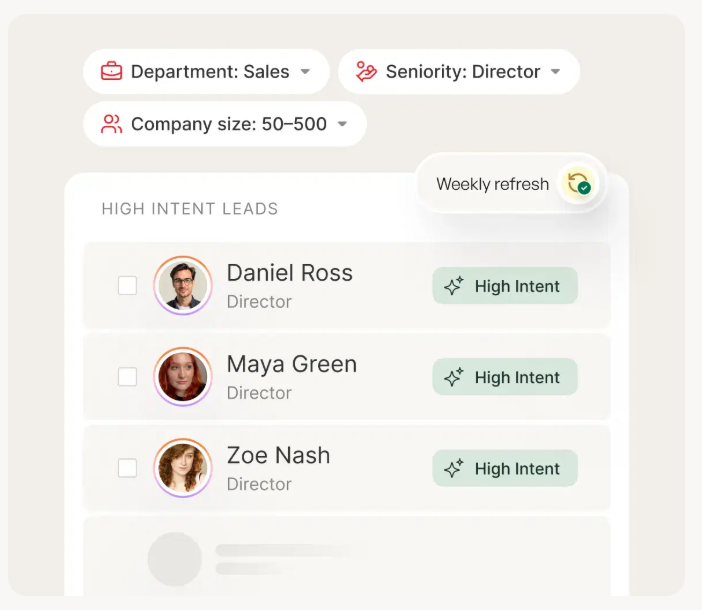
Data freshness. The industry is shifting from static databases to real-time verification and live data pulls. Most providers still refresh around every 6 weeks. If your records are weeks old, a chunk of them are already stale - and stale records turn into bounces fast. Weekly refresh cycles exist. Demand them.
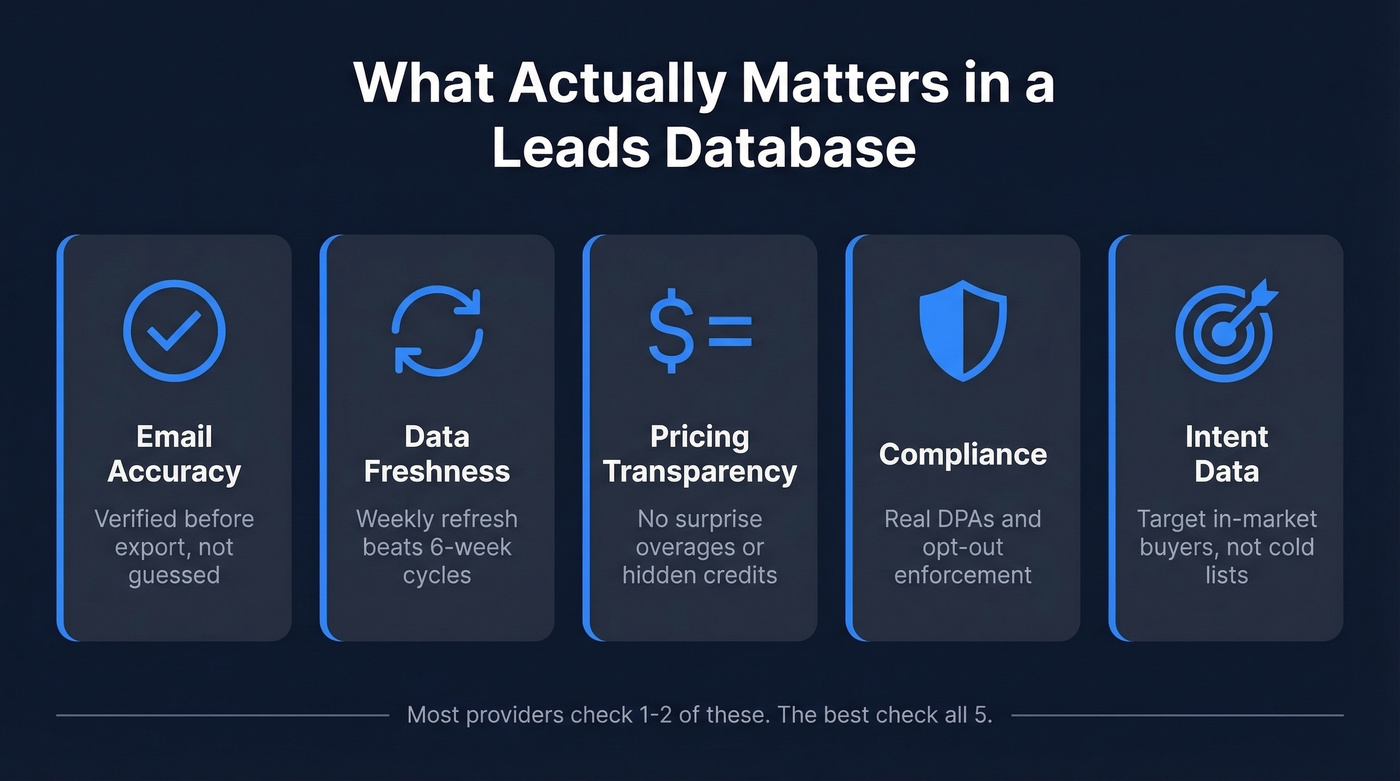
Pricing transparency. If you can't figure out what a tool costs without booking a demo, that's a signal. Credit-based models that look cheap at $79/mo but balloon to $177/mo after overages are designed to confuse you.
Compliance infrastructure. GDPR treats B2B names, emails, and job titles as personal data. You need a provider with DPAs, opt-out enforcement, and legitimate interest documentation - not just a badge in the footer. (More context: is it illegal to buy email lists.)
Intent data. Every contact database has records. That's table stakes. The platforms worth paying for in 2026 layer in buyer intent signals so your reps target in-market buyers instead of cold-calling into the void. (Related: intent based segmentation.)
10 Best Sales Lead Databases for 2026
1. Prospeo
Use this if you care more about data quality than database size, you're tired of verifying exports through a separate tool, or you're an agency that can't afford domain flags from bad data.
Skip this if you need a built-in dialer or full sequencing platform - pair Prospeo with Instantly or Lemlist for that.
Prospeo's database covers 300M+ professional profiles, 143M+ verified emails, and 125M+ verified mobile numbers. The standout number: 98% email accuracy on a 7-day refresh cycle. That refresh cadence is the real differentiator - it's why Snyk went from 35-40% bounce rates to under 5%, and Meritt tripled pipeline from $100K to $300K per week. Teams using Prospeo book 26% more meetings than ZoomInfo users and 35% more than Apollo users.

The 30+ search filters include Bombora intent data across 15,000 topics, technographics, job changes, headcount growth, and funding signals. Native integrations push directly into Salesforce, HubSpot, Instantly, Lemlist, Clay, and Zapier. Pricing starts at roughly $0.01 per email with a free tier of 75 emails/month. No contracts, no sales calls, self-serve onboarding. (If you’re building a multi-source workflow, see Clay list building.)
2. Apollo.io
Use this if you're bootstrapped, need a free starting point, and plan to verify exports through a separate tool before sending.
Skip this if you're running high-volume outbound and can't afford 30%+ bounce rates tanking your domain.
Apollo's database covers 275M+ contacts and it has a genuinely generous free tier - 5 mobile credits and 10 export credits per month. Paid plans run $49-$119/mo per user. It's earned a 4.7/5 on G2 with 9,476 reviews, which is hard to argue with for adoption.
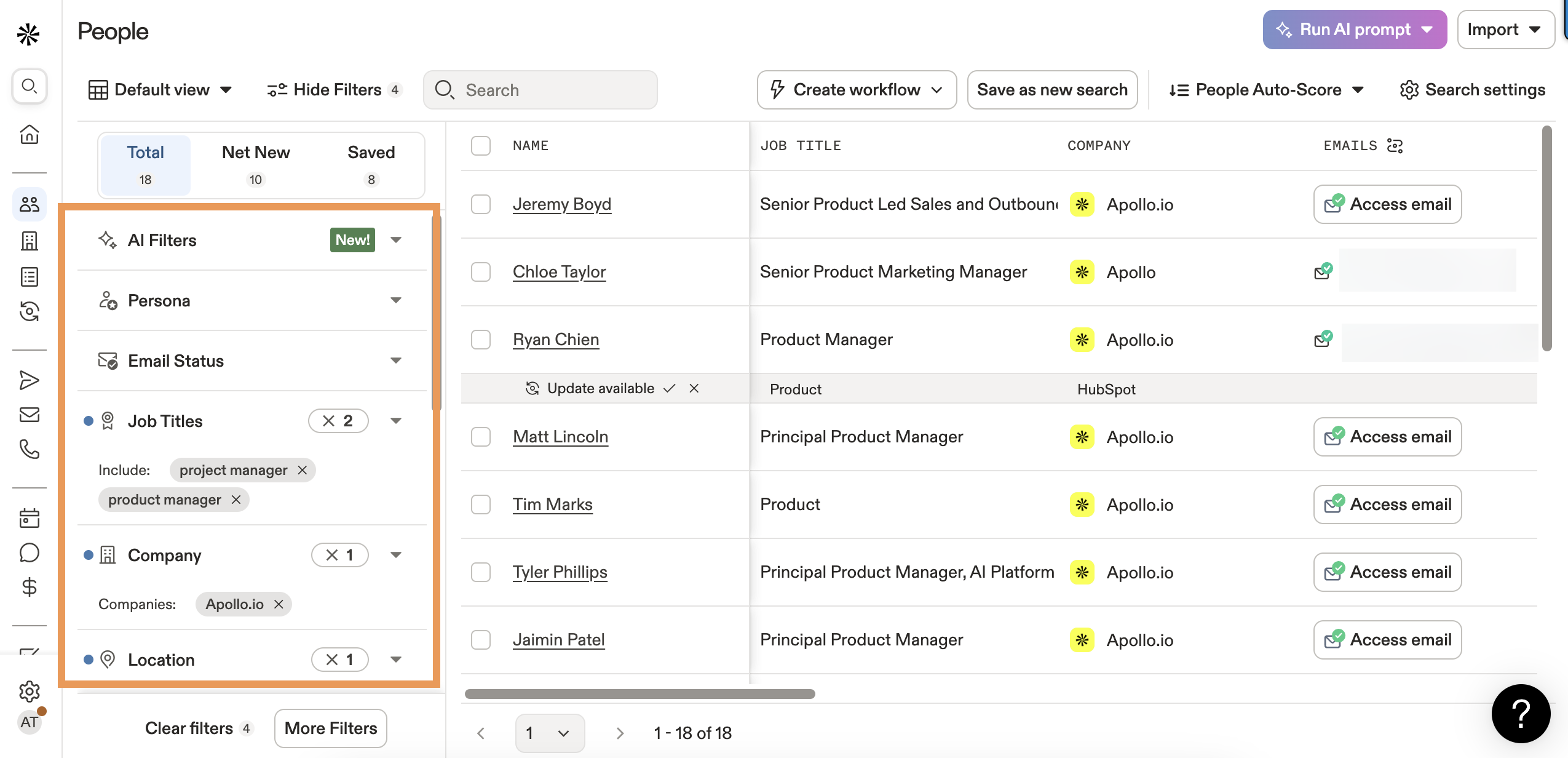
Here's the thing: Apollo's data quality is a known problem. Practitioner tests on r/coldemail report 32-38% bounce rates on exported lists. A separate thread flagged 80-90% of profiles looking stale or abandoned. Apollo is an excellent prospecting UI bolted onto a database that needs external verification. Use it as a search engine, then verify elsewhere before you send. (If you’re comparing prospecting sources, see best sales prospecting databases.)
3. ZoomInfo
Use this if you have 10+ reps, a $30K+ annual budget, and need the deepest US database with intent, chat, and workflow features under one roof.
Skip this if you're a team of five trying to figure out why your data vendor costs more than two SDR salaries.
ZoomInfo is the Rolls-Royce of B2B data - and just as overpriced for most teams. Professional starts around $14,995-$15,000/year. Advanced starts around $24,000/year (often closer to ~$29,995 for Advanced+). Elite typically lands in the $35,995-$40,000+/year range. Add Global Data ($9,995), extra credits (~$3,000 per 5,000), and additional seats (~$1,500-$2,500 per user/year), and teams routinely land near $50,000/year. Negotiated discounts of 30-65% off list are common, but you'll sign multi-year contracts with 60-90 day cancellation windows.
Let's be honest: ZoomInfo is still the best all-in-one GTM platform. But most teams don't need all-in-one. The #1 complaint on Reddit is paying for modules that never get turned on. If you're enterprise and will use the full stack, it's the default. Everyone else is subsidizing features they'll never touch.
4. Cognism
Cognism covers 400M business profiles and 200M verified business emails with a strong EMEA focus that ZoomInfo can't match. Their Diamond-verified mobiles deliver ~98% phone accuracy - the real draw for teams dialing into the UK and EU. GDPR compliance is baked in, not bolted on.
Vendr benchmarks put Grow at ~$22,500/year for 5 users and Elevate at ~$37,500/year. Not cheap, but significantly less than ZoomInfo for comparable EMEA coverage. Best for EU-focused teams needing compliant data and verified direct dials.
5. Lead411
Lead411's killer feature is unlimited exports on select plans - no credit anxiety, no surprise overages. The Pro tier includes Bombora intent data and trigger events like job changes, funding rounds, and hiring surges. Starting at $49/mo with a 7-day free trial, it's one of the most transparent pricing models in the space. (If you rely on triggers, see how to track sales triggers.)
The database isn't as large as Apollo or ZoomInfo, but the trigger-based approach means you're reaching people at the right moment rather than blasting a static list. We've seen it work particularly well for teams selling into fast-growing companies where timing matters more than volume.
6. Seamless.AI
Seamless.AI's pricing is designed to confuse you. Pro runs ~$79/user/month with 1,000 credits, though other sources estimate Basic plans at ~$147/mo billed annually. Burn through credits in 20 days at 50 lookups/day, and you're buying extra packs at $49 per 500. One user reported actual monthly spend of ~$177. Enterprise is $149/user/month with a 5-user minimum.
Email accuracy runs ~85% in practitioner testing, phone accuracy ~60%. The UI and integrations are decent, but you shouldn't need a spreadsheet to figure out what a contact provider costs. Skip it if you're doing bulk prospecting - the credit math will eat you alive.
7. Lusha
Lusha is a browser-extension-first tool built for individual reps who need a handful of contacts per day, not bulk list building. Free plan offers 40 credits/month, paid starts around $39-$49/mo per user. G2 rates it 4.3/5 across 1,618 reviews. Practitioner-reported bounce rates land around 22-28%. Best for quick-access lookups, not pipeline-scale prospecting.
8. Hunter.io
Hunter is an email-finding specialist, not a full contact database. Free plan gives you 25 searches/month, paid from $49/mo. Best for finding emails at specific companies when you already know who you're targeting. Not built for list building at scale. (If you’re evaluating alternatives, see Hunter alternatives.)
9. UpLead
UpLead verifies emails on export, eliminating the need for a separate verification step. Pricing starts at $99/mo for 170 credits. Best for mid-market teams who want built-in verification without bolting on another tool. (Related: data enrichment services.)
10. Instantly
Instantly bundles a lead database with its cold email platform, marketing 160M+ verified contacts (and positioning its broader database at 450M+). If you're already running sequences in Instantly, adding the database keeps everything in one place. Best for teams who want one-tool simplicity over best-in-class data. (If you’re scaling outbound safely, see best way to send bulk email without getting blacklisted.)
Side-by-Side Comparison
| Tool | Starting Price | Intent Data |
|---|---|---|
| Prospeo | ~$0.01/email | Bombora (15,000 topics) |
| Apollo.io | Free / $49/mo | Not a core focus |
| ZoomInfo | ~$14,995/yr | Yes |
| Cognism | ~$22,500/yr | Yes |
| Lead411 | $49/mo | Bombora (Pro) |
| Seamless.AI | ~$79/user/mo | Limited |
| Lusha | $39/mo | No |
| Hunter.io | $49/mo | No |
| UpLead | $99/mo | No |
| Instantly | Add-on | Not a core focus |
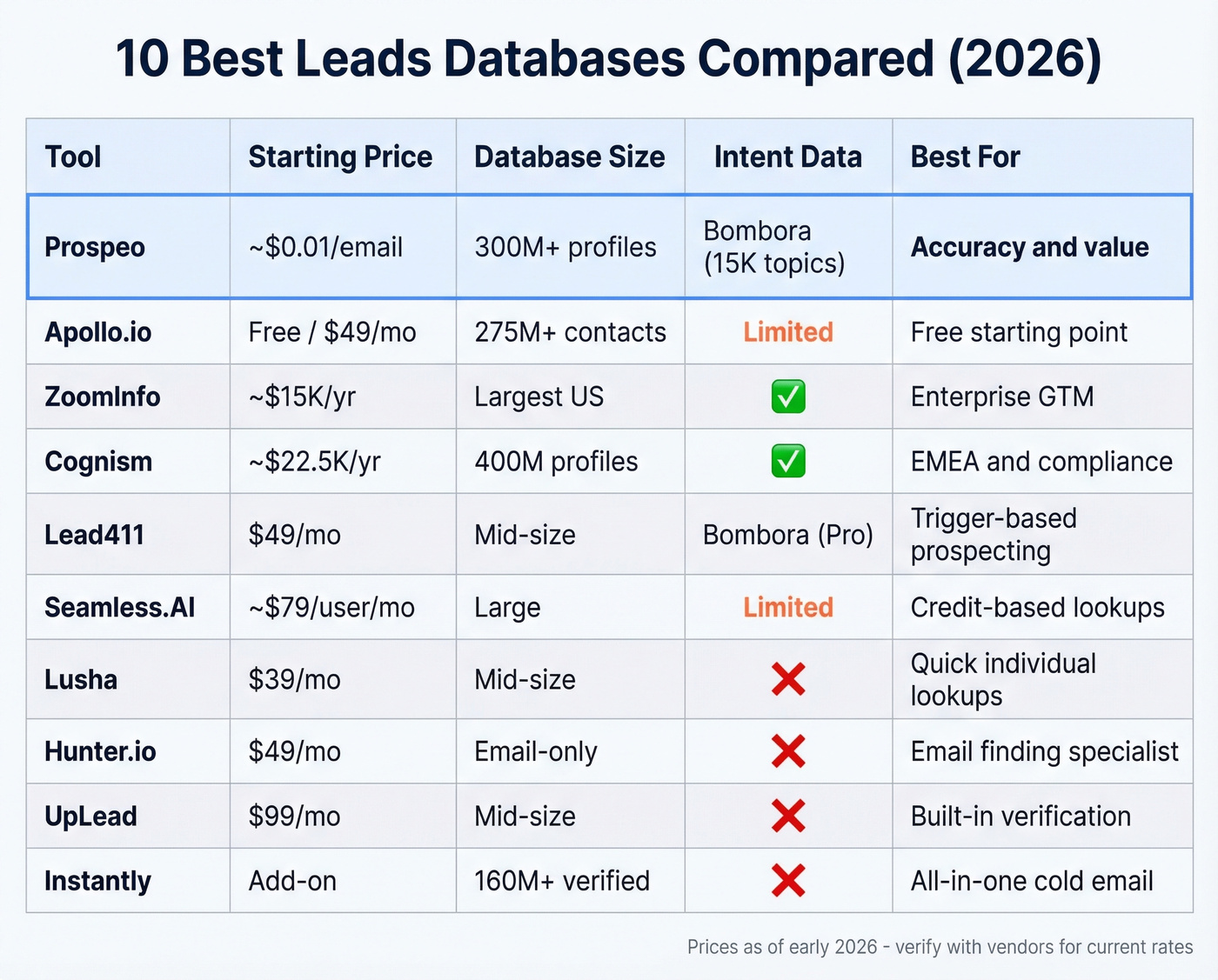
For CRM integrations, Apollo, ZoomInfo, and Cognism all connect to Salesforce and HubSpot natively. Lead411 supports major CRMs as well.

You just read what bad leads databases actually cost - bounced emails, flagged domains, and wasted SDR hours. Prospeo's 300M+ profiles are verified on a 7-day refresh cycle with 98% email accuracy. That's why Snyk cut bounce rates from 35% to under 5% and Meritt tripled pipeline to $300K/week.
Start pulling verified leads at $0.01/email - no contracts, no sales calls.
Real Bounce Rates by Tool
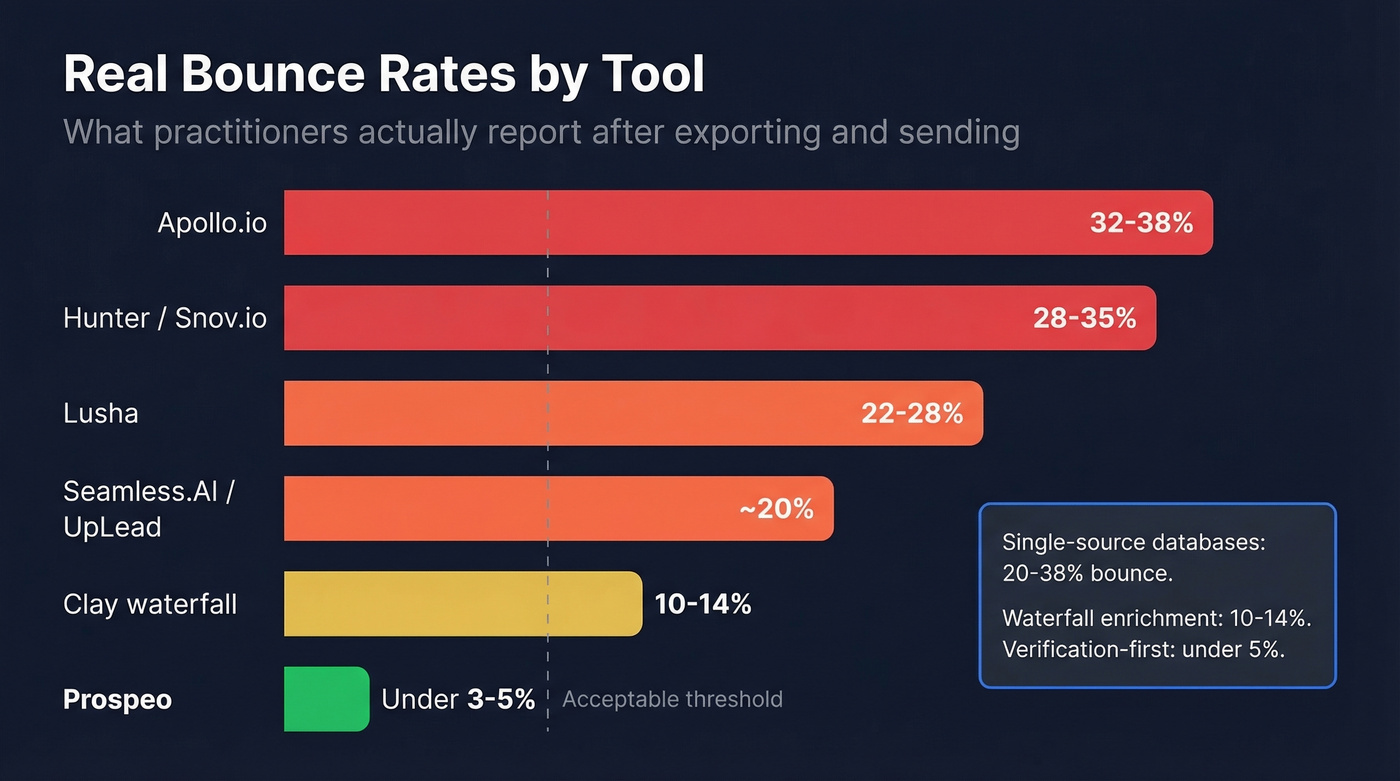
Vendor accuracy claims are marketing. Bounce rates are reality. Here's what practitioners report after exporting and sending:
| Tool / Approach | Reported Bounce Rate |
|---|---|
| Apollo.io | 32-38% |
| Hunter / Snov.io | 28-35% |
| Lusha | 22-28% |
| Seamless.AI / UpLead | ~20% |
| Clay waterfall | 10-14% |
| Prospeo customers | Under 3-5% |

Single-source databases produce 20-38% bounce. Waterfall enrichment - stacking multiple sources - cuts it to 10-14%. Verification-first platforms push it under 5%. In our testing, the difference is dramatic: when bounce rate drops from 35% to 4%, every other metric in your funnel improves. Your reply rates go up, your domain stays healthy, and your ops team stops spending half their week scrubbing records. (To go deeper, see our email deliverability guide.)
The Real Cost of Bad Data
The sticker price is never the real price. Seamless.AI's $79/mo Pro plan sounds reasonable until you burn through 1,000 credits in three weeks and start buying $49 top-ups. ZoomInfo's Professional tier starts around $15K/year, but add Global Data, extra credits, and a couple of seats and you're at $50K+ before you've sent a single email.
The smarter framing is cost per valid lead. If your provider bounces 35%, your $0.50/lead is really $0.77/lead - before you factor in domain reputation damage and the ops hours spent cleaning your CRM. If the vendor won't publish pricing, that's a signal about who their pricing model benefits.
Compliance Risks Nobody Mentions
Most "best leads database" roundups skip compliance entirely. That's a mistake.
CAN-SPAM carries fines up to $43,280 per violation. Opt-outs must be honored within 10 business days. TCPA penalties run $500-$1,500 per violation for unsolicited calls or texts. CCPA hits at $2,500 per violation, $7,500 per intentional violation. And under GDPR, B2B contact details are personal data - you need a lawful basis, proper disclosures, and the ability to handle data subject requests.
Choose providers that offer GDPR documentation, enforce opt-outs globally, and supply DPAs. A cheap database with no compliance infrastructure is an expensive liability.
How to Choose the Right Provider
Solo or small team (under 5 reps, under $500/mo). Start with Prospeo's free tier for accuracy or Apollo's free plan for search volume. For most small teams, 75 verified emails/month is enough to run targeted campaigns without burning your domain. (If you’re building your outbound motion, see sales prospecting techniques.)
Mid-market (5-20 reps, $500-$2K/mo). Lead411 wins if trigger-based prospecting matters. Lusha works for quick browser-extension lookups, though it's not built for bulk exports.
Enterprise (20+ reps, $15K+/yr budget). ZoomInfo for US depth and the full GTM suite. Cognism for EMEA coverage and GDPR-native compliance.
Agencies. Instantly works if you want outreach bundled in. Otherwise, look for no-contract, API-accessible platforms with pricing that scales with client volume - credit overages will kill your margins faster than anything else.
Every database on this list has records. The difference is whether those records connect you to real buyers. Prospeo layers Bombora intent data across 15,000 topics with 30+ filters - technographics, job changes, funding, headcount growth - so your reps target in-market accounts, not dead leads.
Teams using Prospeo book 26% more meetings than ZoomInfo users. See why.
FAQ
Are sales lead databases legal to use?
Yes - B2B prospecting databases are legal under CAN-SPAM, CCPA, and GDPR when used properly. You need a lawful basis (legitimate interest for B2B), must honor opt-outs within 10 business days, and should choose providers that supply DPAs and compliance documentation.
What bounce rate should I expect?
Under 5% is excellent and protects sender reputation. Under 10% is acceptable for most outbound programs. Above 20% means your data source is actively damaging deliverability - practitioner tests show single-source providers often produce 20-38% bounce.
Is there a free B2B contact database worth using?
Apollo.io offers the largest free searchable database, but data quality requires external verification (32-38% bounce). Prospeo's free plan gives 75 verified emails per month with 98% accuracy - fewer contacts, but significantly cleaner data that won't flag your domain.
What's the difference between deliverability and inbox placement?
Deliverability (~98%) means the receiving server accepted the email without a hard bounce. Inbox placement (~84%) means it landed in the primary inbox, not spam or promotions. Bad data hurts both metrics, but inbox placement determines whether anyone actually reads your message.
Should I suppress old contacts when switching providers?
Always. When migrating between providers, export your suppression list - contacts already contacted or opted out - and import it into the new platform before launching sequences. Re-emailing opted-out contacts from a new tool doesn't reset their status and risks CAN-SPAM and GDPR violations.