

Personalized First Lines: What the Data Actually Says (and the Bigger Lever Nobody Talks About)
You spent three hours writing personalized first lines for 20 prospects. Zero replies. Then you check the logs - four bounced, six went to people who left the company months ago. The remaining ten? Solid openers, but they landed in inboxes that were never going to convert because the targeting was off.
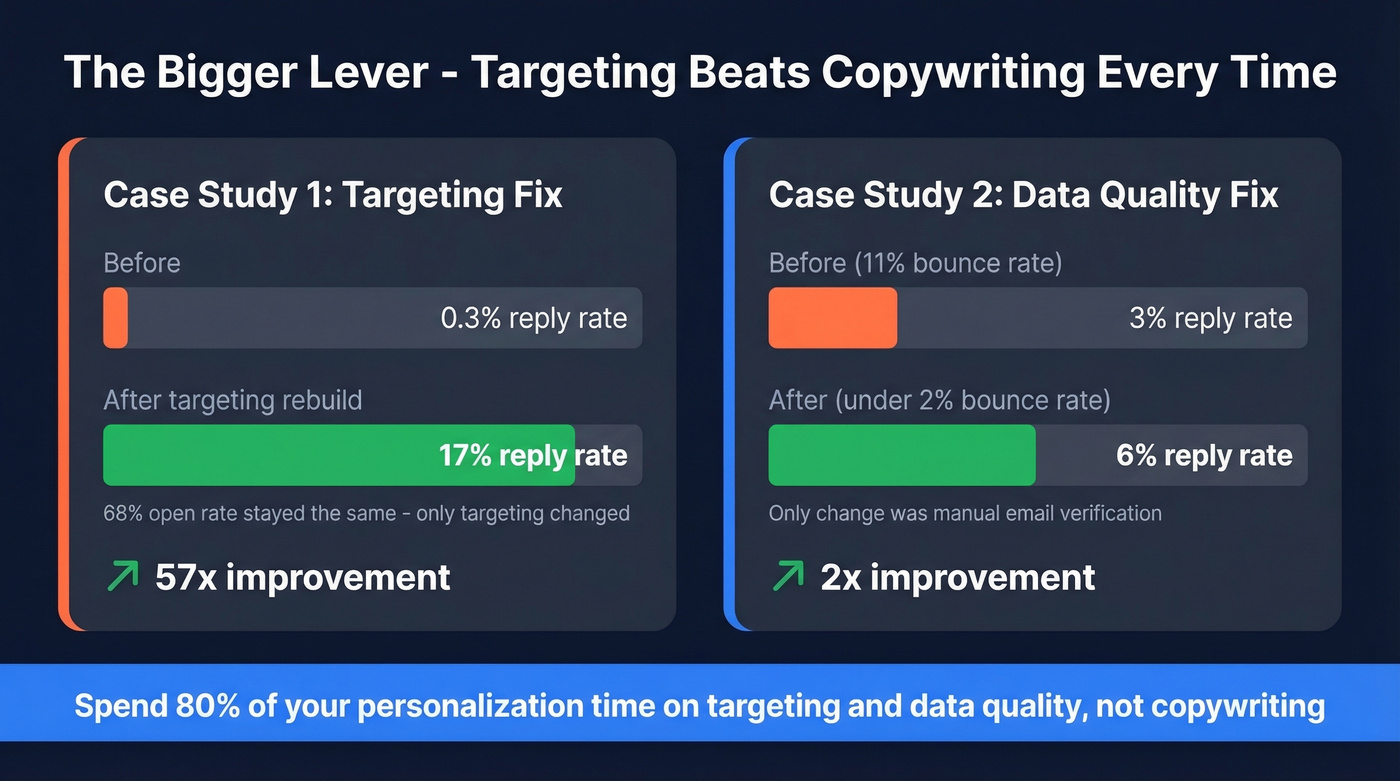
That's the dirty secret of cold email personalization. The first line matters, but it's a multiplier on top of data quality and targeting - not a replacement for either.
Quick version: Personalized first lines can lift reply rates 2-5x when your list and targeting are already solid. Use AI with tight guardrails for most outreach; reserve manual research for high-ticket targets. And before personalizing anything, verify your data - a 10% bounce rate will tank your domain reputation faster than any first line can save it.
What Cold Email First Lines Actually Do
Your first line isn't just an opener - it's inbox copy. In Gmail, Apple Mail, and Outlook, the first line doubles as preview text, the snippet readers scan before deciding whether to open. Autoplicity saw roughly an 8% increase in open rates after optimizing preview text; WeddingWire saw a 30% lift in click-through rates from the same change.
That matters more than ever now that benchmarks are sliding. Belkins analyzed 16.5 million cold emails across 93 business domains in 2024 and found a 5.8% average reply rate - down from 6.8% the year before. Instantly pegs "good" B2B reply rates at 5-10%, with 15%+ as exceptional. Inboxes are more crowded, filters are smarter, and reply rates keep dropping, which makes first-line personalization one of the few remaining levers that consistently moves the needle.
Three Tiers of Personalization
The right approach depends on your deal size, volume targets, and how much time you can burn per lead.
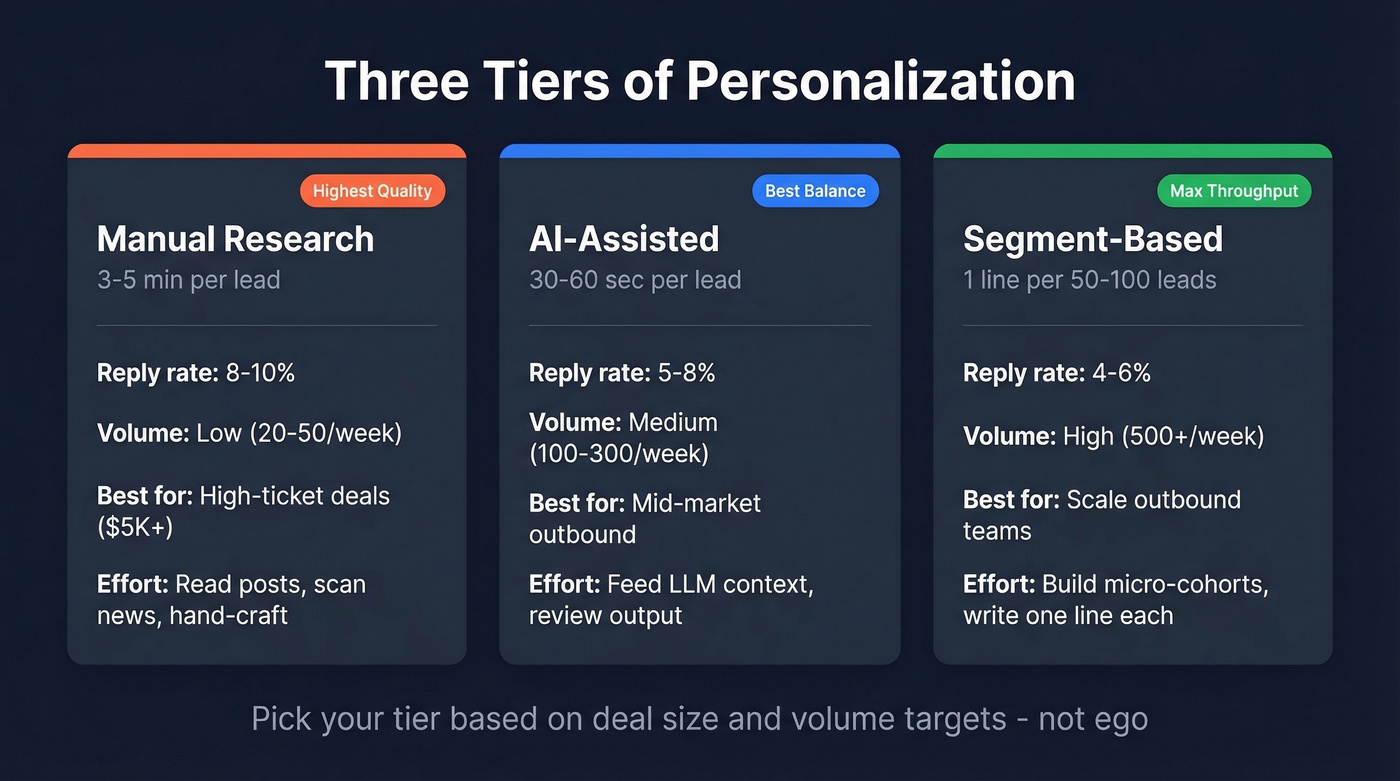
Manual research is the 3-5 minutes per lead approach (cap yourself there - going longer rarely pays off). Read the prospect's recent posts, scan company news, craft a line that proves you did the homework. Practitioners on r/coldemail report reply rates jumping from ~2% to 8-10% with this level of effort. Reserve it for deals where a single reply is worth thousands of dollars.
AI-assisted personalization is where most mid-market teams should live. Feed an LLM the prospect's company info, recent news, and role context, then generate an opening line with tight guardrails. We'll get to the prompt that actually works in a moment. If you're building this into a workflow, it helps to start with a solid AI cold email outreach playbook.
Segment-based "generic personalization" is the move for high-volume outbound. Split your list into micro-cohorts - first-time founders vs. serial entrepreneurs, bootstrapped vs. funded, SaaS vs. services - and write one tailored line per segment. Each line feels personal because it references something true about their situation, even though it's the same line for 50-100 people. Datablist calls this the "mini-campaign" approach, and it's the best balance of personalization and throughput we've found for teams sending at scale.
How to Create Custom Openers With AI
The "uncanny valley" problem is real. AI can reference a prospect's website and still produce lines that feel off. The fix isn't better models - it's better prompts. For more on the craft side, see our guide to AI for sales emails.
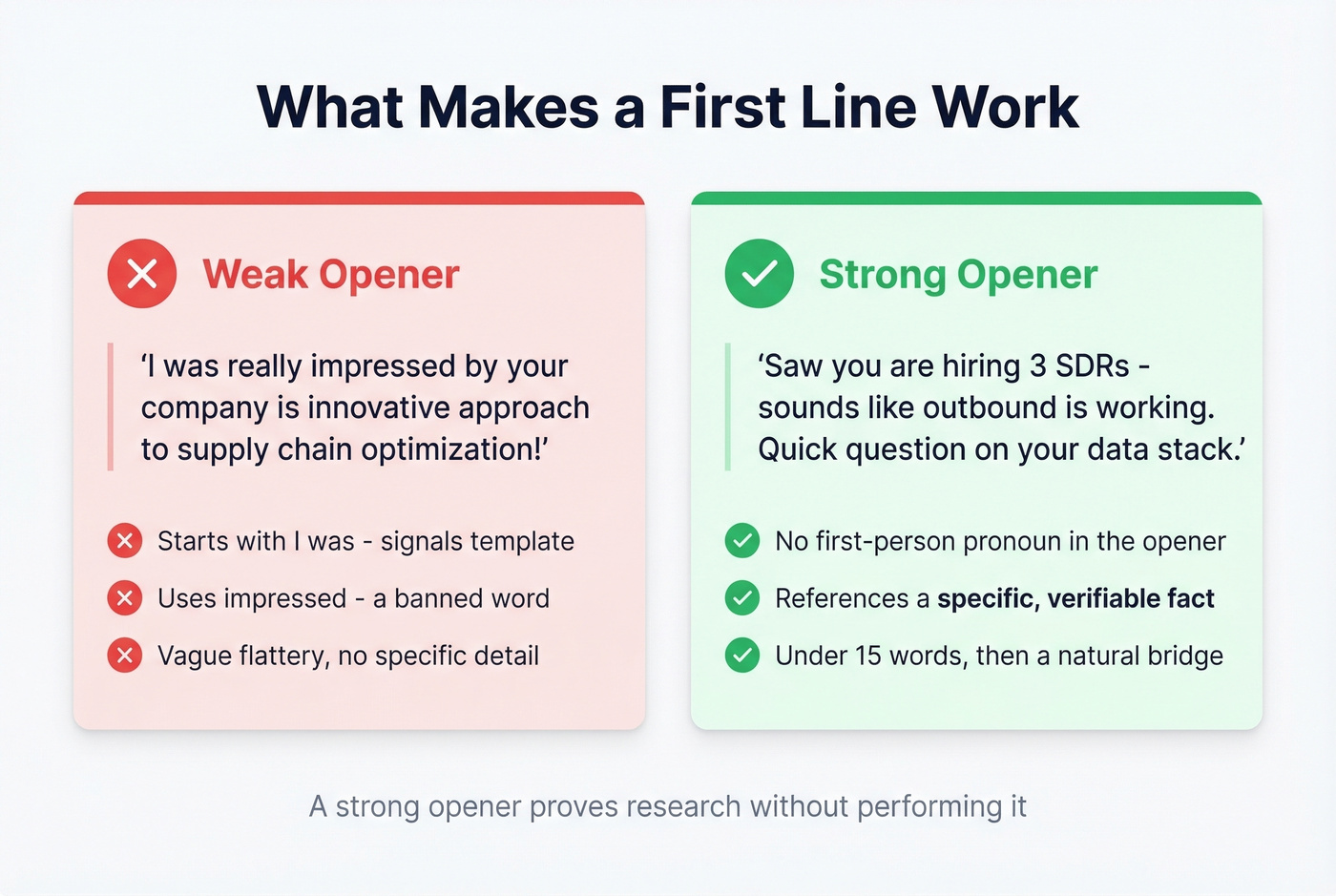
One rule we follow: avoid first-person pronouns in your opening line. "I noticed..." and "I saw..." immediately signal a template.
Here's a prompt template adapted from a practitioner on r/ChatGPTPromptGenius who tested it across 200+ outreaches and reported 15-20% reply rates:
Write a cold email first line for [PROSPECT NAME] at [COMPANY].

Tone: casual-professional. No exclamation points.

BANNED: "hope this finds you well," "just reaching out,"
"I came across your," "impressive."
Reference something specific and recent: [INSERT CONTEXT].
First line under 15 words. No first-person pronouns in the opener.
In that practitioner's testing, Claude nailed the casual-professional tone better than GPT-4 out of the box. GPT-4 works great too, but it needs heavier guardrails to stop defaulting to corporate-speak.
Bad: "I was really impressed by your company's innovative approach to supply chain optimization!"
Good: "Saw you're hiring 3 SDRs - sounds like outbound is working. Quick question on your data stack."
The difference is specificity and restraint. A strong personalized cold email opener proves research without performing it.

You just read it: an 11% bounce rate killed reply rates before any first line had a chance. Prospeo's 98% email accuracy and 7-day data refresh mean your carefully crafted openers actually reach real inboxes - not dead addresses from six weeks ago.
Stop personalizing emails that bounce. Start with verified data.
The Bigger Lever Nobody Talks About
Here's the thing: most teams should spend 80% of their "personalization time" on targeting and data quality, not copywriting. Your first line is a multiplier, not a foundation. Get the foundation wrong and no amount of clever copy saves you.
One cold email operator posted on r/coldemail about hitting a 68% open rate - but only a 0.3% reply rate. After rebuilding targeting with intent signals like SDR job listings, founder comments about sales challenges, and competitor churn, reply rates jumped to 17%. That's not a copywriting fix. That's a targeting fix. If you need a system for this, start with an Ideal Customer Profile and layer in identifying buying signals.
Another operator cut their bounce rate from 11% to under 2% through manual verification and watched reply rates double from 3% to 6%. If you're diagnosing this in your own program, use our email bounce rate benchmarks and fixes.
Bounce rate is the quiet killer. Every bounce chips away at domain reputation, dragging down deliverability for the emails that do reach valid addresses. We've seen this pattern over and over: teams obsess over subject lines and first lines while sending to lists with 8-12% bounce rates, then wonder why nothing converts. Prospeo's 98% email accuracy and 7-day data refresh cycle exist specifically to solve this upstream - Stack Optimize built their agency to $1M ARR on that foundation, keeping bounce rates under 3% with zero domain flags across all clients. If you're trying to protect deliverability, this ties directly into sender reputation and your overall email deliverability.

Tools at a Glance
You need two layers of tooling: the data layer (verified contacts) and the personalization layer (craft and send). Most teams need one from each. Skip the personalization tools if you're doing segment-based openers manually - they're overkill for that workflow. If you're evaluating stacks, compare options in our roundup of SDR tools.
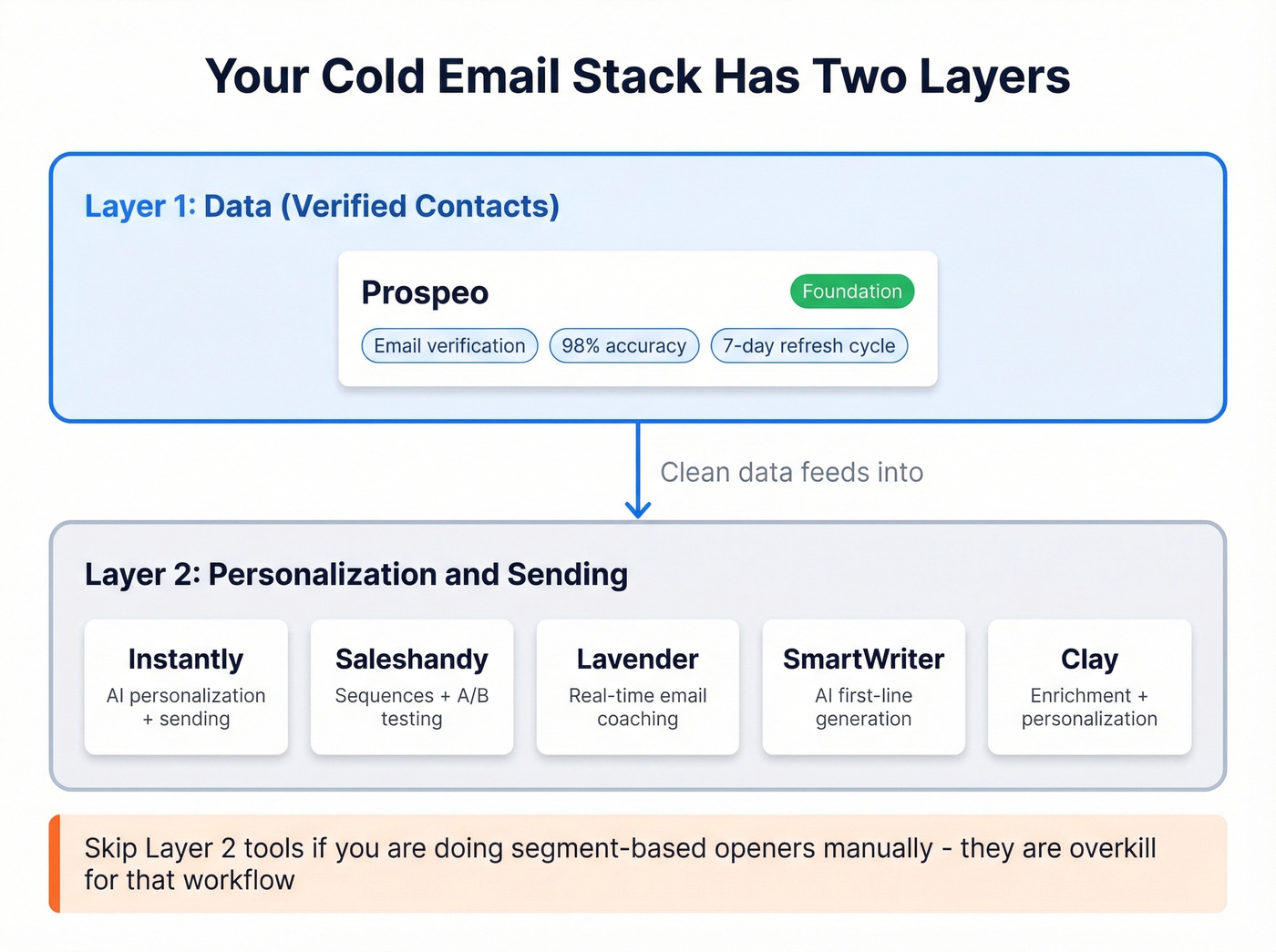
| Tool | Best For | Starting Price |
|---|---|---|
| Prospeo | Verified emails + data | Free (75 emails/mo), ~$0.01/email |
| Instantly | AI personalization + sending | $30/mo |
| Saleshandy | Sequences + A/B testing | $25/mo |
| Lavender | Real-time email coaching | Free tier, $27/mo paid |
| SmartWriter | AI first-line generation | $49/mo (400 credits) |
| Clay | Enrichment + personalization | $149/mo (free trial) |
Segment-based personalization only works when your list data is fresh. Prospeo gives you 30+ filters - buyer intent, job changes, headcount growth, technographics - so every micro-cohort you build is targeting people who are actually in-market right now.
Build laser-targeted segments for $0.01 per verified email.
Personalized First Lines FAQ
Do personalized cold email opening lines actually increase reply rates?
Yes - practitioners consistently report jumps from ~2% to 8-10% with genuine personalization. But the lift depends entirely on list quality. A great first line sent to a bounced or outdated address produces nothing. Verify contacts before you write a single word.
Should I use ChatGPT or Claude for writing openers?
Claude produces a more natural, conversational tone out of the box. GPT-4 works well but needs heavier guardrails - ban exclamation points and spammy phrases, and instruct it to write like a human on their third email of the day. Test both with the same prompt and pick whichever fits your audience.
How do I keep my personalized emails from bouncing?
Start with verified contact data on a short refresh cycle. Layer that with proper domain warmup across 5+ sending domains, and keep bounce rates under 2% - that's the threshold where deliverability stays healthy.
What's the fastest way to personalize at scale?
Use segment-based personalization: split your list into micro-cohorts by company stage, industry, or role, then write one tailored opener per segment. Each line references something true about their situation without requiring individual research. Most teams can cover 500+ prospects per week this way, and the reply rates hold up surprisingly well compared to fully manual approaches.