

Marketing Personas: The Practitioner's Guide to Building Personas That Don't Collect Dust
You've sat through the workshop. Someone spent 45 minutes deciding whether "Marketing Mary" drives a Subaru or a Honda. Meanwhile, nobody asked a single customer what problem they were trying to solve.
That's the state of marketing personas at most companies - decorative documents that never touch a campaign, a budget decision, or a sales call. Personas work. The data is overwhelming on that point. But most teams build them wrong, file them away, and wonder why nothing changed. This guide covers how to build personas that drive decisions and how to turn them into real prospect lists instead of letting them rot in a shared drive.
The Short Version
71% of companies that exceeded revenue and lead goals had documented buyer personas. Companies that missed goals? Only 26%. You don't need ten personas or one per product line - three to five is the sweet spot. And the biggest gap in every persona guide is the "now what?" - turning a finished persona into a list of real people you can contact. Most guides stop at the PDF. We won't.
The process: start with quantitative segmentation, layer in qualitative interviews, draft tight personas, then operationalize them into prospect lists and campaign targeting. Everything else is decoration.
What Is a Marketing Persona?
A marketing persona is a semi-fictional representation of your ideal customer, built from real data and research. The concept traces back to Alan Cooper, a software designer who popularized the technique in his 1999 book long before it became a marketing staple.
The terminology gets messy. "Buyer persona," "user persona," "customer persona" - people use these interchangeably, but they're slightly different lenses. A buyer persona focuses on the purchase decision. A user persona focuses on product interaction. A marketing persona sits in between, emphasizing how someone discovers, evaluates, and responds to your messaging. For most B2B teams, these overlap enough that the distinction is academic.
There's also a useful distinction between proto-personas - assumption-based drafts created from internal knowledge before any research - and research-backed personas built on real data. Proto-personas are fine as a starting point, but treating them as finished products is how you end up with fairytale documents. Every proto-persona needs validation against real customer data before it touches a campaign.
ICP vs. Persona
These get confused constantly, and the confusion wastes real effort.
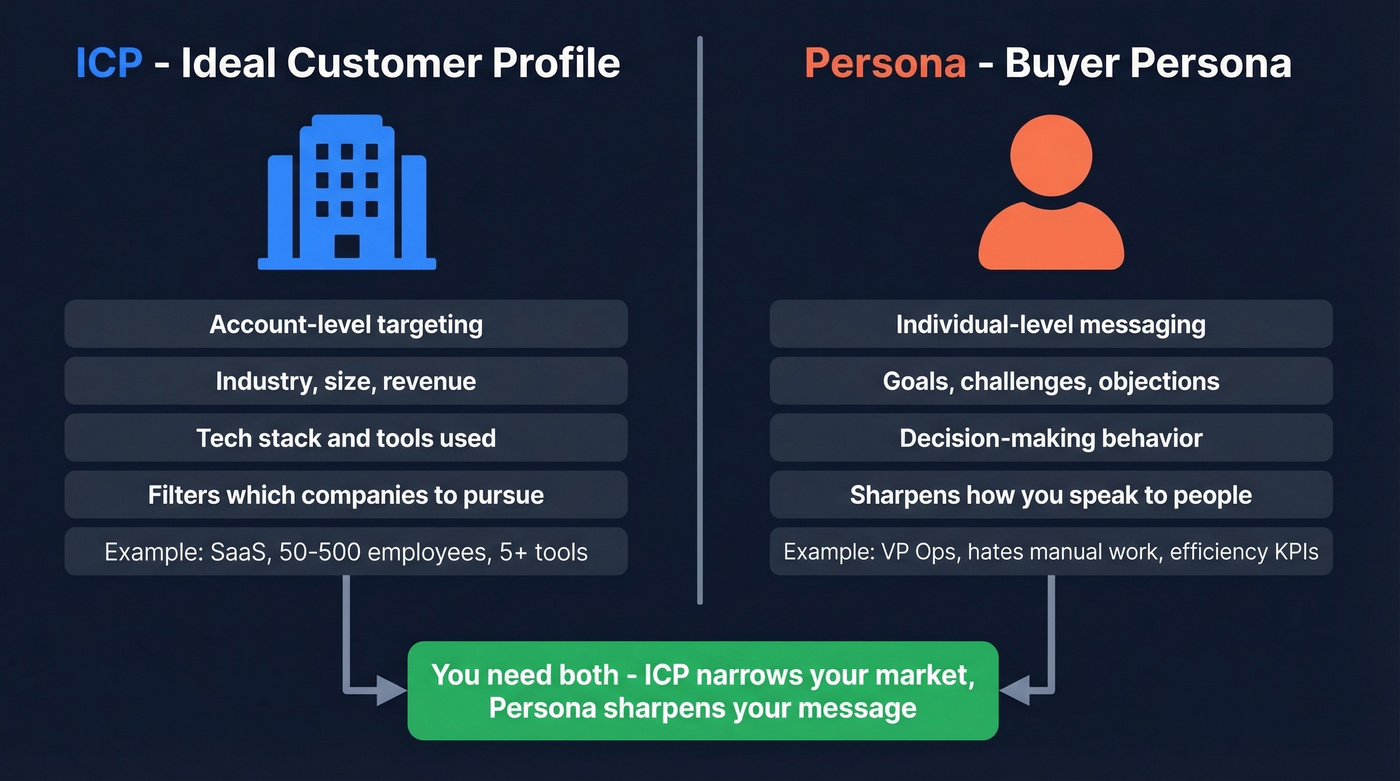
An Ideal Customer Profile (ICP) defines which companies you should target. A persona defines which people within those companies you should speak to. ICP is account-level. Persona is individual-level.
| Dimension | ICP | Persona |
|---|---|---|
| Defines | Which companies to target | Which people to speak to |
| Level | Account / company | Individual |
| Key attributes | Industry, size, revenue, tech stack | Job title, goals, challenges, objections |
| Example | SaaS, 50-500 emp, 5+ tools | VP Ops, efficiency KPIs, hates manual work |
A concrete ICP example from Zapier's content team: fast-growing companies with 50-500 employees, using 5+ disconnected tools, with dedicated ops teams losing 10+ hours per week to manual data entry. That's the company filter. The persona then asks: who inside that company feels the pain, who owns the budget, and who can block the deal?
You need both. The ICP narrows your market. The persona sharpens your message.
Do Personas Actually Work?
Let's settle this with numbers.
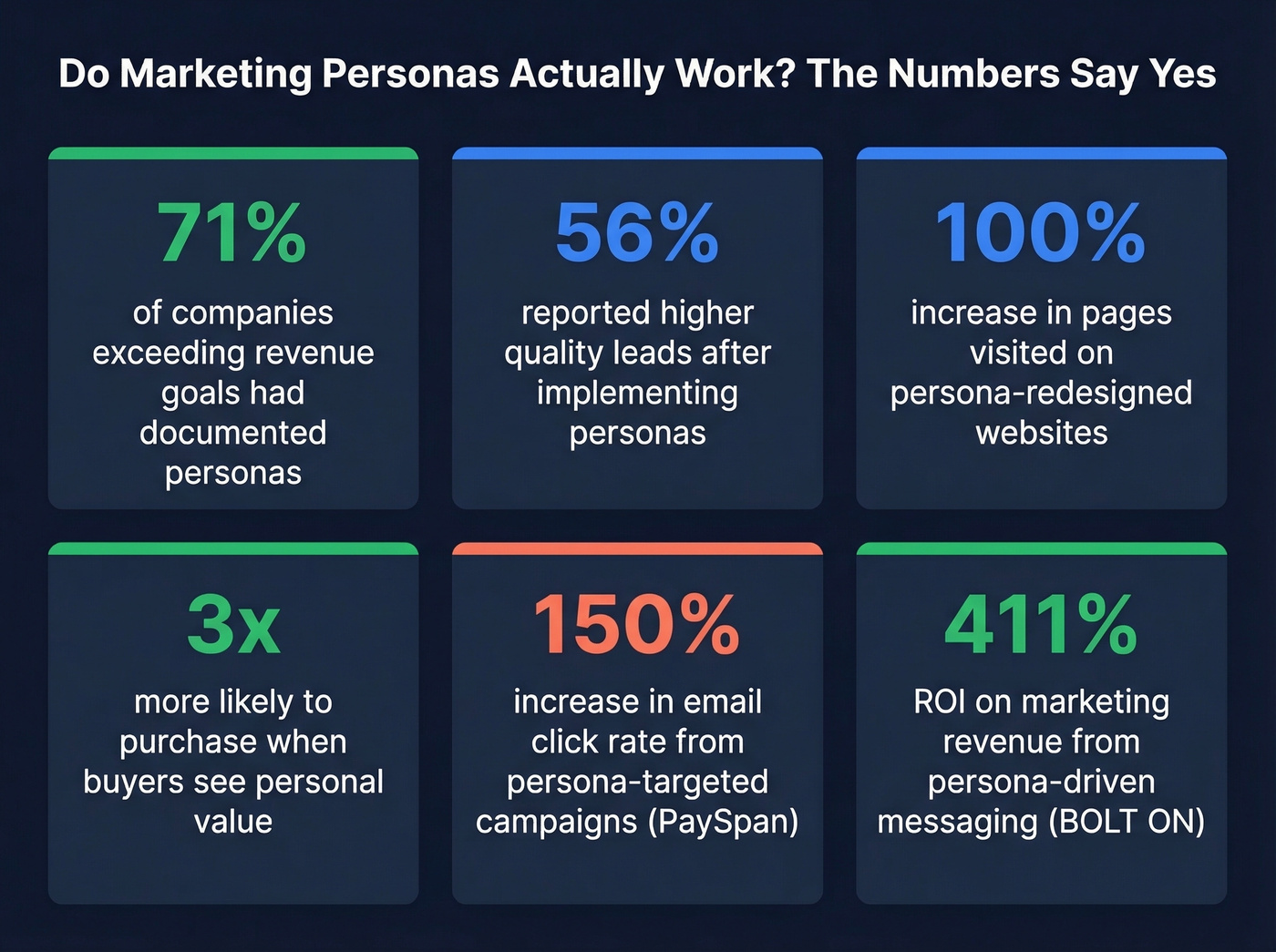
71% of companies that exceeded revenue and lead goals had documented buyer personas. Among those that implemented them well, 56% reported higher quality leads and 36% reported shorter sales cycles. Websites redesigned around persona insights saw a 100% increase in pages visited per session. B2B buyers who see personal value in a product are 3x+ as likely to purchase - which means personas that capture individual motivations, not just job functions, directly impact close rates.
The research method matters enormously. 82.4% of organizations exceeding revenue goals conducted qualitative interviews with buyers. Top performers were far more likely to interview sales teams (58.8%) and executive leadership (70.6%). Meanwhile, 41% of high performers used external studies compared to just 17% of low performers.
PaySpan ran persona-targeted email campaigns and saw a 150% increase in click rate, with 65% of all downloads coming from their top buyer persona. BOLT ON Technology attributed a 411% ROI on marketing-impacted revenue to persona-driven messaging and targeting.
These aren't fluffy numbers. They're the difference between spray-and-pray marketing and campaigns that convert.
Why Most Personas Fail
Most personas are useless - not because the concept is wrong, but because the execution is lazy. The consensus on r/b2bmarketing is blunt: "fairytale personas" get created when marketers don't talk to customers or sales, and they become documents that collect dust. Five mistakes show up over and over:
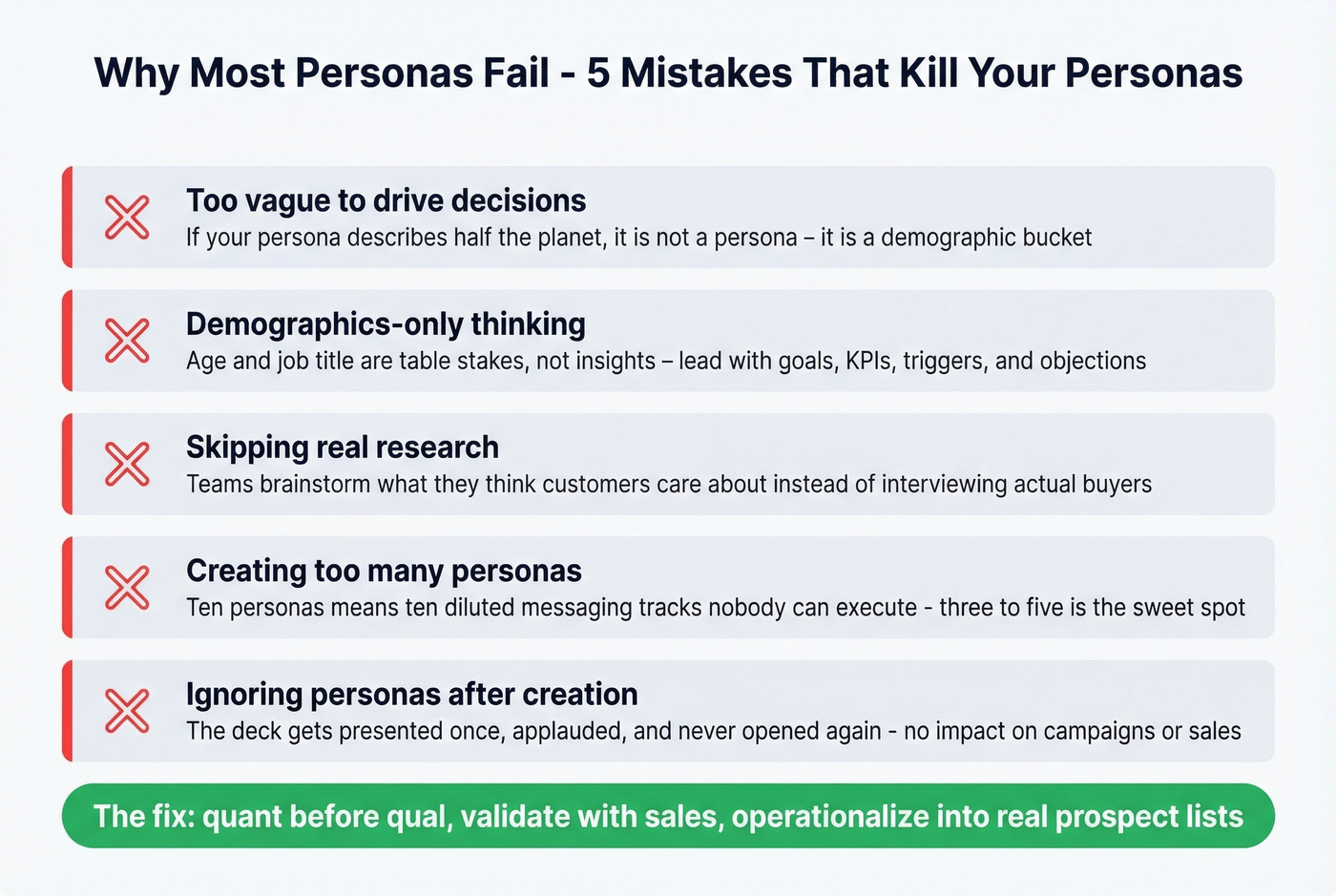
1. Too vague to drive decisions. If your persona could describe half the professionals on the planet, it's not a persona - it's a demographic bucket. A persona that doesn't change how you spend money is decoration. Every persona should make at least one marketing decision obvious.
2. Demographics-only thinking. Age, gender, location, job title - these are table stakes, not insights. B2B personas built like B2C profiles miss firmographics, buying committees, and the decision journey. Lead with goals, KPIs, triggers, and objections. Demographics come last.
3. Skipping real research. This is the big one. Teams sit in a conference room, brainstorm what they think customers care about, and call it a persona. No interviews. No data. No validation. Talk to real customers. The interview framework is in Step 2 below.
4. Creating too many personas. Ten personas means ten diluted messaging tracks that nobody can execute against. Three well-researched personas beat ten generic ones every time.
5. Ignoring personas after creation. The persona deck gets presented once, applauded, and never opened again. It doesn't feed into sales enablement, content strategy, or ad targeting. We'll cover how to fix this in Step 5.
One more failure mode: over-personalization can backfire. A Forbes Councils panel warned that hyper-granular targeting can feel like surveillance. There's a line between relevant and creepy - personas should help you be useful, not intrusive.

You just built a research-backed persona. Now what? Most guides stop at the PDF. Prospeo turns personas into prospect lists - use 30+ filters including job title, intent signals, technographics, and headcount growth to find the exact people your personas describe. 300M+ profiles, 98% email accuracy, refreshed every 7 days.
Your persona isn't finished until it's a list of real contacts you can reach.
How to Build Marketing Personas
Five steps. Quant before qual. Validation before rollout. The process is straightforward - the discipline to follow through is the hard part.
Step 1 - Quantitative Segmentation
Start with your existing customer data, not a brainstorm. Pull your customer list and segment by firmographics (industry, company size, revenue), technographics (tools they use), and revenue metrics like ACV, LTV, and expansion rate.
The goal is to find patterns that matter financially. Buffer's marketing team offers a great example: when they segmented by revenue band, they found that 83% of customers paying $0-$100/month generated only 34% of total revenue. That single insight reshapes which persona gets priority. If your highest-value segment looks completely different from your highest-volume segment, you've already learned something critical.
Step 2 - Qualitative Interviews
This is where personas go from spreadsheet segments to actionable profiles. Remember: 82.4% of organizations exceeding revenue goals conducted qualitative buyer interviews. One HubSpot marketing team reported a 40% conversion lift from a single campaign change driven by interview feedback.
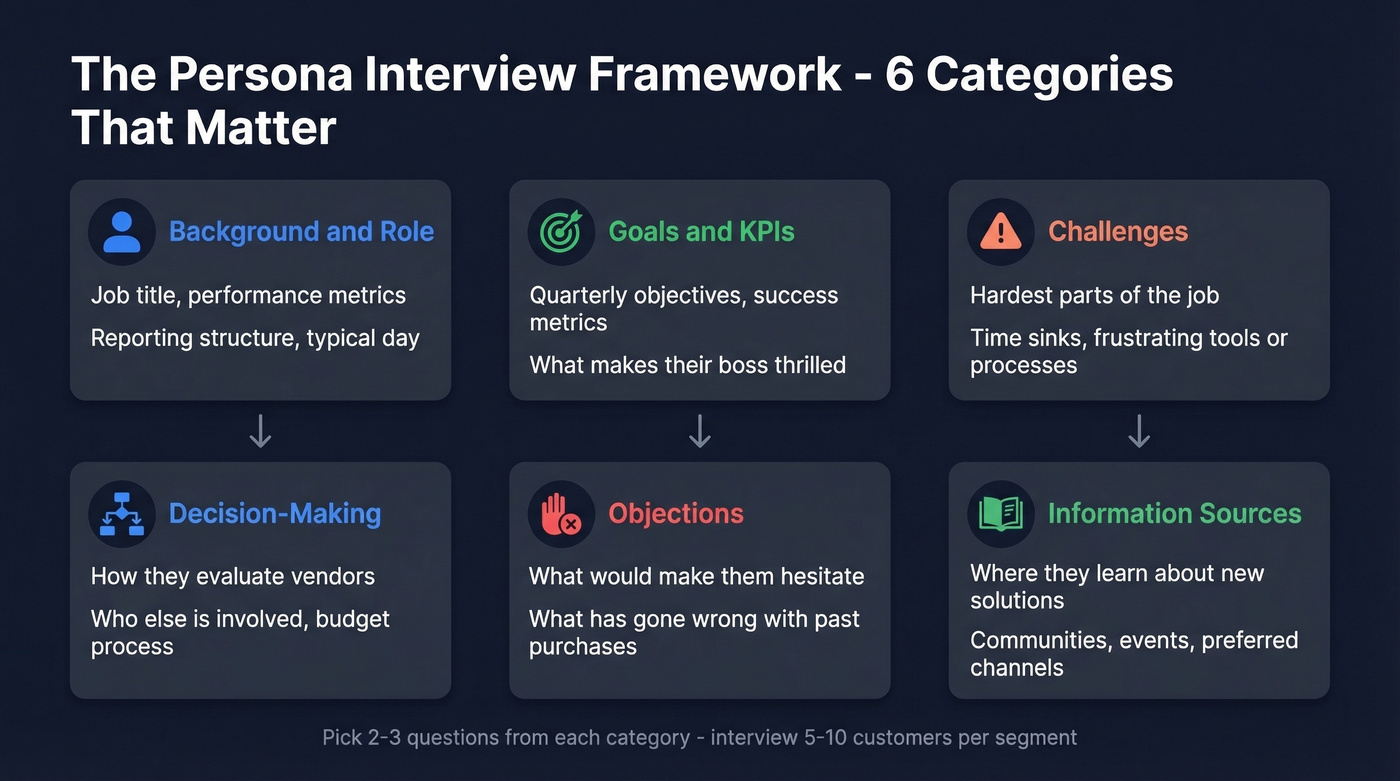
Start internally - interview your sales reps, account managers, and customer service team. They hear objections, frustrations, and buying triggers every day. Then interview 5-10 customers per persona segment.
Here's the thing: most interview guides give you 50 questions and no structure. We've found it's better to group them into six categories and pick two or three from each:
Background & Role - Job title, performance metrics, reporting structure, typical day.
Goals & KPIs - Quarterly objectives, success metrics, what makes their boss thrilled.
Challenges - Hardest parts of the job, time sinks, frustrating tools or processes.
Decision-Making - How they evaluate vendors, who else is involved, budget process.
Objections - What would make them hesitate, what's gone wrong with past purchases.
Information Sources - Where they learn about new solutions, which communities and events they trust, preferred contact channels.
Analytics tools show you what people do. Interviews explain why. This qualitative layer is what separates personas that drive revenue from demographic profiles that sit in a slide deck.
Step 3 - Draft the Persona
Synthesize your research. Resist the urge to add personal fluff - nobody needs to know that "Marketing Mary enjoys hiking and craft beer." Focus on what drives decisions: job responsibilities, KPIs, triggers that start a buying process, objections that stall it, and the content formats they consume.
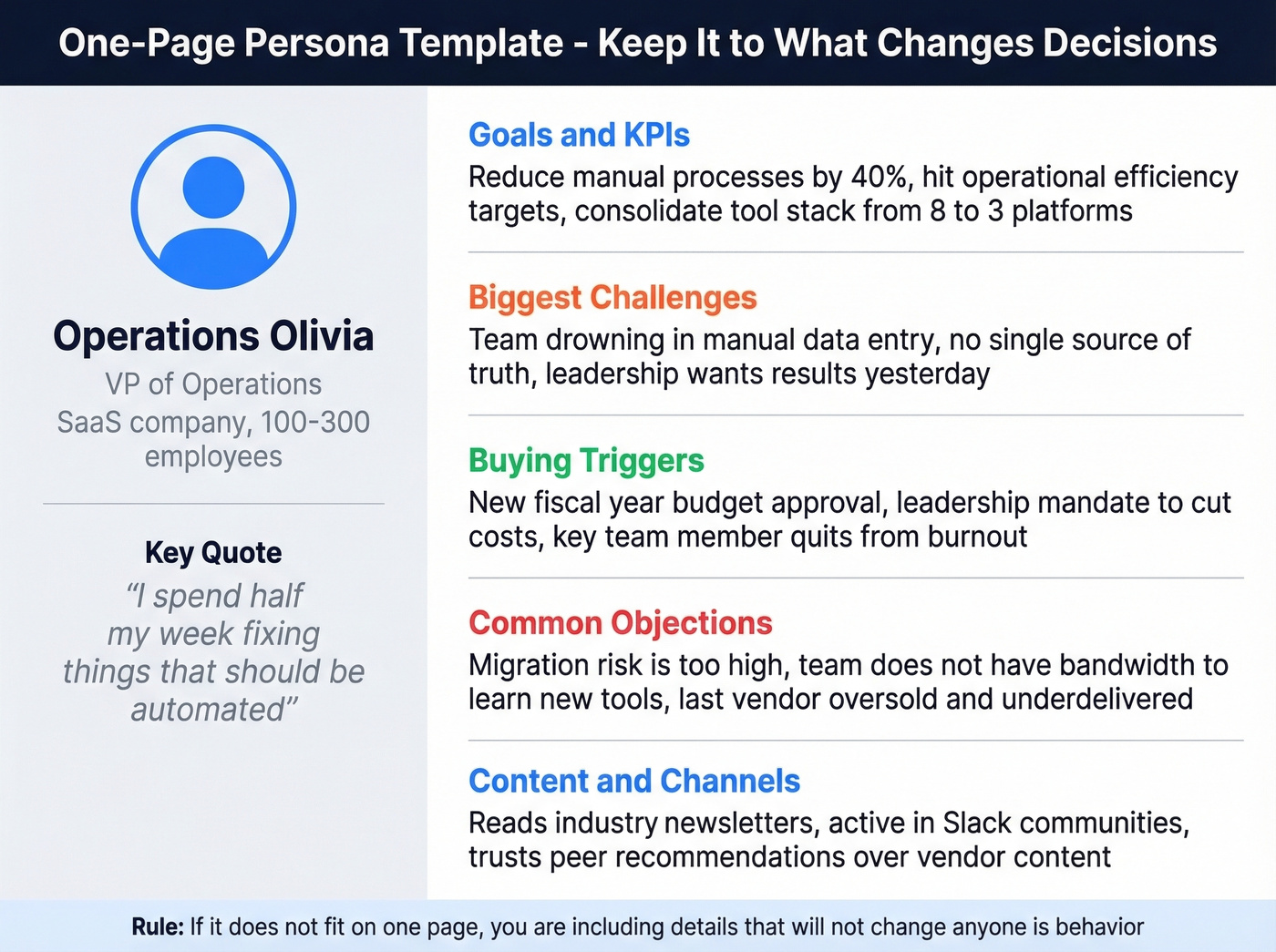
Keep each persona to one page. If it doesn't fit on one page, you're including details that won't change anyone's behavior.
Step 4 - Validate and Pressure-Test
Before you roll anything out, cross-check your draft personas against reality. Sit down with your sales team and ask: "Does this match the people you're closing deals with?" Run the persona against your last 20 closed-won deals. If the persona doesn't describe at least 60-70% of those buyers, something's off.
This is also where negative persona types emerge. An anti-persona is someone who looks like a fit but isn't - they can't afford your product, they'll churn in 90 days, or they'll consume support resources without expanding. Detractor personas represent people who actively resist your solution within a buying committee. Influencer personas capture people who don't hold budget authority but shape the decision through recommendations or technical evaluations. Documenting who you don't want to target is just as valuable as documenting your primary buyer.
Step 5 - Socialize Across Teams
A persona that lives in the marketing team's Google Drive is a persona that doesn't work.
Roll it out with team-specific meetings explaining how each department should use the personas, a 2-4 week follow-up to check adoption, and a shared Slack channel for persona-related questions. In our experience, the teams that skip this step are the ones complaining six months later that "personas didn't work for us."
Personas should feed into:
- Sales enablement - battlecards, objection-handling scripts, discovery questions
- Content strategy - topic selection, format choices, distribution channels
- Pricing and packaging - which features matter to which persona
- Product roadmap - feature prioritization by persona impact
- Customer success - onboarding flows tailored to persona goals
- Product marketing - messaging frameworks that map features to specific buyer pain points
If your persona doesn't change how at least two teams operate, it's not done yet.
Persona Template and Examples
The fields you need differ between B2B and B2C:
| Field | B2B | B2C |
|---|---|---|
| Company profile | Yes | - |
| Buying committee role | Yes | - |
| Decision authority | Yes | - |
| Budget ownership | Yes | - |
| Lifestyle / hobbies | - | Yes |
| Household income | - | Yes |
| Emotional triggers | Light | Heavy |
| Goals & KPIs | Heavy | Light |
B2B Example: "Operations VP Olivia"
- Title: VP of Operations at mid-market SaaS, 200-800 employees
- Reports to: COO or CEO
- KPIs: Operational efficiency, cost per process, team productivity
- Goals: Eliminate manual workflows, consolidate tool stack, reduce headcount growth while scaling output
- Triggers: New funding round, leadership change, failed audit, tool contract renewal
- Objections: "We've tried automation before and it broke." "My team won't adopt another tool." "I need to see ROI in 90 days."
- Content preferences: Case studies, ROI calculators, peer benchmarks. Active in industry Slack communities and ops leader circles.
- Communication preferences: Email for initial outreach, prefers async demos over live calls
- Buying committee role: Primary champion; needs sign-off from CFO and IT
B2C Example: "Weekend Runner Rachel"
- Age range: 28-42
- Income: $65K-$110K household
- Goals: Run a half-marathon, stay consistent with training, avoid injury
- Frustrations: Generic training plans that don't account for her schedule; gear recommendations from elite athletes that don't apply to recreational runners
- Emotional triggers: Seeing friends post race photos; feeling sluggish after a sedentary week
- Content preferences: Instagram Reels, podcast episodes under 30 minutes, app-based training plans
- Purchase behavior: Researches heavily before buying shoes ($120-$180 range); impulse-buys accessories under $40
The core difference: B2B focuses on organizational context, buying authority, and measurable outcomes. B2C focuses on lifestyle, emotional drivers, and individual purchase patterns. B2B personas also need to account for buying committees of 6-10 stakeholders, which means you'll often need multiple personas per account.
From Persona to Prospect List
Here's where most guides just... stop. You've built a beautiful persona document. Now what? The persona says "VP of Marketing at SaaS companies with 50-200 employees using HubSpot" - but nobody translates that into a list of real people to contact.
Building the persona is only half the job. Your competitors are already running sequences against these exact titles. The persona is only valuable if it becomes a targeting filter.
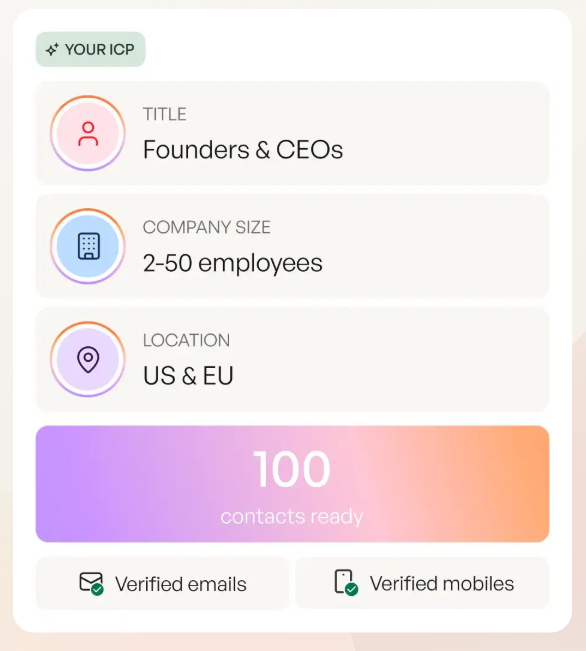
Every attribute in your persona maps to a searchable data point: job title, industry, company size, technology stack, intent signals, funding stage, headcount growth. Prospeo's B2B database lets you take those persona attributes and turn them into a verified contact list - 300M+ professional profiles, intent data tracking 15,000 topics via Bombora, and 98% email accuracy mean the list you export actually matches the persona you built.

And remember - B2B deals involve 6-10 stakeholders. You don't just need the VP. You need the director who'll evaluate your product, the CFO who'll approve the budget, and the end user who'll champion adoption. Multi-threading across the buying committee starts with having verified contact data for each role.
Skip the six-month research project if your deal size is under $15K. Build two personas, pull a list, and start testing messaging. You'll learn more from 500 real conversations than from another workshop about Marketing Mary's car.
If you're building lists from persona attributes, it helps to standardize your filters (industry, size, tech stack) with a simple firmographic filters checklist.
Keep Your Personas Alive
Personas aren't a project. They're a living document. The moment you file them away and move on, they start decaying.
Set a quarterly review cadence at minimum. But certain signals should trigger an immediate update:
- Job changes - if your target persona's typical tenure is 18 months, your persona data goes stale fast
- Company growth signals - a persona built for 50-person startups doesn't apply once those companies hit 200 employees
- Technology adoption shifts - if your ICP used to run on Marketo and now they're migrating to HubSpot, that changes your messaging
- Intent signal changes - new topics trending in your persona's research behavior
Connect your personas to your CRM data. When enrichment runs automatically and surfaces changes in your contact database - job moves, company growth, tech stack shifts - you catch persona drift before it costs you pipeline.
If you want to go deeper on keeping records current, compare data enrichment services and decide what to automate.
The companies that exceed revenue goals don't just document personas - they operationalize them. Prospeo lets you layer buyer intent data across 15,000 topics with department-level filters so your persona-driven campaigns hit real buyers, not stale records. Starting at $0.01 per verified email, no contracts.
Bridge the gap between persona strategy and pipeline with data that actually connects.
AI Persona Tools for 2026
A handful of tools can speed up the formatting and drafting stage. Let's be honest though - none of them replace the research. They just make the output prettier.
HubSpot Make My Persona is free and gets the job done for basic profiles. Describe your ideal customer in plain language, the AI populates standard fields, and you export a shareable PDF. Solid starting point, but it won't do research for you.
UXPressia offers a free tier with more design flexibility - drag-and-drop persona cards, journey maps, and collaboration features. Paid plans run ~$10-$50/user/month. Good for teams that need polished deliverables.
Delve AI takes a different approach, pulling from your website analytics and social data to generate data-backed personas. Pricing starts around ~$50-$150/month depending on the plan. The output is more quantitative than most generators, which is a plus, but it still needs human validation. We've tested it and found the analytics-based approach useful as a supplement to interviews, not a replacement.
Xtensio provides free persona templates with a clean visual editor. More of a formatting tool than a research tool, but the templates are well-structured.
Crystal is worth a look for adding personality and communication-style guidance on top of your personas, especially for sales outreach.
Using an AI persona generator without customer research just creates prettier fairytale personas. Use these tools to structure what you've learned from interviews and data - not to skip the learning entirely.
If you're turning personas into outbound, pair them with proven sales prospecting techniques and a tight B2B cold email sequence.
FAQ
How many marketing personas do I need?
Three to five for most companies. That's enough to capture meaningful differences in buying behavior while keeping each persona actionable. More than five usually means you haven't prioritized - consolidate until each represents a genuinely distinct segment.
What's the difference between B2B and B2C personas?
B2B personas emphasize firmographics, buying committee role, decision authority, and the multi-stakeholder journey. B2C personas lean heavier on lifestyle, emotional triggers, and individual purchase behavior. The biggest structural difference: B2B deals involve 6-10 stakeholders, so you'll often build multiple personas per target account.
How often should I update my personas?
Quarterly at minimum. Trigger an immediate review when you enter a new market, launch a new product, or notice a shift in closed-won deal patterns.
Can AI replace customer research for personas?
No. AI tools like HubSpot Make My Persona are useful for formatting and drafting, but they can't replace qualitative interviews and quantitative segmentation. A polished AI-generated persona built on assumptions is still a fairytale - use AI to speed up the template step, not skip the research.
How do I turn a persona into a prospect list?
Map your persona's attributes - job title, industry, company size, tech stack, intent signals - to search filters in a B2B data platform. Export verified contacts matching your criteria and feed them directly into outreach sequences. The persona defines who to target; the data platform finds them.