

The Best Phone Number Management Dialers in 2026
You're 150 dials into the day and your third number this week just got slapped with a "Spam Likely" label. The SDR team is burning through cold calling numbers faster than you can provision them, and your connect rate is cratering. Meanwhile, some Reddit thread is telling you auto dialers are dead.
They're not dead. But the ones without real phone number management might as well be. A phone number management dialer - one that actively monitors, rotates, and remediates your caller IDs - is the difference between consistent conversations and wasted dial volume. Here's which dialers actually solve this problem, and what you need to fix upstream before your dialer even matters.
Our Picks (TL;DR)
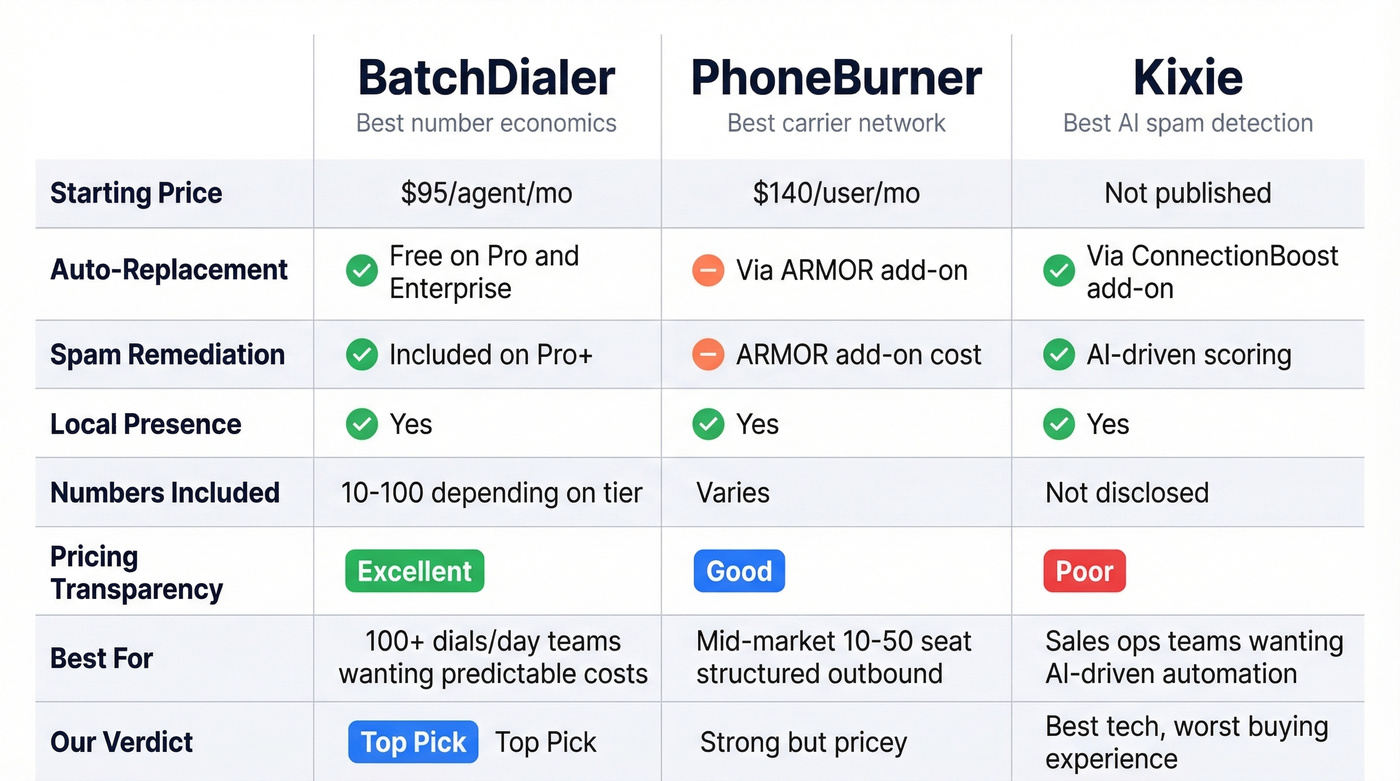
- BatchDialer - Most transparent number management pricing on the market. Auto-replacement is included on Pro ($151/agent/month) and Enterprise ($199/agent/month), so you know exactly what you're paying per number.
- PhoneBurner - ARMOR spam remediation pairs with a Tier 1 network prioritized by carriers. Best for mid-market sales teams running structured outbound with consistent daily volume.
- Kixie - ConnectionBoost's AI spam scoring is the most technically sophisticated approach to caller ID reputation. The pricing opacity is frustrating, but the tech is real.
What "Number Management" Actually Means
Most "best auto dialer" guides treat phone number management as a footnote - a checkbox feature buried under predictive algorithms and CRM integrations. That's backwards. For any team doing serious outbound volume, number management is the feature that determines whether everything else works.
Whether you're shopping for a dialer for sales reps or evaluating an enterprise calling platform, the same principle applies. Even solo reps without a CRM see local numbers as a direct lever for answer rates. One r/LeadGeneration user specifically cited local presence as their primary requirement to avoid spam warnings - no fancy integrations, just clean local numbers that actually connect.
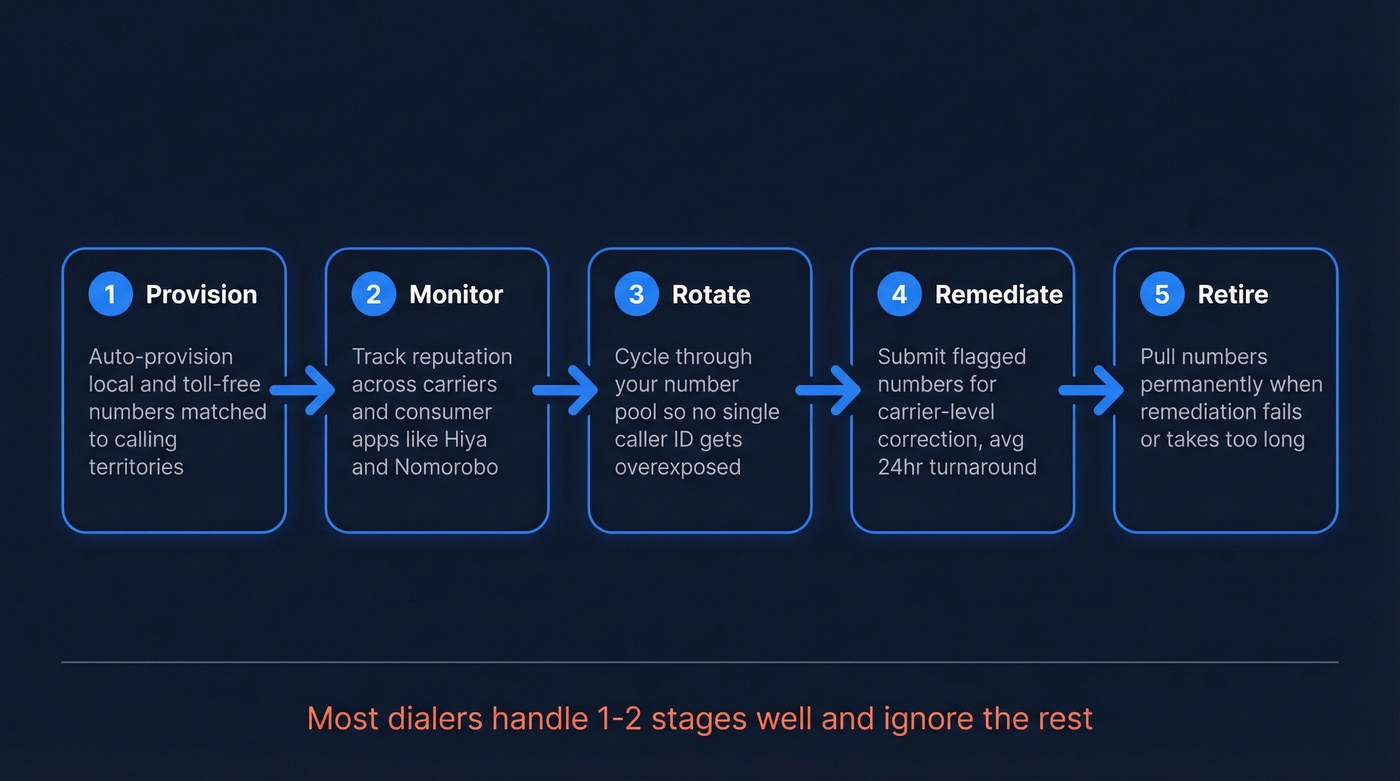
Here's the lifecycle your dialer should handle end-to-end (few actually do):
- Provision - Auto-provision phone numbers matched to your calling territories, including local or toll-free options.
- Monitor - Track each number's outbound reputation across carriers and consumer apps like Hiya.
- Rotate - Cycle through your number pool so no single caller ID gets overexposed.
- Remediate - When a number gets flagged, submit it for carrier-level correction.
- Retire - When remediation fails or takes too long, pull the number from rotation permanently.
A Reddit user in r/InsuranceAgent laid out exactly what practitioners want: "Phone Number Reputation Management & Auto Replacement" alongside local presence and click-to-call, with monthly billing and a one-seat minimum. That's not a niche request. That's the baseline for any outbound phone system in 2026.
The problem is that most dialers handle one or two stages well and ignore the rest. BatchDialer nails provisioning and replacement economics. PhoneBurner's ARMOR focuses on monitoring and remediation. Kixie's ConnectionBoost tries to automate the whole cycle with AI. None of them can fix what happens before the call - which is where your data quality comes in (and where data enrichment and list hygiene matter).
Why Caller ID Reputation Matters Now
The spam-flagging ecosystem has gotten dramatically more aggressive. A 2026 CIDR report analyzing 14.5 million caller ID flag events found that roughly 50% of flags now originate from crowd-sourced call-blocking apps - not carriers. That's a critical distinction. You can have perfect carrier compliance and still get flagged because enough consumers reported your number through Hiya, Nomorobo, or their phone's built-in spam filter.
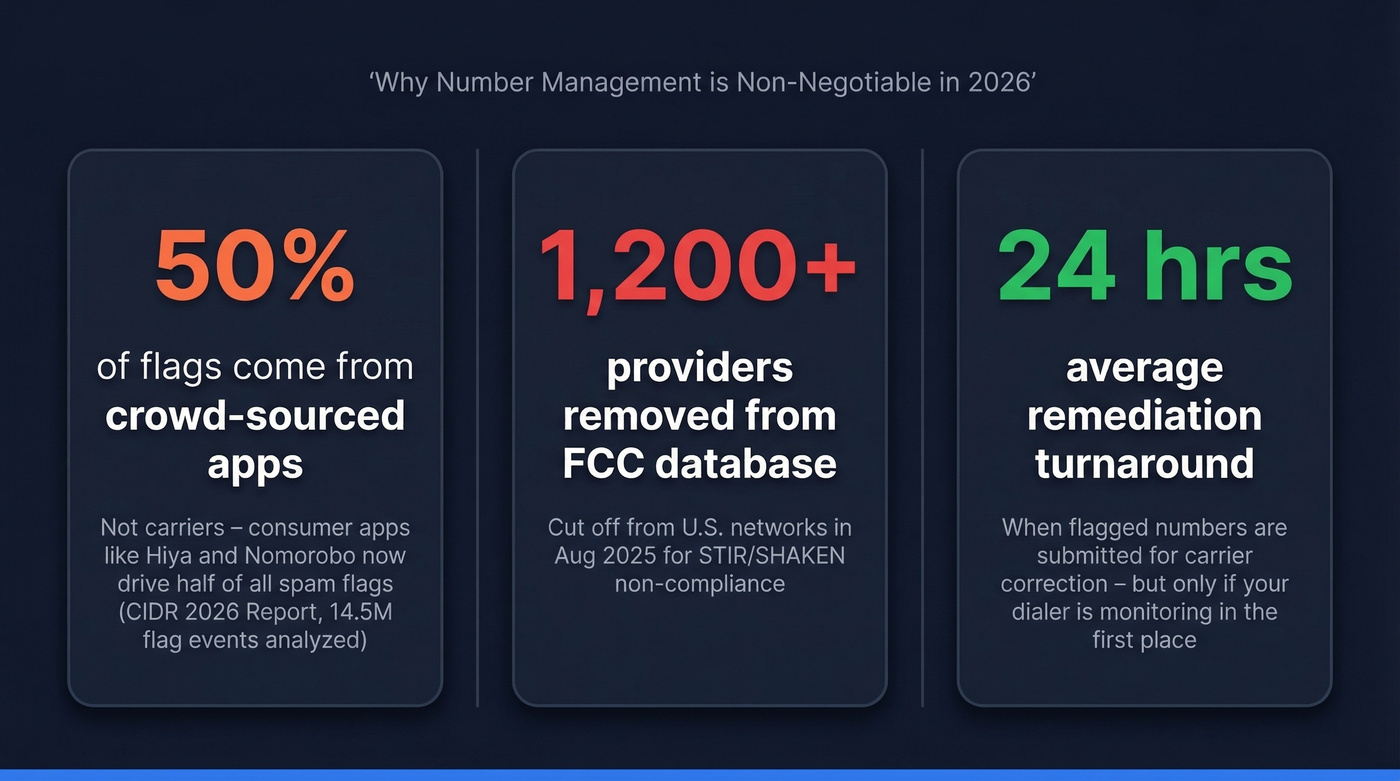
The regulatory side is tightening too. STIR/SHAKEN - the call authentication framework mandatory on U.S. IP networks since 2021 - now has real teeth. In August 2025, the FCC removed 1,200+ providers from the Robocall Mitigation Database for failing to comply, effectively cutting them off from U.S. networks. If your dialer's carrier can't sign calls with Level A attestation (the carrier has fully verified the caller's identity and right to use the number), your calls are more likely to get flagged or blocked entirely. Level B means the carrier verified the caller but not the number. Level C means the carrier did neither. Most spam filters treat B and C calls with increasing suspicion.
The "auto dialers are dead" sentiment floating around Reddit since 2021 isn't entirely wrong - it's just incomplete. Dialers that don't manage number reputation are dead. The ones that do are outperforming manual dialing by a wide margin, delivering measurable ROI through higher connect rates and fewer burned numbers. Average remediation time when a number does get flagged? About 24 hours from submission. That's fast enough to recover - if your dialer is actually monitoring for flags in the first place.
How Phone Number Reputation Works
Phone number reputation works like a credit score for your caller IDs. Carriers and consumer apps assign each number a credibility score influenced by carrier analytics, spam detection systems, and consumer reporting tools. Understanding the difference between a direct dial and a switchboard line matters here too - direct dials bypass gatekeepers, which means higher answer rates and longer call durations that actually help your reputation.
Three metrics that reputation directly impacts:
- Connect rate - the percentage of dials that result in a live conversation (a core sales operations metric).
- Abandon rate - the percentage of answered calls where no agent is available (common with predictive dialers).
- Drop rate - calls that disconnect due to system issues. High drop rates signal robocalling behavior to carriers.
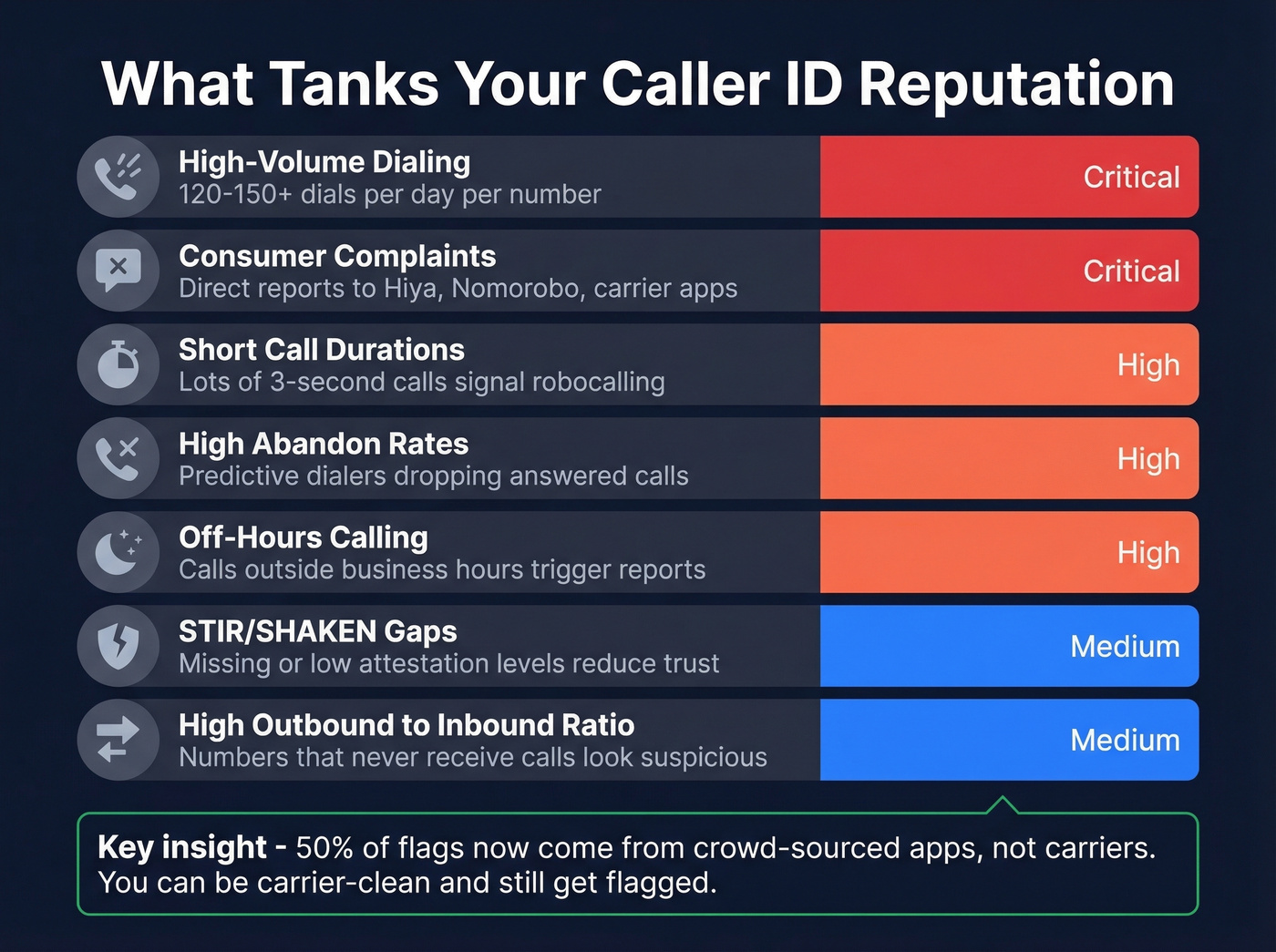
These factors trigger reputation hits:
| Trigger | Why It Hurts |
|---|---|
| High-volume dialing | 120-150+ dials/day can get numbers labeled fast |
| Consumer complaints | Direct reports to Hiya, Nomorobo, carrier apps |
| Short call durations | Lots of 3-second calls signal robocalling |
| High abandon rates | Predictive dialers dropping calls tanks reputation |
| Off-hours calling | Calls outside business hours trigger consumer reports |
| STIR/SHAKEN gaps | Missing or low attestation levels reduce trust |
| High outbound:inbound ratio | Numbers that never receive calls look suspicious |
The critical nuance is that carrier flagging and consumer-app flagging are separate systems. A number can be clean on AT&T's network but flagged in Hiya's database. Numeracle publishes that 99.8% of numbers they actively manage display clean and label-free, with 1-3 day average carrier response times to remediation requests. That's the benchmark for what "managed" looks like.
We've seen teams running 80 dials a day with zero issues, and teams at 150 dials burning through numbers weekly. The volume threshold depends on your answer rate, average call duration, and complaint volume. A team dialing verified, accurate numbers at 150/day will have fewer reputation problems than a team dialing bad data at 80/day.

Number management keeps your caller IDs clean - but clean numbers dialing wrong contacts is still wasted volume. Prospeo gives you 125M+ verified mobile direct dials with a 30% pickup rate, so every dial your managed numbers make actually reaches a decision-maker.
Stop burning managed numbers on bad data. Start with verified direct dials.
Best Dialers for Number Management
We ranked these based on three factors: feature depth, pricing transparency, and real-world user feedback from sales teams and contact centers (especially teams building a repeatable cold calling system).
BatchDialer
Here's the thing about BatchDialer: it's the only dialer vendor that treats phone numbers as a first-class pricing lever. That transparency alone puts it at the top of this list for teams that want to understand their number economics.
Starter runs $95/agent/month with 10 numbers included and $2 per extra number. Pro jumps to $151/agent/month but includes 40 numbers, drops the extra-number cost to $1.50, and - crucially - includes free automatic number replacement plus smart local presence. Enterprise at $199/agent/month gives you 100 numbers at $1/extra with the same free auto-replacement.
The sweet spot is Pro. You're getting smart local presence, auto-replacement when numbers get flagged, and enough included numbers to run a moderate-volume operation without surprise costs. The local dial feature alone - matching area code on outbound calls to your prospect's region - can lift answer rates 30-40%. Best for teams running 100+ dials/day per agent who want predictable number costs.
PhoneBurner
Charging extra for spam remediation on a $140-215/user/month dialer feels like charging extra for seatbelts on a luxury car. That's the core tension with PhoneBurner: ARMOR is the right feature, but it should be table stakes at this price point, not an add-on.
Standard starts at $140/user/month on annual billing ($165 monthly), Professional at $165 ($195 monthly), and Premium at $183 ($215 monthly). ARMOR layers on number monitoring, spam flag remediation, and answer rate analytics. PhoneBurner also includes call recording on Professional and Premium tiers, so managers can review calls without bolting on a separate tool.
PhoneBurner is positioned as the only dialer to place calls on a Tier 1 network prioritized by carriers, and ARMOR is built to reduce "Spam Likely" flags and keep numbers clean. For mid-market sales teams running structured outbound campaigns with 10-50 seats, it's a strong option - just budget for the add-on from day one. The call experience is polished, with minimal latency and clear audio quality that keeps prospects on the line.
Kixie
| ConnectionBoost Pros | ConnectionBoost Cons |
|---|---|
| AI-driven spam scoring across shared phone number pool | No published pricing |
| Automatic number removal and replacement | Annual contracts are a common blocker for SMB buyers |
| Progressive caller ID rotation built in | Add-on cost on top of base plan |
| Local presence dialing included | SMB-hostile sales process |
ConnectionBoost is the most technically ambitious approach to number management on the market. Kixie's system tests numbers in a shared pool, assigns each a spam/scam score using AI, and automatically removes and replaces numbers that score poorly. Carriers look at how long a number has been active, its outbound-to-inbound call ratio, and how many missed calls it generates. ConnectionBoost optimizes across all of these simultaneously.
Kixie also offers strong admin visibility - managers can see real-time number health, agent activity, and flag status across the entire team from a single dashboard. That's a differentiator for sales ops leads managing 10+ reps.
The frustrating part? Kixie doesn't publish pricing. ConnectionBoost is listed as a "Premium Add-on" on their pricing page, but no dollar amount appears. Expect $75-150/user/month for core plans plus the ConnectionBoost add-on. Hiding pricing behind a sales call in 2026 is a red flag for a product targeting SMB sales teams.
Orum
Orum is the parallel dialing specialist - and arguably the best multi-line dialer for teams that need to increase calls per hour without sacrificing number health. Launch tier gives you 5 caller IDs per month with parallel dialing up to 5 lines. Ascend bumps that to 10 caller IDs per user per month and parallel up to 10. Minimum 3 seats.
Pricing is quote-based - expect around $250+/user/month. Built for 5+ seat SDR teams doing high-volume outbound. The 3-seat minimum and enterprise pricing rule out solo reps and small teams. Skip this if you're a two-person operation or need month-to-month flexibility.
Convoso
Convoso's Ignite system is the most sophisticated number management engine available - priced accordingly at $150-300/user/month. It runs real-time DID health scoring, dynamically routes calls through the best-performing numbers, and proactively procures and retires numbers based on reputation data. Teams using Ignite properly see 30-50% contact rate increases, which tracks with what we've observed from operations that actively manage their number pools.
Convoso also surfaces a nuance most dialers ignore: a number can be flagged on one carrier but clean on another, and Ignite routes accordingly. The platform supports branded caller ID, displaying your company name instead of just a number - a feature that can meaningfully lift answer rates. Built for contact centers with 20+ agents. Overkill for small sales teams.
CallTools
CallTools markets call reputation monitoring, caller ID auditing, and the ability to swap bad CIDs quickly. It also offers unlimited minutes. The problem? Very little published detail on methodology, performance metrics, or pricing. Expect ~$100-150/user/month based on the competitive landscape. Evaluate it alongside Convoso if you're shopping for contact center dialers, but know that CallTools publishes less about how its number management actually works than most competitors.
RingCentral
RingCentral pricing starts around $65/user/month (paid annually). RingCX includes predictive, progressive, preview, and voice broadcast dialing modes plus a manual alternative (TCPA Safe Dial). You get the reliability of a UCaaS giant. Number management isn't the reason teams buy RingCentral - it's a unified phone system that can also run outbound dialing. For teams that need inbound call routing alongside outbound, RingCentral's platform is hard to beat on breadth (and if you're comparing options, see Dialpad alternatives too).
Aircall
Aircall runs $40/user/month and is a clean, modern VoIP phone with strong integrations. It supports international numbers for teams operating across multiple markets. It isn't positioned around number reputation management, though. Best for teams that'll pair it with a third-party monitoring service like Numeracle. Aircall also works well for remote teams thanks to its browser-based interface and mobile app.
Nextiva
Nextiva starts at $129/user/month. It's a UCaaS platform that can support outbound calling, with call routing built into its contact center tier. Number management isn't a headline differentiator here.
MightyCall
MightyCall starts at $25/user/month. It's a budget-friendly option for very small teams that need a virtual number and basic calling features. If you're not yet doing enough volume for reputation to be a concern, you can start here and graduate to a more capable dialer as you scale (or compare MightyCall alternatives if you need more features).
Number Management Features Compared
Table 1: Core Number Management
| Tool | Base Price | Rep. Monitoring | Auto Replace | Local Presence |
|---|---|---|---|---|
| BatchDialer | $95-199/agent/mo | Yes (Pro+) | Yes (Pro+) | Yes (Pro+) |
| PhoneBurner | $140-183/user/mo | Yes (ARMOR add-on) | Via ARMOR | Yes |
| Kixie | ~$75-150/user/mo | Yes (ConnectionBoost) | Yes (auto) | Yes |
| Orum | ~$250+/user/mo | Limited | Manual | Yes |
| Convoso | ~$150-300/user/mo | Yes (Ignite) | Yes (dynamic) | Yes |
| CallTools | ~$100-150/user/mo | Yes (marketed) | Yes (manual) | Yes |
| RingCentral | ~$65+/user/mo | Limited | No | Yes |
| Aircall | $40/user/mo | Limited | No | No |
| Nextiva | $129/user/mo | Limited | No | Yes |
| MightyCall | $25/user/mo | Limited | No | Limited |
Table 2: Number Economics & Billing
| Tool | Numbers/Agent | Extra # Cost | Billing Options |
|---|---|---|---|
| BatchDialer | 10-100 | $1-2 | Monthly or Annual |
| PhoneBurner | Not public | Not public | Monthly or Annual |
| Kixie | Not public | Not public | Quote-based |
| Orum | 5-10/mo | Included | Annual (quote) |
| Convoso | Dynamic pool | Included | Annual (quote) |
| CallTools | Not public | Not public | Quote/demo |
| RingCentral | Varies | Varies | Monthly or Annual |
| Aircall | Varies | Varies | Monthly or Annual |
| Nextiva | Varies | Varies | Monthly or Annual |
| MightyCall | Varies | Varies | Monthly or Annual |
Bottom line: If you're evaluating dialers primarily on number management, BatchDialer wins on transparency, Convoso wins on sophistication, and Kixie wins on automation. Start with whichever priority matters most to your team and work outward.
How Dialers Improve Sales Performance
Beyond number management, the right dialer compounds gains across your entire outbound operation:
Local presence dialing matches your outbound caller ID to the prospect's area code and consistently lifts answer rates 30-40% over toll-free or out-of-area numbers. Every dialer on this list except Aircall and MightyCall supports some form of local number matching.
Increased call volume is the obvious win. Parallel and power dialers let reps make 3-5x more outreach calls per hour compared to manual dialing. Orum's parallel approach is the most aggressive; PhoneBurner's power dialer is the most reliable for sustained daily volume.
Clean caller ID display - showing a recognizable number or your company name via branded caller ID - is the single biggest factor in whether a prospect picks up. Every dollar spent on number management pays dividends here.
Recording and coaching built into your dialer means managers can review calls, identify patterns, and coach reps without switching platforms. PhoneBurner and Kixie both handle this well (and it pairs well with tighter sales prospecting techniques and rep workflows).
The compounding effect is real: clean data feeds clean numbers, clean numbers feed higher connect rates, and higher connect rates feed more conversations per hour.
Fix Your Data Before Your Dialer
Here's a pattern we see constantly: a team invests in a dialer with great number management, loads a purchased list, and watches their caller IDs get flagged anyway. The dialer's reputation monitoring can't fix a list full of disconnected numbers. Every call to a dead line inflates your abandon rate, shortens your average call duration, and generates exactly the signals that trigger spam flagging.
If your average deal size is under $15k, you don't need ZoomInfo-level data infrastructure. But you absolutely need verified phone numbers. Prospeo's database covers 125M+ verified mobile numbers with a 30% pickup rate - compared to 12.5% for ZoomInfo and 11% for Apollo. That's not a marginal difference; it's the difference between your number pool lasting weeks versus days. Data refreshes every 7 days versus the 6-week industry average, and 98% email accuracy rounds out the picture for multi-channel teams (especially if you're building a broader outbound lead generation motion).
Real results back this up. Meritt's connect rate tripled to 20-25% after switching to verified mobiles. Snyk's bounce rate dropped from 35-40% to under 5% across 50 AEs. Your dialer manages your numbers - clean data makes sure those numbers are worth managing.
Number Pool Economics
The question every sales ops lead asks: how many numbers do I need per agent? The answer depends on volume.
| Daily Dial Volume | Numbers Per Agent | Rotation Strategy |
|---|---|---|
| 40-80 dials | 5-10 | Basic rotation, weekly monitoring |
| 80-120 dials | 10-20 | Daily rotation, active monitoring |
| 150+ dials | 20-40 | Aggressive rotation, auto-replacement |
Let's run the math on BatchDialer since they're the most transparent. A Starter agent at 80 dials/day needs about 15 numbers - 10 included, 5 extra at $2 each = $10/month on top of the $95 base. A Pro agent at 150 dials/day needs around 30 numbers - 40 included, so you're covered at $151/month with free auto-replacement. That's clean economics.
Orum takes a different approach: 5-10 caller IDs allocated per user per month, with the parallel dialer cycling through them automatically. The allocation model works when you have enough seats to pool numbers across the team.
The hidden cost most teams miss isn't the numbers themselves - it's the productivity loss when numbers get flagged. A flagged number means lost dials during the remediation window (about 24 hours to 3 days), plus the re-warming period where a fresh number hasn't built enough history to display cleanly. Teams running verified data through their dialers extend their number pool life by reducing the triggers that cause flags in the first place. For teams using a local presence strategy, this is especially important - burning through local numbers in a key territory means you can run out of clean DIDs in that area code entirely.
FAQ
How many dials before a number gets flagged?
There's no universal threshold, but numbers dialing 120-150+ times per day with low answer rates can get flagged within days. A number reaching verified contacts at 150/day with a 15% connect rate will last far longer than one hitting disconnected lines at 80/day. Monitor daily and rotate proactively.
Can I fix a number already flagged as spam?
Yes. Remediation through Numeracle or dialer-native tools like ARMOR and ConnectionBoost takes 24 hours to 3 days depending on the carrier. Numeracle reports 99.8% of managed numbers display clean and label-free. The key is catching flags early through active monitoring, not periodic spot-checks.
Does my dialer handle number management or do I need a separate tool?
BatchDialer, PhoneBurner (with ARMOR), Kixie (with ConnectionBoost), and Convoso (with Ignite) have built-in management. Aircall, RingCentral, and Nextiva lack dedicated reputation workflows, so you'd pair them with a third-party service like Numeracle or CIDR to monitor and remediate.
Does data quality affect caller ID reputation?
Directly. Dialing disconnected or wrong numbers shortens average call duration and increases the exact patterns that trigger spam flags. Verified mobile data with high pickup rates reduces these signals at the source - which is why we recommend cleaning your lists before worrying about dialer features.
What is STIR/SHAKEN and why should I care?
STIR/SHAKEN is a U.S. call authentication framework mandatory on IP networks since 2021. Calls with Level A attestation - meaning the carrier fully verified the caller's identity - are significantly less likely to be flagged. In August 2025, the FCC removed 1,200+ non-compliant providers from the Robocall Mitigation Database, making attestation level a real operational concern.
The article above proves it: short call durations and high abandon rates destroy number reputation. The fix starts before your dialer - with accurate direct dials that connect to real buyers. Prospeo's 98% email accuracy and 125M+ verified mobiles mean longer conversations and fewer wasted dials.
Protect your caller ID reputation by fixing your contact data first.