


Phonexa Pricing, Reviews, Pros and Cons: What You'll Actually Pay in 2026
Phonexa's pricing page says $250/mo. Some third-party sites still list $100/mo. Neither number tells you what you'll actually spend.
Once you factor in setup fees ($500-$2,000), per-minute call tracking charges, and usage-based rates across Phonexa's eight-module suite, the real monthly bill for a busy pay-per-call operation looks nothing like the sticker price. We dug into the official pricing, ran the math on realistic usage scenarios, and cross-referenced review platforms to give you the full picture.
30-Second Verdict
Phonexa is built for high-volume pay-per-call agencies and lead-gen networks that need call tracking, lead distribution, and analytics under one roof. But that $250/mo "starting price" is misleading - setup fees ($500-$2,000) and usage charges mean most active teams land at $700+ monthly on the Lite plan once usage kicks in. Small teams or online-only lead operations will find it overbuilt and overpriced.
What Phonexa Actually Costs in 2026
Here's what Phonexa's official pricing page shows:
| Component | Lite | Premium | Enterprise |
|---|---|---|---|
| Base price | $250/mo | $500/mo | $1,000/mo |
| Setup fee | $500 | $1,000 | $2,000 |
| Seats / APIs | 25 / 5 | 50 / Unlimited | Unlimited |
| Publishers | 10 | Unlimited | Unlimited |
| Campaigns | 15 | 90 | Unlimited |
| Call tracking | $0.045/min | $0.04/min | $0.035/min |
| Lead tracking | $0.0003/ping | $0.0002/ping | $0.0001/ping |
| $0.20/1K | $0.15/1K | $0.11/1K | |
| Click tracking | $0.30/1K | $0.25/1K | $0.20/1K |
| Suppression list | $0.50/1K | $0.35/1K | $0.15/1K |
| AI Call Agents | $0.225/min | $0.225/min | $0.225/min |
| Contract | Pay-as-you-go | Pay-as-you-go | Custom |
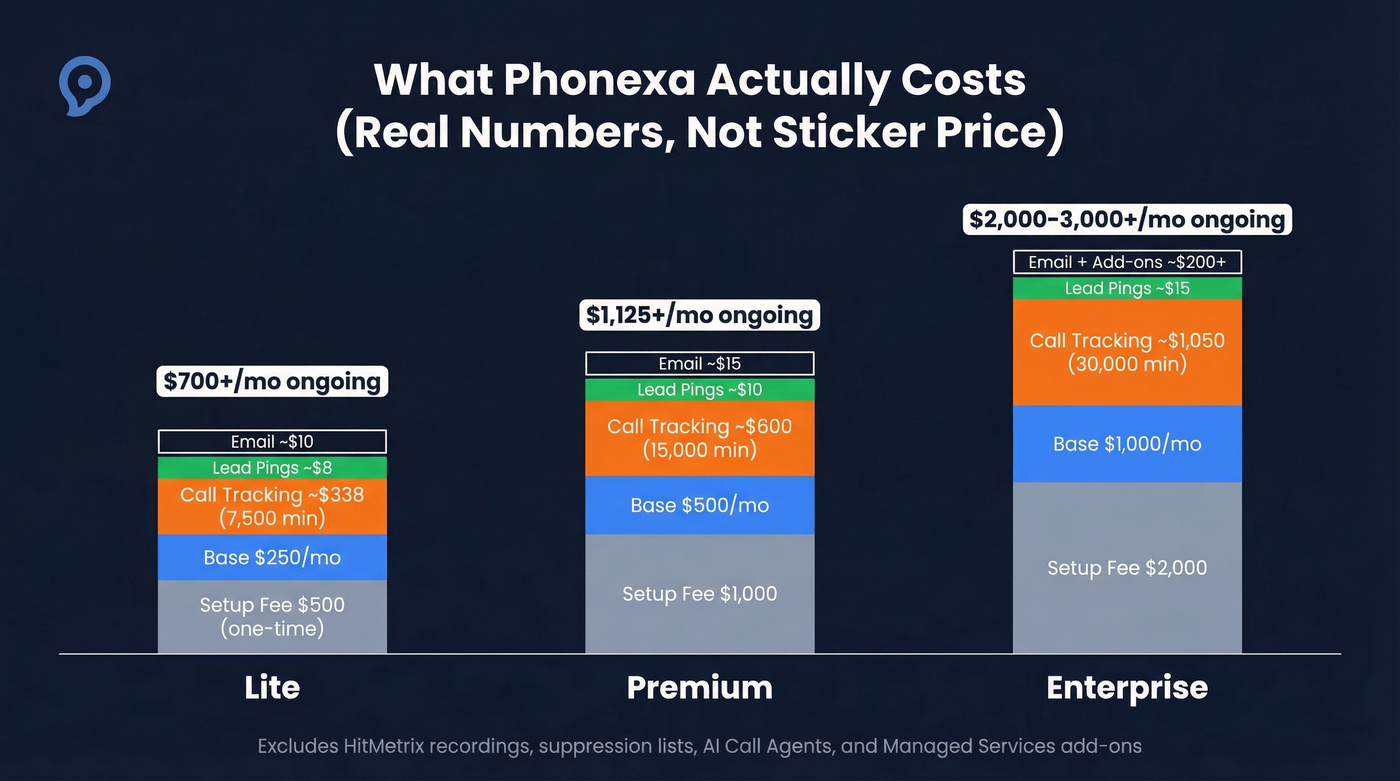
The base fee is just the entry ticket. We ran the numbers on a typical mid-volume Premium scenario: $500 base + 15,000 minutes at $0.04 ($600) + 50,000 pings at $0.0002 ($10) + 100K emails at $0.15/1K ($15) = roughly $1,125/mo minimum - and that's before suppression lists, HitMetrix user recordings ($0.0035 each), or Phonexa's optional Managed Services package. A busy agency easily lands in the $1,500-$3,000/mo range.
If you're trying to model total cost of ownership across your stack, it helps to map these usage fees back to your lead generation metrics and expected average B2B lead conversion rate.
What Users Say in Reviews
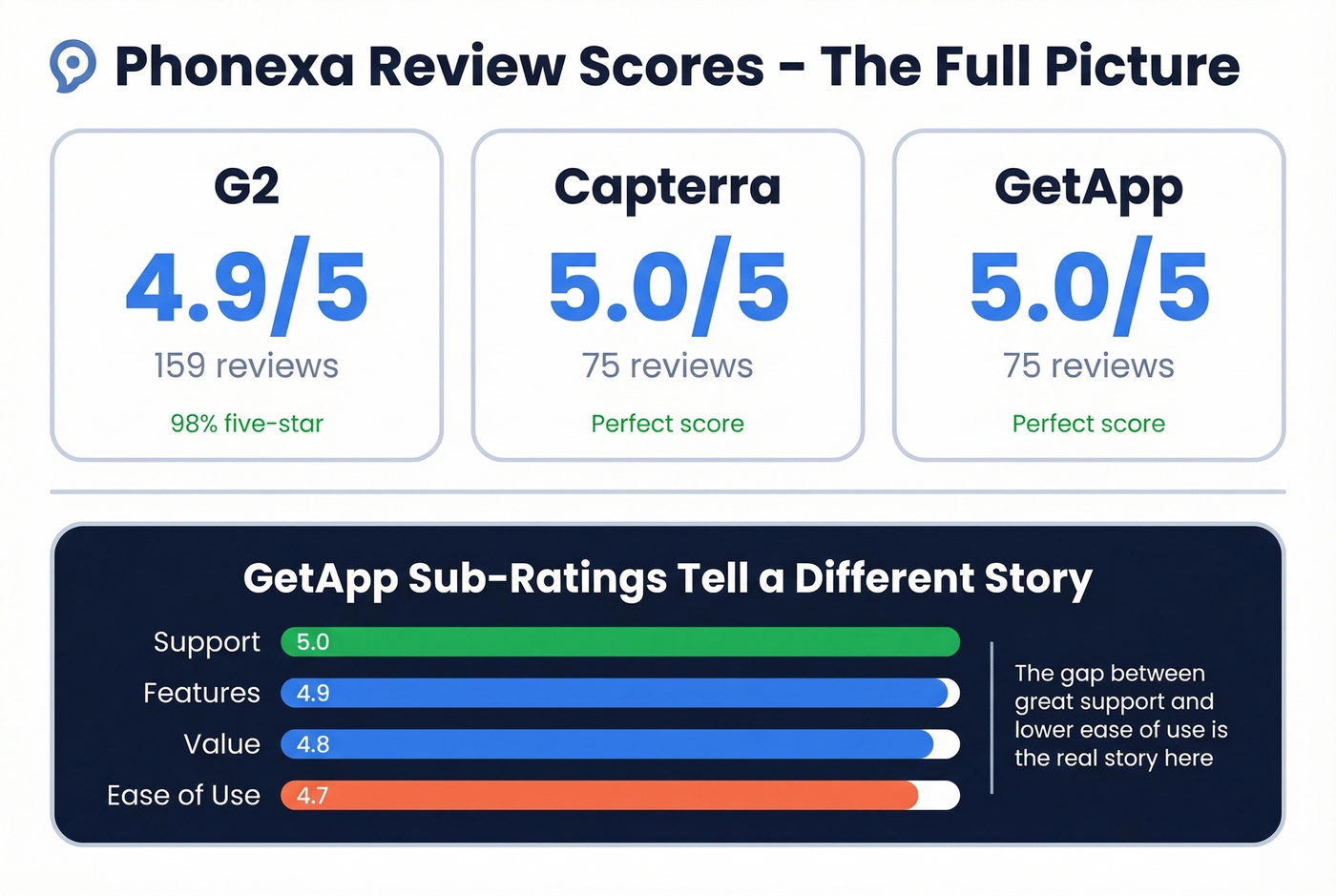
Here's the thing: 98% five-star reviews on G2 doesn't mean Phonexa is flawless. In our experience, near-perfect aggregator scores usually indicate a niche product with a self-selecting user base, not universal appeal. Networks running high-volume call campaigns genuinely love it. Everyone outside that niche finds it complex and overbuilt.
GetApp's subratings tell a more nuanced story - Value scores 4.8 and Ease of Use lands at 4.7, while Support hits a perfect 5.0. That gap between "support is amazing" and "the product isn't always easy to use" is consistent with what individual reviewers describe.
We didn't find meaningful Phonexa-specific discussion on Reddit, so most public sentiment here comes from those review aggregators.

Phonexa's routing logic is only as good as the data you feed it. Stale emails and dead phone numbers tank your conversion rates no matter how sophisticated your IVR is. Prospeo verifies 143M+ emails at 98% accuracy and 125M+ mobile numbers - refreshed every 7 days, not every 6 weeks.
Clean your lead data before it hits the distribution platform.
Pros and Cons
What works well:
- Support and onboarding are consistently praised across every review platform we checked. This isn't lip service - users specifically call out named account managers.
- All-in-one consolidation. Agencies juggling CallRail, an affiliate platform, and a separate email tool can collapse everything into one suite.
- Call routing is where Phonexa genuinely excels. The IVR, call scoring, and distribution logic are mature and battle-tested at scale, which is why enterprise pay-per-call networks stick with it year after year.
- Scalability. The platform handles high-volume operations without choking.
What doesn't:
- Steep learning curve. One Capterra reviewer put it bluntly: "the system isn't intuitive enough to drop in and hit the ground running." That tracks with our read of the product.
- Pricing complexity. Usage charges across modules make budgeting unpredictable, and the real cost surprises teams who only looked at the $250/mo headline.
- Dated UI. Multiple reviewers flag the dashboard and reporting as feeling behind modern SaaS standards.
- Workflow gaps. You can't combine pixel tracking with S2S postback - you're forced to choose one. Commission tiering is effectively gated to Enterprise, and the LMS module lacks a proper pending/approve/reject conversion workflow.
Who Phonexa Is (and Isn't) For
Use this if you're an agency or network running high-volume pay-per-call campaigns across home services, insurance, legal, or financial services - and you have someone technical on staff who can handle the setup.
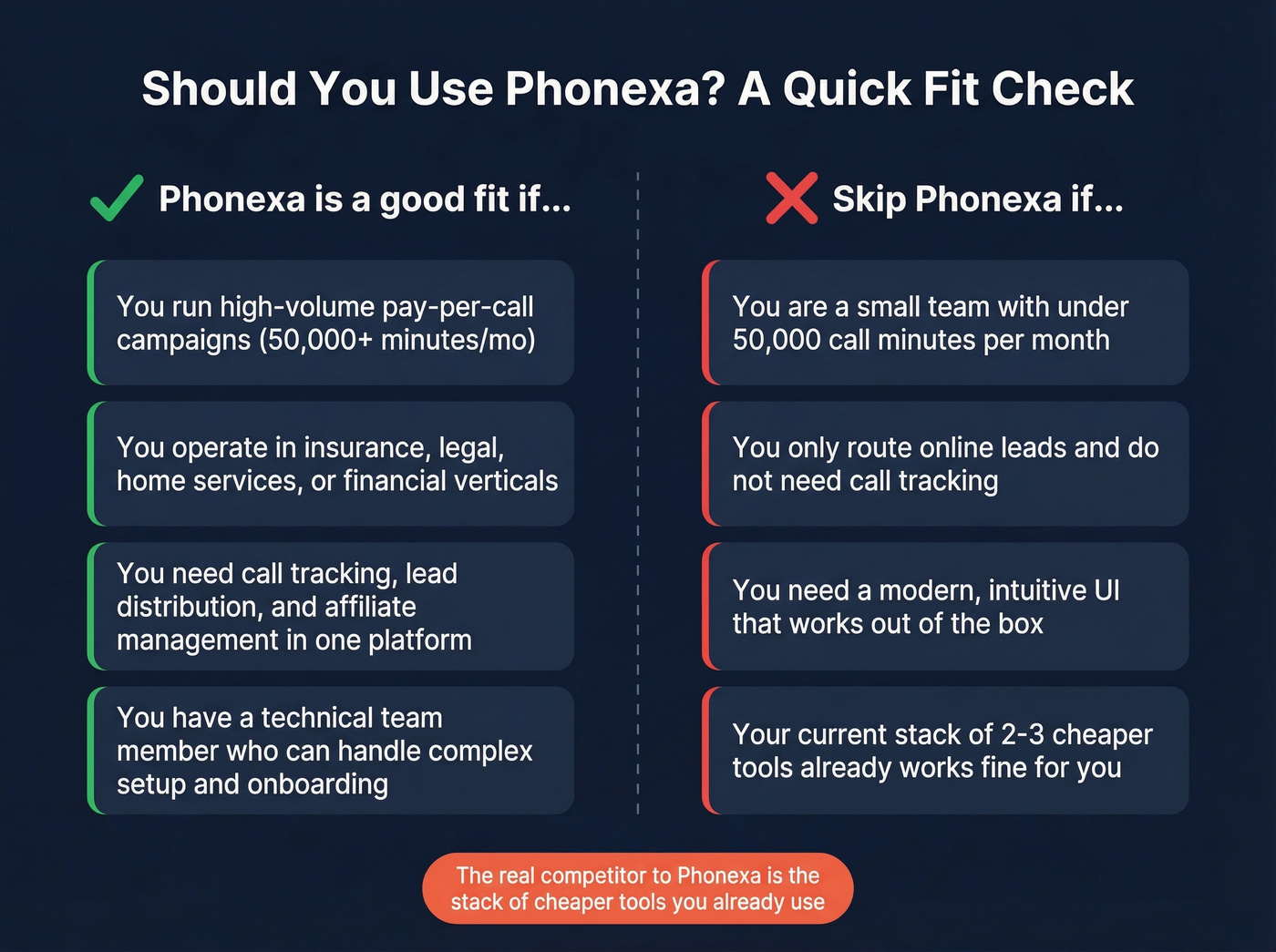
Skip this if you're a small team, you only route online leads, or you need a modern UI out of the box. The complexity and cost don't justify it under roughly 50,000 call minutes per month.
Let's be honest: Phonexa's real competitor isn't any single tool. It's the stack of three cheaper tools you're already using. If that stack works, don't switch. Phonexa only wins when consolidation genuinely saves you operational headaches, not just vendor count.
If you're building a more modular stack, start with a clean lead generation workflow and a clear lead scoring model so routing rules don't amplify bad inputs.
Alternatives Worth Considering
Need just call tracking? CallRail ($45-$145/mo) is simpler, cheaper, and faster to set up. It won't distribute leads, but most teams evaluating Phonexa are really wondering if they need the full suite. Often, they don't.
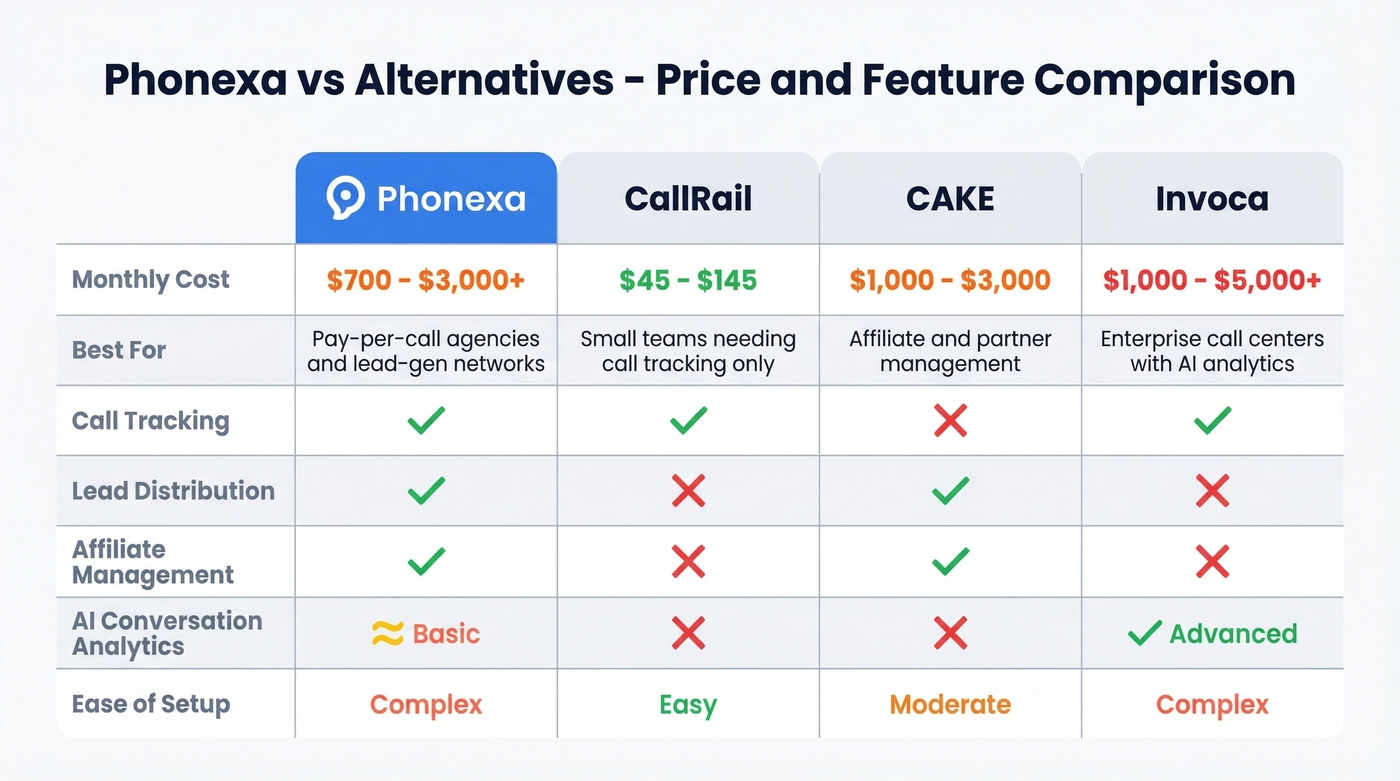
For affiliate-focused operations, CAKE handles conversion tracking, offer management, and partner payouts better than Phonexa's Lynx module. Serious operations typically pay in the low thousands monthly. boberdoo is another common comparison for lead distribution, though Capterra reviewers who switched from it to Phonexa cite consolidation as the primary reason.
Invoca ($1,000-$5,000+/mo) is enterprise-grade call analytics with AI conversation intelligence - overkill for small shops, powerful for large call centers that need deep speech analytics.
One thing we've seen repeatedly: distribution platforms are only as good as the data feeding them. If your contact records are stale or bouncing, even the best routing logic won't save your conversion rates. Prospeo covers that upstream gap with 98% email accuracy and a 7-day data refresh cycle, verifying contacts at roughly $0.01/lead before they ever hit your routing platform. If you're comparing vendors for that upstream layer, see our breakdown of data enrichment services and how to reduce email bounce rate.

Spending $1,000+/mo on Phonexa but still seeing bounces? The problem isn't your routing - it's upstream data quality. Prospeo delivers verified emails at $0.01/lead with 98% accuracy and a 30% mobile pickup rate, so every contact that enters your call flow is real.
Stop paying to route leads that don't exist.
FAQ
Does Phonexa offer a free trial?
Phonexa's official pricing page focuses on paid suites starting at $250/mo. GetApp lists a free trial and a free version, so if a trial matters to you, ask for it directly during the demo call - don't assume it's self-serve.
Are there long-term contracts?
Lite and Premium plans are pay-as-you-go with no long-term commitment. Enterprise and Custom terms vary based on volume and packaging - expect sales to push annual agreements at higher tiers.
What's the real monthly cost for an active team?
Most mid-volume teams on the Premium plan spend $1,100-$1,500/mo once call tracking minutes, lead pings, and email sends are factored in. High-volume agencies running 30,000+ minutes regularly hit $2,000-$3,000/mo before add-ons like HitMetrix or Managed Services.
What if I only need call tracking, not the full suite?
CallRail at $45-$145/mo is the obvious answer. You'll lose lead distribution and the affiliate modules, but if you're not using those features, you're paying for dead weight inside Phonexa.