


Power Almanac Review: Pricing, Pros, Cons, and Honest Verdict
$5,400 a year for a database that only covers local government. That's either a steal or a waste - depending entirely on whether local government is your market.
We've spent time digging into Power Almanac's pricing tiers, verification process, and real user feedback to give you a straight answer on whether it's worth the spend in 2026.
30-Second Verdict
What Is Power Almanac?
Power Almanac is a subscription contact database focused entirely on U.S. state and local government decision-makers. It covers about 343,000 records spanning roughly 22,000 local governments, with 98% coverage of local governments with populations over 1,000.
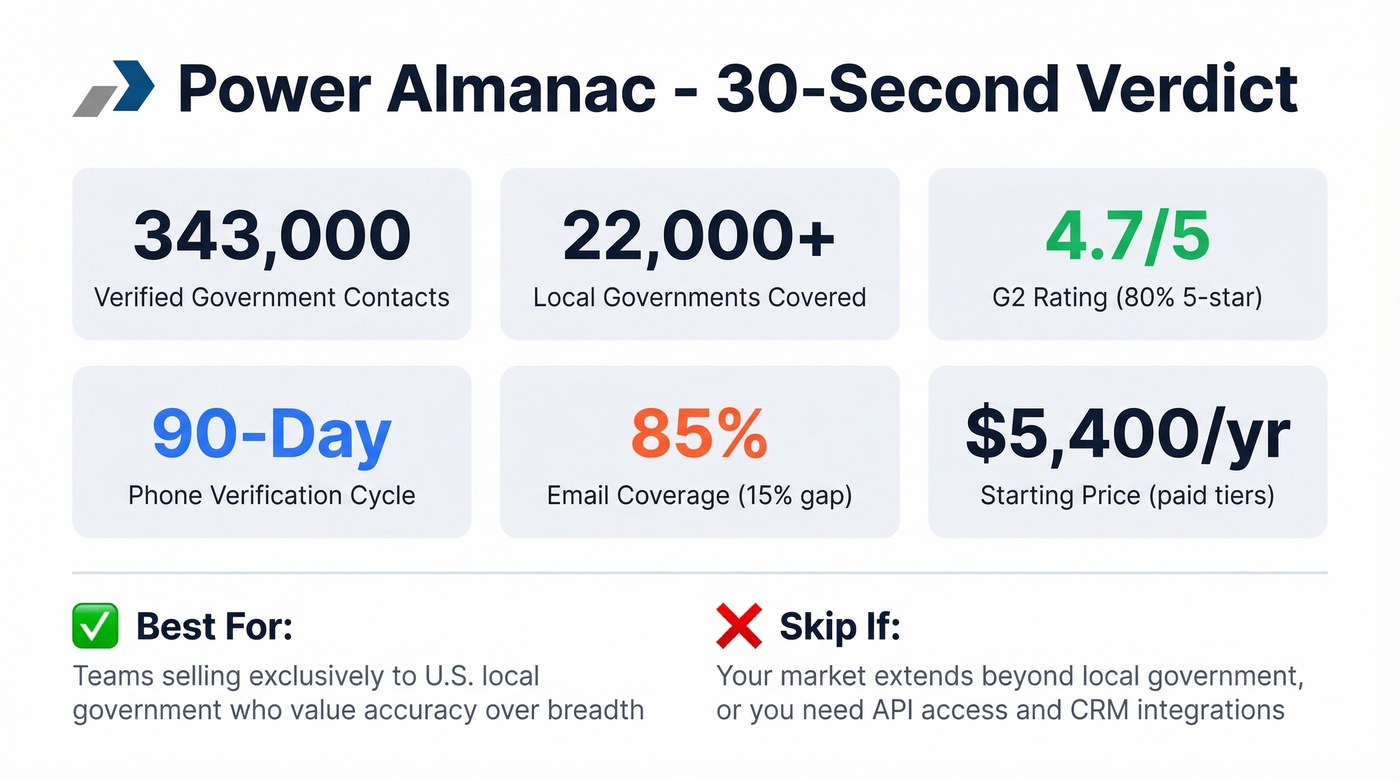
The database uses the U.S. Census Bureau as its starting dataset, with each government assigned a unique Census Bureau Government ID - a trust signal that grounds the whole operation in authoritative public data. A 16-person research team phone-verifies every record on a 90-day cycle, and new contacts require 11 mandatory fields before being marked complete. The average record age sits around 11 weeks.
GovExec fully acquired Power Almanac in April 2022, bringing enterprise-level backing to what was already a solid niche product. The database has grown from ~266,000 records at the time of GovExec's initial 2021 investment to about 343,000 today.
Pricing Breakdown
Power Almanac runs on an annual credit system. One credit equals one contact record download.
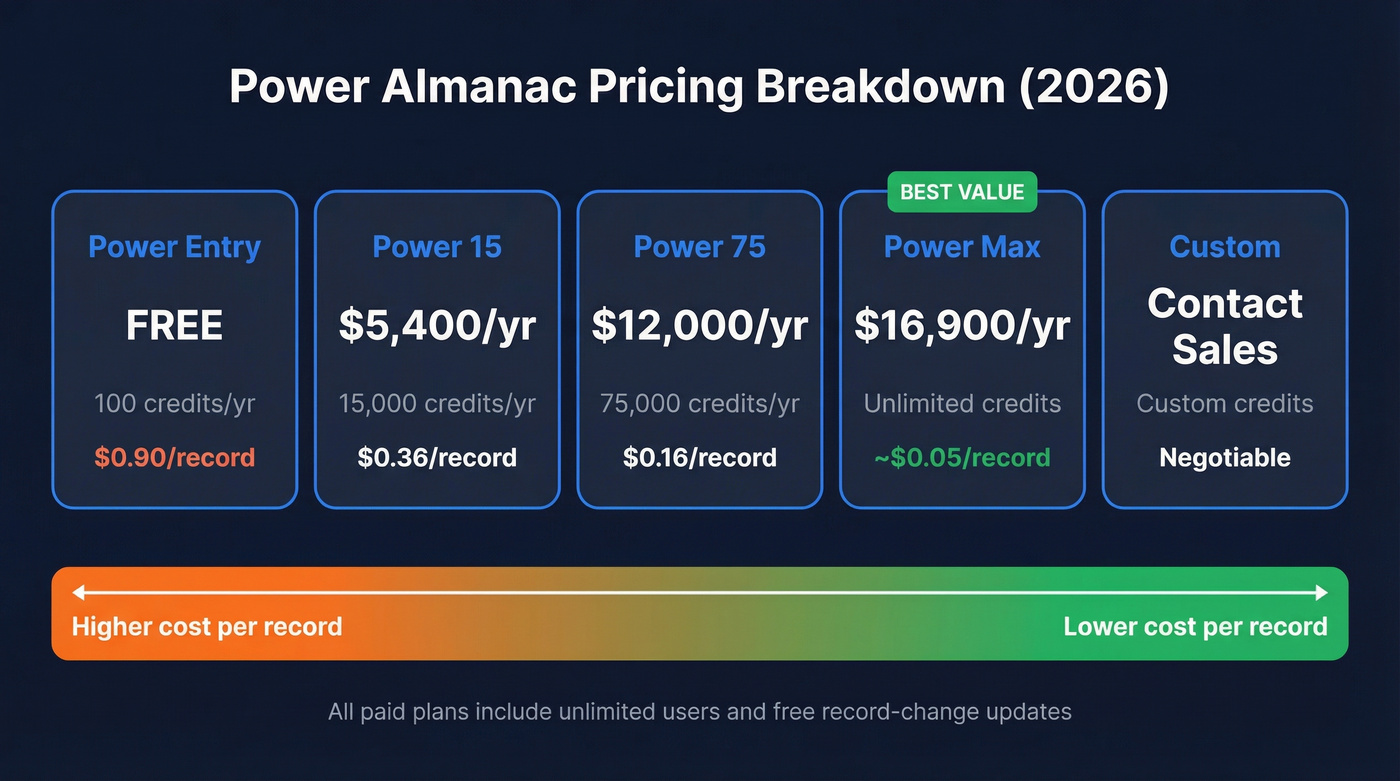
| Plan | Price | Credits/yr | Cost/Record |
|---|---|---|---|
| Power Entry | Free | 100 | $0.90/record |
| Power 15 | $5,400/yr | 15,000 | $0.36 |
| Power 75 | $12,000/yr | 75,000 | $0.16 |
| Power Max | $16,900/yr | Unlimited | ~$0.05 |
| Custom | Varies | Custom | Negotiable |
Every paid plan includes unlimited users and free updates for downloaded records.
The per-record cost drops dramatically at scale, making Power Max the clear value play for teams that need the full database. For context, buying Power Almanac data through a third-party broker like Data Axle runs about $250/M for emails and $125/M for postal addresses, with only semiannual updates. The direct subscription is fresher by a wide margin and often cheaper at volume.
If you're comparing this against broader sales prospecting databases, the key tradeoff is depth in one vertical vs. coverage across industries.

Power Almanac's 85% email coverage means 1 in 6 government contacts is missing an email. Prospeo's email finder fills those gaps with 98% verified accuracy at $0.01 per email - no annual contract required.
Stop leaving 15% of your government prospects unreachable.
Pros: Where It Excels
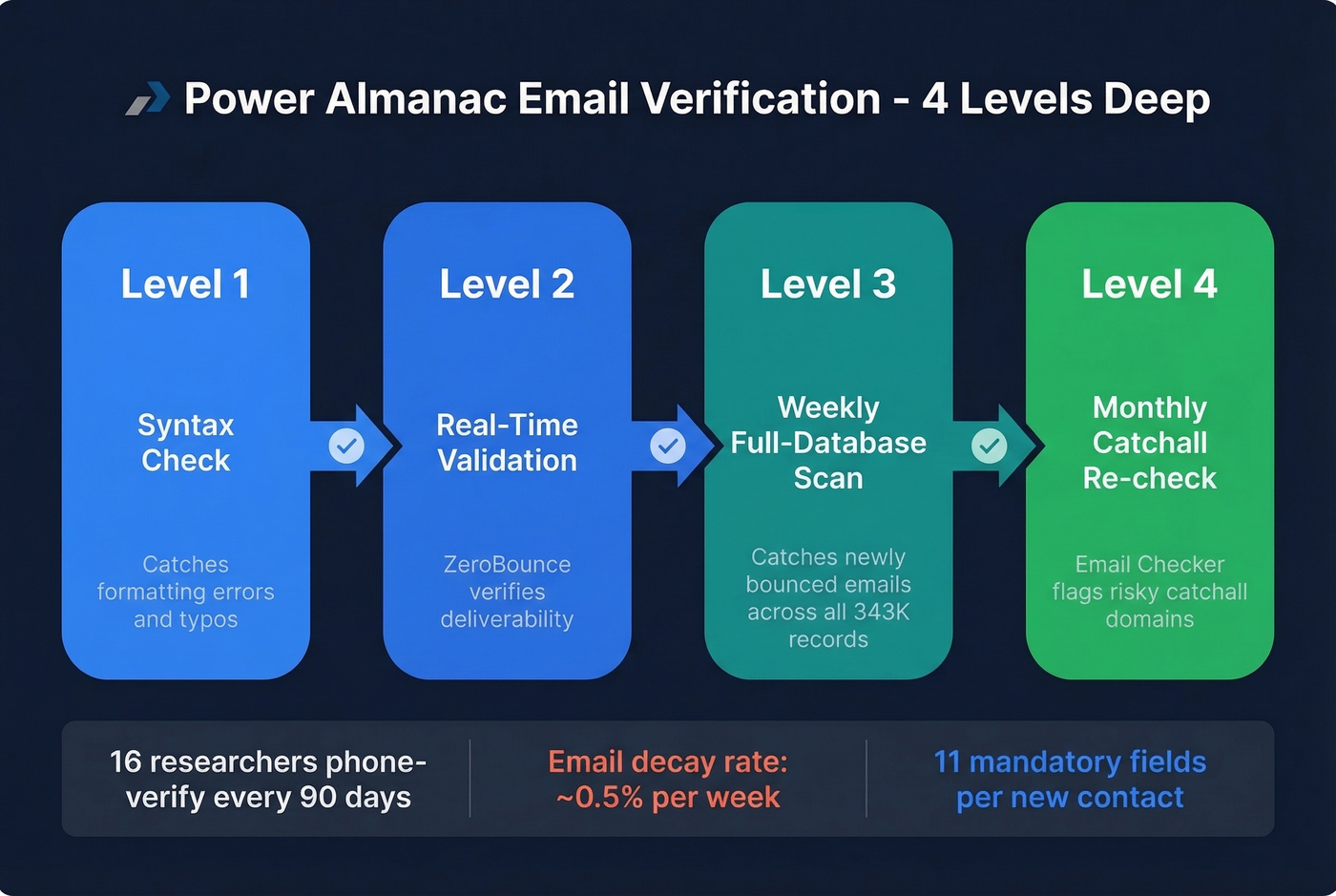
The verification methodology is genuinely rigorous. We've reviewed dozens of government data providers, and Power Almanac's process is the most thorough we've seen. Sixteen researchers call 21,000+ local governments every 90 days. Email validation runs four levels deep - syntax checks, real-time validation via ZeroBounce, weekly full-database validation, and monthly catchall re-checks via Email Checker. Email decay runs about 0.5% per week across the database, which is exactly why those weekly sweeps matter. This isn't web scraping dressed up as verification. (If you're building a stack around verification, see our guide to Bouncer alternatives.)
Role-based targeting is another standout. Power Almanac uses what they call Role Intelligence - standardized roles instead of inconsistent job titles. In government, where "Director of Public Works" and "Superintendent of Infrastructure" can be the same job, this cuts targeting errors significantly. It's a small thing that saves real time when you're building lists. This kind of segmentation pairs well with tighter firmographic filters when you expand beyond public sector.
Users back this up. The product holds a 4.7/5 on G2 with 80% five-star reviews. Users consistently praise the simple UI, accurate data, and support that "feels like a partnership." One customer reported booking meetings within three weeks of launching a campaign. The sample size is small (10 reviews), and organic Reddit discussion is essentially nonexistent - but the sentiment from actual users is uniformly positive.
All paid plans include unlimited users and free record-change notifications, so when a contact switches roles, you refresh the record at no extra cost.
Cons: Real Limitations
Look - Power Almanac is excellent at what it does, but it has real limitations you need to know about before writing a check.
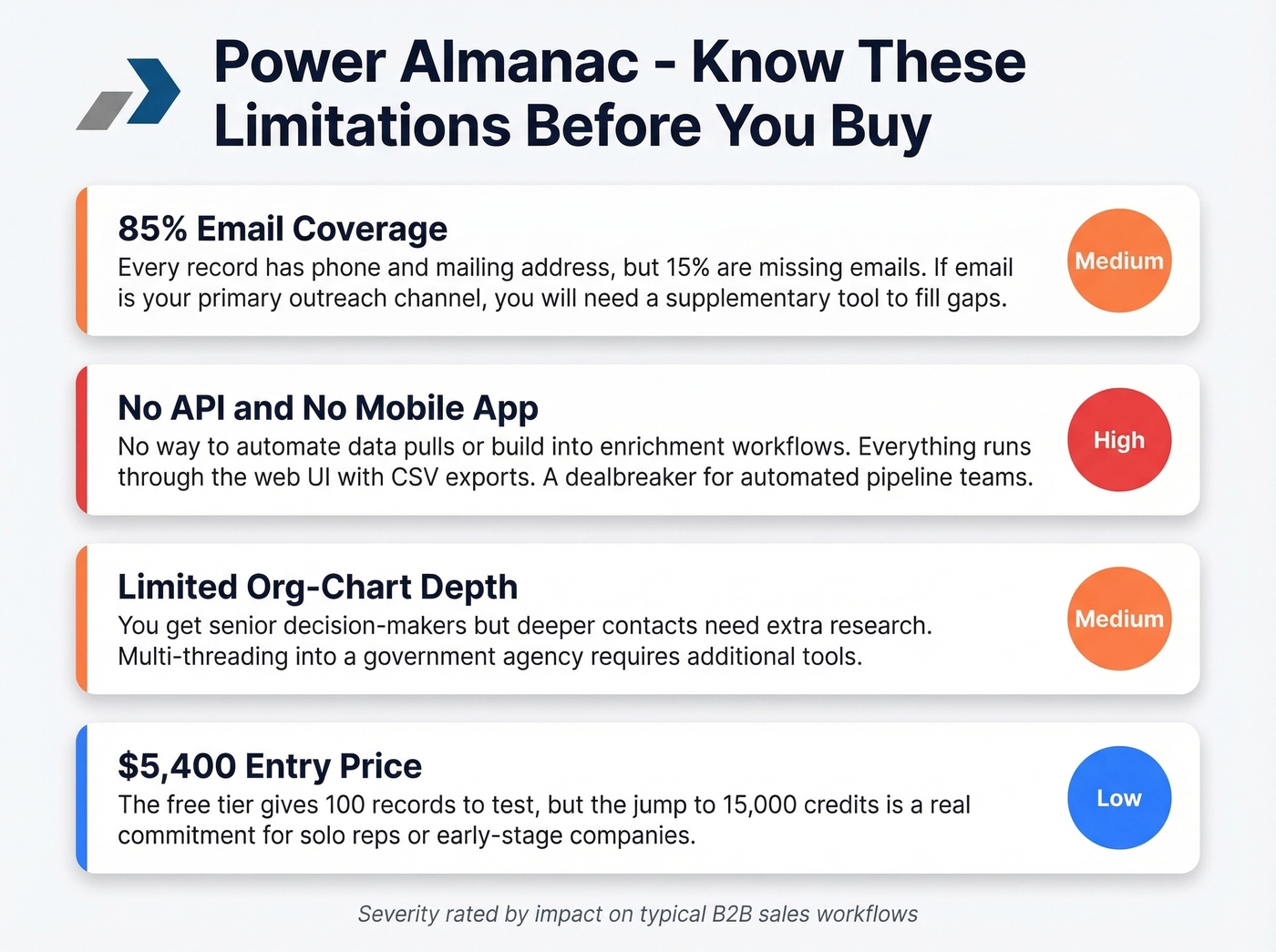
~85% email coverage. Every record has phone and mailing address, but email coverage sits at 85%. That 15% gap is the biggest practical limitation if email is your primary outreach channel. For the records missing emails, a tool like Prospeo's email finder can fill those gaps at 98% accuracy. If you're doing this at scale, it helps to understand email bounce rate benchmarks and what "good" looks like.
No API and no mobile app. You can't automate data pulls or build Power Almanac into enrichment workflows. Everything runs through the web interface with CSV exports. For teams running automated enrichment pipelines, this is a dealbreaker - full stop. If API access is non-negotiable, compare options in our roundup of data enrichment services.
Limited org-chart depth. You'll get the senior decision-makers, but deeper org-chart contacts need extra research. If you need to multi-thread into a government agency, Power Almanac alone won't get you there.
$5,400 entry price is steep for small teams. The free tier gives you 100 records to test, but the jump to 15,000 credits is a real commitment for a solo rep or early-stage company.
Who Should Buy (and Who Should Skip)
Buy Power Almanac if you sell exclusively to local government, your team can justify $5,400+/year on a single vertical database, and you value data accuracy over breadth.
Skip it if your TAM extends beyond local government into commercial B2B, healthcare, tech, or other verticals. You'll need a general-purpose platform instead. Also skip if you need API access for automated enrichment - Power Almanac simply doesn't offer it. (If you're pressure-testing your market size, use a quick addressable market framework.)
For solo reps testing the government market, use the free 100-record tier first. Don't commit $5,400 on a hunch.
Let's be honest: Power Almanac is the rare niche database that's actually worth the premium. Most vertical data products are just filtered versions of the same recycled datasets. Power Almanac's 16-person phone verification team is a genuine moat. But if local government is less than 60% of your pipeline, you're overpaying for a tool you'll underuse. If you're building outbound beyond gov, start with proven sales prospecting techniques to keep list quality from becoming your bottleneck.
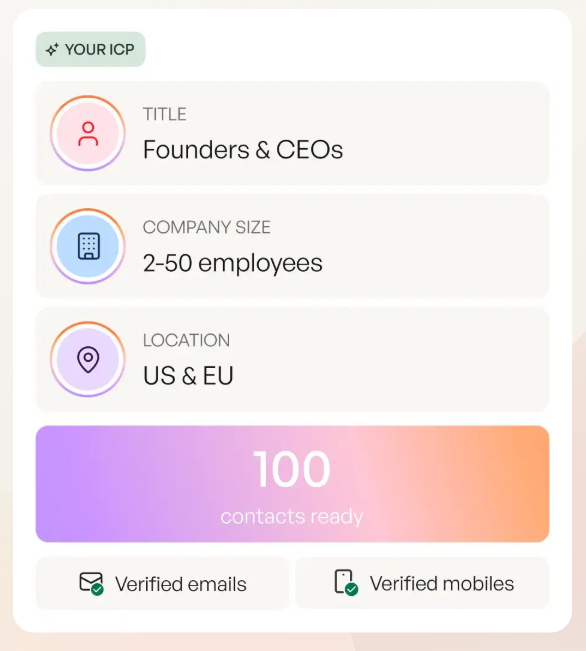
If your pipeline extends beyond local government, a $5,400/yr niche database won't cut it. Prospeo gives you 300M+ profiles across every industry, 30+ search filters, CRM enrichment, and API access - everything Power Almanac doesn't offer.
Get enterprise-grade B2B data without the enterprise price tag.
FAQ
What does a Power Almanac "credit" mean?
One credit equals one contact record download. Credits are annual - unused credits expire at renewal. You can purchase additional download credits mid-cycle if you exhaust your allocation.
Can I integrate Power Almanac with my CRM?
No. There's no native CRM integration or API. You export contacts as CSV files and import them into Salesforce, HubSpot, or your CRM of choice. For teams that need automated enrichment workflows, this is a significant limitation worth weighing before you buy.
How do I fill gaps in Power Almanac's email coverage?
For the ~15% of records missing email addresses - or contacts outside local government entirely - a general-purpose email finder can close the gap. We've found that pairing a niche government database with a broader platform gives you the best of both worlds: deep government coverage plus everything else.
Is it worth the cost for small teams?
At $5,400/year for the lowest paid tier, it's a serious investment for a one- or two-person team. Start with the free Power Entry plan (100 records) to validate that local government contacts actually convert for your offer before committing to a paid subscription.