

Predictive Sales Intelligence: What It Is, What It Costs, and Why Most Teams Get It Wrong
A VP of Sales we know spent around $180,000 on a predictive sales intelligence platform last year. Six months later, his team was still forecasting in spreadsheets because nobody trusted the scores. The algorithm wasn't the problem - the contact data feeding it had a bounce rate north of 30%. Every prediction built on that foundation was garbage.
That story isn't unusual. It's the norm.
The Short Version
What it does: Machine learning analyzes your CRM data, buyer signals, and engagement patterns to score deals, forecast revenue, and flag churn risk - automatically.
What it costs: Enterprise platforms often start around $60K/year, and per-seat pricing can run up to $650/user/month depending on the suite. Mid-market CRM-native options start around $100/user/month. The data layer underneath can be nearly free.
Where it fails: Bad contact data poisons every prediction. If your email bounce rate is above 5%, fix that before you buy anything else.
What Predictive Sales Intelligence Actually Means
Predictive sales intelligence uses machine learning to analyze historical sales data, buyer behavior, and market signals to forecast which deals will close, which accounts will churn, and where reps should spend their time. It turns your CRM from a system of record into a system of action.
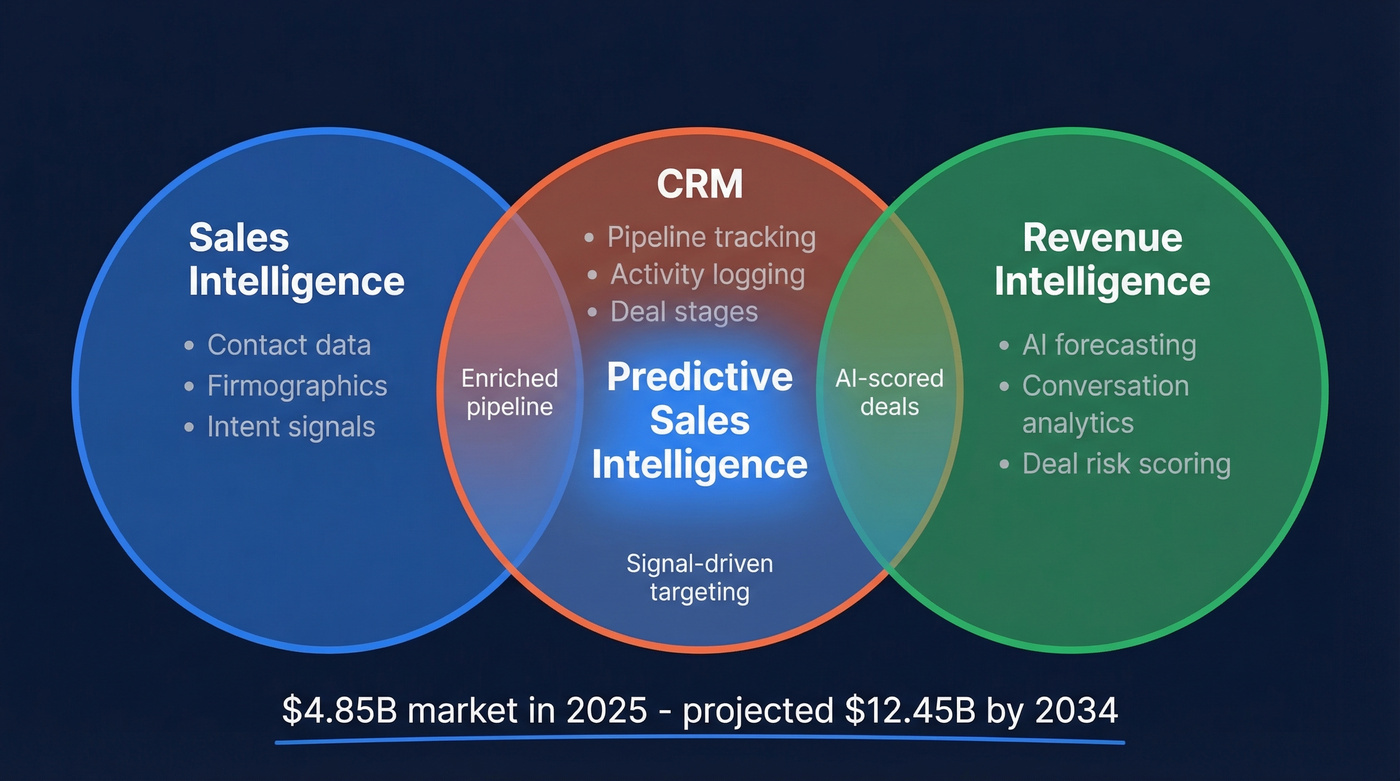
The category sits at the intersection of three overlapping markets. Sales intelligence covers external prospect data - contact info, firmographics, intent signals. CRM handles internal pipeline and activity tracking. Revenue intelligence layers AI across both to forecast outcomes and flag deal risk. MarketsandMarkets research found that 45% of sales professionals struggle to choose the right technology across these categories, which makes sense - the boundaries blur more every quarter.
The market is growing fast. The global sales intelligence market reached $4.85B in 2025 and is expected to hit $5.37B in 2026, on track to reach $12.45B by 2034, with North America holding 42% of the market. That growth is driven by one thing: teams that apply predictive analytics to B2B sales effectively are outperforming teams that don't. Companies using the right combination of predictive tools report 28% higher win rates and 26% larger deal sizes.
Signals That Power Predictions
Predictive models are only as good as the signals feeding them. The inputs fall into four buckets:
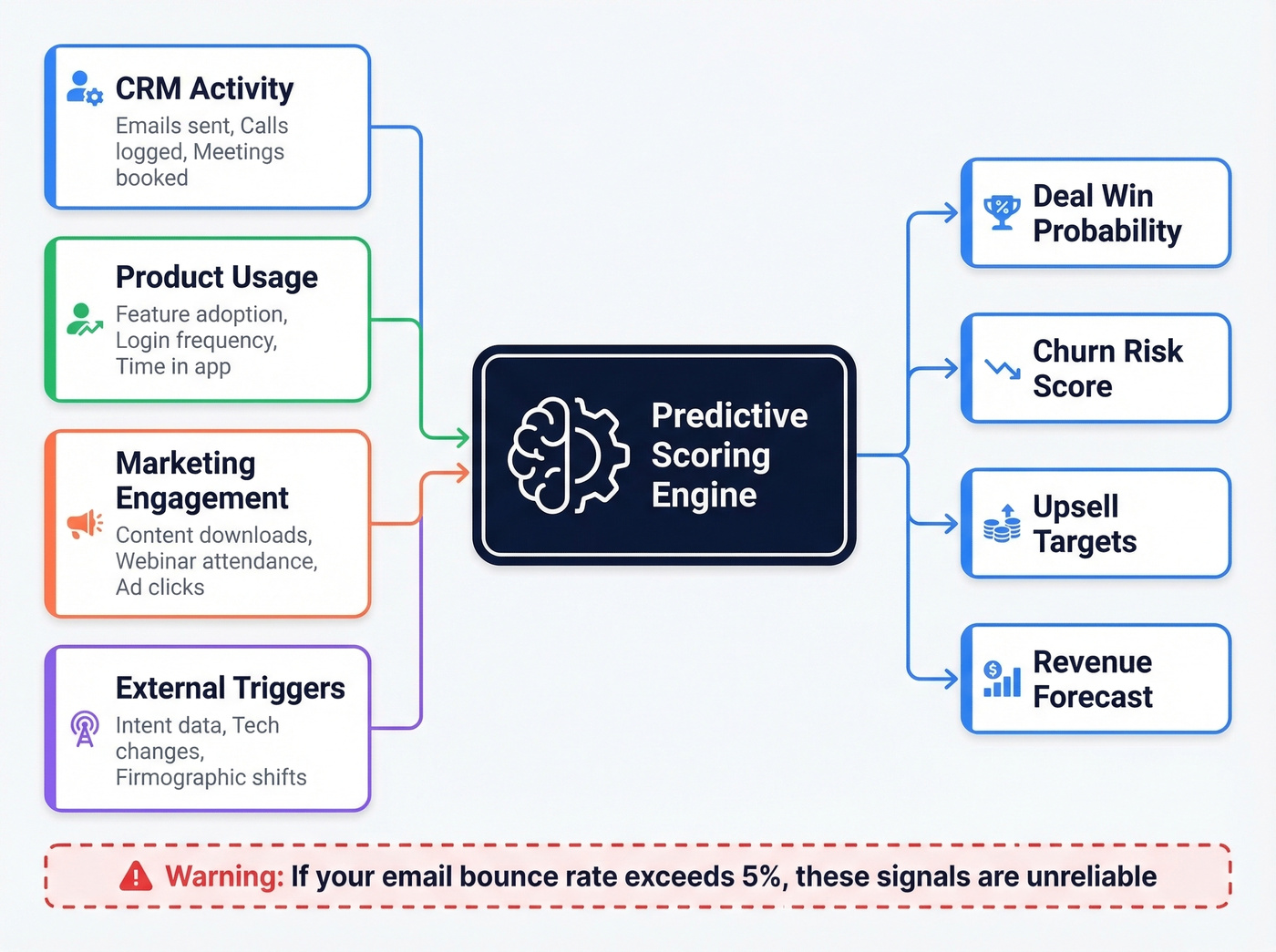
- CRM activity - emails sent, calls logged, meetings booked
- Product usage - feature adoption, login frequency, time-in-app
- Marketing engagement - content downloads, webinar attendance, ad clicks
- External triggers - intent data, technographic changes, firmographic shifts
A strong buying signal might combine a recent Series B announcement, three new VP-level hires, and a spike in competitor-comparison searches. No single signal is enough, but the combination is powerful.
Intent data deserves special attention because it's where most of the predictive magic happens. First-party intent tracks what prospects do on your properties - pricing page visits, demo signups, documentation deep-dives. Third-party intent captures behavior across the broader web: commercial keyword searches, competitor research, G2 and Capterra activity. The distinction between known intent like form fills with an email attached and anonymous intent based on IP-level company identification matters for how much you can trust the signal. Known intent is gold. Anonymous intent is directional at best.
What It Produces
The outputs cluster around four use cases: deal scoring and win probability, churn prediction, upsell and cross-sell targeting, and quota forecasting.
Here's the thing most vendors won't tell you: the critical design choice isn't which algorithm you pick. It's whether predictions embed into workflows or sit in dashboards nobody checks. The best implementations push scores directly into CRM views, trigger Slack alerts, and auto-prioritize sequences. Idle dashboards are where AI-driven forecasting goes to die.

This article makes it clear: predictive sales intelligence fails when contact data is dirty. Prospeo's 98% email accuracy and 7-day refresh cycle give your AI models the clean foundation they need - at $0.01/email instead of $1/lead from legacy providers.
Fix the data layer before you spend six figures on predictions.
What Results Look Like
Organizations using AI forecasting report 15-20% higher forecast accuracy, 25% shorter sales cycles, and up to 30% improvement in quota attainment. For context, manual forecasting rarely exceeds 60-70% accuracy. Leading AI implementations can exceed 90% for 30-90 day windows. Gartner pegs well-implemented AI scoring at a 30% increase in sales productivity and a 25% decrease in sales cycle length.
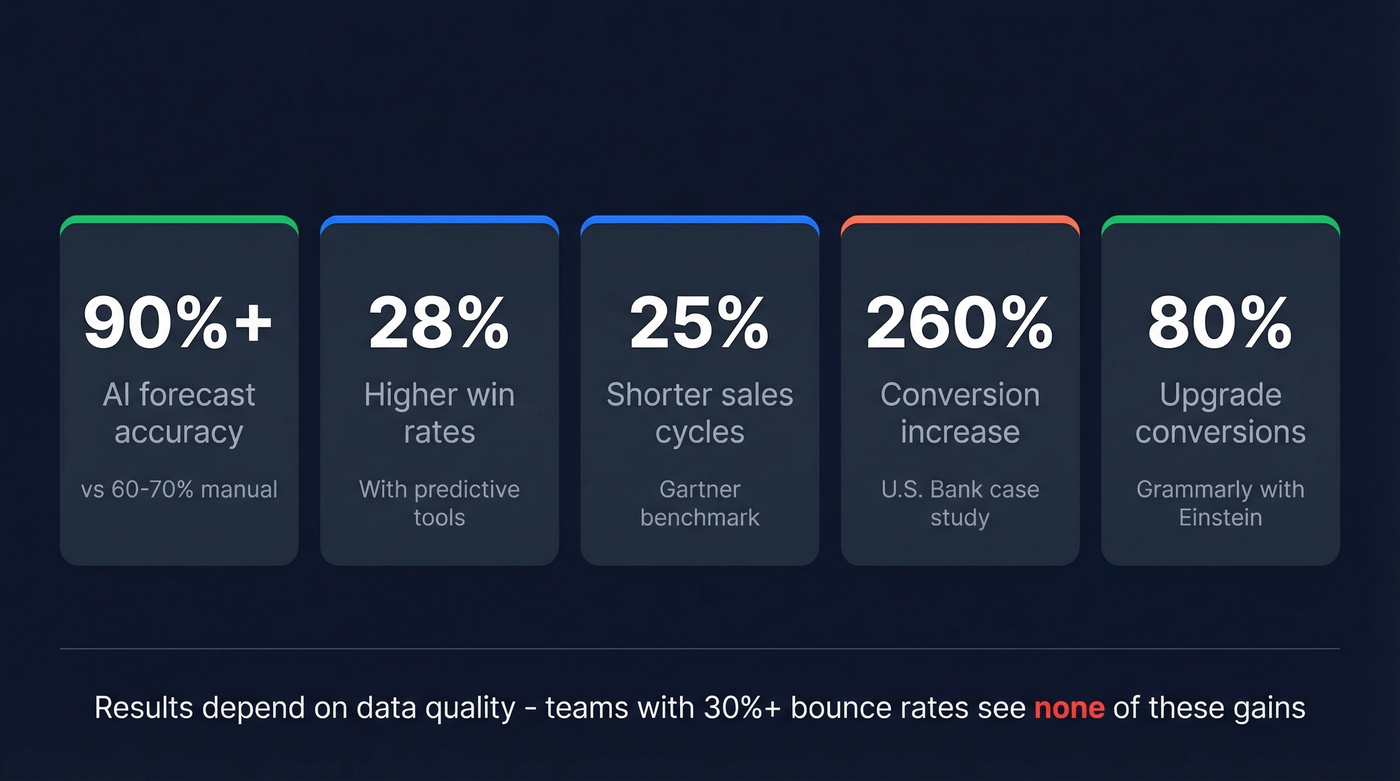
U.S. Bank saw a 260% conversion rate increase after implementing AI lead scoring, with a 35% shorter sales cycle - all within four months. Grammarly used Salesforce Einstein to drive an 80% increase in upgrade conversions and cut their sales cycle from 60-90 days down to 30.
Those are the success stories. The failure rate is high, and it almost always traces back to the same root cause.
2026 Pricing Breakdown
The pricing spread is enormous:
| Tool | Category | Price Range | Best For |
|---|---|---|---|
| 6sense | Intent + ABM | $60K-$300K/yr | Enterprise ABM |
| Clari | Revenue Intelligence | $200-$400/user/mo ($30K-$50K/yr min) | Pipeline forecasting |
| Gong | Conversation Intel | $5K-$50K/yr platform fee + ~$250/user/mo | Deal coaching |
| Salesforce Revenue Cloud + Agentforce | CRM + AI | $500-$650/user/mo | Salesforce orgs |
| HubSpot Ops Hub + Breeze | CRM + AI | $100-$250/user/mo | Mid-market |
| People.ai | Activity Capture | $50-$100/user/mo | Activity intel |
| Dynamics 365 + Copilot | CRM + AI | ~$180/user/mo | Microsoft orgs |
| ZoomInfo | Data + Signals | $15K-$40K/yr | Contact data at scale |
| Prospeo | Data Quality Layer | Free - ~$0.01/email | Verified contacts |
The market is consolidating fast. Gartner published its first "Magic Quadrant for Revenue Action Orchestration" in December 2025, and the Clari-Salesloft merger closed the same month. Expect more bundling and higher minimums.
Let's be honest: most teams don't need a $60K platform. If your average deal size is under five figures, you're over-engineering the problem. You need clean data, a CRM with built-in scoring - HubSpot Breeze or Salesforce Einstein both work - and the discipline to actually use it.
If you're evaluating stacks, it helps to compare sales forecasting solutions and best sales forecasting tools side-by-side before you commit.
Where It Fails (and Why)
Predictive intelligence fails for execution reasons, not algorithmic ones. The consensus on r/salesops and r/sales threads we've followed is consistent - the most common complaint isn't about the algorithms. It's about alert fatigue and scores that can't be explained to reps.
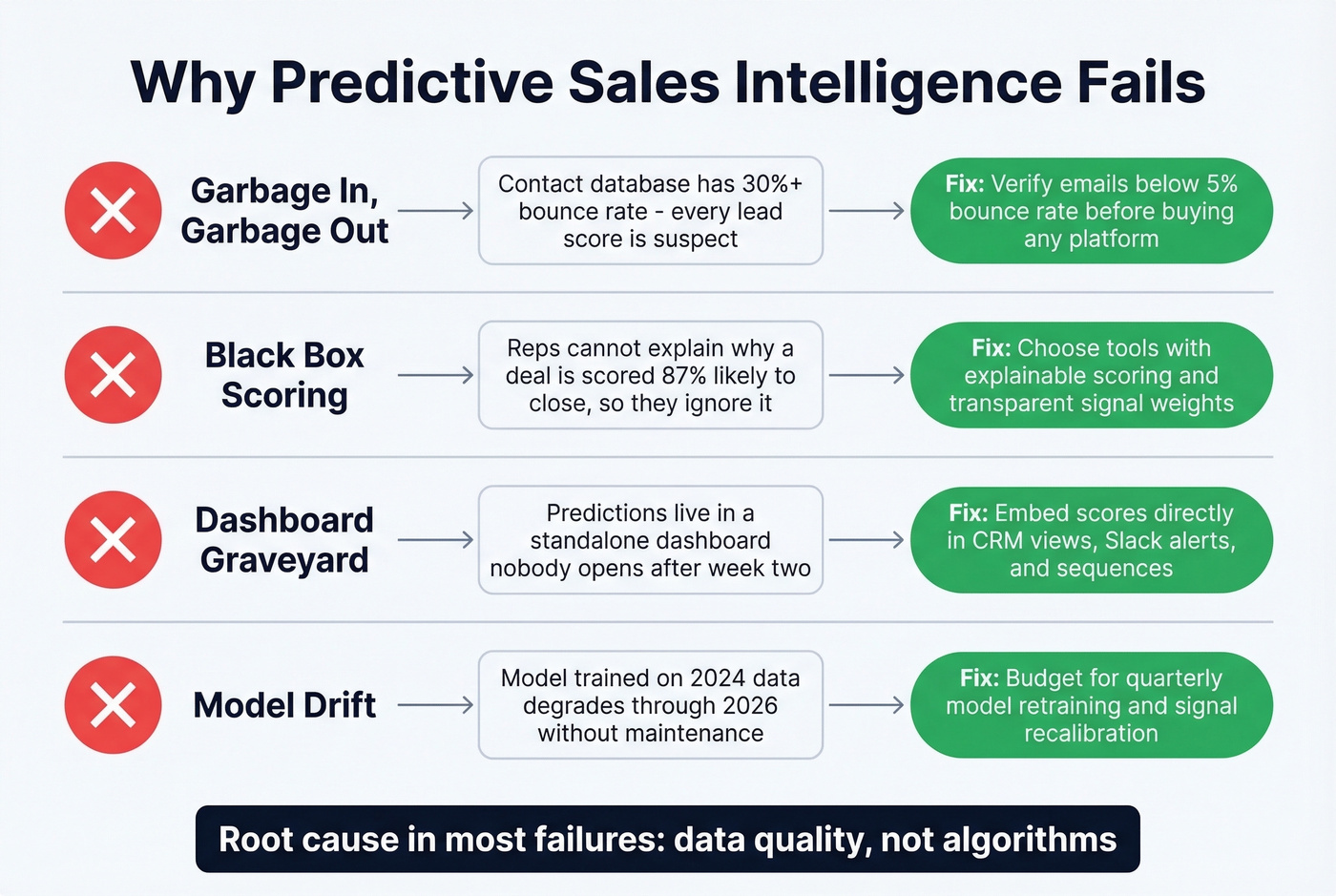
Garbage in, garbage out. If your contact database has a 30%+ bounce rate, every lead score is suspect. The model can't distinguish signal from noise when the underlying data is stale. We've seen this firsthand with teams who came to us after burning through six figures on a platform that never delivered.
Black-box scoring. Reps don't trust scores they can't explain. If the system says an account is "87% likely to close" and nobody can articulate why, reps ignore it. Every time.
Another dashboard nobody checks. Implementation without workflow integration means predictions exist in a vacuum. If scores don't surface inside the CRM, adoption craters within weeks.
Model drift. A model trained on 2024 patterns degrades through 2026 unless someone's maintaining it. Most teams don't budget for ongoing tuning, and by Q3 the predictions are stale.
Expect 6-12 weeks for a mid-market scoring rollout and 3-6 months for enterprise multi-source deployments.
The data quality problem is solvable, though. Prospeo verifies emails at 98% accuracy on a 7-day refresh cycle and integrates natively with Salesforce, HubSpot, and major outbound tools - so clean data flows directly into whatever scoring model you're running. At roughly $0.01 per email, it's a fraction of the cost of the platform sitting on top.
If you want a deeper benchmark on what “good” looks like, start with email bounce rate and then work backward into email deliverability.

How to Get Started Without Wasting $180K
Remember the VP from the intro? His forecast was off by around 30%, and the root cause wasn't the platform - it was the data underneath. Here's how to avoid repeating his mistake:
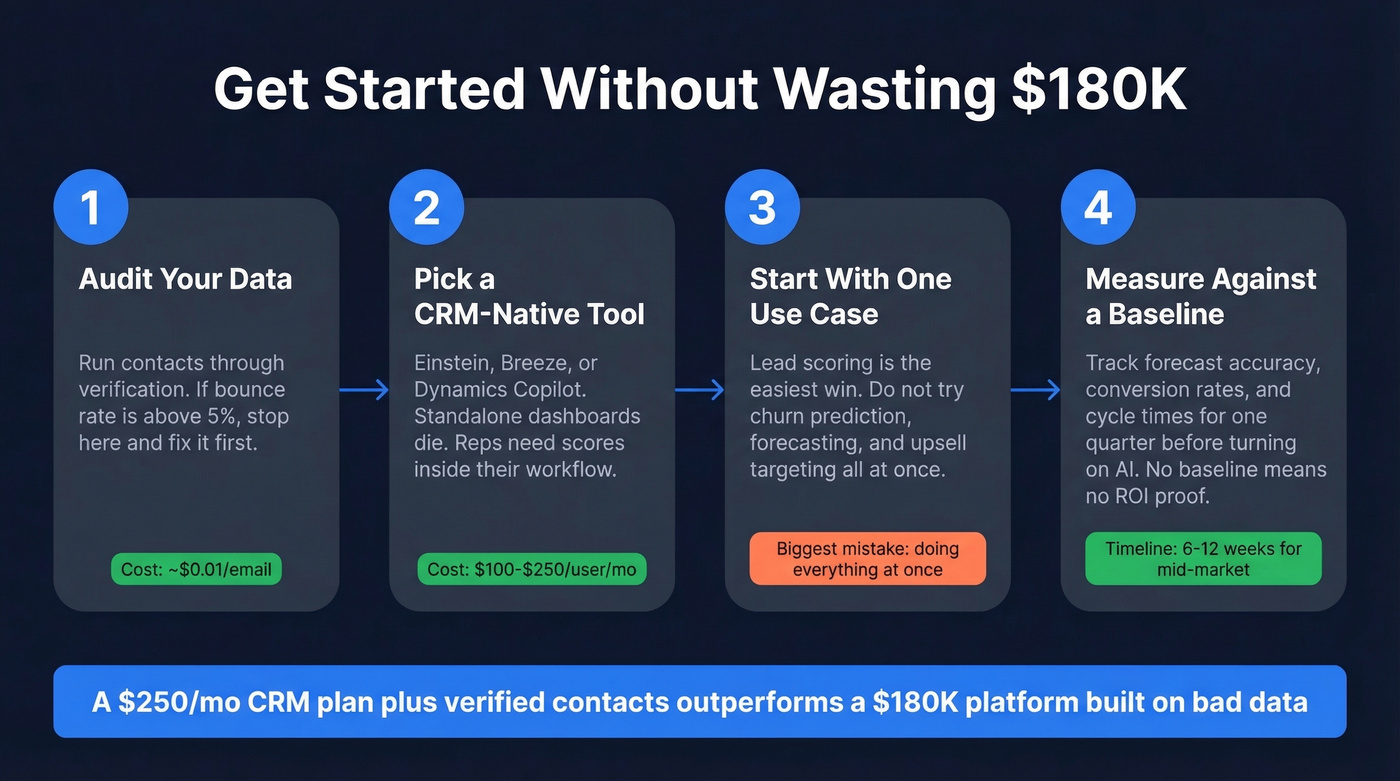
Audit your data quality first. Run your contact database through a verification tool. If your bounce rate is above 5%, fix that before spending a dollar on predictive tooling. Skip this step and nothing else matters. (If you need options, see data enrichment services and AI email checker.)
Pick a tool that embeds in your CRM. Standalone dashboards die. Native CRM scoring from Einstein, Breeze, or Dynamics Copilot has a massive adoption advantage because reps never have to leave their workflow.
Start with one use case. Lead scoring is the easiest win. Don't try to deploy churn prediction, forecasting, and upsell targeting simultaneously - that's how you end up with a $180K shelfware problem. If you want to formalize it, use a simple lead scoring model first.
Measure against a baseline. Track your current forecast accuracy, conversion rates, and cycle times for one quarter before turning on AI scoring. Without a baseline, you can't prove ROI, and without ROI proof, the CFO kills the renewal.
The VP who spent $180K on a platform he never used? He would've gotten better results with a $250/mo HubSpot plan and a verified contact database. Predictive intelligence only delivers value when the data underneath it is trustworthy.
Teams spending $60K+ on predictive platforms still see garbage scores because their bounce rates exceed 30%. Prospeo cuts bounce rates below 4% with 5-step verification and 300M+ profiles refreshed weekly - so every lead score your AI generates actually means something.
Stop feeding bad data to expensive algorithms.
FAQ
What's the difference between sales intelligence and revenue intelligence?
Sales intelligence focuses on external prospect data - contacts, firmographics, intent signals. Revenue intelligence layers in internal CRM activity, conversation analytics, and pipeline health to forecast outcomes across the entire revenue cycle. Sales intelligence is the input layer; revenue intelligence is the prediction layer.
How accurate is AI-driven sales forecasting?
Leading implementations achieve 90%+ forecast accuracy for 30-90 day windows, compared to 60-70% for manual forecasting. Results depend heavily on data quality - organizations with stale or incomplete contact data see significantly worse accuracy regardless of how sophisticated the platform is.
Do I need a dedicated predictive intelligence platform?
Most mid-market teams don't. HubSpot Breeze and Salesforce Einstein include native lead scoring and forecasting that's good enough for teams under 50 reps. The bigger ROI often comes from fixing your underlying data quality first, then layering on your CRM's built-in AI.
What does the data quality layer look like in practice?
Clean, current contact data is the foundation every predictive model needs. That means verified emails with sub-5% bounce rates, fresh records refreshed weekly rather than monthly, and native CRM integrations so enriched data flows directly into scoring models without manual imports.