

Price Objection Handling Examples: A Diagnostic Approach That Actually Works
You nailed the demo. The champion was nodding. Then the email lands: "The price is higher than we expected." Your stomach drops, and your finger hovers over the discount button.
Don't press it.
Most price objection handling examples hand you 30 scripts and zero diagnosis - that's why they fail. The response to "too expensive" depends entirely on why the buyer said it. We've spent years watching deals die (and survive) over pricing conversations, and the pattern is always the same: reps who diagnose first close more and discount less.
The Quick Version
Stop memorizing 30 rebuttals. You need a 4-step framework and the scripts below. Diagnose first: is this an objection (they're unsure of value) or a negotiation (they want it but want a better deal)? The response is completely different.
If you only learn three responses: "Too expensive compared to what?", "Is price the only thing keeping us from moving forward?", and silence - wait 5 seconds.
Why "Too Expensive" Is Rarely About Price
Buyers push back on price because it works almost every time - not because the price is wrong. RAIN Group's buyer research makes this clear: 88% of buyers receive discounts when they ask, 83% say "just ask for a better price" is an effective tactic, and 59% achieve pure price concessions where the price drops without any change to scope.
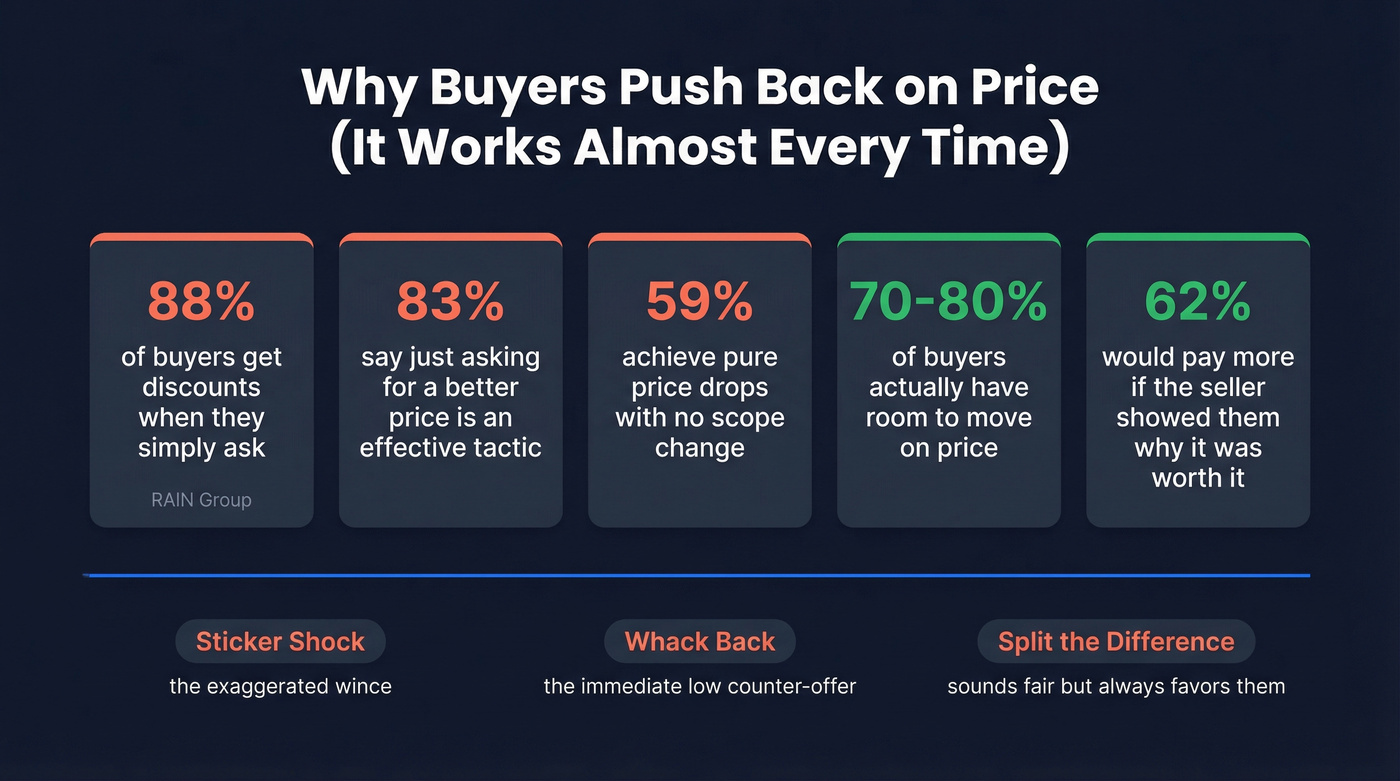
They even have names for what they're doing to you. "Sticker Shock" is the exaggerated wince at your number. "Whack Back" is the immediate counter-offer designed to anchor low. "Split the Difference" sounds reasonable but always splits in their favor. Once you can name the tactic, it loses its power.
Here's the thing: loss aversion means the pain of spending money is roughly twice as powerful as the pleasure of gaining something. So even when a buyer sees the value, their brain screams "negotiate" by default. Only 20-30% of buyers are genuinely price-sensitive. The other 70-80% have room to move - if you give them a reason. And 62% admit they'd pay more if the seller demonstrated why it was worth it.
Diagnose Before You Respond
An objection means the prospect hasn't decided your solution fits - they're questioning value, not haggling. A negotiation means they want what you're selling but want a better deal. Responding to an objection with a discount is the fastest way to lose margin and credibility.
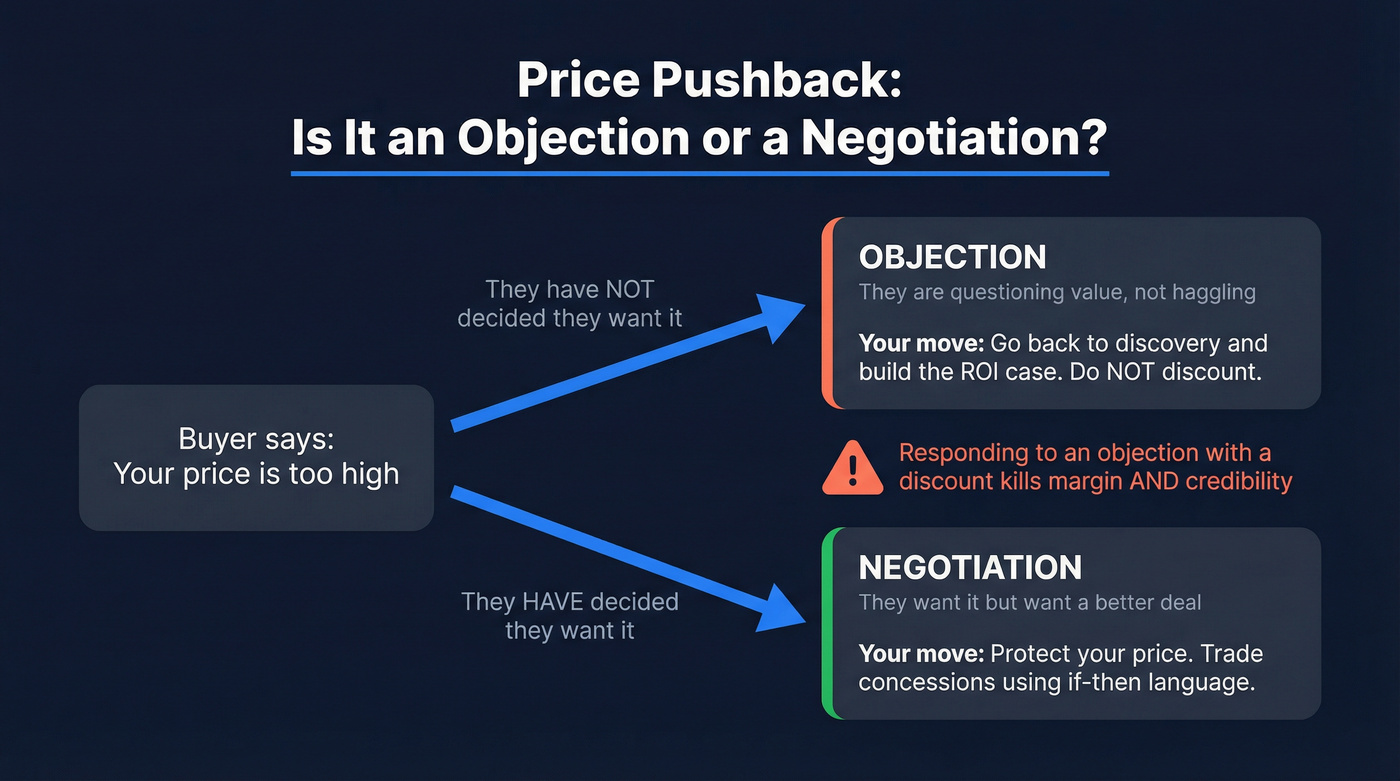
Ask yourself: has this person decided they want the solution? If yes, you're negotiating - protect your price and trade concessions. If no, you're still selling - go back to value and discovery.
| What They Say | What They Mean | Your Move |
|---|---|---|
| "Too expensive" | Haven't seen value | Build ROI case |
| "Can you do better on price?" | Want it, want a deal | Trade, don't cave |
| "I need to run this by..." | Can't justify internally | Help build the case |
| "Competitor X is cheaper" | Comparing options | Reframe the comparison |
The Framework: Cushion, Clarify, Isolate, Respond
Four steps. Memorize these, not 30 scripts. Research from RAIN Group shows top performers are 58% more likely to run thorough needs discovery - this framework forces that discipline.
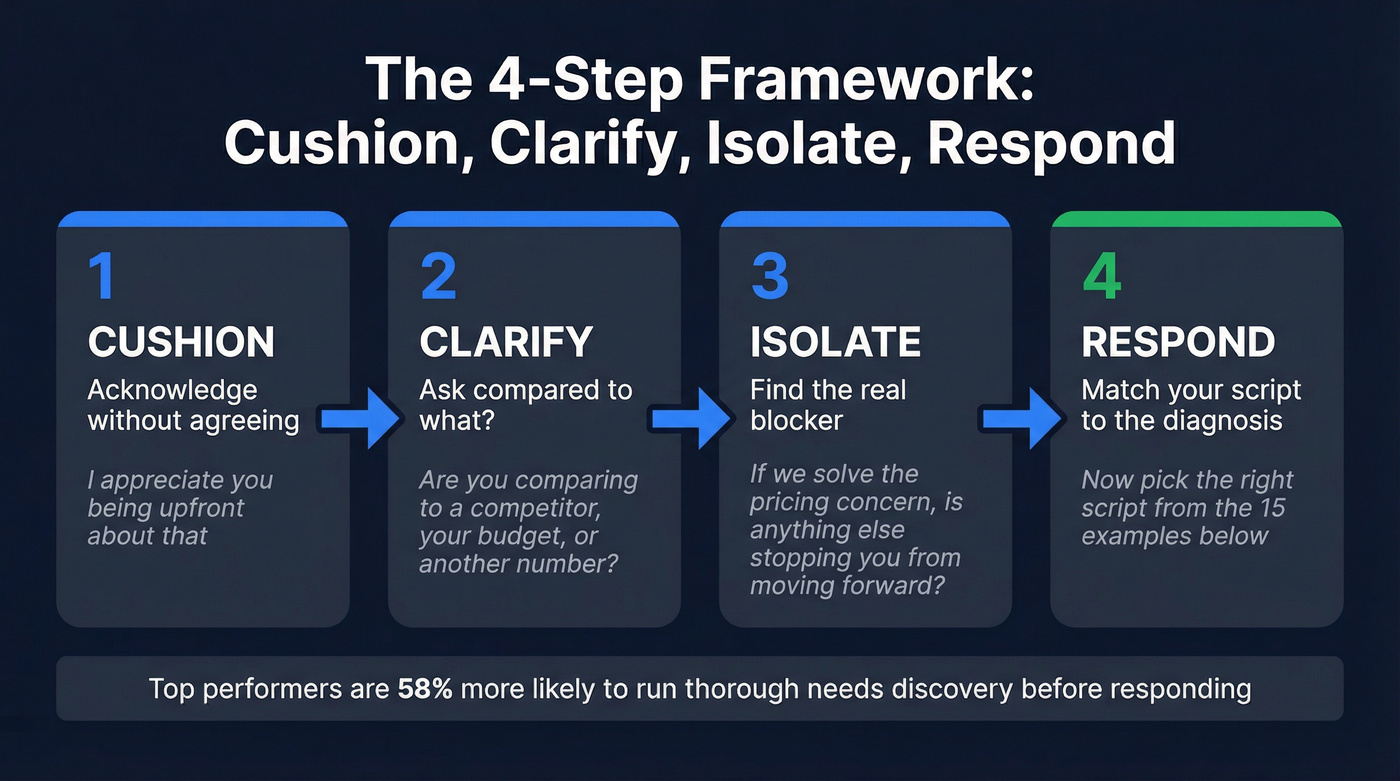
- Cushion - Acknowledge without agreeing. "I appreciate you being upfront about that" works. "You're right, we're expensive" doesn't.
- Clarify - Ask "compared to what?" This reveals whether they're comparing to a competitor, their budget, or a number they invented.
- Isolate - "If we address the pricing concern, is there anything else preventing you from moving forward?" If they say yes, price wasn't the real objection.
- Respond - Match your response to the diagnosis.
Isolating the real blocker before you respond is one of the fastest ways to protect margin. The framework sounds simple. That's the point - you need something you'll actually use when your palms are sweating on a call.

The best price objection script is worthless if you're pitching the wrong person. Prospeo's 30+ filters - including buyer intent, job changes, and department headcount - put you in front of decision-makers who actually control budget. 98% email accuracy means your follow-up lands every time.
Stop defending your price to people who can't sign the check.
15 Scripts Organized by Buyer Type
"I Haven't Seen Enough Value Yet" (Objection)
These buyers aren't convinced the outcome justifies the spend. Top performers are 63% more likely to build strong ROI cases, which is exactly what these scripts do.
ROI reframe: "If this saves your team 15 hours a week, that's $39K in recovered productivity against a $24K investment. What would you do with those hours?"
Cost-of-inaction: "What's it costing you right now to not solve this? If the answer is 'nothing,' we should probably pause. If it's real money, let's compare."
Break-it-down: "$24,000 a year is $65 a day - less than your team's coffee budget. The question is whether $65/day solves a problem worth solving."
Worked example: "A customer in your space was spending $39K annually on the manual workaround. They switched at $24K and freed up two headcount. Want me to walk through their numbers?"
"I Want It But Want a Better Deal" (Negotiation)
They've decided. Now they're optimizing. Don't panic - this is a buying signal.
Say the number. Then shut up for five seconds. State your price, close your mouth, and count to five. The silence does the work. Most reps fill it with a discount.
"Compared to what?" - The most versatile question in sales. Forces them to name the anchor. If they can't, the objection is reflexive, not real.
Isolate the blocker: "Is price the only thing between us and a signed contract?" If yes, you're negotiating. If no, there's a hidden objection you haven't surfaced yet.
If-then conditional: "If we move to a 24-month term, I can adjust the per-seat rate by 12%. Does that work for your budget cycle?"
"I Can't Justify This Internally" (Stakeholder)
The person across from you isn't the problem - their CFO is. This is where most deals die quietly, and it's rarely about your price being wrong. It's about your champion not having the ammunition to fight for you in a room you'll never enter. We've seen this kill six-figure deals that were otherwise done.
Start with "What would make this an easy yes for your team?" and let them tell you what the business case needs to look like. Then offer to build it together: "I've helped three similar companies get this approved. Want me to draft the internal justification doc with you?" Finally, present the premium package first. When you walk back to the mid-tier, it feels like a concession - even though it's the plan you wanted to sell all along. That's anchoring bias working in your favor.
"We Have a Cheaper Alternative" (Competitive)
Don't trash the competitor. Reframe the comparison.
Premium positioning: "We're not the cheapest option, and that's intentional. The question is whether the gap in [specific outcome] is worth the price difference."
Scope tradeoff: "I don't discount the work, but I'm happy to adjust scope. What matters most - full implementation or a lower starting price? I've seen teams switch to save 20% and lose 60% of the value."
Skip this approach if the competitor genuinely does the same thing at a lower price. In that case, you need a differentiation conversation, not a pricing one.
What to Trade Instead of Discounting
Top-performing sellers are 81% more likely to maintain deal margins. They don't hold the line by being stubborn - they trade.
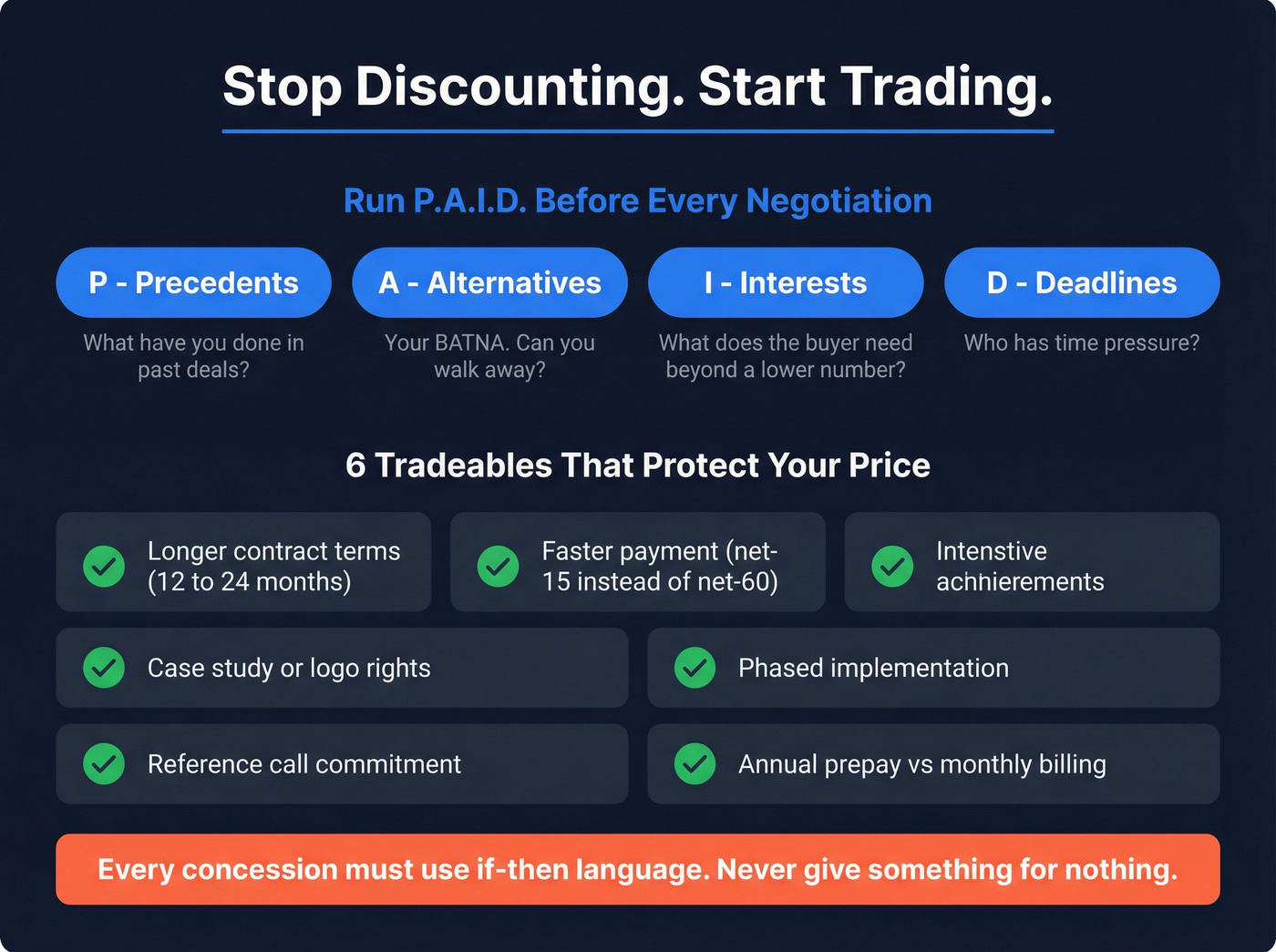
Before any negotiation, run through P.A.I.D.:
- Precedents - what have you done in past deals?
- Alternatives - your BATNA. Can you walk? (Set a clear walk away point.)
- Interests - what does the buyer need beyond a lower number?
- Deadlines - who has time pressure?
Concrete tradeables that protect price: longer contract terms, faster payment (net-15 instead of net-60), case study rights, phased implementation, or a reference call commitment. Every concession should use if-then language. Never reduce scope unprompted - if the reduced version still meets their needs, your original proposal looks bloated. If it doesn't, you've sold them something inadequate. Either way, you lose credibility.
When to Bring Up Pricing
Conventional sales training says delay pricing as long as possible. Gong's data says the opposite.
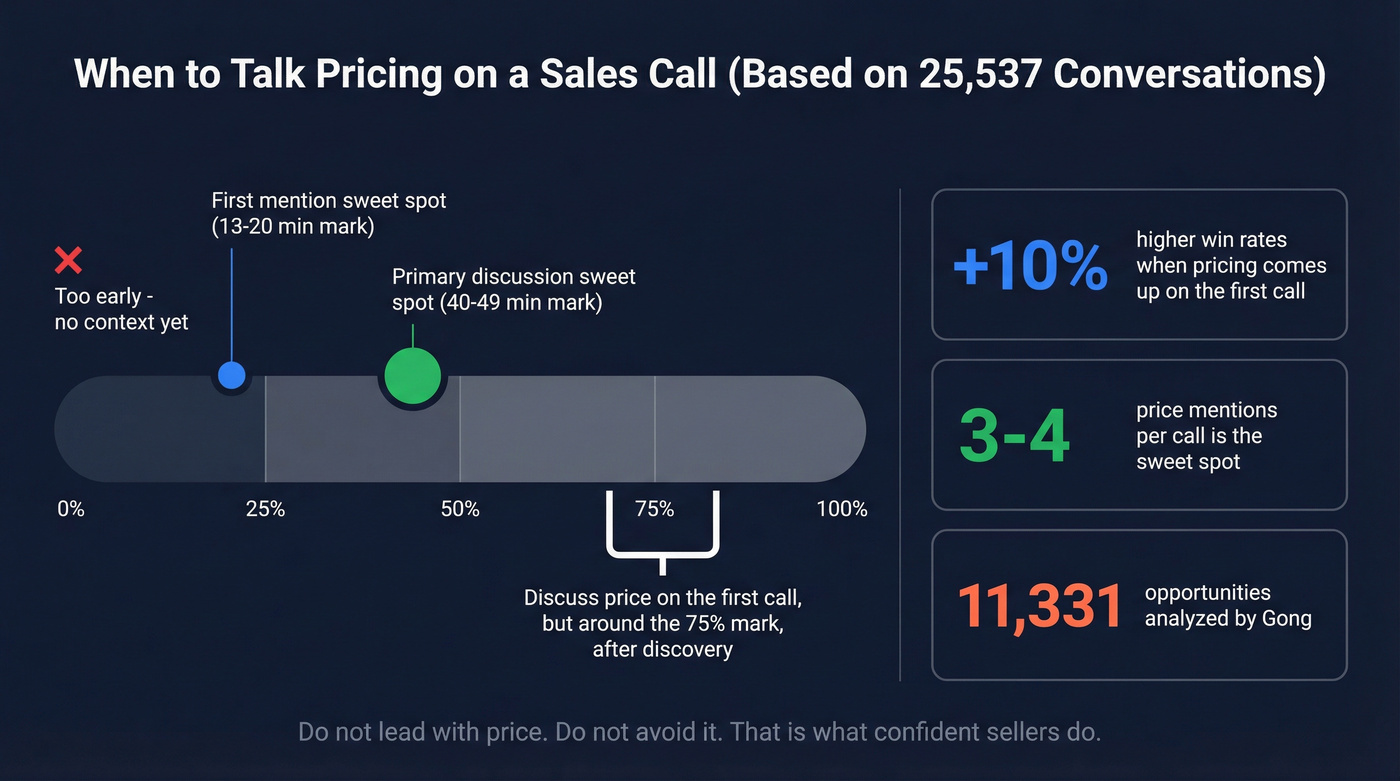
Their analysis of 11,331 opportunities found win rates are roughly 10% higher when pricing comes up on the first call. A separate analysis of 25,537 B2B sales conversations found the sweet spot is 3-4 price mentions per call, with top performers most commonly discussing it around the 40-49 minute mark and also frequently around the 13-20 minute mark.
These findings aren't contradictory. Discuss price on the first call - but late in the call, around the 75% mark, after discovery. Don't lead with it. Don't avoid it. That's what confident sellers do (and it helps to have a tight product demo checklist).
Fix the Pipeline, Fix the Price
Let's be honest: if you're discounting every deal, you don't have a pricing problem - you have a qualification problem. The reps who never discount aren't tougher negotiators. They just have enough pipeline to walk away.
And qualification starts with reaching the right people. One of our team ran an experiment last quarter: same outbound sequence, same messaging, but swapped in verified decision-maker contacts instead of scraped lists. Response rates jumped, and not a single deal required a discount to close. When you're talking to the person who owns the budget, the "let me check with my boss" objection disappears entirely.
That's where your data stack matters. Prospeo gives you 300M+ profiles at 98% email accuracy with 30+ filters to target by job role, department, and company size - so you're pitching the person who can actually say yes. A full pipeline is the best negotiation leverage you'll ever have (especially when you’re using repeatable sales prospecting techniques and tracking pipeline health).
You just read that 70-80% of buyers have room to move on price - if you give them a reason. That starts with reaching the right stakeholders with verified contact data. Prospeo gives you 125M+ verified mobiles with a 30% pickup rate, so you can have pricing conversations live instead of losing deals in email threads.
Direct dials turn price objections into closed deals.
FAQ
What's the best response when a prospect says "your price is too high"?
Ask "too expensive compared to what?" This forces the buyer to name a specific anchor - a competitor, a budget number, or nothing at all. If they can't answer, the objection is reflexive. Isolate whether price is the only blocker, then match your response to the diagnosis.
Should you discuss pricing on the first sales call?
Yes. Gong's analysis of 11,331 opportunities found win rates are roughly 10% higher when pricing comes up on the first call. Bring it up around the 75% mark, after discovery. Buyers respect sellers who don't dodge the money conversation.
How do you handle price objections without discounting?
Trade instead of cave. Offer longer contract terms, faster payment, or case study rights in exchange for holding price. Use if-then language: "If we move to 24 months, I can adjust the per-seat rate." Never reduce scope unprompted - it undermines your original proposal.
How do you prevent price pushback before it happens?
Most late-stage pricing surprises happen because you're not talking to the budget holder. Building your pipeline with verified decision-maker contacts - filtered by job role, department, and company size - means you're pitching the person who can actually say yes, not someone who needs to "run it up the chain."