

Product Battle Cards: How to Build Cards Your Reps Will Actually Use
A RevOps lead we work with ran a battlecard audit last quarter. The team had 14 product battle cards across a shared drive. Average last-modified date: nine months ago. Rep usage in competitive deals: zero. The cards were beautifully designed, thoroughly researched, and completely ignored.
That's the norm. 68% of sales opportunities are competitive, and 79% of CI professionals produce battlecards - but only 26% say reps use them enough. The creation problem is solved. A competitive battlecard template exists for every format imaginable. AI can draft a card in 15 minutes. The real problem is adoption, and that's what this guide is about - building battle cards reps actually open mid-call, backed by data from Klue's analysis of 150+ battlecard audits and maturity assessments.
The Only Quality Bar That Matters
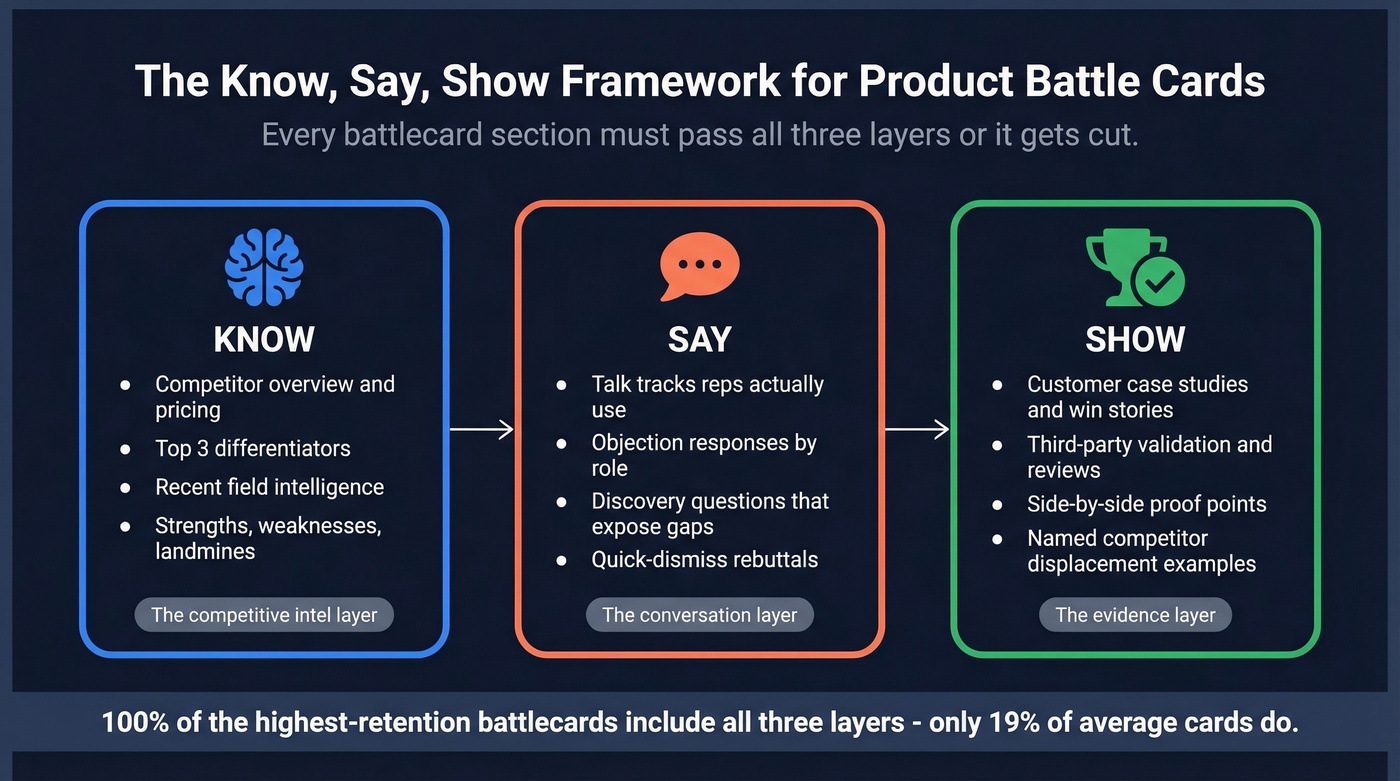
Every section of a battlecard must pass the "Know, Say, Show" test. If it doesn't include what to know about the competitor, what to say to the prospect, and what to show as proof, cut it. 100% of the highest-retention battlecards include all three components. Most cards only have one. That's why they collect dust.
What Is a Product Battle Card?
A product battle card is a short, scannable competitive reference designed for sales reps to use before or during live calls. It's not a one-pager - that's customer-facing marketing collateral. It's not a competitive analysis deck - that's for leadership. A battlecard is internal, tactical, and built for speed.
Product marketing and competitive intelligence teams typically create them, though in smaller orgs the founder or head of sales often writes the first version. The best ones live where reps already work: inside the CRM, pinned in Slack channels, or surfaced through marketing enablement platforms. The worst ones live in a Google Drive folder nobody bookmarks.
Why Most Competitive Battlecards Fail
Klue analyzed 150+ battlecard programs and the findings are damning. Only 43% of battlecards include talk tracks. Only 19% include supporting evidence like third-party validation. Only 35% include customer-facing proof points like case studies or win stories. The majority tell reps about a competitor without telling them what to say or what to show.
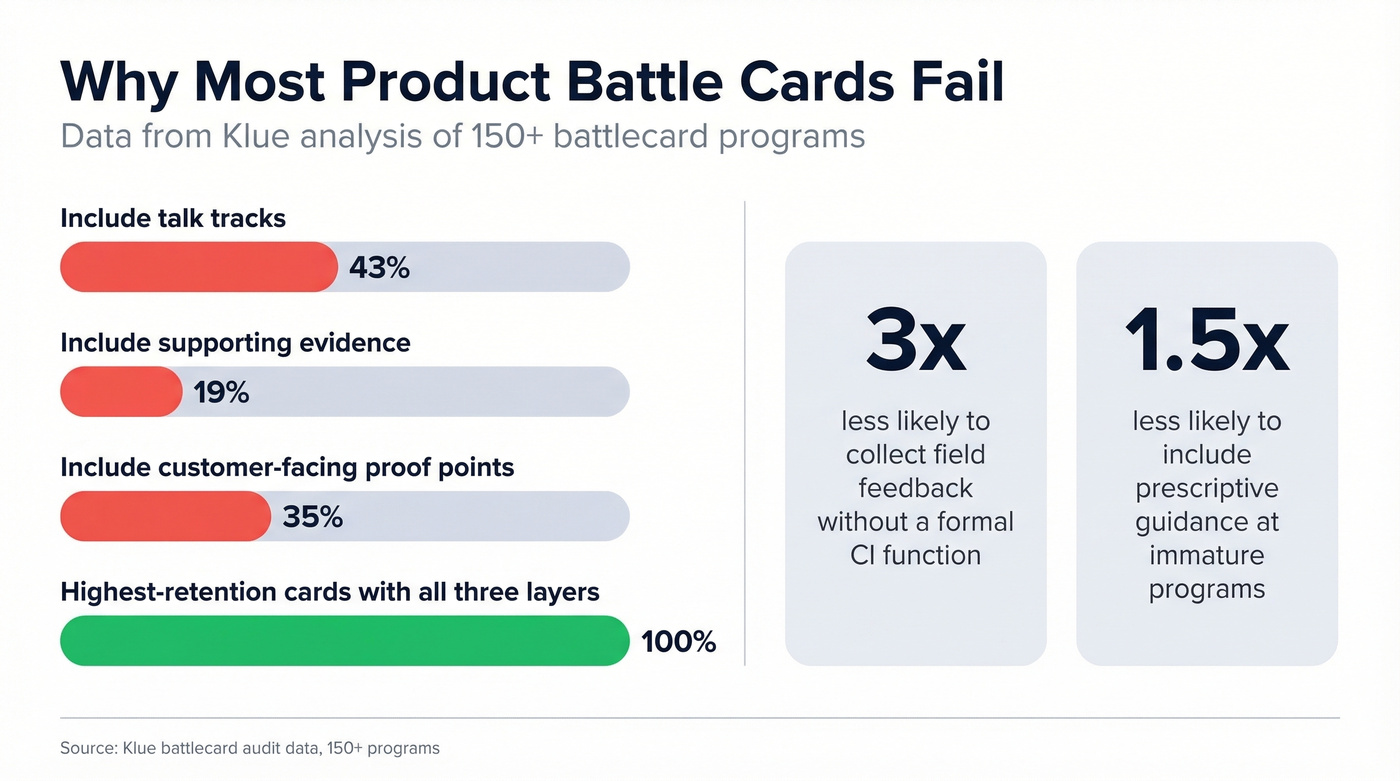
The cards that actually get used look completely different - 100% of the highest-retention battlecards in Klue's dataset included all three layers. Not a coincidence.
The adoption gap gets worse at immature programs. Teams without a formal CI function are 3x less likely to collect field feedback from reps, which means their talk tracks sound like marketing copy instead of real objection responses. They're also 1.5x less likely to include prescriptive guidance for when and how to use the intel. A card that says "Competitor X is weak on integrations" without telling the rep exactly what question to ask is a card that stays closed.
The "Know, Say, Show" Framework
This framework comes from Klue's audit data, and it's the simplest quality bar for any battlecard section. If a section doesn't cover all three, it's incomplete.
Know
The competitive intel layer. Competitor overview, pricing model, strengths, weaknesses, and recent field intelligence. Crayon recommends structuring this around five components: Why We Win (top 3 differentiators), competitor strengths and how to respond, recent wins by segment, recent field intel with a "so what," and landmines. Keep it factual and current - stale intel is worse than no intel because reps lose trust in the entire card.
Applied Frameworks takes a different approach with their 15-cell Competitive Advantage Matrix, mapping regions like "Money maker" and "Secret sauce" directly to battlecard sections. It's a useful input exercise before you start writing.
Say
Talk tracks, objection responses, discovery questions, landmines that expose a competitor's weakness, and quick-dismiss rebuttals for competitors you rarely face. This is where most cards fail - only 43% include any talk tracks at all. Write them the way reps actually talk, not in corporate positioning language.
Here's the thing: you should build role-specific versions of the same competitor card. A BDR needs discovery questions and quick qualifiers. An AE needs pricing objection responses and proof points for late-stage deals. Same competitor, different cards.
Show
Proof points, case studies, third-party validation, and any customer-facing evidence a rep can reference or share. "We beat Competitor X at a 500-person fintech last quarter" is infinitely more powerful than "We have superior technology." Only 19% of battlecards include this layer.
Crayon's ABC quality bar - Accuracy, Brevity, Consistency - is the baseline for execution. Every section should be accurate (verified, not stale), brief (scannable mid-call), and consistent (same structure across all your cards so reps know where to look).

Battle cards need proof points to pass the "Show" test. Prospeo gives your reps 98% verified emails and 30% mobile pickup rates - the kind of concrete stats that turn a battlecard from shelf-ware into a weapon. Build your competitive proof layer on data that refreshes every 7 days.
Arm your reps with data competitors can't match.
Battle Card Types Worth Building
Stop making 15 battlecards. Make three great ones for your top competitors. For the rest, a one-paragraph quick dismiss is enough.

| Type | When to Use | Key Sections |
|---|---|---|
| Competitor | Head-to-head deal | Strengths, weaknesses, talk tracks, landmines |
| Objection-handling | Any deal stage | Top 5 objections + scripted responses |
| Product-specific | Feature comparison | Side-by-side capabilities, proof points |
| Pricing | Negotiation stage | Their tiers vs yours, discount triggers |
| Industry/vertical | Vertical selling | Vertical pain points, relevant case studies |
| Key talking points | Internal alignment | Core messaging, positioning statements |
| Market news | Trigger-based outreach | Competitor launches, funding, leadership changes |
Most teams over-invest in the competitor card and completely ignore the objection-handling card. But objections repeat across every competitor. One great objection card often outperforms three mediocre competitor cards because reps face the same five pushbacks regardless of who they're up against.
Build deep cards for the competitors in 80% of your deals. For everyone else, a quick-dismiss rebuttal - two or three sentences a rep can deliver without hesitation - covers it.
Real-World Examples That Work
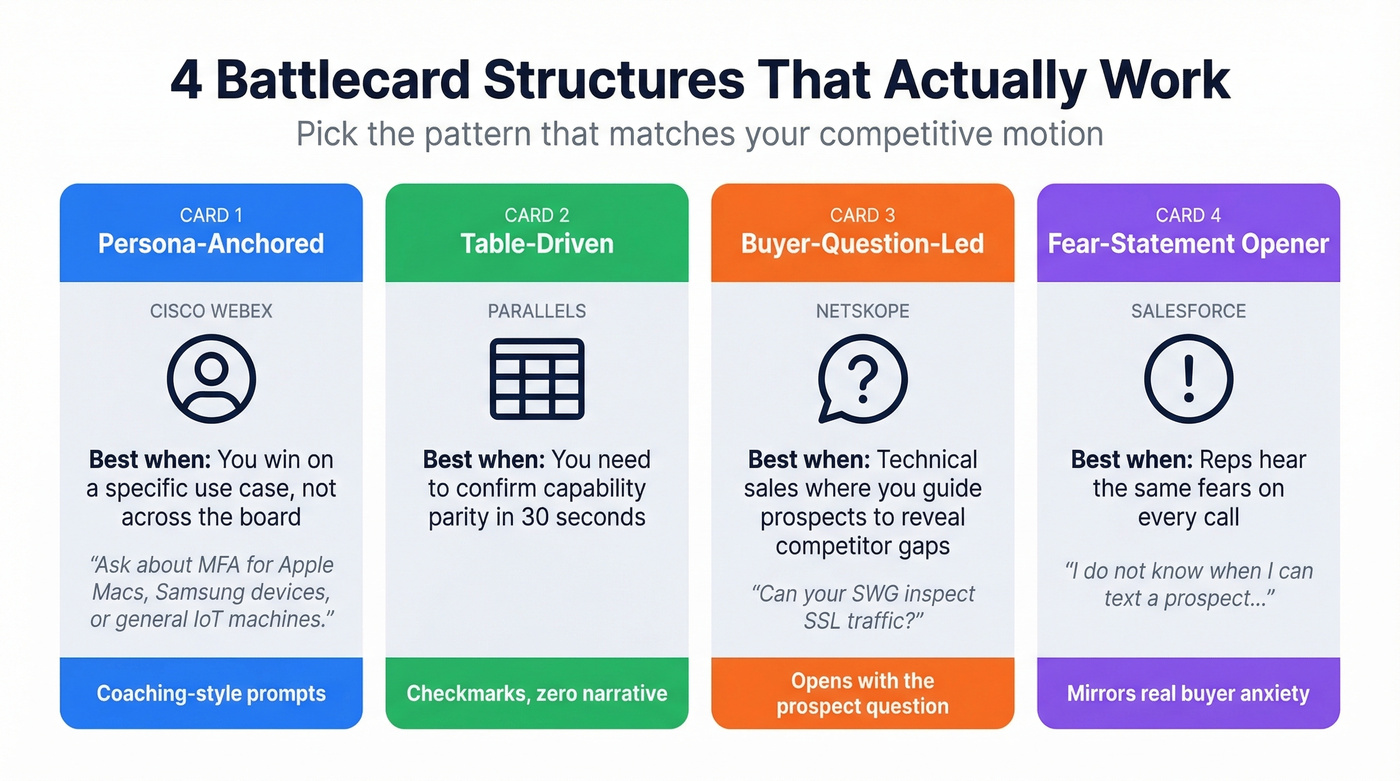
Most battlecard advice is abstract. Here are four structural patterns from Dock's archive of 24+ public battlecards - which also includes cards from DocuSign, Lenovo, AWS, Samsung Knox, and others - that show what actually works in practice.
Cisco Webex - Persona-Anchored
"Ask about MFA for Apple Macs, Samsung devices, or general IoT machines."
That's a coaching-style discovery prompt from Cisco's Webex vs. Zoom/Microsoft card. Everything anchors around a single persona: "Thema, Remote Worker." Every competitive comparison is framed through end-to-end security and control - Thema's primary concern. This format gives the rep a character to sell to, not a feature list to memorize. If your product wins on a specific use case rather than across the board, steal this structure.
Parallels - Table-Driven, 30-Second Scan
Parallels' card against Citrix is blunt: checkmarks, short labels, zero narrative. It's designed for replacement deals where the rep needs to confirm capability parity in 30 seconds flat. If your competitive motion is "we do everything they do, cheaper," this format is hard to beat. We've seen teams adopt this template fastest because it requires the least reading.
Netskope - Buyer-Question-Led
What if the card opened with the prospect's question instead of your positioning? Netskope's partner battlecard does exactly that: "Can your SWG inspect SSL traffic?" It then includes micro case studies of wins against named competitors. This format works for technical sales where the rep needs to guide the prospect into revealing a gap the competitor can't fill.
Salesforce Direct Connect - Fear-Statement Opener
This card opens with a buyer fear: "I don't know when I can text a prospect..." Then it walks through practical sections - who can use it, when to use it, why to sell it - plus pricing and setup details. The fear-statement opener mirrors what the rep is actually hearing on calls. It feels like a cheat sheet, not a document.
Building AI-Assisted Battle Cards
AI can draft a battlecard in about 15 minutes. A practitioner on r/CustomerSuccess shared a three-step workflow using Google Gemini: run a "Deep Research" competitor analysis covering features, pricing, alternatives, sentiment, and ICP. Feed in your own product info to generate a comparison. Convert to a one-page infographic.
Kompyte published copy-paste ChatGPT prompts for each battlecard section - positioning, objection handling, landmines, kill shots. These are genuinely useful starting points.
Real talk: AI hallucinates pricing, confuses product tiers, and misses recent launches. Human verification isn't optional. Budget 15 minutes for the AI draft and another 30-45 minutes for fact-checking, adding field intel, and writing talk tracks that sound like your reps actually talk. The AI gives you structure and speed. Your PMM gives you accuracy and voice.
Driving Adoption: Cards That Get Used
The best battlecard nobody opens is worthless. Adoption is an ops problem, not a content problem.
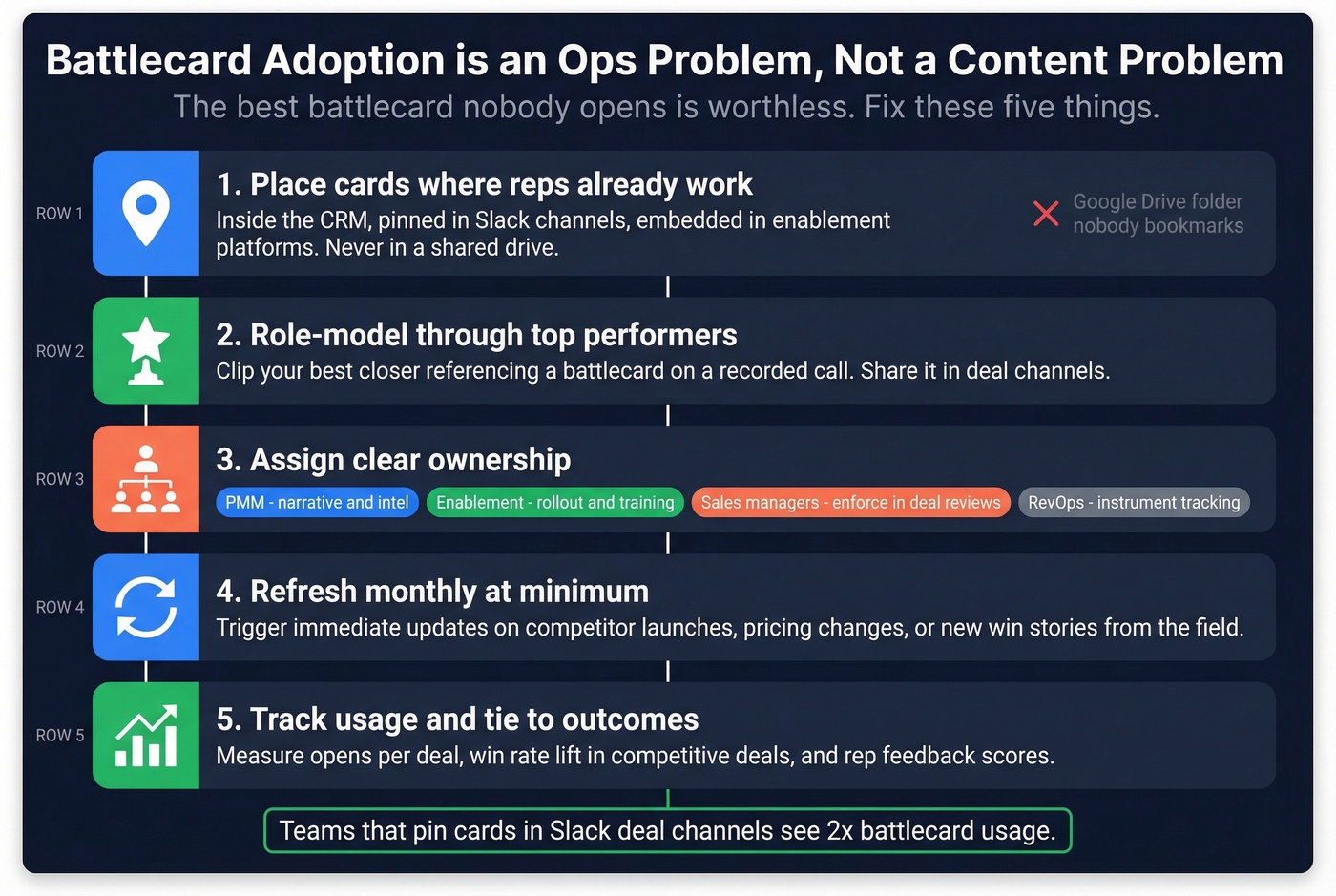
Store cards inside the CRM, pinned in Slack or Teams channels, or embedded in your enablement platform. Not in a shared drive. Not in a wiki nobody checks. In our experience, the single biggest adoption lever is placement - if a rep has to leave their workflow to find the card, they won't. The goal is real-time sales content that surfaces automatically when a competitor is mentioned in a deal, not static PDFs buried three clicks deep.
Role-model through top performers. When your best closer references a battlecard on a recorded call, clip it and share it. We've seen teams double their battlecard usage just by pinning cards in the Slack channels where deals get discussed.
Assign clear ownership: PMM owns the narrative and competitive intel, enablement owns rollout and training, sales managers enforce usage in deal reviews, RevOps instruments tracking. Refresh monthly at minimum. Trigger immediate updates when a competitor changes pricing, launches a feature, or you lose a deal to a new objection. Stale cards destroy trust faster than missing cards.
The KPIs that matter: win rate in competitive deals (before/after and with/without battlecard usage), battlecard open rate (target 60-80% of competitive opps for mature teams), and rep ramp time. sales operations metrics help you instrument this without turning it into a reporting project. 71% of companies using battlecards report increased win rates, and 93% of those say the increase exceeds 20%.
Battle Card Tools and Costs
You don't need Crayon or Klue to start. Most teams should start with a Google Doc and a monthly update cadence. Graduate to a platform when you have 10+ competitors and a dedicated CI person.
| Tool | Price | Best For |
|---|---|---|
| Google Docs / Notion | Free | Starting out, no tracking |
| Playwise HQ | Free (5 users); Pro $250/mo; Enterprise $450/mo | Small teams, AI-generated cards |
| Kompyte | From $300/yr | Budget CI with battlecard features |
| Crayon | ~$20-40K/yr | Mature CI, 10+ competitors |
| Klue | ~$20-40K/yr | Enterprise CI with audit tools |
Crayon and Klue are serious enterprise investments - they make sense when you're tracking a dozen competitors across multiple product lines and need automated monitoring, not just static documents. Kompyte is the budget-friendly middle ground. Skip Playwise if you already have a Notion workspace with decent templates; it won't add much.

One thing battlecard platforms don't solve: the data problem. Your cards can tell reps exactly what to say, but if the CRM is full of outdated contacts, reps never reach the prospects those battlecards were designed for. Tools like Prospeo - with 98% email accuracy and a 7-day data refresh cycle - handle that layer so your battlecard investment actually pays off. If you're tightening this part of the stack, start with data enrichment services and a clean definition of firmographic filters.
The best battlecards include real win stories backed by real outreach results. Teams using Prospeo book 26% more meetings than ZoomInfo and 35% more than Apollo - at $0.01 per email. That's a proof point worth putting on every card your reps carry into a deal.
Stop writing battlecards with stats you can't back up.
FAQ
What's the difference between a battle card and a one-pager?
A one-pager is customer-facing marketing collateral designed to be shared with prospects. A battlecard is internal - built for reps, used mid-call, focused on competitive positioning and objection handling. One goes to the buyer. The other stays with the seller.
How often should you update battle cards?
Monthly at minimum, with immediate refreshes when a competitor changes pricing, launches a feature, or you lose a deal to a new objection. Stale cards erode rep trust - 74% of reps stop using a card after encountering outdated intel once.
Who should own the battle card program?
Product marketing owns the narrative and competitive intel. Sales enablement owns rollout and training. Sales managers enforce usage in deal reviews. RevOps instruments tracking and measures win-rate impact.
How many battle cards does a team need?
Deep cards for your top three competitors - the ones showing up in 80% of your deals. For the rest, a one-paragraph quick dismiss. Three great cards beat fifteen mediocre ones every time.
Can you build effective battle cards without a CI platform?
Yes. Start with Google Docs, a Slack channel for field intel, and a monthly update cadence. Graduate to Crayon or Klue when you have 10+ competitors and a dedicated CI person.