

Progressive Dialers: What They Are & When to Use One in 2026
"Whenever I answer the phone and there's a beep, I hang up. I'm team progressive." That's a real line from r/MCAlegend on Reddit, and it captures the core problem with predictive dialers in two sentences. The awkward pause, the abandoned call, the compliance risk - all because the system dialed before an agent was ready. Progressive dialers fix this by design.
What Is a Progressive Dialer?
A progressive dialer automatically dials the next number on your list only after an agent finishes their current call and confirms readiness. One call per available agent, every time. No algorithm guessing when a rep will wrap up, no multi-line dialing, and far less chance a prospect picks up to dead air.
Your agent finishes a call, the system presents the next contact's info from your CRM or uploaded list, and the dialer places the call once the rep signals they're good to go. It skips busy signals, disconnected numbers, and answering machines automatically, so agents spend time on live conversations instead of voicemail greetings.
Use cases go well beyond cold calling. Healthcare scheduling, bank surveys, market research, and renewal campaigns all benefit from the one-to-one pacing this dialer type enforces. Any scenario where personalization and compliance matter more than raw volume is a fit.
The Quick Version
A progressive dialer dials one number per available agent, eliminating abandoned calls and the compliance headaches that follow. If your team has fewer than 10 agents, this approach is almost always the right choice over predictive.
- Budget picks: CloudTalk ($27/user/mo) or JustCall ($29/user/mo)
- Highest user satisfaction: DialedIn (4.8/5 on GetApp, 306 reviews)
- Under 10 agents? Go progressive. Over 25 with high-volume B2C? Consider predictive with compliance guardrails.
- The prerequisite nobody mentions: Verify your phone numbers before loading them. Disconnected numbers waste agent time and destroy your caller ID reputation.
Progressive vs. Predictive, Power, and Preview
| Dialer Type | How It Dials | Agent Control | Abandonment Risk | Best For |
|---|---|---|---|---|
| Progressive | One call per ready agent | High - agent confirms | Near-zero | B2B, <10 agents |
| Predictive | Multiple lines simultaneously | Low - algorithm decides | High | High-volume B2C |
| Power | Continuous, one-at-a-time | Medium - auto-advances | Low-medium | Mid-volume outbound |
| Preview | Agent reviews, then triggers | Highest - full prep time | Near-zero | Complex/high-value |
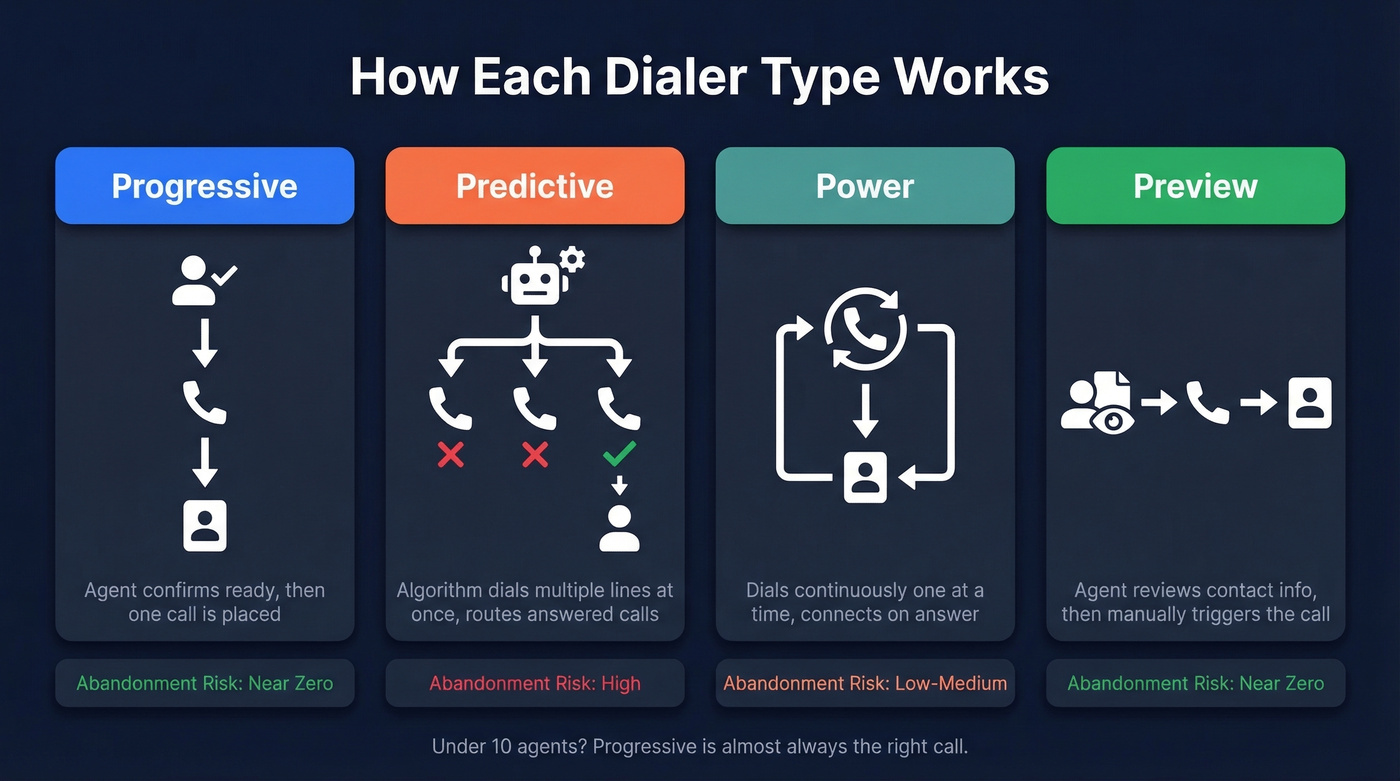
The confusion usually sits between power and progressive. A power dialer dials continuously through your list - up to 70 calls per hour - and connects the agent only when someone answers. A progressive dialer waits for the agent to confirm readiness before dialing at all. That distinction matters when your reps need 15 seconds to review a contact's history before the call.
Predictive dialers are the speed demons. They can push B2C agents from 4 contacts per hour to 16+, but they achieve this by dialing multiple numbers simultaneously and routing answered calls to whoever's available. When the algorithm miscalculates, prospects pick up to silence - or worse, get connected to a rushed agent with zero context.
Here's the thing: reps spend just 36.6% of their time actually selling. Any dialer type improves on manual work. But progressive pacing gives you the productivity lift without the same compliance exposure.
Performance Benchmarks
Automated dialing eliminates up to 90% of manual dialing tasks. Progressive dialers won't match predictive on raw volume, but they're built to avoid abandoned calls entirely - there's simply no reason to place a call when no agent is available.
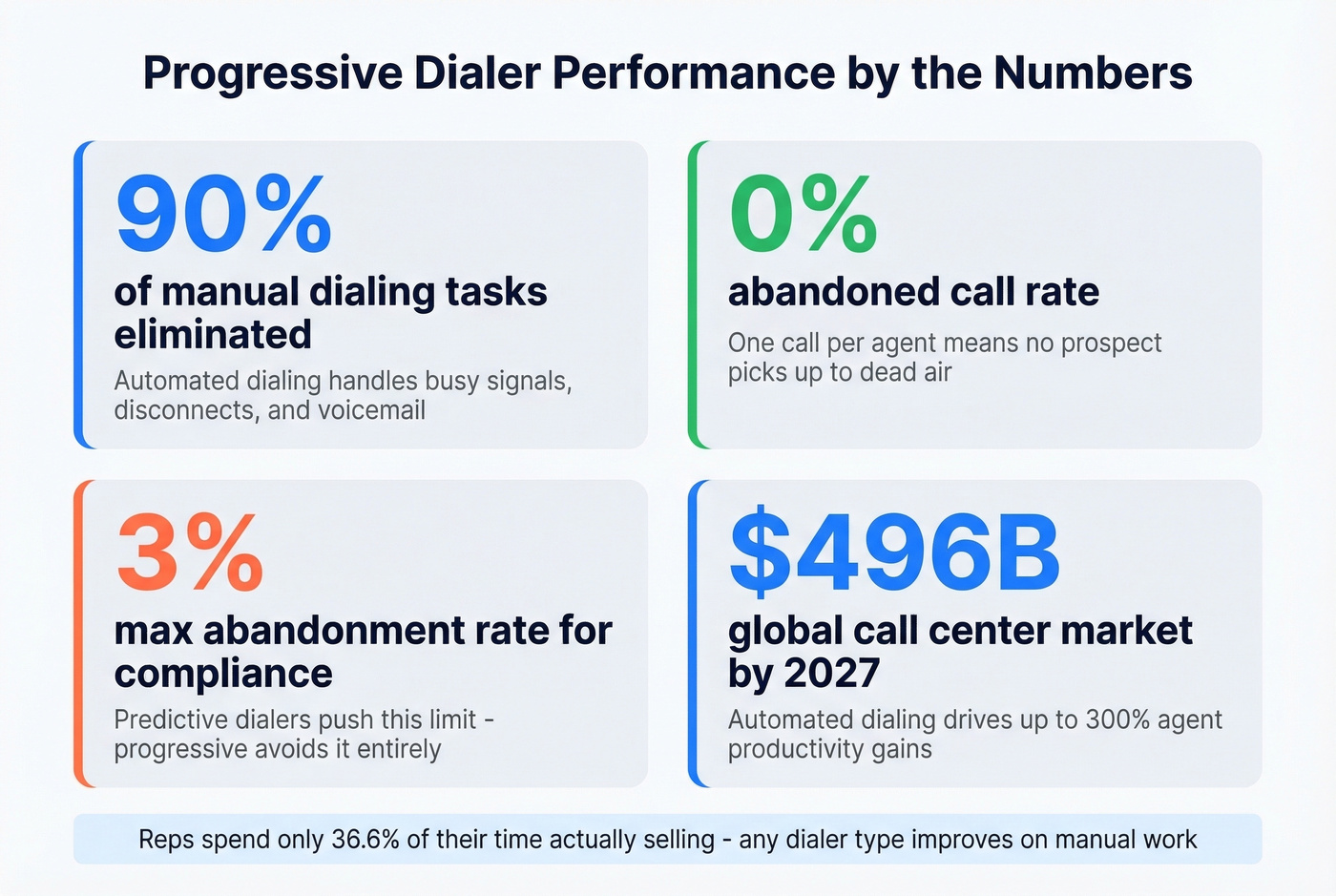
The common compliance benchmark is a ~3% maximum abandonment rate, and predictive systems can get uncomfortably close if pacing is aggressive. Progressive architecture sidesteps this scenario altogether.
The global call center market is projected to hit $496B by 2027, and automated dialing systems can improve agent productivity by up to 300%. That 300% figure comes from predictive-style benchmarks, but even one-to-one dialing delivers a meaningful fraction of that gain while keeping your legal team calm.

Progressive dialers eliminate abandoned calls, but they can't fix disconnected numbers. Every dead number wastes agent time and tanks your caller ID reputation. Prospeo's 125M+ verified mobile numbers hit a 30% pickup rate - refreshed every 7 days so your reps dial real people, not voicemail graveyards.
Stop burning agent hours on dead numbers. Start every dial with verified data.
Compliance in 2026: What Changed
TCPA penalties run $500-$1,500 per violation - per call. A 5,000-contact campaign with sloppy consent management can generate seven-figure liability in a single afternoon. TCPA litigation surged nearly 95% versus the prior year.
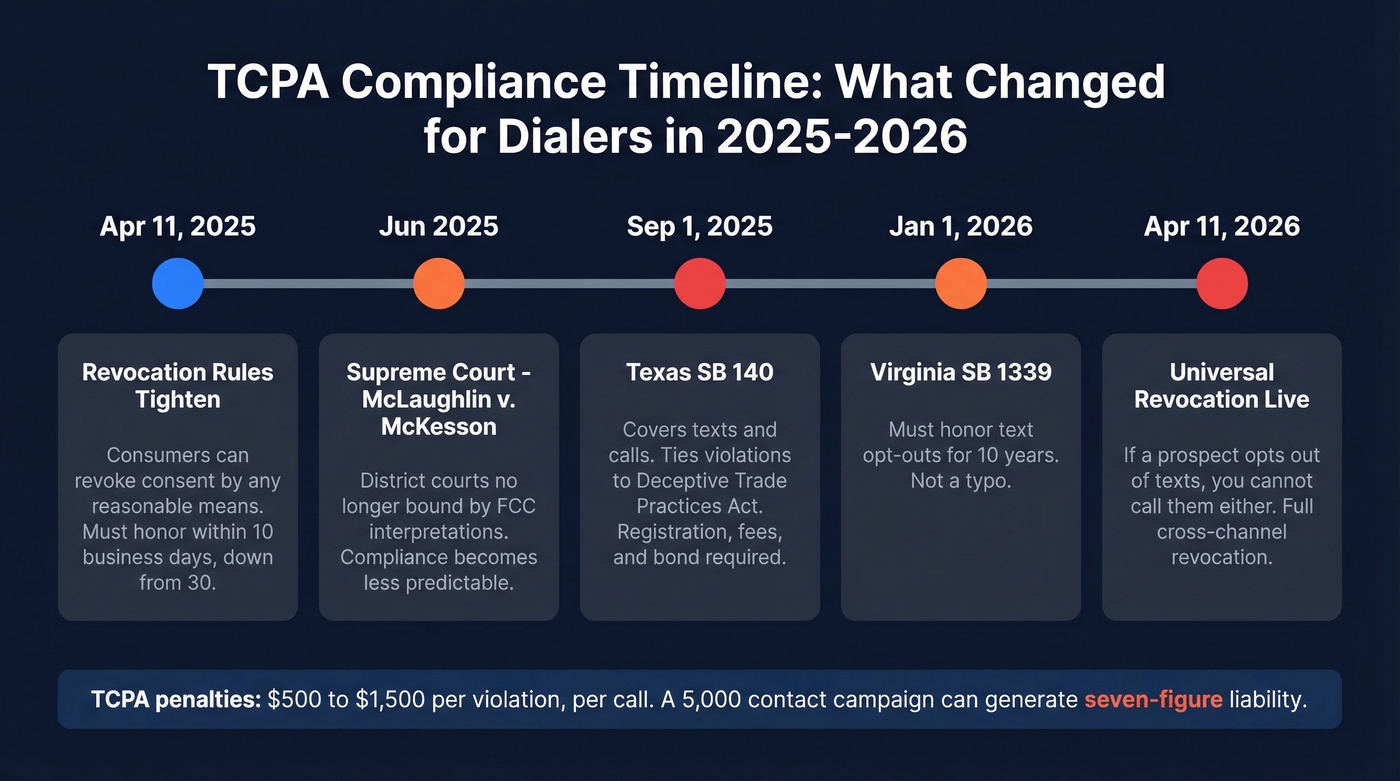
The big federal shift landed on April 11, 2025. Consumers can now revoke consent by any reasonable means - a voicemail, an email, a verbal request on a call. Businesses must honor revocation within 10 business days, down from the previous 30-day window. You're allowed one confirmation message after a text opt-out, but it must go out within 5 minutes and contain zero marketing content.
As of April 11, 2026, universal revocation is live. If a prospect opts out of your texts, you can't call them either.
The Supreme Court's McLaughlin v. McKesson ruling in June 2025 added another layer: district courts aren't bound by FCC interpretations in civil TCPA cases. Judges can chart their own course. That makes compliance less predictable, not more.
State Laws You Can't Ignore
Federal compliance is the floor, not the ceiling.
Texas SB 140 took effect September 1, 2025. It covers texts and calls, ties violations to the Deceptive Trade Practices Act, and requires registration plus fees and bond requirements. Virginia SB 1339 took effect January 1, 2026 - you must honor text opt-outs for 10 years. Not a typo.
Connecticut SB 1058 restricts calling windows to 9 AM-8 PM local time, with penalties up to $20,000 per violation. Maine LD 2234 requires checking the FCC's Reassigned Numbers Database before making sales calls. Using it creates a safe harbor; skipping it doesn't.
Progressive dialers don't solve compliance on their own, but their one-call-per-agent architecture eliminates the abandoned-call risk that triggers the most common complaints. (If you need the full legal checklist, start with a TCPA compliance checklist.)
Why Calls Get Flagged as Spam
STIR/SHAKEN prevents caller ID spoofing, but it doesn't stop spam labels. Your calls can be fully authenticated and still get flagged.
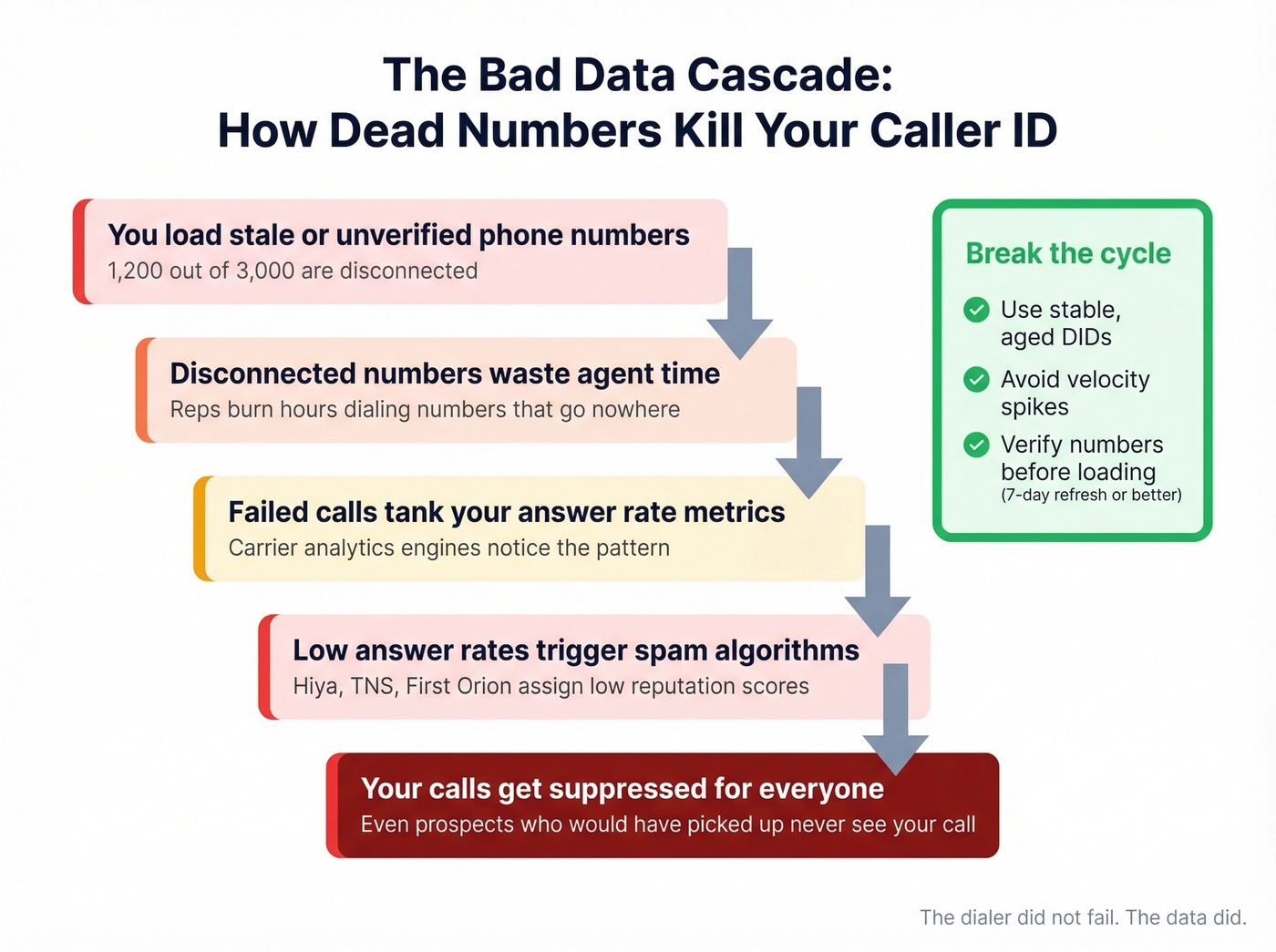
Carrier analytics engines - Hiya, TNS, First Orion - assign reputation scores based on behavioral signals: call volume spikes from a new DID, low answer rates, repeated attempts to the same numbers, new or recently recycled DIDs with no history, and negative feedback from recipients who mark calls as spam. On top of that, iOS "Silence Unknown Callers" and Android's built-in spam protection suppress calls at the device level. Americans receive 2.5 billion robocalls per month, so carriers and device makers are aggressive about filtering.
Mitigation comes down to discipline: use stable, aged DIDs, avoid velocity spikes, create prior interaction before calling, and - most importantly - dial numbers that actually work. (More detail here: caller ID reputation.)
The Data Problem Nobody Talks About
You bought 10,000 "verified" contacts. Your dialer burns through 3,000 in the first week - 1,200 are disconnected, 400 trigger spam flags from rapid-fire failed attempts, and your caller ID reputation is wrecked before you've had a single real conversation.
Everyone obsesses over dialer type. The real question is whether your calling lists are worth dialing at all.
Bad phone numbers create a cascade. Disconnected numbers waste agent time. Failed calls tank your answer rate metrics. Low answer rates trigger carrier spam algorithms. Spam labels suppress your calls to the prospects who would've picked up. The dialer didn't fail - the data did.
Most B2B data providers refresh records about every six weeks. In that window, people change jobs, get new numbers, and your "verified" list decays. We've seen teams triple their connect rates just by switching their data source, before touching their dialer settings. Prospeo's Mobile Finder runs on a 7-day refresh cycle across 125M+ verified mobile numbers with a 30% pickup rate, at roughly $0.01 per lead.
You just read that reps spend only 36.6% of their time selling. A progressive dialer helps - but loading it with stale data kills the gains. Prospeo delivers 98% email accuracy and verified direct dials at $0.01/lead, with a 7-day refresh cycle that's 6x faster than the industry average.
Clean data in, live conversations out. That's the formula.
Top Software Picks + Pricing
| Tool | Starting Price | GetApp Rating | Best For |
|---|---|---|---|
| CloudTalk | $27/user/mo | 4.4/5 (268) | Budget teams |
| JustCall | $29/user/mo | - | SMBs, quick setup |
| Aircall | $40/user/mo | - | Mid-market |
| DialedIn | $99/user/mo | 4.8/5 (306) | Highest satisfaction |
| Five9 | ~$119/user/mo | 4.2/5 (481) | Enterprise |
| Nextiva | $129/user/mo | - | Full UCaaS stack |
| RingCentral | ~$150+/user/mo | - | Existing RC customers |
| Convoso | ~$100+/user/mo | 4.5/5 (386) | High-volume B2C |
| VICIdial | Free (open source) | 4.7/5 (264) | Self-hosted, technical teams |
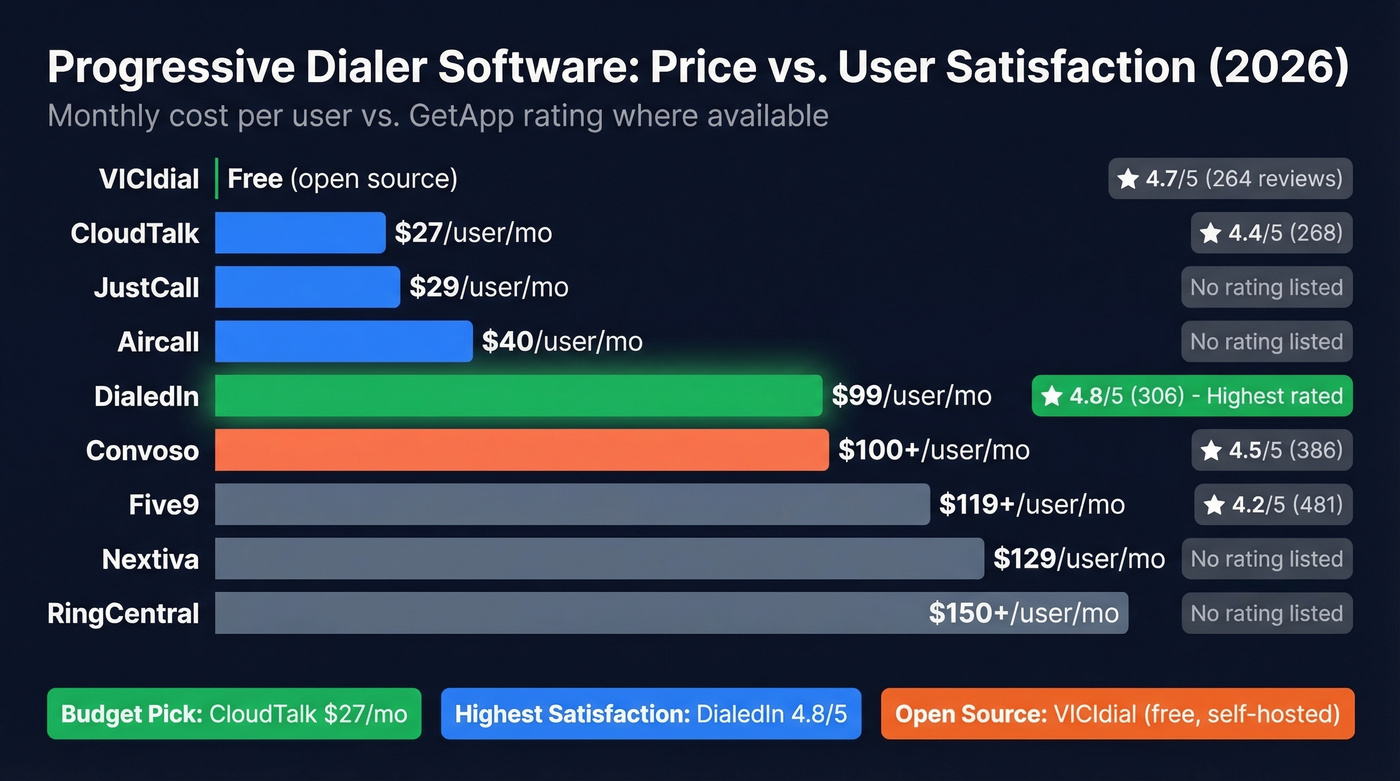
Budget pick: CloudTalk at $27/user/mo is hard to beat for small teams. JustCall at $29/user/mo is comparable and touts setup in under an hour. Either works for teams under 10 reps who need progressive dialing without enterprise complexity.
Highest satisfaction: DialedIn carries a 4.8/5 on GetApp across 306 reviews. At $99/user/mo it isn't cheap, but the rating gap between DialedIn and the rest of the field is significant. If budget allows, it's the one I'd pick.
Enterprise: Five9 and RingCentral. Real talk: it's 2026 and Five9 still won't publish dialer pricing on their website. Expect ~$119/user/mo as a starting point, with annual contracts and custom quotes for anything beyond basic.
B2C high-volume: Convoso is purpose-built for outbound call centers running predictive and progressive campaigns at scale. The review volume - 386 ratings at 4.5/5 - speaks to real adoption.
Open-source wildcard: VICIdial is free, self-hosted, and carries a 4.7/5 across 264 reviews. You'll need a technical team to deploy and maintain it, but for organizations that want full control without per-seat licensing, it's the only real option. Skip this if you don't have a dedicated sysadmin - the setup and maintenance overhead is real.
If you're comparing dialer categories across the board (not just progressive), see our full guide to dialers.
Setting Up Your Dialer
Getting the software installed is the easy part. Configuration is where teams stumble.
Pacing is the first thing to get right. Your dialer's pacing algorithm balances two goals - minimizing agent idle time and minimizing abandoned calls. Start conservative. A 10-30 second wrap-up window between calls gives reps time to log notes without killing throughput.
Timezone segmentation saves you from expensive mistakes. Segment your lists by timezone before loading them. Connecticut's 9 AM-8 PM window is the strictest, but calling anyone at 7 AM local time is a bad idea regardless of legality. We learned this the hard way watching a client's Connecticut complaint rate spike after a single morning campaign. (If you want the data-backed timing view, check the best time to call prospects.)
CRM integration is non-negotiable. Connect your dialer to Salesforce or HubSpot so reps see contact history, deal stage, and notes before the call connects. Progressive dialers give you that prep window - use it. (Related: call prep.)
List hygiene is the single highest-ROI step most teams skip. In our experience, running contacts through a verification tool before loading them into your dialer matters more than any configuration tweak. Disconnected numbers waste agent time and tank your caller ID reputation. Do this first.
Let's be honest: if your average deal size is under $5k, you probably don't need a $99+/seat dialer. CloudTalk or JustCall paired with verified data will outperform an expensive dialer fed garbage numbers every single time.
FAQ
What's the difference between progressive and predictive dialers?
A progressive dialer dials one call per available agent, waiting until the rep confirms readiness. A predictive dialer dials multiple numbers simultaneously using algorithms to predict agent availability. Predictive is faster but creates abandoned calls and carries higher compliance risk under TCPA.
Do progressive dialers comply with TCPA?
Progressive dialers are inherently lower-risk because they eliminate abandoned calls by design. You still need proper consent, DNC list scrubbing, compliance with state-specific calling windows, and the 10-business-day revocation honor window that took effect in 2026.
How do I improve my dialer's connect rate?
Start with verified phone numbers - disconnected numbers waste agent time and damage caller ID reputation. Also use aged, stable DIDs, avoid call-velocity spikes, and segment lists by timezone.