

Caller ID and Cold Calling: Why Your Calls Get Flagged and How to Fix It
Your SDR team's connect rate dropped from 8% to 3% overnight. Nobody changed the script. Nobody changed the list. The dialer looks fine. What happened? Your numbers got flagged as "Spam Likely" - and now carriers are silently killing your calls before a single prospect sees your name.
74-80% of consumers won't answer unknown calls. B2B cold calling connect rates already sit in a brutal 3-10% range, with 5.5% as the average. Layer a spam label on top of that, and you're functionally invisible. 81% of businesses report lost revenue due to incorrect spam flagging - the system isn't just catching robocallers. It's catching you.
Your caller ID reputation is the invisible variable that decides whether your outbound program works or doesn't. Let's fix it.
Do These Three Things First
Before you read another word:
- Check if your numbers are flagged right now. Numeracle's free Caller ID Test lets you submit up to 3 numbers and see how they display across carriers.
- Register with all three carrier analytics engines - Hiya, First Orion, and TNS. Each carrier uses a different partner, so a clean bill from Hiya means nothing on Verizon.
- Fix your data before you fix your dialer. Every wrong number you call is a reputation hit. Verify your phone list before reps start dialing - bad data is the fastest way to get flagged.
How Carrier Spam Labeling Actually Works
Most sales teams think "spam labeling" is one system. It's not. Each major US carrier outsources its call analytics to a different partner, and each partner runs its own algorithms, its own consumer feedback loops, and its own remediation process.
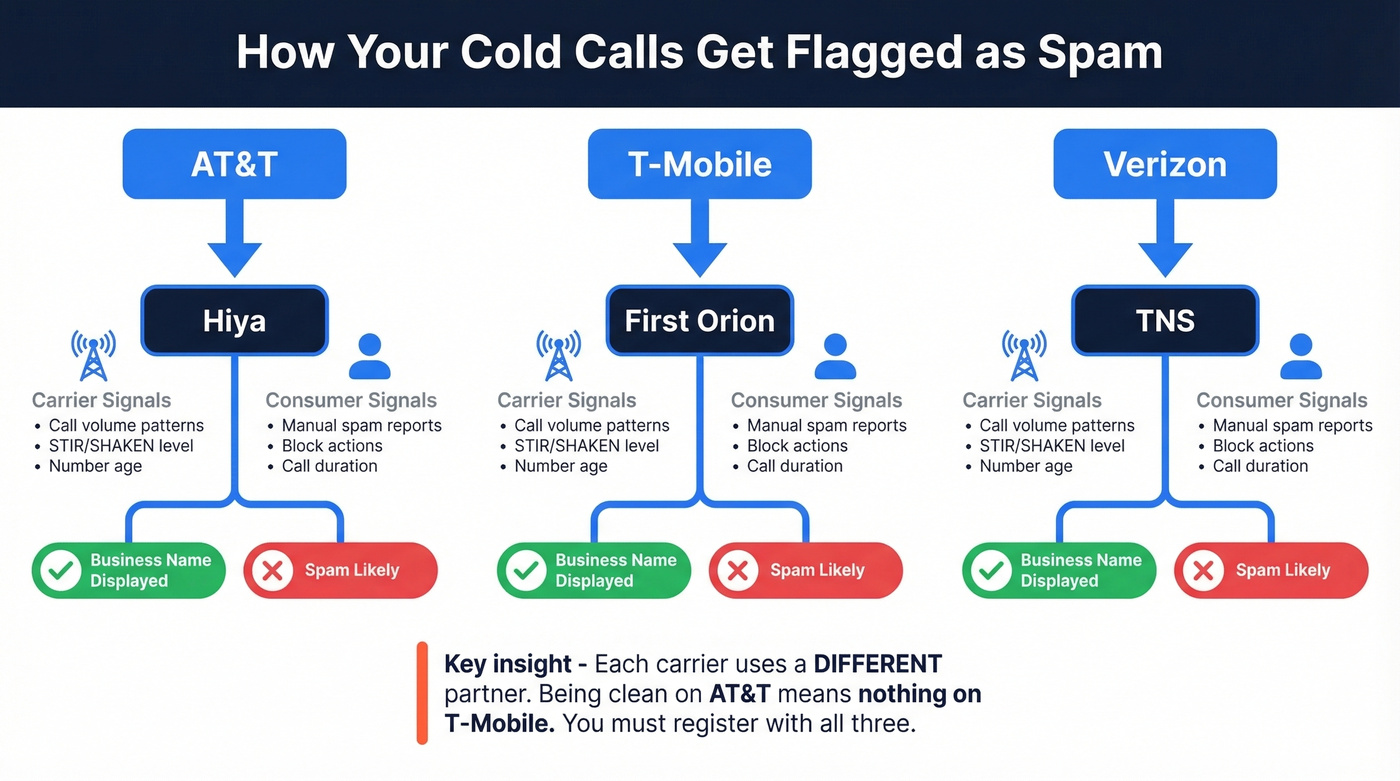
| Carrier | Analytics Partner | What They Control |
|---|---|---|
| AT&T | Hiya | Spam labels on AT&T |
| T-Mobile | First Orion | Spam labels on T-Mobile |
| Verizon | TNS | Spam labels on Verizon |
This is the most actionable insight in the entire article. If your numbers are flagged on T-Mobile but clean on AT&T, submitting a remediation request to Hiya won't do anything - you need First Orion. In our experience, this carrier-to-analytics-engine mapping is the single most overlooked piece of the puzzle, and most dialer vendors never explain it.
These engines pull from two signal types. Carrier-level signals include call volume patterns, STIR/SHAKEN attestation, number age, and network behavior. Consumer signals include manual blocks, spam reports, and engagement patterns - did the call get answered, and how long did it last? Both feed into the algorithm that decides whether your next call shows "Spam Likely" or your actual business name. One B2B caller on r/sales reported that a single prospect's spam report triggered "Spam Likely" labeling that impacted future calls across the entire carrier network.
STIR/SHAKEN Attestation
STIR/SHAKEN is the call authentication framework carriers use to verify you're authorized to use the number you're calling from. It assigns one of three attestation levels:
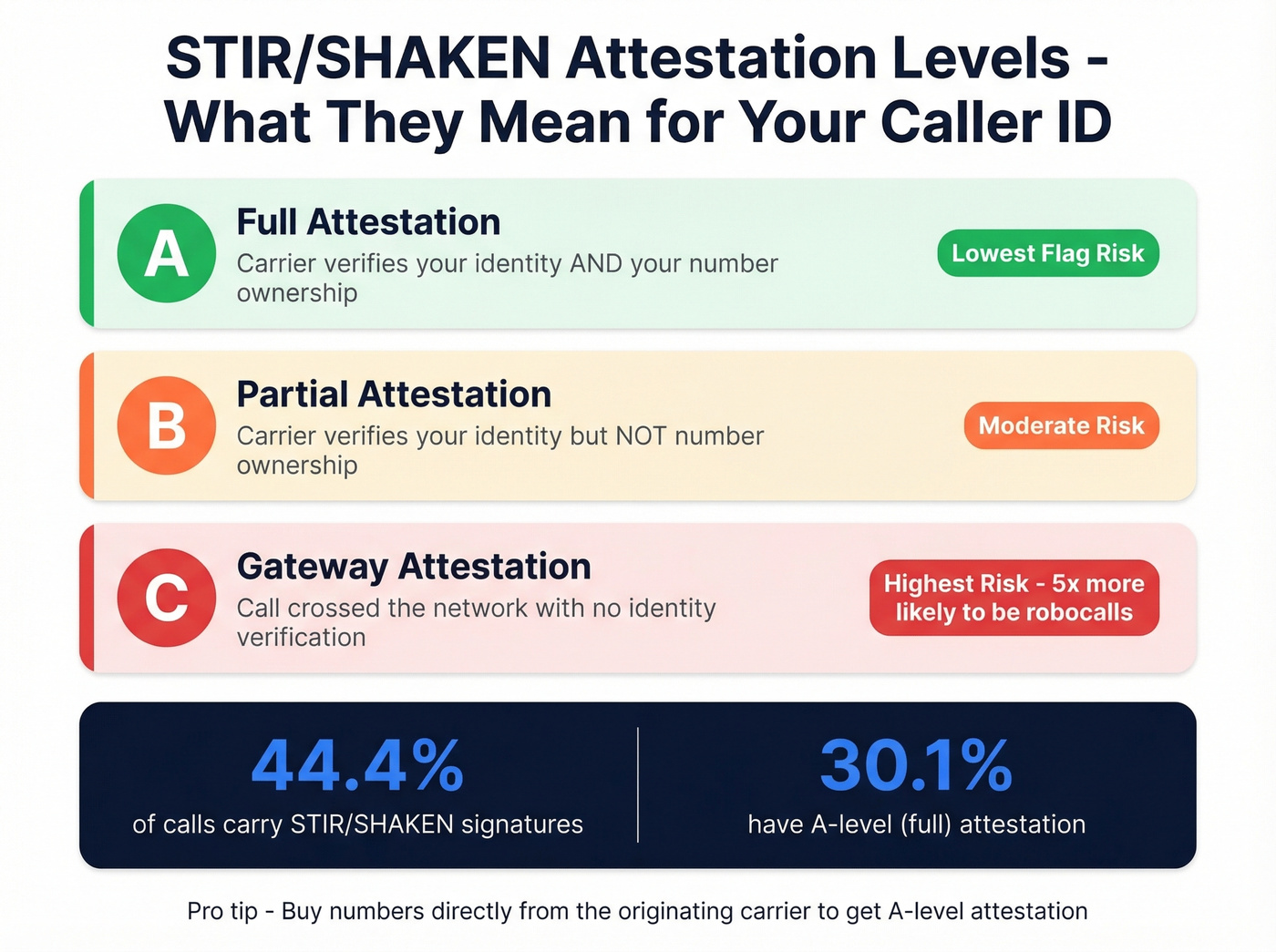
| Level | Meaning | Risk |
|---|---|---|
| A (Full) | Carrier verifies caller identity + number ownership | Lowest flag risk |
| B (Partial) | Carrier verifies caller but not number ownership | Moderate risk |
| C (Gateway) | Call crossed the network; no identity verification | Highest risk |
As of December 2025, only 44.4% of calls carried STIR/SHAKEN signatures at termination. Of those, just 30.1% had A-level attestation. Calls with B or C attestation are roughly 5x more likely to be robocalls.
The practical takeaway: if you want A-level attestation, buy your numbers directly from the originating carrier. Resold or ported numbers typically max out at B-level, which puts you at a disadvantage before you've dialed a single prospect.
Mistakes That Get Numbers Flagged
Stop buying more phone numbers. Start fixing the ones you have.
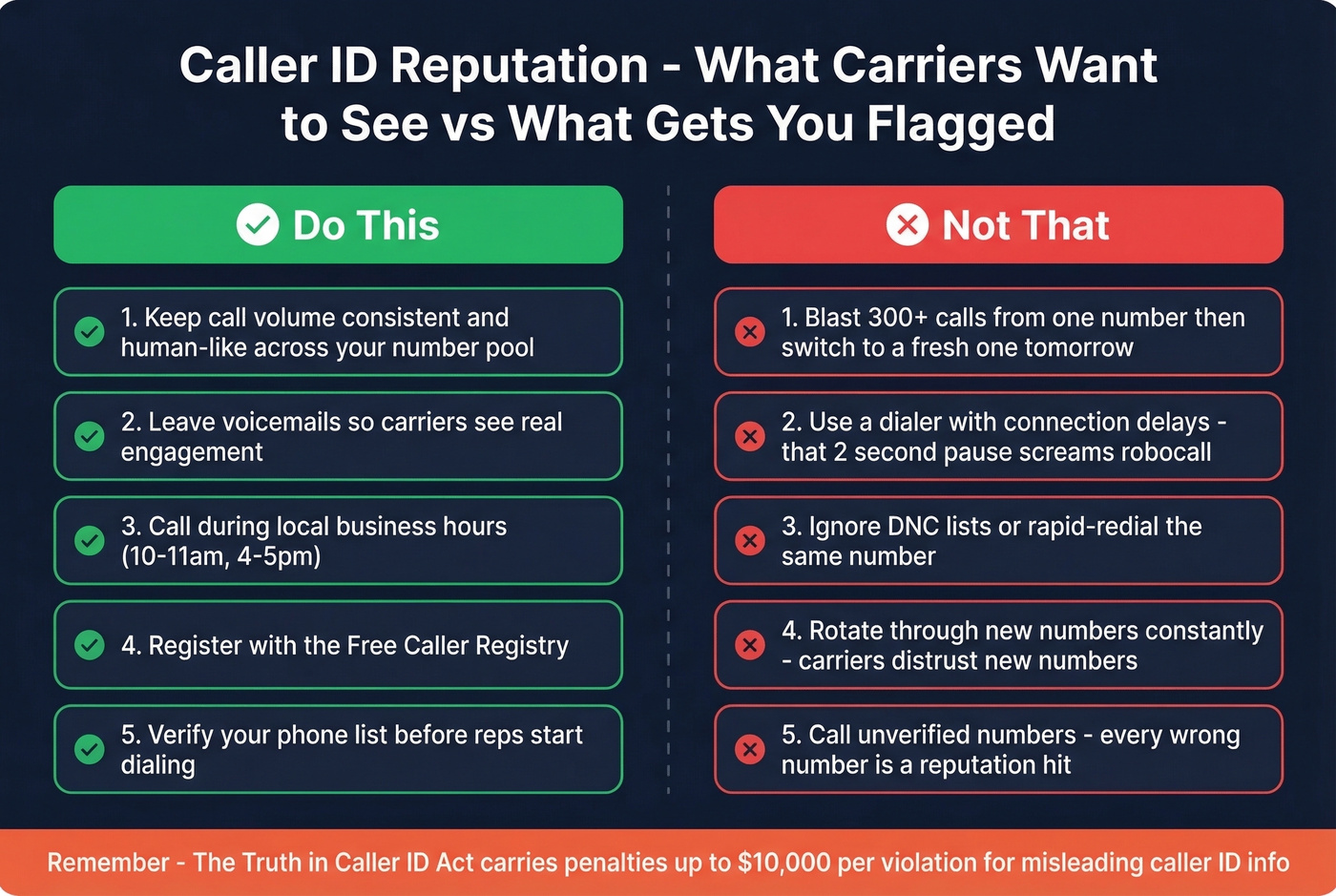
The number rotation strategy that every dialer vendor sells as a feature? Carriers treat it as a red flag. Fresh numbers with sudden volume spikes look exactly like robocaller behavior. Reddit practitioners have called this out repeatedly - continual rotation worsens your answer rates because carriers distrust new numbers with no history.
Do this:
- Keep call volume consistent and human-like across your number pool
- Leave voicemails - silent hangups are a spam signal
- Call during local business hours (10-11am and 4-5pm show the best connect rates)
- Register with the Free Caller Registry and maintain a working callback number
Not that:
- Blasting 300+ calls from a single number in one day, then switching to a fresh number tomorrow
- Using a dialer with connection delays - that 2-second pause after "hello" screams robocall
- Ignoring DNC lists or rapid-redialing the same number
- Calling numbers you haven't verified - every unanswered dial to a wrong number is a reputation hit
Beyond spam labels, the Truth in Caller ID Act carries penalties up to $10,000 per violation for transmitting misleading caller ID information with intent to defraud. The FCC enforces it.

Every unanswered call to a wrong number is a spam signal to carriers. Prospeo's 125M+ verified mobile numbers are refreshed every 7 days - not the 6-week industry average - so your reps dial real people, not dead numbers. Teams using Prospeo see a 30% mobile pickup rate, sending carriers exactly the positive engagement signals that keep your caller ID clean.
Fix your caller ID reputation at the source: your data.
Bad Data Is a Caller ID Problem
Here's the thing: nobody talks about this causal chain. Bad phone numbers lead to short or unanswered calls. Carriers flag your number. You get a spam label. Connect rates crater.
Think about what it looks like from the carrier's perspective. Your number makes 200 calls a day. 150 ring for 3 seconds and go unanswered - because the numbers are wrong, disconnected, or belong to someone who left that company two years ago. That pattern is indistinguishable from a robocaller. The algorithm doesn't care about your intentions. It cares about engagement signals.
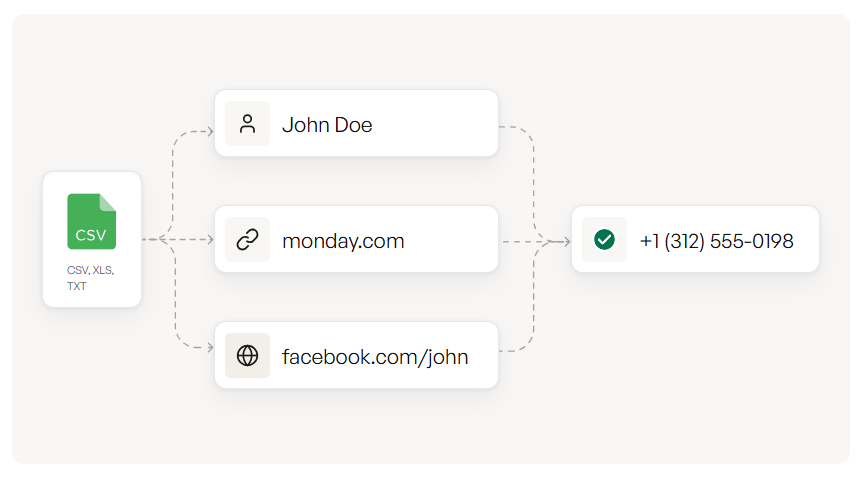
The cheapest caller ID fix isn't a reputation management service - it's clean data. Direct-dial answer rates run 12.7% versus 8.1% for mobile numbers, so the quality of your list matters as much as the size. Phone numbers go stale fast. People change jobs, change carriers, change numbers. Prospeo's mobile database covers 125M+ verified numbers on a 7-day refresh cycle, compared to the 6-week industry average - and with a 30% mobile pickup rate, reps reach more real people, sending exactly the positive engagement signal carriers want to see. We've watched teams recover connect rates within weeks just by cleaning their phone lists before dialing.
If you're building a repeatable outbound motion, pair this with a documented cold calling system and a few proven sales prospecting techniques so your reps aren't improvising under pressure.
How to Check If You're Flagged
You can diagnose this in five minutes:
- Run the Numeracle free test. Go to Numeracle's Number Check, submit up to 3 numbers, and see how they display across major wireless carriers.
- Do a manual callback test. Call your outbound numbers from a personal cell on a different carrier. See what shows up.
- Check carrier-specific apps. T-Mobile's Scam Shield, AT&T's ActiveArmor, and Verizon's Call Filter each maintain their own label databases.
Fixing Flagged Numbers
Let's be honest: remediation is slow, inconsistent, and sometimes doesn't work at all.
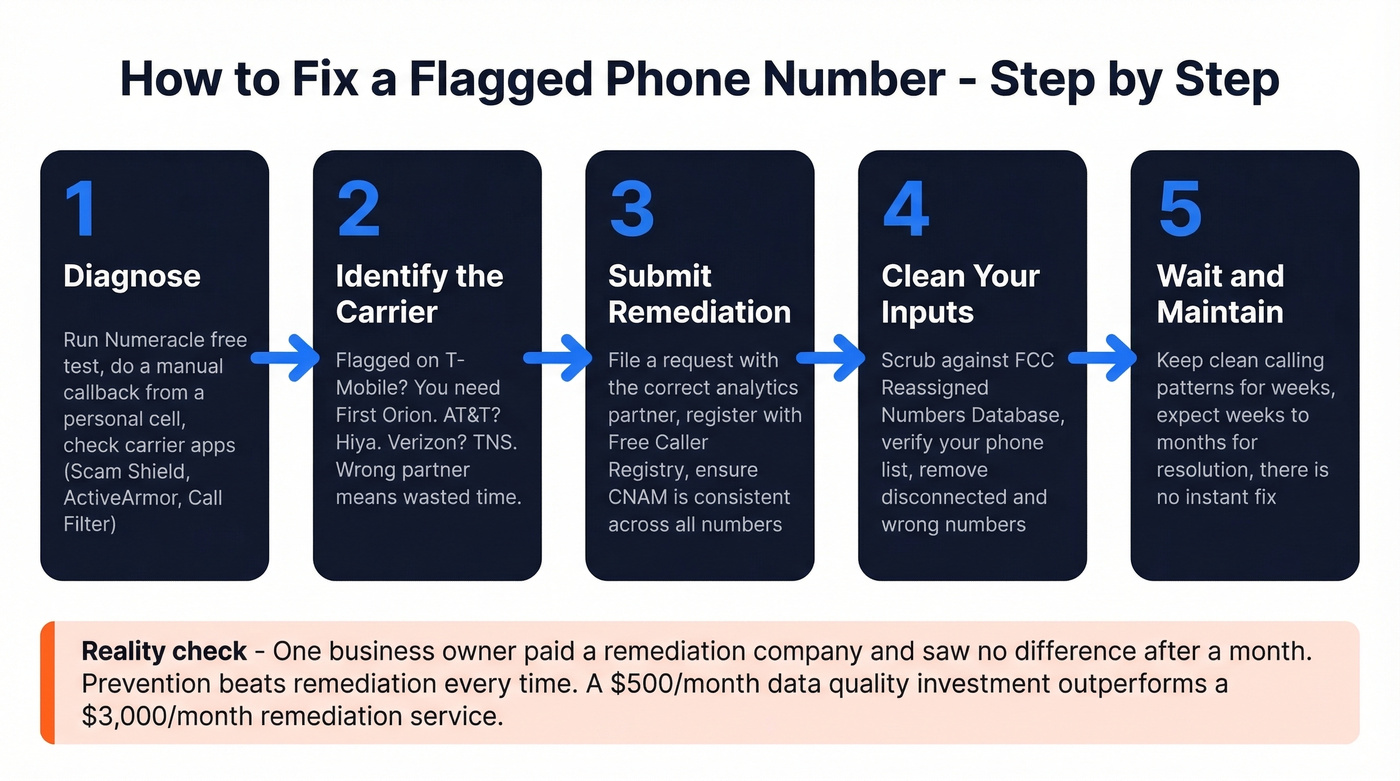
- Identify which carrier flagged you using the diagnostic steps above
- Submit a remediation request to the correct analytics partner - Hiya for AT&T, First Orion for T-Mobile, TNS for Verizon
- Register with the Free Caller Registry and ensure your CNAM is consistent across all numbers
- Scrub your list against the FCC Reassigned Numbers Database
- Maintain clean calling patterns for weeks while the flag is under review
One business owner on r/Entrepreneurship paid a remediation company and saw "no difference" after a month - even though their calls were opt-in annual benefit reviews. Cool-off periods vary by carrier, but expect weeks to months. There's no instant fix, and anyone selling you one is overselling.
Most teams spend money on remediation when they should spend it on prevention. A $500/month data quality investment will do more for your caller ID reputation than a $3,000/month remediation service. I've seen it play out dozens of times - fix the inputs and the outputs fix themselves.
If you're evaluating tooling changes, it can help to compare your stack against modern SDR tools and make sure your workflows are supported by solid contact management software.
Branded Caller ID
Branded calling is the single biggest upgrade most B2B teams are ignoring.
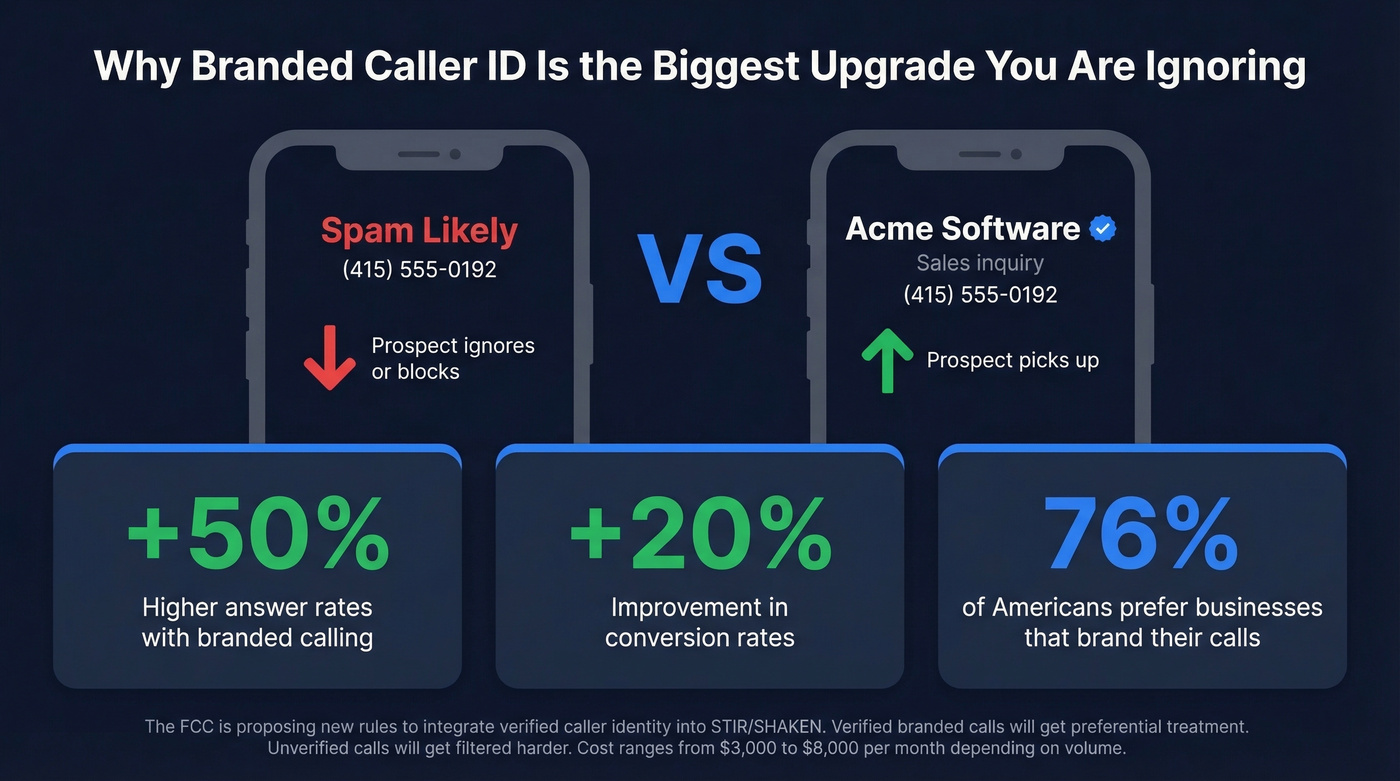
Instead of "Spam Likely" or a bare phone number, branded calling displays your company name, logo, and sometimes the reason for the call on the prospect's screen. A TNS/Kantar survey found 76% of Americans prefer to engage with businesses that brand their calls, and 75% admitted they've missed calls from unknown numbers they would have answered if they'd known who was calling.
Branded calling can lift answer rates by up to 50% and improve conversion rates by 20%+. That's not incremental - that's the difference between a channel that works and one that doesn't.
The FCC's 2026 FNPRM on call branding proposes integrating verified caller identity into STIR/SHAKEN via Rich Call Data. The trajectory is obvious: verified, branded calls will get preferential treatment, and unverified calls will get filtered harder. Services from Hiya, First Orion, and TNS typically run $3,000-$8,000/month depending on call volume. Not cheap, but for teams making thousands of outbound calls weekly, the ROI math works fast.
To maximize the lift, align branded calling with your broader B2B sales funnel and tighten your sales activities so the extra connects turn into meetings.
The Complete Checklist
- Test your numbers with Numeracle's free check before every campaign
- Register all outbound numbers with Hiya, First Orion, and TNS
- Buy numbers from your originating carrier for A-level STIR/SHAKEN attestation
- Verify your phone list before dialing - every wrong number is a reputation hit
- Keep per-number daily volume consistent - avoid spikes and sudden drops
- Leave voicemails (silent hangups trigger spam algorithms)
- Scrub against the FCC Reassigned Numbers Database
- Investigate branded calling if you're making 500+ calls/day
If your team is also running email alongside calls, make sure your follow-up motion is tight with these sales follow-up templates and a consistent sequence management process.
Bad data doesn't just waste rep time - it trains carrier algorithms to flag you as spam. At $0.01 per lead, Prospeo gives you direct dials that actually connect. Meritt cut their bounce rate from 35% to under 4% and tripled pipeline. Your caller ID reputation starts with numbers that pick up.
Stop feeding carriers the engagement pattern of a robocaller.
FAQ
How many calls per day can I make from one number without getting flagged?
No universal threshold exists, but most practitioners cap at 100-150 calls per number per day. Size your number pool so each number carries a human-like load - sudden spikes above your baseline are what trigger carrier algorithms.
Does cold calling with a local number still work?
Local presence dialing helps, but carriers are skeptical of numbers that suddenly appear in area codes with no history. It works best in markets where you have real business presence - a freshly provisioned local number with zero reputation can backfire and get flagged faster than your main line.
What's the best area code for cold calling?
No single area code universally outperforms others. What matters more is matching the code to your prospect's region and ensuring the number has established carrier history. A local number with strong engagement signals will always beat a "premium" area code that was provisioned yesterday.
Can bad prospect data cause my numbers to get flagged?
Yes. Wrong numbers generate short, unanswered calls - exactly the pattern carriers flag as spam. Verify your list before dialing to keep engagement signals clean and protect your number reputation.
What is STIR/SHAKEN and do I need it?
STIR/SHAKEN authenticates whether you're authorized to use your outbound number. A-level attestation - the highest - means the carrier vouches for your identity and number ownership. Get it by purchasing numbers directly from your originating carrier rather than resellers.