

Prospecting and Cold Calling: The Complete 2026 Playbook
It's 9:15 AM on a Tuesday. You've got 200 dials on the board, a script you half-believe in, and a list that bounced 18% last week. The problem isn't your pitch - it's everything underneath it. Prospecting and cold calling still work in 2026, but lazy dialing doesn't, and the gap between the two has never been wider.
69% of buyers have accepted a cold call from a new vendor in the past year. Meanwhile, 42% of salespeople say prospecting is the hardest part of the job. That disconnect tells you everything: buyers will pick up, but most reps aren't giving them a reason to stay on the line. 84% of new B2B opportunities still start with a phone call - so let's put the "cold calling is dead" debate to rest.
What You Need (Quick Version)
Verified mobile numbers, not main lines. Cell phones connect at roughly 30% pickup rates. Main lines route you to phone trees and voicemail graveyards.
A multichannel cadence, not single-touch dials. Multichannel sequences drive 287% higher response rates than single-channel strategies. Calls work best sandwiched between emails, social touches, and content shares.
Compliance awareness. TCPA lawsuits jumped 95% year-over-year, and the rules around AI-generated voices, consent revocation, and state-level regulations changed materially in 2025. Ignorance isn't a defense when fines run $500-$1,500 per violation.
Prospecting vs. Cold Calling
These terms get used interchangeably, but they're not the same thing. Prospecting is the full process of identifying, researching, and engaging potential buyers across every available channel. Cold calling is one tactic within that process - the phone component of a broader outreach strategy.
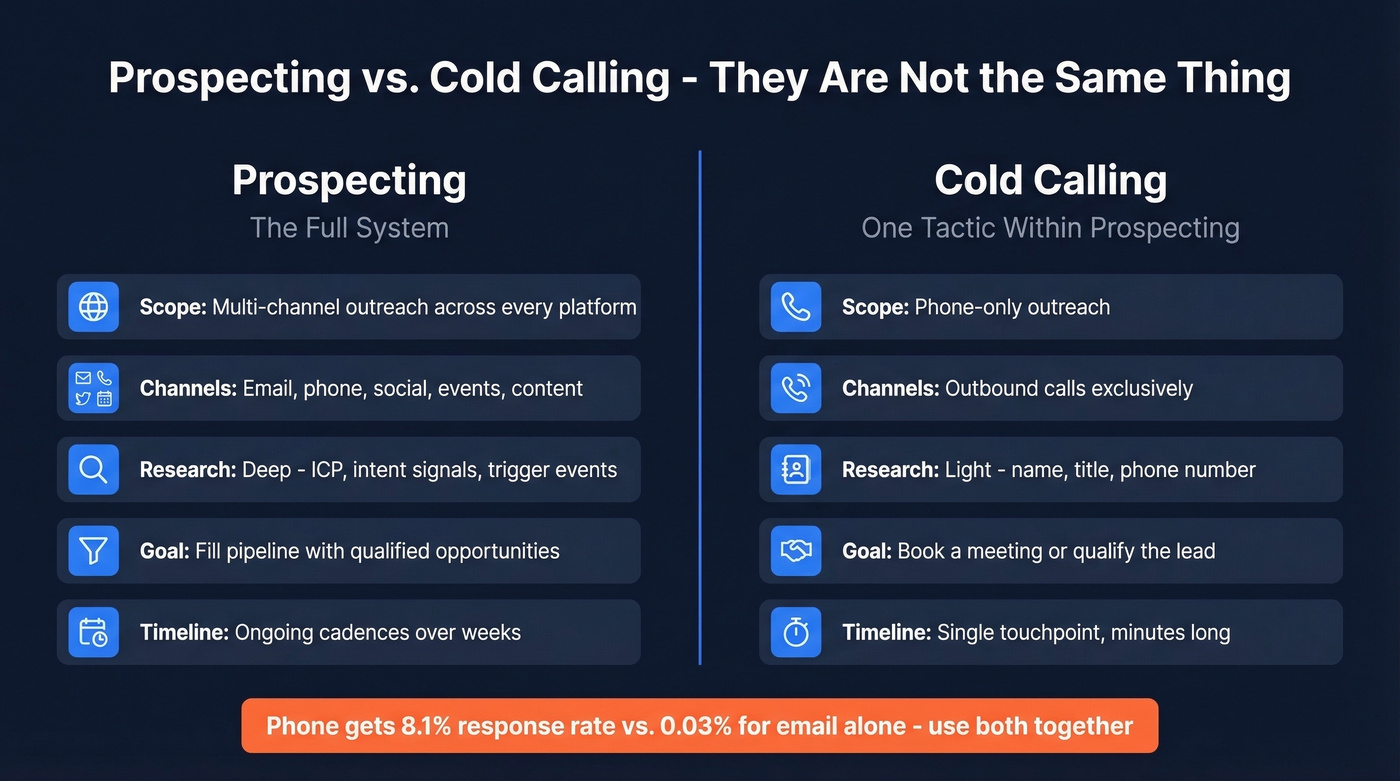
| Prospecting | Cold Calling | |
|---|---|---|
| Scope | Multi-channel | Phone only |
| Channels | Email, phone, social, events | Outbound calls |
| Research | Deep - ICP, intent, triggers | Light - name, title, number |
| Goal | Fill pipeline with qualified leads | Book a meeting or qualify |
| Timeline | Ongoing, weeks-long cadences | Single touchpoint |
Phone outreach pulls an 8.1% response rate compared to 0.03% for email alone, per historical XANT research. The takeaway isn't "pick one." Email opens the door and a well-timed call walks through it.
Cold Calling Benchmarks in 2026
Here's what the data says across multiple studies:
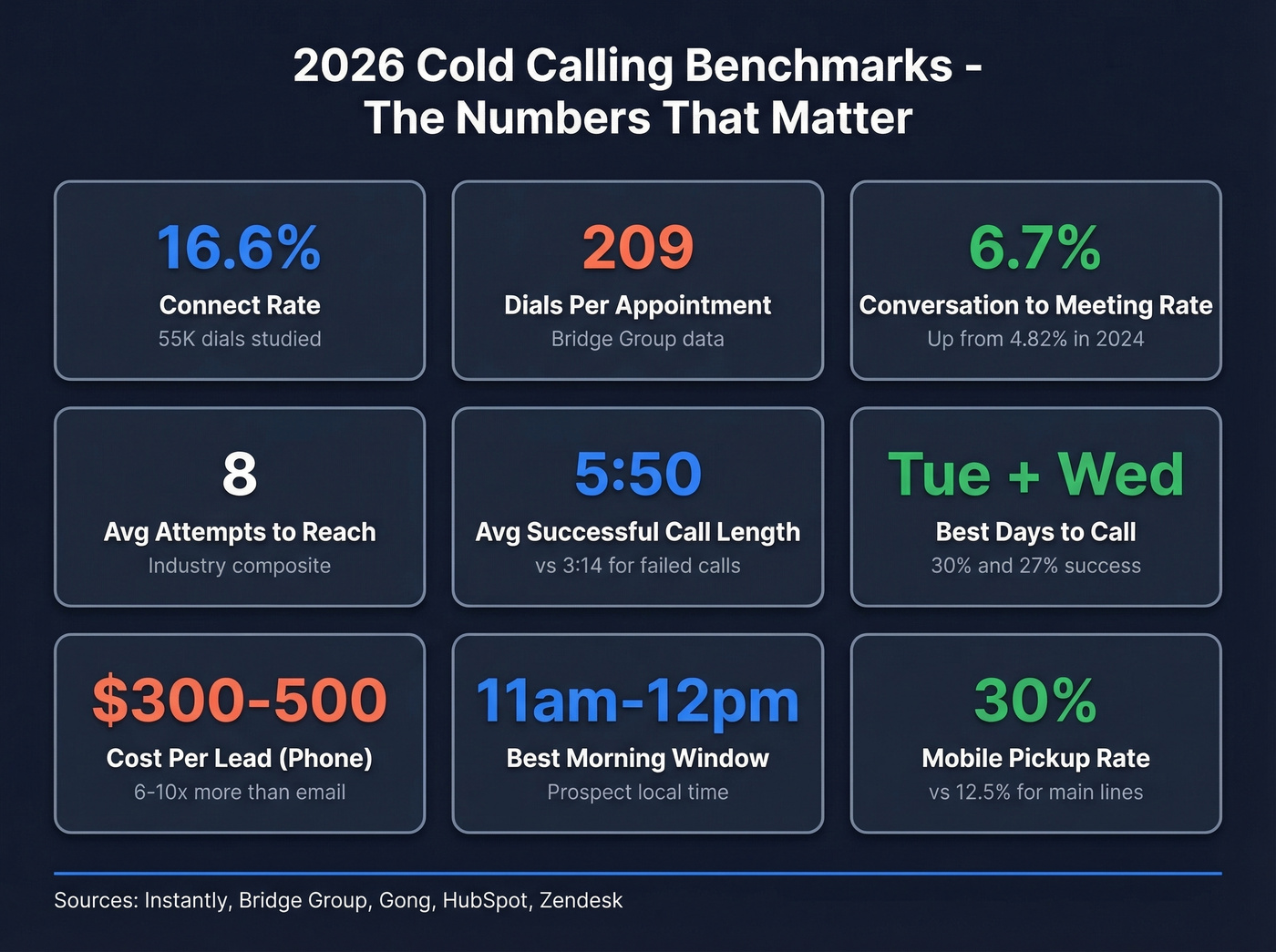
| Metric | Benchmark | Source |
|---|---|---|
| Connect rate | 16.6% across 55K dials | Instantly (2025 study) |
| Calls per appointment | 209 dials | Bridge Group |
| Answered calls/appt | 59 | Baylor University |
| Avg attempts to reach | 8 | Industry composite |
| Conversation-to-meeting | 6.7% | Instantly (2025 study) |
| Avg successful call | 5:50 | Gong |
| Avg failed call | 3:14 | Gong |
| Best days | Tue (30%), Wed (27%) | HubSpot |
| Best windows | 11am-12pm, 4-5pm local | Zendesk |
| Cost per lead (phone) | $300-500 | Industry composite |
| Cost per lead (email) | $30-50 | Industry composite |
A few things jump out. The 6.7% conversation-to-meeting rate is the highest in years - up from 4.82% in 2024. That improvement tracks with better data quality and multichannel sequencing, not better scripts. The gap between successful calls (5:50) and failed ones (3:14) tells you that getting past the two-minute mark is the real inflection point.
Here's the thing: 209 dials per appointment sounds brutal. But that number drops dramatically when you're dialing verified mobile numbers instead of switchboards. The consensus on r/techsales is blunt - don't call main lines at large orgs. Phone trees and call centers won't route you to decision-makers. Cell phones are the only path that consistently works.
Phone outreach costs 6-10x more per lead than cold email. But it converts at dramatically higher rates and builds relationships that email never will. If your average deal size is under $5K, email-first makes sense. Above that? Calls are where deals start.
Fix Your Data First
Stop obsessing over scripts. Fix your data.
B2B data decays at 22.5% per year - that's 2.1% per month. People change jobs, get promoted, switch numbers. Sales reps lose 27.3% of their productive time to bad contact data. More than a quarter of your team's capacity, gone, because the numbers in your CRM are stale.
We've seen this pattern repeatedly: an SDR manager stares at a dashboard showing 150 dials and 4 conversations. The instinct is to coach on openers and tonality. The real problem? Sixty percent of those dials went to disconnected numbers or voicemail traps nobody checks.
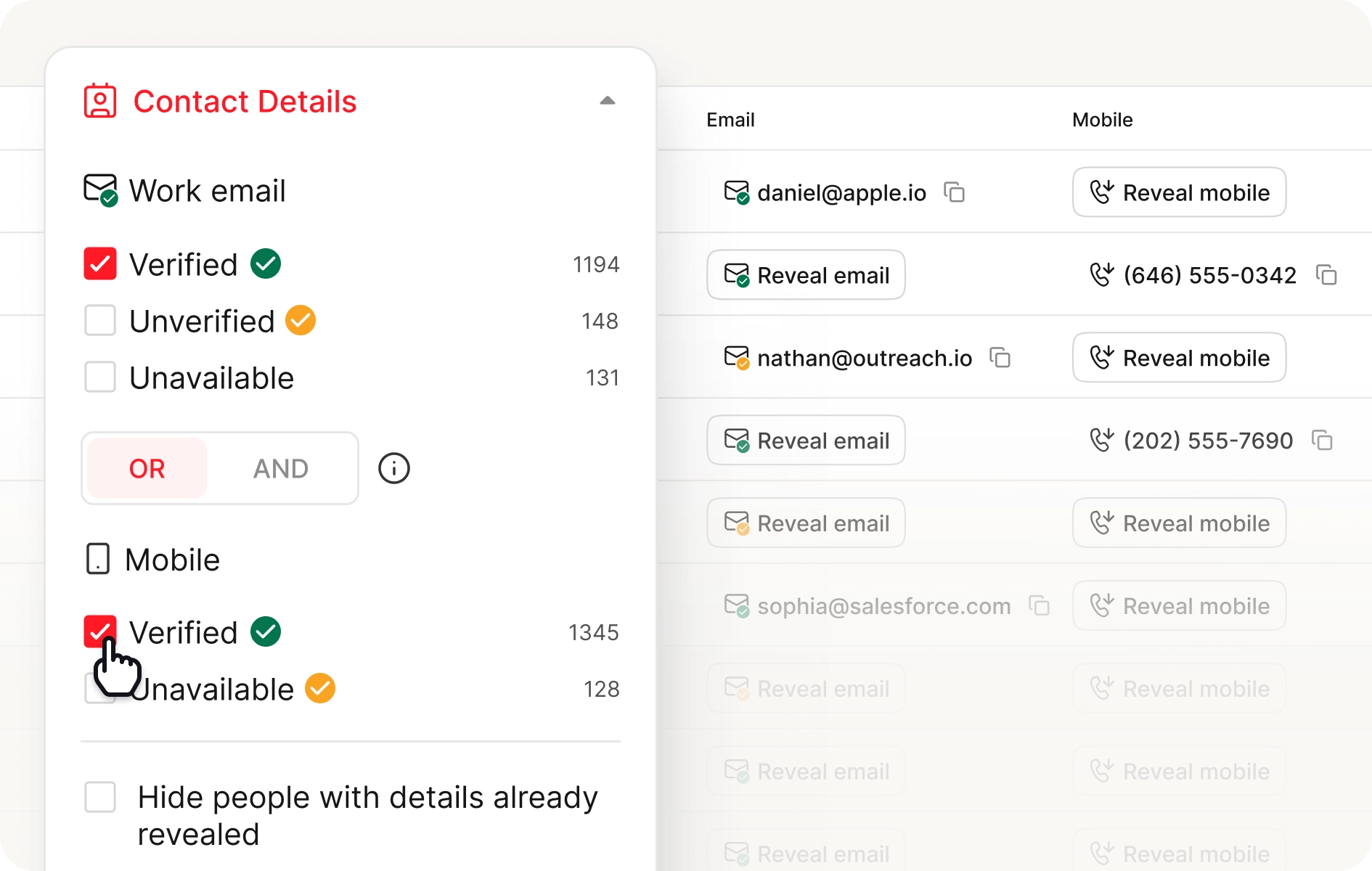
Your data provider's refresh cycle matters more than your opener. Most platforms refresh contact data around every 6 weeks. Prospeo runs on a 7-day refresh cycle, which means the mobile number you're dialing today was verified within the last week - not last quarter. The platform covers 125M+ verified mobile numbers with a 30% pickup rate, compared to the 12.5% industry average. When Snyk's 50-person AE team switched their data source, bounce rates dropped from 35-40% to under 5% and they generated 200+ new opportunities per month.
Anatomy of a Cold Call
The goal of a cold call isn't to sell your product. It's to earn a 15-minute discovery meeting. Every second should serve that single objective.
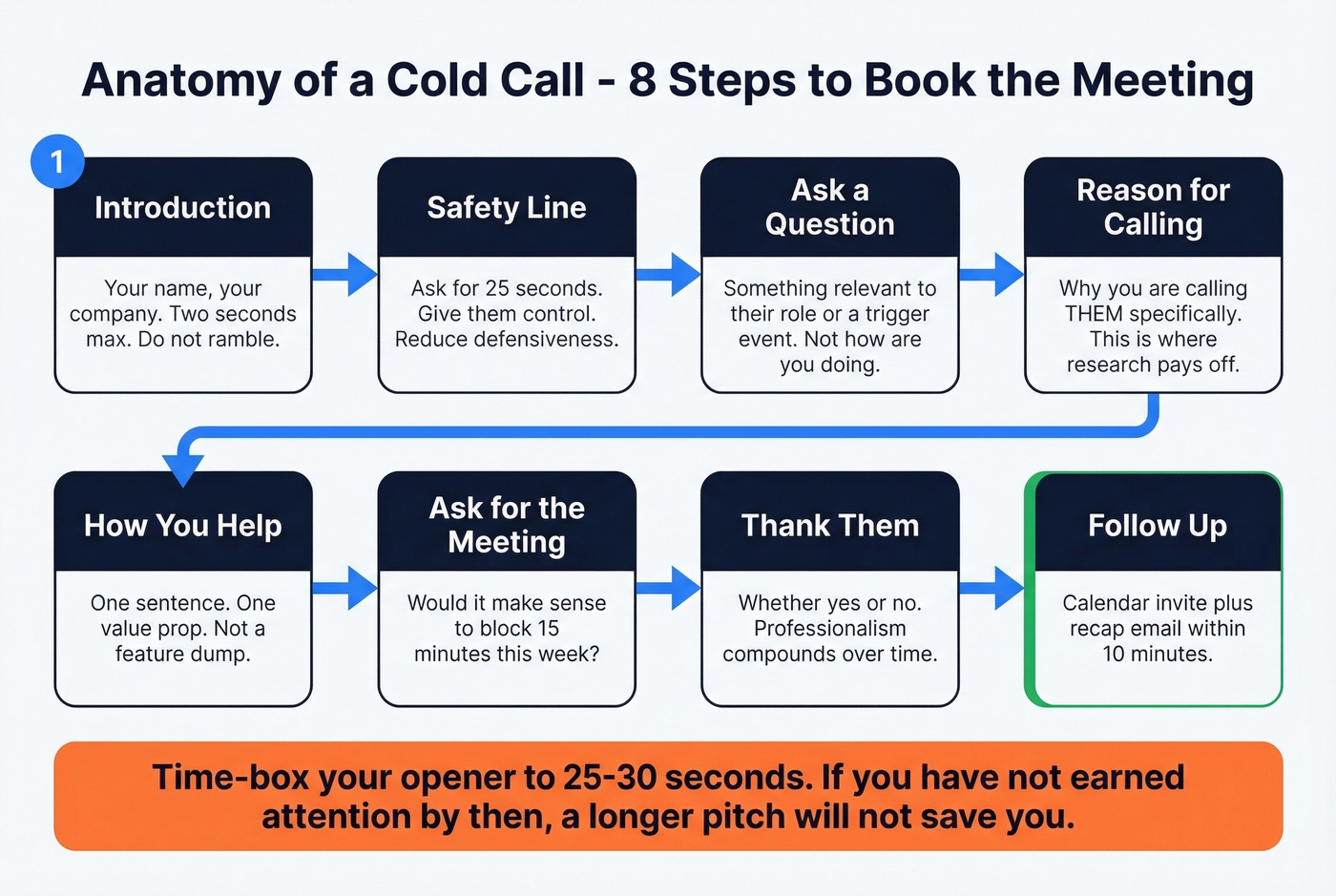
- Introduction - Your name, your company, two seconds. Don't ramble.
- Safety line - "Do you have 25 seconds for me to share why I called?" This gives the prospect control and reduces defensiveness.
- Ask a question - Something relevant to their role or a trigger event. Not "how are you doing today?"
- Reason for calling - Explain why you're calling them, specifically. This is where 5 minutes of pre-call research pays off.
- How you help - One sentence. One value prop. Not a feature dump.
- Ask for the meeting - "Would it make sense to block 15 minutes this week to dig into this?"
- Thank them - Whether they say yes or no. Professionalism compounds.
- Follow up - Send a calendar invite and a brief recap email within 10 minutes.
Time-box your opener to 25-30 seconds. If you haven't earned their attention by then, a longer pitch won't save you. Before you ever pick up the phone, run your pitch through an AI role-play tool - platforms like Second Nature and Hyperbound let you rehearse objections and refine delivery against realistic AI buyers. It's the fastest way to build muscle memory without burning real prospects.

Your dials are only as good as your data. Prospeo's 125M+ verified mobile numbers deliver a 30% pickup rate - more than double the industry average. Every number is refreshed on a 7-day cycle, so you're calling people who actually pick up, not voicemail graveyards.
Cut your dials-per-appointment in half with numbers that connect.
Cold Calling Scripts That Work
Scripts aren't meant to be read verbatim. They're frameworks - guardrails that keep you on track while leaving room to be human.
The Pattern-Interrupt Opener
Most cold calls open with "Hi, this is [name] from [company], how are you?" The prospect's brain immediately categorizes it as a sales call and starts looking for the exit.
Try this instead: "Hey [name], this is [your name] with [company]. I know I'm calling out of the blue - have you got 30 seconds for me to explain why?" That time-box creates a micro-commitment. The prospect thinks, "30 seconds, fine." Now you're in. Another variation that works well: give the prospect two paths - "I can give you the quick version or walk through a specific example. Which works better?" Letting them choose creates engagement before you've even pitched anything.
Gatekeeper Script
Don't try to trick gatekeepers. Ask for help: "Hi, I'm trying to reach [first name] in [department]. Could you help me figure out the best way to make that happen?" Using the prospect's first name signals familiarity. Asking for help activates a cooperative instinct.
Voicemail Script
Keep it under 20 seconds. State your name, one specific reason you're calling, and a clear next step: "I'll send you a quick email with details - look for it from [your name] at [company]." Don't leave your phone number hoping for a callback. That almost never works.
Objection Handling
The most common objection is some version of "I'm not interested" or "now's not a good time." Try: "Totally fair - give me two minutes, and if it isn't for you, I won't call again." That's low-risk for the prospect and buys you enough time to deliver one compelling point. If you can mention a mutual connection, do it - referencing a shared contact increases meeting probability by 70%.
Five Mistakes That Kill Connect Rates
Mistake 1: "Is this Bob?" This immediately signals "I don't know you." Use an assumptive opener instead: "Hi Bob, this is Sarah with Acme." Confident, direct, no question mark.
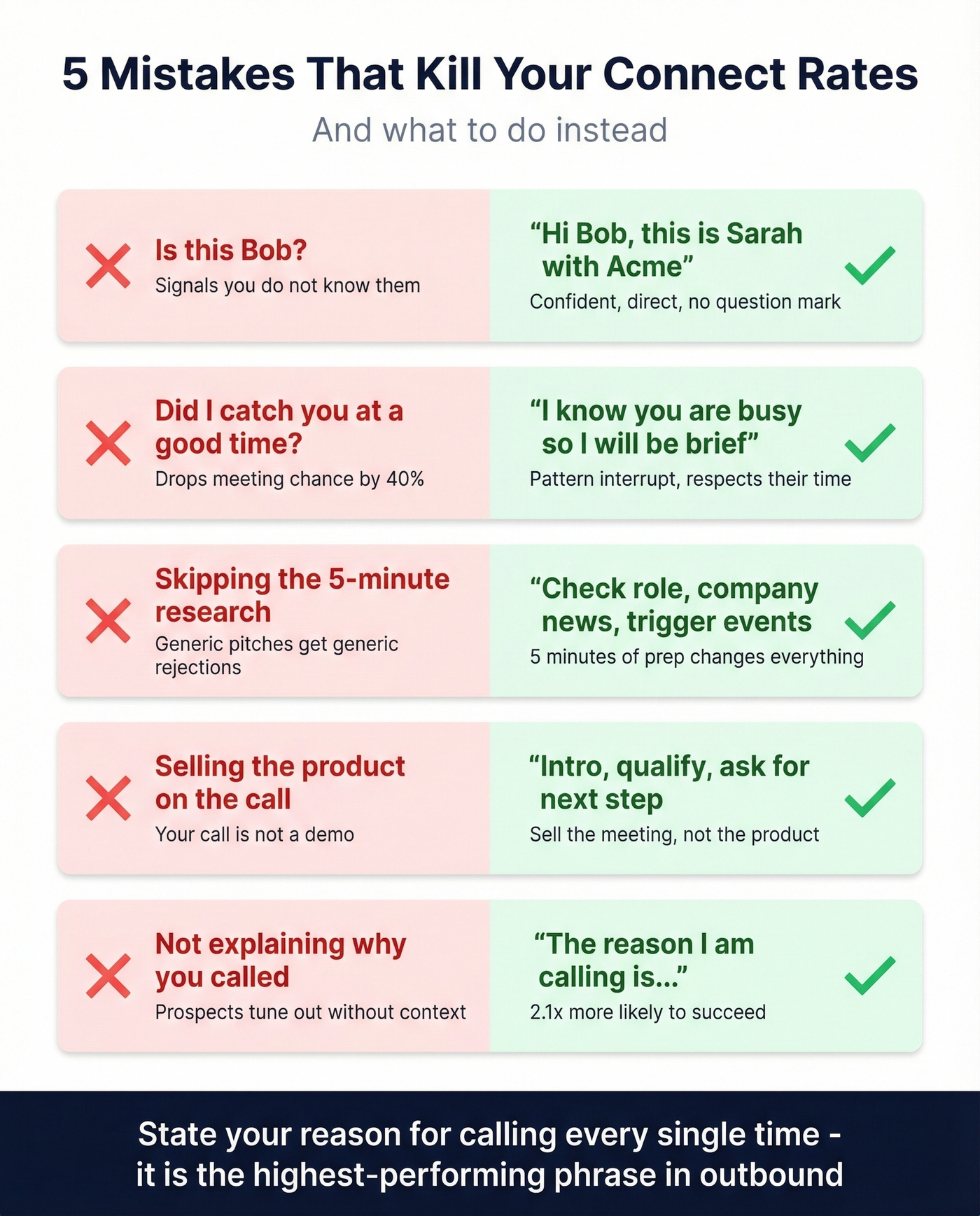
Mistake 2: "Did I catch you at a good time?" Asking "Is this a bad time?" drops your meeting chance by 40%. Replace it with a pattern interrupt: "I know you're busy, so I'll be brief."
Mistake 3: Skipping the 5-minute research. Check their role, recent company news, and any trigger events before dialing. Generic pitches get generic rejections. (If you want a tighter system, start with an ideal customer profile and work outward.)
Mistake 4: Selling the product instead of the meeting. Your call is a 3-minute conversation, not a demo. Intro, qualify, ask for the next step. That's it.
Mistake 5: Not explaining why you're calling. Stating your reason for calling makes you 2.1x more likely to succeed. "The reason I'm calling is..." is one of the highest-performing phrases in outbound phone outreach. Use it every single time.
Building a Multichannel Cadence
A single cold call is a coin flip. A structured multichannel cadence is a system.
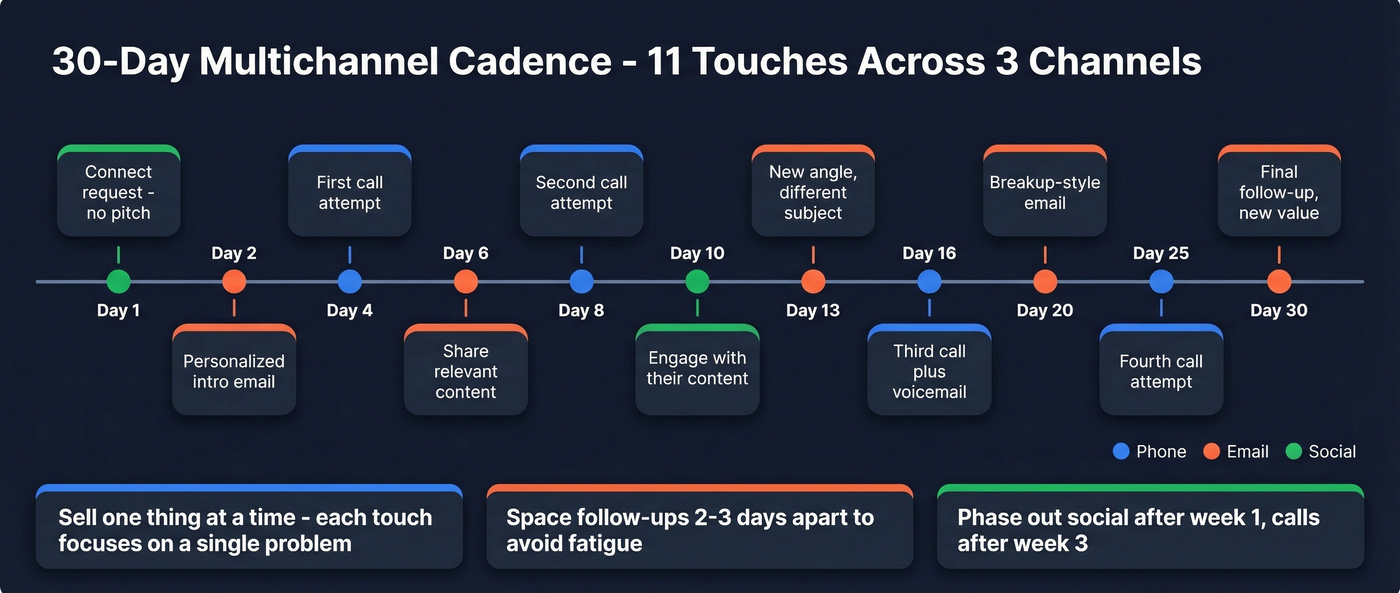
The 30 Minutes to President's Club framework recommends 10-14 touches over 30 days, and that tracks with what we've seen work for mid-market outbound.
| Day | Channel | Action |
|---|---|---|
| 1 | Social | Connect request without pitching |
| 2 | Personalized intro email | |
| 4 | Phone | First call attempt |
| 6 | Share relevant content | |
| 8 | Phone | Second call attempt |
| 10 | Social | Engage with their content |
| 13 | New angle, different subject | |
| 16 | Phone | Third call attempt + voicemail |
| 20 | Breakup-style email | |
| 25 | Phone | Fourth call attempt |
| 30 | Final follow-up, new value angle |
Three principles make this work. First, sell one thing at a time - each theme in your sequence should focus on a single problem, not a feature list. Second, space follow-ups 2-3 days apart to avoid prospect fatigue. Third, phase out social touches after the first week and calls after the third. Diminishing returns hit fast on those channels. If you need copy to support the cadence, keep a set of sales follow-up templates ready.
That persistence makes sense when you consider buying committee size. The average B2B buying group involves 7-10+ stakeholders and cycles run 11.5 months. You're not being annoying. You're being thorough.
Compliance in 2026
The rules changed significantly in 2025. Skip this section at your own risk.
- Calling hours: 8am-9pm in the prospect's local time zone. Not yours.
- TCPA damages: $500 per violation, up to $1,500 for willful violations. Federal DNC fines hit $53,088 per violation.
- AI-generated voices: The FCC's February 2024 ruling classified AI-generated voices as "artificial/prerecorded" under TCPA. You need prior express consent to use them.
- Opt-out rules: As of April 2025, prospects can revoke consent by any reasonable method, and you must honor it within 10 business days - down from 30.
- McLaughlin v. McKesson: The Supreme Court ruled that district courts aren't bound by FCC interpretations in civil TCPA cases. More jurisdiction variability, less predictability.
- State laws: Texas SB 140, effective September 2025, expanded solicitation definitions to include texts and images, with treble damages under DTPA.
- Reassigned Numbers Database: Use it. It provides a safe-harbor workflow for checking whether a number has been reassigned.
TCPA lawsuits jumped 95% year-over-year. This isn't theoretical risk. Scrub your lists, honor opt-outs immediately, and document everything.
Tools for Prospecting and Cold Calling
Data Providers
Get your data right, then build everything else on top. If you're comparing vendors, start with a shortlist of sales prospecting databases and then validate accuracy with data enrichment services.
Prospeo covers 300M+ professional profiles with 125M+ verified mobile numbers - and that 30% pickup rate is the difference between 4 conversations per 100 dials and 12. Email accuracy runs 98% on a 7-day refresh cycle. At roughly $0.01 per email, it's 90% cheaper than ZoomInfo for comparable data. Intent data tracking 15,000 Bombora topics helps you prioritize accounts actively researching solutions like yours. The free tier gives you 75 emails + 100 Chrome extension credits per month; paid plans start around $39/mo with no contracts. Native integrations with Salesforce, HubSpot, Smartlead, Instantly, Lemlist, Clay, Zapier, Make, and more.
ZoomInfo is the enterprise default with strong mobile coverage and deep US data, but you're looking at $15K-40K/year depending on seats and modules.
Apollo offers a generous free tier and paid plans from $49-99/mo per user. Solid for getting started, but data accuracy lags behind dedicated verification platforms.
CRMs
HubSpot's free CRM tier handles basic pipeline management, with Sales Hub starting at $20/mo. Salesforce runs $25-300/mo per user depending on the edition. Pick based on your team size and integration needs. If you're still deciding, use these examples of a CRM to map features to your workflow.
Dialers
Orum and Nooks are the two parallel dialers worth evaluating, running $100-250/mo per user. They multiply your dial volume by 3-5x and pair well with verified mobile lists. If your budget's tight, skip the parallel dialer and focus your spend on better data - a higher connect rate on fewer dials beats a low connect rate on thousands. (If you're building a full stack, start with a cold calling system and add tools in order.)
Snyk's 50 AEs dropped bounce rates from 35% to under 5% and generated 200+ opportunities per month after switching to Prospeo. At $0.01 per email and 10 credits per mobile, you get enterprise-grade prospecting data without the enterprise price tag.
Build your cold call list in minutes, not hours - starting free.
FAQ
Is cold calling still effective in 2026?
Yes - 69% of buyers accepted a cold call from a new vendor in the past year, and conversation-to-meeting rates hit 6.7%, the highest in years. Verified mobile numbers and multichannel sequencing are what separate reps who book meetings from those who don't.
How many dials does it take to book a meeting?
The industry average is 209 dials per appointment, but that drops sharply with verified mobiles. Baylor University's historical benchmark is 59 answered calls per appointment - achievable when your pickup rate exceeds 25%.
What's the best time to make cold calls?
Tuesday and Wednesday convert highest, with the best windows at 11am-12pm and 4-5pm in the prospect's local time zone. Avoid Monday mornings and Friday afternoons - connect rates crater.
What's a good free tool for building call lists?
Prospeo's free tier includes 75 email credits and 100 Chrome extension credits per month with full verification - enough to build a starter list of verified contacts. Apollo also offers a free plan, though its email accuracy is lower at 79% vs. 98%.