

Prospeo vs SafetyMails: Do You Need a Finder or a Verifier?
Comparing Prospeo and SafetyMails is like comparing a fishing rod to a cooler. One catches the fish; the other keeps what you've already got from going bad. They're different tools solving different problems - and most teams actually need the fishing rod.
B2B email lists decay at 25%+ per year. The real question is whether you're solving that problem at the source or just cleaning up afterward.
30-Second Verdict
- Choose Prospeo if you're building outbound lists and need to find, verify, and enrich contacts in one workflow.
- Choose SafetyMails if you already have a large email list - CRM exports, event signups, purchased lists - and just need to scrub it before sending.
- Skip both if you only need occasional lookups. Prospeo's free tier gives you 75 verified emails per month, which covers light usage without a separate tool.
What Each Tool Does
Prospeo
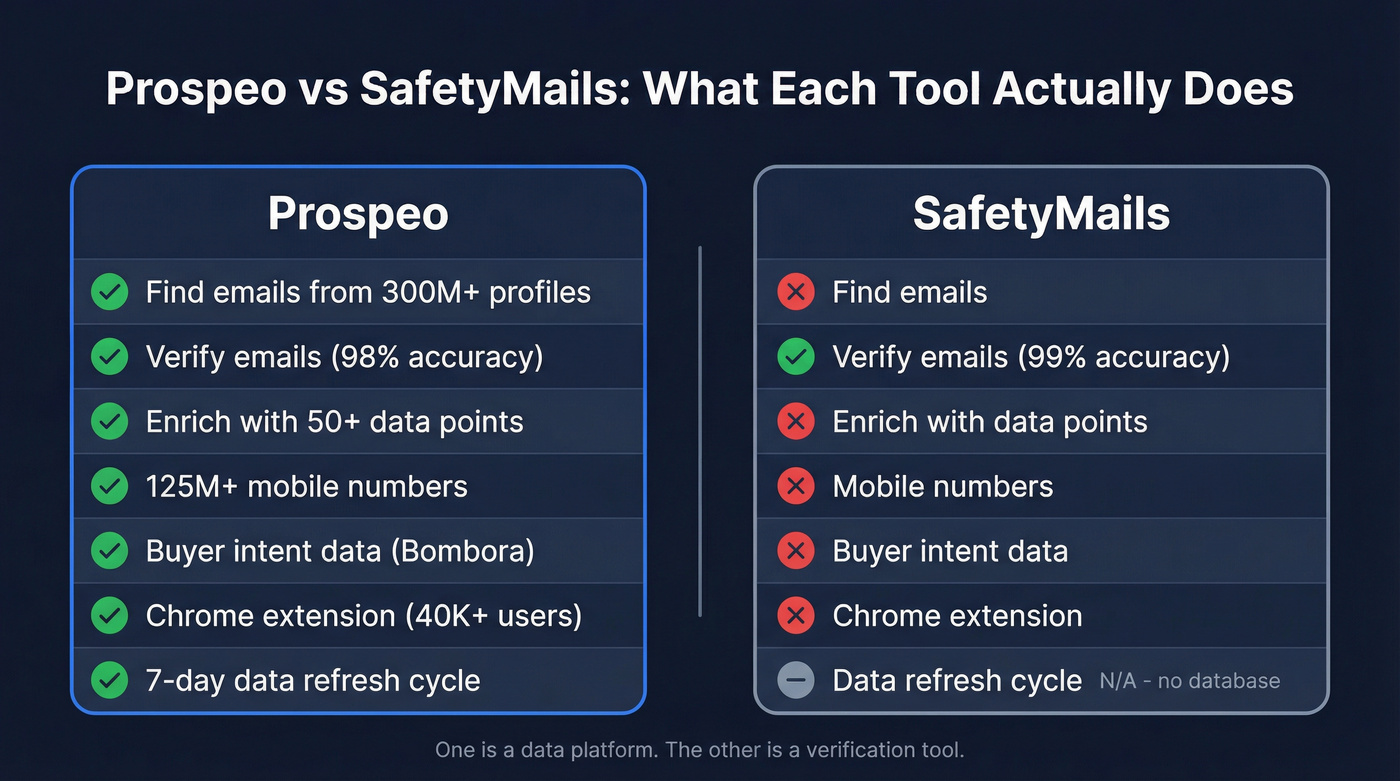
Prospeo is a B2B data platform. It doesn't just verify - it finds contacts from scratch and enriches them with 50+ data points per record.
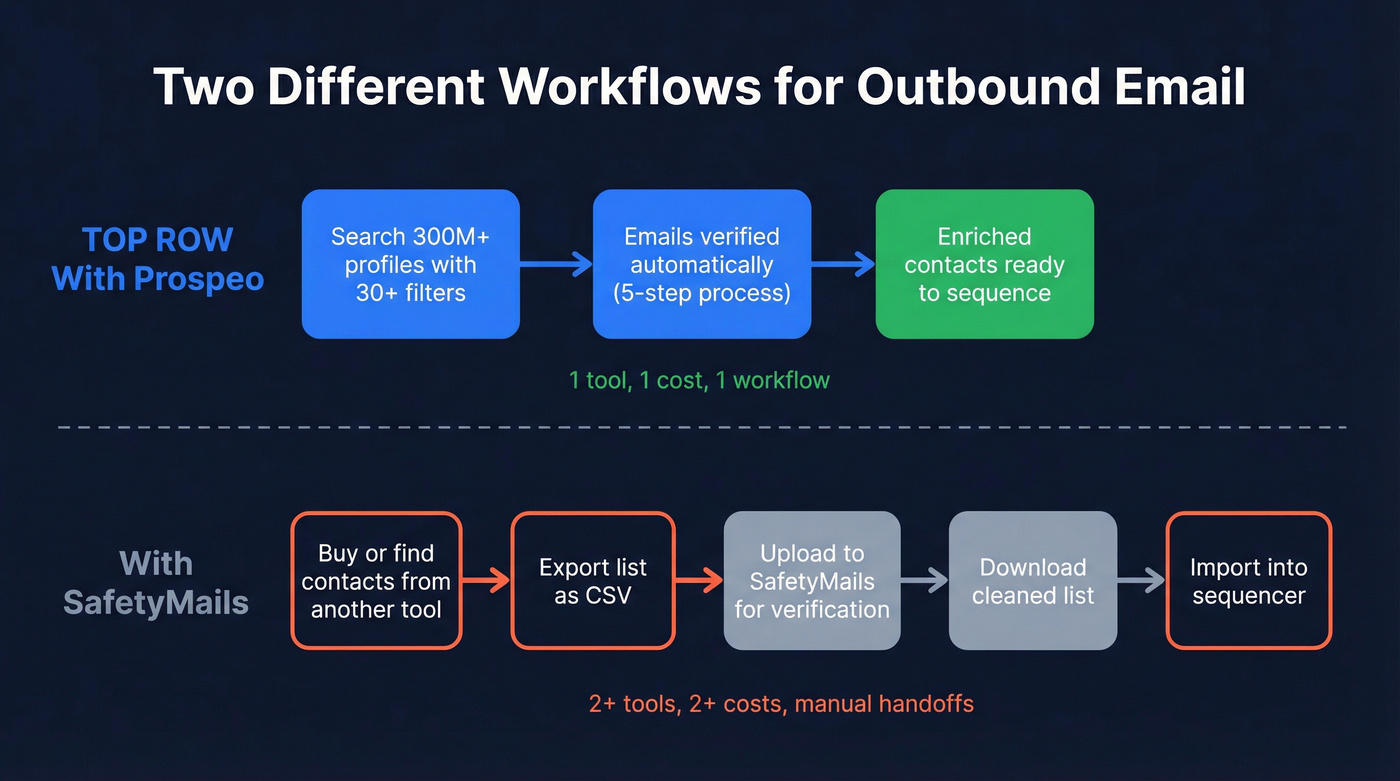
The database covers 300M+ professional profiles, 143M+ verified emails, and 125M+ verified mobile numbers. You get 30+ search filters including buyer intent tracking across 15,000 topics via Bombora, technographics, job changes, and headcount growth signals. Every record runs through a proprietary 5-step verification process with catch-all handling, spam-trap removal, and honeypot filtering, then refreshes on a 7-day cycle - the industry average is six weeks. That catch-all handling matters more than most people realize: standalone verifiers often flag catch-all domains as "unknown" and toss valid contacts into the discard pile, while Prospeo actually verifies deliverability on those catch-all domains instead.
The Chrome extension (40K+ users) pulls verified contact data from professional profiles and company websites without leaving your browser. Native integrations include Salesforce, HubSpot, Smartlead, Instantly, Lemlist, Clay, Zapier, and Make. The CRM enrichment API hits a 92% match rate.
In our testing, the platform replaces the need for a separate finder and a separate verifier for most outbound workflows.
SafetyMails
SafetyMails is a pure email verification tool. You upload a list, it checks deliverability, and you download the cleaned version. That's it.
It runs a 19-step verification algorithm with at least 99% accuracy on verified emails. You can upload up to 2M addresses at once via CSV, TXT, or XLSX. The platform has processed 2B+ emails for 8,000+ customers and holds ISO/IEC 27001:2013, SOC 1 Type II, SOC 2 Type II, and PCI DSS Level 1 compliance certifications. Integrations include Mailchimp, SendGrid, Unbounce, Instapage, HubSpot, Landingi, and others - about 20 in total. Credits don't expire on paid plans, which is a genuine advantage if you verify in bursts.
Users on GetApp give it a 4.9/5 across 33 reviews, praising its clean UI and fast checks. The recurring complaints: too many "pending" results with limited context, billing hiccups causing service interruptions, and no downloadable PDF reports. It's a focused tool - but it's just a verifier. If you need to actually source contacts, you'll need something else in your stack.

Why stack a finder and a verifier when one tool does both? Prospeo finds emails from 300M+ profiles, verifies them through a 5-step process at 98% accuracy, and enriches every contact with 50+ data points - all refreshed every 7 days.
Ditch the extra verifier. Get verified contacts at the source.
Features & Pricing Compared
| Feature | Prospeo | SafetyMails |
|---|---|---|
| Core function | Find + verify + enrich | Verify only |
| Email finding | ✅ 143M+ emails | ❌ |
| Email verification | ✅ 98% accuracy | ✅ 99% accuracy |
| Mobile numbers | ✅ 125M+ | ❌ |
| Data enrichment | ✅ 50+ data points | ❌ |
| Intent data | ✅ Bombora, 15K topics | ❌ |
| Chrome extension | ✅ 40K+ users | ❌ |
| API access | ✅ All plans | Subscription only |
| Integrations | 10+ native | ~20 |
| Free tier | 75 emails/mo | 100 credits/mo* |
| Base pricing | ~$0.01/email | $6.80-$7.50/1K |
| Data refresh | 7 days | N/A (no database) |
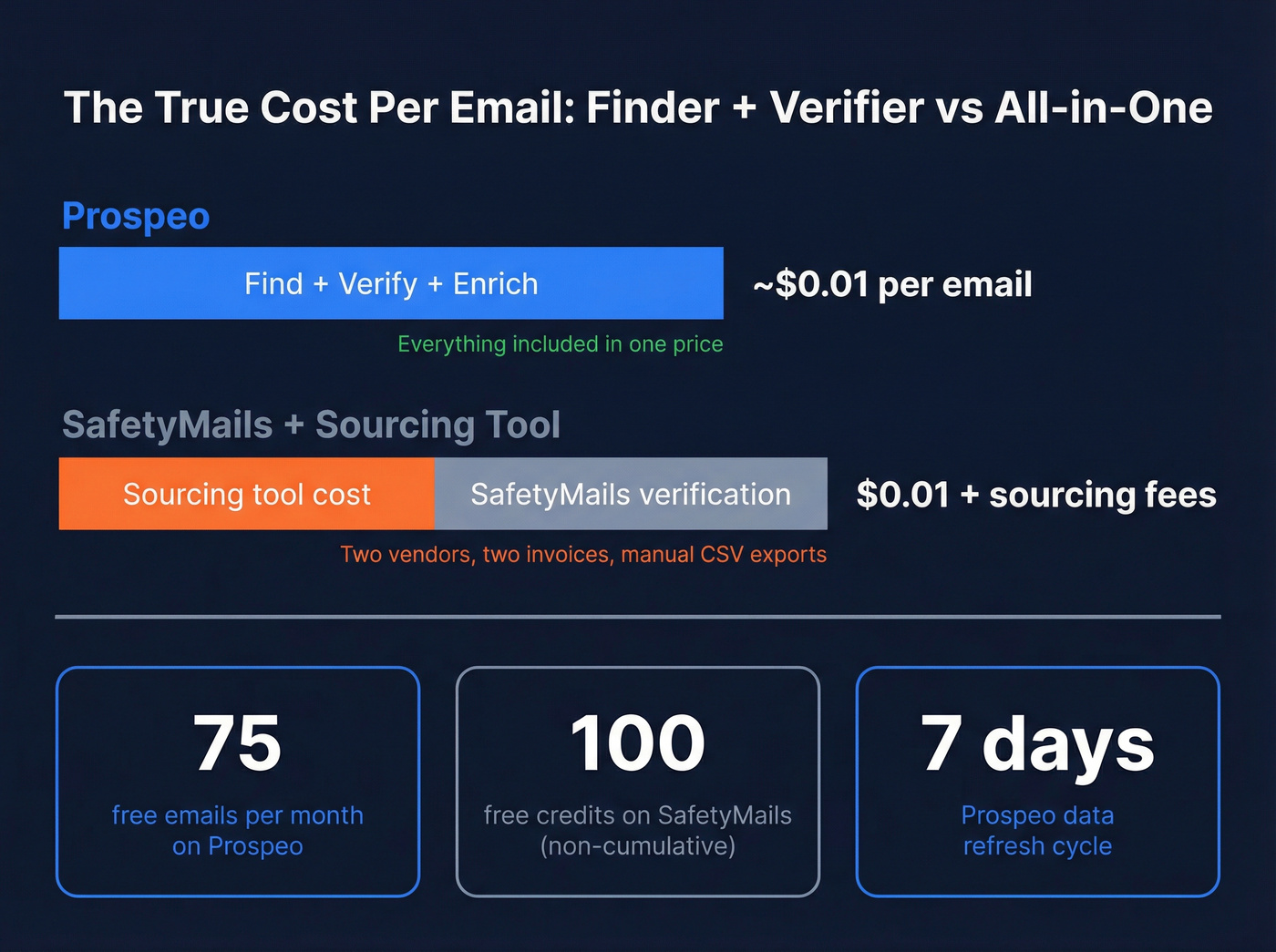
*SafetyMails' free plan credits are non-cumulative, and the free tier ends after your first purchase.
Both tools land around $0.007-$0.01 per email at base tiers. But Prospeo's cost includes finding and verifying together, while SafetyMails charges only for verification. You still need another tool to source those emails, which means another line item in your stack and another vendor to manage.
Here's the thing: if your outbound workflow starts with building lists, paying separately for a verifier is like buying a car and then paying someone else to put gas in it. The only time a standalone verifier makes sense is when you've inherited a database you didn't build.
When to Use Which
You need a data platform, not a verifier. Your SDR team uploaded 5,000 contacts into a sequence and 800 bounced on the first send. The problem isn't verification - the data was bad from the start. You needed verified contacts at the source, not a cleanup tool after the damage was done.
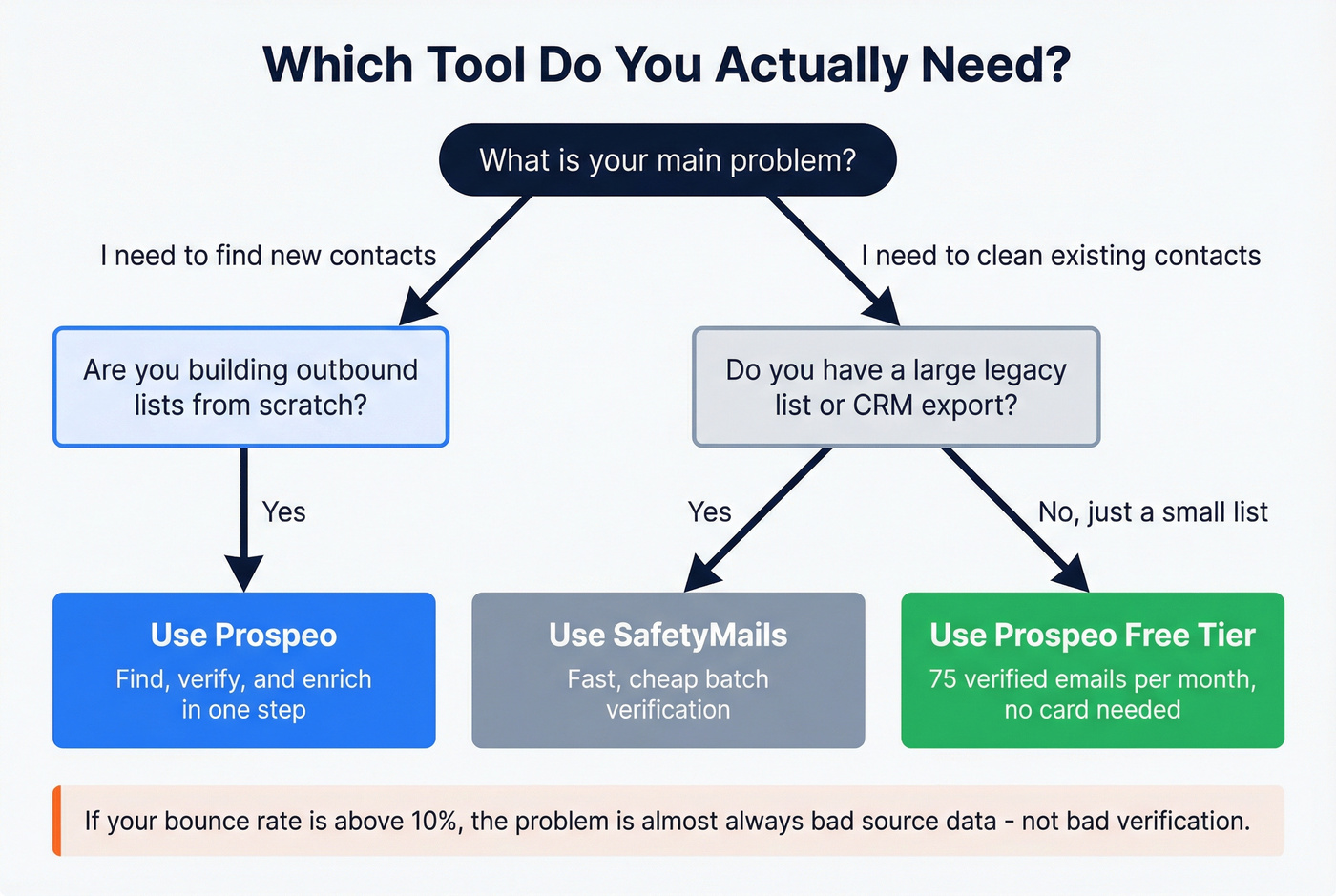
You need list hygiene, not new data. You exported 50,000 contacts from a CRM that hasn't been touched since 2023. Half are probably dead. Running them through SafetyMails before re-engaging is the right call - it's fast, cheap, and purpose-built for that exact job.
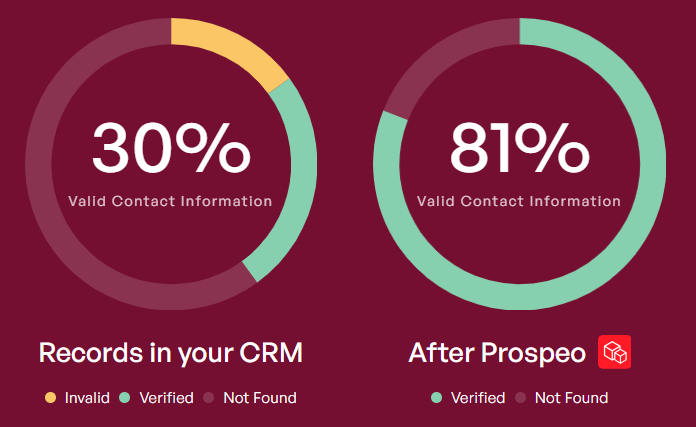
We've seen teams waste months layering verification tools on top of bad source data, treating symptoms instead of the disease. Meritt dropped their bounce rate from 35% to under 4% using Prospeo alone - no separate verifier needed. Snyk went from 35-40% bounces to under 5% across 50 AEs, and their AE-sourced pipeline jumped 180%.
Let's be honest: if your bounce rate is above 10%, the problem almost certainly isn't "we need better verification." It's "we need better data."
Meritt dropped bounces from 35% to under 4% without a standalone verifier. Snyk hit under 5% across 50 AEs. The difference wasn't better verification - it was better source data. Prospeo's proprietary infrastructure catches spam traps, honeypots, and catch-all domains before they ever reach your sequence.
75 free verified emails per month. No credit card required.
The Bottom Line
Most people weighing Prospeo vs SafetyMails are asking the wrong question. If you're building outbound lists, Prospeo is the obvious choice - it finds, verifies, and enriches in one step, eliminating the need for a standalone verifier entirely. If you're cleaning inherited or legacy data, SafetyMails is competent and affordable for that narrow job.
For large one-time list cleanups where you don't need SafetyMails specifically, ZeroBounce is a solid alternative verifier with broader reporting - expect to pay roughly $15-20 per 1,000 emails at lower volumes. NeverBounce is another option worth checking for high-volume batch jobs. And if you want a deeper look at how verification fits into the broader data quality picture, Validity's 2026 email deliverability report is worth a read.
If you're comparing more verification-first tools, start with our roundup of email verification alternatives and then zoom out to the broader stack with outbound lead generation tools.
FAQ
Can Prospeo replace SafetyMails?
Yes, for most outbound workflows. Prospeo finds and verifies emails in one step with 98% accuracy via a proprietary 5-step verification process. The only exception is scrubbing large legacy lists inherited from a CRM migration - that's where a dedicated verifier still earns its keep.
Does SafetyMails find email addresses?
No. SafetyMails only verifies emails you already have. It can't discover new contacts, find mobile numbers, or enrich records with company data. You'd need a separate sourcing tool alongside it.
Which tool costs less per email?
Both land around $0.007-$0.01 per email at base tier. But Prospeo's price includes finding and verification together, while SafetyMails charges only for verification - you still pay for a separate sourcing tool on top.
Is SafetyMails accurate?
SafetyMails guarantees at least 99% accuracy on verified emails and holds a 4.9/5 on GetApp across 33 reviews. Users flag occasional "pending" results with limited context, which can reduce effective accuracy on some lists.