

Psychological Sales Techniques That Actually Work in 2026
When researchers put people in an fMRI machine and gave them Coke and Pepsi, the interesting part wasn't the taste - it was the label. The moment subjects knew which brand they were drinking, brand knowledge lit up brain regions tied to memory and emotion. That's the lesson salespeople have felt for decades: buying decisions aren't purely rational. Harvard professor Gerald Zaltman's research puts a number on it - roughly 95% of purchasing decisions happen subconsciously.
Understanding psychological sales techniques is how you work with that reality instead of against it.
The neuromarketing industry has caught on, valued at roughly $1.44 billion in 2023 and projected to hit $3.11 billion by 2032 at an 8.9% CAGR. Companies are pouring real money into understanding the triggers behind buying behavior. You don't need an fMRI budget to benefit - you just need to understand the principles and know what to say.
The Three That Matter Most
If you master three techniques from this article, make it these. They've got the deepest research behind them and the most immediate impact on close rates:
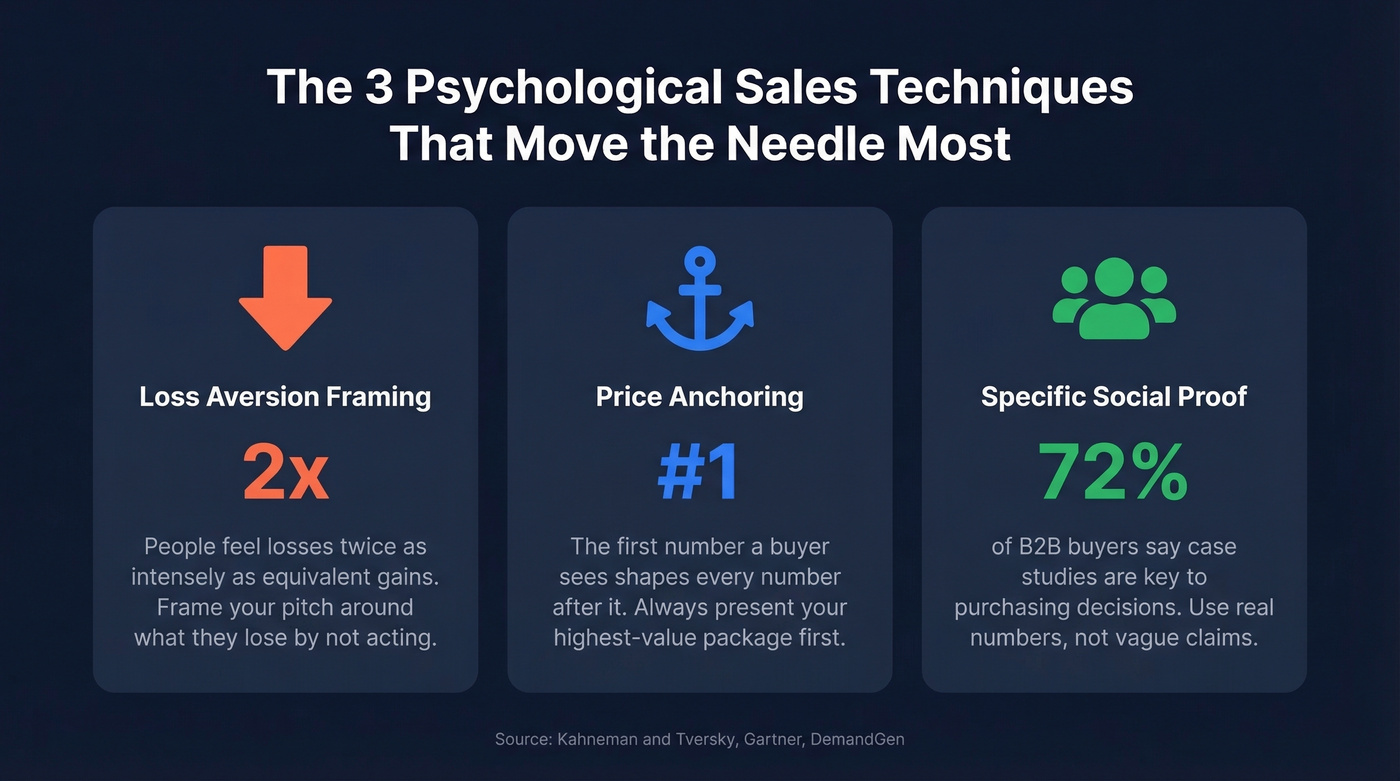
- Loss aversion framing - people feel losses about 2x as intensely as equivalent gains. Frame your pitch around what they'll lose by not acting. This is the emotion close reps rely on most in enterprise deals.
- Anchoring your pricing - the first number a buyer sees shapes every number after it. Control that anchor.
- Social proof with specific numbers - "500 companies use us" beats "many companies use us" every time. Specificity is the multiplier.
Here's an important distinction: B2B buyers respond more to authority and social proof than to scarcity tactics. Scarcity works in e-commerce. In enterprise sales, credibility wins. And every technique here assumes you're reaching the right person with accurate data - more on that later.
7 Principles of Persuasion in Sales
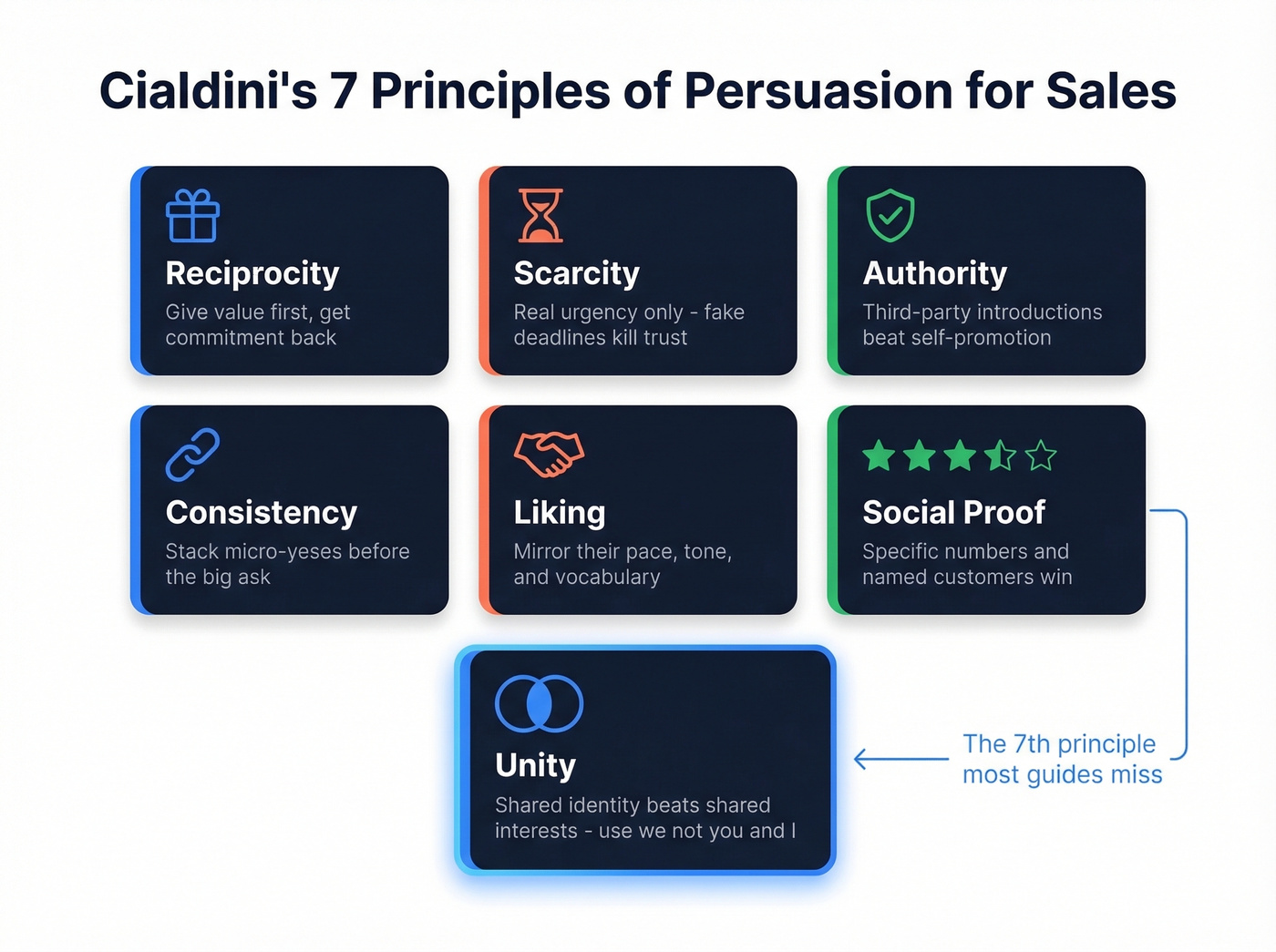
Robert Cialdini's framework is the backbone of modern sales psychology. Most guides cover six principles. The seventh - Unity, from his book Pre-Suasion - is the one almost nobody talks about.
Reciprocity
Give something first, and people feel compelled to give back. The classic study involves restaurant mints. One mint with the check raised tips about 3%. Two mints bumped that to 14%. But when the server left one mint, started walking away, then turned back and said "for you nice people, here's an extra," tips jumped 23%. The personalization mattered more than the gift itself.
In sales, this translates directly. Send a prospect a relevant industry benchmark before your first call. Share a competitive insight they didn't ask for. The gift doesn't need to be expensive - it needs to feel personal and unexpected. A script that works: "I pulled together some data on how companies in your space are handling [specific problem]. Thought you'd find it useful - no strings attached." Among the many sales psychology tips out there, leading with genuine value is the one that never goes out of style.
Scarcity
When British Airways announced it was retiring the London-to-New York Concorde route, demand spiked. Nothing about the flight changed. The product was identical. But the moment it became scarce, people wanted it more.
Here's the thing: in B2B, scarcity needs to be real or it backfires. "We only have three implementation slots left this quarter" works if it's true. Manufactured urgency - "this price expires Friday" when it doesn't - erodes trust fast. The best B2B scarcity play is time-based and honest: "Our onboarding team is booked through Q2. If you want to launch before summer, we'd need to start the contract process this month."
Authority
Try this script before you read the study behind it: instead of introducing yourself, have someone else do it. "Let me connect you with Sarah - she's closed $4M in pipeline for companies exactly like yours this year."
A real estate firm tested this exact approach. Instead of agents introducing themselves, the receptionist would say, "Let me connect you with Peter - he has 15 years of experience in commercial property." That third-party expert introduction led to a 20% rise in appointments and a 15% increase in signed contracts. Gartner's data points the same direction: confident B2B buyers are 3.6x more likely to complete high-quality deals. Authority isn't arrogance - it's demonstrating competence before you ask for anything. For high-ticket closing, establishing authority early is non-negotiable.
Consistency and Micro Commitments
Ask a prospect this: "Would it be fair to say reducing your bounce rate by 30% would meaningfully impact pipeline?" Once they say yes, your pitch becomes about helping them stay consistent with that stated goal.
This works because people want to act consistently with what they've already said or done. Micro commitments - agreeing to a 15-minute call, filling out a brief assessment, sharing their current metrics - build psychological momentum toward the close. This is the foundation of the yes-set close: stack small agreements so the final "yes" feels like a natural continuation rather than a leap. In our experience, the reps who close fastest are the ones who collect three or four small "yeses" before they ever present pricing. These incremental closes quietly move the deal forward without triggering buyer resistance.
Liking
We buy from people we like. That's not groundbreaking, but it's underutilized. Liking isn't about being charming - it's about finding genuine common ground. Mention a shared connection, reference something specific from their background, or simply mirror their communication style.
The mirroring technique is deceptively powerful - matching a prospect's pace, tone, and vocabulary builds subconscious rapport within minutes. Drivers want directness, amiables want warmth. Match the energy, and rapport follows naturally. Two minutes of genuine conversation about a shared interest outperforms ten minutes of polished pitching every time.
Social Proof
72% of B2B buyers say case studies are a key factor in their purchasing decisions. And 87% check prices before ever contacting a supplier - meaning your social proof needs to be visible before the first conversation happens.
Generic social proof ("trusted by thousands") is weak. Specific social proof converts. Compare these two: "Our customers love us" versus "One sales agency switched their data provider and saw pipeline triple from $100K to $300K per week while bounce rates dropped from 35% to under 4%." The second version has teeth. When you're building your own social proof, lead with the number, name the customer when you can, and tie the result to a metric your prospect cares about.
Unity
Most guides miss this principle entirely. Cialdini introduced Unity in Pre-Suasion as the seventh principle - the idea that shared identity drives compliance more powerfully than shared interests. It's not "I like you." It's "you're one of us."
Unity shows up in language. "We" is more powerful than "you and I." Framing your company and the prospect as part of the same group - same industry, same challenge, same values - creates a bond that goes deeper than rapport. "We're both trying to solve the same problem here - getting accurate data to reps before they burn through their call blocks. Let me show you how we've approached it." That "we" does heavy lifting.
Beyond Cialdini: Advanced Tactics
Cialdini gives you the framework. These techniques give you the edge.
Anchoring and Pricing Psychology
Tversky and Kahneman ran an experiment where subjects spun a wheel of fortune rigged to land on either 10 or 65. They then asked subjects to estimate the percentage of African countries in the United Nations. People who saw 10 guessed dramatically lower than those who saw 65 - even though the number was completely random.
Retailers exploit this aggressively. A Consumers' Checkbook study tracked eight major retailers and found that over 50% of items were offered at "false discounts" nearly every week. Foot Locker had items "on sale" 98% of the time. The original price was the anchor - and it was fiction.
In B2B proposals, you control the anchor. Always present your highest-value package first. If your enterprise tier is $2,000/month and your starter is $500/month, lead with enterprise. The $500 option suddenly feels like a steal. A practical script: "Most companies at your stage invest between $1,500 and $3,000 monthly in this. Our recommended package sits at $1,800." You've set the range. Now you own the frame.
If you want to go deeper on this, the same logic applies to the anchor in negotiation when procurement pushes back.
Loss Aversion and Prospect Theory
Kahneman and Tversky's prospect theory established something salespeople intuitively know: losses hurt about twice as much as equivalent gains feel good. People are risk-averse when they're winning and risk-seeking when they're losing.
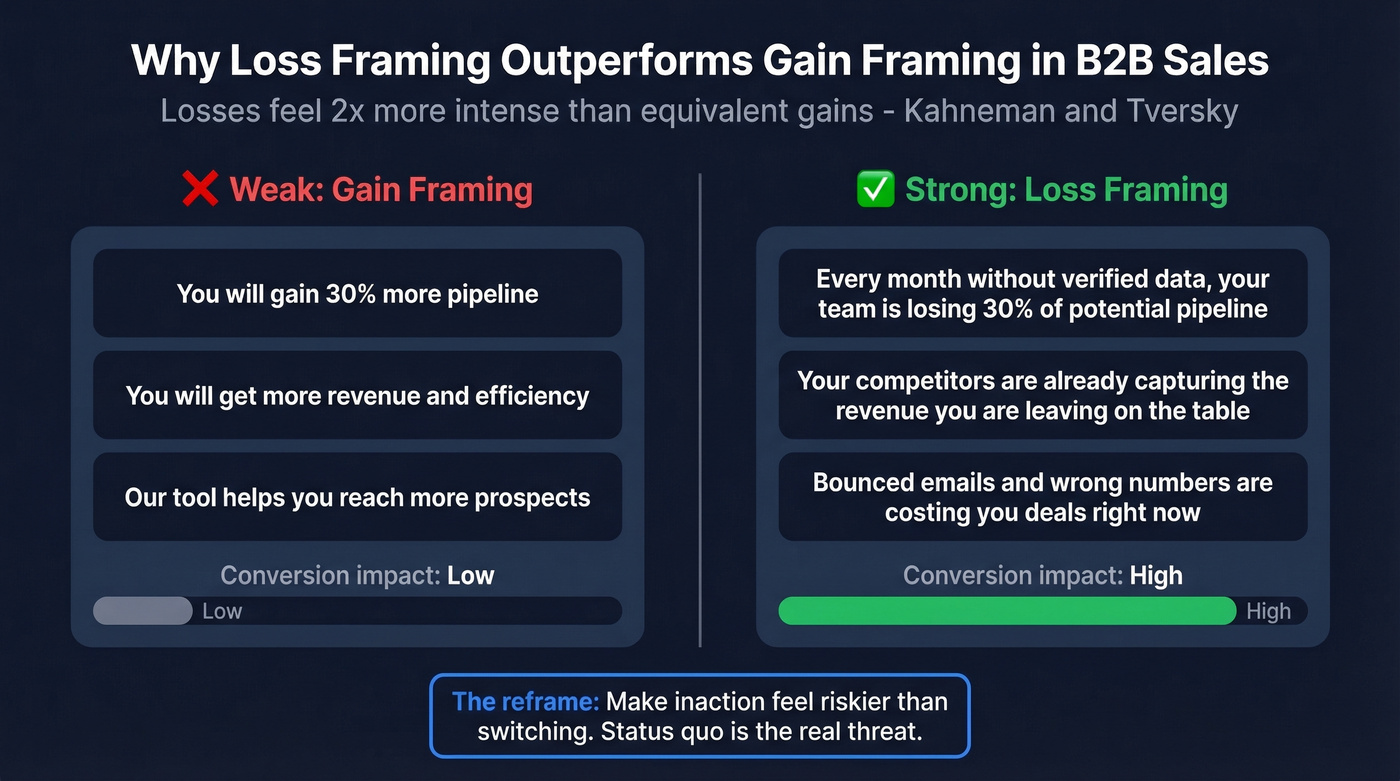
Hot take: loss aversion is the single most underused technique in B2B sales. Most reps default to gain framing - "you'll get more pipeline, more revenue, more efficiency." But the loss frame wins. Free trials work partly because of the endowment effect - once someone has the product, canceling feels like a loss. Status quo bias keeps prospects stuck with inferior solutions because switching feels riskier than staying.
Your job is to reframe inaction as the risky choice. Instead of "you'll gain 30% more pipeline," try: "Every month without verified data, your team is losing roughly 30% of potential pipeline to bounced emails and wrong numbers. That's not a future risk - it's happening right now." We've seen this reframe consistently outperform gain-based pitches in enterprise deals.
Choice Reduction
Tulane University researcher Daniel Mochon found that when consumers were presented with a single option, only 9-10% chose to buy. But when a second option was added - even an inferior one - purchase rates jumped to 32-34%. The presence of choice itself drives action.
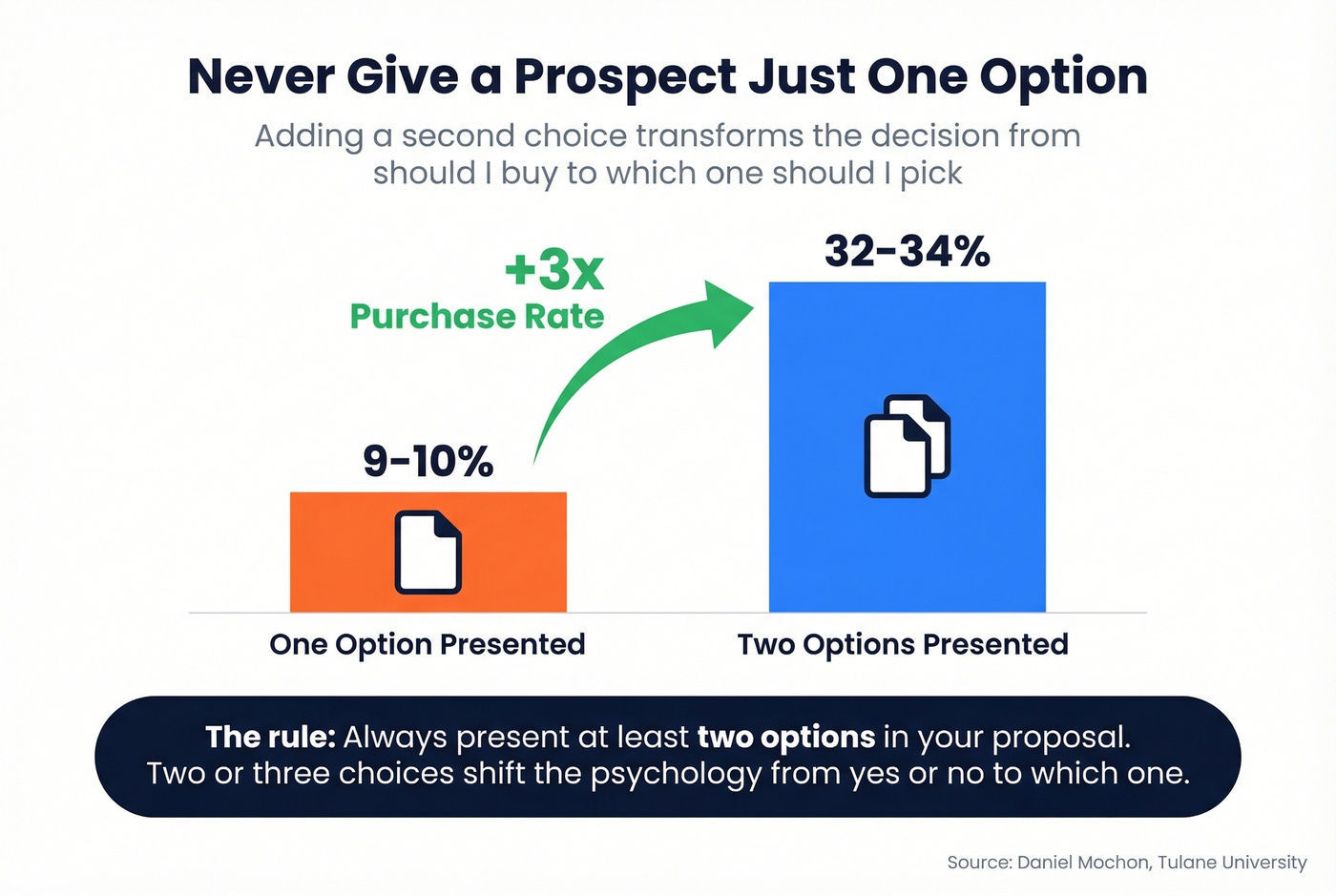
The rule is simple: always present at least two options. Never give a prospect a single proposal and ask for a yes or no. Two or three options transform the decision from "should I buy?" to "which one should I pick?" That's a fundamentally different psychological frame.
How to Close Using Questions
Not every buyer responds to the same technique. Before we get into buyer types, let's talk about questions as a closing tool. The Q&A close works by guiding the prospect to articulate their own reasons for buying - which is far more persuasive than hearing those reasons from you. Ask: "Based on what we've discussed, what would need to be true for this to be a good fit?" Then let the silence work. Staying quiet for a few beats after a closing question puts gentle pressure on the prospect to fill the gap, often with a commitment.
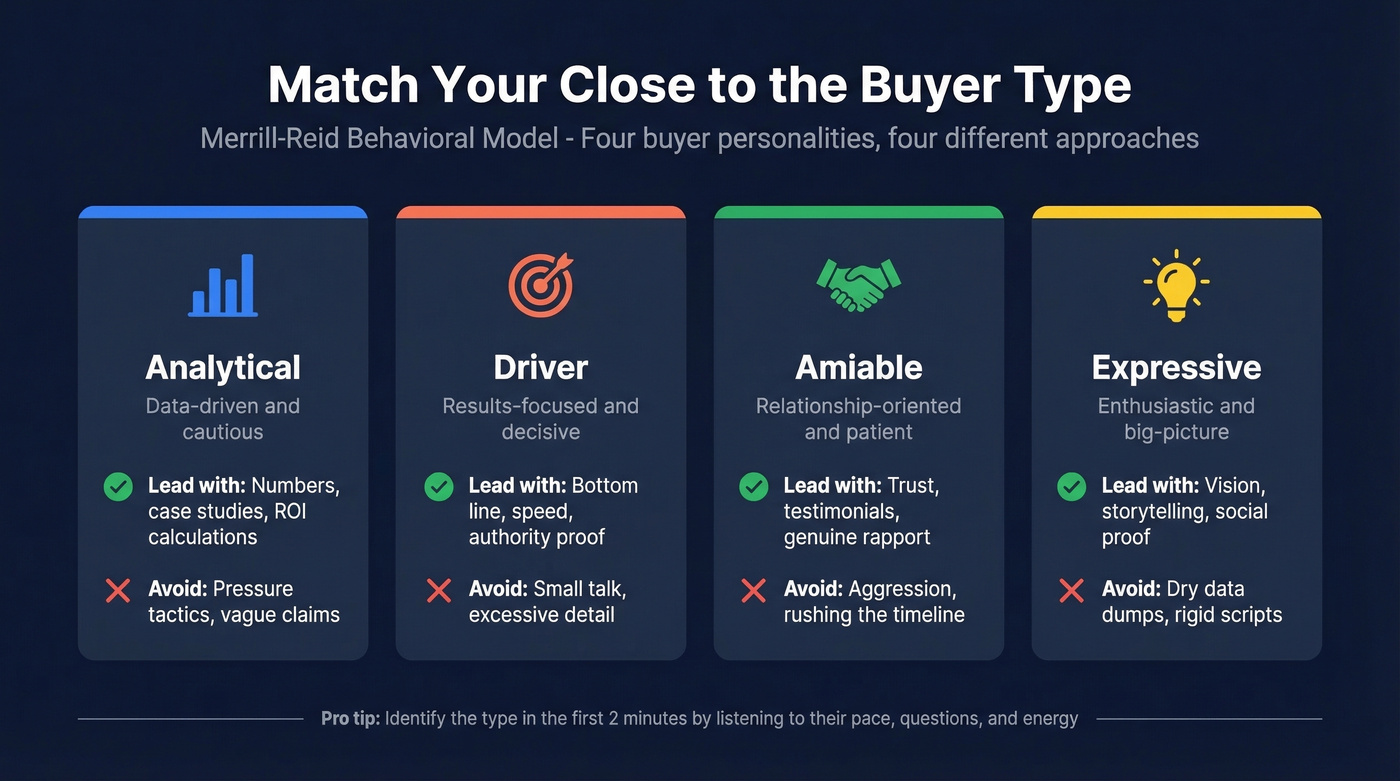
The Merrill-Reid behavioral model breaks buyers into four types, and your pitch should shift accordingly.
| Buyer Type | Key Trait | Lead With | Avoid |
|---|---|---|---|
| Analytical | Data-driven, cautious | Numbers, case studies, ROI | Pressure, vague claims |
| Driver | Results-focused, decisive | Bottom line, speed, authority | Small talk, excessive detail |
| Amiable | Relationship-oriented, patient | Trust, testimonials, rapport | Aggression, rushing |
| Expressive | Enthusiastic, big-picture | Vision, storytelling, social proof | Dry data dumps |
There's another segmentation worth knowing. Neuroeconomics research splits buyers into spending types: roughly 25% are tightwads, 15% are spendthrifts, and 60% fall in the middle. For tightwads, reframe costs as investments and break pricing into per-day or per-lead equivalents. For spendthrifts, emphasize the premium experience. For the majority in the middle, social proof and risk reduction do the heavy lifting.

Social proof only works when it's specific - and so does your prospect data. Prospeo delivers 98% email accuracy with a 7-day refresh cycle, so every anchoring play and authority frame lands on a real decision-maker, not a dead inbox.
Stop perfecting your pitch for contacts that bounce.
Mastering the Close
The best reps match the closing technique to the moment:
- The assumptive close - proceed as if the decision is made. "Should we start onboarding next Monday or Wednesday?"
- The summary close - recap every agreed-upon benefit, then ask for the commitment. This works especially well after you've stacked micro commitments throughout the conversation.
- The storytelling close - end with a brief narrative about a similar customer who hesitated, took the leap, and saw results. Stories bypass analytical resistance and speak directly to the emotional brain.
- The pattern interrupt - when a conversation stalls, a surprising question or a candid admission resets the prospect's attention and reopens the dialogue.
Skip the hard pitch on amiable buyers who need warmth and patience. It'll send them running. Read the room, choose your close, and commit to it.
Your Data Has to Be Right First
Look, your SDR sent 200 cold emails using every technique in this article. Open rate: 2%. The problem isn't the psychology - 40% of those emails bounced. You can't persuade someone who never sees your message.
I've watched reps nail every technique here and still miss quota because their contact data was garbage. We built Prospeo, so take this with appropriate context - but the principle applies to any verification tool: verify before you send. If you're building lists from names, name to email workflows only work when you validate the output. Meritt, one of our customers, saw their bounce rate drop from 35% to under 4% after switching to verified data, and their connect rate tripled to 20-25%. The free tier gives you 75 emails per month to test with no contract and no sales call required. Clean data is the foundation that lets every persuasion technique actually reach its target.
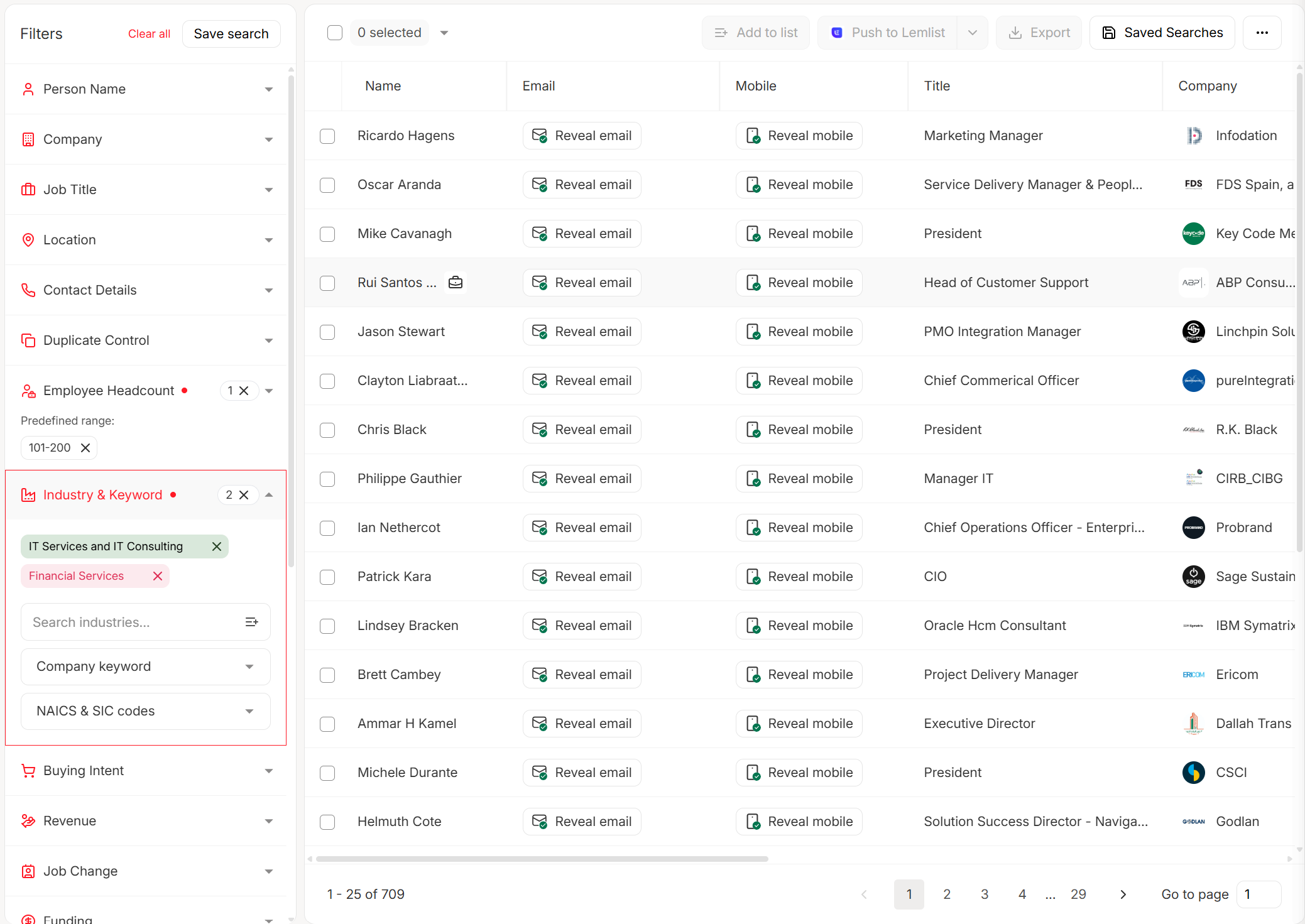
Micro commitments and loss aversion close deals - but only when reps spend time selling, not hunting for valid emails. Teams using Prospeo book 35% more meetings than Apollo users because 143M+ verified emails mean less guessing and more conversations.
Give your reps data that matches their psychology skills.
Mistakes That Kill Deals
These undo every technique above.
Selling features instead of benefits. "Our platform has 47 integrations" means nothing. "You'll cut your data entry by 3 hours a week" means everything. Buyers don't care what your product does - they care what it does for them.
Talking more than listening. If your talk-to-listen ratio is above 60/40, you're pitching, not selling. The best closers listen more than they speak. Silence often does more persuading than words.
Pushing too hard. High-pressure tactics trigger reactance - the psychological urge to do the opposite of what someone's pushing you toward. Back off, and buyers lean in. If you're seeing this a lot, it's usually a sign your discovery questions aren't sharp enough.
Ignoring storytelling. Data convinces the analytical brain. Stories convince the emotional brain - the one that actually makes decisions. Use both together. (If you want a framework, build it into your sales deck storytelling.)
Not following up. Most deals require 5+ touches. Dropping off after two emails isn't persistence - it's quitting before the psychology has time to work. The consensus on r/sales is that most reps give up way too early, and the data backs that up. If you need a system, steal these sales follow-up templates.
When Persuasion Crosses the Line
There's a clear line between persuasion and manipulation, and crossing it has real consequences. Research by Grabe, Ward, and Hyde found that idealized advertising imagery can decrease self-esteem and increase anxiety. Hastings, Stead, and Webb showed that fear-based messaging triggers defensive avoidance - people tune out rather than engage.
False discounting is technically illegal in the US, though Harvard's Program on Negotiation notes it's "rarely policed." That doesn't make it smart. The moment a buyer realizes your "limited-time offer" is permanent, you've lost trust permanently.
Real talk: persuasion helps people make decisions they'll feel good about. Manipulation helps you make a sale they'll regret. If your technique wouldn't survive the buyer finding out about it, don't use it. (More on this in our guide to ethics in sales.)
FAQ
What is sales psychology?
Sales psychology is the application of behavioral science - reciprocity, loss aversion, social proof, anchoring - to influence buying decisions. These principles work because roughly 95% of purchasing decisions happen subconsciously, according to Harvard research. Understanding them gives reps a structural edge over competitors who rely on features alone.
Is using psychology in sales manipulative?
Not when applied ethically. The test: would the buyer feel good about the decision if they knew exactly which persuasion principles you used? If yes, you're persuading. If no, you're manipulating. Ethical persuasion helps buyers reach decisions they'll stand behind.
Which technique works best for B2B?
Loss aversion framing delivers the most reliable lift in enterprise close rates. People feel losses about twice as intensely as equivalent gains, so reframing inaction as a loss consistently outperforms gain-based pitches. Pair it with authority and specific social proof for maximum impact.
How does data quality affect persuasion?
Every technique fails when emails bounce or you're pitching the wrong person. Clean, verified contact data is the prerequisite that lets persuasion actually reach its audience. Tools like Prospeo run a 7-day data refresh cycle compared to the industry average of six weeks, which means your outreach hits inboxes instead of spam folders.