

QBR vs EBR: What's the Difference and When Does Each One Matter?
Most CSMs spend 2-6 hours building each QBR deck. Multiply that across a 30-account book, and you've burned 60-180 hours every quarter - roughly 1.5 to 4.5 workweeks - on slide production instead of strategy, relationship building, or retention. Meanwhile, executives skip the meeting because nobody told them why it matters.
The problem isn't the meetings. It's that nobody agrees on what separates a QBR from an EBR, or when each one earns its spot on the calendar.
Quick version:
- QBRs = quarterly, operational stakeholders, tactical metrics and adoption progress.
- EBRs = annual or semi-annual, executive stakeholders, strategic outcomes and business value.
The Actual Difference Between QBR and EBR
These terms get used interchangeably, and the line between them is blurrier than most people admit. Custify makes a useful point: QBRs and EBRs aren't mutually exclusive. You can run an "EQBR" - an executive-level quarterly review - if that's what the account needs. The real distinction comes down to who's in the room, what you're discussing, and how far ahead you're looking.
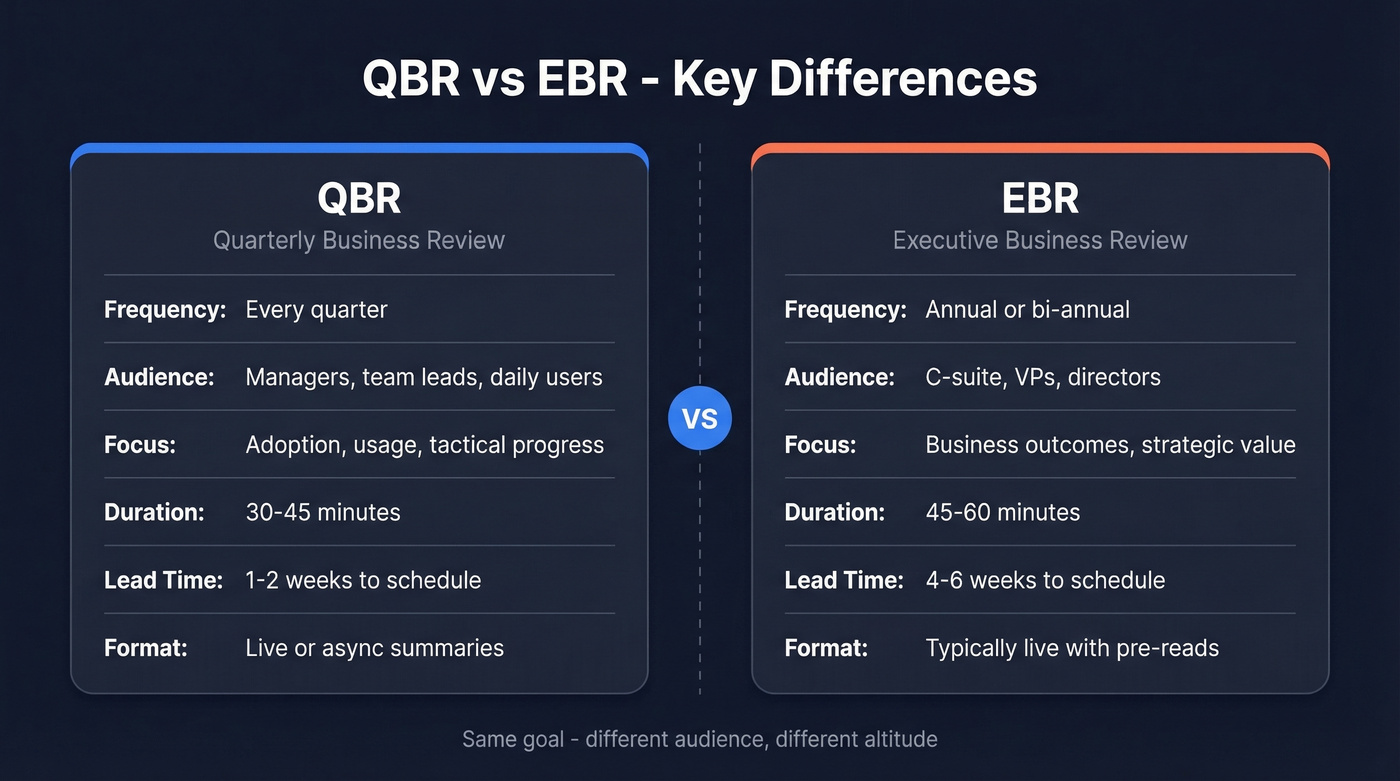
| Dimension | QBR | EBR |
|---|---|---|
| Frequency | Quarterly | Annual or bi-annual |
| Audience | Managers, team leads, users | C-suite, VPs, directors |
| Focus | Adoption, usage, tactical progress | Business outcomes, strategic value |
| Typical content | Feature usage, support tickets, short-term goals | Revenue impact, benchmarking, future roadmap |
| Duration | 30-45 minutes | 45-60 minutes |
| Scheduling lead time | 1-2 weeks | 4-6 weeks |
| Format flexibility | Live or async (automated summaries) | Typically live, with standardized pre-reads |
The scheduling lead time difference matters more than people realize. You can slot a quarterly business review into a regular operating cadence with your day-to-day stakeholders. An executive business review requires personalized outreach weeks in advance, with a clear answer to "what's in it for me?" baked right into the invite. Skip that step and you'll get a last-minute cancellation every time.
When to Use QBRs, EBRs, or Both
Not every account needs both. Not every account needs either.
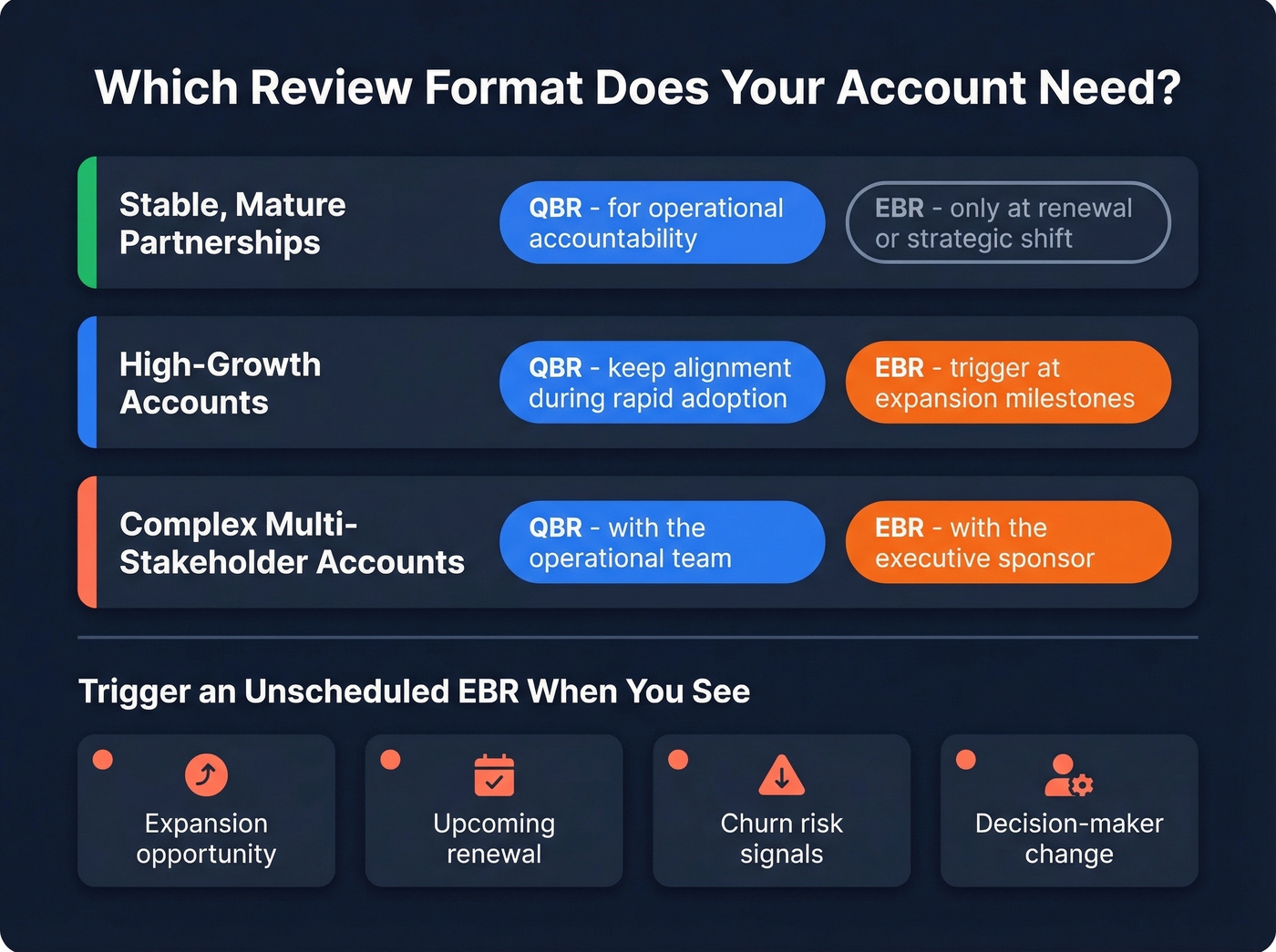
Stable, mature partnerships get QBRs for operational accountability and EBRs only when a strategic shift or renewal is approaching. High-growth accounts need QBRs to keep alignment tight during rapid adoption, plus milestone-triggered EBRs at expansion moments. Complex multi-stakeholder accounts warrant both - QBRs with the operational team, EBRs with the executive sponsor. Different audiences, different agendas.
For EBR frequency by tier, Gainsight's guidance is practical: strategic accounts get bi-annual EBRs, growth accounts get annual, and new customers should have their first executive review three to six months post-implementation - once there's actual value to discuss. Trigger an unscheduled EBR when you spot expansion opportunity, upcoming renewal, churn risk, or a decision-maker change.

Retention drops from 92% to 75% after a sponsor leaves. If your QBR deck references contacts who've already moved on, you're presenting fiction. Prospeo's enrichment API returns 50+ data points per contact with a 7-day refresh cycle and 92% match rate - so your stakeholder map reflects the actual org chart, not last quarter's.
Stop building business reviews on stale contact data.
The One-Slide Alternative
Look, most QBR decks are 30-40 slides of screenshots, charts, and bullet points that nobody reads. Angeline Gavino of CS RevSpeak created a one-slide value review framework (published by ChurnZero) that replaces the entire deck with four sections on a single page:
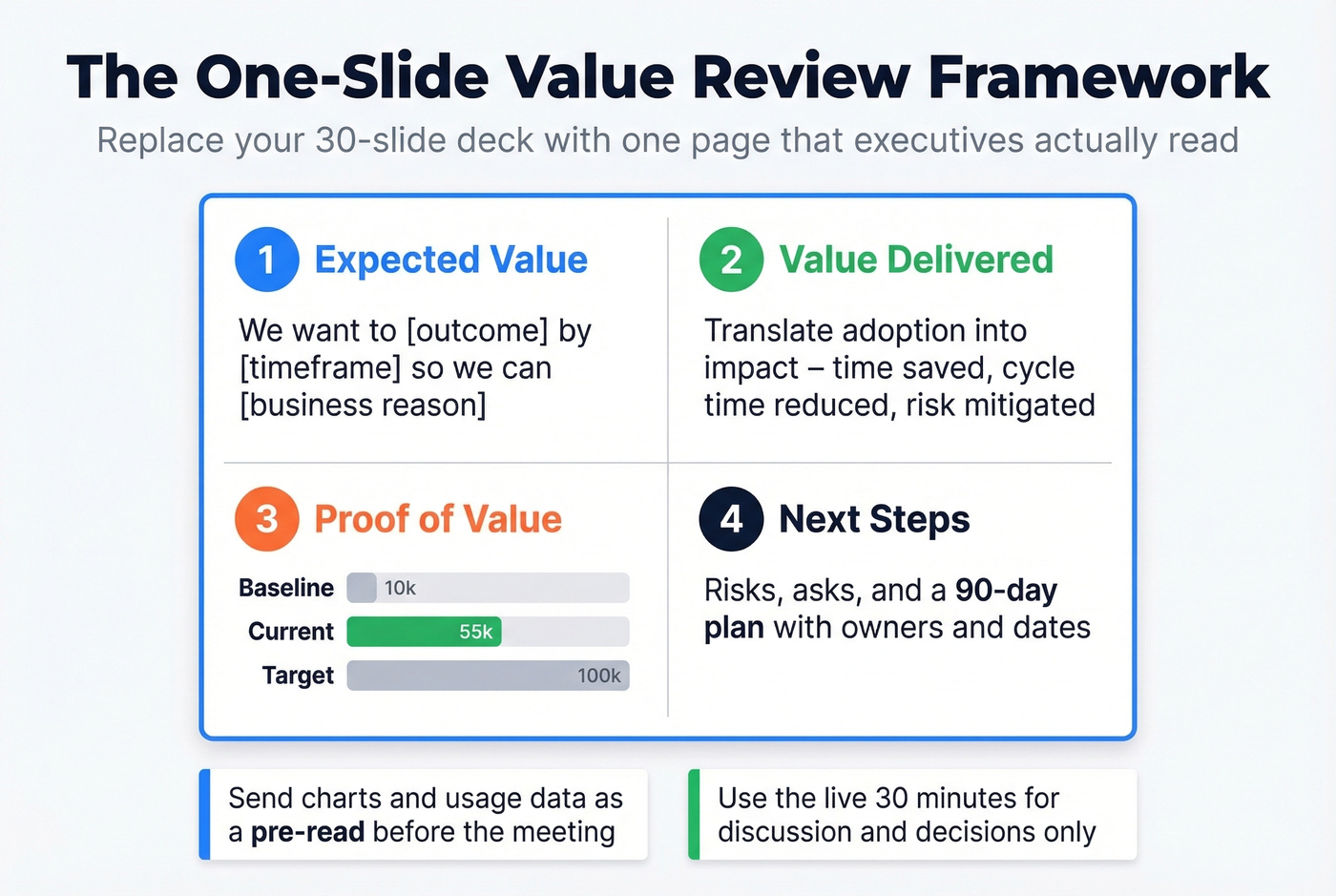
- Expected value - "We want to [outcome] by [timeframe] so we can [business reason]."
- Value delivered - Translate adoption into impact: time saved, cycle time reduced, risk mitigated.
- Proof of value - Baseline, current, target. Three numbers. That's it.
- Next steps - Risks, asks, and a 90-day plan with owners and dates.
Send your charts and usage data as a pre-read. Use the live 30 minutes for discussion and decisions only. We've tested the one-slide format with enterprise accounts and the attendance rate jumped immediately - executives actually want to show up when the meeting is about decisions, not data dumps. Smartsheet offers free QBR and EBR templates if you want a more traditional starting point, but the one-slide approach is where the industry is heading.
Mistakes That Sink Business Reviews
1. No template, no consistency. Rebuilding decks from scratch every quarter guarantees inconsistency. Pick a structure and standardize it across your book.
2. Making it about you, not the customer. Feature launches belong in a changelog. Every slide should connect to the customer's stated goals - if you can't draw that line, cut the slide.
3. No clear objectives going in. Write down what you want before you build anything. The objective shapes the agenda, not the other way around.
4. Drowning in data. We've seen decks with 15 ad hoc reports crammed in because someone asked for them once six months ago. Only 1 in 26 unhappy customers actually complain before churning. The signal is in a few key metrics, not a data avalanche. One CS practitioner on r/CustomerSuccess described their team as being in "customer touchpoint hell" - monthly EBRs for every account, with CSMs spending days building decks that executives skip. If that sounds familiar, you don't need more reviews. You need better ones.
5. Presenting metrics built on stale contacts. Your stakeholder map is fiction if half the contacts have left the company since your last review. This isn't hypothetical: retention drops from 92% to 75% after a sponsor leaves. Prospeo's enrichment API returns 50+ data points per contact on a 7-day refresh cycle, so the stakeholder map in your deck reflects reality instead of last quarter's org chart.
Getting Execs to Show Up
Accounts with strong executive participation are 2.5x more likely to renew. Teams running consistent reviews maintain net retention rates 15-20 points higher than those relying on reactive support alone, and expansion revenue costs roughly $0.61 per ACV dollar versus $1.78 for new acquisition.
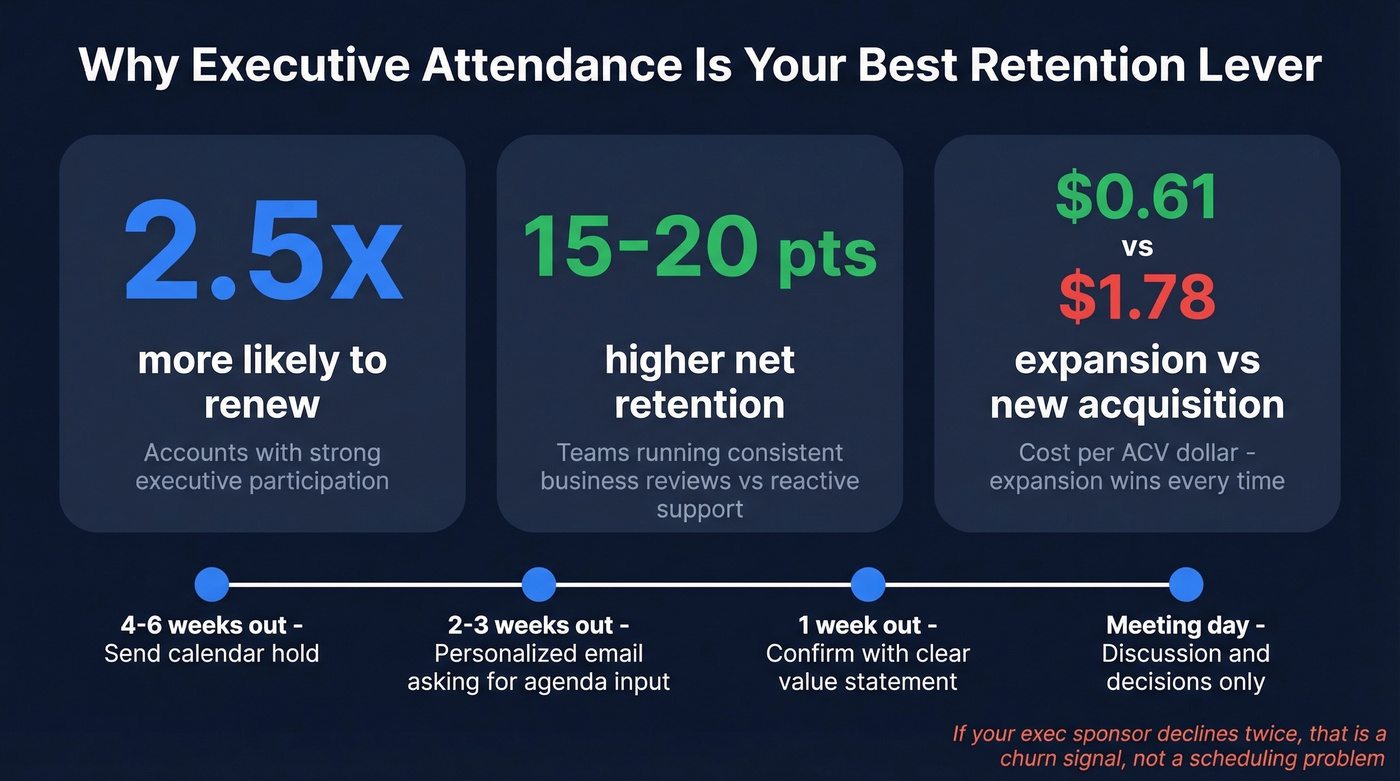
The ROI of a well-run executive business review isn't abstract.
But getting a VP to block 45 minutes for your product review when they've got 25 tools in their stack - and yours ranks near the bottom by spend - requires more than a calendar invite. Give 4-6 weeks' notice with a calendar hold, then follow up with a personalized email 2-3 weeks out asking for agenda input. This flips the dynamic from "vendor presentation" to collaborative planning session. Explicitly answer "what's in it for me?" in the invite itself. If you can't articulate that in two sentences, you're not ready to hold the meeting.
In our experience, if your exec sponsor won't attend after two attempts, that's a churn signal, not a scheduling problem. Treat it accordingly with a simple churn analysis.
Let's be honest: most SaaS companies would get better retention outcomes from one well-prepared annual EBR than from four mediocre QBRs. The format doesn't matter nearly as much as whether you've earned the right to be in the room - and whether you use that time to talk about the customer's business instead of your product.
Getting executives to show up to your EBR starts with reaching the right person at the right email. Prospeo gives you 98% verified emails and 125M+ direct dials - so your personalized invite actually lands in the exec's inbox, not a dead address. At $0.01 per email, keeping your stakeholder map current costs less than the coffee budget for the meeting.
Reach every executive sponsor before your next business review.
FAQ
Are QBRs outdated?
Not inherently - but 40-slide decks presented to mid-level managers are. Scaled accounts are increasingly moving to async reviews with automated summaries, reserving live meetings for strategic conversations. The one-slide value review is the modern replacement for bloated decks. The meeting isn't dead. The deck is.
How long should a business review last?
QBRs usually run 30-45 minutes; EBRs run 45-60 minutes. If you need more time, your deck has too many slides. Send data as a pre-read and use live time exclusively for discussion, decisions, and next steps.
What metrics belong in a QBR vs an EBR?
QBRs focus on operational metrics: adoption rates, feature usage, support ticket volume, and progress against short-term goals. EBRs zoom out to business outcomes - revenue impact, time saved, risk reduction, and benchmarking against peers. Both should tie every metric back to the customer's stated objectives.
How do you keep stakeholder data accurate between reviews?
Decision-maker turnover is the top silent churn driver. Tools like Prospeo refresh contact records every 7 days and return 50+ data points per enrichment, so your CRM reflects current titles, roles, and verified emails before you build your next review deck.