

8 Qualities of a Good Sales Manager - And What Bad Ones Get Wrong
A company promoted their best rep - 150% of quota, consistently - to sales manager. Within three months, everything fell apart. The new manager couldn't coach, couldn't diagnose pipeline problems, and reduced deal reviews to gut-feel calls like "this one feels good." Two reps quit, citing they weren't learning anything. The company estimates it cost them roughly $100K in lost deals and six months of momentum before they reverted him back to an IC role.
That story, from a business owner on Reddit, isn't unusual. CEB Global research shows 85% of employees receive no new manager training before stepping into the role, and 60% of new managers underperform during their first two years. The promotion-to-failure pipeline is one of the most expensive mistakes in B2B sales - and it's almost entirely preventable.
The 8 Traits That Actually Matter
- Coaching ability - structured skill development, not war stories
- Data-driven decision making - leading indicators, not gut feel
- Hiring judgment - the best rep rarely makes the best hire
- Accountability without micromanagement - standards without bureaucracy
- Communication and transparency - explaining the "why" behind quotas
- Protecting selling time - cutting admin drag and internal meetings
- Adaptability - adjusting playbooks as markets shift
- Culture building - creating an environment people don't want to leave
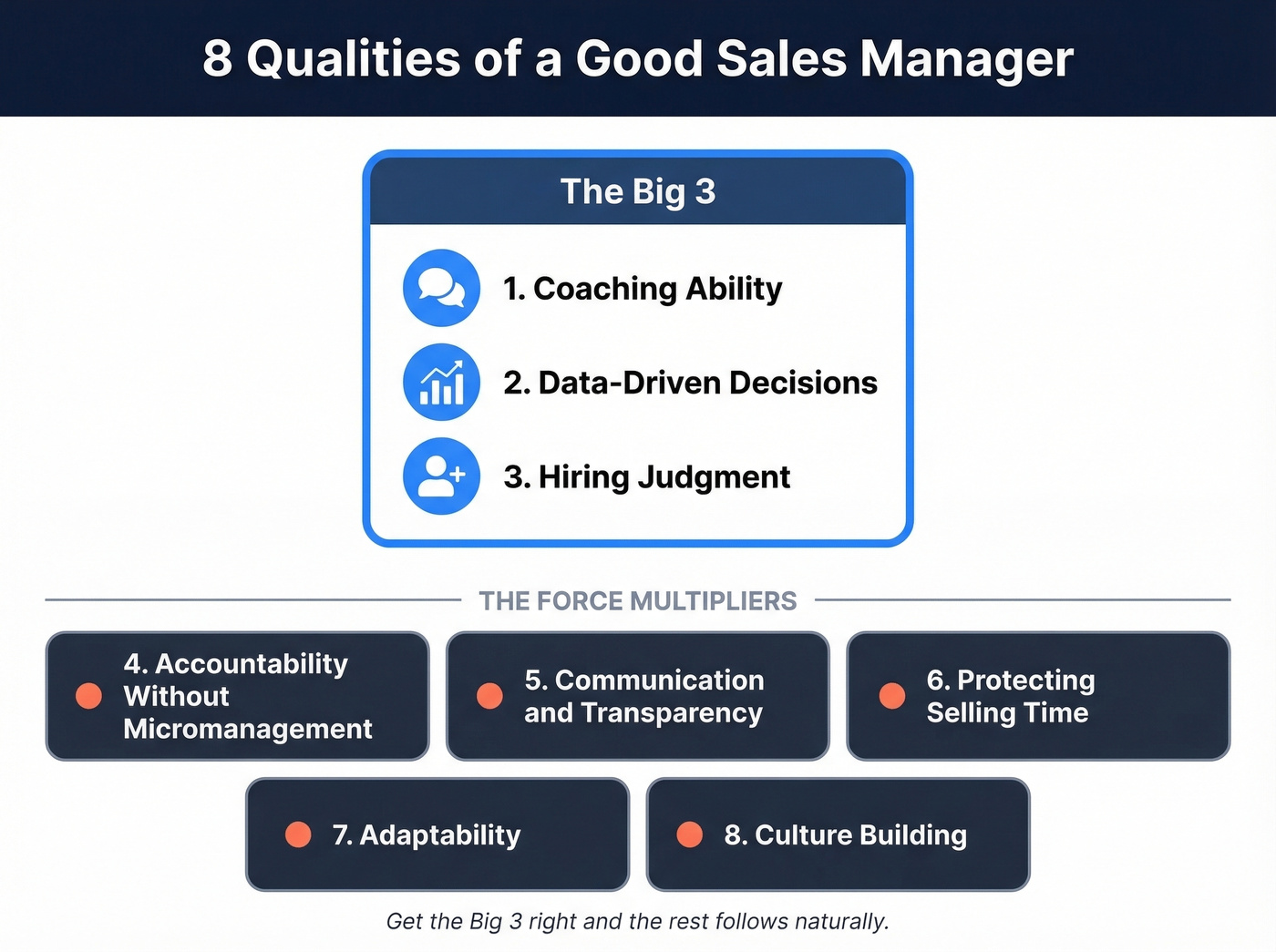
Three matter disproportionately: coaching, data discipline, and hiring judgment. Get those right and the rest follows more naturally than you'd expect.
What Great Sales Managers Actually Do
Coaching Ability
This is coaching: sitting in on a call, identifying that a rep rushes past discovery questions, then running a role-play the next day focused on that specific gap.
This isn't coaching: telling the rep "you need to ask better questions" and moving on.
Only 26% of reps receive weekly coaching. That's a staggering gap, because weekly coaching correlates with 25% higher quota attainment and 30% more deals won - and for every $1 spent on sales training, companies see a $4.53 return. The math isn't subtle.
The best managers we've observed block 30-40% of their week for coaching and 1:1s. Don't bother with coaching programs if your version of coaching is forwarding a Gong recording with "listen to this." Invest here if you want compounding returns on rep performance that no tool or territory change can match. Of all the traits of successful sales managers, the willingness to invest time in developing others is the one that separates good from great.
Data-Driven Decisions
The promoted rep from our opening story ran pipeline reviews on gut feel. "This one feels good" isn't a forecast - it's a guess. And only 41% of salespeople feel their pipeline is accurately reflected in their CRM.
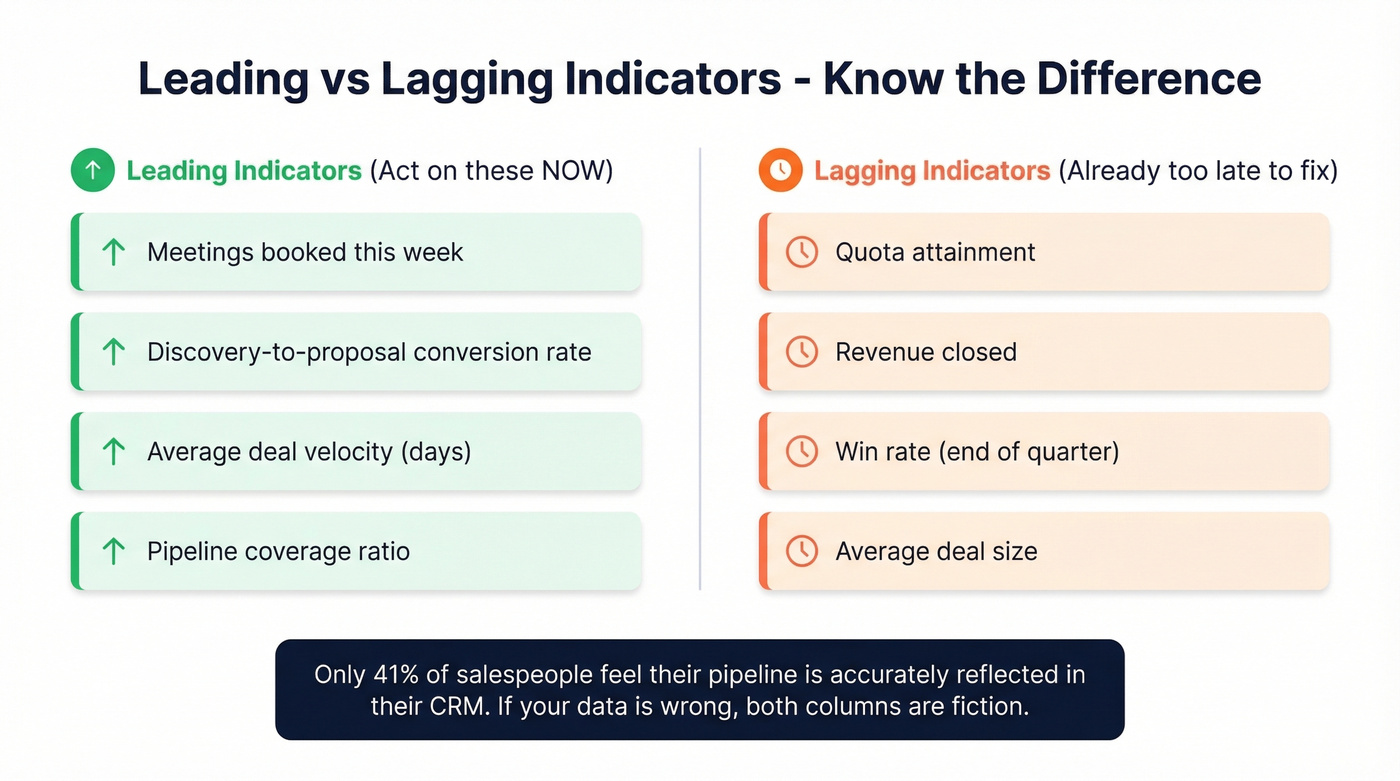
Great managers distinguish between leading and lagging indicators. Quota attainment is lagging - by the time it's bad, you're already behind. Meetings booked, discovery-to-proposal conversion, and average deal velocity are leading indicators you can act on.
Here's what most management articles miss: data quality is a management responsibility, not a rep problem. If a third of your team's emails bounce, your forecast is fiction. The contacts in your CRM are stale, activity metrics are inflated by wasted touches, and reps spend time on dead leads. Tools like Prospeo maintain 98% email accuracy on a 7-day refresh cycle, so reps work live contacts instead of records that went cold six weeks ago. That's a management decision - choosing the data infrastructure your team runs on.

Hiring Judgment
Anthony Iannarino wrote about one of his biggest management mistakes: hiring based solely on experience. The candidate had the resume, the industry knowledge, the references - and did too little once in the seat.
In our experience, the managers who hire well interview for coachability first and resume second. They also fire faster than most are comfortable with - keeping non-producers too long drags down the entire team's standards and morale. The "best rep doesn't equal best manager" principle applies to who you hire onto the team, not just who you promote.
Accountability Without Micromanagement
Most sales managers create policies to control their worst performers, and those policies end up punishing their best ones. Management consultants call this managing to the lowest common denominator - mandatory activity logging, rigid call schedules, approval gates on every discount.
High-accountability companies see 18% higher revenue growth and 24% higher profit margins. But accountability means setting clear expectations and addressing performance issues one-on-one, not layering bureaucracy on the whole team. Your top rep closing at 140% doesn't need to log 60 calls a day. Your bottom rep at 40% needs a direct conversation, a development plan, and a timeline. Those are two completely different management actions, and treating them the same is how you lose your best people while babysitting your worst.
Communication and Transparency
Here's the thing: quota transparency matters more than comp plan generosity. Reps consistently rank "my manager explains how quotas are set" as a top trait in practitioner communities - above team events, above swag, above most perks. Not "here's your number, go hit it," but "here's the market data, here's the territory analysis, here's why your number is what it is."
Only 25% of salespeople receive weekly feedback from their manager. The minimum viable cadence is a weekly 1:1 with every direct report, structured around pipeline, skill development, and blockers. Fifteen minutes is enough if you're prepared. Zero minutes is what most managers default to when they're buried in their own deals.
Protecting Selling Time
Reps spend 35.2% of their time actually selling - roughly 14 hours out of a 40-hour week. Admin tasks eat 5.9 hours. The rest disappears into internal meetings, CRM updates, and manual research.
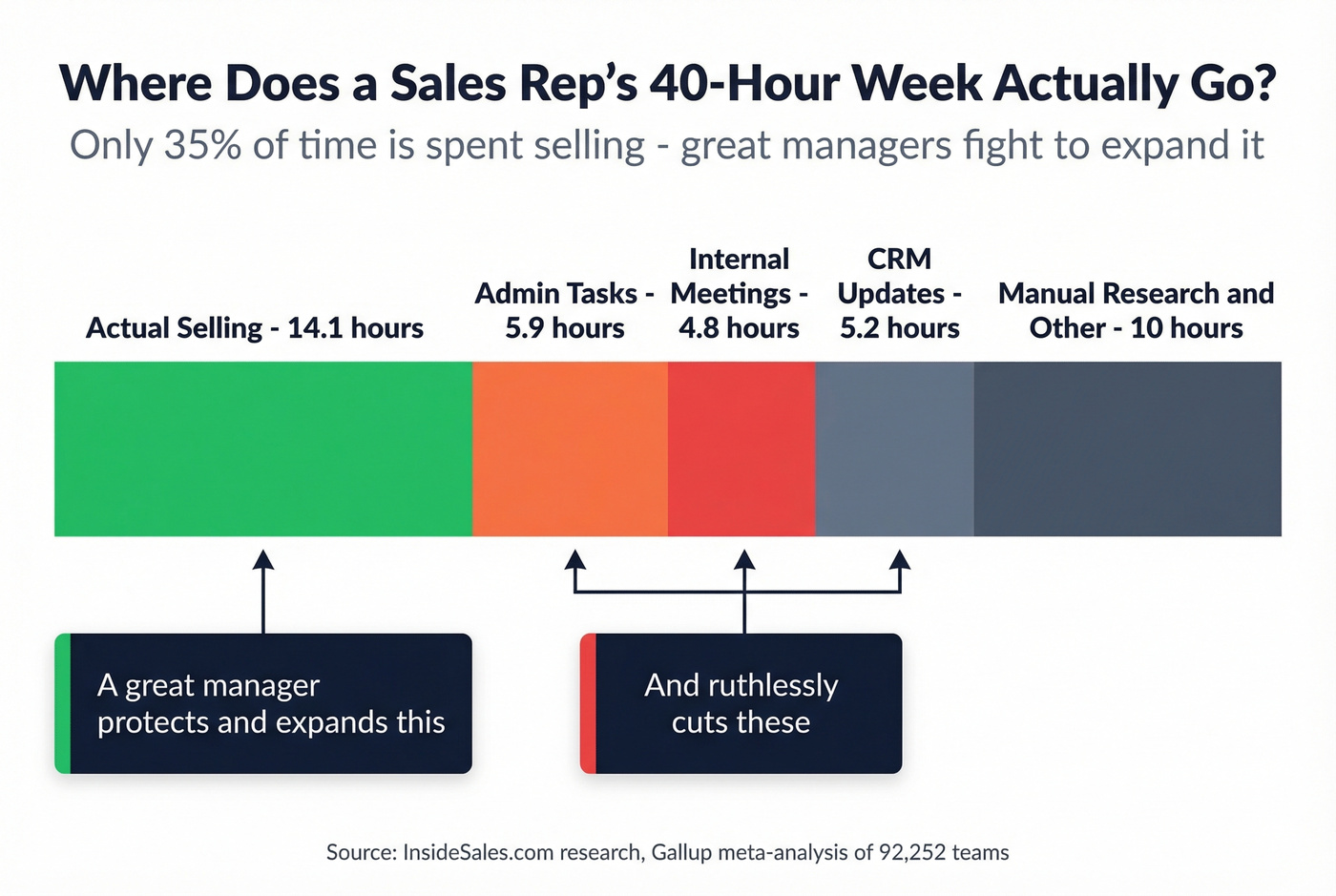
A great manager fights for those 14 hours and expands them. That means killing unnecessary meetings, automating data entry, and pushing back on cross-functional requests that don't serve pipeline. Gallup's data - drawn from a meta-analysis of 92,252 teams across 104 organizations, 26 industries, and 46 countries - shows 97% of managers carry individual contributor duties, spending a median 40% of their time on IC work. If you're managing a team and carrying a bag, automate everything you can. That's an infrastructure decision that gives hours back across the whole team every single week.
Adaptability
73% of CSOs prioritized growth from existing customers heading into 2026. If your playbook is still 100% net-new outbound, you're misaligned with where revenue leadership is heading.
Great managers stay close to market signals - what's changing in buyer behavior, which competitors are gaining ground, how AI is reshaping the sales process. They adjust territory plans, comp structures, and messaging before the quarterly review forces their hand. Rigid managers who run the same playbook for three years straight eventually get replaced by someone who won't.
Culture Building
Gartner's seller culture research is sobering: only 26% of sellers believe their culture gives them a competitive advantage, and just 19% feel their organization successfully tied culture to success.
Remember the two reps who quit in our opening story? They didn't leave because of comp. They left because they weren't learning anything. Culture isn't ping-pong tables and pizza Fridays - it's whether people feel like they're growing, whether high performers are recognized, and whether toxic behavior gets addressed. The best managers build cultures where reps stay because the environment makes them better at their jobs. That's the retention strategy no amount of equity can replace.

Data-driven management starts with data you can trust. Prospeo refreshes every record on a 7-day cycle - so your pipeline reviews reflect reality, not six-week-old contacts. 98% email accuracy means your reps' activity metrics actually measure selling effort, not wasted touches on dead leads.
Stop forecasting on fiction. Give your team live, verified contacts.
What Bad Sales Managers Do
These anti-patterns show up repeatedly in practitioner communities - and they're the inverse of strong sales leadership:
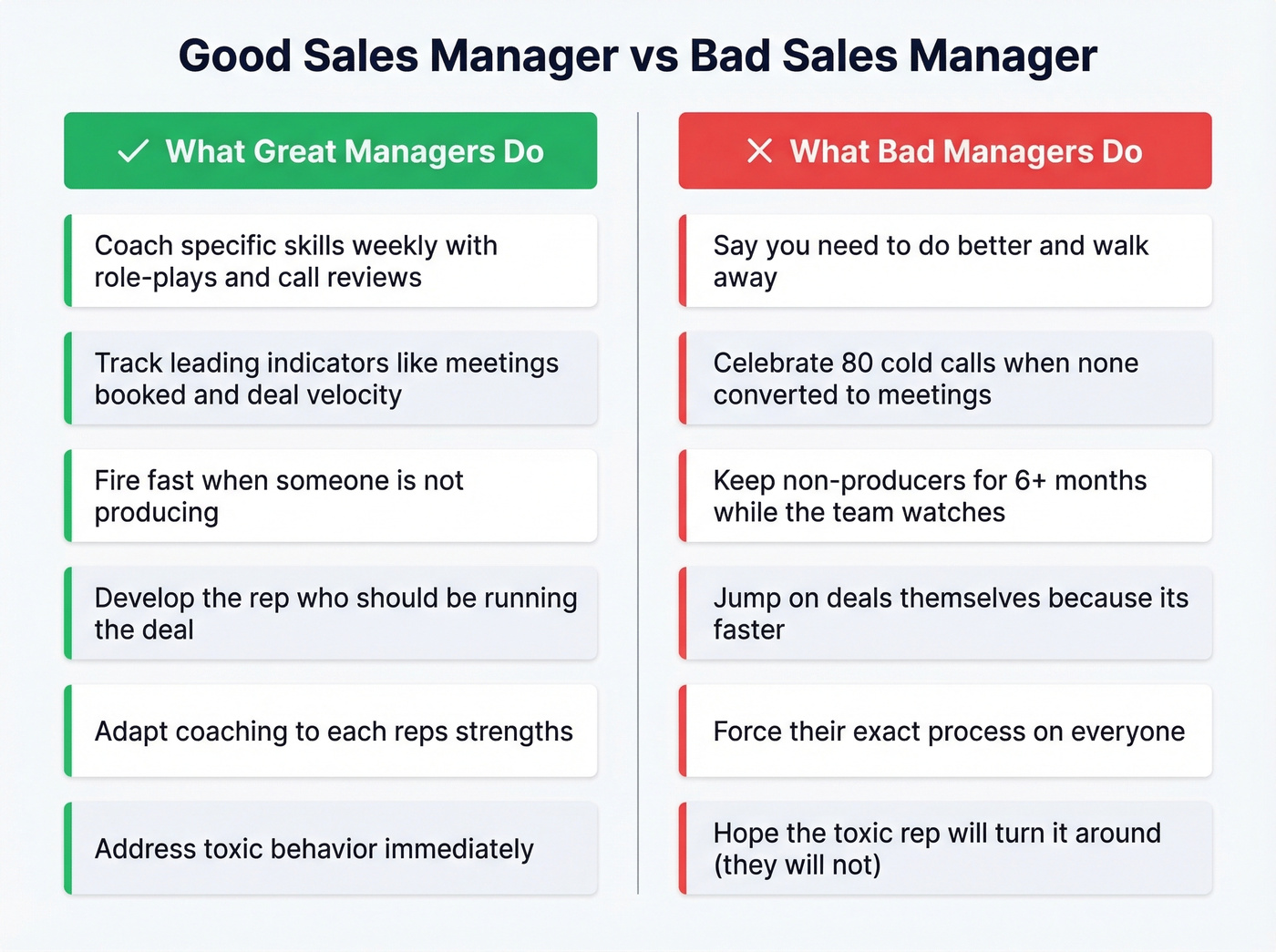
- Overvaluing activity without outcomes. Celebrating 80 cold calls when none converted to meetings. Activity metrics matter only as leading indicators tied to results.
- Delaying firings. Keeping a non-producer for 6+ months while the rest of the team watches and recalibrates their own effort downward.
- Defaulting back to selling. The most common first-time manager failure: jumping on deals instead of developing the rep who should be running them. You're not a closer anymore.
- Assuming everyone works like they did. Your path to success was one path. Forcing your exact process on reps with different strengths kills creativity and ownership.
- Zero coaching cadence. No weekly 1:1s, no call reviews, no skill development plan. Just "hit your number" and radio silence until quarter-end.
- Tolerating toxic dynamics. One rep who constantly complains, undermines peers, or cuts ethical corners will poison the team faster than a bad quarter. Skip the "let's see if they turn it around" phase - they won't.
Your First 90 Days as a Sales Manager
If you're stepping into a sales management role - or resetting after a rough stretch - follow this priority order:
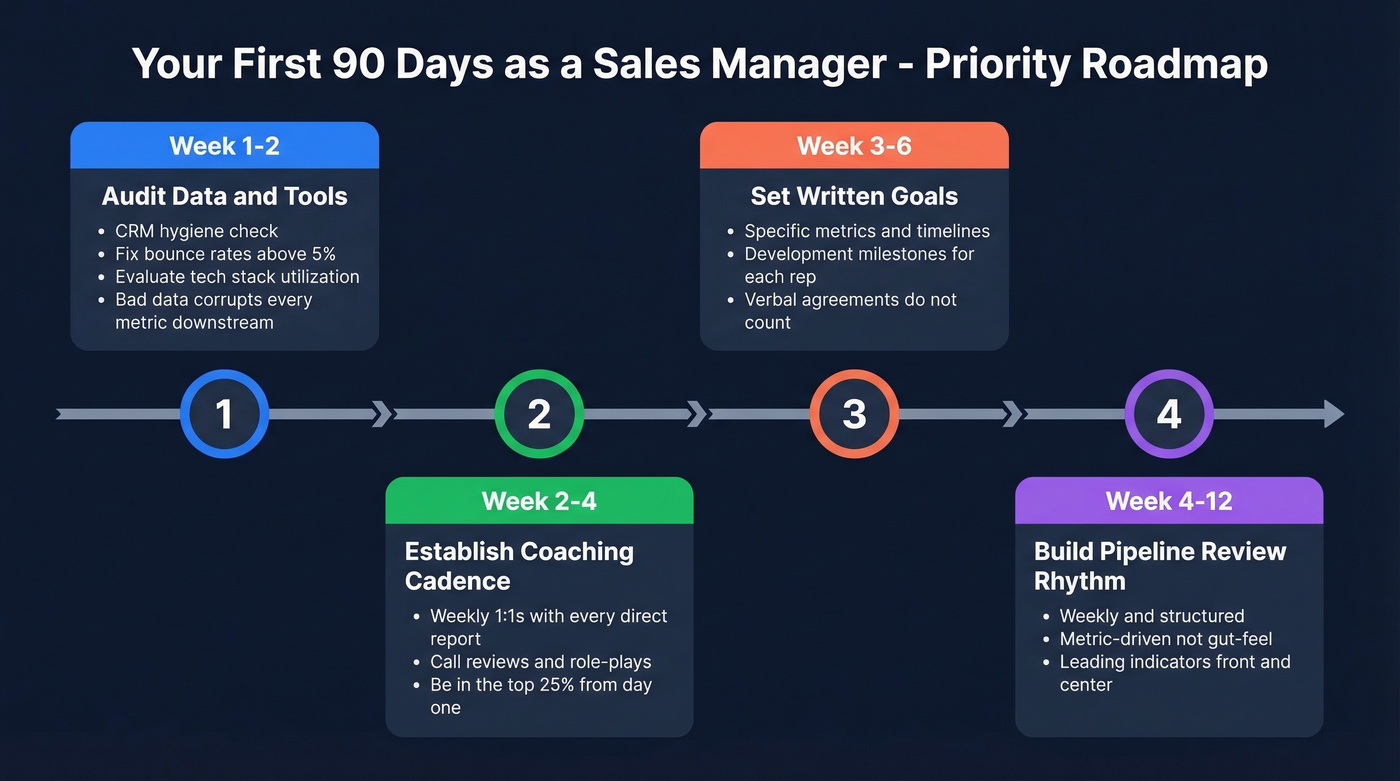
Week 1-2: Audit your data and tools. CRM hygiene, contact accuracy, tech stack utilization. If your team's email bounce rate is above 5%, fix that before anything else. Bad data corrupts every metric downstream. We've seen teams like Snyk cut bounce rates from 35-40% to under 5% and grow AE-sourced pipeline 180% just by switching to a provider with a weekly refresh cycle. (If you need benchmarks and fixes, start with bounce rate.)
Week 2-4: Establish a coaching cadence. Weekly 1:1s with every direct report. Only 25% of sales managers have a structured coaching program - be in that 25% from day one.
Week 3-6: Set clear, written goals with every rep. Only 57% of sales teams have them. Specific metrics, timelines, and development milestones. Verbal agreements don't count.
Week 4-12: Build a pipeline review rhythm. Weekly, structured, metric-driven. Not "how's your pipeline feeling?" but "walk me through the three deals most likely to close this month and what's blocking each one." (For the metrics that predict revenue early, use a pipeline health checklist.)
Let's be honest about time allocation: a practical weekly split is 30-40% coaching and 1:1s, 20-30% pipeline and forecast management, 10-20% recruiting and onboarding, with the remainder on admin and cross-functional work. If your calendar doesn't reflect those ratios, something's off.
The best sales managers protect selling time. Reps spend just 14 hours a week actually selling - and bad data makes it worse. Prospeo gives your team 143M+ verified emails and 125M+ direct dials at $0.01/email, so reps prospect instead of researching dead ends.
Cut the admin drag and expand your team's 14 selling hours.
FAQ
What's the most important quality in a sales manager?
Coaching ability. Weekly coaching correlates with 25% higher quota attainment and 30% more deals won, with a $4.53 return for every $1 invested. Only 25% of sales managers have a structured coaching program. Everything else a manager does amplifies or diminishes based on how well they develop their people.
Why do top sales reps fail as managers?
Selling and developing others are completely different skill sets, and 85% of new managers receive zero training. Great reps succeed through personal execution - instinct, relationship-building, deal craft. Management requires diagnosing other people's gaps and coaching behaviors you might do unconsciously. Without training, 60% underperform in their first two years.
How many direct reports should a sales manager have?
Gallup's meta-analysis of 92,252 teams puts the average at 12.1, but the median is 5-6 - a small number of managers oversee very large teams and skew the average. Engagement and coaching quality decline as span increases, especially since 97% of managers also carry IC duties. If you're player-coaching with more than 8 reports, coaching is getting shortchanged.
How can sales managers improve team data quality?
Switch to a provider with a short refresh cycle - stale contacts inflate activity metrics and tank deliverability. Teams like Snyk cut bounce rates from 35-40% to under 5% and grew AE-sourced pipeline 180% after making that infrastructure change.